← The Rachman Review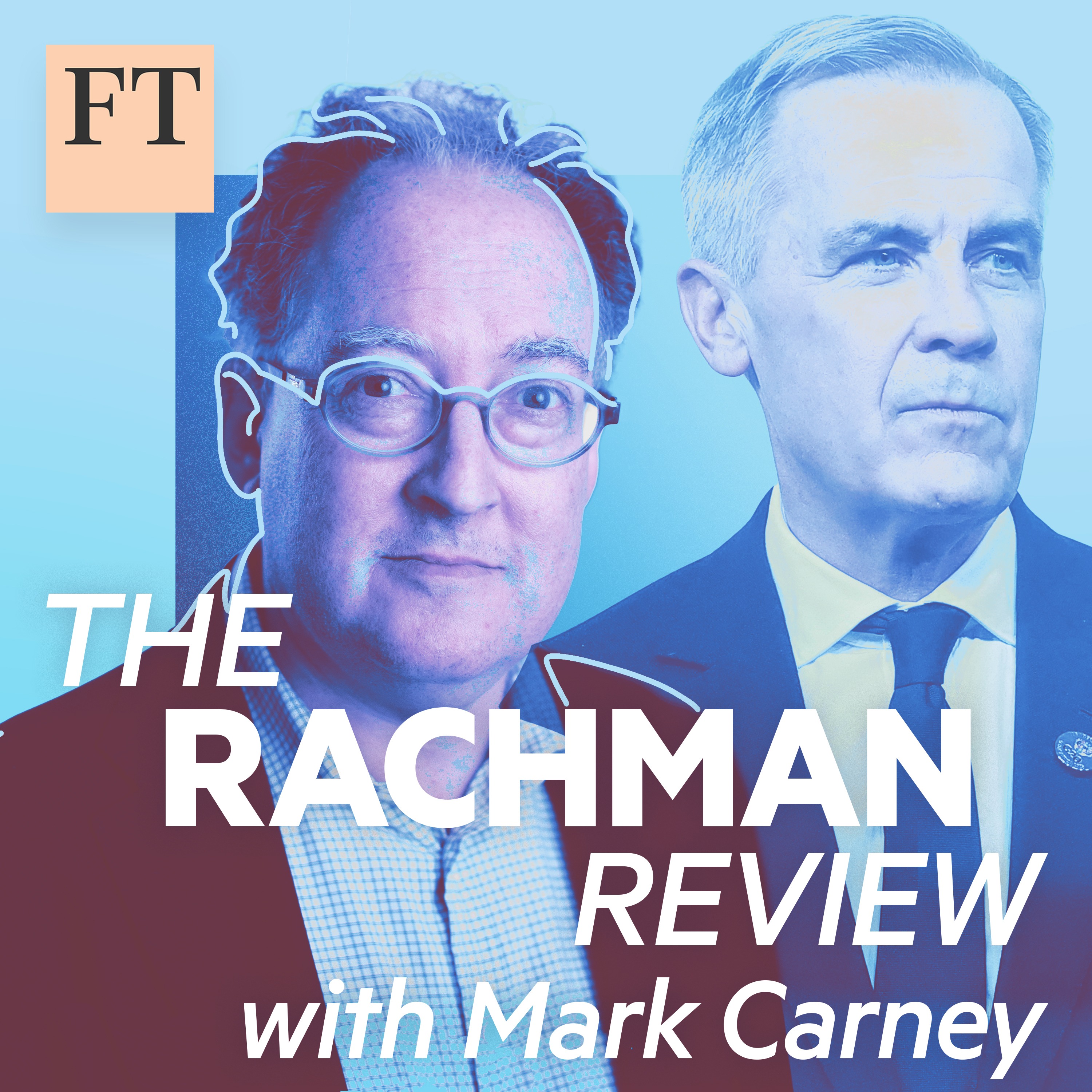
The Rachman Review
Mark Carney on a world in rupture — and what comes next
00:15:21
‘Globalisation is over, but like-minded countries can still work together’
Loading summary
Transcript27 lines
- [00:00]
Schwab Advertiser
At Schwab, how you invest is your choice, not theirs. That's why when it comes to managing your wealth, Schwab gives you more choices. You can invest and trade on your own plus get advice and more comprehensive wealth solutions to help meet your unique needs. With award winning service, low costs and transparent advice, you can manage your wealth your way at Schwab. Visit schwab.com to learn more.
- [00:28]
Gideon Rachman
Hello and welcome to the Rachman Review. I'm Gideon Rachman, Chief foreign Affairs commentator of the Financial Times. This is a special edition of the podcast from the World Economic Forum in Davos. A speech made here on Tuesday evening by Mark Carney, the Prime Minister of Canada, has caused something of a sensation. I was sitting on the Davos stage while Carney made his speech and got to interview him afterwards. So what is Carney's view of the New World Order? There are a great many speeches made from the Davos stage and relatively few of them get much attention, largely because most are quite bland and careful. Mark Carney's address was different. It was direct, hard hitting, and it took on some of the most difficult challenges of the Trump era. Here are some excerpts from the speech and to be clear, these are edited highlights that we've run together. The whole speech is worth reading.
- [01:30]
Mark Carney
For decades, countries like Canada prospered under what we called the rules based international order. We joined its institutions, we praised its principles, we benefited from its predictability, and because of that we could pursue values based foreign policies under its protection. We knew the story of the international rules based order was partially false, that the strongest would exempt themselves when convenient, that trade rules were enforced asymmetrically, and we knew that international law applied with varying rigor depending on the identity of the accused or the victim. This fiction was useful and American hegemony in particular helped provide public goods, open sea lanes, a stable financial system, collective security, and support for frameworks for resolving disputes. So we placed the sign in the window, we participated in the rituals and we largely avoided calling out the gaps between rhetoric and reality. This bargain no longer works. Let me be direct. We are in the midst of a rupture auto transition over the past two decades, a series of crises in finance, health, energy and geopolitics have laid bare the risks of extreme global integration. But more recently, great powers have begun using economic integration as weapons, tariffs as leverage, financial infrastructure as coercion, supply chains as vulnerabilities to be exploited. You cannot live within the lie of mutual benefit through integration, or when integration becomes the source of your subordination the multilateral institutions on which the middle powers have relied, the wto, the un, the cop, the architecture, the very architecture of collective problem solving, are under threat. And as a result, many countries are drawing the same conclusions. That they must develop greater strategic autonomy in energy, food, critical minerals in finance and supply chains. And this impulse is understandable. A country that can't feed itself, fuel itself, or defend itself has few options. When the rules no longer protect you, you must protect yourself. So we're engaging broadly, strategically, with open eyes. We are calibrating our relationships so their depth reflects our values. And we're prioritizing broad engagement to maximize our influence. And given the fluidity of the world at the moment, the risks that this poses and the stakes for what comes next. And we are no longer just relying on the strength of our values, but also the value of our strength. The powerful have their power, but we have something too. The capacity to stop pretending, to name reality, to build our strength at home and to act together. That is Canada's path. We choose it openly and confidently, and it is a path wide open to any country willing to take it with us. Thank you very much.
- [04:56]
Gideon Rachman
When Connie finished, he got a standing ovation, which again, is pretty rare in Davos. Then he came over for the interview. In his speech, Carney had said that real sovereignty flows from the ability to withstand pressure from other states. So I began by asking him if Canada's reliance on trade with the US Makes his country uniquely vulnerable to pressure.
- [05:18]
Mark Carney
Well, the proof is that we have been able to withstand the pressure, and there has been considerable pressure. I'll give you a couple of facts. We've actually created more jobs since the tariffs were put on than the United States. In absolute number. Economy is growing at the second fastest rate within the G7. There are pockets of extreme pressure, without question in Canada, but headline, we're reacting. The second thing, and it's a fundamental point, is the recognition that we can give ourselves far more than any foreign country can take away. There's lots of efficiencies in having one Canadian market, the trillion dollars of domestic investment, and building these partnerships abroad, all. All of which are bigger returns than what's been lost. That's not to say we would rather not lose it, but we can withstand the pressure, and we are.
- [06:06]
Interviewer
I was interested that you said basically the old world's not coming back, so you're not seeing this as a period where you just have to get through. A normalcy will return.
- [06:15]
Mark Carney
That is our view, and we regret it, but we're not going to sit around and mourn it. We're acting and we're acting in a way, but both that's in our interests, but we believe in a way with others that's building imperfectly in steps, a new system. I'll give you one example in hand back, which is we are members of trade agreements that comprise already 1.4 billion people around the world. So we have the most extensive network. We are trying with others to bring some of those networks together. The most prominent example is the Trans Pacific Partnership in the EU and acting of a bridge. It's not a direct benefit for Canada, but it is a benefit for Canada that these groups come together. Ngozi is here consistent with the WTO rules, both of which are. And in that way, we're building back out amongst willing partners.
- [07:05]
Interviewer
And you talked about the need not to put the sign in the window anymore, to pretend that things are still the same. Do you think to put it directly that the NATO alliance is still doing that, still pretending it's the old transatlantic partnership when it's really kind of going.
- [07:22]
Mark Carney
Clearly NATO is experiencing a test right now, and the first response to that test has to be to respond in a way that ensures the security of the Arctic in a robust way for all possibilities. This is actually a point that we have been making in recent years. It's a point that I made at the NATO summit back in June, which seemed like a pledging summit, but also was to get NATO policies in the right direction. But I think in the immediate term, one of the imperatives is to reinforce things that Canada is doing, Nordic, Baltic, Gate are doing, the UK are doing, other NATO partners, France included, in a comprehensive way that provides much greater security in the Arctic. This is the test. And so the NATO sign stays in the window, but we've got to meet the moment of that.
- [08:14]
Interviewer
A big theme of your speech was the need for middle powers to work together. But you've just been to the other great power, to China. And I think people very intrigued by seeing that meeting. And some people say kind of that's a mistake, really, because you're going to make yourself more dependent on China. They're not that benign either. The US will be very annoyed. What's the defense of what you're doing and what do you hope to get out of it?
- [08:38]
Mark Carney
The first thing is to say it's not a defense. I know the way you frame the question, but it's offense. It's something positive as opposed to against. We're for something as opposed to being against. The second is There are very clear guardrails in that relationship. I spoke of calibration of relationships in my remarks. That's what I mean by it. But within those clear guardrails are huge opportunities in energy, both clean and conventional, obviously in motor vehicles, in agriculture, in financial services, all of which is mutually beneficial. So it's additive. And look, it's the second largest economy and it's our second largest trading partner. We should have a strategic partnership with them within those guardrails. And that's what we've achieved.
- [09:17]
Interviewer
And it is an interesting reversal though, because I think certainly during the Biden administration there was this sense that the Western world was trying to decouple from China or de risk at least. And is now in this new world that really going to go into reverse and de risking from China because there are other risks is less of a thing.
- [09:36]
Mark Carney
Again, you need a web of connections. And to miss out in that web, some of the largest ones, United States, we already have that. China, India, Mercosur, European Union, that's a mistake. That's not managing your relationships properly, that makes you stronger, makes you more resilient. And then on top of that, I'll give you again, I'll appeal, since it's in the headlines, to the Nordics. Nordics plus Canada, it's 20% of global GDP. It's not the first thing people would realize. But that relationship, which is deepening for security reasons because we're like minded, those are the types of partnerships that I think we'll see more of.
- [10:13]
Interviewer
And you got a round of applause when you said something strong about standing on principle on Greenland. Do you think we can find an off ramp on that? I mean, I'm sure you'll speak of it, but put it this way, if there isn't a north ramp, where does this go?
- [10:29]
Mark Carney
I strongly believe that there's a better outcome that come from the discussions that have been catalyzed in an unusual way, admittedly, and we absolutely stand by the principles that are referenced. That solution starts with security and a security, yes, of Greenland, but more broadly of the Arctic. Canada is foursquare contributing to that. We're at the start of a major ramp up above and beyond. So we'll be a major contributor to that. NATO has to deliver on that. We're working intensively in order to do it as well. Prosperity for the people of Greenland. In the end it comes back to the people there. And there are opportunities to do that in ways that would strengthen all of the alliance.
- [11:12]
Interviewer
And when President Trump says, oh, you know, Greenland's under threat from Russia, even from China. Is that for real?
- [11:20]
Mark Carney
Russia is without question a threat in the Arctic. Without question. Russia does lots of horrible things. And I'll take the opportunity to condemn their unjustified and horrific assault on Ukraine almost at its fourth year. They are a real threat in the Arctic. One against we need to protect, which is why we have 365 day air, sea and land presence. It's why we're adding to our submarine fleet, adding to our air fighter fleet, why we're building out over the horizon radar to protect from Russian missile threats and others, and why we will work with our NATO partners. The threat is more prospective than actual at this stage in terms of actual activity in the Arctic, and we intend to keep it that way.
- [12:08]
Interviewer
Another big issue that's going to come up this week is this Board of Peace that President Trump is keen on. Not sure whether it's for Gaza or for the entire world, but apparently Canada's been invited. Are you going to join?
- [12:20]
Mark Carney
We have been invited and I think we should recognize the progress that has been made in at least getting towards the end of the first phase of this process. And the activation, if I can put it that way, of the process to set up the Board of Peace is the start of phase two. And that's to be welcomed. And this is a positive vehicle. Our view is we need to work on the actual structure of the vehicle you just referenced. Is it for Gaza? Well, the UN resolution, Security Council resolution 2803 references a border peace for Gaza. That's where we see it becoming immediately operative. In our view, it's better to be designed in that way for the immediate needs there. There are many other needs around the world. First point, second point, it needs to coincide with the immediate full flow of humanitarian aid into Gaza. We are still not where we need to be. Conditions still are horrific. So that needs to come alongside. We think there's aspects of the governance and the decision making process that could be improved. But we will work with others, obviously work with the United States to improve the horrific situation there and to move onto a path to a true two state solution.
- [13:33]
Interviewer
There's a suggestion you can get permanent membership of the Board of Peace by ponying up a billion dollars. You're going to write a check for that?
- [13:40]
Mark Carney
We would write checks and deliver in kind to improve the welfare of the people of Palestine. But we want to see it delivered direct to those outcomes, promoting peace. And so the mechanics and how it works that way.
- [13:54]
Interviewer
Okay, final question. President Trump and a lot of people who agree with him condemn globalism a lot. And I suspect, you know, you would be the kind of epitome of a globalist. You know, you worked for Goldman Sachs, I believe you were a central banker. You know, you're comfortable and lived in several countries. Is globalism first of all, is it a thing and is it over?
- [14:17]
Mark Carney
Well, look, understanding how the world works, having appreciation for other cultures, understanding the connections and being able to or at least appreciating ways that how we connect, whether it's through technology, trade, investment, culture, can enrich our lives and that's a good thing. And also help solve problems. Being detached from where you live and the broader needs of society. There is an epithet for that. I don't know that the G word is the one. There's certainly what we're finding to go back to the points I was making is that there are a number of like minded countries that want to work through partnership to achieve those goals for their citizens and for the world more broadly. The call is for more to recognize what's really going on right now and to pool their resources to the benefit of citizens. So it won't be global, it won't cover the globe, but it will be more powerful.
- [15:20]
Interviewer
Okay, Prime Minister, thank you very much indeed.
- [15:30]
Gideon Rachman
That was Mark Carney, Prime Minister of Canada, ending this edition of the Rachman Review. Thanks for listening and please join me again next week.
- [15:50]
Interviewer
Thinking long term about your investment career. Hear stories, advice and lessons from seasoned leaders at Capital Group on the Capital Ideas podcast. Subscribe and start listening today. Published by Capital Client Group, Inc.
- [16:06]
Schwab Advertiser
Wallet. Feeling light after the holidays? Recovery starts with TikTok slash and free. Pick products, share the link and watch the price drop to zero. Download TikTok search slash free and start slashing today.