Loading summary
Transcript68 lines
- [00:00]
A
Foreign.
- [00:06]
B
Watch fans and welcome back to another episode of the Real Time show with me, your friendly neighborhood watchmaker, Rob Nutts. I am joined by my friendly neighborhood jeweler co host Alain Ben Joseph and one half of the founding duo of Straum, the Norwegian sensation. That's not his nickname. That's what we call the brand. We call him many things. For today, we're going to call him Ace. Hi, Ace. Welcome to the studio.
- [00:27]
C
Hey, thank you for having me. Appreciate it.
- [00:30]
B
It's my pleasure. I was just looking back at the back catalog of TRTS because we've been around for more than three years now and you were one of the earliest guests, I think within the first six months of the show. So it's great to have you back now. Now your company has been in existence for four plus years and it has grown from a very ambitious beginning to a very recognizable brand right now. So why don't you tell us what's life been like at Strom since you were last on the Real Time show?
- [00:58]
C
Yeah, so I'm trying to recall that. Appear. Maybe it was such a terrible appearance by me that I've simply chosen to forgotten it. Forget it. But yeah, in four years. So that's 2021. I think a lot has happened. That was when we launched our, well, first collection and since then we have developed Jan Mayan. We went on the expedition with you. Rob, thanks for joining us. That was great. We have developed multiple models within the Yon Mayan collection and of course we're also working on multiple new collections. Grown as a company. It's strange really to look back at how much have changed for us.
- [01:42]
B
Did you expect to be in this position when you started back in 2021? Is that something? Is this where you expected to be four years later or did you have a more detailed or an even more vague roadmap?
- [01:52]
C
That's a good question. I think when we started, Luss and I didn't really know what to expect. We were, as some of you might know, we were not like watch people when we started the company. So we have really been, you know, learning on the job when it comes to the watch market. And so I think it was really hard for us to predict what would happen. And luckily we have not yet failed. So it's just been very exciting for both Lasse and I. We're really thankful and happy.
- [02:22]
A
So O stand, AKA Ace, which is a bit confusing for me to use that word because some people call me Ace. But for this sake of this show, we'll call you Ace, I'm happy actually to see your handsome face because I only know you from the Real Time show podcast episode. So for those that aren't that familiar with Straum as I am, because I only know you because of the epic models. Why is it that Lasse, Lass and you, as industrial designers, started a watch brand? Why are you guys that mad?
- [02:59]
C
I guess, given that you call it madness, I think stupidity is probably then the best description. But Lasse and I, we studied together in school many years ago. We studied industrial design, and then we went our own ways and we worked in various jobs. Lasse worked in Norway. I worked abroad for a few years until Lasse sent me a text message. And he asked me, hey, do you want to start something together? He had sort of picked up that I had similar ambitions as him. And I said, yeah, let's go for it. And at the time, I was living in Singapore, so we dabbled with various consumer electronic ideas. And we then read a article about how companies created these products and launched them on Kickstarter. And they would have Chinese factories copy their product, you know, basically make that product, put it up on Amazon or AliExpress at half the price and shipping immediately. And it would just like, completely undermine the Kickstarter campaign, obviously. And so we decided, let's not, you know, walk into that trap. Let's. Let's make something that we can protect a bit more against copycats, I guess. And so we said, okay, how do we do that? Well, we try and build a brand. We try and condense a lot of value into that brand. And then we. I thought, okay, let's. Let's focus on what is a bit special for us, which is Norwegian nature and the resources that we have in our country. And the idea of the product actually came almost last in that series of decisions, which was, okay, how about watches? Let's try that. And the reason why Watches was actually really appealing to us is because we realized that watches are really intimate, personal objects where you can distill and sort of fill them with a lot of story and meaning for people. And so we realized that actually this is a very exciting product for us to develop. And so we just, you know, we got going.
- [05:12]
B
You've done a great job developing those products, obviously, and we can see the nature in them. We talk about that frequently. But you're not just building a brand, you're building a whole universe that you want to invite people to come and be a citizen of. How are you going to get those people to come into the stroud family. What are you doing in addition to making excellent products and marketing very well to encourage people to choose your brand and your universe above all others?
- [05:38]
C
Yeah, it's a good question. I think we're trying to do two things, right. We're trying to make really fantastic products that people really love and when they put them on their wrist, they. They fall in love with them. That's absolutely essential. But then we're also trying to communicate and share this universe of strom, which is all about going out in nature and exploring nature and perhaps more specifically the story that anybody can do it. There's no magic sort of formula. The average Joe can go out and have fun and explore things. And the proof of that is the fact that we went to Yonmajon and bit embedded and we're not made of any special stuff. We're just average Joes. At least I consider myself that up to you, Rob, whether you consider yourself an average Joe.
- [06:32]
B
You're average for Norway, but I think you should travel a bit more if that's what you think. Globally.
- [06:39]
C
Yeah. So that narrative is important for us to tell people that you can also do this. It's not something special. Prep for it and you can do it.
- [06:48]
A
Talking of special, your watches are very special. And I want to explore two avenues. One that's maybe rhetorical, being outsiders and designers. Probably that's why they're kick ass designs, the SRAM watches and the Yanmayim collection right now. But you can answer that if you don't think it's rhetorical. Dear Ace, what I wanted to ask, and I've been on this hypothesis. Hypothesis and actually an intellectual journey that I love Scandinavian design that's been instilled in me by my father. Now the Danish were leading with the Danish design, but you see a hardcore movement in Nordic watch Vikings, which you guys are. And Rob is an adopted one. He's a reincarnated one. He dabbles with you guys. He dabbles with. With arcanon. He dabbles with. Help me out, Rob, with the Finnish guys. Something with an O.
- [07:56]
B
There's too many alon. Don't list all my scandi.
- [07:59]
A
So again, that hypothesis has been confirmed that Rob is a reincarnated Viking and a Nordic soul. Ace, would you say your designs are very Norwegian?
- [08:15]
C
That's a good question. I just want to mention that there was a lot of cultural exchange between Ireland and Norway at the time of the Vikings as well. So I think Rob might be a more true Viking that you make it out to be. Alan but if they're truly Norwegian, I don't know, they lend. I think there's certainly a lot of traditional watchmaking design in our product. And that arguably is, you know, continental European design in that sense. Although I think what we bring to the table as more Scandinavian is perhaps the sort of, you know, trying to make things pure and clean. But then also obviously for us, the style design is something that we want to really capture Norwegian design or Norwegian nature. So I don't know, it's. I wouldn't say they're very Norwegian or Scandinavian in their form necessarily.
- [09:29]
B
There's one thing, because I know where you're coming from with that. Obviously, like you say, it's a relatively traditional watch shape. You know, there's a case it isn't like wildly paired back any more than any other very functional tool watch. But there is an element of like Scandinavian thinking, I think, in the way that you approach all the details and what makes Straum stand out from other tool watches, especially in this price bracket, aside from the incredible machining quality and the sensible design decisions you've made in the way that you manage the finishes and the transitions thereof, especially on the titanium model, going from a blasted surface to a polished edge, which is exceptionally well done for under €2,000. It's those little things like the sense the sensibilities in the strap design, which I'd love you to talk a little bit about because that's something you've developed since we last had you on the show. And the things like the strap adapters that allow people to wear what is otherwise a watch that requires an integrated bracelet or strap on anything they like. And then things like the quick release, which is incredible because it doesn't disrupt the design at all. I've seen lots of good quick releases that function very, very well. Not only does yours function very well, it doesn't detract from the aesthetic and at all. So take us through the thought process. You've done a series on Instagram called Microns Matter. Is that correct? Is that the name of it? This is something really interesting for our listeners, I think, because you are an industrial designer, you're product focused guy, you have the story of Straum, obviously, but you've injected it into these products that carry with them all of your experience, all of your professionalism and your detail oriented nature. So talk us through those design processes, the things that you ran into that you weren't expecting, and tell us about the end result of those three things. Specifically the strap adapter, the quick release and also the rubber straps.
- [11:16]
C
Yeah, sure. So thanks for pointing that out, I think. And it's obviously important here to keep Lhasa in mind as well. And I think the fact that we're two industrial designers, founders and you know, doing the design work, what that. And Lasse and I are also quite similar in how we think and we have similar levels of ambition. I think what happens then is we get a very high quality design process. One that is very considerate, one where we're almost competing and being the most sort of carefully considered version of ourselves. You know, okay, can we do this better? Can we do this better? It becomes almost a sport board for us. And so I think what that leads to is a process that probably runs a bit slower than if you were just a one man show. But I think the quality is much, much higher. And we're not afraid to say, like, you know what? This is not good enough. We're not going to do this, or we don't have the skills or the capacity or the money to do it. So I think that hopefully translates into our products. And then, yeah, you mentioned some products like, I'll just knock them off, like the strap adapters, right. Those are attachments where you can then use regular. It provides basically a regular set of lugs on a integrated steel case or a titanium case. And for that one, we really focused on making that as compact and as sleek as possible. Even if you look at it in detail. We even considered the direction of brushing. So the direction of brushing is actually oriented according to the case, not according to the part itself. So there is like a clean transition across the two different parts. And obviously it carries over our signature mid link that you see on our bracelet. That's become kind of a signature shape for us. Where you have this oblong shape with sort of curved tips or ends. Yeah, you can see it there. That's really an element that we created initially on the case back of our first model, the upav, where we would have a horizontal plaque which when sort of aligned or offset from the case back would have these curved ends. And we chose to basically establish that as a signature element. And we've carried that on to, to new models. The strap couplings that you mentioned, the intention there was again, how can we combine aesthetics and functionality in the best possible way? And so what we've chosen to do there is to establish a quick release mechanism. But we didn't want to sort of bake it into the case. We didn't want to bake it into the straps because if, let's say you bake that into straps, the unit cost of straps would go way up. Right. And for a customer, then if you want to change up the straps or something happens, you want to buy a new one, it becomes prohibitively expensive. So what we've done is we've shifted all that complexity into the, the mid link, the coupling piece, which then serves as the interface between a fairly simple strap and a traditional case. And I think it took a lot of samples and considerations and we've printed things in multiple scales to get the mechanism just right. And eventually. Yeah, but through this process of just slow and steady progress and collaboration, I think we've created something great.
- [15:22]
A
Yeah, guys, this is not going to be a short episode. Rob wanted to do a short episode. I'm even pivoting. I'm going to do an extra episode alone with Ace. Rob, you're not invited. You're hijacking my questions. We can go different routes while listening to you now, Ace. It's mind boggling because I can't understand how you can produce all of this for this price point that the mining is at. But before we deal with that, just very briefly, a ramp up for me as a consumer. I actually got introduced to you guys as a brand from a distance by Rob while he was at Fratello. That's where I heard about you guys. I still don't have one on my wrist because I 100% wanted one. But I knew there was a TRTS collab coming, which is the reason for this party today on this podcast and we'll deal with that later. So obviously in February, I'll have my personal strum finally. And I held out because I love titanium and the first generation was steel. Now, when I saw the first pictures ever, and this is a compliment, I got Nautilus vibes, but definitely not a copycat. When I held it in my hands, I said, hey, this is a watch that holds its own. It's new, it's different, it's designed, but it feels like it's always been there, so it doesn't feel new. Sometimes you hold the watch and you know it's going to be an evergreen. So at this crossroad, I have many questions for you, but maybe the first thing is you guys. As newbies to the watch industry, how did you get about to know how to make a watch that is contemporary but feels timeless? And how did you know to make it below 12 millimeters? Because you need years of watch experience to understand dimensions. And obviously you are industrial design. So you understand dimensions, but how did you know not to surpass that 12 millimeters? Rob obviously is infamous or famous for his VII, his visual impact index, and I've said this many times by him writing that very important document in the horological canon made him legendary.
- [17:49]
C
So.
- [17:49]
A
And not only my eyes, but so. So these little elements is, I want to know from. From influence being Norwegian Nordics design, which you didn't really deal with my question. But you know what? For time's sake, I'll park that question for next episode we're going to record and maybe we should just philosophize about design and Nordic design and why you guys in the Nordics are so successful today. And is there a red thread in that influence of design? So I'll park that. So let's focus now. Sorry for the long intro. How did you guys know that this was a hit?
- [18:29]
C
Yeah. First of all, I just want to say that you've just handed me what I consider a big compliment, which is saying that it feels like it's always been there. I think that's a very generous thing to say and it makes me happy to hear that. It makes me happy also because I think designers in general, and perhaps especially industrial designers doing watch design a good amount of imposter syndrome, right? Because we come in left field to a product category that's been around for hundreds of years and we say, okay, we can make something new here that's kind of, I don't know, ambitious in and of itself. And to hear from people that we've somewhat succeeded with, that means a lot to us. So thank you. You mentioned Nautilus, I think, of course, we've. As industrial designers, we spend a lot of time doing research and learning about the product category. That's very much a thing. If you want to succeed as a designer, you have to be flexible in the sense that you can learn and adapt to new categories. So obviously we did that. Our first collection, the opav, was very much a dress rehearsal, I guess, for Jan Mayan, although it does have its own qualities, maybe it's a bit more idiosyncratic than Jan Mayen was. Jan Mayan was perhaps a step in a slightly more traditional direction. But then of course, with additions like the straum coupling and the rubber straps, we're stretching that sort of traditional frame, I think. So.
- [20:15]
B
Yeah.
- [20:17]
C
What was your question again, Alan?
- [20:19]
A
Sorry, it was all over the place a bit, but do it. So let me boil it down.
- [20:26]
C
You.
- [20:26]
A
You said you did the research and you say that industrial designers often or designers are left field. They do the homework. Some do, some don't. People think that if you're an outsider of the horological world and you're a designer, you always have a successful a design, a successful watch, which are two different things. A successful watch means that consumers want to buy and wear two different things than being a good design on paper. And your watch resonates not only with me. I'm not giving you compliments because we launching the collab or we launch a collab this week and we're mid midstream of the pre order window. We did the collab because we love you guys and we admire you. But as a consumer and a collector, I don't want new watches. I don't want buy new watches. Every time there's a fair or I open my Instagram, I'm like, please, please, please let there not be a watch I need to buy. As an addict, you guys ticked all the boxes. And I've been wondering, why is it the dial? Are, are those the finishes that Rob just described? Those angles of matte polish and, and what you've been explaining that the, the, the matte finishing is intentional in a particular direction. And, and you use la joupere. Why did you, why didn't you go for a lower quality? And how can you do this stuff for this price point and with this click system of the straps? Because people that collect watches like quality know this is expensive. So. So again, I'm getting lost in my own enthusiasm and words. The question was, no, I know where I'm going. Sorry, it's. My enthusiasm is.
- [22:07]
B
You are gushing.
- [22:08]
A
How did you guys know this is good and this is stroud. So the price point and the quality and the design. Because you can learn on paper that it needs to be an 11 and a half millimeters or 9.7 without a crystal, which Rob and I always make fun of watchmakers right, about thickness without a crystal. You don't wear a watch without a crystal, so don't even mention it. But that's a different story. You guys did the ramp up. If you only exist 4 years, your learning curve is very steep. So were you collectors yourself? Are you guys obsessive? So. So that's the question.
- [22:44]
B
Let's break this down into two steps though, because you jump in between like an analysis of the OPAV and an analysis of the Yan mine because you know the Lejoux parade was came later. And you know the, the click system and the strap that you're talking about came in the second Edition. I think the essence of the first question that you were posing was how on earth did you get the OPWAV so. Right. To make such a statement when it launched.
- [23:08]
C
Yeah. I'm not going to show you the initial sketches that Lasse and I created back in 2017, 18. Right. But my point there is that it goes back to this, you know, giving the process enough time. And again for Las and I, it was very much designing and learning in hand in hand and doing it together. Right. So basically forehands and studying, understanding the category of watches, the proportions, transitions, forms. Again, Lasse and I, we've done lots of industrial design in different categories, consumer, electronic, etc. Where the rules of the game are different. However, there are central core principles in design that apply to any category, proportions. The VII was it, Rob. Yeah, and so I think. And also I think it's important to point out some luck. Right. I think luck plays a part.
- [24:21]
B
Being.
- [24:21]
C
Able to mix the right type of ingredients to make people attracted to the product. So I think it's just, yeah, a good collaboration between Lasse and I and just given enough time and. Yeah.
- [24:36]
B
So moving on from that initial debut, the one that made such an impact on the watch world and on me personally, the next thing that came out of Strahm was the Jan Mayen. And that was a big project that was kind of developed in conjunction with the idea of going on this expedition as we did from Svalbard to Jan Mayen. And the goal was to create a watch that was inspired by and designed for the raw Norwegian nature that we would meet along the way. And we, we met it full in the face. Maybe this is a good moment to just touch upon the Straum X, the Real Time show Jan Mayan Titanium Stormy Seas edition that we've just launched. And tell us in your own words where the inspiration for that model came from and what's special and new about this piece in comparison to its predecessors.
- [25:25]
C
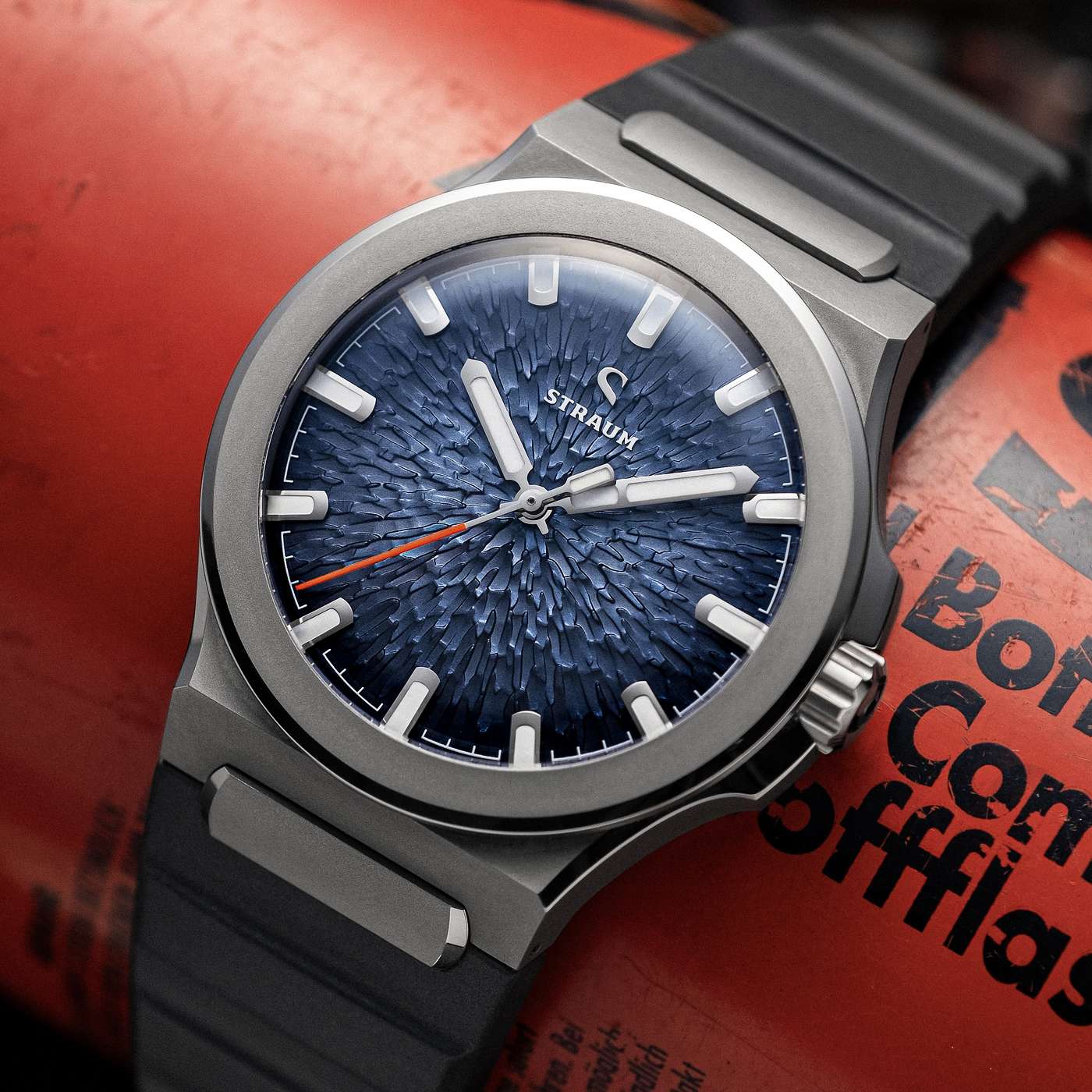
Yeah, so really the sort of central inspiration for the TRTS model is the experience that we had sailing to Yan Mayan where we hit a huge storm which eventually caused the sail to tear on our sailing boat. And mind you, this is a 70 foot, 70 ton, steel hull, double steel hull boat, which, I mean this, this thing is built for Arctic conditions and we set a new speed record and yeah, we broke this sail which when it happened and you know, all of us on the boat, we, we looked at the captain and we were like, okay, is this, is this normal or should we be concerned? And the face Communicated. You should be concerned. We were like, okay. So we really wanted to capture that moment, those weather conditions in a dial. And I think we've been able to achieve that. We've been able to create this ominous sort of serious type of watch face that just, I don't know, it has some sort of richness. It's not, you know, we've shown this watch on a couple of fairs now. And one key thing that stands out is that people look at it and go, it's not quite blue, it's not quite gray. But it's also both like the. Just. It has this like, alluring color and effect to it that I think really draws people in. And then, of course, it has this special seconds hand which is caught in special fluorescent paint. When it receives UV light, typically from a torch or even from just normal daylight, it absorbs one wavelength and then sends out another. And it just like, it looks, you know, people call it the lightsaber. And yeah, it looks very special. And of course, the point of that seconds hand is to point out the fact that in situations like we experience, time is, you know, I guess it's a bit individual, but for me at least it feels like time slows down and you become especially aware of the situation and the environment and.
- [27:51]
B
Yeah, so my favorite memory, and it's a funny thing to say because although we survived it, so I guess we can sort of smile about it and laugh about it now. But at the time it was quite harrowing. I would say it caught us all by surprise because we were having a nice, quite relaxing evening or I'm not actually sure what time of day it was because there was no darkness, of course, in that part of the world at that time of year. So we were sitting around the table and yeah, suddenly we hear this massive bang come from above us and there's a Skymatic. I'm still not sure that Lasse hadn't snuck outside and cut the sail up with his knife. Just we all looked at it and like you say, we went slightly ashen faced. And if I remember correctly, it was Carl, co pilot, co captain, or what's the word? Captain's assistant, that was on the wheel at the time. And John, the captain was actually asleep at the time. He was off shift and so we had to drag him out. And he's a very gruff Englishman of Irish heritage, Captain John MacKenzie, nickname the Kraken. So obviously, instantly, a man that I had a great deal of respect for. And he just, he looked at it and he wasn't one for drama in the least. And he was like, oh, crap, you know, this is bad. And at the time, I have to admit, like, not being like a seasoned Arctic sailor, I wasn't really sure how bad it could be. But he quickly brought us up to speed as to what could actually happen if we didn't get this mainsail done. It might not seem that drastic a thing. You might think we could just continue to plow on with a slightly less functional sail, but the problem is when you lose control of that sail, it becomes very susceptible to being caught in a gust of wind that could pull the boat sideways into the wave. And if that happens, that can cause the boat to tip. Because we were dealing with 7 meter high waves and as Ace said, we were going up these and coming down the other side, up the crest, down the trough at 21 and a half knots, which is a crazy speed for a boat that size. Really. The normal speed it travels at is around 6 to 7. So it was, it was quite like a roller coaster to begin with. But when we found ourselves in this situation, time was critical. It was essential that we got it sorted as quickly as possible. Now, of course, too many cooks spoil the broth, so we weren't all going to rush out on deck and like clip ourselves into the cables as you have to do in that situation. Although, funny aside, when you are clipped into these cables and it's designed to keep you attached to the boat if you go over the side. John told us, stony faced, as he often is, that if one of us had gone over the side, the speed of the boat and the force of the water rushing past us would have pressed us against the boat so tightly that we probably wouldn't have been able to be pulled back aboard even if our legs were still sticking up, kicking around by the rails. So he said, you'd probably be drowned before we got you back on the boat. You might be better off just cutting loose and hoping that we can recover you, which of course you can't in a storm like that. You can't turn a boat around and go back for somebody. If somebody does go overboard, then the only thing you can do is throw a life ring to them or the javelin that we had on the back of the boat. And in those winds, which were around 80 km an hour. I don't know about you, Ace, but I know that I could throw a javelin more than about 2 or 3 meters, let alone like the speed, the space you'd need to cover to get somebody that had fallen overboard when you're traveling that quickly. So we all sort of marshal ourselves, what can we do? And John heroically goes out on deck, clips himself in. I think Morton, one of the crew members, was with him, and he asked for ballast. This is my favorite memory. And we all sort of looked at each other thinking, oh, who's the biggest guy here? And as it turns out, it was you. So you went out. Johannes and I were in the pilothouse. I'd grabbed the wheel because it felt cinematic. The boat was actually on autopilot at that moment, but I grabbed it in case we got pulled sideways. And then the idea in my head was, turn off autopilot, pull it back towards, so we're pointing up a wave. So I was standing there, basically waiting to see if any bad things would happen, watching you perform the greatest ballast job I've ever seen in my life. So they were pulling down the sail and basically lumping Ace on top of it like a big bag of sand. And he was trying to hold this thing so it didn't blow away in the wind. And to be quite frank, you made quite quick work of it and managed to get it down without incident. And then we were left with one small sail at the front and the generator, which at the time, we didn't really have much use for. But I remember fondly watching you, like, scrabbling around on the deck as the boat was, like, listing from side to side extremely violently, just desperately trying to hold onto this sail and make sure that it didn't blow away or cause us any more damage. So, thanks. I appreciate you saving our lives, playing a part in that at least. And, yeah, the only thing I really practically contributed to the situation was the knife that ended up cutting the sale down in pieces. My beloved Rambo that I bought in case I got attacked by a polar bear, which did result in a very funny situation in Dresden when I went to a knife shop and I was, like, browsing the wares and the guy says, oh, what kind of knife are you after? And I said, something that's good for close quarters stabbing. And he looked at me as if he should call the police. And I was like, no, it needs to be stouter, the blade needs to be sharper. And he's like, what are you gonna do? And I said, hopefully nothing, but maybe stab a polar bear. And he was like, aha, I have the perfect knife for you. And as it turned out, thankfully, I didn't have to kill a beautiful wild creature, but it did come in useful. Talking of coming in useful, of course, the watches that we carried up to Jan Mayan up most of Beerenberg, were also very useful for us in that moment. But what did you realize at that time, because most of us were wearing opavs, we had a couple of Jan Mayan prototypes with us, just cases and early dials. What did you realize on the trip were things that you wanted to bring into the Yanmaijan design to make it even more suitable for that kind of environment than the OBV had been itself.
- [33:28]
A
Yeah.
- [33:29]
C
I'm actually wearing, I believe, the glacier white that we brought on Behrenwalk.
- [33:36]
B
Is that the one I attempted to assemble on the boat?
- [33:39]
C
Yeah. Thankfully, we brought a watchmaker with us, and he fixed it basically with, I believe, there was some duct tape involved, which is the way all watchmakers work, I guess. Yeah.
- [33:51]
B
Just. Just so.
- [33:51]
A
Anyone?
- [33:52]
B
Just so this doesn't ruin my reputation, I made a movement holder ring out of duct tape because the. We had all the components but the movement holder. So we just needed something to, like, hold the movement in place. So I just very precisely to the micron, rolled up a piece of duct tape and made a little bit.
- [34:08]
A
It's very important I stop you now here.
- [34:10]
B
Carry on. So we're talking about what we. What was it that you took from the trip that actually informed how you wanted to finish off the design of Yanmai, which was quite advanced at that point, but there were some things that you could still add and tweak at that point.
- [34:23]
C
Yeah. So one thing that you will see in this up close is that the texture of the dial is not complete.
- [34:30]
B
Right.
- [34:32]
C
We had not yet nailed down the way we treat the dial with coatings and lacquers. So in this case, it's very opaque and the snow pattern is almost not visible. And, of course, climbing Berenberg, the volcano, we spent most of our time looking down on the snow, struggling and, you know, being in general pain. So we had ample opportunities to study the snow patterns, and we actually did take a lot of photos and brought that back. And, of course, there's always improvements and tweaks to be made. So we made multiple improvements to the bracelet, the clasps, I believe, some changes to the crystal on the case as well. So, all in all, I think it was a great expedition, and I think it made a lot of sense to bring these prototypes up the mountain and see how they performed.
- [35:35]
B
So, obviously, you're still developing new products. You've had two home runs with the OPAV and the mine collections and the various versions thereof. What's next and what kind of expeditions can we expect you to be attempting in the future?
- [35:51]
C
Yes, I guess that's a leading question given that you know some of it and you're of course, a full complete member of the Stroma Explorers Club. So we have multiple collections in the work. We have collections that will really continue and I think amplify further the trajectory that we're on in terms of dial design. Even more focus on lume and more expressive patterns, making these patterns and dials even more true to the sort of Norwegian nature element that we're embracing. And then we actually have some other collections which will move into more, even more traditional watchmaking type products. We're looking at various complications and we're also looking at how can we build products that are even more functional and even more built for the environment that they should perform within. So, yeah, a lot of stuff going on. Our main issue is just bandwidth, really.
- [37:11]
B
Planning these expeditions takes a lot of time. Having been on the Yanmayen voyage, I can't believe how quickly you managed to get that one set up and sorted, to be honest, because logistically it's a nightmare. There's a lot of things that have to be taken into consideration. Not just finding an appropriate vessel and a qualified captain and crew to assist with the crossing, but also access to Yan Mayan. You know, these things aren't straightforward. You can't just rock up there and go on land. Especially not as a foreigner, as was I the only non Norwegian on the trip? I think I. I think I was actually. I'm surprised they let me. I'm surprised they let me on the shore at all. But also, of course, once you're there, there, there are certain rules, like it is a national park, protected. You can't just take anything you want back from there. There's one area where you're allowed to gather rocks, which of course is where you found the basalt for the special editions. And there's some great content that you created there of walking up and down these almost fantastical cliffs that don't. Don't seem real at all. I mean, the whole island is like something out of a Terry Pratchett or Tolkien esque fever dream. It's absolutely incredible to witness. The only landscape I've ever seen that comes anywhere close to it is Iceland. I've never been to the Faroe Islands. Maybe they're similar, I don't know. But Iceland is the closest corollary that is easy to fly to. You can't, as a civilian, fly to Jan Mayan, unfortunately. But We've looked into many different challenges that we might be able to undertake in the future that are relevant with a Norwegian link. Of course. Luckily the Norwegians, being some of the finest explorers in the world, have bases and posts and portions of remote nations or continents, in the case of Antarctica, all around the world and they own a few islands that you wouldn't expect far, far, far away from Norway itself. We've looked at different ways to get to these places and obviously we're considering flying to some of them or taking boats part of the way and other transport further. What would your dream form of transport be? Would it be skidoo? Would it be plane, microlight, hang glider, dog sleds? What would it be?
- [39:19]
C
I guess depends on where you go. I remember talking to Macinthe Kraken, our captain on the way to Yonmajen about other islands and you know, remote areas owned by Norway. Like you mentioned. Obviously we have some locations in the South Arctic Sea. Is that what you call it? Basically towards the South Pole, the Antarctic Sea.
- [39:49]
B
I'm not sure, I've never been.
- [39:50]
C
Sorry. Yeah, the Antarctic, me, yeah. And of course you have the notorious Drake Passage and the winds and the conditions down there which when you hear about it, you know, they don't really elicit confidence. I think John spoke about 30 meter waves and yeah, really intense conditions. But of course I don't know if it's me or maybe it's the Norwegian genetic sort of setup. But going on these expeditions seem really attractive and exciting. So I think we absolutely want to see if we can get to some of these locations and explore and see how it is.
- [40:38]
A
Talking of exploring and being explorers, the most famous explorer watch is obviously the Explorer by the Green Hulk. Would you guys pivot in the future with the brand making? I don't want to use the world build real tool watches because this is also to watch. But it's beautiful on land while you're not exploring and desk diving like we are now behind our computers. Do you think that the future for Straum is creating different families where this is a beautiful hybrid. I would even dare to call it a Gada watch, a go anywhere do anything watch, which it is. And with the titanium you made it even more of a tool watch. Would you make a ulitarian like a military esque watch in the future you think? Is that on the roadmap?
- [41:32]
C
Yeah, I think the short answer is yes. Rob is obviously involved in product development with us as well. And what has crystallized within our brand is two tenets Right. So we have the inspired by tenet which is, you know, the expressive dials capturing nature and putting them on the wrist. And then we have a second tenet which is built for and those tend to be more, you know, functional field watches, et cetera. And I think with Jan Mayan we're somewhere in between or we're combining the two. But we, we are really keen to explore both of these tenets or these directions and sort of distill those two directions even more in collections. And of course as designers, the functionality, the functional aspect is important to us and so I think we're finding this built for direction to be really exciting. Of course we have no. It would be fantastic if these watches could be truly built for extreme environments. But we also acknowledge the fact that you mentioned Desk Diver. A lot of customers buy watches because they really like them or it makes them feel a certain way. So it would be fantastic to have one of our watches on the peak of Everest, but it doesn't stop us from really exploring that direction. Anyway, very cool because obviously what I.
- [43:13]
A
Was thinking, this is a shout out to our mutual friends of micro mil spec, which are also Norwegian, but that's, that's the, the utter end of the spectrum because the name says it all. They make mil spec watches for actually military units today. So I think there's a gap to be filled there. So very interesting and I reckon you guys are considering to make it a magnetic so because that often is a problem for modern city dwellers and explorers. I don't know how much time I have, Rob, so while I have the mic, I'm just jumping in and grabbing it. A very practical question. I ordered mine Stormy seas Yanmai and TRTS collab. Can't wait till February 1 question asked. Love the rubber straps. Love the fact that they have a proprietary click changing system. I would obviously want a titanium bracelet. Can the people that ordered the special edition obtained a titanium bracelet while ordering in the coming week or afterwards?
- [44:18]
C
So the answer is yes, exactly. When it'll be sort of published and offered for sale is to be determined. But we are developing the titanium bracelet. The reason why we haven't launched it yet. So we could have just done the steel version in titanium of course, with the necessary modifications that comes with changing the material and then leave it at that. But we're hoping and aiming to make some significant improvements to the bracelet and we think it's going to be great and we will launch it when we think it's ready. And yeah, that's basically it.
- [45:00]
B
But the important takeaway is if you buy the Stormy Seas or any other titanium yanmayan right now, at some point you will be able to get a titanium bracelet bracelet for it. So if that's the thing that's keeping you on the fence, hop off the fence. There's no need to be there anymore. The bracelet is coming now. You mentioned something very interesting, which it makes sense to me and to Alon because we're inside the industry, but it's something that probably doesn't really make so much sense to people outside of the industry that really desire this titanium bracelet. I've seen several comments where people say, oh, I'd buy this right now if it were on a titanium bracelet. Why is it taking so long? You mentioned that there are necessary modifications to a design or to a machining program perhaps when working with a different material. Can you tell us a little bit about that? Just one or two things so people can understand why this isn't just as easy as copy and pasting the design from one material to another.
- [45:52]
C
Sure, yeah. So we can focus on one element for example, which is the micro adjust. Right. So for the titanium bracelet we want the micro adjust to be included in the bracelet and to make in our case our microjust which has an internal ratchet mechanism that relies on basically metal against metal friction. Titanium is different from steel. Steel has self lubricating properties, whereas titanium has a super thin oxide layer which actually increases the friction a lot. And especially on grade five, that friction is sufficient enough to make actual modifications to the dimensions. Right. And you might have to also apply coatings to achieve basically a smooth functioning. So that's one element. Obviously the bracelet's also going to be fully grade 5 titanium, which calls for different considerations when machining grade 2 titanium. You can machine basically cold like steel, but with grade five you have to heat the material to a certain temperature before you can start machining it. We're obviously also carrying on our ambitions of mixing bead blasted and polished edges. So that requires careful consideration in manufacturing. And we're also working on a quick release mechanism for the bracelet to really complete a quick release ecosystem for all our basically case platform.
- [47:38]
B
A lot of people will have seen you online, they'll have seen you on Instagram, they'll have heard you on TRTS and the other podcasts. We were on Scottish watches together just the other day and that'll be out I believe video on Saturday, audio on Monday, this coming Monday. So that'll be the the 15th of November for the video and it'll be the 17th for the audio only. Remember, the pre order window for the Stormy SEAS closes at 6pm Central European Time on November 20th. So you don't have all that much time to make a decision. Thing that might be keeping people from clicking Buy now is the fact that they've never seen this realm in real life and they've never had the chance to try it on their wrist. Although I can attest with a 16.5 centimeter wrist that they are very comfortable and very versatile and work on most wrist sizes. For some people that's not enough. So where can they see you? Where can they get the watches in hand? Because if they don't want to make the purchase now, that's totally fine. Of course there's going to be more models coming. There's a brilliant core collection that will be available in perpetuity. There's a beautiful gold green special edition available from the Time and Time Time and Tide lounges in London and in Melbourne. So people have got options all over the place. Although we want you to obviously join the TRTS family, there's no R to make a purchase you're not comfortable with. I see you guys traveling all the time. Even your wife was representing Straum Affair in Singapore just this past week with Spring Sprang Sprung, I think it was. I always forget. I love that name for a fair. It's brilliant, isn't it? So obviously you're working, you're on the road relentlessly. But since this podcast is coming out on November 13, 2025, where will people be able to see you next? So they can get strand on their wrist for the first time? Potentially.
- [49:18]
C
Yeah. So next fair we're attending is Microprog in Prague, obviously. And yeah, Rob, you'll be there. Alan, will you be there?
- [49:27]
A
Fortunately not, but really want to go. But Ban and Ondra are great, Great Friends & Trts is a media partner. But I'm stuck exploring this little island of uk. So I promise next year I'm there.
- [49:42]
C
Cool. Yeah, I hope to see you there next year. We were there last year, it was fantastic. Really looking forward to this year's fair as well. And yeah, so people can make their way to Prague if they want to. Rob, you mentioned some of the retailers that we're collaborating with. We have a retailer in Norway, we have some. We have wind up in New York where you can book a appointment and you can check out our products. And I think it's also important just to point out that a very common reaction when we go to these fairs and we went to a lot of them this year is I think, think what we hear all the time is people say, wow, they look so much better in person than in photos. Wow, the dials really come to life in person, etc. So I think it's important to point that out to people. I'm sure people know this, but it is very much the case with our watches as well, and especially our dials, which react to light in very different ways.
- [50:43]
A
So yeah, please give a shout out to your Norwegian retailer because we can't find them on your website right now. So give them a little shout out as well for people that might visiting Norway.
- [50:52]
C
Yeah, so they're called Christensen. It's a very Norwegian name. They're located on the main street in Oslo. It's called Karl Johann. And thanks for pointing out regarding our website, we're working on publishing all that information online as well.
- [51:10]
B
And of course come February, if not before, and surely before, because we'll sort this out. You can always visit Alon, wherever he is in the world and try on his watch. Or of course, course, hit me up and come and try on one of mine because I've got a few kicking around in a box somewhere, mostly on my wrist, sometimes two at a time. Ace, thank you so much for spending so much time with us, talking to us about the brands, talking about our experience that shaped the TRTS Stormy Steez edition and what the future holds for Straum. We can't wait to get you back on again in the future and discuss the developments. Another year, another 24 months down the line. If you have any questions for Ace or for Lassa, then you can get in touch with them directly. Of course you can find them on Instagram. Stroud, that's S T R A U M. If you want to contact us, you can do so also on Instagram herealtime show via the contact form on the official website www.therealtime show. Or you can just send us an email at either Rob Alarm or David herealtime Show. We will be back soon with more interviews with the industry's finest and a couple of Q&As as well, because they've been somewhat absent recently. Until then, stay safe and keep on T in.