Podcast
The Remarkable SaaS Podcast
Hosted by Ton Dobbe · EN
For B2B SaaS founders who are done blending in.
The Remarkable SaaS Podcast features unfiltered conversations with SaaS founders navigating the real challenges of building software that matters.
Hosted by Ton Dobbe, author of The Remarkable Effect, each episode zooms in on one of the 10 traits that define remarkable software companies—like offering something truly valuable and desirable, and aiming to be different, not just better.
Some guests are scaling fast. Others are still in the trenches—but all share hard-won lessons about what it really takes to create pull, shorten sales cycles, and become the only logical choice in their market.
Expect:
Honest conversations—no hype, no theory
Tactical insights from sales-led SaaS founders
Practical ideas you can apply to sharpen your product and your positioning
If you're building a SaaS business that deserves attention—not just more noise—this podcast is for you.
28episodes
Episodes
Newest firstAll episodes
#392 – How Georgi Petrov built four companies on profit, not fundraising
Feb 1100:46:09Tap to summarizeA story about choosing margins over momentum—and letting investors call you wrong. This episode is for SaaS CEOs stuck around 20% EBITDA and wondering what it actually takes to double it without cutting their way there.Most SaaS companies treat 20% EBITDA as a healthy number. Georgi Petrov targets 50.Georgi, CEO of Uxify, has founded four companies in 15 years with two exits—including one to WP Engine. He doesn't get there by cutting. He gets there by building differently from day one: small teams with high ownership, self-service at premium prices, and a refusal to add cost before it earns its place.And this inspired me to invite Georgi to my podcast. We explore why targeting 50% EBITDA changes every hiring decision, every pricing decision, and every partnership decision a founder makes. Georgi shares hard-won lessons on why small teams outperform large ones, why focus beats optionality, and why selling business outcomes—not product features—makes premium self-service pricing work.We also zoom in on two of the 10 traits that define remarkable software companies: – Acknowledge you cannot please everyone – Focus on the essenceGeorgi's journey proves that starting from profit forces every decision to earn its place.Here's one of Georgi's quotes that captures how he actually gets to 50% EBITDA:"Most of the high-leverage decisions that we made turn out to be not so good decisions. We find the good somewhere in the middle. Not having a support team sounds like a high-leverage decision, but that's ultimately bad, because customers need 24/7 support. So, ultimately, expand the support team, but do it in a smarter way, and that's how we end up. If we're super able to leverage a lot, very likely we can achieve much more than 50%, but I think you end up somewhere about 50% ultimately."By listening to this episode, you'll learn:Why profitability shapes better decisions than fundraising ever willWhat self-service at premium prices requires to actually workWhy the biggest partners rarely deliver the biggest resultsWhen adding people stops creating productivity and starts destroying itFor more information about the guest from this week:Guest: Georgi Petrov, CEO of UxifyWebsite: uxify.com
Transcribe →
#391 – How Pete Hunt turned a tool into a tribe
Jan 2800:39:29Tap to summarizeA story about users competitors can't steal. This episode is for SaaS founders wondering why their users like the product but don't love it.Second movers usually copy the leader's playbook.Pete Hunt, CEO of Dagster Labs, took a different path. He joined as Head of Engineering in 2022, became CEO ten months later, and inherited a company that was #3 or #4 in a crowded category. Today they're #2 overall—and #1 for greenfield deployments.The difference? Pete built a product with values so clear that choosing it feels like choosing sides.And this inspired me to invite Pete to my podcast. We explore what happens when users choose you for reasons competitors can't copy. Pete shares why being #2 means you have to be 10x more aggressive, why relabeling a version number created an inflection point without changing code, and what broke when his sales forecasts started slipping.You'll discover why the real challenge wasn't preserving his culture—it was changing it.We also zoom in on two of the 10 traits that define remarkable software companies: – Acknowledge you cannot please everyone – Master the art of curiosityPete's journey proves that remarkable companies don't just build tools—they build tribes.Here's one of Pete's quotes that captures his contrarian belief about technical buyers:"These technical folks connect with the values of the product in an emotional way. It's a very powerful thing. People would choose JavaScript frameworks based on their values—something that becomes their identity. People say brand marketing doesn't work on developers. I just think it's completely wrong.By listening to this episode, you'll learn:Why healthy pipeline numbers lieWhy crossing the chasm meant changing culture, not preserving itWhat a version number change did that new features couldn'tWhy sales teams hold onto deals they should killFor more information about the guest from this week:Guest: Pete Hunt, CEO of Dagster LabsWebsite: dagster.io
Transcribe →
#390 – How Jim Whatmore chose patience over speed to dominate UK field service
Jan 2100:35:47Tap to summarizeA story about building market leadership by saying no to obvious growth—on purpose. This episode is for SaaS founders chasing international expansion—and questioning if dominating locally first makes more sense.Most SaaS companies chase international markets early. Get traction locally, then expand globally fast.Jim Whatmore, CEO of Joblogic, walked away from that playbook. He spent three years attending HVAC shows in the US, picked up customers, then stopped. He saved his marketing budget for UK and Ireland only. He turned down international revenue to dominate his home market first.From 11 people and £500K revenue in 2013 to 500 people today. Ten-year grind to £9M, then quadrupled in two years through four strategic acquisitions. Vista Equity Partners betting £100M+ on the execution.And this inspired me to invite Jim to my podcast. We explore how geographic restraint and strategic patience create market dominance. Jim shares his thinking about why he walked away from US customers, how staying trade-agnostic opened entire markets, and why he spent four years completely rebuilding his cloud platform while competitors kept betting on their old stack. And you'll discover why he bought competitors instead of trying to outbuild them.We also zoom in on three of the 10 traits that define remarkable software companies:Acknowledge you cannot please everyone – UK and Ireland only, walking away from US revenueFocus on the essence – Field engineer workflows are similar regardless of tradeMaster creating momentum – Quadrupled revenue in two years after a decade of patient buildingJim's story is proof that dominating your home market beats chasing global reach too early.Here's one of Jim's quotes that captures why geographic focus matters:"Our tagline for job logic is growing job logic, for us, it's personal, and it's personal because of the tenure of a lot of my team have been with us for a long time, and a lot of our customers have been with us for a long time. And there's a lot of value in that, that we're present and that we're on the ground, and that we know our customers, and that's more difficult to achieve in a different geo without a bulletproof strategy."By listening to this episode, you'll learn:Why walking away from international revenue accelerates home market dominanceWhen staying trade-agnostic beats vertical specialization in field serviceWhy acquiring competitors with legacy tech accelerates customer base growthWhat patience actually looks like when rebuilding platforms under competitive pressureGuest InfoFor more information about the guest from this week:Guest: Jim Whatmore, CEO at Joblogic Website: joblogic.com
Transcribe →
#389 – How Tal Peretz questioned the AI playbook and created results competitors can't match
Jan 1400:43:27Tap to summarizeA story about choosing what others avoid—and creating competitive advantage no one can copy. This episode is for sales-led SaaS founders wondering why their AI product investments are not creating the competitive edge they expected.Most SaaS companies race to add AI features and wonder why nothing changes.Tal Peretz, CEO of Onfire, took the opposite path. Before writing a single line of code, he interviewed 275 revenue leaders. Then he spent months building a proprietary data layer from the public web—Reddit, Stack Overflow, Discord—tracking 50 million engineers. Only after that foundation was solid did he add AI on top.The result: customers generating 4x more pipeline with the same headcount, $50 million in closed deals since beta launch, and a $20 million funding round.And this inspired me to invite Tal to my podcast. We explore how mastering curiosity—reading signals competitors ignore—creates competitive moats that compound over time. Tal shares how 275 customer interviews revealed one critical pattern everyone else missed, and why choosing the hardest buyers simplified everything else. You'll discover why he spent months building invisible infrastructure before writing features, and how that decision alone separated Onfire from hundreds of AI tools fighting for attention.We also zoom in on three of the 10 traits that define remarkable software companies:Master the art of curiosityAim to be different, not just betterSell the idea, not the productTal's journey proves that remarkable companies don't chase the obvious path—they build the hard thing first, creating advantages no competitor can copy.Here's one of Tal's quotes that captures his contrarian thesis:"AI basically makes sales much harder, not easier, because the noise-to-ratio right now goes up. When we started the company, we said the main advantage is to find the needle in the haystack in your context. Building what we call our Knowledge Graph—this is probably the main IP of the company."By listening to this episode, you'll learn:Why building infrastructure before features creates advantages competitors cannot replicateWhat customer discovery reveals when you interview hundreds before building anythingWhy focusing on the hardest segment often creates easier sales than targeting everyoneWhy adding intelligence to strong foundations beats bolting features onto weak dataFor more information about the guest from this week:Guest: Tal Peretz, Co-founder and CEO at OnfireWebsite: onfire.ai
Transcribe →
#388 – How Panos Siozos reached 12.5K customers across 150 countries
Jan 700:53:48Tap to summarizeA story about solving two problems everyone else picks between. This episode is for SaaS founders with deep domain expertise—and wondering why the market isn't responding the way they expected.Most SaaS companies struggle because they know what the solution should be.Panos Siozos, CEO of Learnworlds, came from a research background in educational technology—three generations of teachers, deep pedagogical expertise. He could have built the pedagogically perfect platform.Instead, he put the scientists in the backseat and listened to what customers actually needed. That decision took him from building in isolation to 12,500 customers across 150 countries.This inspired me to invite Panos to my podcast. We explore why expertise becomes dangerous when it drowns out customer truth. Panos shares what happens when your expertise blinds you to what customers already know. You'll discover why Learnworlds wins where every competitor chooses: learning depth or selling power.We also zoom in on three of the 10 traits that define remarkable software companies:They offer something valuable AND desirableThey master the art of curiosityThey create NEW value possibilitiesPanos's story is proof that customer problems beat perfect solutions.Here's one of Panos's quotes that captures his customer-first philosophy:"We put the scientists in the backseat. We said, Okay, now we may be theoretical experts in pedagogy and educational technology, but these guys, they have a problem. We need to solve their real problem, not the things that we have in our mind."By listening to this episode, you'll learn:Why theoretical expertise becomes dangerous when it silences customer problemsWhat happens when you marry deep capability with practical customer needsWhen customers show you markets you never planned to serveWhy solving today's customer problem beats building tomorrow's perfect productGuest InfoGuest: Panos Siozos, CEO & Co-founder Learnworlds Website: www.learnworlds.com
Transcribe →
#387 – How Mariano Garcia-Valiño proved he could save lives—but couldn't find anyone willing to pay
Nov 1900:45:05Tap to summarizeA story about how "everyone agrees" is the most dangerous lie in SaaS.This episode is for SaaS founders frustrated watching their solution solve real problems—but wondering why no one actually buys it.Most healthcare startups don't fail because their tech doesn't work. They fail because they can't find anyone willing to pay for it.Mariano Garcia-Valiño, Founder and CEO of Axenya, spent 18 months proving his preventive care model worked clinically—reducing diabetes costs by 20% and mortality risk by 18%. Then he spent another year without selling a single dollar because insurers, hospitals, and patients all had reasons not to care enough to pay.He found the answer by buying a healthcare broker and changing who he sold to: employers in Brazil who actually bear the cost and have the timeframe to benefit from prevention.This inspired me to invite Mariano to my podcast. We explore why solving the right problem for the wrong buyer kills traction—and how changing your business model changes who cares. Mariano shares how he rejected the obvious paths (selling to insurers, doctors, or patients) and instead built a broker model that aligns incentives with outcomes. You'll discover why clinical proof means nothing without economic urgency.We also zoom in on three of the 10 traits that define remarkable software companies:Acknowledge you cannot please everyoneMaster the art of curiosityAim to be different, not just betterMariano's story is proof that the best solution dies without the right buyer—and why changing your business model, not your product could be the easy way out.Here's one of Mariano's quotes that captures the challenge he faced:"It's one thing to actually see the problem and find a technical solution for the problem. It's a different thing to deploy it in the right place within a very complex value chain that has a lot of incentives that are not well aligned."By listening to this episode, you'll learn:Why solving a highly valuable and critical problem alone won't create a market without economic incentive alignmentWhat happens when you build for huge global humanity problems instead of expensive local onesWhy focusing on who pays reveals better opportunities than focusing on who usesHow buying your distribution channel creates stickiness competitors can't copyFor more information about the guest from this week:Guest: Mariano Garcia-Valiño, Founder and CEO at Axenya Website: axenya.com
Transcribe →
#386 – How Rex Kurzius built a business that funds itself
Nov 1200:50:22Tap to summarizeA story about choosing autonomy over speed—and building something that lasts.This episode is for SaaS founders tired of chasing growth rounds—and wondering if slow, profitable building could win.Most software companies raise capital to scale fast. Rex Kurzius, Founder of Asset Panda, rejected that path entirely. His father ran a bakery. His brother built MailChimp. Rex grew up watching immigrant work ethic turn into entrepreneurial success—and applied the same principle to software.He spent 13 years building Asset Panda from startup to a world-class asset tracking platform. No investors. No board pressure. No artificial timelines. Just solving one problem—asset tracking—and letting customer revenue fund each next step.And this inspired me to invite Rex to my podcast. We explore why staying curious matters more than being right. Rex shares his thinking on positioning pivots (consumer to business, product to platform), building without investor timelines, and the inverse relationship between AI and headcount growth. You'll discover why he calls himself the turtle in the race—and what slow, steady building creates.We also zoom in on three of the 10 traits that define remarkable software companies: Master the art of curiosity Focus on the essence Turn customers into fansRex's story is proof that building slow beats chasing speed—when you solve real problems.Here's one of Rex's quotes that captures his growth philosophy:"It's not about being perfect, and it's not about being right. It's about being curious and having the ability to deal with failure, learn from that failure, and adapt to succeed."By listening to this episode, you'll learn:Why staying curious beats being right when building softwareWhat happens when you fund growth with customer revenue, not investor capitalWhy solving client problems matters more than hitting investor timelinesHow building slow creates more enduring value than chasing speedFor more information about the guest from this week:Guest: Rex Kurzius, Founder and CEO of Asset PandaWebsite: assetpanda.com
Transcribe →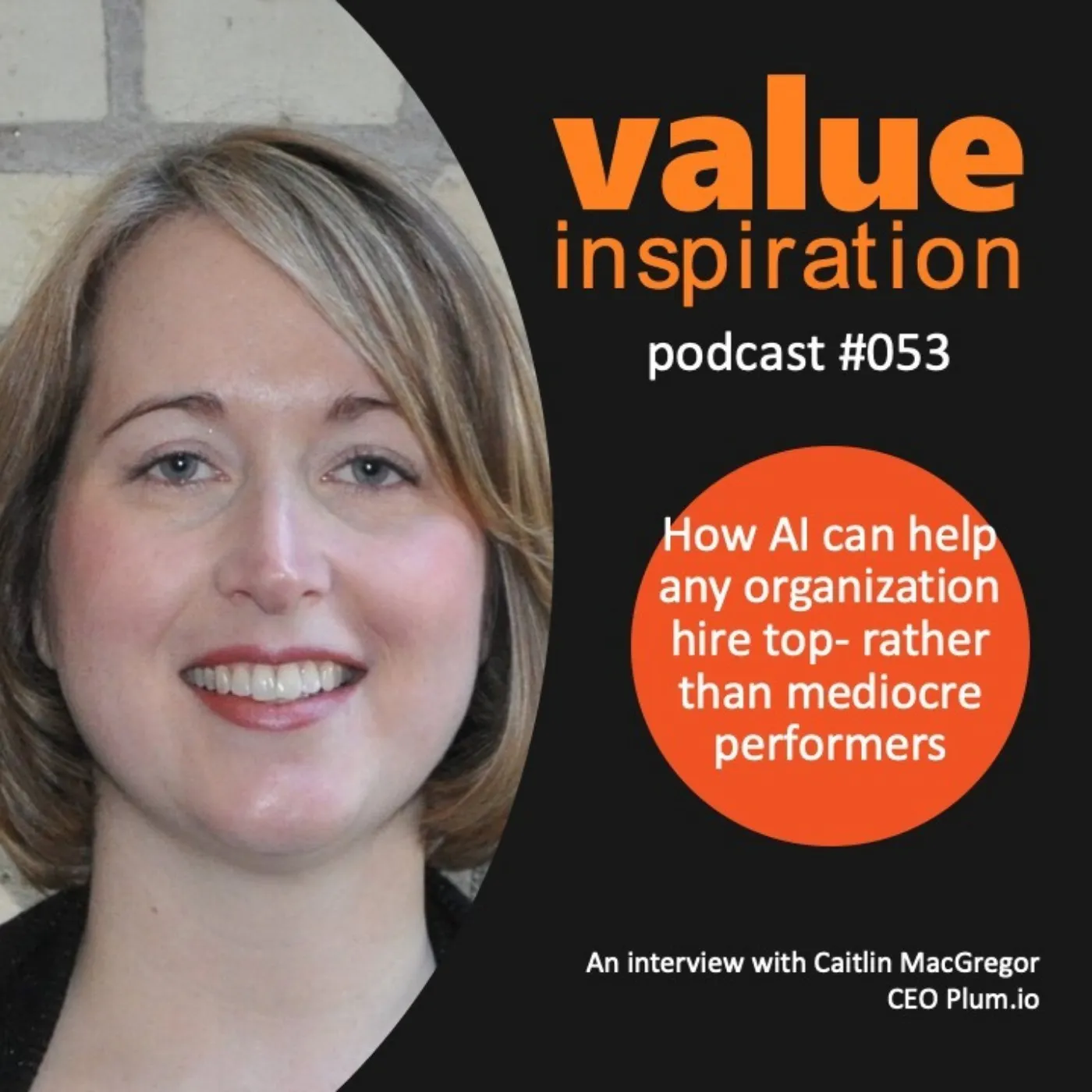
How AI can help any organization hire top- rather than mediocre performers
Feb 11, 2019Tap to summarizeThis podcast interview focuses on product innovation that has the power to transform how we hire and manage talent going forward, and my guest is Caitlin MacGregor Caitlin is the CEO and Co-founder of Plum. After being President/Director of two startups, Caitlin founded Plum in order to transform talent processes to prepare business owners, like herself, for the future of work. Shortly after that Plum was awarded 2015 Gold Stevie International Business Award for best new product or service of the year. The company was also selected as one of the top 10 businesses led by women by Springboard Enterprises NYC. Plum's mission is to help companies hire, grow, and retain top talent with the power of AI and Industrial/Organizational Psychology. By measuring talents such as leadership, innovation, communication, and more, Plum hosts the single largest database for quantifying human potential at every stage of the employee journey – from predicting successful hires, to informing professional development, strategic workforce planning, and high-potential capability. This inspired me, hence I invited Caitlin to my podcast. We explore the challenges in the talent acquisition and talent management space, and why so many companies are challenged with hiring top-talent. We also discuss how the changes in the marketplace require a different approach to hiring, reskilling and redeploying talent – and why assessing where someone went to school or previously worked are not the things to look for. Here are some of his quotes: “Some of the statistics say that, you know, it's a 5050 chance of hiring the right person. a lot of companies don't have 50% turnover. So a lot of the times what happens is that they're putting up with mediocre people maybe 20% of their organization are top performers. But if you understand what makes a top performer, a top performer and you can quantify that you can actually change that ratio so that you can get more people that that meet that criteria. It's really understanding that every single person has the potential to be a top performer, just not in every role, that that each person has a unique set of talents that makes them a top performer. So it's really about how do you figure out what makes somebody exceptional, and then figure out the jobs that will allow them to succeed.” During this interview, you will learn three things: How looking for scarcity can you help uncover hidden market gems that you can open by democratizing access That to maximize your success as a software business it’s key to align every aspect – all the way from product strategy, to marketing, to Sales, to Service How new business ideas are born by looking with a fresh eye at what it takes to avoid costly investment decisions. See acast.com/privacy for privacy and opt-out information. Learn more about your ad choices. Visit megaphone.fm/adchoices
Transcribe →