Loading summary
Transcript180 lines
- [00:04]
David McCloskey
For exclusive interviews, bonus episodes, ad free listening, early access to series first look at live show tickets, a weekly newsletter and discounted books. Join the declassified club@therealisclassified.com this podcast is.
- [00:19]
Sponsor/Ad Voice
Brought to you by Carvana. Carvana makes car selling fast and easy from start to finish. Enter your license plate or VIN and get a real offer in seconds, down to the penny. If you accept, Carvana will come pick up your car from your drive, or you can drop it off at one of our car vending machines. Either way, you get paid instantly. It's fast, transparent and 100% online car selling that saves your time. That's Carvana.
- [00:44]
Gordon Corera
Carvana.
- [00:46]
Sponsor/Ad Voice
Pickup fees may apply. This episode is brought to you by Ebay Buying a car should feel secure, start to finish. That's why you should buy your next ride on ebay. Whatever you're into, ebay's got it. From classics to SUVs and trucks to imports, all in one place. And with Secure Purchase, the process is streamlined and protected. Secure Purchase means no DMV visit, sellers and titles are verified, all the paperwork is handled, and financing, delivery and insurance options are built right in. Plus, eligible vehicle purchases are backed by up to $100,000 in protection. Looking to sell your ride? Secure purchase makes that easy too. Your buyer and their funds are verified and the title transfer and loan payoff are totally seamless. So skip the hassle. Shop with confidence. Buy your next car on ebay. Ebay Things People love Secure Purchase is powered by Caramel Dealer Services LLC, an eBay subsidiary. You're deep into your favorite true crime binge. The twists, the theories and suddenly hunger hits. Grab a Paleo Valley 100% grass fed beef Stick these aren't your average gas station snacks. They're made from real beef sourced from regenerative small American family. No preservatives, no gluten, no grains, soy or sugar. Just naturally fermented protein that fuels your obsession. Whether you're road tripping, hiking or pulling an all nighter with your favorite case, choose from 5 Bold Flavors Original Jalapeno Summer Sausage, Garlic Summer Sausage and Teriyaki. They're keto, Paleo and carnivore friendly, made to work with your lifestyle, not against it. With over 55 million sticks sold and a 60 day money back guarantee, you've got nothing to lose. Get 15% on your first order@paleovalley.com just use code Paleo at checkout.
- [02:48]
David McCloskey
December 2020 Former police officer Grisha Dimitri Dmitriev arrives in the Central African Republic with a small Group of Russian instructors. Grizza's assignment does not seem complicated because the instructor's tasks are only to teach the local army soldiers the basics of tactics and methods of fighting. However, everything goes wrong. From age a coup in the country, Russian instructors together with their charges, fight back against the bandits. But for Grisha, who has never taken part in military operations, this business trip turns into a living hell. Well, welcome to the Rest is classified. I'm David McCloskey.
- [03:28]
Gordon Corera
And I'm Gordon Carrera.
- [03:30]
David McCloskey
And that is the promotional blurb for a film that I'm sure all of our of our, you know, English speaking and understanding audience will remember. It is a film called the Tourist. It's not the Johnny Depp and Angelina Jolie version of the Tourist. It is a film that is financed by Yevgeny Prigozhin to promote I think really the brand image of the Wagner group and in particular its exploits in Africa. And we last Gordon hung out with Yevgeny Prigozhin as he was sort of undergone really an amazing transformation over the course of the first three episodes of this series. He has gone from caterer, government services, sort of contractor, PR sort of machine financier and promoter. And he's now a mercenary warlord and he is now also financing films. Yeah, blending I guess the mercenary warlord with the PR guru.
- [04:37]
Gordon Corera
We had described him as kind of like a version of Gordon Ramsay.
- [04:42]
David McCloskey
I think the shining terms is this tenuous analogy.
- [04:46]
Gordon Corera
I feel like this is the episode where he really moves. I mean, perhaps trolling the American election is also not Gordon Ramsay, but this is.
- [04:53]
David McCloskey
We've hung on too long already for.
- [04:55]
Gordon Corera
Gordon Ramsay and his lawyers. We are definitely not making any analogy with Gordon Ramsay at this point as he becomes mercenary warlord in Africa. That is definitely not fairly stepped out.
- [05:06]
David McCloskey
Of his chef's hat, out of the kitchen.
- [05:09]
Gordon Corera
So the key thing we've seen in the last episode was that he developed a business model for the Wagner Group, named after this Dmitry Utkin Wagner in Syria and Ukraine. And it's a kind of group which is operating in alliance with the Russian military. But not always a very happy alliance, a kind of tense alliance, but also is trying to make its own money and do its own business deals. But now Prigozhin is going to move to try and take that model global effectively and to kind of build it further afield into new conflicts. And Prigozhin and his private jet will be spotted all over Africa. He often travels now under a fake name and wearing disguises and wigs. And we should say that if you are gonna watch this on YouTube or you're on social media, it's worth looking at some of the pictures of Prigozhin's disguises that he uses in Africa because they're kind of wild. Because Prigozhin is this balding, heavyset man.
- [06:15]
David McCloskey
He looks like Sacha Baron Cohen in the Dictator.
- [06:17]
Gordon Corera
Sacha Baron Cohen in the Dictator. That is exactly what it is. I mean, they're high comedy. I can't believe he actually used some of these. I mean, like massive, big fake beards.
- [06:28]
David McCloskey
Admittedly, especially the one here in the bottom left where he's got those big shades on.
- [06:32]
Gordon Corera
Yeah.
- [06:33]
David McCloskey
You really can't tell it's him?
- [06:34]
Gordon Corera
No, he just looks like an old man playing at being a soldier. Quite weird. And then there's another one where he's just got these kind of eyes. He's clearly maybe doing a selfie and he's in some weird uniform. I mean, so you think he looks.
- [06:46]
David McCloskey
Like Alistair Campbell in the bottom right one?
- [06:49]
Gordon Corera
Not in any way.
- [06:50]
David McCloskey
David, Maybe a little bit.
- [06:52]
Gordon Corera
No, not in any way. Just to, just to clarify, we're going.
- [06:55]
David McCloskey
To see, we're going to finally determine if Alistair actually listens to this podcast.
- [06:58]
Gordon Corera
Yeah. Cuz.
- [06:59]
David McCloskey
Because there will be a response. There'll be a response to that.
- [07:01]
Gordon Corera
So he's going in these kind of crazy disguises. Although it's not that low key, but it's kind of semi low key because I guess he still remember we'll come back to this kind of claiming he doesn't run Wagner, you know, publicly. He's saying, I had nothing to do with the research agency. This, this strange man with the beard and the glasses does. So that's why, I guess he's using these disguises because he's got to go broker the deals. But he doesn't want to be seen as, you know, Prigozhin doing it on the whole.
- [07:29]
David McCloskey
And yet his jet is going.
- [07:31]
Gordon Corera
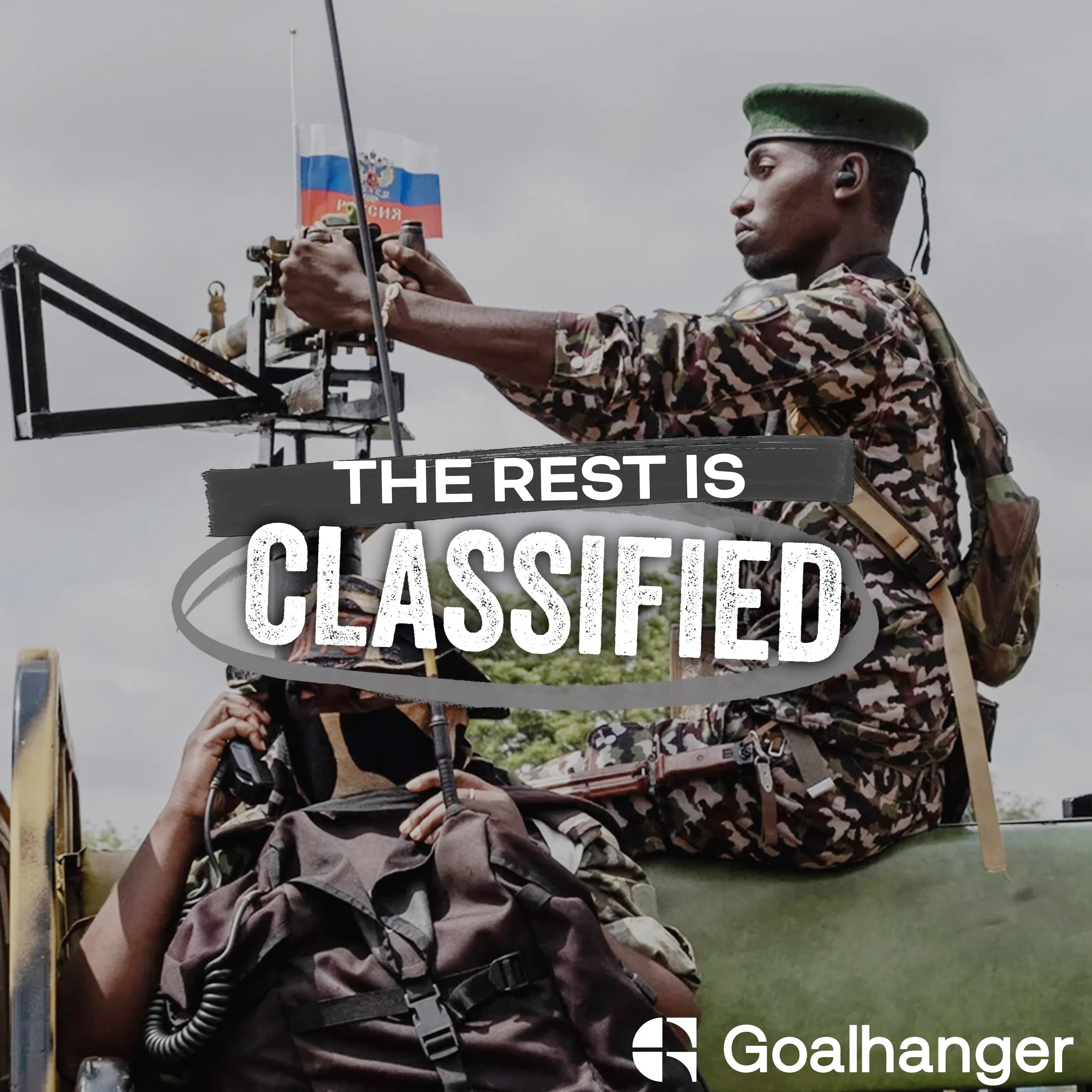
Yeah, his jet is being spotted all over and he's got a team of kind of media exper, professors, linguists, as well as mercenaries that are looking for business opportunities. And Africa is a continent where, you know, depressingly there are conflicts, there's violence, there are governments who need help against providing security. Providing security, but against, you know, militias, rebels. ISIS is on the rise in parts of Africa. The Islamic State group. So there's a kind of logic to it. You know, a couple are interesting to kind of understand what Prigozhin is doing. Central African Republic, one of the kind of early places, landlocked country Full of gold and diamonds. So already you can see the attraction for Mr. Prigozhin, who's learned in Syria that oil and gas, natural resources are good for business.
- [08:18]
David McCloskey
Some kind of mineral or natural resource concession is a helpful way for him to make the business model work.
- [08:24]
Gordon Corera
Exactly. Islamists, other groups, militias, gangs, foreign powers. France had been there, pulls out. There's a vacuum. Prigozhin and Russia move in. It's a training program where he's saying, we can help protect your regime. We can fight off any opponents, and militias, we can secure and guard the natural resources. And all you have to give us in return is a cut, little concession.
- [08:47]
David McCloskey
You make it sound sinister, Gordon.
- [08:49]
Gordon Corera
Just give us 25% of the gold. And in return, if you're a leader, you get a private army. You get Russian weapons to go with them. They'll do what you want. They'll play by dirtier rules than many other Western governments. And you don't even have to pay them direct because you can just take it from the profits. So it's not even like you need to give them cash. You know, they're just going to take a kind of skim a bit off the top. There's going to be gems, diamonds, gold. They're going to take control of this massive gold mine, chasing away other miners. There's pictures of this huge gold mine, which at first have been worked by hand, but then they're going to come along and kind of industrialize it, and it's going to bring in massive amounts of income. Prigozhin is actually going to start negotiating peace deals in the country between different militias, basically so he can get free passage to move some of the golden things around. One of the interesting questions is, how far is this Moscow and how far is it, you know, Prigozhin? And the answer is, it's, as ever with this story, it's quite hard to tell.
- [09:56]
David McCloskey
I think it's more Prigozhin.
- [09:58]
Gordon Corera
Yeah.
- [09:58]
David McCloskey
As we've seen, very entrepreneurial.
- [10:01]
Gordon Corera
Yeah.
- [10:03]
David McCloskey
Very willing to take action and risk.
- [10:06]
Gordon Corera
Yeah.
- [10:06]
David McCloskey
The subtext to a lot of the story in Africa is sort of, frankly, the retreat of. Of the French.
- [10:11]
Gordon Corera
Yeah, yeah. Retreat, the French. Yeah.
- [10:14]
David McCloskey
I think Prigozhin is kind of stepping in and saying, look, Moscow's not gonna stop me.
- [10:19]
Gordon Corera
Yeah.
- [10:20]
David McCloskey
You know, there's an overlap of interest here, and he just kind of does it.
- [10:24]
Gordon Corera
Yeah. But I think that's absolutely right. He's doing it for himself. But I also think, you know, it's useful for the Kremlin. It is useful for The Kremlin. It's useful for Kremlin. I think that's right.
- [10:34]
David McCloskey
He's doing it for himself. And it's useful for the Kremlin because.
- [10:37]
Gordon Corera
Often what you see with these African deals is there's a kind of Kremlin diplomatic deal and then Wagner moves in. And of course, if you're the Kremlin, Wagner is kind of you want to project Russian power, power around the world. The whole thing about Putin is you want to be a global power, not just like a regional power. That's the image of Russia and the sense that Russia lost that role and now Putin is restoring it. And of course, Wagner is a kind of low cost way of projecting power across Africa, of making yourself useful to governments, of building relationships and doing it on the cheap. And there is this way in which it's a kind of modern form of colonialism. Resource extraction in war zones guarded by Wagner mercenaries, financed by the profits they extract. The British system. The East India Company in the earliest days was a private company which basically takes over India and has its own armies and militias and eventually gets absorbed into the state. But there's a kind of age old aspect to this, but just kind of placed into the modern Russian context, I guess there is also a dark side because, you know, as news starts to emerge about this, people start investigating it. And in July 2018, three well known Russian journalists working for a kind of media company linked to the Kremlin, critic Khodorkovsky, a kind of former oligarch who fell out with Putin, are going to go to the Central African Republic to investigate, you know, the links between Wagner, Prigozhin's Concord Company and what's happening there. They're trying to go to a gold mine, but instead their car is taken the wrong route, they get ambushed and all three are killed. You know, none of their possessions are taken. It's claimed it's by kind of Islamist rebels, but investigations will show that the driver had been in touch with officials who in turn were in touch with Wagner. So you suddenly look like Prigozhin is kind of killing Russian journalists who are investigating his activities there. So it's a sign of how far he's willing to go to kind of protect to some extent these businesses. Sudan, another one, Prigozhin, turns up on his private jet, don't know which disguise he was using for a kind of deal for gold with President Omar Al Bashir, who's under indictment from the International Criminal Court. Again, Putin is also meeting with Bashir and signing a deal because The Kremlin's got interests. Russia wants to set up naval bases at Port Sudan on the Red Sea. And here's Wagner offering security support. And what's so interesting here is Wagner is offering security support for Bashir's forces. Omar Al Bashir gets booted out of office, and then Wagner go and work for the people who've taken over. So they don't really care who they work for. They're not super loyal, I think it's fair to say, to the particular leader who's employed them.
- [13:22]
David McCloskey
Yes. I think Prigozhin has shown throughout the course of his career, I think a certain pragmatism.
- [13:29]
Gordon Corera
Pragmatism. And then I love this fact. From 2021 until mid-2022, at least 16 planes loaded with gold departed Sudan for a Russian controlled air base, which again.
- [13:40]
David McCloskey
We only get to Wagner provides a lot of benefits to Putin. Right. As we've said, it's deniable, it's low cost. If it's raising money.
- [13:49]
Gordon Corera
Yeah.
- [13:49]
David McCloskey
There's also, you know, there's a cash flow. Yep. That again, we don't know.
- [13:54]
Gordon Corera
Yeah.
- [13:54]
David McCloskey
But I guarantee you that, you know, Prigozhin cut Putin in.
- [14:00]
Gordon Corera
Yeah, someone will be cutting.
- [14:01]
David McCloskey
Yeah, there's a cut. Right. And so again, you know, I remember speaking with a former chief of station who worked in Moscow for a long time and, you know, he told me, think about Russia as a business.
- [14:13]
Gordon Corera
It's.
- [14:14]
David McCloskey
It's easier to think about the country as a business. You can use a lot of mental models, but if you use business, you're usually going to be on the money. And here again, this is another way for the Kremlin to raise money and not to raise money for the state necessarily, but for individuals. Right. So I think it's yet another reason why this kind of adventurism would be attractive to Putin.
- [14:39]
Gordon Corera
Yeah. Some of the other examples touch on briefly are interesting as well. Libya, big civil war since the overthrow of Gaddafi. It's one of those conflicts, the civil war, where you get lots of other countries pile in with proxies to support one group or the other. Interestingly, November 2018, Prigozhin was filmed at talks between Russia's Defense Minister and General Haftar, who'll be Russia's proxy in the fight, even though Haftar had once lived in Virginia. But hey. But Haftar is now, is now their man. And it's interesting that Prigozhin is visible at this meeting, you know, alongside his kind of rival, the Defence Minister, Shoigu, Sergei Shoigu. And Gerasimov, the head of the Russian military. And Russian officials respond by saying that he's there in his role as a caterer organizing an official dinner.
- [15:30]
David McCloskey
We're back to the Gordon Ramsay comparison.
- [15:32]
Gordon Corera
Exactly. Seems somewhat implausible. But again, Russia wants to back Haftar. It's going to supply weapons, mercenaries to him. And about 300 Wagnerites set out, along with artillery, tanks, drones. Some come from Syria as well, some come from Sudan. Haftar at one point looks like he's going to take Tripoli. Then the Turks get involved and bring in these new drones and things like that and actually push them back. So it's not a great success. And it's the same actually in Mozambique. They're going to get involved actually, with an insurgency against isis. Again, a country with lots of gas and resources. One of the interesting things about Mozambique, just briefly, is that there's a quote here from John Lechner's book, Death Is Our Business. Everyone and their uncle were pitching to the Mozambicans. A South African mercenary remembered, and Wagner was clearly one of them. And so you get this sense that actually there's a kind of.
- [16:27]
David McCloskey
There's a market.
- [16:28]
Gordon Corera
There's a market. Yeah. And you know what pitch deck looks like says that Erik Prince, you know, who is famously Blackwater US guy, is supposedly there pitching to the, you know, the Mozambicans. I've got some mercenaries. The South Africans are there pitching their mercenaries to it. And Prigozhin wins the deal. The deal, yeah.
- [16:48]
David McCloskey
He must have had some snazzy PowerPoint slides that he brought with him.
- [16:52]
Gordon Corera
I think it's possibly the fact that Russia was going to pay off some debts and bring some tanks. That's like. That's better than a good picture on PowerPoint.
- [17:01]
David McCloskey
We like to think these markets don't exist.
- [17:04]
Gordon Corera
Yeah.
- [17:05]
David McCloskey
And we like to think that, oh, they're sort of. Sort of naughty, you know, and we can. But there's a reality that there's. I mean, there's a business opportunity here.
- [17:15]
Gordon Corera
Yeah.
- [17:16]
David McCloskey
For entrepreneurial guys and girls. Mostly guys.
- [17:20]
Gordon Corera
Yeah.
- [17:20]
David McCloskey
But entrepreneurial people who have sort of, you know, violent people at their disposal.
- [17:27]
Gordon Corera
Yeah.
- [17:28]
David McCloskey
And capacity.
- [17:28]
Gordon Corera
Right.
- [17:29]
David McCloskey
I mean, it just.
- [17:29]
Gordon Corera
And he's been there through history. It is. I mean, we talked about that previously. You know, you go back to kind of go back to ancient times and Carthage, but you also go back to Italian, you know, city states, all these kind of conflicts. 1960s in the Congo, you have mercenary. So it's always been there, this business. But we kind of like to not look at it that much.
- [17:49]
David McCloskey
What is the difference do you think, between a mercenary and a government contractor? Because if we took Blackwater in Iraq.
- [17:58]
Gordon Corera
Yeah.
- [17:59]
David McCloskey
As an example, we would call that a government contract. It's a government contractor. Right. In our context and system, we'd say, okay, that's a. There is that. Is it different? Yeah, it's a. I don't know. It's a.
- [18:11]
Gordon Corera
It's in my head. There's a slight difference as well, where a company is contracting with its own government to provide additional help versus selling its wares to whatever government will pay the highest bidder. I don't know. I'm not sure what the difference is.
- [18:26]
David McCloskey
Yeah, it's interesting if there is one, it's a narrower one than we probably like to think.
- [18:33]
Gordon Corera
Yeah, yeah, I think that's right. So Mozambique, they win the deal, but it doesn't actually go very well. They find it's a pretty big insurgency and they struggle with it. Mali is another one. And again, this goes back to our earlier point. Mali's an interesting one because the French were there to help push out an Islamist insurgency and deployed loads of troops there, but eventually it's going to pull them out. And so kind of Wagner moves into the gap. The French leave the vacuum in Africa in return for mining concessions. But there's some awful. I mean, we shouldn't underplay how awful. Some of the reports are of massacres, including by Wagner, troops of civilians. You know, there's going to be mass graves in villages, you know, where unarmed men are just being killed because they're suspected. You know, the village is linked to so called rebels. And so Wagner's gonna get a reputation. Kind of real violence.
- [19:28]
David McCloskey
Is it conducting these on its own or is it in collaboration with government in some cases that it's working with or for?
- [19:37]
Gordon Corera
That's also the ambiguities because they're there as trainers or instructors, which as we actually know from some of our other episodes, including where the US has been training and instructing the Colombians.
- [19:47]
David McCloskey
You're not comparing the training and instructing of the.
- [19:51]
Gordon Corera
Well, I'm suggesting Wagner. Are you, Gordon, if you do remember our interview. No, no, no, no. But my point was that the definition of training and instructing is quite elastic. You know, you can, you can get very involved in operations when you're technically only there to train. Yes, that's my comparison rather than a moral judgment. And I think here, you know, I think it's Wagner who's doing the dirty stuff. And there's going to be, you know, reports of a massacre of more than 300 civilians and raids on mines and all these kind of associated with Wagner and what it does. But I think just one more fact about Wagner which I think is really interesting, which is we focused on the kind of mercenary side of it, but actually it's more than that because one of the things that we talked about early on was the kind of fusion of security work and information warfare with the way in which Prigozhin operates. And that's also what he's offering to these governments. So they don't just offer military trainers, instructors, fighters. They also offer political propaganda campaigns. They offer disinformation social media campaigns on Facebook to attack enemies and support a government. You know, you get a whole package with Wagner.
- [21:07]
David McCloskey
He hasn't rolled the catering up into that.
- [21:10]
Gordon Corera
No, I don't think. You also get bleenies and things like that.
- [21:13]
David McCloskey
Bleedonalds.
- [21:14]
Gordon Corera
Bleedonalds. So you get. You know, it's so interesting. Cause you can imagine when Prigozhin goes to see one of these presidents in his wig, probably takes the wig off when he meets him, but he says, like, I'll give you troops. The Russian military will give you weapons. I will give you a propaganda campaign which will support your regime and will attack your enemies. Also you get a presidential advisor, security, bodyguards, technical counter surveillance expertise, even people who can do polygraphs to check staff for any threats. This is, as we've seen all along, Prigozhin understanding what a leader wants. Yes. And then offering it to them. The whole package which fuses kind of propaganda warfare, kind of what now people often call grey zone activities. Just this whole spread of activities. And he's just good at that.
- [22:04]
David McCloskey
And so maybe there with Prigozhin having really, I think, perfected this business model, let's take a break and when we come back, we'll see how he tries to use it to increase his standing in the Kremlin and how that is going to make him some very powerful enemies.
- [22:21]
Gordon Corera
See you after the break.
- [22:27]
David McCloskey
This episode is brought to you by Attio, the CRM for the AI era.
- [22:32]
Gordon Corera
Now, David, people think that spycraft is just car chases and secret codes, but an awful lot of it is just idling around, waiting for the action.
- [22:42]
David McCloskey
It's a bit like starting your own business. You think it's going to be as easy as creating and selling a product, but the reality is business owners spend far too long trying to get their CRM to fit a system not built for them.
- [22:54]
Gordon Corera
Attio's AI driven CRM enables you to Take control of your platform to build something from the ground up that fits your needs.
- [23:03]
David McCloskey
James Bond had Q's, X ray shades, an explosive watch and a pen grenade. Business owners have adio's real time customer insights and platform that grows with them. All tools relevant for your mission to build a company from the ground up.
- [23:18]
Gordon Corera
Attio even has something called agent collaboration.
- [23:22]
David McCloskey
Yes, but in this case that means giving people the ability to let AI work seamlessly in the background for them.
- [23:29]
Gordon Corera
Try Attio for free@attio.com trick una silla de masajes puede pares er extravagante Ocho configuraciones differentes intensidada justable.
- [23:49]
David McCloskey
Pareser extravagante y dos bueno a un mas Peru Cuando es ha sillas de.
- [23:53]
Gordon Corera
Masaes bien en conunauto se vuelben bastante practicas El Volks bag en tunciones premium como los hacientos de lanteros con masaje disponiveles solo parese extravagante in Walmart's Huluville. Everyone ready their cart? Amazing Black Friday deals are about to start online and in the app. Such great deals to explore. Everything you love from tech, toys and more. The days to save and the ones to remember. It's only the 25th to the 30th of November. Set your alarms. Don't miss out. These deals are epic. Without a doubt, the who's are all ready. But are you? Walmart Black Friday deals await. Who knew? This episode is brought to you by State Farm. Listening to this podcast. Smart move. Being financially savvy. Smart move. Another smart move. Having State Farm help you create a competitive price when you choose to bundle home and auto bundling. Just another way to save with a personal price plan. Like a good neighbor, State Farm is there. Prices are based on rating plans that vary by state. Coverage options are selected by the customer, availability, amount of discounts and savings and eligibility vary by.
- [25:12]
David McCloskey
But welcome back. The informal motto for Wagner Gordon has become Death is our business and business is good.
- [25:20]
Gordon Corera
Wow.
- [25:21]
David McCloskey
Wow. Put it on the T shirts. Yeah, that's right.
- [25:24]
Gordon Corera
That's the merch.
- [25:25]
David McCloskey
So Prigozhin has perfected this kind of stew, hasn't he? I can't help but think, just to bring it back to the man for a second, that he sees all of this as kind of a pitch to Putin.
- [25:37]
Gordon Corera
Yeah.
- [25:38]
David McCloskey
For more and more influence.
- [25:40]
Gordon Corera
Yeah.
- [25:40]
David McCloskey
And prestige in kind of the court.
- [25:43]
Gordon Corera
Yeah.
- [25:43]
David McCloskey
You know.
- [25:44]
Gordon Corera
Exactly.
- [25:44]
David McCloskey
And one of the things that we, I guess, might be worth reflecting on too at this point is just how effective are these services that he's providing? Because there's a sense where Prigozhin, as we've seen, is a pretty effective salesman and PR man. But are his services really changing outcomes on the ground? Is it really?
- [26:07]
Gordon Corera
Or.
- [26:07]
David McCloskey
Or is it more of a way for him? Again, you know, we went back, we talked in the last episode about his effort to influence the 2016 campaign. And a lot of the. The sort of. The trolling.
- [26:19]
Gordon Corera
Yeah.
- [26:20]
David McCloskey
The creation of these online accounts that are used to sort of, you know, stir the pot in the States. It makes a pretty snazzy thing that he could point to with Putin and others to say, look what I'm doing. But is he kind of over his skis when it comes to selling his own influence and kind of, I guess, the effectiveness of Wagner?
- [26:41]
Gordon Corera
If you look in Africa, it's effective in some countries. He is building his own brand and the brand of Wagner quite effectively. And I think it is part of him trying to get into the inner circle. If we think of Putin, which I think Mark Galeotti kind of describes as a kind of like a. A king in a medieval court, there's definitely an inner circle of courtiers who are Putin's friends from his old days in St. Petersburg. And even though Prigozhin was from the St. Petersburg days, he was staff, he was the caterer, he wasn't in the inner circle. And so I definitely think there's this effort in which he is building something to try and get into that inner circle and break into that inner circle. And it goes back to him showing his usefulness, you know, to the Kremlin in what he's doing. And that is part of it, beyond the kind of effectiveness on the ground. And so he's developed a kind of toolkit, and he's going to use it in Africa. He's going to use it, interestingly enough, the kind of political influence operations as well. Closer to home in Belarus, you know, neighboring Russia, to defend president there, Lukashenko, when Lukashenko has some problems with protest, Prigozhin is going to go in there and use his kind of influence to try. And his media campaign to try and support him. Because also Belarus has been kind of a hub for equipment going through. So he's busy and he's building. And that's another sign. He's building a relationship with Lukashenko, who's going to be important, actually, when we get to the final act. So we've talked about Prigozhin as the businessman, and, yeah, he's about making money. But I think it is much more than that. It's building a kind of power base. Wagner is growing. It's, you know, by 2018, it's about 4,300 people in the military side. Still not legal, though, under Russian law to have a run a mercenary group. So he's kind of. It's what's interesting. It's like you can have a kind of private security force guarding a facility, but you're not supposed to have this. So he's kind of still on the edge of the law, playing within the world of criminality, smuggling gold and diamonds. He's not quite got the status, you know, the inner circle status that I think he wants.
- [28:47]
David McCloskey
Isn't everyone basically on the edge of the law in Russia, though?
- [28:49]
Gordon Corera
I mean, you're some more than others, Right?
- [28:53]
David McCloskey
Okay, fair enough. But that. That also does seem an advantage to Putin.
- [28:57]
Gordon Corera
Yeah, right.
- [28:57]
David McCloskey
Is it? In a sort of obvious one is even as you're obviously not just tolerating, but encouraging this guy.
- [29:04]
Gordon Corera
Yeah.
- [29:05]
David McCloskey
You make sure that there's a legal sword sort of hanging over him so that you have, you know, leverage. Yeah, right.
- [29:13]
Gordon Corera
But also, I think he's moved heavier into the mercenary period we've seen here, this kind of 20, 17, 18, 1920 period. And I think Prigozhin himself, you see, start to change a bit. It's a bit like Joseph Conrad's famous novel, you know, the Heart of Darkness, in which Kurtz, you know, this kind of colonel goes into Africa and is changed by it. And I think Prigozhin himself starts to become a little bit wilder, you know, and you can see it in the pictures that we looked at, but he feels more like a kind of international outlaw than he does a straight businessman. So I think that's the problem. And I think there's an element of him which wants to go legit. He's Michael Corleone, you know, in Godfather Part 3, who's, like, legit. Who wants to go to Gajit legit. But. But he's now found that his thing is being an international mercenary warlord. He can't go back to being a kind of a businessman.
- [29:59]
David McCloskey
I will say, though, that, you know, in my. In my time as a management consultant, I saw plenty of overstretched CEOs or executives who also looked increasingly deranged. They were just a few steps away from donning the Prigozhin beard, you know.
- [30:16]
Gordon Corera
Beard and the combat fatigue.
- [30:18]
David McCloskey
Yes, exactly. We keep calling him a mercenary warlord.
- [30:21]
Gordon Corera
Yeah, Right. But he's also a CEO.
- [30:23]
David McCloskey
He's also a CEO.
- [30:24]
Gordon Corera
Yeah, he's CEO.
- [30:24]
David McCloskey
He's a very stretched CEO.
- [30:26]
Gordon Corera
Yeah.
- [30:26]
David McCloskey
Who has a lot of demands on his time.
- [30:28]
Gordon Corera
Yeah.
- [30:28]
David McCloskey
Who's running a very large organization. And it's the sort of organization that's brought in at a moment of high stress for its clients, let's say, you know, so they're not getting the best, you know, of the Malians. No, Gordon. Or the Central Africa public. It's the worst. You know, they're being brought in at the worst possible. That would stretch anybody.
- [30:49]
Gordon Corera
That would stretch anybody. But also the problem for him, I think, is that he's also becoming famous for this, because people are watching Wagner, and particularly in the west, they start freaking out because they can see the way Wagner is extending Russian influence around Africa, and they don't know quite how to deal with it, because it's moving fast. I mean, that's the thing about Wagner. It's nimble, it's fast, it's moving into the vacuum in the spaces in Africa. And that's a problem.
- [31:16]
David McCloskey
And I do think it is in this period where the Wagner brand or the lore starts to get out in front of the reality of how effective or influential it is on the ground. Or even with Putin.
- [31:28]
Gordon Corera
Yeah.
- [31:28]
David McCloskey
There's a tendency, I think, to overstate.
- [31:30]
Gordon Corera
Yeah, I think that's true.
- [31:31]
David McCloskey
How influential they really were. How effective they were. Because again, as we've said, Prigozhin is not getting. He's not getting invited into the box at the ice hockey games with Putin.
- [31:42]
Gordon Corera
No, that's right. And, you know, 2018 onwards, he's getting sanctioned by the US as well. Heavier sanctions on him personally, many because of the election interference. And so he's also worried about his assets and he's trying to. To move them around. He's getting his jet, private jets impounded. And I think he is resentful. He's not with the cool kids in Moscow, invited to, you know, set the ice hockey games. He's just that little bit too wild and dangerous to be legit. I think he leans in, which is what? If you're a management consultant, you probably tell him to lean into the brand. If that's your brand, go for it. Rather than.
- [32:17]
David McCloskey
I don't know what. But it would take three to four months and cost a million dollars.
- [32:22]
Gordon Corera
It involves some fancy pitch decks and.
- [32:24]
David McCloskey
Involves some very fancy pitch decks. Yeah.
- [32:26]
Gordon Corera
But one of the things I love is he starts. He then starts to develop his own film studio and finance films, and, I mean, action films set in Africa, involving Wagner troops and they always involve these kind of heroic fighters battling normally Islamists and the CIA often. And you know, his PR machine will then fluff them with good reviews. But that's the tourists that you read.
- [32:52]
David McCloskey
Yeah, the tourists, that's right. As you've noted here, it only has a 5.3 out of 10 on IMDb.
- [32:57]
Gordon Corera
Not great.
- [32:58]
David McCloskey
Even despite the trolling.
- [33:00]
Gordon Corera
Yeah, Even despite the PR machine you put your full PR machine into and it gets 5.3 out of IMDb. That's not great.
- [33:09]
David McCloskey
Some of this, some of the dialogue in this film, though, because we've gone down the rabbit hole.
- [33:13]
Gordon Corera
Yeah, let's do it.
- [33:13]
David McCloskey
You know, Americans say they fight for democracy, Russians fight for justice.
- [33:20]
Gordon Corera
It's good. This stuff is.
- [33:22]
David McCloskey
It's very on the nose.
- [33:23]
Gordon Corera
It's very on the nose. So I think leading into the Wagner brand, it's going to encourage more recruits. He's stepping out the shadows a little bit. There's more public references to him on social media and Telegram. There's even a website at one point called joinvagner.com looking for far right sympathizers for the US and Europe who want to fight with them. It's an English language looking interesting enough. A far right, which is back to the kind of. It specifies far right that seems to be what they're looking for is the kind of people who want a bit of adventure and a fight and are of. Attracted to the. I mean, remember Dmitri Utkin? Wagner himself is kind of man with SS tattoos, you know, so. Sure.
- [34:06]
David McCloskey
You're assuming that someone on the far left wouldn't want to join, though.
- [34:09]
Gordon Corera
I don't know. I'm guessing. But that's what they seem to be going for, the kind of imperialist, nationalist worldview. Join PMC Wagner to protect the peace and tranquility of civilians from terrorists and bandits.
- [34:22]
David McCloskey
That's got a nice ring to it.
- [34:24]
Gordon Corera
That's the pitch. Prigozhin gives his first interview to the Western press, speaks to the Sunday Telegraph. Interestingly, he is still denying any connection between him and Wagner or the Internet Research Agency.
- [34:37]
David McCloskey
I suppose there's no advantage to actually outright admitting it, right?
- [34:41]
Gordon Corera
Yeah. He says, I've got no connection to Wagner, I've got no connection to mercenary groups. Worries me greatly that some people think I have such a connection. I am a pacifist, he says. Sounds like a pacifist. I think here he's still trying to kind of straddle the mercenary warlord, but not publicly because he doesn't want to be put under sanctions. And he's trying to protect his assets and there's a reward from the US about him. He's still using the dark arts because bellingcat, the private investigative, open source investigative group, revealed some of the links between Prigozhin and people in the Kremlin and the kind of calls he's making between them. And Prigozhin is also gonna launch lawsuits against Elliot Higgins, the founder of Bell and Cat, for articles and tweets linking him to Wagner, and uses, depressingly, London lawyers to go after Elliot Higgins. I mean, why are there so many.
- [35:34]
David McCloskey
Lawyers in your country that are willing to do these kinds of things? Gordon?
- [35:37]
Gordon Corera
Yeah, it's a source of some regret. It's fair to say to me as a journalist that there are people willing to do that and take Prigozhin's money to go after journalists for investigating him. But those are the kind of techniques he and other oligarchs are going to use. But worth saying that still, relations with the Kremlin are not that easy. The Russian Ministry of Defence, which we know is uneasy about Wagner, is also building up its own mercenary groups, one called redout or redoubt, which had been going for a while, and that seems to be their alternative to Wagner. And it's the classic kind of Putin thing, isn't it? We described it as a court and he's the king. And his trick is never let anyone get too powerful, always have alternatives, play them off against each other, be insecure. So, you know, here you have another mercenary group which you can play off against Wagner. Don't let anyone get too big, don't let Prigozhin get too big. Just keep it in play.
- [36:35]
David McCloskey
So that would be the top down, sort of Kremlin political view of it. The other lens you could take to, you know, this idea of the MOD having its own mercenary group is that Wagner has been this entrepreneurial startup that has succeeded in these markets. And this would be the equivalent of like the sort of bulking behemoth which realizes it's missing out on this new high growth opportunity and tries to incubate inside itself its own little version of the startup without much success.
- [37:13]
Gordon Corera
Yeah, yeah. Which is going to try and build up. So now we're coming into 2022. In January 2022, Prigozhin has with Alexeev, who is the number two of the GRU military intelligence. The row is supposedly in his office. And Alexeev is the kind of guy who has handled Wagner. He's been the kind of contact person and it's Because Prigozhi is annoyed. He's getting locked out by the Ministry of Defense and Putin is not speaking to him that much. He hasn't had a call for him with Putin personally for six months. So you get a sense here that his rise, his growth of the brand has been useful for the Kremlin, but only up to a point. And it's reached that point. And so as you get to the start of 2022, the Ministry of Defense is kind of like, we're just going to keep you at arm's length. You know, we don't want you to get any bigger or any, or get any more involved. And Putin as well is kind of just keeping him at arm's length a bit. This kind of rough and tough mercenary guy.
- [38:08]
David McCloskey
He's staff.
- [38:10]
Gordon Corera
He. Staff.
- [38:10]
David McCloskey
And he doesn't like that. Yeah, I think that is. He, he has aspirations for himself that go beyond just being staff.
- [38:19]
Gordon Corera
And here's the problem, because just as at this moment, the Prigozhin seems to be locked out and he's not getting his calls returned. Start of 2022, something big is brewing. Around 175,000 Russian troops, regular military are building up on the borders of Ukraine. Now, most of the time think that this is a bluff to put pressure on Ukraine and that there's not going to be a real invasion and they're going to be wrong.
- [38:46]
David McCloskey
So, Gordon, I think that is a good spot to end this episode. When we come back next time, we'll see how this war in Ukraine, this actual, proper, massive invasion of Ukraine, is going to totally transform Prigozhin's fortunes, bring him to the highest of highs and ultimately lead to his demise.
- [39:07]
Gordon Corera
That's right. But, but, but just a reminder, if you want to hear those episodes now, you can joining the Declassified club@therestdisclassified.com and you'll get access to our special miniseries, won't you?
- [39:20]
David McCloskey
That's right. We will be doing a three parter on sort of the secret world of the KGB and Vladimir Putin showing his rise, his time in the KGB and his ascent to power. Some special guests for that series. You won't want to miss it. So go and sign up for the Declassified Club to get access to. We'll see you next time.
- [39:42]
Gordon Corera
See you next time.