Loading summary
Transcript121 lines
- [00:04]
David McCloskey
For exclusive interviews, bonus episodes, ad free listening, early access to series first look at live show tickets, a weekly newsletter and discounted books. Join the Declassified club@the restisclassified.com.
- [00:25]
Gordon Carrera
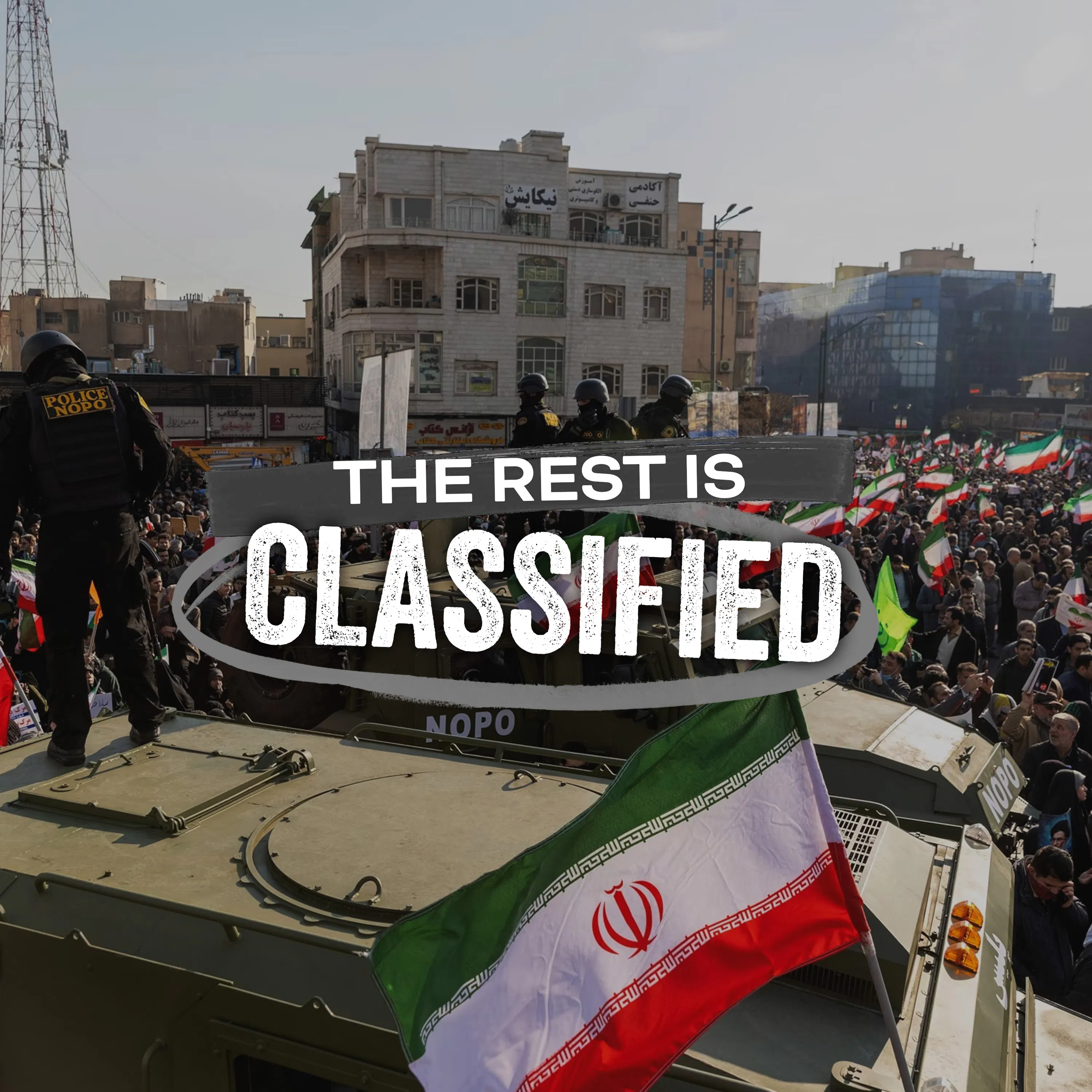
Protests in Iran, a violent crackdown. Is the country on the verge of a revolution?
- [00:31]
David McCloskey
And amid all of this unrest, how do intelligence agencies. How is the CIA looking and examining the crisis in Iran?
- [00:39]
Gordon Carrera
Well, welcome to the Rest is Classified. I'm Gordon Carrera.
- [00:42]
David McCloskey
And I'm David McCloskey.
- [00:43]
Gordon Carrera
And we are going to be looking at Iran this week. It's another interruption to our regularly scheduled programming. If you were waiting for that series on Kim Philby, Britain's greatest traitor that we've been promising, it will come soon. But we just felt that the, the kind of urgency of events in Iran required us to have a look at it because I mean, those protests and the crackdown that we've seen have been a real challenge, haven't they, to the Islamic regime? David?
- [01:10]
David McCloskey
I don't think it's hyperbolic to say, Gordon, that this is the most significant internal challenge that the Islamic Republic has ever faced and certainly faced since 1970 died. I mean, the scale and the intensity of these protests, the crackdown, the level of violence, the death toll, it's uncertain, but it's still rising and it looks like it's going to be the most violence that the regime has meted out against its own people ever. It's truly an unprecedented situation for the Islamic Republic.
- [01:44]
Gordon Carrera
Yeah, I think that's right. And even though we're recording this on Sunday 18th January, things of course could change in the coming days. It looks like for the moment the repression has managed to stop those protests. But I think one of the questions we want to look at is what does that mean for the long term stability for the regime and particularly how will intelligence agencies be trying to understand that? And this question about how good, how effective agencies like the CIA, MI6, others are at predicting revolutions, uprising, understanding when or not they're actually going to be able to topple a regime. And I think that's where we can really apply our REST is classified lens to this situation and try and understand how people might predict what happens next.
- [02:28]
David McCloskey
And so those are the big questions we'll be tackling in this two part series. And before we get to them, a quick word from our sponsors at hp.
- [02:41]
Gordon Carrera
This episode is sponsored by hp. Most people are not counterespionage experts, but that won't stop them getting targeted by cyber criminals seeking to extract their secrets.
- [02:53]
David McCloskey
HP understands that approximately 4 in 10 UK businesses have reported cyber breaches in the past 12 months alone. That's why HP Business laptops, desktops and workstations bought directly on HP Store are secure, straight out of the box with their endpoint security.
- [03:09]
Gordon Carrera
No more stressing about dodgy emails or unexplained pop ups. HP's independently verified Wolf Pro Security works alongside your existing security tools to protect your business users and reputation from malware and evolving cyber threats with your first click.
- [03:26]
David McCloskey
You don't need an alias or a secret hideout to stay safe, just Wolff Pro Security working tirelessly to protect your hard work. It's security that's built in, not bolted on.
- [03:37]
Gordon Carrera
Find out more about how HP can protect your business@hp.com Classified podcast listeners benefit from a 10% discount on all business PCs, printers and accessories using the code TRIC10. Terms and conditions apply. This episode is brought to you by.
- [03:57]
Dominic Sambrook
The Hillside Strangler get ready for the Hillside Strangler, the new MGM original docuseries revisiting LA's most terrifying serial murder case. Return to the investigation with legendary homicide detective Frank Salerno as he retraces the hunt that consumed a city and for the first time on camera, hear convicted killer Kenneth Bianchi share his disturbing account.
- [04:19]
David McCloskey
Watch the Hillside Strangler now on MGM.
- [04:22]
Dominic Sambrook
New episode streaming Sundays.
- [04:25]
Sponsor/Advertiser
This podcast is brought to you by Carvana Car shopping shouldn't feel like preparing for a marathon of paperwork. That's why Carvana makes buying and financing your car easy. From start to finish. Search thousands of vehicles with great prices, all online, all on your time, and when you're ready, your new car shows up right at your door. It doesn't get better than that. Buy your car the easy way on Delivery fees may apply.
- [04:59]
Gordon Carrera
So David, as we kind of delve into this story of Iran, and we've looked at Iran in the past on our podcast. We did our first two episodes back on 1953 and the kind of coup organized by MI6 and CIA. But as we look at the situation now, I guess your experience inside the CIA is particularly relevant here, isn't it, in the kind of analytical understanding of what's going on in a crisis like this.
- [05:22]
David McCloskey
I did have the, I guess fortune or misfortune, depending on how you look at it, of, of covering Syria during the the kind of early stages of the protest movement, the uprising and eventually what became a civil war of, of a bunch of opposition factions against Bashar al Assad's regime. And so I was, I was a CIA analyst who was looking at that uprising which began in 2011, you know, and obviously morphed into terrible violence that went on for over a decade and is still going on today. So I have a, I think a particular perspective on how an intelligence agency is going to react to a fast moving crisis like this and what it feels like to sort of be wrestling with some of these really, really big questions about what's going on in the country that you happen to be following. Because you know, you think the, the Iran and we'll go much deeper into this, but the Iran analysts are now confronting a series of massive questions about what's coming next and the stability of the regime or lack thereof. And so how do you make sense of that as an intelligence analyst?
- [06:33]
Gordon Carrera
Yeah. So I guess in this first episode we'll look at what David's successors, the people we sometimes call the Minnie McCloskeys, what will they be up to now.
- [06:41]
David McCloskey
My analytic progeny all over the intelligence community?
- [06:45]
Gordon Carrera
What kind of questions and demands will be they're getting from policymakers. And then in our second episode we'll look at how some past scenarios, whether it's in Iran 1979, or whether it's the fall of communism or the Arab Spring, how they help us understand how intelligence agencies sometimes struggle to predict this kind of political change. And then for our club members, we'll also have a kind of bonus episode with Arasha Zizi, an Iranic expert and commentator who's going to share his perspective on where things might be headed. So do sign up for the declassified club if you want to hear that. So David, what are the mini McCloskey's being asked, what are they looking at right now? Maybe we should start with setting up just briefly the current state of play.
- [07:29]
David McCloskey
Protests began in late December. They began in two major markets in downtown Tehran. And the very as is quite common, as we'll see in these types of situations, the protests begin not from a desire for or a stated desire for regime change or revolution, but because of economic pressures and stressors. Right. So the protests really begin after the Iranian real currency plunges to I believe its most devalued state ever, which is 1.42 million rials per US dollar, which obviously has inflationary pressures. It pushes up the price of food and other daily necessities. So you have of immediate economic concerns that kind of get things going at early December.
- [08:19]
Gordon Carrera
Yeah, it's interesting, isn't it, that it was shopkeepers, I think a kind of mobile phone shopping areas in some of the big markets who were the first to close because they were, they were just saying, we can't do business like this with the problems over imports, with the problems over the currency. And they're the first ones to kind of go out on the streets. But it does reflect that kind of deeper problem for the kind of cost of living with the plummeting currency. You're hearing people saying it's hard to get cooking, cooking oil, the price of chicken is kind of going way up. So that, that was the kind of immediate cause, wasn't it, that the economic anxiety at the end of December.
- [08:54]
David McCloskey
I think what also distinguished this period of protest and unrest is how quickly the protests spread and the geographic extent of them, which again, shows something very real about the economic pressures that ordinary Iranians are feeling. So by the end of the first week of January, demonstrations had reached over 280 locations and touched almost all of Iran's 31 provinces. So this is a massive peaceful protest movement that is building. And of course, you know, as the momentum builds, again, also typical in these situations, the demands start to shift from purely economic to more political. That becomes much more acute because the Iranian regime cracks down and cracks down brutally on the protests.
- [09:47]
Gordon Carrera
Yeah, there's a few days where it's not clear what they're going to do and whether they're going to try, maybe offer some concessions. And then you have this absolutely brutal crackdown, which we saw a few days ago. I mean, the stories are just terrifying and awful of, you know, children being shot in the head, of people going around on motorbikes, just kind of spraying the protesters with machine guns, people being hunted down in alleyways. And the truth is we don't know the death toll. I think no one knows the death toll. I mean, you've seen low estimates in the low thousands. Some estimates, you know, go up to 20,000. Of course, the reality is, we just don't know.
- [10:25]
David McCloskey
Compounding the uncertainty is President Trump has been, I think, a bit of a wild card. It's fair to say he's certainly raised the stakes of the situation. I think, quite honestly, I think he has given Iranians who went out to protest false hope about what the US's intentions really were. Because, you know, on the 2nd of January, Trump writes on his Truth Social account, if Iran violently kills peaceful protesters, the U.S. will, quote, come to their rescue. Right. Which is a pretty clear statement. Then on the 13th, Trump calls off any meetings with Iranian officials and promises without specifying that help is on the way. And then just this Friday, again on Truth Social, he thanks Iranian leaders for calling off mass executions, hangings, which Trump has been very focused on throughout the crisis. So there's this, I think, massive question kind of hanging over the unrest, which is, at some point, might the US Strike Iran militarily and cripple or attempt to cripple its military security apparatus, the institutions that it's using to crack down? And that's been hanging over this entire thing. I think it still is, but at this point, it looks a bit like the president was stringing Iranian protesters along.
- [11:48]
Gordon Carrera
One of the challenges in understanding what's gone on is that the Iranian authorities have shut down the Internet, international phone lines. They put a blackout on the country. It's very interesting in this way. I mean, at the moment, there's some signs that Internet connectivity are being restored a little bit, but pretty much it's still shut down. I think we should come back to this later when we look at, you know, where things might go next. Because I think this ability to shut down communications has two motives, really, from the Iranian authorities. One is it makes it harder for the protesters to organize themselves if you can shut down or control connectivity. And the second one is it stops the outside world knowing what's going on and seeing potentially how bad it is, and therefore, you know, mobilizing to do something about it. So I think that has been an important factor in this, is that shutdown of Iranian communications and the ability of the regime to at least control some aspects of information getting out. We do know, even with that, that the crackdown has been, I think, bloodier than those we've seen in the past, because it's not the first set of protests that Iran has seen, but this is certainly the most dramatic.
- [12:58]
David McCloskey
I think there was a round in 2022 following the death of a young Iranian woman named Mahsa Amidi in state custody. Just an absolutely tragic and brutal, um. There was another set of protests in 2019 following a massive spike in fuel prices. That round had spread to over 20 cities, led to maybe 2,000 people being killed, hundreds of banks destroyed. There are also protests in 2009 over the results of Iran's presidential election. So protest is not uncommon in the Iranian context. But the scale and intensity of these protests, I mean, even, I think sources inside US Intelligence agencies have said these are significantly more widespread and violent in terms of the crackdown than any of those other rounds of protest.
- [13:47]
Gordon Carrera
So that's the situation as far as we do know at this point. Let's talk a bit now about what might be going within the CIA, within the analytical arm the Minnie McCloskeys, we call them. Who will be working on it and what will they be doing?
- [14:00]
David McCloskey
Well, so inside the. The CIA, it used to be the case that the operations people and the analytic people were sort of in totally separate organs of the bureaucracy, right? Different silos, different directorates. Well, what has happened since about 2015, 2016, very Orwellian phrase. The CIA has been modernized, Gordon. I would argue you don't ever want to be part of an organization that's being modernized as a general rule of thumb. But what has happened is that the old kind of Iran operations division and what had been in my day called the Office of Near east and South Asian Analysis, Gordon, it went through many name changes since got fused together. And so you have, I would say, probably hundreds of people. I mean, the actual number I don't know. In a. Certainly classified. Hundreds and hundreds of people who are spending all day inside what is now called the Near East Mission center, working on Iran, right? Thinking about nothing other than Iran. Because Iran is a big country, it's a big account. It's important to the US you have analysts inside Nemec, as it's called, that Near East Mission center, who have very finely sliced portfolios on Iran. So it's not like there's five or 10 people doing this. There's probably a team of 10, 15 people who are doing nothing other than looking at Iran's economy. You know, there's an entire team of people who are looking at Iran's military. There's an entire team of people who look at Iran's leadership structure and put together the sort of bios and what they call leadership profiles of all of the major figures inside the Iranian regime. So there's a massive community of people who are spending all of their time writing stuff and briefing inside the intelligence community, inside the sort of national security bureaucracy on Iran. I could all. You'd also. I think you'd have to say that from a collection standpoint, Gordon. Every source that the CIA has globally, that's Iranian or has connections to Iran in any way, is being tasked with, you know, providing insight on what's going on.
- [16:08]
Gordon Carrera
And then you're gonna have. You've got the other agencies in the U.S. you've got kind of signals intercept, communications intercept, NSA. You could have foreign partners, aren't you, who are going to be feeding stuff in neighboring countries, I guess, Middle east partners. And the Brits, you know, unlike the Americans, do have an embassy in Tehran, but it's been evacuated. It's been moved out in the last couple of weeks when things looked bad. But the Brits do have some understanding of what's going on on the ground. But when I spoke to someone about it in the last few days, they were saying a lot of what people will be doing will be because of the shutdown of Internet connectivity, is talking to people who are coming out over the borders, you know, at some of those border crossing points. And those border crossing points will be the kind of hubs where people are saying, what's going on, you know, what are you hearing? What's happening? Because that might be one of the only ways of actually kind of getting the information in and out with that shutdown. But I guess it's about pulling all that together if you're inside the CIA's analytic division, to try and kind of come to a truest possible understanding of what's actually going on on the ground.
- [17:08]
David McCloskey
There's a database that we used, it was called Trident when I was inside. And it pulled everything in. Right. So if you had different kind of searches set up, that would pull in all of the signals intelligence, all of the human, all of the state reporting links to the imagery reports, the satellite, the overhead stuff, and then the press in a situation like this, oftentimes journalists, the wire reports that are on the ground or have connections to people who are inside are very, very valuable. And what I would say, just sort of anecdotally from my time working on Syria, and in particular in those first few weeks of the unrest In March of 2011, if you left your desk for a briefing and you went downtown, let's say you went down to the, the nsc, you know, at the White House.
- [17:57]
Gordon Carrera
The nsc, that's the National Security Council, where policymakers meet.
- [18:01]
David McCloskey
Yes. And you came back two, three hours later. If you wanted to read everything that had come in, you would have to spend like the rest of your day just getting caught up on the reading because there was just so much stuff that would come in. And in a situation like this where the questions that policymakers are asking because you know, everything ladders up inside the CIA and inside the US Intelligence community to the production of the President's Daily Brief, the pdb, and so the big questions, right, that the analysts are being asked are usually in a fast moving situation like this, going to go into a PDB article at some point, you could be asked anything from what's going on with this or that military or security unit, you know, all the way up to how stable is the Islamic Republic. You sort of have to get caught up on that reading all the time. And so what ends up happening is you're just, you're overloaded, right? You're absolutely overloaded as an analyst in this, in this situation. And you know, the big questions that you're being asked, how long can this government hold on? That's going to be the big one. Two, what are the scenarios for how this plays out? Because a smart policymaker wants to understand or have a sense of, well, are there three or four different versions of the world that come out of this and how might I prepare for each of them? Right. And then I think the third one, which is more of a policy question, sort of gets into this, I don't know, this sort of gray area where how does a CIA analyst respond to a question like this is what can we do to shape these scenarios? How might we affect the outcome of what's going on in Iran? And these were the exact questions that we got on Syria. And I'd imagine very similar questions are being asked right now of the Iran mini McCloskey's.
- [19:48]
Gordon Carrera
So I think there with those questions in mind, let's take a break and when we come back, we'll look at maybe the ways in which you can approach trying to answer those questions. What are the pillars of regime stability? How might you understand whether they're weakening, whether there might be the potential for collapse? So we'll see you after the break.
- [20:09]
Dominic Sambrook
Hi everybody. It is Dominic Sambrook here from the Rest Is History. Now, you have probably been watching the scenes on the streets of Iran. You may be wondering where all this comes from. So on the Rest Is History. We have just recorded a four part series on recent Iranian history. So it kicks off with the Iranian revolution that brought down the Shah Mohammad reza Pahlavi in 1978, 1979. And it's actually his son who is now leading opposition to the Ayatollahs from exile in the United States. So in this series we explore the history behind the Islamic revolution in Iran at the end of the 70s. Where did people like Ayatollah Khomeini come from? Where did their ideas come from? Why did they have so much support? Why was the Shah driven out of Iran in the first place? And what did it have to do with American intervention and indeed British intervention in the 1950s? And we look at the unfolding story of the revolution and then the amazing story of the SEIZURE of the US embassy in Tehran, the taking of initially 66 hostages by the Iranians. This is probably the story that I most enjoyed researching and writing. So please, if you're interested in Iranian history and what's going on, check it out. And if you want to taste it, we have a clip for you at the end of this episode.
- [21:32]
Gordon Carrera
Shopping is hard, right?
- [21:34]
David McCloskey
But I found a better way.
- [21:35]
Gordon Carrera
Stitch Fix online Personal styling makes it easy. I just give my stylist my size, style and budget preferences.
- [21:41]
David McCloskey
I order boxes when I want and how I want, no subscription required. And he sends just for me, pieces.
- [21:47]
Gordon Carrera
Plus outfit recommendations and styling tips.
- [21:50]
David McCloskey
I keep what works and send back the rest.
- [21:52]
Gordon Carrera
It's so easy. Make style easy.
- [21:55]
David McCloskey
Get started today@stitchfix.com Spotify. That's stitchfix.com Spotify.
- [22:06]
Gordon Carrera
Welcome back. We've set up what's happened, but let's now look, David, I think, at what will be going on inside the CIA in terms of how they assess the stability of the regime, the kind of techniques, the indicators they'll be using to understand what's going on.
- [22:19]
David McCloskey
Gordon, before we do that, I don't normally like to indulge your desire to talk about the United Kingdom and its security services, which you frequently do on this program and I've discouraged you from in the past, but I can't, I can't believe I'm doing this. But I'm going to ask you a question about the Brits, which is, you know, we just talked about what the CIA is up to and what's going on in kind of the US Intelligence community. But what's the, what's the answer in the UK?
- [22:46]
Gordon Carrera
Well, it is slightly different because, of course, MI6 is a collection agency rather than an analytic agency. That's why the CIA is slightly different. So the analysis happens in the Joint Intelligence Organization inside the Cabinet Office, and it's smaller. Definitely. I guess the one thing they do have is they do have some Iran expertise because we've had this embassy in Tehran. I mean, I visited it about 20 years ago, but it's, there's been a diplomatic presence. You do have people who understand the country and have been there on the ground and can probably feed into that. But the scale is definitely different, I think, from the Americans in terms of the kind of analytic kind of firepower they can then suddenly throw at this question. So I think, yeah, there's a difference there in scale.
- [23:28]
David McCloskey
My guess is most of the analytic products that the US Is producing are also being cleared in some way, shape or form for the uk yeah.
- [23:40]
Gordon Carrera
Despite some other tensions at the moment. We should come to that at another point around Greenland and things. I think there is still on something like Iran, I think you'd expect there to be a lot of intelligence sharing and kind of analytics sharing as well. I think that is definitely the case. You know, when it comes to the Middle east, there's still quite a lot of close cooperation. So, yeah. Let's have a look at how you think the CIA will be assessing the kind of strength and likely survival of the Islamic Republic regime in Iran.
- [24:06]
David McCloskey
The way that we did this at the Agency was to look at a regime like Iran's or Syria's, which I was working on through a lens of pillars of stability, the things that support it, that give it power and authority and that keep it in power. And there's different ways you can describe these things, but there's essentially six. There's elite cohesion, there's loyal and effective military and security services, a fragmented, divided, weak, whatever you want to call it, opposition. There's a socioeconomic contract of some sort of with the people. There's a legit, I guess we'd call it legitimacy narrative. There's something that gives the regime the ability to claim that it's the rightful sort of power structure or governing system of a country. And then the last one is kind of the foreign environment, foreign backers. How hostile or non hostile is the environment around you regionally and internationally? Does it support your state or is it working against it? And those are the things that the analysts are looking at right now to understand are they. Are these things weakening or are they working for the regime?
- [25:28]
Gordon Carrera
Should we drill down into those? I think they're really helpful as a way of kind of analyzing the situation. So I guess the first of those was elite cohesion, which means are the group of people running the country still singing from the same song sheet? You know, how far are they really aligned with the same objectives and the same drama? Because I find that one a really interesting one because, you know, this regime came into power in 1979, and while it's a kind of theocracy, it's also had free elections, we should say, or semi free elections. So you've seen kind of periods of reformists and hardliners in power based on who's done better in those elections. You've seen a kind of ebb and flow between those two. And I mean, I visited Iran a bit in the early 2000s at a time when the reformists had the upper hand, where there was more kind of openness. I mean, I could get Ibiza, which said something at the time. You've seen this kind of ebb and flow between the two sides. But it feels like something has changed, I think, in the last few weeks, because it's felt like it's suddenly kind of spinning out of control. You've had a reformist, actually a more reformist president at the moment who's in power, but who's ended up instituting an absolutely brutally repressive crackdown. So there's maybe cohesion, but also a kind of instability there, do you think?
- [26:47]
David McCloskey
Having a mental model for what the Islamic Republic of Iran actually is, I've always found to be a bit challenging because it does have these kind of weirdly pseudo democratic structures inside the government, but then it also has this theocratic underpinning or overpinning to it.
- [27:11]
Gordon Carrera
Yeah.
- [27:11]
David McCloskey
And then it also has, I would say, sort of elements of what it's almost like a military autocracy. Right. In the extent to which some of the coercive institutions, in particular the irgc.
- [27:26]
Gordon Carrera
The Iranian Revolutionary Guard Corps.
- [27:28]
David McCloskey
Right. Have become, I guess, a power center of the government itself, this sort of enforcer of the Supreme Leader's autocratic will and deeply, deeply embedded in the economic structures, both official and unofficial, inside the Islamic Republic. So you have these kind of a lot of different layers to this thing. But what has happened over the past, I don't exactly know where you draw the line, but certainly, you know, over the past 10 or 15 years has been that power is much more tightly concentrated around the Supreme Leader, Ali Khamenei and the irgc, the sort of military and security apparatus that keep the regime in power. So it's become more concentrated. Elites like, for example, I mean, Kareem Sajadpur and Jack Goldstone have written a great article, by the way. I would commend to our listeners to read in the Atlantic looking at sort of the conditions for revolution in Iran and each of these tripwires, if they've been tripped or not. And they make the point that every living former president of Iran has been silenced or sidelined, that you have these kind of elites that had maybe more of the political types, Right. Who have less and less power in this system and in theory could develop connections with an opposition that would undermine some of this pillar.
- [28:52]
Gordon Carrera
Because I think it's true to say that the current president, who is at the more reformist, liberal end, prevaricated a little bit, you know, there were some signs he wasn't sure what to do. But in the end, it looks like on this first kind of pillar, elite cohesion, in the end, the elite cohered around the idea of repression. Now that may not last. But at the moment, elite cohesion has not broken because kind of both the more reformist and the hardliner elements have both kind of effectively signed up for this kind of repression. Let's look at the next one maybe then, which is the second of those pillars was a loyal and effective security forces. I mean, this is always crucial, isn't it, when you've got a kind of unstable situation, can you rely on your own security forces basically to go out there and shoot protesters? You know, can you rely on them? Or when it comes to, you know, face to face between a security force and its own people, do they refuse to. To fire? And again, on this one, it doesn't appear so far as if that's been weakened dramatically, does it?
- [29:55]
David McCloskey
There does not seem to have been any, certainly senior kind of level defections, obviously, from the level of violence. The units that have been put out to suppress the protests, to kill protesters, to make arrests, you know, seem to have performed as requested and required by the regiment. There have been instances, I think, of some security units were either unable, obviously, to suppress protests or. Or in some cases, I think, armed resistance to. To the regime. And there have been some cases, it seems, where Iranian security forces have essentially said, look, we're not gonna. We're just kind of gonna let this happen. Right. We're not gonna actually suppress the protest.
- [30:40]
Gordon Carrera
Right.
- [30:40]
David McCloskey
There little instances of that throughout the last few weeks. But when you kind of look at. Have the security forces in general performed, I think the answer is that, you know, the regime has held the line. Right?
- [30:52]
Gordon Carrera
Yeah.
- [30:52]
David McCloskey
And you have. You haven't seen significant cracks in these institutions. And maybe it's worth a little bit going to talk about the institutions because we say loyal and effective military and security services. Well, in an authoritarian regime such as Iran's, and it was a very similar setup in Syria, you'd find a similar setup in. In Russia or in China. The way you run these systems is on what I would call like a hub and spoke model. You have, number one, very large security organizations. I mean, we're talking in the Iranian context about hundreds of thousands of people that are technically on the rolls of some of these. These organizations. And all of the organizations have a bit of an overlapping mandate. And they all watch each other.
- [31:40]
Dominic Sambrook
Right.
- [31:40]
David McCloskey
They all spy on each other. Yeah.
- [31:42]
Gordon Carrera
You don't want one single organization. It's the classic thing. You want a kind of a National guard as well as an army, so that you can't be overthrown if you're a regime by, you know, One group. So I guess we should say there's, there's a kind of law enforcement command, isn't there? Which is effectively the kind of national police force which is. Got different units. Then you've got the besiege. Maybe we should explain what those are. Those are more like a kind of paramilitary civil defense, social control. Kind of quite thuggish, aren't they? I mean they're the ones who kind of ride around on motorbikes, breaking up demonstrations, that, that kind of thing.
- [32:19]
David McCloskey
That's the thing is there's also levels inside that in the besiege. Right. So there's, there's the people who are, you know, they get the phone call at 10 at night that hey, we need to go out and put your leather jacket on because you're going to drive your motorcycle around and harass people. Yeah, but your day job is, you know, you're a bricklayer all the way up to more professional, elite, anti riot kind of, you know, units. Right. So there's a wide range even inside an organization like the besiege.
- [32:48]
Gordon Carrera
And then the third one is the Islamic Revolutionary Guards called the irgc, which is distinct from the military itself but is actually effectively a, a large military force, but which could be used, you know, at home and abroad.
- [33:01]
David McCloskey
I guess there's a hierarchy here in when we went through it, sort of bottom to top, right. The anti riot, the national police, the law enforcement command, up to the Basij, up to the irgc. One of the interesting things about this series of protests and unrest is I think an indicator of how strained the security forces were, was the need to use the IRGC to use the IRGC sort of ground forces in anti riot or sort of protester suppression. Right. Because if you're the regime, you'd prefer to not be using units like that to suppress a protest. I mean this is what the law enforcement command and the besieger for. So I think it's a sign of how, you know, one of the other kind of dynamics that's just, I think worth elaborating a bit is like how you suppress these kind of uprisings becomes to some degree a resource management problem. And you have to think about, okay, you've got a certain number of units that you probably know if you're the supreme leader or the people around him without a shadow of a doubt will do the things that you need them to do. Right?
- [34:18]
Gordon Carrera
Yeah.
- [34:19]
David McCloskey
Where do you allocate those units and how do you make sure that you don't put units like low level riot police or besieged, who might flee in the face of protesters or armed resistance or not shoot. You end up with, even at the bottom, these kind of cracks in your security apparatus that, if word gets out, can dramatically change the way that the protesters themselves view the sort of resolve of the regime.
- [34:47]
Gordon Carrera
Yeah. So just to maybe finish off that point about security forces, I guess what we're saying here is they were relatively effective in suppressing the demonstrations and the protests, but there might be some signs of cracks in terms of where people were deployed, and I think that's perhaps we'd agree, something to watch. So the next one was opposition. You know, how coherent is the opposition? This is an. An interesting one, isn't it? Because on the one hand, I think what struck me about the protests was they started with the bizaeris, as we talked, the merchants, the businessmen. This wasn't just kind of liberal students and reformers. It was across the country. It wasn't just Tehran. It was a wide grouping of people, and that was quite challenging. But there wasn't a single organized opposition voice in the way that might make it more likely to be able to overthrow a regime. It. It wasn't quite coherent in that way, was it?
- [35:45]
David McCloskey
No. The way you could probably categorize the Iranian opposition at this point is that there's probably a broadly shared consensus on kind of the reasons for outrage. Right. Everything from, as we discussed the economic situation all the way up to the, I guess, completely, you know, authoritarian politics. Right. That sort of defined the state and frankly, sense of, like, you have a government that's deciding matters of personal intimacy, how people dress, how they wear their hair, things that many in this opposition find, you know, as I do, deeply, deeply offensive. But what we don't see is a level of kind of coordination and cohesion among the opposition. Right. If you. If you sort of look at the elite cohesion of the regime, and then you look at the opposition, it's kind of night and day.
- [36:35]
Gordon Carrera
You've got the son of the former shah, you know, Reza Pahlavi, as being a kind of figurehead. But I'm slightly unconvinced that he really has the width and the depth of support, other than as maybe a transitional figure to really coalesce people around a single point which could challenge the regime.
- [36:54]
David McCloskey
Right. I mean, I think at most he would be a symbolic figurehead for some portion of the opposition. But he's not in Iran. He doesn't have the ability to command.
- [37:03]
Gordon Carrera
He hasn't been there for years. Yeah.
- [37:05]
David McCloskey
He doesn't have the command of Sort of resources inside the country.
- [37:09]
Gordon Carrera
What's still surprising, though, I think that, you know, he became that figure. So I think it's interesting, but surprising.
- [37:16]
David McCloskey
The other one, I guess, is kind of ticking into the next pillar, Gordon, is this idea that there's even an authoritarian system. There is a bit of a social or socioeconomic contract, right, between the people and the government.
- [37:29]
Gordon Carrera
And that's the one where I think Iran is in real trouble. If I was an analyst, if I was a mini Mikoski, now I'd be like, this is the one where Iran might have got through this very acute crisis in the last few days. But the underlying problem, the socioeconomic contract, that contract is broken. And it's very hard to see it fixable for this Iranian regime. That is the kind of, I think, one of the weakest pillars for it, isn't it?
- [37:57]
David McCloskey
I would agree. I mean, Kareem Sajadpour in that article makes the point that in American politics, inflation rates of over 3% will tend to bring down administrations. And Iran's inflation rates, which are more than 50%, Gordon, across the board, and over 70% for food, which is an insane, insane number. I mean, over the last year alone, the real has fallen more than 80% relative to the US dollar. So it's a complete evaporation of the wealth and purchasing power of the Iranian people for just basic foodstuffs. I mean, in Iran, a liter of milk is around rs20,000, right? So it's just, I think on top of the inflation also, you just have this systemic problem of corruption, economic mismanagement, brain drain. And given that the price of oil is not in a great spot, I think it's down over 20% or something like that over the past year. The Iranians, you have a lower price. But then also because of the sanctions, Iran has been forced to sell its oil to China and it does so at sort of absolutely cut rate prices. So the state's coffers are not filling as they have in years past.
- [39:10]
Gordon Carrera
They were looking at providing some subsidies and they were so kind of flimsy and pathetic that I think that was one of the things which set off the problem. So I think we can agree that pillar is fundamentally weak. Next pillar, getting onto, I think, our fifth, the legitimacy narrative. I think this one is a really interesting one because the government has, you know, portrayed itself as this great kind of revolutionary power underlined by, of course, religion and the sheer religion. They've tried to claim that the people who are protesting are terrorists backed by foreign powers. You can See them trying to engage that legitimacy narrative there to try and say we are the rightful protectors of this country and, you know, against foreign powers trying to undermine it. I'm utterly unconvinced anyone buys that these days. And I think their legitimacy, their sense that their ability to govern the country also was undermined by that 12 day war with the US and Israel last summer where basically, you know, they were able to take out some of the senior figures and military figures which showed that the government was weak, didn't strike back. So you just feel the kind of legitimacy for this regime is, is evaporating. I think that is a weak pillar in my mind.
- [40:18]
David McCloskey
I would agree. And Karim Sajadpour and Jack Goldstone of that article, they. One of their contacts was a political science professor based in Tehran who had this great quote which I think sums it up perfectly, which is, at the beginning of the revolution, the regime was 80% ideologues and 20% charlatans. Right. So there was a real ideological component to involvement in the revolution in 79. And that professor said, today it's the reverse. So we've got 80% charlatans, people who are out to make money and hold positions of power, and then 20% who care about the ideology. So, yeah, I think there's a sense that the ideological underpinnings of the entire system are, are very weak right now. And then I think the last pillar, Gordon, the kind of foreign environment, it hasn't been a great couple years for Iran in the region, I would say. Yeah, for a long time Iran had friends and strategic depth in the Middle east from this so called axis of resistance, right. This network of partners and proxies and, and clients that it had built up over the years in Syria, in Lebanon, in Iraq, in Yemen that has been pretty brutally chipped away at by, in particular by the Israelis in the conflict against Hezbollah killing Hassan Dasrallah. I mean, a story we talked about a bit in a few episodes on this podcast on the pager attacks that wrecked Hezbollah's command and control. Bashar Al Assad's not the president of Syria anymore. He's gone. Yeah, he's gone. Hamas's leadership is in disarray. And the 12 day war in, in Iran last summer, the Israelis basically, with absolute impunity, operated in Iranian airspace, killed Iranian military and security officials seemingly at will. Even Iran's friends, supposed friends like China again, they're sort of squeezing Iran for better rates on the oil that they're trying to buy.
- [42:24]
Gordon Carrera
Iran does get support from China and Russia, and I think it's interesting actually Russia has particularly given it some support on how to crack down on protesters and how to do surveillance and things like that and some of the technologies of that, which is very interesting, but still fundamentally, particularly after you look at Venezuela, I think if you were Iranian, you're going to be going, they're not going to come and bail us out. There are allies, they'll help us to a point, but we're kind of on our own. And I think that is the reality for it. So if you're looking at the foreign environment, that last pillar, you've got less of a network of deterrents around you with the kind of Hezbollahs and Assads and the like. Your allies are a bit shaky. And then as we said right at the start, you've got the wild card. And it is a wild card of the US Does Donald Trump want to do a deal with the Iranian regime about opening it up somehow or does he want regime change? And I think that's the kind of wild card and the question mark. So that's the pillars, I guess, just as we come to an end of this first episode. How challenging is it to actually take those six pillars and then just say, well, the answer is yes or no. It's stable or unstable. It's not as simple as that, is it? Partly because it's quite hard to get.
- [43:32]
David McCloskey
It's as simple as that. It's that easy.
- [43:34]
Gordon Carrera
Yeah. It's not a binary, is it?
- [43:37]
David McCloskey
The last, I guess on the. Just to pick up one thing on the Trump kind of wildcard point, you could look at the foreign environment actually, and look at what happened in particular in the 12 day war last summer and say that the US basically, what do we drop 16 bunker buster bombs on Iran during Operation Midnight Hammer? The Iranian regime has probably spent almost a half trillion dollars on its nuclear program. Now, the nuclear program wasn't destroyed in that strike, but I think what the sort of culmination of that 12 day conflict showed is that the Islamic Republic cannot provide military security to its people.
- [44:19]
Gordon Carrera
What you hear anecdotally is a lot of people in Iran going, why did we spend so much money on a nuclear program which get destroyed? Why did we spend so much money backing Hezbollah and some of these other causes when we can't not feed ourselves at home? And those things didn't protect us and were wiped out pretty quickly. So you can see why actually those things are actually kind of feeding into this delegitimization of the Iranian regime at the moment. Where does that leave us in terms of predicting what will come next? I think the truth is it's still pretty hard to predict, isn't it?
- [44:53]
David McCloskey
This is the art with the Pillars method, is that you can go through, as we just did, and say the legitimacy narrative's gone. The forward environment is not great. The socioeconomic contract is in tatters. The opposition, though, is still pretty weak and divided. Elites have so far rallied around the flag, and the military and security services have remained loyal. Okay, here's the problem. The fundamental problem is that not all of the pillars bear the same load, right? They're not all equally weighted in terms of their, you know, sort of support for their regime or their importance. And the most important ones, from the standpoint of an intelligence service are the ones where you're most likely to have very significant intelligence gaps. And this is really important point where we reach the limits of human cognition and prediction, in my opinion. There's some great academic work that has been done on this point, and we'll talk about this more in our next episode. A fundamental problem is that you have public and private views. Every human does, whether you're a protester, whether you are an elite who is working in the office of the Supreme Leader, whether you work for the irgc, right? You have a public and a private view. Those could be the same thing. But oftentimes, and especially in authoritarian regimes, they're not. And I love this, Gordon, because in the notes here, I just would comment to everyone. I had written out sort of a description of this, and Gordon wrote right next to it. He said, this is quite abstract and theoretical, so definitely needs a bit of unpacking, which is a. Which is a great. A great Gordon Carrera edit to my very, very thoughtful paragraph. I had written here about how we would describe this. All right, let me try. I'll try to explain. So here's the argument, and there's an economist and political scientist named Timur Karan who's done a lot of work on revolutions. And he has made the point that, for the most part, they're impossible to predict. And it gets to this idea of, because of this gap between public and private views, you don't know when there's going to be a revolutionary bandwagon. And so the argument goes like this. You, Gordon, you might have a private view. Say that view is the Islamic Republic is totally corrupt, right? We've wasted tons of money on a nuclear program and supporting Assad and, you know, sending weapons to Hezbollah. And now gas prices are through the roof. And I can't feed my family. Right. And so it's really an illegitimate government, but there isn't anything I can do about it. So that's. A private view is just. I hate this government, but I can't really do anything about it. The public view might be, well, these. You know, we've got some problems, sure. But, you know, the regime is fundamentally legitimate. Right. Because you don't want to be arrested, you don't want to be hassled. You don't want to have your job prospects destroyed. Right. So you have this public kind of political view now, Gordon, I don't observe your private view. I don't know what that is. I observe your public view of the situation. Right. And we all have these public views because they provide some kind of benefit to us. Right. The private views can shift and do shift without anyone knowing that they've actually shifted. In this case, could shift to the Islamic Republic of Iran is illegitimate. And there actually is something that I can do about this. I can get involved in a protest. I could pick up a weapon.
- [48:33]
Gordon Carrera
Or just go out on the streets.
- [48:34]
David McCloskey
Yeah, or just go out on the street.
- [48:35]
Gordon Carrera
On the streets and protest. Yeah.
- [48:37]
David McCloskey
And so that shift, that shift in private views, basically what starts you down a path toward a tipping point or what Timur Koran calls this revolutionary bandwagon. So the critical thing here is any major shift in public views, by definition, it has to be surprising, right? So if everybody knew that some popular hidden view was popular, then the public view would have already shifted. And so, by definition, you can't predict it.
- [49:06]
Gordon Carrera
I'm gonna say you explained that very well in terms unpacking it, because I think.
- [49:09]
David McCloskey
Thank you, Gordon.
- [49:10]
Gordon Carrera
I'm gonna compliment you because I think it does make sense, because particularly in an authoritarian country, your willingness to express your private view or to reveal that it's changed is gonna be very limited. It's only when you get a bandwagon of a lot of other people, you suddenly go, oh, hang on a sec. A lot of other people feel like this. We're gonna express this publicly and turn out on the streets to do something about it. But I do take your point, and I think, you know, to bring it back to our kind of question, which is if you're an intelligence anal, this. The point is, it is very hard to collect on people's private views. Not their public views, but their private what's going on inside their head in any country, but let alone in a relatively closed country or a country with a heavy security service. So I guess the point is it is very hard to understand those shifts and changes. If you're a spy service, let's say.
- [50:01]
David McCloskey
You'Re the agency you're looking for, what are the signposts of a coming revolution in Iran? You basically would have to understand the point at which millions of people on the streets or inside the military and security services, when you, you would have sort of this cascading shift in public views. Right. Like.
- [50:27]
Gordon Carrera
Yeah.
- [50:27]
David McCloskey
What is the point at which you understand the prevalence of everybody else's private views? So it triggers the shift in the public view. That is not something you can really easily collect on it. In particular, you know, when we talk, go back to the pillars, I mean.
- [50:42]
Gordon Carrera
Yeah.
- [50:43]
David McCloskey
The two that are most important, I would argue, are elite cohesion and the loyalty of the military and security services.
- [50:51]
Gordon Carrera
Yeah.
- [50:52]
David McCloskey
There you have the added challenge of trying to understand what might be going on in the heads of, in some cases, a very small group of people inside the governing structures of Iran, inside the management and sort of senior level positions of all these security services, like what's going on in their heads. That's usually a spot where intelligence agencies, you know, even effective ones are going to have real gaps.
- [51:17]
Gordon Carrera
Yeah, I totally agree. What you want is a source inside the Revolutionary Guards, inside the kind of heart of the elite. But I think even in some of those cases, a bit like people, those people. People may not be willing to express, even within those circles or even if they were your source and your agent, what they really think and what they might do inside a crisis, I think that could be quite hard to predict. Will those people, when it comes to giving the order to shoot, will they want to do it? How will they react? What will happen? Those are very hard things to collect on as an intelligence agency and to predict. And I think in some cases the people inside there don't always know how they're going to operate. So I think all of that, I think, does help explain why it is quite challenging to not just when a kind of revolutionary moment is coming, but also how the authorities exactly are going to react and what they're going to do about it and whether they're going to be able to crush it.
- [52:14]
David McCloskey
There's also the hard truth, which brings me no joy to say, but just does need to be said, which is a regime willing and able to use its coercive apparatus to suppress unrest and suppress dissent can stay in power for a long time even. Yeah, even if you are a. I mean, as many Iran commentators have said, you know, this is kind of a Zombie regime that's lost its legitimacy, is very internationally isolated and has wrecked its own economy. You could make the argument that the North Korean regime has pulled off this trick for decades, which is you just manage regime stability through lethality at the.
- [53:00]
Gordon Carrera
End of the day. But also, if you think about the subject, you know, well, Bashar al Assad, he has this challenge in 2011. A lot of people would say the. The pillars have weakened for him, but it takes, what, 13? How many years was it before he actually was overthrown?
- [53:11]
David McCloskey
Over 13 years.
- [53:13]
Gordon Carrera
So the ability to kind of understand that just because those pillars are weakened, that it's going to mean the end soon. I think that is also really difficult.
- [53:20]
David McCloskey
And we'll talk about 1979 and kind of the. The nature of the revolution that brought this regime to power in our next episode. But I do think one of the learnings that the Iranian regime has taken, both from that experience and also from Syria, is that you, as an authoritarian government, have a very short window right up front when you have this kind of unrest to demonstrate overwhelming and brutal force in order to stop that revolutionary bandwagon. And when we were working on Syria back in 2011, one of our senior analysts wrote a paper which I think might have actually made it to President Obama's desk. And it was a question on comparing Assad, President Assad's response to the shots back in 1979. And there were differences, certainly, but a major similarity was actually, despite the brutality that Assad used, he really waffled. There was a mixture of coercion applied very unevenly, but also sort of hesitancy and offering, or trying to offer sort of political and economic carrots kind of. The regime did not just go all out.
- [54:40]
Gordon Carrera
Yeah.
- [54:41]
David McCloskey
And crack down. And. And I think what we might be seeing right now is the Iranian regime having taken that lesson to heart and just brutally suppressing the unrest. You know, straight away, you can have an illegitimate government where many people, you know, despise it, and yet they can still kind of kill their way out of a mess, potentially.
- [55:04]
Gordon Carrera
Yeah. And I think might be a great place to leave it for the moment, because in episode two, we're going to come back to this subject and look a bit deeper, I think, into how intelligence agencies have managed to, or sometimes not managed to predict the course of some of these uprisings or revolutions, and then apply that to what it can tell us about Iran today and how likely the regime is to survive. And a reminder, if you want to get that episode before anyone else, then do join the Declassified club@therealDisclassified.com you'll also get an access to that interview on the situation in Iran, which is going to come out for club members on Friday. But otherwise, do join us for the next episode and we'll see you next time.
- [55:47]
David McCloskey
We'll see you next time.
- [55:56]
Dominic Sambrook
Hi there, it's Dominic Sambrook again from the Rest Is History. Now I mentioned during the break that we have new series on recent Iranian history, so here is a short extract for you. If you want to hear the whole series, then search for revolution in Iran on the Rest Is History. Wherever you get your podcasts or search for us on YouTube, There are crowds in the streets every day. There are attacks on banks and restaurants every day. And already in some towns in Iran, power has been taken from the legitimate authorities and it's been taken over by Revolutionary Strike Committees. Now, if you're with the revolution, this is very exciting. If you're not with the revolution, it is terrifying. And in his memoirs, Ambassador William Sullivan describes standing at the US Embassy and looking out through an upstairs window and he sees in the distance troops holding back demonstrators. He sees cars burning in the middle of the road, he sees smoke rising from burning buildings. And he thinks something has to change. You know, we have to do something. So on the 9th of November, he sends a secret cable to Washington with the title Thinking the Unthinkable and he says the Shah is finished, it's over and if we don't act now, Iran, which is so vital to us, will slip out of our hands forever. He says we should ditch the Shah right now and it may well be time to do a deal with the Ayatollah Ruhollah Khomeini. If you enjoyed that clip, then please search for the Rest Is History wherever you get your podcasts.
- [57:44]
Sponsor/Advertiser
New Year, New Me. Cute, but how about New Year, New Money? With Experian you can actually take control of your finances. Check your FICO score, find ways to save and get matched with credit card offers giving you time to power through those New Year's goals you know you're going to crush start the year off right. Download the Experian App based on FICO Score 8 model offers an approval not guaranteed. Eligibility requirements and terms apply subject to credit check which may impact your credit scores. Offers not available in all states. See experian.com for details.
- [58:12]
David McCloskey
Experian the new year brings new health.
- [58:16]
Gordon Carrera
Goals and wealth goals. Protecting your identity is an important step.
- [58:20]
David McCloskey
Your info is an endless places that.
- [58:22]
Gordon Carrera
Could expose you to identity theft leading.
- [58:24]
David McCloskey
To lost funds, lifelock monitors millions of data points per second. If your identity is stolen, our restoration specialists will fix it, guaranteed, or your money back. Resolve to make identity, health and wealth part of your New Year's goals with LifeLock, save up to 40% your first year. Visit LifeLock.com podcast Terms apply.