← The Rest Is Classified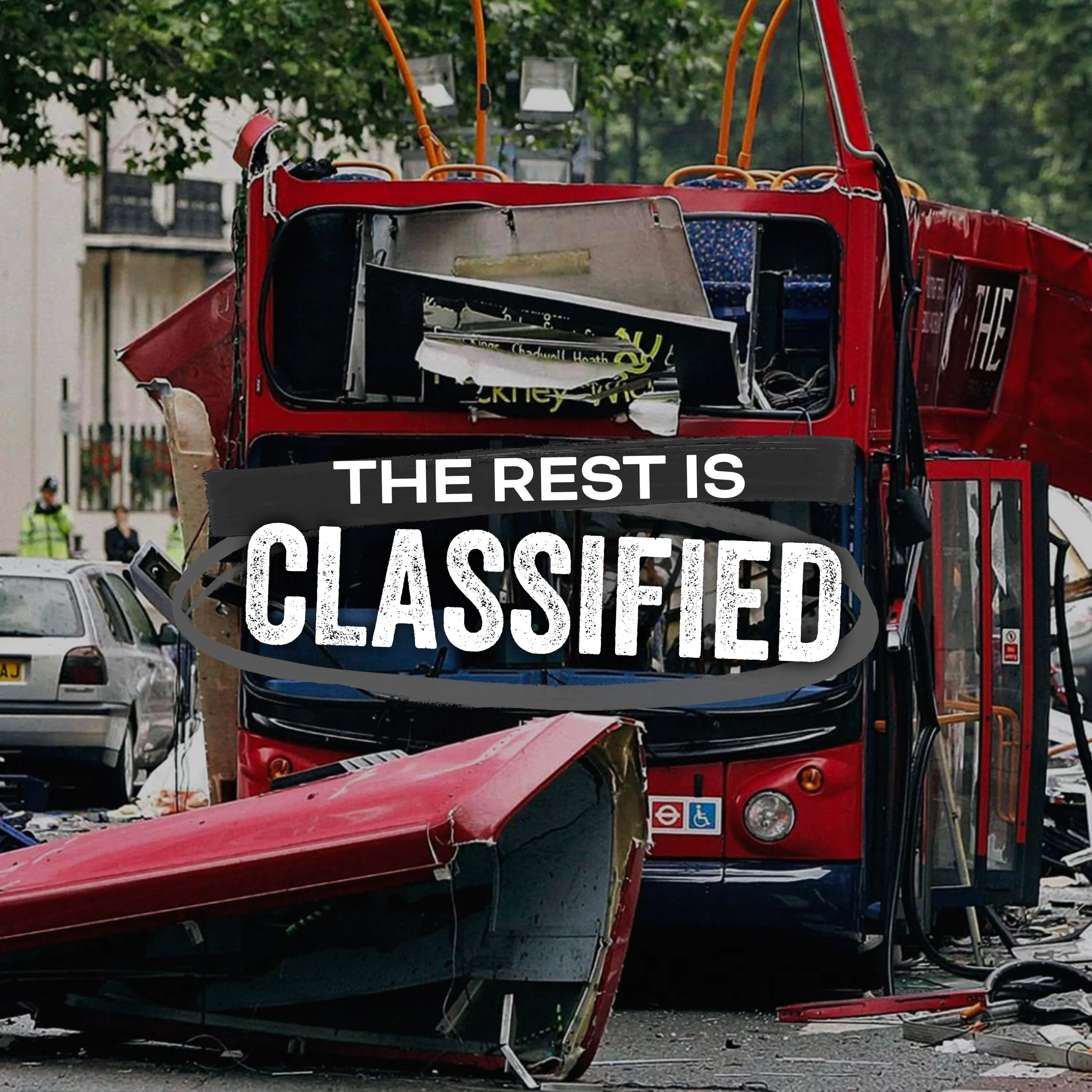
The Rest Is Classified
126. Al Qaeda’s Deadliest Plot: The Terror Attack That Never Happened (Ep 2)
00:34:22
Loading summary
Transcript111 lines
- [00:04]
A
For exclusive interviews, bonus episodes, ad free listening, early access to series first look at live show tickets, a weekly newsletter and discounted books. Join the Declassified club@the restisclassified.com. A group of terrorist suspects are buying strange items. Syringes, drink bottles. MI5 are watching, but they don't yet know they are planning a deadly terrorist attack to rival 9 11. Well, welcome to the Rest is Classified. I'm David McCloskey.
- [00:41]
B
And I'm Gordon Carrera.
- [00:42]
A
And last time, Gordon, we looked at the beginnings of the MI5 investigation into a man called Abdullah Ahmed Ali. And going back and forth to Pakistan, he had his luggage searched at Heathrow on his way back in June 2006. And some strange things were in there, weren't they, Gordon? Strange batteries and Tang.
- [01:02]
B
Tang.
- [01:03]
A
Which makes me reconsider my luggage that I'll pack for my return journey to the United States. And that left MI5 wondering what in the world might be going on at a somewhat bizarre flat on Forest Road in East London. We left off last time, Gordon, with MI5 carrying out a covert entry, a breaking and entering operation, into the property to find out what is going on inside. And they've bugged the place, haven't they, with audio and with video to watch what Abdullah Ahmed Ali and his friends are up to.
- [01:36]
B
That's right. After a few nights work, not much sleep, a branch team have succeeded. They've got that audio and video coverage of the Forest Road flat by the start of August 2006. MI5 can now see and hear what's happening inside in real time. And without that access, none of the other bits of information and intelligence would make sense. It's what brings it all together and gives clarity to what this group are up to. And police officers have since talked about the excitement in the ops room where they can see the video, they can see what's going on in the room. So surveillance cameras are going to show the first video evidence of bomb making. So they see these men with jars and components. There's the Tang. But also these bottles of Oasis and Lucozade, which are.
- [02:22]
A
I don't think we have either of those.
- [02:24]
B
Yeah, well, Oasis is like a fruit drink, fruit water flavor. Other drinks are available. Lucozade, a fizzy energy drink. And the men spend five and a half hours at work. One afternoon in that kitchen, the MI5 and the police are able to watch Ali and Tambir Hussain, who's his kind of lieutenant, you know, his number two.
- [02:45]
A
Was he the one who wasn't able to dig a hole?
- [02:46]
B
No, that was acid salt. Okay.
- [02:48]
A
That was the quartermaster. Yeah.
- [02:50]
B
Tambir Hussain and Ali are gonna be drilling holes in the bottom of these drink bottles, but without breaking the seal on the cap. So they're drilling from the bottom, draining off the liquid, putting something in it with a large syringe. So it's just a small hole they put in and then trying to reseal it. Now, over the buzz of the drill, the surveillance team or the team who are listening in can hear talk about batteries, Tang, hydrogen peroxide. And it's the hydrogen peroxide which are going to worry them because they know Sarwa in High Wycombe has been buying that stuff under a false name. It's been going around South Wales, Leeds, buying it. And then in the flat at one point they hear Ally and Tanvir saying, that's the boom, mate. The boom. Now, that immediately makes it sound like it's a bomb.
- [03:41]
A
And this is now the point in the episode where Gordon Carrera will teach us how to make a bomb. So go on, Gordon.
- [03:48]
B
This is where, with some reluctance, I once again engage in one of my science lessons worthy of the rest is science.
- [03:54]
A
We obviously did the episode with Hannah Fry where we talked about kind of.
- [03:59]
B
We talked about quantum encryption, quantum encrypt.
- [04:02]
A
And maybe you need to head on over there for explosive lessons.
- [04:06]
B
Yeah, explosive lessons.
- [04:08]
A
So we should say, though, that legally we're not going to teach anybody how.
- [04:12]
B
To make a bomb.
- [04:12]
A
No. Right.
- [04:13]
B
No, we're not revealing anything which is not in the public domain. And don't try this at home, as we often say. Yes, as we said with the nuclear bomb stuff as well.
- [04:21]
A
But before we get into how to make a bomb, Gordon, here's a message from our sponsors at hp.
- [04:30]
B
This episode is sponsored by hp. Most people are not counterespionage experts, but that won't stop them getting targeted by cybercriminals seeking to extract their secrets.
- [04:42]
A
HP understands that approximately 4 in 10 UK businesses have reported cyber breaches in the past 12 months alone. That's why HP Business laptops, desktops and workstations bought directly on HP Store are secure, straight out of the box with their endpoint security.
- [04:58]
B
No more stressing about dodgy emails or unexplained pop ups. HP's independently verified WolfPro security works alongside your existing security tools to protect your business users and reputation from malware and evolving cyber threats. With your first click.
- [05:16]
A
You don't need an alias or a secret hideout to stay safe, just WolffPro security working tirelessly to protect your hard work. It's security that's built in, not bolted on.
- [05:26]
B
Find out more about how HP can protect your business@hp.com Classified podcast listeners benefit from a 10% discount on all business PCs, printers and accessories using the code TRIC10. Terms and conditions apply.
- [05:45]
C
This podcast is brought to you by Carvana. Car shopping shouldn't feel like preparing for a marathon of paperwork. That's why Carvana makes buying and financing your car easy from start to finish. Search thousands of vehicles with great prices, all online, all on your time. And when you're ready, your new car shows up right at your door. It doesn't get better than that. Buy your car the easy way on Carvana. Delivery fees may apply.
- [06:19]
B
So the cameras are going to reveal the men are using tools to hollow out batteries. So remember the batteries that Ali was bringing back from Pakistan and replacing the inside of the batteries with hmtd, which is a type of explosive and the battery is only a case in which to use it. And this is the really interesting bit. Why was he bringing back Pakistani batteries rather than using good old fashioned patriotic British batteries?
- [06:48]
A
And the answer battery brands do you have here?
- [06:51]
B
We have Duracell and we have other brands are available. I feel like I'm doing a lot.
- [06:55]
A
Of free promoting all manner of British retail.
- [07:00]
B
But the crucial thing is Duracell is.
- [07:02]
A
Not a British battery.
- [07:04]
B
Well, it's, well, it's a battery.
- [07:05]
A
It's like, I don't know, I think it's probably an American battery.
- [07:08]
B
And to be American.
- [07:10]
A
But the crucial thing is, yes, Becky driven producer is saying it's an American.
- [07:16]
B
Okay, okay. Well, whatever it is, the key fact is that the, the UK bought batteries, whatever company makes them are harder to open up and hollow out than the cheaper Pakistani batteries. So that is the first bit of the mystery solved is why was he importing a load of batteries? It's because the ones in Pakistan are easier to open up and turn effectively into empty cases. They're less solid. Then they see the men using a Maglite bulb, which is from a torch flashlight. Exactly. One of the torches. And they've been buying these. And they're bearing the filament of the torch by breaking the glass and they're using that to heat up and turn into an initiator. And that's activated then by the flash button of a disposable camera. As I said, all of this in the public domain. So the batteries and camera together will set off the actual bomb, the main charge, and they are attached by tape, it looks like, to one of the drink bottles that they've been using. And crucially, the drink bottle has been emptied out through the bottom. And the idea is to replace the liquid that was in it with liquid hydrogen peroxide. That's the main charge of the bomb, which will do with the damage. And then they're resealing the bottom with resin so that it looks like the bottle is unopened. So it just looks like one you've bought. Now, here is the answer to the Tang mystery as well, because they can also see them experimenting, putting Tang powder into water, and they realize the Tang isn't an accelerant or anything like that for the bomb, as some thought of first. It's just coloring. It's basically to dye the liquid to make it look like, for instance, the leucozade, which is a yellowish, fizzy liquid, to make it look the same, the hydrogen peroxide, when you put it in. But there's still a mystery, because I can see them making these what look like bombs. But what do you do with these bombs? Because the reality is they're pretty small. They're really, really small. So in 77, they'd had backpack bombs. So the whole backpack is filled with. With the. With the charge. So that's why those bombs were able to do so much damage. But these, these pretty small bombs, they're not going to do that level of damage on a bus or a train or a crowded place. And also, why are you trying to hide what they are? You know, why are you trying to hide them in bottles if that's what you're doing? So immediately, you know, they're only a 40th, I think, of the strength of the July 7, 2005 bombs. A 40th. So immediately, that again raises questions, which is where would you want to be able to hide a bomb? And where would it be useful to have such a small bomb which could still do some damage?
- [09:58]
A
Well, that sounds like a cliffhanger to me, Gordon. Maybe there. We take a break, and when we come back, we'll answer that really dark and fascinating question of why in the world you would want a very small bomb, 1 40th the size of the seven. Seven bombs. And we'll also look at the origins of the idea for this plot and the person behind it. We'll see you after the break.
- [10:22]
C
New Year, New Me. Cute. But how about New Year, New Money? With Experian, you can actually take control of your finances, check your FICO score, find ways to save, and get matched with credit card offers, giving you time to power through those New Year's goals you know you're going to crush. Start the year off right. Download the Experian app Based on FICO Score 8 model offers an approval not guaranteed. Eligibility requirements and terms apply subject to credit check which makes impact your credit scores. Offers not available in all states. See experian.com for details.
- [10:50]
A
Experian. Well, welcome back. I think, Gordon, it's worth going back to dive into the origins of this.
- [11:04]
B
Plot because I think it is really interesting to understand where this came from and crucially, who is behind it. And it goes back to those visits that Ali was paying to Pakistan from 2003, 2004 and crucially, his 2004 visit, because on that visit he meets a Briton in Pakistan called Rashid Ralph. And of course we came across him, didn't we, in our 77 series as the planner, to some extent the mastermind behind those attacks. Rashid Ralph is born in mirpur, Pakistan in 1981 and his father brings him over to Birmingham as a child. Mirpur is Kashmiri region where lots of people come back and forth between the UK and Pakistan. Kashmir, of course, is this region which is fought over between India and Pakistan and where, particularly in this period of the 90s, you get a lot of militant groups growing up, terrorist groups growing up, who are fighting against India in Kashmir. And his family have deep links into Pakistan. People in the 90s start going to jihadist camps where they're going to be trained to fight Indians and you get money flowing as well as people. And after 9 11, that jihadist network is also going to get even more tightly integrated with Al Qaeda and the battle against the West. Ralph, as we talked about in our 77 episodes, he flees to Pakistan in 2002 after his uncle is stabbed to death. It's quite murky as to why. Possibly an honor killing linked to marriage.
- [12:43]
A
The way you've written it and said it makes it sound sort of he happened to leave after his uncle mistake.
- [12:48]
B
I think he's wanted for the murder.
- [12:49]
A
He stabbed his uncle.
- [12:50]
B
Him and a friend. Him and a friend are wanted for.
- [12:52]
A
The murder, which I think is an important detail to establish.
- [12:57]
B
And then he goes out to Pakistan, he marries into jihadist circles even deeper, comes into contact with Al Qaeda and effectively becomes a talent scout for them. So he is looking at Britons coming into Pakistan from Britain and working out which ones Al Qaeda could use for different operations. So in late 2004 he does this for the ringleaders of the 77 and 2172005 attacks. So he meets the leaders of that and introduces them to an Al Qaeda operational planner and a bomb maker called Abu Ubaidah al Masri. And then he does the same for Ali from this liquid airline plot. So we talked about Ali coming out linked to this charity. Ralph recruits him, tapes him to meet Abu Ubaidah al Masri. Ali initially seems to say he wants to fight in Afghanistan and be a martyr out there. He's angry, he says, about Afghanistan, the invasion of Iraq. But. But Ralph and Abu Ubaidah see the value of Ali in going back to the uk. They can see he's pretty smart. And, you know, Ralph will later write, he was a very clever, patient brother and a natural leader. So Ali returns to the UK January 2005, but he goes back to Pakistan again June 2005. He's actually in the camps with his friend who we mentioned last time, Asad Sawa, who lives in High Wycombe when the 77 attacks happened. And Rashid Ralph, who's been behind those two attacks, wants to do more attacks. And this is crucial to the origins of this liquid bomb plot, because he recognizes that after 7 7, it's going to get harder to build the same kind of hydrogen peroxide bombs, because those were built and sourced in the uk, even though the people have been trained in Pakistan. But it's now going to get harder to get hold of the large amounts of hydrogen peroxide chemicals to make a bomb, because you need to concentrate it, because it's going to be much more suspicious if you're seen buying this hydrogen peroxide, especially in the kind of quantities you'd need. So you need to do it in a smaller quantity, but it is easy to get in Pakistan. So it's really interesting because Ralph's first idea is to buy the chemicals in Pakistan, concentrate them in Pakistan and then send them over to the West. The challenge of that is getting them on a plane, obviously. So Ralph starts to look at airport security and he starts to research how bomb detector machines work at airports. And he says, we analyze the various machines that we use for checking baggage and persons, and we found it was very difficult to detect liquid explosives. So he can see that the liquids are easier to smuggle than solid explosives. So his first idea is to ship the concentrated hydrogen peroxide to the UK for use in bombs in bottles marked rose water, which looked unopened. And then, of course, he has this kind of brainwave, a really dark one, though. If you can smuggle it onto the plane to send to the UK the concentrated hydrogen peroxide, could you go one step further? Could you actually take it on a plane and then detonate it on a plane and find a way to use that to blow up a plane? That's the kind of origins of the plot through this idea of how do you get hydrogen peroxide onto a plane?
- [16:10]
A
One of the questions for me that hangs over this story that I don't, and I actually, I put this to Jonathan Evans when we saw him and I. I'm still not quite sure about the answer is why didn't they construct these in Pakistan, where presumably you would not have had a similar high counterintelligence environment that you would have in the uk and then you could just bring them fabricated into the UK and conduct an attack from London as the base. Yeah, because the amount of preparation, the, the provisioning, the need to sort of recruit accomplices here, those are all of the things that get them caught.
- [16:52]
B
I guess we'll come back to it, but I think the key point is that they want the operation to be launched out of the UK and towards the targets, as we'll see, which is the us. And I think that is part of their thinking.
- [17:06]
A
You still could have just brought it into the UK and then flown out.
- [17:10]
B
Rather than make it in the uk.
- [17:11]
A
Yeah, it's the, it's the fabrication which is going to take time. Which is going to take time and creates a whole bunch of surface area for MI to. To bind them.
- [17:20]
B
To bind them, you know. Yeah, because they're going to try and work out how to get them onto the planes and they, they're going to realize that you could color the hydrogen peroxide without losing its explosive properties. And they recall Ali to Pakistan once they work this out in, in the camps. So that May trip, May 2006, Ali comes back to Pakistan and he meets the bomb makers and he gets really specific training for the bomb. Now it's interesting because Ralph will actually later claim that Ali was actually questioned at Heathrow on departure and that the Brits alert Pakistani intelligence, the isi, to track him on arrival. Now, Ralph claims that this is on a later account. He leaves. And it may be true, it may not be that the ISI actually requested local police in Islamabad to stop and search him. But, but the Ali gets tipped off because of contacts and friends, of family about the interest, and so he evades it. But he's out there in this May June period, 2006, Sawa Asad Sawa, who's the quartermaster, also joins them. They agree that Ali will build a team to use the devices and separately Sarwa will be the quartermaster to get hold of the supply. Sa, it looks like, doesn't want to blow himself up.
- [18:38]
A
Understandable.
- [18:39]
B
Which is understandable. And so he'll be kind of kept largely separate. And he's the one in High Wycombe, everyone else in Walthamstow. And the idea is he's going to get together the materials and he's going to build a team and build the actual devices at the last minute. And then Sahwa will stay and be able to organise further waves of attacks. So that seems to be the plan. And they are worried about surveillance. They know that there's greater monitoring. So Ralph actually says, we trained him, Ali quickly and wanted him to leave as soon as possible. He was told to do anti surveillance measures when he got back and only start work when he was comfortable that everything was clear. So then, having had that training. Yeah, doesn't go so well. Having had that training, that is when Ali then comes back, June 2006, with the batteries he's brought back with him with the Tang to start pushing forward the plot. Having been trained in this special bomb.
- [19:34]
A
There is still a line of communication once Ali is back. Yeah, between Ali, his cell here and Ralph in Pakistan.
- [19:42]
B
And I think that is also another important part of the story. It's quite intense communication between Ali and sarwa in the UK and Ralph in.
- [19:50]
A
Pakistan, which MI5 does not have at the time.
- [19:53]
B
Well, it's a bit unclear because we learn about it, so it is quite possible they were intercepting the communications and we only get the details from a later trial when some of the materials go public. So it's a little bit unclear how much MI5 know at the time, but they're definitely kind of security conscious. Sarwa sends details of a new phone number in code in which the last four digits had to be subtracted by two to generate the real number. Sarwa then uses that phone only for contacting Ralph and there's 30 calls over the next month. Ralph has individual email accounts for each person he contacts. Ali registers two email addresses in Pakistan to fake names. Ralph has four phones with him in Pakistan, three for the plotters in the UK and one for other people in Pakistan. He even asks Sawa for a voice changer because he's worried about interception. And I think the point is Ralph in Pakistan is micromanaging the plot, especially the making of the explosives. And this goes back to the previous year, the 2005 bombings, because seven, seven had worked. And if you remember, in that case, it's partly because Ralph had been talking to the plotters kind of pretty regularly. The 217 team had had much less contact with him and that bomb had not gone off. And so, again, the communication is constant because they want to make sure it works. There's contact about planning and they're feeding back the team in London about. And High Wycombe about what's going on. There's messages from SAWA To Ralph July 18, going, you know, I have 15 suppliers to give Calvin Klein aftershave. One box of 50 is only 175 pounds. The aftershave was code for the hydrogen peroxide and the one 75 pounds was the concentration. So they're starting to put together the team and put together the packages for the bomb. But the crucial question is, you know, what is the plan?
- [21:42]
A
All right, so it's clear now to MI5 that this is a bomb. Right. But I think the question has got to be, what? What's the target?
- [21:50]
B
Yeah. And as they see them in the kitchen on this video surveillance, drilling in the bottle and doing things, the surveillance also overhears the men talking about American cities, including New York, Miami, Philadelphia, Dallas, where you are, Washington, Chicago, Los Angeles. And it started to become clear that this is to do with the US and it's to do with aircraft. Because the point about what they're working on, these bottles are these are ordinary things that you could carry on a flight, crucially, the unopened drink bottle and a disposable camera and some batteries. So those are the kind of items you need to make the bomb. And you could carry them all in your hand luggage, quite innocently, and then in a few minutes, go into a bathroom in a plane and put it together. Put it together?
- [22:44]
A
Yeah.
- [22:45]
B
You open up the camera, attach wires, tape it all to the drink bottle, and then what you could do is press that against the side of a plane and you press the camera button, which sends the charge in to heat up the filament, start the initiator and then do the main detonation. That's not going to kill anyone, as you said. There's no shrapnel that's attached to it, but played in midair. It's going to blow a hole in the side of MI5.
- [23:12]
A
Test this, right?
- [23:13]
B
Yeah. So the investigators will get MI5s, they've got weapons intelligence team, they've got scientists linked to the dstl, which is the kind of weapons, you know, an explosive lab in the uk, who are going to look and say, could you. Could. Would this work? Would it punch a hole in the side of the plane. And the answer is it would. There's also another revelation from the surveillance which makes them understand this is potentially massive. Not just the one or two attackers they're seeing. There's a crucial conversation where they hear Ali saying, we got six people in it. There's another three units. There's another three dudes. Then Tanvir replies, There's another three more. 7, 8, 9, 10, 11, 12, 13. That's 15, 18. Phew. Think of it. Yeah. One man more. 19, if they got there, would match the number of hijackers on 9, 11. Now, that might have been their kind of ideal, but they're at least looking at six, maybe nine, you know, something in that ballpark of people that they're going to have as part of the team, ideally, to carry these bombs onto.
- [24:13]
A
Planes, which, when you think about what that could have meant.
- [24:18]
B
Yeah.
- [24:18]
A
If it happened over the Atlantic, as they seem to be planning.
- [24:22]
B
Yeah.
- [24:22]
A
Jonathan Evans at MI5 brought this up. There would be no understanding of what exactly had happened and you would probably not recover the wreckage for a very long time, if ever.
- [24:36]
B
Yeah.
- [24:36]
A
And so there'd be no forensics to understand why the plane had gone down. It would've probably ground global aviation to a complete halt, not for, like, a day, but for a while. And you would have left open the possibility that there could have been more waves of attacks as soon as planes start flying again. It would have been potentially on the scale of or greater than 9, 11.
- [25:03]
B
I think that's right. Because I think if you. If you do the maths, depending on how many planes you've got, you've got maybe, you know, 300 people on each plane. If you did have nine planes, you're suddenly looking at a death toll comparable.
- [25:14]
A
Pretty similar.
- [25:15]
B
And as you said, the fact that you wouldn't know if they went down over the Atlantic, you wouldn't have the forensics to know. You would either let planes continue to fly, in which case these guys are preparing more waves, or you stop all flights, you know, until you understand it, which could be who knows how long, which destroys the kind of global economy. So as well as loss of life, the economic and the social impact of this would have been.
- [25:42]
A
Would have been massive.
- [25:43]
B
Would have been massive. Yeah. I think that's why it's so significant as a plot. So we're into the early days of August. Ali sends an email to Rashid Ralph, it says, by the way, I've set up my mobile shop now. Now I only need to sort out an opening time. Ali's Also keeping Rashid Ralph up to date about new recruits. He talks about my mate Gugi. He's up for the gig. Okay. Is it okay if we put him in? No longer looks like he's a junkie, whatever that means. And then there's another message. I spoke to Fatty and explained to him he has to move his office within one month and start fresh. You know, he's doing well and keeps his head down and he don't like the junkies anymore. You know, weird messages which you could imagine if you're intercepting them, if you're MI5, if they were intercepting them, they're not obvious what's going on.
- [26:29]
A
Right.
- [26:30]
B
Because these guys are aware of possible surveillance. And Ali tells Raf it'll take a few days, then I'll start trading, you know, Ali is concerned. It's interesting that he's being followed by Police or MI5. And Ralph later says, I told him not to panic. And they refer in their emails to possible surveillance as a skin problem. You know, I've got a skin problem or skin complaint. And so Ralph is also worried about this and pressing him to move faster. They're also seeing some of the men fill out new passport applications claiming they lost them or accidentally put them in the washing machine, hoping maybe that might reduce the risks when they do get on a flight. At one point they're even talking about taking a baby with them. First week of August, though, another development is going to take authorities fears up another notch and really make them fear something may be on soon. August 6, a mobile surveillance team are on Ali and they see him head to an Internet cafe in Walthamstow. It's quite a small Internet cafe. Mines. And they're still around, but less so.
- [27:30]
A
Than they used to. Yeah, but not nearly what they would have been.
- [27:32]
B
No. But the police surveillance team decide they need to follow him in to know what's going on. A female police surveillance officer, she's young, in her twenties, follows him in. She's going to sit as close to him as she can, just a few feet away. And it means she can see over his shoulder what he's doing online in this cafe. And it looks like he's communicating with someone. He's actually emailing Ralph to say the surveillance on him doesn't feel too bad and they'll open up shops soon. If only he knew.
- [28:03]
A
Literally, literally looking over his shoulder.
- [28:06]
B
He's a police surveillance officer. But then he starts opening tabs on his web browser, one for Heathrow, looking at baggage restrictions. And then he starts to look at flight times and he's noting down the flight times on a notepad app on the computer and he notes details of seven direct flights from London to the US and Canada. The first one is United flight which leaves San Francisco at 2:15 in the afternoon. The last one was an American Airlines flight to Chicago which left at 4:50 in the afternoon. So the crucial thing is all the flights are within a window of 2 hours 35 minutes.
- [28:44]
A
And the idea was that they would do this simultaneously.
- [28:47]
B
Yeah. And that they would all, if they all leave in that period, if you're going to blow, let's say seven of them, then they will all be in the air at the same time and ideally over water. So as we were saying, you can read forensics a bit. So he's, he's specifically researching the flight times for flights to target other destinations. Toronto, Montreal, Chicago, again, Washington, New York. He's looking for one way flights and you know, clearly now they are moving to actually researching the times. And he's going to download the notes of the fl, float flight times onto a memory stick he's brought with him and then he writes to Ralph. I've done all my prep. All I have to do is sort out opening timetable and bookings.
- [29:30]
A
Why do terrorists always buy one way tickets? It's super suspicious. Yeah, just buy the round trip. Yeah, I love just spring on the round trip ticket.
- [29:39]
B
Yeah.
- [29:39]
A
They always, it's like the most suspicious thing in the world.
- [29:42]
B
Yeah.
- [29:42]
A
You get a one way ticket to San Francisco. Like you've never been to San Francisco.
- [29:47]
B
Yeah.
- [29:48]
A
And you're going for six weeks, like just.
- [29:50]
B
Yeah.
- [29:50]
A
I mean it's ridiculous.
- [29:51]
B
Yeah, yeah.
- [29:52]
A
This is going to make MI5 feel as though it's becoming imminent now at this stage he feels like he's sorted the bomb making and now you're getting into final logistics.
- [30:03]
B
Yeah. And that is going to be the crucial question which is how imminent. There's another warning sign because the teams are listening into live surveillance of Forest Road, the flat, and they hear Ali and another man in the flat at one point and they can hear a conversation but they can't see it. It's not in the kitchen where they've got the video coverage and Ali sounds like he's coaching the other guy to say things. I'll ask you this, you say that and actually realize that they are listening live to a martyrdom video being made by the attackers. I mean that must be chilling if you're, if you're actually hearing people preparing for the video that's going to be broadcast after they've carried out one of these attacks. And, I mean, they'd actually already recorded some. We spoke earlier about July 27th. They'd seen them go in. So this is before they had the surveillance and they drew the curtains. Then they were there for like a couple of hours. That's when they'd made some of them already. Now they're making more, what they refer to as wedding videos in the coded emails to Pakistan. So it's clear now you're getting close to the final stages.
- [31:06]
A
Well, I guess this is where things start to get tricky. Oh, yeah. And our American listeners will be grateful to know that in the next few episodes we're going to see the arrival of the CIA, because we have not had Americans in this story yet, much to my chagrin. Although, Gordon, the way you've. The way you've sort of written this story.
- [31:24]
B
Yeah.
- [31:25]
A
The CIA is not going to come off too well in this because this. This is. We're going to see in these next few episodes, I think, the intelligence relationship between the two countries really at work. How it works. How sometimes there can be incredible tension.
- [31:41]
B
Yeah.
- [31:41]
A
Between the US and the UK over counterterrorism operations in particular in this era. And, you know, it's.
- [31:50]
B
Even you're going to admit this is a tricky one.
- [31:52]
A
Even I'll admit this is a tricky one.
- [31:53]
B
It's a tricky one. And I think the power imbalance is going to become clear as we look next time at just how it's not maybe surprising the Americans know about this plot, but it's once they understand that it's US cities, North American cities that are target, that suddenly that sends tensions really skyrocketing.
- [32:14]
A
So there, Gordon, with both services potentially going at each other's throats. And this. This plot really ready now in these advanced stages. Let's end when we come back next time, we will see how this all unfolds and how the CIA and the Brits eventually cooperate to stop it.
- [32:35]
B
That's right. And just a reminder, if you want to hear the rest of the story straight away, join the declassified club@therealisclassified.com. you'll also be able to hear those special episodes we've done inside MI5 with Jonathan Evans. Otherwise, we'll see you next time.
- [32:49]
A
We'll see you next time.