Loading summary
Transcript149 lines
- [00:04]
David McCloskey
For exclusive interviews, bonus episodes, ad free listening, early access to series first look at live show tickets, a weekly newsletter and discounted books. Join the Declassified club@therealDisclassified.com you're deep into.
- [00:18]
Gordon Carrera
Your favorite true crime binge the twist, the theories and suddenly hunger hits. Grab a Paleo Valley 100% grass fed beef stick. These aren't your average gas station snacks. They're made from real beef sourced from regenerative small American family farms. No preservatives, no gluten, no grains, soy or sugar. Just naturally fermented protein that fuels your obsession. Whether you're road tripping, hiking or pulling an all nighter with your favorite case, choose from five bold original jalapeno summer sausage, garlic summer sausage and Teriyaki. They're keto, paleo and carnivore. Friendly, made to work with your lifestyle, not against it. With over 55 million sticks sold and a 60 day money back guarantee, you've got nothing to lose. Get 15% on your first order@paleovalley.com Just use code Paleo at checkout.
- [01:18]
Experian Voice
You know that one friend who somehow knows everything about money?
- [01:22]
David McCloskey
Yeah.
- [01:23]
Experian Voice
Now imagine they live in your phone. Say hey to Experian, your big financial friend. It's the app that helps you check your FICO score, find ways to save and basically feel like a financial genius. And guess what? It's totally free. So go on, download the Experian app. Trust me, having a BFF like this is a total game changer.
- [01:46]
Progressive Voice
This episode is brought to you by Progressive Insurance. Fiscally responsible financial geniuses, monetary magicians. These are things people say about drivers who switch their car insurance to Progressive and save hundreds. Visit progressive.com to see if you could save Progressive Casualty Insurance Company and affiliates. Potential savings will vary. Not available in all states or situations.
- [02:23]
Tony Blair
Breaking news we're getting from the PA Newswire that there's been reports of an explosion outside Liverpool street station.
- [02:32]
David McCloskey
Well, there may be fatalities.
- [02:33]
Tony Blair
We need ambulances and waters of us through Pink's Cross. They're moving back. Please. Most Londoners actually are not going to be afraid by this. I think they're going to continue their daily business.
- [02:52]
David McCloskey
We consider the attack last week on.
- [02:54]
Tony Blair
British soil an attack on the civilized world. And what we are confronting here is an evil ideology. It is not a clash of civilizations. All civilized people, Muslim or other, feel revulsion at it. Whatever you do, however many you kill, you will fail.
- [03:17]
David McCloskey
I am just going to make a short statement to you on the terrible events that have happened in London earlier today. Today and I hope you understand that at the present time we are still trying to establish exactly what has happened and there is a limit to what information I can give you. And I will simply try and tell you the information as best I can. At the moment it is reasonably clear that there have been a series of terrorist attacks in London. There are obviously casualties, both people that have died and people seriously injured. And our thoughts and prayers, of course, are with the victims and their families. It is important, however, that those engaged in terrorism realize that our determination to defend our values and our way of life is greater than their determination to cause death and destruction to innocent people in a desire to impose extremism on the world. Well, welcome to the Rest is classified. I'm David McCloskey.
- [04:06]
Tony Blair
And I'm Gordon Carrera.
- [04:07]
David McCloskey
And that is Tony Blair, former Prime Minister of the UK speaking at Gleneagles our on the morning of July 7, 2005. And now this episode is launching Gordon on this is July 7th of 2025 and this is the 20th anniversary of what has come to be known as the 77 attacks, the 77 bombings in London, I believe the largest terrorist attack in London's history. And on this series on the Rest is Classified, we are going to to talk about those attacks, the investigation to uncover exactly what happened and what it all means 20 years later. Yeah, for the UK that's right.
- [04:50]
Tony Blair
I mean 52 people killed, shocked the country. Kind of seminal moment for the UK and I covered it at the time as a journalist. There's lots of coverage about different aspects of it, about what happened, about the victims, about the first responders. There's been some documentaries. But I think what we want to do in this series is if give a real insight from the Rest Is Classified perspective. So particularly looking at the role of MI5, giving a sense of what it does, how it responded, about counter terrorist investigations, about some of those questions, about whether it missed anything involving the attack. But also look at it in the context of the role of Al Qaeda in Pakistan and Afghanistan and its role behind not just 7 7, but another attempted attack two weeks later, which I don't think is always fully understood or appreciated. So I think, you know, this will be a particular way of telling the story with that lens in mind.
- [05:43]
David McCloskey
Yeah, kind of a, I guess a deep dive into how exactly counterterrorism investigations are run. And I mean, I guess in just set some of the context maybe for listeners who aren't as familiar with these attacks. I mean as I come to this, I mean is it fair to say that this was something akin to the UK's 9 11, I mean, which might. Maybe that's a bit of an overstatement, but just to kind of paint the picture of how bad, big of a deal this was. I mean, what would.
- [06:10]
Tony Blair
Well, it's interesting, isn't it, because I don't think it was quite the UK's 9 11, because we got used to some degree of terrorism in the uk, particularly from Northern Ireland. So you'd had terrorist attacks going back, particularly from the 70s onwards, and we'd had some hints of Al Qaeda, like violence. So it didn't quite come out of the blue in the way that 911 did, nor the scale of 9 11. So I think there was certainly shock, which we'll come to, but it was perhaps arguably more predictable that something like this would happen than 9 11, I think, for the United States. So important, but maybe not quite seismic in that sense.
- [06:48]
David McCloskey
And I suppose it is happening in the context of the broader conflict with Al Qaeda. Yeah, it's in general, which is really hot in the mid 2000s. So maybe, I mean, go to 77 2005. It's summer, it's London.
- [07:05]
Tony Blair
Yeah, it was a great summer's day in some ways, because London is waking up on 7 July 2005, still basking in the very happy news that the previous day it had won the right to hold the 2012 Olympics in London. And it was a victory all the sweeter because we beat Paris, beat the French, beat the French, always good because they were convinced they were going to get to hold the Olympics in 2012. I think we won by four votes. So, you know, there's a huge party actually that day and there was, you know, parties in Trafalgar Square in the centre of London. Bit of a hangover the next morning. It was a big deal. Tony Blair's the Prime Minister now, Interestingly enough, he's not in London and this is part of the story because he's hosting world leaders in Scotland. And you read from his reaction at the start at Gleneagles that had started the day before on July 6. Amongst those attending are President George W Bush, who's had a bike accident on the first day.
- [07:56]
David McCloskey
Is he just casually biking around clinicals?
- [08:00]
Tony Blair
He was on his bike, being Action Man, I guess. And he goes around the corner and there's police all around the site. And he lifts his arm from the handlebars to kind of wave and say hello to a police officer.
- [08:11]
David McCloskey
Someone stuck a stick right in the smoke.
- [08:13]
Tony Blair
No, no, I Think he just comes off because he takes and he crashes into the police officer, who ends up in crutches. Also present.
- [08:19]
David McCloskey
He's actually. Crutches. So police officers are legitimate assholes.
- [08:21]
Tony Blair
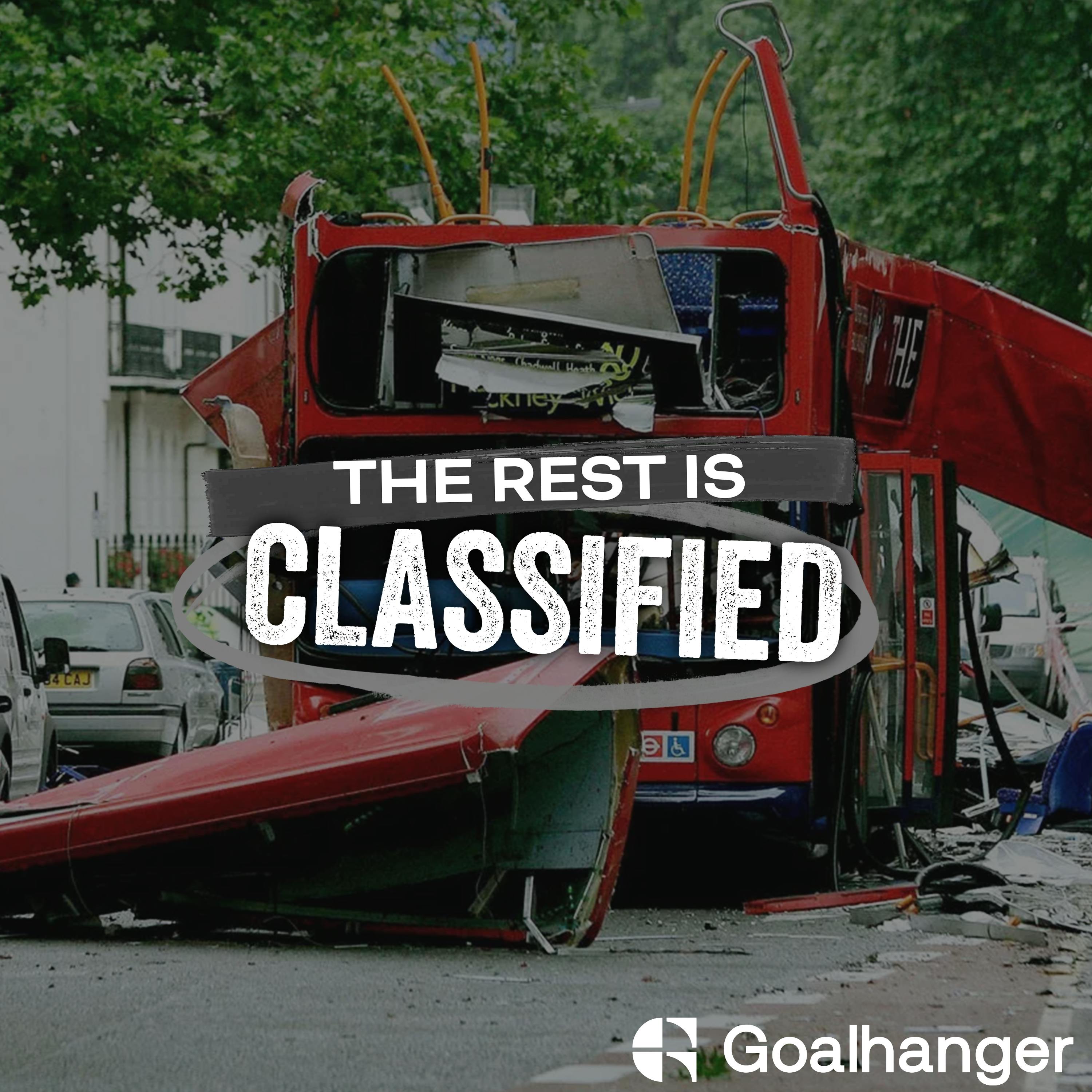
Yeah. No, George W Bush is okay, but it's the poor police officer. The police officer, but also present in the UK for this summit, which tells you how long ago it was, was Vladimir Putin. So different era because it's the G8 rather than the G7 leaders. So that's London that morning. But then at 8:49, something happens on the Tube system that morning. It's rush hour and at first no one knows what. In the next few minutes, there's two more incidents on the Tube network. No one is sure what or why. Now there's a kind of avalanche of messages coming into operators on the transport and emergency services at that time and. And it is really hard for them to understand what had happened, partly because it's taken place underground and between tunnels and there are very few eyewitnesses. So it's very confusing just understanding what it is, where it's happened and when it's happened. So they're getting a multitude of kind of messages into the people running the Tube network, which is consistent with some kind of explosion and it could be a bomb, but also with other possible causes it including the rupture of high tension cables or the loss of a bulk supply point. Very technical reasons why you could have those signals. So as of 9am, so about 10 minutes after the first thing, they're still not saying it's terrorism, but the suspicions are certainly growing that something serious is going on, because you've got multiple reports of this. Now, I can remember this quite vividly because I was in the office of the BBC then, which was in Shepherd's Bush. And the first reports around 9:23 on the BBC were about an explosion, but still not clear that it's a bomb. So still the explosion could have been caused by a power surge and I was asked to look into it. And so just after about 9:45, I remember getting on the phone to someone at MI5 and said, you know, do you know what it is? And they said, too early to tell. This is a very vivid memory because as I was talking to them on the phone, we had a kind of internal messaging system where internal messages, information, news wires, stuff from the public would all kind of come in and you could see it and it would flash up if something was urgent. And as I was on the phone actually with this contact, something flashed up on the screen. And it was a message saying eyewitnesses had called into the newsroom because they'd seen the roof blow off a bus on Tavistock Square. Now, that had happened at 9:47am and I actually remember reading that message to this MI5 contact who immediately just hung up the phone. And, you know, the reason was that something happening on a bus above the tube and the tube tells you suddenly this is not just something going on underground.
- [10:56]
David McCloskey
Was that news to your MI5 contact?
- [10:58]
Tony Blair
Well, yeah, and I think it was, yeah.
- [11:00]
David McCloskey
Roof blew off a bus.
- [11:02]
Tony Blair
And, you know, that's what's interesting is that you think that inside somewhere like MI5 or any kind of intelligence agency, security agency, they know everything that's going on immediately. But the reality is this stuff is just happening.
- [11:13]
David McCloskey
Yeah.
- [11:13]
Tony Blair
And often news organizations have got more of a network out there and are getting the information as fast as they are.
- [11:19]
David McCloskey
No, I think there is something to that, is that these security organizations, I mean, the CIA was certainly this way. Sometimes you had to feel that because of the kind of protective shell you've got around the organization, the real time stuff doesn't always get in as quickly.
- [11:34]
Tony Blair
When something's really unfolding in the moment, it takes time for intelligence security services to get their messages processed and, you know, checked, whereas news organizations often faster.
- [11:44]
David McCloskey
But you know at that point then that it's terrorist attack. It's a terrorist attack.
- [11:47]
Tony Blair
Yeah. It certainly looks so MI5 worth explaining a little bit about what it is, I guess, because people, particularly if they're not from the uk, may not know that much about it. Domestic security service. So, you know, we talk quite a lot on the pod, haven't we, about MI6, which is the secret intelligence services and does the spying abroad. MI5 deals with domestic threats, founded in 1909 and for most of its history had been a kind of spy catching service, looking first for German spies, then Russian spies through the Cold War. But it does start to work on terrorism, particularly from the 1970s, Northern Ireland and, you know, from the 1990s, it's looking to move more into terrorism in terms of dealing with it. And so wrestles control of dealing with Northern Irish terrorism from the Police Special Branch. So that's its kind of newer role. And you're starting to see the signs of Islamist terrorism in the 1990s internationally, but not that much in the UK. So the time of 9 11, 2001, it's got about 2,000 staff and it's growing to deal with this threat because 911 makes clear it's there but it's still kind of expanding. It's still in that process of growth rather than being that big. I found an official report from the time and it said the total number of desk officers in the International Counterterrorism section looking at Islamist work numbered in the tens at times.
- [13:06]
David McCloskey
Right. Because if you we think about the episodes that we did on Osama bin Laden, we talked about the explosion in staffing in the CIA's Counterterrorism Center. Now it's not exactly apples to apples here. The CIA is externally facing, but the CIA probably over the same period from 2001 to 2005 in the Counterterrorism center, it probably grew by 10 times, something like that. This is shockingly small, I think, relative to that. I mean, even if it's kind of ticking up slowly growth wise, the absolute number here seems remarkably low to me.
- [13:37]
Tony Blair
I found that amazing. And as of June 2005 they've got about 16 operations running. Looking at the facilitation of attacks in the UK and 26 overseas. Five potential suicide bombers in the UK. These are all from official figures. They're also looking at kind of people sending people out to Iraq to get involved there and fight there.
- [13:55]
David McCloskey
I guess there would have been a lot of concern with people coming back from jihad and Iraq and then planning attacks here.
- [14:01]
Tony Blair
So they're busy. But I think crucially there's no warning of 77. One of the things I remember this coming out is that the threat level nowadays it's public then. It used to be secret, but at that time it's actually gone down in May 2005 from something called Severe General to Substantial because it was judged there was not a group with very British.
- [14:22]
David McCloskey
Names for Severe General. Severe General. Substantial, yeah.
- [14:26]
Tony Blair
Yes. It's funny, they were not public, so I guess they were people on the inside.
- [14:32]
David McCloskey
It wasn't like the US kind of color coded system that came out after 911.
- [14:36]
Tony Blair
They're public now. But actually at that time that was still a secret, was for kind of government officials to know. But it just shows it had gone down.
- [14:43]
David McCloskey
It gone down.
- [14:44]
Tony Blair
So 77 is going to come as a shock. It is going to come out the blue, as I said. You know, you've got this sense in which they are watching it unfold on TV. MI5 is divided into branches and G branch is the counterterrorism branch. The new recently appointed head is a guy called Andrew Parker who's later going to become the head of all of MI5. He's watching events unfold on a TV news screen like everyone else, you know, and he's running that kind of counterterrorism team.
- [15:11]
David McCloskey
The question here, is it an intelligence failure? There's different types of intelligence failures. There's failures where you have the dots in your system and you don't connect them. And then I guess there's the type which maybe this is starting to feel like, based on the way we've described it so far, which is there weren't any dots to connect, meaning that you actually didn't penetrate the group that was intending to attack you.
- [15:34]
Tony Blair
It's a really good question because I think this question, is it an intelligence failure? In a sense, your job is to stop attacks if something happens.
- [15:40]
David McCloskey
By definition.
- [15:41]
Tony Blair
By definition there's an element of failure because you fail to have any intelligence about the group right now. Sometimes it's because you've failed to collect it, sometimes you fail to put it together. I think the, the truth is there are elements of both there. And I think we'll maybe through the series answer those questions and I think it's a really good question to hold in mind. Could they have stopped it? Could they have somehow either put together the information or collected the information to stop it? And I think maybe rather than try and answer it now, will get to that question through the series and by the end maybe we'll let people have a think about how they'd answer it.
- [16:16]
David McCloskey
I mean, I guess the other lens to take just thinking again to the Bin Laden series with the parallel of just it's a terrorist attack, is do you have strategic warning versus something actionable you can use to disrupt the plot? Because I think in 2001 on the bin Laden case, the CIA provided immense amount of strategic warning that something was coming.
- [16:37]
Tony Blair
Yeah.
- [16:37]
David McCloskey
But nothing that would have actually enabled the US to stop the attack.
- [16:41]
Tony Blair
Yeah.
- [16:42]
David McCloskey
And here, I mean, the threat level declining would sort of suggest.
- [16:46]
Tony Blair
They didn't say it, that you missed the strategic warning. Well, I think, I think it is definitely true. They didn't see it coming in the broader or the specifics. Right. So G1 is the branch and G is the counterterrorist branch and G1 is the branch here dealing with the kind of Islamist counterterrorism.
- [17:02]
David McCloskey
The lettering is confusing.
- [17:04]
Tony Blair
Yeah.
- [17:04]
David McCloskey
To me as an American, because we, we don't do this at the CIA.
- [17:07]
Tony Blair
We have abcd.
- [17:08]
David McCloskey
No, it's not. Yeah, it's not this like anodyne sort of alphabetical thing. Right. It's just the name.
- [17:13]
Tony Blair
It's kind of semi public, but it's not really well known. Yeah, not super public. So within G Branch, they're going to set up that morning what's called a security service emergency room. And that's the kind of ops room for a high tempo event. Nowadays they're called Intelligence operations centers and they've got a room specifically to do that. But in those days they basically had to just set one up. You find a conference room and you pull people into it and you create an emergency room which is going to deal with it. People are going to be working 12 hour shifts. It's going to become littered with pizza boxes. Andrew Parker, who as I said, has just become the head of Counter Terrorism, tells the staff there to pick up the phone, call your families, tell them you're fine, and then tell them you're not coming home. It's going to be codenamed Operation Stepford. It's kind of odd codename, but where.
- [17:55]
David McCloskey
Do the code names come from in MI5?
- [17:58]
Tony Blair
MI5 and Police Code names are kind of randomly generated.
- [18:01]
David McCloskey
That's what every security service says though. Right. But then I guess no one would have chosen Stepford.
- [18:06]
Tony Blair
No. And we'll come on to some of the others because some of the others are even weirder for the related counter territories.
- [18:10]
David McCloskey
Should have picked a different one.
- [18:11]
Tony Blair
Yeah, I think, yeah. So there's also this sense, I think, within MI5 that everyone wants to do something, but what can you do at that moment? Because something's happened. You've got bombs going off, but they're waiting for the first leads to come in from the scene and that's going to take time because it's so hard to get access, particularly underground, to those sites where the bombs have gone off and collect any evidence. They're asking, is there any intelligence from GCHQ, the listening agency, or from MI6 or for their own agents that they might have missed any chatter about an upcoming attack? And the answer is no. Another question they're asking is, where are sois now? Sois are subjects of interest, which is basically their targets for surveillance. Are there any of the ones that they're watching who gone missing? Are there any who they'd been carrying out surveillance of any of the hundreds of people who might be involved in this attack? Can you account for them and all of their top sois? You know, there's no sign that they're missing. And you've also got all these teams within MI5 and you can imagine it kind of running around going, what can we do? Something big's happened. You know, what can we ask our agents who we're running the tech ops team are saying, you know, what can we do? And the answer is you actually can't do that much until you've got some leads to chase.
- [19:20]
David McCloskey
So in 2005, if you're trying to find a subject of interest.
- [19:24]
Tony Blair
Yeah.
- [19:24]
David McCloskey
What does that actually practically look like? Like, what are they doing? This isn't an MI5 asset.
- [19:29]
Tony Blair
The SOI is a potential terrorist. Right.
- [19:32]
David McCloskey
And so is it calling the police to then have them go and check to see if the person's at home, or is it checking to see if their phone is active in a particular part of the country?
- [19:41]
Tony Blair
I guess it depends on how high they up your target list as well, how much surveillance you've got of them.
- [19:45]
David McCloskey
Yeah.
- [19:46]
Tony Blair
Because only if someone's at the top of the list and you're worried about them doing something imminently, would you have them under actually constant surveillance, as opposed to just occasional surveillance or knowledge of what's going on. So, yeah, there'll be a kind of different process depending on how worried you were and how much surveillance you've got on them, whether it's just checking their phones or whether it's actual physical surveillance or whether it's something else around them.
- [20:09]
David McCloskey
And also for our American listeners, then, because you don't have a constitution. Right. You can. The people that MI5 might be surveilling here.
- [20:18]
Tony Blair
Yeah.
- [20:18]
David McCloskey
What is the legal process by which you would put somebody under surveillance?
- [20:24]
Tony Blair
So it's a good question. You need a warrant. You do need a warrant.
- [20:27]
David McCloskey
You still need a warrant.
- [20:27]
Tony Blair
You definitely need a warrant signed by the Home Secretary.
- [20:30]
David McCloskey
You can't just do it on the Queen's signature.
- [20:32]
Tony Blair
Well, that is a kind of queen signature through the Home Secretary this time, but depending on the level of surveillance and intrusion. So if you want like a full phone tap on someone, so you want to actually be intercepting the content of their phone calls, you need a warrant signed by the Home Secretary. So that's fairly high bar. There's lower bars, depending if it's a lower level of surveillance that you might want on someone.
- [20:54]
David McCloskey
Okay.
- [20:55]
Tony Blair
So we have laws. We may not have a constitution. We've got laws. Thank you for checking.
- [20:59]
David McCloskey
I like to mention at least quarterly on this podcast that you don't have a constitution.
- [21:03]
Tony Blair
Thank you very much. We do fine without one. Thank you. Now, meanwhile, the Prime Minister, as we made clear, is up in Scotland 1205, as you read at the start, you know, says it's clear, it's terrorism. He's going to fly down at lunchtime that morning, though. Before that, there's already the first meeting of something called cobra. Now that's a better code.
- [21:19]
David McCloskey
That's a good code.
- [21:20]
Tony Blair
That's a code name. And that's Cabinet Office Briefing Room, which is. Which is less exciting. But COBRA sounds good. And that's the government emergency room. That's our equivalent of the situation.
- [21:29]
David McCloskey
Where does A come from in the act?
- [21:31]
Tony Blair
Cabinet Office Briefing Room. A. Okay. But really it's Cabinet Office Briefing Room. Yeah, but it sounds better to call.
- [21:38]
David McCloskey
It does, yeah.
- [21:39]
Tony Blair
And so they have their first meeting at 10am when things are really unclear. You haven't got the Prime Minister there yet. People are struggling to get there, the roads are clogged. And at that point in the morning, they're still unclear how many explosions even and how many scenes they're dealing with. No one knows. Attending that COBRA is Eliza Manningham Buller. Now, she is the head of MI5 and she's going to be kind of an important character in this story, we should say. We're also going to be talking to her for our club members for a bonus episode. She's been head of MI5 since 2002. Second woman to run it after Stella Remington. And she'd grown up in the world of security because her father had been Attorney General and had actually prosecuted spies like George Blake. More importantly, though, her mother had had kept spy pigeons in World War II.
- [22:22]
David McCloskey
That is. Yeah, that's more important. Yeah.
- [22:24]
Tony Blair
She'd been an English teacher for a while. Then she's Talent spotted to MI5. She's going to rise up the ranks and working on terrorism as well as espionage. But, you know, 77 is really an unprecedented test of leadership for an MI5 director, because we'd never had anything quite like it.
- [22:40]
David McCloskey
How long are MI5 directors typically in that role too? She's been there for three years at this point.
- [22:45]
Tony Blair
Is that three to five? You know, maybe a bit longer. Yeah. I think in MI5 there was a sense that they'd kept a clean sheet and now suddenly they get out the blue. And so I think there is a real sense of shock. And she's gonna speak to staff. Over at the Tannoy that day. People remember an address.
- [23:02]
David McCloskey
Staff, what is a Tannoy?
- [23:04]
Tony Blair
A Tannoi is like a loudspeaker, so it just means you can reach all the rooms. Normally you do it for like the fire alarm message we'll be able to hear.
- [23:11]
David McCloskey
It's a loud internally.
- [23:13]
Tony Blair
And she says, what happened is what we feared, been warning about and worked so hard to prevent. This is what you are all here for, people remember her saying and you know, a lot of people who heard it said it was very powerful and that she's going to come into her own as a leader. She actually sends, it's interesting, about a third of the staff home, which surprises some ministers because she knows she needs them fresh.
- [23:35]
David McCloskey
Seems like a wise move.
- [23:36]
Tony Blair
Yeah, yeah, yeah.
- [23:37]
David McCloskey
That this isn't going to be a two day sprint.
- [23:39]
Tony Blair
Yeah, exactly. It's going to be a marathon, not a sprint. So the call is going to go out. We need as many, as many people as possible with counterterrorist experience in MI5 and you need to rest some of those people. So at that point the priority is to find out who did this, you know, and the fear is it's going to be similar to you had the Madrid bombs in 2004, which are pretty terrible when bombs again left on transport system at rush hour and in that case the bombers escaped and planned more attacks. So that is the fear.
- [24:05]
David McCloskey
That does make it extremely troubling, doesn't it, for everyone in that situation room or that conference room because you're thinking not only do we miss this potentially, but are we gonna miss another wave? So maybe there we take a break and when we come back, we'll see how the investigation rolls on to uncover exactly what happened on 7 7.
- [24:27]
Tony Blair
See you after the break.
- [24:29]
Capella University Voice
At Capella University. Learning online doesn't mean learning alone. You'll get support from people who care about your success, like your enrollment counselor, who gets to know you and the goals you'd like to achieve. You'll also get a designated academic coach who's with you throughout your entire program. Plus career coaches are available to help you navigate your professional goals. A different future is closer than you think with Capella University. Learn more at Capella. Edu.
- [25:00]
Gordon Carrera
Subtle results still you, but with fewer lines. Botox Cosmetic Outobotulinum toxinae is a prescription medicine used to temporarily make moderate to severe frown lines, crow's feet, feet and forehead lines look better in adults.
- [25:14]
Botox Voice
Effects of Botox cosmetic may spread hours to weeks after injection causing serious symptoms. Alert your doctor right away as difficulty swallowing, speaking, breathing, eye problems or muscle weakness may be a sign of a life threatening condition. Patients with these conditions before injection are at highest risk. Don't receive Botox cosmetic if you have a skin infection. Side effects may include allergic reactions, injection site pain, headache, eyebrow and eyelid drooping and eyelid swelling. Allergic reactions can include rash, welts, asthma symptoms and dizziness. Tell your doctor about medical history, muscle or nerve conditions, including ALS or Lou Gehrig's disease, myasthenia gravis or Lambert Eden syndrome, and medications including botulinum toxins, as these may increase the risk of serious side effects. For full safety information, visit botoxcosmetic.com or call 877-351-0300.
- [25:56]
Gordon Carrera
See for yourself at botoxcosmetic.com hi everyone.
- [26:00]
Millie Bright
Millie Bright and Rachel Daly. Here from the Rest Is Football Daily Brightness. With the women's Euros underway, we want to tell you how we'll be covering the Euros and all the games this summer, and also what it means to have a little bit of daily brightness in your life.
- [26:12]
Rachel Daly
For those of you that don't know, myself and Millie were part of the England team that lifted the Euros in 2022 and will be giving all insights and detailed information about what life is like in camp and what the girls may be experiencing this summer.
- [26:24]
Millie Bright
We will be discussing all the big stories that come out of this summer's tournament and we'll be cheering on England as they look to defend their title.
- [26:31]
Rachel Daly
We'll also talk about our lives outside of the game and what we get up to, whether it's DIY time on the golf course, highs and lows of football and the challenges that we face and things that we are eternally grateful for.
- [26:43]
Millie Bright
It's going to be an incredibly exciting summer and we'd love you to join us and come along the journey with us. Just search the Rest Is Football Daily Brightness. Wherever you get your podcast, don't forget to subscribe and also follow us on Instagram and TikTok.
- [27:00]
David McCloskey
Well, welcome back. We are in the emergency room with MI5 on July 7, 2005. And I'd imagine, Gordon, at this moment there's a ton of probably useless information that is flooding the security service. But really the key here, I guess, is to determine, well, who actually set off these bombs. Are they suicide bombs? So, I mean, how does MI5 get into this business of identifying the bombers?
- [27:27]
Tony Blair
Yeah, yeah. And as we said beforehand, they have no intelligence about it. And then suddenly you get a flood because you've got people phoning in from the public, of course, going, I've seen something suspicious. You know, there's all kinds of messages which are flooding the system and there's a lot of rubbish that has to be sifted through. There's warnings of more attacks. There's wild speculation. I actually went back and looked at some of my kind of messages from the day and someone passed on a tip, which I remember getting, which was said a CIA inside source, whatever that was, said that US intelligence had picked up information this week through an untested informant that several mujahideen had been dispatched to London and Rome via Turkey to conduct terrorist operations. Now, obviously. Rubbish.
- [28:04]
David McCloskey
Who's sending that in?
- [28:05]
Tony Blair
Yeah, I don't know. I mean, it just was coming through. I think an American contact saying, I've heard this from the CIA, all kinds of stuff is just buzzing around the system. There was an assumption, though, I think, at the time, and this is interesting, that it was an assumption that people had come into the country, had left bombs, and then escaped again abroad.
- [28:24]
David McCloskey
Okay.
- [28:24]
Tony Blair
And it was interesting. That was the kind of initial assumption in those first few hours. And actually the reality is going to be very different and harder to confront. I mean, that's if you like the 911 model as well, isn't it? People have come into the country to carry out the attack from abroad, and also it's maybe easier to deal with that.
- [28:41]
David McCloskey
You don't want it to be Brits.
- [28:42]
Tony Blair
Exactly. So there's no intelligence leads, and finding out who the bombers were is going to involve police work at the scene. So this is where the police are really leading the investigation. It's forensics and it's CCTV images at this point.
- [28:55]
David McCloskey
Is London entirely blanketed in CCTV cameras?
- [28:59]
Tony Blair
Yeah, it is pretty big at the time. Although one of the interesting things going back is, for instance, when the bus blew up, they go and look for the CCTV on the bus and it's not working. And so it's one of the kind of terrible tragedies, actually. There's lots of the CCTV cameras, including on some of the trains, they are not working right. You think CCTV is perfect, but it's pretty imperfect, I think people at the time would say.
- [29:21]
David McCloskey
I think that is a theme of, in general, spy tech that will probably cut across every series we do. And that definitely cuts across any kind of interview I do with former CIA case officers or FBI special agents, which is a lot of this stuff breaks all the time. In the same way that all of our personal tech, we have issues constantly with our computers and phones and cameras. Like, it's the same case in the spy world, whether it's Covcom, whether it's cctv, it's like a lot of this stuff just doesn't work.
- [29:46]
Tony Blair
Yeah, and that's definitely the case here. So the investigation is really focusing on the forensics at the scene and they start to make a series of breakthroughs. Now, these aren't public at the time. But that first night, just before midnight on 7th of July, they find a brown leather wallet at the scene of one of the bombs, which includes a bank card with the names Mr. Sadiq Khan and also a Sanuka membership card for a Mr. S Tanwir. Then the next evening they find another bank card, but at Edgware road for a Mr. S card. Now, that's quite a common name and initials, but the fact that two different sites, the same possible name is interesting. The next day, they link the cards to addresses a Mohamed Siddiq Khan in Batley, West Yorkshire, and a Shahzad Tamwir, also nearby in Leeds.
- [30:30]
David McCloskey
So how did they get from those common names to an address?
- [30:34]
Tony Blair
I guess you've got the bank card, you can start to trace through the bank card and the name. So, and they're going to find other items as well. They're going to find another set of items in the name of a Hossee Hussain from the bus, and that's linked to a missing persons report for Haseeb Hussein from his family and police are going to go visit the family and they say, well, he traveled to London with his friends Mohammed Sadiq Khan and Shahzad Tanwir. So it's starting to come together by the 10th, you know, and his brother says little in front of the parents, but then passes on details of a burner phone to police, which leads to address. Then on the 12th of July, these three individuals, Mohammed Sadiq Khan, Tamwin and Hussein, are identified from CCTV at King's Cross. And at the same time, pathologists in a pretty gruesome process, are identifying which people were in close proximity to the bombs. And then they're matching it to the IDs and actually don't want to get too detailed, but from the location of some of the body parts, you can work out it was suicide bombers and, and that the bombs were at ground level. And then that same day, they also get CCTV from a Luton railway station pointing to another person, Germain Lindsay, joining the other three on the morning of the attack. So, crucially, by now, by about the 12th of July, you've got a picture of it and what's crucial is that it's suicide bombers. That's what the pathology and the forensics are telling you, and that they're British.
- [32:03]
David McCloskey
The suicide bomber point, I mean, as grisly as it is, does that give you maybe some hope that it's over?
- [32:10]
Tony Blair
Yeah.
- [32:10]
David McCloskey
That it's a single wave, they've all killed themselves and that there isn't another Attack coming. Yeah, I guess in theory there could be, but the fact that you don't have someone on the loose. Yeah, potentially who is a bomber who had planted the bombs maybe gives you some measure. I think it does, yes.
- [32:26]
Tony Blair
So I think that's a good way of putting it. I think there's a kind of co. Combination of reassurance that they're not still out there, but shock that it's British suicide bombers. And I think inside MI5 people have got used to the idea that you might get homegrown, which is kind of, I think, unpleasant phrase. But attackers, because they'd seen some plots involving homegrown attacks. They'd also heard talk about martyrdom operations, but often abroad that people are going to do. Those in Iraq and Afghanistan, they hadn't seen it before, But I think MI5 were kind of aware of the possibility. But I think for the public, I think it's much more of a shock. I think the idea that it was people within the UK who want to kill their fellow citizens by blowing them up on the Tube in the bus, I think that was really unsettling for.
- [33:09]
David McCloskey
People over this Now, I guess, five day period from the 7th to the 12th, what did London feel like? Was there a fear that there was more coming? And so people are sort of batting their homes like, is the tube shut?
- [33:20]
Tony Blair
So there was fear, but what was really noticeable, I remember this really vividly, was how quickly people wanted to say, we are not going to be killed by terrorists and we're going to get back to normal. So they're trying to get the transport system back up and moving on the 7th of July and it is back up and moving. So some places are. But they're trying to get London moving. I remember people kind of talking about it and saying, we are not going to be stopped by this, we are going to try and get back to normal. So it was a slightly odd atmosphere. It was both unreal, but also people trying to get back to real life. Yeah.
- [33:50]
David McCloskey
Stiff upper lip kind of mentality.
- [33:51]
Tony Blair
Yeah. Definitely lit spirit, you know, I think people did make references to that and I think that was the feeling. So on the 12th of July, the investigation's really moving fast and there's raids of properties, including 18 Alexandra Grove up north, the bomb factory. It's a ground floor flat near student accommodation, rented out to Jermaine Lindsay. Now, police are very nervous when they go in because they're worried the whole place could be wired and that's obviously a risk.
- [34:14]
David McCloskey
They find the place because they connect his name to the, to the lease. Yeah.
- [34:19]
Tony Blair
And to the Hasib Hussains family who've, through a burner phone, they work out that a place has been rented out and you know, that they've been visiting there and they see a couple of the names associate themselves with this place. So they go in there and the place is a mess. It's chaos. Most of the bomb making equipment is still in place. It's clear it was the bomb factory. There's an overpowering stench. And then crucially, there's a bathtub full of gunk. And it's later described by police officers as looking like the top of a cheese pizza when you've taken it just out of the oven, like a kind of bubbling on top. Now, forensic investigators will be able to establish from all of this material that the bombs consisted of several kilograms of high explosive containing mainly hydrogen peroxide with an improvised detonator, which had then been carried in rucksacks. But what's really noticeable, we'll come back to this, is that they're very unusual devices. So in fact, it's the first time that these specialists at the Met Police bomb squad who've to be fair, seen a lot of devices over the years, but it's the first time they've seen this type of bomb in the UK or pretty much anywhere in the world. And so there is a real question at this moment. Well, how did these guys come up with this really unusual bomb design? And that's an important question we'll come back to. But yeah, crucially they know it's suicide bombers and it's no longer a manhunt.
- [35:41]
David McCloskey
And I guess from the, I guess the standpoint of the investigation, the uniqueness could also be a signature. If someone in some terrorist group somewhere has a particular knowledge set around making this type of bomb.
- [35:53]
Tony Blair
Exactly.
- [35:53]
David McCloskey
In theory, it could help you track down who's ultimately responsible for dispatching these guys or radicalizing them or equipping them.
- [36:00]
Tony Blair
And I think that is going to be a really interesting part of the investigation is who designed the bomb and who gave them the instructions, if you like to do that. Because it's not something you could find on the Internet or you could do yourself. But they've got a sense then of who these people might be. Now, I don't want to get too deep into the personalities of the bombers. I think there is something about not overly humanizing them and giving them too much attention when you don't do it for the victims. But I think it's important to know just a little bit about them, because it comes that question about the investigation about the links to Al Qaeda, Afghanistan and Pakistan, which is part of this story, as well as whether they could have been stopped or caught by MI5. So Muhammad Siddiq Khan, often known as MSK, is effectively the ringleader. Born in 1974, so he's 30 at the time of the bombings. Born in Leeds, Yorkshire, Pakistani immigrant. Family clashes with his family. Moves away from their more traditional form of Islam to a more austere Wahhabism, more extreme fundamentalism, and a marriage as well, to a woman called Tasina. Patel also seems to be a break with the family. So he's going to get drawn into the jihadist world, going back a few years through a combination of things. One was the issue of Kashmir Province, recently been in the news, disputed between Pakistan and India. And he'll start raising funds, funds and actually is going to start going to camps linked to the Kashmiri Jihad in Pakistan. And also drawn into the circles of radical extremist preachers in Britain. We talked a bit about that in some of our Bin Laden episodes, didn't we, about the fact that there are preachers like Abu Hamza at Finsbury Park Mosque around whom circles of extremism grow. So he's moving in these kind of jihadist circles, even pre 911 and then certainly after it. And he's clearly the leader. Then he draws in some of the others. Shahzad Tanwir, who's a few years younger, 22, another younger person, Haseeb Hussein, who's 18. All those three are from Beeston in Leeds, and they're of Pakistani heritage. The fourth, more unusual, Jermaine Lindsay, he's only 19 at the time. He's actually born in Jamaica and then comes to the uk, converts to Islam and also falls under the sway of kind of radical Jamaican heritage preacher operating in the uk. That's the makeup of the group who've all coalesced around Mohammed Sidi Khan. But going back to that investigation, I think the big moment for MI5 comes on July 9th. We talked a bit about how this security service emergency room has been set up. They're receiving the exhibits from the police, the names. Junior staff straight out of Induction, I think, are logging these details and they're checking them against their databases and they check the names Mohammed Sadiq Khan and Shahzad Tamwir against their database. And I think to their surprise, they find that they have appeared previously in another counter terrorist operation run by MI5, which was codenamed Crevice Bit of a rough code name. It is a bit of a rough code name.
- [39:03]
David McCloskey
And I mean definitely a randomly generated.
- [39:04]
Tony Blair
Definitely random generated. And I think one of the questions will be did something fall between the gaps? That's going to be one of the questions which makes the code name even more telling. And that is going to be one of the questions because they've realized they've seen at least two of the attackers before in their investigations. And so that will raise the question, what did they know about them? And in some way could they have foreseen the attacks?
- [39:27]
David McCloskey
Well, and maybe there, Gordon, with that question, which I think is going to hang over, I mean, this entire series, could this have been stopped? Let's end and when we come back next time we will see exactly how this investigation unfolds now that MI5 knows it maybe had some dots to connect. But we would be remiss, I suppose, before letting people go if we didn't say that. For those who want to get access to this entire four part series right now and our interview with Eliza Manningham Buller, the director of MI5 at the time, go and join the declassified club that's right@therestisclassified.com and you can get access to this entire series right now. And that episode with Eliza, that will be only available to club members. But of course, if you don't want any of that, we don't hold it against you and the episodes will be out as normal. We will see you next time.
- [40:23]
Tony Blair
See you next time.
- [40:31]
Narrator
From Wondery. This is the Spy who this month we open the file on Oleg Lelon, the spy who saved MI5. Lelin's actions changed the course of the Cold war. In the 1970s, a Russian who defected to Britain after being caught in a love affair that shook the world. His actions triggered the biggest removal of spies by any government in history. It's a story of an overstretched security service in need of a win and a covert plan to bring catastrophe to Britain's streets. Follow the Spy who on the Wondery app or wherever you listen to podcasts. Or you can binge the full season of the spy who saved MI5 early and ad free with Wondery Plus.