Loading summary
Transcript164 lines
- [00:04]
David McCloskey
For exclusive interviews, bonus episodes, ad free listening, early access to series first look at live show tickets, a weekly newsletter and discounted books. Join the Declassified club@the restisclassified.com youm're deep.
- [00:18]
Advertisement
Into your favorite true crime binge, the twist, the theories and suddenly hunger hits. Grab a Paleo Valley 100% grass fed beef Stick these aren't your average gas station snacks. They're made from real beef sourced from regenerative small American family farms. No preservatives, no gluten, no grains, soy or sugar. Just naturally fermented protein that fuels your obsession. Whether you're road tripping, hiking or pulling an all nighter with your favorite case, choose from 5 Bold Flavors Original Jalapeno Summer Sausage, Garlic Summer Sausage and Teriyaki. They're keto, Paleo and Carnivore friendly, made to work with your lifestyle, not against it. With over 55 million sticks sold and a 60 day money back guarantee, you've got nothing to lose. Get 15% on your first order@paleovalley.com just use code Paleo at checkout. This podcast is brought to you by Carvana. Got a car to sell but no time to waste? Hop onto Carvana.com to get a real offer for your car in seconds. All you have to do is enter your license plate, answer a few quick questions and if you accept the offer, Carvana will pay you as soon as you hand the keys over. They even offer same day pickup in many cities. Save your time, score some cash and sell your car. The convenient way to Carvana Pick up. Times vary, fees may apply. This podcast is brought to you by Carvana. Buying a car shouldn't eat up your week. That's why Carvana made it convenient. Car buying that fits around your life, not the other way around. You can get pre qualified for an auto loan in just a couple of minutes and browse thousands of quality car options, all within your terms, all online, all on your schedule. Turn car buying into a few clicks and not a full week's endeavor. Finance and buy your car at your convenience on Carvana Financing. Subject to credit approval. Additional terms and conditions may apply.
- [02:25]
David McCloskey
In November of 42 I was called up to Major Hampton. He said he had just got a telegram from London asking if I could take on a job in Norway and if I could pick five of the unit to go with me. I asked do they need to be skiers? And they didn't know because they didn't know anything. They just knew that it was an operation that had to be Done as quickly as possible. Well, I picked out the five I wanted and said, I've been offered a job. I don't know what it is yet. Do you want to follow? And everybody, of course, they cheered. And I knew I had a good team. A very good team indeed. Welcome to the Rest Is classified. I'm David McCloskey.
- [02:58]
Gordon Carrera
And I'm Gordon Carrera.
- [03:00]
David McCloskey
And that was Joachim Ronenberg.
- [03:03]
Gordon Carrera
Joachim. Joachim Ronenberg.
- [03:05]
David McCloskey
I practiced beforehand, Gordon, and I still screwed up.
- [03:08]
Gordon Carrera
You've just lost all our Norwegian listeners already.
- [03:11]
David McCloskey
Can you say it again for me?
- [03:12]
Gordon Carrera
Joachim? I'm going to go with Joachim.
- [03:14]
David McCloskey
That was Joachim Ronenberg recalling the moment he was asked to lead, I think, what was arguably the most daring, dangerous and important sabotage mission of the Second World War. And he's going to lead that into his native Norway. It is codenamed Operation Gunnerside. And it is our story this week on this explosive two parter about great skiing action. And on the Rest Is Classified. Of course, it would not really be a Rest Is Classified episode, would it, Gordon, without you needing to explain some aspect of nuclear science and engineering. So there's going to be all kinds of wonderful adventures in store for everybody this week on the Pod. And, Gordon, you're a huge fan of this story and also Joachim. Joachim.
- [04:01]
Gordon Carrera
Joachim. Yes, I am. Now, it's fair to say, David, there is this saying which you might know, which is never meet your heroes. Which is one of the reasons why, I think, if you're ever offered the chance, don't enter a room with Edward Snowden. He'd only let you down. He'd only disappoint you if you ever met him in real life.
- [04:19]
David McCloskey
But oh, my gosh, every week someone comes up to me. They basically say, how can you be on that podcast with Gordon Carrera? He loves Edward Snowden so much. Someone came out to be in Dallas like two weeks ago and showed me a picture of a baby onesie that has the letters printed on it, ww, E S D. It's what would Edward Snowden Do? And it is available apparently on Amazon. And he said, I think Gordon might like this for his kids. I said, gordon's kids are older than that.
- [04:48]
Gordon Carrera
Yeah, they are. That would not be a good look.
- [04:51]
David McCloskey
Nonetheless, the sentiment stands.
- [04:52]
Gordon Carrera
Yeah, but I am quite reluctant on the whole, despite what you think think about me, to divide the world into heroes and villains. Normally that is a mistake, but here I think we are talking about someone who I actually genuinely think is a true hero in my eyes and who embodies what I think is a particular type of heroism. And I got to meet him, so I met Joachim.
- [05:17]
David McCloskey
He did not let you down once you met him?
- [05:19]
Gordon Carrera
He did not let me down. So he did not let me down when I met him and when I spoke to him. I met him many years after he took part in this, what I think is the most daring sabotage mission of the Second World War, and also a genuinely important one. So it's got the excitement and the action of, you know, the most dramatic story. And there was a not perfect Hollywood movie, the heroes of Telemark made about it, which is not entirely accurate, but the fact a movie was made about it tells you how exciting it was. And yet it also really mattered because it goes to this crucial question, which is very modern as well, which is how do you stop a country developing a nuclear bomb?
- [05:57]
David McCloskey
We're talking about this story in the wake of the aerial bombing raid on Iran's nuclear program. And of course, on this program, we've also looked at how do you stop a nuclear program? How do you slow one down? Right? Everything from killing scientists to cyber attacks. You know, we just concluded that series on Stuxnet and kind of the digital weapons you could use to halt a nuclear program. But this time, I mean, going back now into the Second World War to do a bit more of a historical series on the rest is classified. I mean, we're going to look at this is a good old fashioned physical way to attempt to slow down or stop a nuclear program involving essentially a Norwegian ski team, which is very wonderful.
- [06:39]
Gordon Carrera
Norwegian ski team takes on Nazi nukes is the simple way of putting it.
- [06:43]
David McCloskey
That's good, Gordon. You just came up with that right now. That's good.
- [06:45]
Gordon Carrera
I literally just made that up. But it does go back to the start of the Second World War and the fear that the Nazis are putting together a nuclear program and that they could get the bomb before the Allies. And of course, if they'd managed to do that, it would have changed the course of the war and therefore the course of history, really. So it's that consequential. And so we are going to go back to this period, start of the Second World War, early 40s, when these scraps of intelligence are going to come in that the Nazis are up to something and it's focused on this crucial site in Norway. And to stop them, they're going to do something much riskier, really, and more daring than bombing from the air, as we've just seen in Iran. But they're going to put a small team on the ground. To carry out an act of sabotage.
- [07:30]
David McCloskey
And I mean, any good adventure story, of course, has a protagonist, a main character who's going to lead the team and unite everyone around them. And so our main character, Gordon, why don't you introduce us to Joachim? Jochim. Joachim.
- [07:44]
Gordon Carrera
I'm so sorry, Norwegian listeners, I'm so sorry.
- [07:49]
David McCloskey
I'm honestly not trying to do this.
- [07:50]
Gordon Carrera
Okay, okay.
- [07:51]
David McCloskey
This is just my shambling Americanism. Gordon.
- [07:54]
Gordon Carrera
Mr. Ronneburg. You can call him from now onwards. Yeah, so he's born in 1919. So by the time we meet him in the Second World War, he's going to be only in his early 20s. So he's young by then. He's tall, 6 foot 3, long angular face, lengthy dark hair with the side parting, quite laid back as a character, and yet also fearless. So one of the aspects I think of his heroism is, is that, you know, especially when you look at pictures of him, he kind of looks quite ordinary. You know, he's good looking, he's young, but he's not in many ways your typical hero. He's also not your typical soldier. He's not someone who wants to fight and to kill. There's no tradition of military service in his family. His family are actually big in the business of exporting dried and salted fish in a town called Olesund, which I know is the correct pronunciation. I visited last year, went there on a family holiday to Olesund. Absolutely gorgeous town up on the Norwegian coast. It's interesting, it's town with close ties to Germany, as there's a big fire which destroys the center of Hollusund in 1904 and the Germans, the Kaiser himself helps rebuild it. And then lots of German tourists are coming there. Although Joachim Ronneberg remembers in the 30s, lots of them were coming in the 30s as tourists and taking lots of pictures of the harbor and the boats. And you're like, looking back, they might have not just been tourists, I think.
- [09:16]
David McCloskey
Taking pictures of the spires.
- [09:17]
Gordon Carrera
Yeah, the cathedral spires. So he's not done any military training. What he is, and this is crucial, is a real outdoorsman and a skier. So he knows the mountains. He describes them as his playgrounds. Since when he was a small boy, he would go in his Easter holiday and stay in the mountains, moving from one hut to another. He'd been a boy scout, joined a local skiing club. War comes end of the 30s. First, of course, Germany invades Poland. But then in the spring of 1940, the Nazis sweep through Western Europe, take the low countries of the France and They invade Norway in April 1940.
- [09:53]
David McCloskey
I'm looking at the picture now. I realize you're in the middle of going through the. The Second World War, but he looks like Matt Smith, I think.
- [10:02]
Gordon Carrera
From the crown.
- [10:02]
David McCloskey
From the crown.
- [10:03]
Gordon Carrera
The Doctor who and other things. Yeah.
- [10:05]
David McCloskey
I think Matt Smith is probably, what, a good couple decades older than this guy in this picture.
- [10:09]
Gordon Carrera
But he's got kind of angular face.
- [10:11]
David McCloskey
Angular face, yes.
- [10:13]
Gordon Carrera
Yeah, that's not a bad comparison.
- [10:14]
David McCloskey
Anyway, I.
- [10:16]
Gordon Carrera
Anyway, back to the Second World War.
- [10:17]
David McCloskey
I was just looking at the picture, trying to come up with a celebrity comparison. If you're just think of a younger version of Matt Smith in skis.
- [10:26]
Gordon Carrera
And our young hero, when Norway is invaded in April 1940, is taken by surprise. Now Norway gets invaded by the Nazis and Britain tries to land some troops to help fight them off. But the operation fails. That disaster is one of the reasons why Churchill ends up becoming Prime Minister. But still, by June, the Nazis have basically got control of Norway. Now the invasion takes them by surprise. Joachim himself is taking part in Alpine skiing competition at the time. His father wakes him up and says, there's a war on. We're being occupied. He had no idea about it. The crucial thing is he decides he wants to leave. He doesn't want to live under Nazi occupation. Age 21, he decides he's going to escape, and lots of people are doing that at this time, and they're going to try and flee the country. And he writes two letters. One to give to the Germans when they come to his parents and ask about what's happened to him. And another one which is only going to be delivered after he's gone to his parents to tell him really why he's leaving. And we've got that here. Do you want to read it?
- [11:29]
David McCloskey
I do want to read it, yes. This is young Yakim writing to his parents. Says, you will wonder why I did not come to dinner while my bed is empty. You can seek solace in the fact that you are now sharing the same sacrifice as many families in our beloved country. And also that I will never feel more free than on the day we cast off from Norwegian soil and plow the sea, bound for freedom's last hope. Live well, then, dear Mother and Father, we will meet again before too long. You will always be with me wherever I go in the world.
- [11:56]
Gordon Carrera
Quite powerful, isn't it? This young man who's leaving everything behind. And he's going to make his way over to Scotland, initially to the uk. And I think one of the things helpful, if you look at a map, if you want to understand it, and if you don't know the geography, actually how close the north of Scotland, and particularly the Shetland Islands off Scotland are to Norway. I mean, they're really close, are actually physically close and actually culturally close. And, you know, there's fishing links between the different communities. And during the war, there'll be something called the Shetland Bus, which is not an actual bus, but it's a secret boat link which allows agents to be brought in and out of Norway from the Shetlands. But there's also fishing boats going out. And young Joachim goes on one of these fishing boats to Scotland. He's never been on a boat before. He's never been on the open seas, at least on a boat. So he's seasick. But he decides he wants to join the navy because he thinks it's exciting. So I kind of. You already get a sense of a bit of a taste for adventure.
- [12:54]
David McCloskey
It's like Mansfield Cumming. He's a prospective navy man who also gets violently ill at sea.
- [13:00]
Gordon Carrera
Yeah, exactly. Like the first chief of MI6. Yeah, that's right. Another friend of the show. So he goes, goes to Scotland, then comes down to London. Interestingly enough, he goes first to a place called the Royal Victoria Patriotic Building, which is quite close to where I live in South London. Not that far from Gold Hanger offices either, where we're recording. It's all the important places in life. That's right.
- [13:22]
David McCloskey
Two landmarks in South London.
- [13:23]
Gordon Carrera
Landmarks.
- [13:24]
David McCloskey
Gordon's address, which is in the show notes. And Goal Hanger Towers.
- [13:27]
Gordon Carrera
And Goal Hangers Towers. It's a big, huge, quite menacing Gothic building with dark corridors. And it's where refugees are taken. So people who arrive in the country, fleeing Europe, taken here first. And it's a kind of filtering station where they're interrogated, partly to see whether they might be spies who are being sent to Britain. And one or two are discovered to be spies. And then it's quite handy because Wandsworth Prison is just over the road. It's a place where MI6, the British secret Service and another group, which we'll explain a bit more about, the Special Operations Executive, are recruiting those refugees, or at least looking for people amongst those refugees who might be good for, let's call it, special work. And Joachim is going to be one of those. It's kind of memorable. He's only there for a brief period, but he remembers sitting around playing poker, you know, with people from all around the world. And with bombs falling on London, you'd obviously never heard those kind of experience. So he's told while he's there about something called a Norwegian Independent Company who are a group who are going to do kind of special operations and fight back in Norway. And he decides he wants to join them. And he's picked up through them and through this thing called Special Operations Executive soe, which, for people who don't know about it, who aren't kind of big Second World War fans, SOE was set up by Churchill to, in his words, set Europe ablaze.
- [14:52]
David McCloskey
What a charter, What a mission statement.
- [14:55]
Gordon Carrera
Yeah, it's just like go out there and just blow things up. So if you imagine MI6 are there quietly gathering intelligence and SOE are very loudly blowing things up.
- [15:06]
David McCloskey
Using said intelligence.
- [15:07]
Gordon Carrera
Ideally using said intelligence. Although I think it's fair to say the two organizations were not always easy bedfellows. There's quite a lot of tension between them, for obvious reasons. But Joachim is going through SOE training, so he goes first on armed and unarmed combat training. Quite tough to weed people out. Then he gets more spy training, cover story codes, then sabotage and explosives training and then parachute training. He complains the scenery isn't very realistic in the middle of England because it doesn't look like Norway. It's not enough mountains. But he's very good at this. And he actually is going to be picked up to be a trainer himself because he's so good. But also it's kind of interesting because he says he found the training quite difficult because he's fundamentally quite a peaceful person. And he says he was disturbed by being taught to slit people's throats with a knife and things like that because it gives him trouble sleeping. So you get the sense, again, he's not a natural killer.
- [16:04]
David McCloskey
He's not like a ruthless person. And he has not been exposed at this point in his life to any violence. Really.
- [16:11]
Gordon Carrera
Yeah, he just wants to do his bit. So having been through training, doing some training himself, late November 1942, he's summoned to SOE headquarters at Baker street and told, as you read from right at the start, that he's been picked for an important job if he wants to do it. And he's been told this team's mission is to sabotage a plant back in Norway and a set of cylinders. But he's actually at this point not told anything more or why it's so important, which I think is interesting.
- [16:42]
David McCloskey
And here we are continuing with our recent theme on the rest is classified of large cylindrical objects in a plant.
- [16:50]
Gordon Carrera
Yeah.
- [16:50]
David McCloskey
How do you destroy them when the other side doesn't want you to destroy them.
- [16:54]
Gordon Carrera
Right?
- [16:55]
David McCloskey
And it's probably worth explaining here. Now, this is not a centrifuge cascade at Natanz, right, Gordon? But it is time for another nuclear lesson from Gordon Carrera, because we've got to explain what this plan is and why it's important and what those big cylinders are doing. Our producer Callum has suggested, actually that once we're done with all of these, we should stitch them together. We can go back to the. The Klaus Fuchs episodes. We could take the Ducksnet episodes. We can take what you're about to do and you basically have a manual.
- [17:29]
Gordon Carrera
On how to make a nuclear bomb.
- [17:30]
David McCloskey
How to make a nuclear bomb, maybe. That could be our coffee table book, Gordon. You know how the rest is history. Guys have one. We could have a rest is classified coffee table book, which is Nuclear Bombs 101 from Gordon Carrera and David McCloskey.
- [17:43]
Gordon Carrera
It's that accurate and that detailed. It's that good.
- [17:45]
David McCloskey
It's going to be heavily, heavily censored and redacted. Heavy water.
- [17:50]
Gordon Carrera
Heavy water. That's what it's about. It's water.
- [17:53]
David McCloskey
Heavy water.
- [17:53]
Gordon Carrera
Let's go back 1930s, go back to our Klaus Fuchs days. Scientists working out you can split the atom for energy and perhaps to make a bomb. So this idea is, just as the war has started, is in the air, but mainly in secret. Churchill, at the start of the war, early on, has said the priority is to make sure Britain builds this and no one else does. And eventually that's going to lead to what's called the tube alloys program as cover for the uk, which will then kind of join with the US Manhattan.
- [18:23]
David McCloskey
Project, because you didn't have the money or the resources to really.
- [18:27]
Gordon Carrera
But we had the expertise.
- [18:28]
David McCloskey
Sink your teeth into it.
- [18:29]
Gordon Carrera
We had Klaus Fuchs. What more do you need? We had a Communist spy.
- [18:32]
David McCloskey
You had a communist spy to contribute to the effort.
- [18:36]
Gordon Carrera
He was good, though. So that's the kind of Allied program, But the Germans, MI6 is getting intelligence about intensive German activity that suggests they're also trying for a bomb. It's pretty fragmentary, but there are these fears that actually in the lead, and crucially, 1941, they're going to have got a report from Norway about Germany stepping up activity in this plant at Vermork, which is in a region called Telemark, about 100 kilometers from Oslo, in the southeast of the country. And this is where we get to heavy water. So Vermork is home to the Norsk Hydro plant, which, when it was Built was the largest hydroelectric plant in Europe. We'll come back a bit to the geography. The region's on a plateau. There's a gorge with a river in the valley, but also a lake up on the plateau. And water is being redirected from the lake on the plateau down this gorge with the industrial plant about halfway down on a kind of cliff edge. And the water comes down through tunnels from the top and turns turbine generators, which provides massive amounts of power. But the additional bit of this is some of the water then goes into what's called electrolysis cells. David. Ooh. Taking notes. Yeah.
- [19:53]
David McCloskey
What is that? I'm writing feverishly now, which I think.
- [19:57]
Gordon Carrera
You'Ll find uses electricity to drive a chemical reaction. In this case, it splits the hydrogen and oxygen apart. Hydrogen pumped to a local factory to make fertilizer. But from the 1930s, there's a professor at the plant called Leif Tronstadt. Good name. He's worked out you can do something more with all this kind of energy and water. And in the basement of the plant there's another set of these specialist electrolysis cells, which are cylinders and they could take some of the water and turn it into something called heavy water. Deuterium. It's heavy because, David, it has an extra neutron in its nucleus compared to normal water.
- [20:39]
David McCloskey
Just as I figured.
- [20:40]
Gordon Carrera
Just as you figured. The clues in the name. If you put an ice cube of heavy water inside water, it will drop because it's heavier. But doing this right takes enormous amounts of power.
- [20:50]
David McCloskey
Doesn't a neutron have an atomic weight of zero, though? Is that right? I should have checked this beforehand. I guess there's an extra thing. But it shouldn't be heavier. Right. What's the atomic mass of a neutral?
- [20:59]
Gordon Carrera
You did. Taking us down a little bit of a diversion here, which I'm not sure is going to get us back to skiing and adventure. So I'm going to go back to the story and tell you. You work that one out. But the key point is it takes huge amounts of power and water and a lot of time to produce just a small amount of this heavy water. No one's quite sure what it's for.
- [21:16]
David McCloskey
In the 30s, the atomic mass of a neutron is approximately 1.0087 atomic mass units. That's slightly more than the mass of a proton. So I was incorrect, which was entirely foreseeable.
- [21:31]
Gordon Carrera
So back to heavy water. So one of the routes to making a nuclear bomb is through building a nuclear reactor. For the reactor to work, you have to moderate the fission of the Uranium, which is splitting apart. And one of the way of doing that, it's thought at the time, is to use heavy water as a moderator. So this is leading edge science. And Vermork in Norway is really the only place in the world capable of producing heavy water at scale at the time, and there's hardly any in existence as the war starts. There's about 185kg of heavy water in the world, most of it.
- [22:06]
David McCloskey
Oh, wow.
- [22:07]
Gordon Carrera
In Vermont. Yeah, at the start of the war, just as the war starting. So back a little bit earlier, there's been this race to actually get hold of that stop pile and the Germans are trying to buy it and the company are a bit kind of, you know, unsure about that. And the French get wind of it and the French do this kind of crazy operation, all credit to the DU bureau of the French. They do a great operation where they substitute bags at an airport so that the Germans think that the heavy water is going on a cargo flight to Amsterdam and they intercept that when in fact, they've switched the bags and the French have put it on another flight to Scotland. It's going to end up, weirdly, at some point at Windsor Castle during the war briefly, and be kept there, which is a kind of odd place to keep heavy water. But back to our story. The Germans, as we've said, invade Norway in 1940. So they haven't got those stocks, but they've got the plant and MI6 here. That the Germans have given the order to increase heavy water production maybe fivefold. Bad news worth saying. MI6 have good sources in Norway, lots of people working with them. And I think the best book to understand what's going on in this period in Norway is a book called Secret Alliances by Tony Insel, who's a former British diplomat turned historian. Brilliant book which is all about secret operations. SOE, MI6 and the Norwegians in the war. One of the sources MI6 have is Leif Tronstadt, the professor who's developed it and help build a plant. And he tells MI6 that's helpful, by.
- [23:39]
David McCloskey
The way, when planning a sabotage operation. The guy who actually designed the plant happens to be there.
- [23:45]
Gordon Carrera
He and another engineer actually escaped to London from Norway, having provided intelligence. So they're going to be really important in helping plan it. And he is telling the Brits as well, once he's arrived, you can't bomb the plant. Too much risk to civilians in the area, who obviously he wants to protect because they're Norwegians. It's too hard as well to Bomb from the air, he says, because of the location on that cliffside, get spotted coming in by air, need to be accurate. So it's just too difficult. So it's got to be sabotage. So that becomes the only option for them to try and go after it. Now there are. Before we get to Jochim and Operation Gun aside, there's some precursors which just worth touching on briefly. A team called Grouse, codenamed Grouse, is dropped in October 1942 to send back intelligence. They're Norwegians, including two school friends from the local area. They've got to send back messages, intelligence reports, make contact with the local sources who are on the ground. There's this fascinating bit where they're sending that by wireless telegraphy sets Morse code effectively. And the receivers, the people hearing it back in Britain, have been trained to know the hand, literally the way in which each operator sends a message. And the idea is every person actually uses the Morse code set uniquely. You can tell if it's not the right hand because that means maybe the set has been captured by the Germans and is being operated. And they can tell when Grouse at one point are sending back signals. It doesn't look like the right hand, the right person operating it. But then they actually discover it's because the person is. Is so frostbitten, their fingertips are frozen and they can't press the keys properly because it's that cold. They try their first attempt at sabotage, which is called Operation Freshman. Now, this is a pretty wild operation because it involves dropping a team of 34 commandos who are going to be towed by a plane while they are in gliders.
- [25:50]
David McCloskey
Sounds safe.
- [25:51]
Gordon Carrera
These gliders are going to kind of glide onto the Norwegian snow and ice and then they're going to get off and then they're going to go and do their sabotage. Some remarked that the gliders resembled a coffin. And I'm afraid that is telling. And it was a wild plan. And it was the first time they'd really tried to do anything like this in that kind of weather. And the pilots, you know, the planes have never really towed in that kind of weather. It goes catastrophically wrong because the planes can't find the landing site. They get iced up. They have to descend. They hit turbulence. That means the turbulence means the ropes towing the gliders snap. One of the airplanes just crashes, another one makes it back. Both gliders go down. Some of the commandos die on impact. Others are captured by the Germans and are executed by the Germans.
- [26:52]
David McCloskey
They're not just imprisoned.
- [26:54]
Gordon Carrera
No, because they're what are considered commandos. And the Nazi High command has issued the commando order which says kill commandos even if they surrender, even if they're in uniform. So it's a disaster. And what's more with them are maps indicating what they're targeting was which was Vermork and their plant. So it's pretty much as bad as it could be at that point. And so Combined Operations hq, the commando people have been running that operation. It now gets handed off to Special Operations Executive. Because I think there's a sense you try, you know, you come up with a different scheme. And that is where Joachim Ronnenberg is going to be selected and asked to create a team of six to go in and do it.
- [27:44]
David McCloskey
And the grouse team is still there on the ground. Right there. So there's still a team of two who are there in the area collecting intelligence.
- [27:52]
Gordon Carrera
Right.
- [27:52]
David McCloskey
So you've got some real time sense of what's going on at the plant. One thing I'm trying to think about is what would you say is kind of the modern equivalent of the heavy water? Because it's not like nuclear technology at this point isn't a proven thing. Right?
- [28:09]
Gordon Carrera
Yeah.
- [28:10]
David McCloskey
It's interesting how much risk they're willing to take to try to take down a plant that is working on a fairly cutting edge and as yet maybe unproven bit of nuclear technology.
- [28:23]
Gordon Carrera
I mean, I do think it is the equivalent of the Natanz enrichment plant. It's that kind of thing. But you're right, it's a less proven technology at that time. But if you've even got the possibility of wartime that the Nazis could use it, I think you can see why it becomes a priority to take it down. So even though Freshman has failed terribly, they're gonna try and send in this next team which is going to be led by Joachim. And he's asked to bring in these other people, five other people. He picks people who he thinks he can ski. He's actually the youngest of the team, which I think is interesting. And yet he's, you know, clearly the leader. The plan originally is to go in three weeks after he summoned in to SOEA headquarters. But the problem is the weather. You need good weather to go. That doesn't happen very often in Norway in the winter. You know, they have some aborted attempts to go out there. The pilots can't tell the difference, they say, between clouds and mountaintops, which is not great when you're flying a plane. But at least they get a bit more time to prepare. As a result so they're looking and they're getting the intelligence from the professor who's there, who's also so desperate to be parachuted in. The professor is like wanting to take part in operations and giving them more details of the layout.
- [29:39]
David McCloskey
The ski game might not be up to Yakim's level though, right?
- [29:42]
Gordon Carrera
Yeah, maybe not. He's a bit older, but he's still, I think he's pretty gung ho in his own way. And they're looking, of course, what else they do? They look at scale models of the plant. We love our scale models.
- [29:52]
David McCloskey
We love a good scale model. I mean, I would love an excuse to build a scale model of something right now and use it to plan an operation.
- [30:00]
Gordon Carrera
They've looked at their scale models, they've got their skis, they've got their kit together. Eventually. Time to go. February 16 and Joachim Ronnenberg says to me very, very many years later, when I asked him about that moment, he said, we very often thought to ourselves that this was a one way trip.
- [30:17]
David McCloskey
Oh, all right. That's a good cliffhanger, Gordon. So maybe there with this prospects of a one way skiing trip to a Norwegian heavy water plant. Let's take a break and we come back. We'll see how this adventure gets on.
- [30:31]
Gordon Carrera
This episode is brought to you by Lifelock. When you visit the doctor, you probably hand over your insurance, your ID and contact details. It's just one of the many places that has your personal info and if any of them accidentally expose it, you could be at risk for identity theft. Lifelock monitors millions of data points a second. If you become a victim, they'll fix it, guaranteed. Or your mic money back. Save up to 40% your first year@lifelock.com podcast terms apply.
- [31:06]
David McCloskey
Well, welcome back. Operation Gunnerside is now officially underway. Gordon and our Norwegian ski team are airborne over Norway and in the pitch black of a Norwegian winter. And it sounds like a terrible skiing vacation to me, to be quite honest.
- [31:26]
Gordon Carrera
Yeah, it's not Aspen, I think it's not Aspen in the winter. It's deep winter, pitch black when Joachim Ronnenberg and the others jump from the plane. Initially they land and they don't know where they are. They'll slowly realize that they're actually 20 miles away from the right drop site.
- [31:44]
David McCloskey
No one ever hits the drop site in these stories.
- [31:46]
Gordon Carrera
No, they don't.
- [31:47]
David McCloskey
You just never do. You're always miles and miles from where you're supposed to be.
- [31:51]
Gordon Carrera
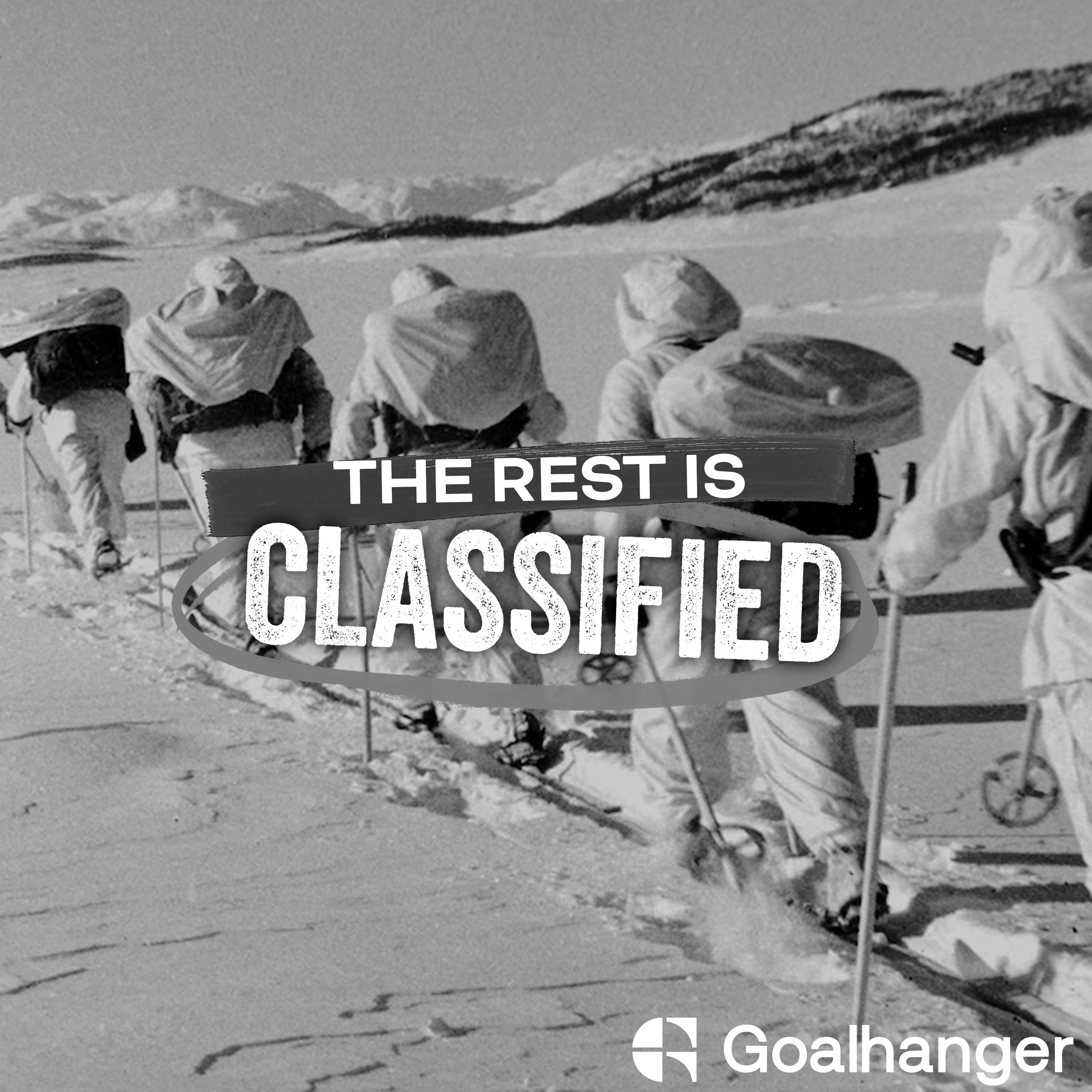
I got some sympathy with the pilots, I'm going to be honest. They're Interesting. They've got snowsuits on, although underneath British battle dress, because one of the things they're going to try and do is not look Norwegian because they figure they've potentially got a bit more protection and a bit more protection from reprisals for the local population if it looks like they're British. So they've got snowsuits, British battle dress, Tommy guns painted white, wooden skis, and then this I found extraordinary rabbit fur lined underpants.
- [32:23]
David McCloskey
I thought I was the only one who had a pair, but I don't.
- [32:26]
Gordon Carrera
Know where you get those from. Maybe where you are there, I've got a guy.
- [32:31]
David McCloskey
Sounds very warm.
- [32:32]
Gordon Carrera
It sounds warm. It sounds warm. They've also got suicide pills in case they get captured. And they've got 11 containers full of all their equipment, you know, the explosives, everything else they need. There's a massive blizzard, inevitably.
- [32:45]
David McCloskey
Obviously there's going to be a massive.
- [32:47]
Gordon Carrera
Blizzard and the storm hits. They can't see anything. They've got to take refuge in a hut, the nearest hut they can find. First morning, they can't even open the door of the hut. They're that snowed in.
- [32:57]
David McCloskey
This is a somewhat ignorant question about Norway, but why are there huts everywhere?
- [33:01]
Gordon Carrera
There are huts everywhere because people just, I think, use them to, to escape. I don't think they're particularly fancy. I think they're just kind of quite basic huts littered around the countryside. Norwegian listeners write in and tell us your hut culture and more. But I think that's the, that's the thing. They're there. So five days they're stuck in the hut, unable to get out. They finally go out and they see someone coming towards them and that person is carrying a rifle. So it's a moment of tension because is this a German? Is it someone who can blow the whole operation? So they approach this guy, this lone individual on his skis with a sled he's pulling and a rifle. And it turns out he's a professional hunter, stroke poacher. I think there's a little bit of ambiguity about what it was. And on his sled is 50 pounds of reindeer meat, which he's, you know, been out collecting. And he's been out in the wilds, supposedly for months, just hunting and collecting this stuff to eventually take back to people in Oslo. Now, Joachim Rodenberg then asks him about his politics.
- [34:05]
David McCloskey
Natural segue. What do you think of the Nazi occupation?
- [34:09]
Gordon Carrera
Here's the problem for our. For our poacher hunter. He says he's a supporter of the Quisling Party and We should say the quisling is the Norwegian equivalent of Vichy France. The kind of collaborationist government is the quisling government in Norway. And this guy has just said he's a supporter of them.
- [34:29]
David McCloskey
It's a bad start to the operation off the drop site blizzard. And then the guy shows up with meat and he's. He's a supporter of the Nazi government, supposedly. Or at least he says so.
- [34:38]
Gordon Carrera
Well, he says so. And the more they talk to him, the more they think he's possibly not the brightest spark. And he might be just saying that because he thinks that's the thing most likely to save him. So it doesn't look like he's a member. He's not got kind of party IDs on him. He then offers to help them with the route that they need to go to meet up with the grouse team who've been in there for about five months already. And he's going to guide them along with a map and a compass. You get a sense he's a slightly odd character. I mean, he asked to buy one of their Tommy guns at one point.
- [35:13]
David McCloskey
Probably be great for killing reindeer.
- [35:14]
Gordon Carrera
Yeah, great for killing reindeer. And he wants to shoot reindeer as he's going. Cause he thinks, oh, this is a great opportunity to do some hunting.
- [35:21]
David McCloskey
What do they tell him they're doing? They tell him they want to go to the plant. So they've told him where they're going.
- [35:27]
Gordon Carrera
They're trying to kind of meet up with the grouse team. So eventually they do find the grouse team. And the grouse team, this is a wild story of survival in itself because they've been living up in this really harsh Norwegian winter for months with no supplies, eating moss. So they've been making soup out of moss. So they are starved, sick. I mean, it's been bad.
- [35:54]
David McCloskey
Do they have the rabbit fur lined underpants or do they just have normal.
- [35:57]
Gordon Carrera
Even if they did, even if you've got those rabbit underpants, I think you're in a bad place. I think eating moss. So there's a joyous meeting up at a food and it's time to head to the plant. But the question is, what do you do with the hunter?
- [36:08]
David McCloskey
What would you do, Gordon?
- [36:09]
Gordon Carrera
Well, they've been given orders which are let nothing get in the way of finishing the job. And you kind of know what that means. And you can't afford to take him with you. I mean, he can't come on an operation. You can't afford to leave anyone behind to guard him. So you've Only got two choices, really, haven't you? You either let him go or you kill him. And there's a debate in the team. Some of them clearly do want to kill him. But it's interesting because Joachim Rodenburg doesn't want to. And one of the other members of the team actually says, I'll shoot him for you. I'm going to shoot him for you, because I can see you don't want to do it, so I'll do it. And Joachim says, no, I'm not sure. We have to do it. And it's interesting later in life when he explains why he didn't want to do it. He says he didn't know what the effect would be on the members of the team at shooting an innocent man who just happened to be in the wrong place at the wrong time, and he felt it would trouble their conscience. It's kind of interesting, isn't it? Again, goes to the. The nature of this man, that he's quite sensitive and quite thoughtful about these things. So they get him to write a letter, sign a letter, saying that he's been helping them in some kind of sabotage activity, which is.
- [37:21]
David McCloskey
I think that's a good idea.
- [37:22]
Gordon Carrera
Yeah. They get him to sign it, and they say, we're going to let you go, but we will make sure the Germans get this letter. If you tell anyone about us, will make out that you were part of it. So it's a risky move. It's a risky move, but, you know, they let him go, and it doesn't look like he does anything. So they've dispatched with the hunter, fortunately, without having to literally bump him off.
- [37:46]
David McCloskey
Would you have shot him, Gordon? Would you have directed one of your ski team, David?
- [37:51]
Gordon Carrera
I can sense. I can sense you're a hard man. You're a hard man. You. I could sense where you're heading. Go on. What would you have done?
- [37:57]
David McCloskey
I don't know. I don't know.
- [37:58]
Gordon Carrera
I think I'd struggle, too. I just struggle to just execute this guy. It's also interesting, isn't it, because you spent a few days with him and he's helped you. Trekking around, you've got a bit of a feel for him. He's not the sharpest tool in the toolbox. I think that makes it a bit harder than in the heat of the moment. You're getting discovered, and you've got to make the decision. I think. I don't know.
- [38:17]
David McCloskey
I like to think I wouldn't have shot him, but I don't know.
- [38:20]
Gordon Carrera
Okay.
- [38:20]
David McCloskey
I think I might have shot him or had someone shoot him.
- [38:22]
Gordon Carrera
Okay.
- [38:23]
David McCloskey
Seems risky. Let this guy go.
- [38:25]
Gordon Carrera
It is risky.
- [38:25]
David McCloskey
I. Yeah, you know, it's admirable. It's an admirable risk.
- [38:28]
Gordon Carrera
Now comes the key question. They've got to attack the plant. They've got explosives to blow up these precious cylinders and drain the heavy water. But how are they going to get in? So we should just briefly set out the geography of this. Again, it's called the site and the industrial plant the Winter Fortress in a book by the same name by Neil Bascom. And it certainly looks like one. I mean, it does look like a kind of bond layer, doesn't it? There? It's carved into the rock of a gorge, a big, you know, seven, eight story industrial plant made of stone. And it's on a kind of ledge halfway up the cliff side of the gorge on the south side of the valley. Behind it, going further up to the top, are the pipelines bringing the water down to the generator. There's a single track railway line going along the wall of the gorge to the nearby town to bring in machinery, although there's also a lock gate. And then There is a 75 foot long suspension bridge which is connecting across a valley to the other side of the gorge.
- [39:32]
David McCloskey
There's always a bridge.
- [39:34]
Gordon Carrera
It's quite Indiana Jones, isn't it?
- [39:35]
David McCloskey
Yeah, exactly.
- [39:36]
Gordon Carrera
It reminds me of that bit. Is it Indiana Jones, Temple of Doom at the end where they're on that, that kind of suspension bridge and there's a big drop down and there's the river below. It looks exactly like that except with an industrial plant at one end. So you've got the kind of bridge going along the gor and the river valley below it. Problem is, how do you get across? There's actually only 30 German guards on the site, partly because they're pretty convinced it's impregnable. There are mines, there are searchlights and crucially, there's around 200 reinforcements who can be called in from the nearby town if the alarm is sounded.
- [40:15]
David McCloskey
Are there dogs?
- [40:17]
Gordon Carrera
I don't know about the dogs, actually. Feels like there should be. Might be cold.
- [40:21]
David McCloskey
It feels like there should be dogs. There would be a scene in the film where they come upon, you know, our intrepid ski team sort of stakes out the site and we'll see, you know, Germans walking in, sort of the winter air with dogs and there's lights.
- [40:35]
Gordon Carrera
And the only proper way in is over the suspension bridge. Two guards patrol the bridge. There's a guardhouse on the far side where the Plant is where a third soldier's got an automatic weapon and access to an alarm arm which you could easily activate if there's any trouble on the bridge. And then you know you've got the reinforcements are going to go. Going over the kind of the back of it, if you like where the pipelines are, you know, there's three options really to get in. You can go. If you try and go over the far side, the back where the pipelines are feeding in. There's guards there as well, and minefield, so that's out. The next option is the bridge across the valley. That's the most direct access, which is why you've got all the kind of guards there. Chances are you could fight your way across, but the alarm's bound to get sound. Reinforcements are going to come in one way mission, even if you get across and that's near. But the third option, the third option, David, is to climb down the gorge, cross the valley floor in the river, climb up the other side, which is even steeper. Kind of imagine a sheer cliff face and then sneak onto the railway line, avoiding any guards. Best chance of surprise. But 600 foot drop and the Germans basically don't think it's even possible. So they've accepted the local advice that this is an impossible route. So, so they've not really got any guards on it. But the odds of doing that, of being able to do the climb down, across, up, sneak in, they do seem pretty tricky. And so Joachim Ronenberg again kind of goes and talks to his team and he says like, okay, what do we do? The odds are pretty bad. They all think it's a one way ticket. He feels as the leader that he has to give them all a say in it. So they discuss it and they have a vote on how to get in and also how to get out. I mean that's leadership. But it's kind of interesting because it's quite democratic leadership.
- [42:37]
David McCloskey
Why hadn't they worked this out beforehand? Because they had the scale model. You feel like you work things out with the scale model?
- [42:43]
Gordon Carrera
Yeah, I guess so. But I think what they're also finding is only when you get there and when they've got the fresh intelligence from grouse, who've got, we should say sources inside the plant who are able to tell them what's going on and some of the routines that you can see what the latest situation is and you can actually visualize it and work it out. So I think it's only when they get there that they're going to decide finally on what the plan is. And you know they're going to vote. The vote is up and down the cliff face. The obvious winner.
- [43:18]
David McCloskey
Let's do this. Let's do this climb. Which I guess it seems like obviously the most insane version, but perhaps less insane than trying to go through a minefield or conducting a suicide mission over the bridge. So it actually, in some ways, maybe the most harrowing seeming option is actually the least, the least risky in, in an odd way, yeah.
- [43:39]
Gordon Carrera
But it's interesting. Rodenberg says when you look at the gorge, he says, you feel it's impossible. You know, that's what he felt at the time. It just didn't look like you could do it. But that is what they're going to try and do.
- [43:51]
David McCloskey
Well, and that is actually a perfect place to end it, isn't it, Gordon? Because it's quite, it is literally a cliffhanger.
- [43:56]
Gordon Carrera
It's literally a cliffhanger.
- [43:58]
David McCloskey
Joachim Ronenberg and his team literally climbing the gorge to get to the heavy water plant. So I think we should leave it there and we come back next time for the thrilling conclusion of Operation Gunnerside. We'll see just how that attack unfolds. But of course, Gordon, if you do not want to wait, dear listeners, you can become a member of the declassified club@therealisclassified.com sign up, binge listen, get access to all of our series early and find out what in the world happens to Jochen Ronenberg and his team. We'll see you next time.
- [44:38]
Gordon Carrera
See you next time.
- [44:43]
David McCloskey
Mama Papa.
- [44:44]
Advertisement
Mi cuurpo crece a un ridmo.
- [44:46]
David McCloskey
AlarmTech.
- [44:59]
Gordon Carrera
Support for this podcast and the following message comes from America's Navy. The Navy offers new graduates hands on training and experience in careers like computer science, aviation and medicine, plus education and sign on bonuses. Parents help your grads start their career today@navy.com Olivia loves a challenge. It's why she lifts heavy weights and likes complicated recipes. But for booking her trip to Paris, Olivia chose the easy way. With Expedia, she bundled her flight with a hotel to save more. Of course, she still climbed all 674 steps to the top of the Eiffel Tower. You were made to take the easy route.
- [45:41]
David McCloskey
We were made to easily package your trip.
- [45:43]
Gordon Carrera
Expedia made to travel flight inclusive packages are atoll protected.