Loading summary
Transcript54 lines
- [00:00]
A
Foreign
- [00:04]
B
this episode is brought to you by whoop.
- [00:06]
A
Whoop is one of my favorite all time products. It's clear we're living through pretty stressful times right now. It's easy to underestimate how much that can affect our sleep and ability to stay focused day to day.
- [00:20]
B
Yeah, avoiding burnout can feel like a full time job in and of itself.
- [00:24]
A
Whoop helps with the bit people miss that shows what actually is going on beneath the surface. Caddy. It's a screen wearable device that monitors your sleep recovery, lifestyle and stress.
- [00:38]
B
Yeah, and this matters to me. It even looks very elegant.
- [00:41]
A
Did you hear that guy's Whoop is so stylish that even Katty K will wear the whoop.
- [00:46]
B
It's the little gold clasp. I like that.
- [00:48]
A
I'm telling you, I had no idea how much my old routine was impacting my health. But since using Whoop and making those small adjustments, I've already started to feel the difference. Better sleep, clearer thinking even more energy.
- [01:02]
B
Head to join.Whoop.com politics to get started with Whoop today.
- [01:11]
C
For adults with Crohn's disease or ulcerative colitis symptoms, every choice matters. Tremphy offers self injection or intravenous infusion from the start. Tremphya is administered as injections under the skin or infusions through a vein every four weeks followed by injections under the skin every four or eight weeks. If your doctor decides that you can self inject Tremphya, proper training is required. Tremphya is a prescription medicine used to treat adults with moderately to severely active Crohn's disease and adults with moderately to severely active ulcerative colitis. Serious allergic reactions, increased risk of infections or lower ability to fight them and liver problems may occur before treatment. Get checked for infections and tuberculosis. Tell your doctor if you have an infection, flu like symptoms or need a vaccine, explore what's possible. Ask your doctor about tremphya today. Call 1-1-800-526-7736 to learn more or visit trempharadio.com.
- [02:18]
B
Hello and welcome to the Rest is Politics. Us with me, Kati K and our new superstar, Anthony Scaramucci.
- [02:24]
A
Yeah, I was gonna wear my sunglasses, Catty, but I knew you would be critical of that so I'm just back.
- [02:31]
B
I would know. I love but I'm wearing starring in your son's movie. Oh my goodness, Letitia. For those of you not watching, admit it, life would be boring without me is what Anthony rusted all over his chest after having played James Bond villains.
- [02:44]
A
By the way, before this show started, if you saw the look and the eye roll from Katty K. It hurt.
- [02:50]
B
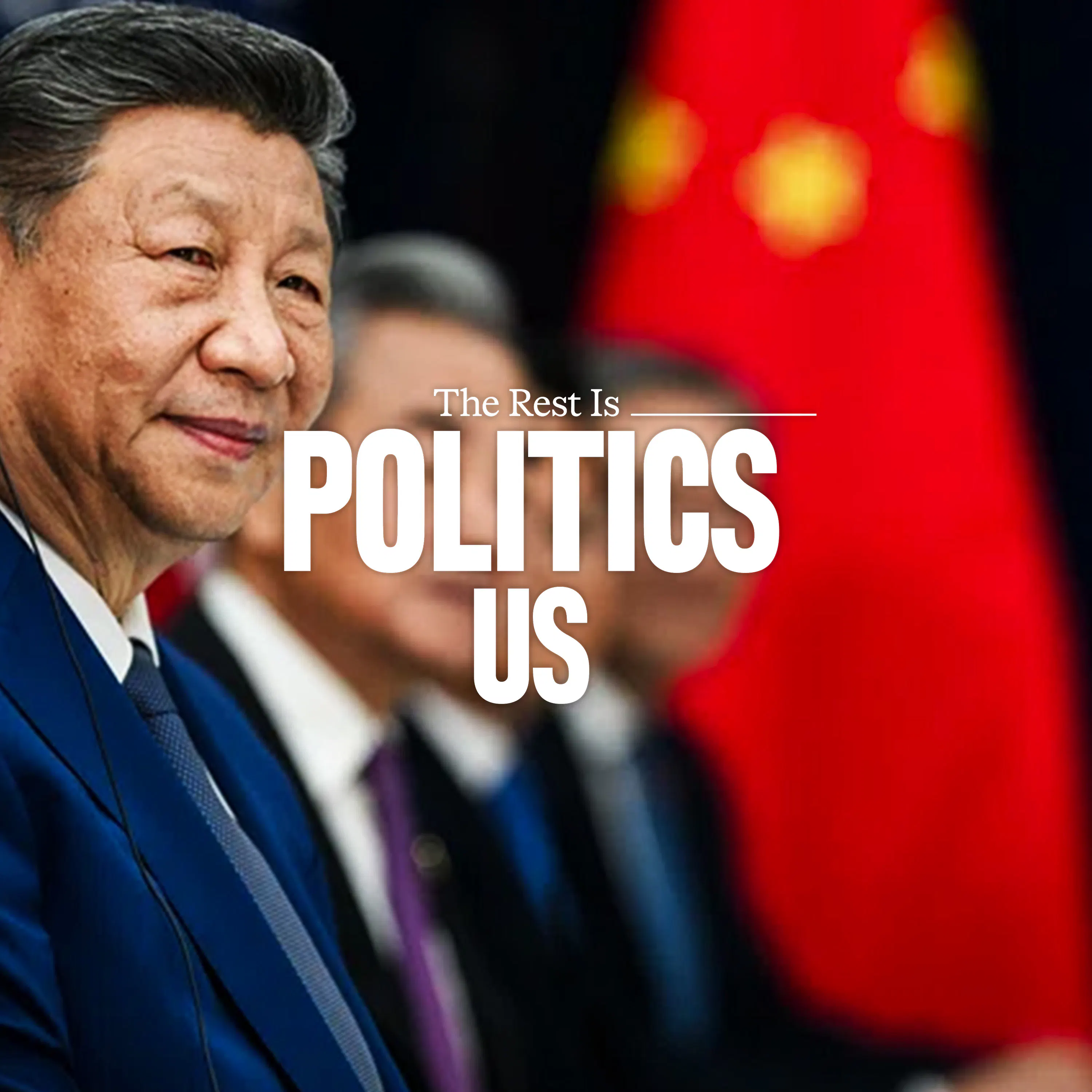
It's so good to have you back. Anyway, we thought we would jump in to give you a quick update on the Trump and Xi meeting that has just wrapped up. President Trump on his way back to talking about how China has a ballroom. That seems to be the main thing that he learned and so he should have one, too. And what a great meeting it was. He says it was a huge success and we just thought it was worth a quick run through of what we both made of the meeting.
- [03:17]
A
But first, caddy, okay. We should probably talk a little bit about the general sale that is now live for our North American tour. How about that? Okay, so you go to the restlesspoliticsus.com and you get your tickets right now.
- [03:33]
B
Yeah. We can't wait to see you there. Anthony and I live on tour in October. We're going to be going to Atlanta, Boston, New York, Washington, Minneapolis, Chicago, and Toronto in Canada. We love doing these tours. We love meeting you. We'll take your questions live. So please sign up and get those tickets and we will see you in October.
- [03:52]
A
All right. We know a lot of you guys are multitasking. While you're listening to us, stop everything you're doing right this second. Go to thereestispoliticsus.com and buy your tickets. We want to see you and we're looking forward. I'm excited, Katty. It's going to be right before the midterms, too, so there'll be a lot of things going on.
- [04:10]
B
Yeah. And it'll be good to meet our listeners in North America. Okay, let's have a quick listen, quick update on how this summit went. I do think it was very important that it happened first time in 10 years that the two leaders have met. Obviously, a huge amount of tensions around the world. There's been periods in the relationship over the last decade where there has not been very much dialogue at all. So having dialogue between the two leaders of the two great superpowers in the world is definitely advantage. They got a deal, it looks like, on Boeing aircraft that had been delayed, but maybe not as big as the markets had hoped it was going to be. I think there were some good things that came out of it. Scott Besant announced that they are going to have talks around AI and AI security. People are getting much more nervous about that because Anthropics Mythos AI program that is very good at detecting weaknesses in infrastructure vulnerabilities. I think that's a good Thing as well. Put that in the tick column. China didn't get the advanced H200 Nvidia chips. Some people are saying that is an advantage, too. But I think Anthony Trump went into these talks having made three big mistakes over the last year that kind of dominated the way that the Chinese received them. He launched the tariff war last year, which he had to then row back on because of the Supreme Court and because the Chinese stood up to him. He threatened to take Greenland, which alienated most of Europe and weakened the Western alliance. And then he launched an unnecessary war in Iran, which has also weakened America's global reputation. And that was the backdrop to this summit. And I don't think America came out of the summit. I don't think Trump came out of the summit with any of those huge, big announcements of investments into America that he would have liked to have had. And it's not clear that much progress was made on getting the Chinese to put pressure on Iran to reopen the Straits of Hormuz. They may do that behind the scenes going forward now, but I think that's a big one to watch. What did you make of it? What's your headlines? Good, bad, indifferent, Medium?
- [06:19]
A
I mean, I would say medium neutral. I would say nothing big really came out of it. But I just want to take people back to last summer. You and I were talking about Trump and his campaign, and then we did a series on Donald Trump, and I said to you that President Xi had Graham Allison's book with him. The title of the book is called Destined for War. And he had it with him in April of 2017 when he went to Mar a Lago. And so obviously, I looked at that, I said, okay, I got to read this book. And so I read the book, passed it on to my kids, et cetera. And I think it's important for people to understand what she was saying, because he's close to Graham Allison, who's the dean of the Kennedy School of Government. And there's another great book, if you guys don't mind, I'll just throw it up here. It's Athens in Sparta by Adrian Goldsworthy. Just came out. I haven't started this yet, but I will. And it's about rising superpowers threatening the existing power structure. And so there's been 16 episodic moments since the Peloponnesian War. And so what did Thedicides write about? He said, well, Athens and Sparta went at each other. They were competitive superpowers on the Peloponnese. They thought the war was going to last a short period of time. It lasted 30 years and it destroyed both city states. And so this was a cautionary tale. And Graham Allison basically said since that moment, there's been 16 episodic events, 12 of which have led to war. The most recent one is between our two countries. The United States was rising in the 1920s, but the United Kingdom accepted this because same culture, same religion, Judeo Christian values, same legal system. And so it was accepted. So there was no war. But this is a totally different culture, one party system versus a democracy, et cetera. And so there's a lot of warning lights on. And Xi doesn't want that fight. And so I thought it was interesting for him to bring it up. Of course, Trump reacted to it poorly.
- [08:26]
B
I thought it was, I thought that was very interesting for him to bring it up because in the context of these diplomatic events, she is not given to speaking in what was a pretty unveiled threat. I thought when he said that were America to intervene on Taiwan or help Taiwan, that could be a very effectively, that could be a very dangerous situation. He didn't use the word America, but it was pretty clear what he meant. But even for Xi to have said that, I thought at the beginning of this summit, didn't you? I thought it was pretty unusual that he went as far as he did. He stood his ground on Taiwan in a way I think is not in, in public, in a way that is not particularly common for the Chinese leader.
- [09:06]
A
I think. I think he was trying to tell people pretty plaintively a, these current structural conditions make a miscalculation on your side catastrophic. I think he was trying to say that and. But I don't think he's ready to attack Taiwan. I can give a lot of reasons for that. But before I go there, I want you to analyze the tweet that came from the president and was put on the White House feedback about Xi's comments, because I have an opinion of it, but I'd like to hear yours first, if you don't mind.
- [09:42]
B
So this is the context of all of this, guys, is that the fear in Washington as Trump left for China would be that he would change America's position on Taiwan. Taiwan is important for two reasons. It's the Saudi Arabia of the 2000s, 92% of high end chips produced in Taiwan. And it is also a symbol, I think, of America's commitment to alliances and democracy, particularly in that region. And what she would have liked is for America for President Trump to say that it opposes, actively opposes Taiwan's independence rather than saying that it won't support Taiwanese independence. That sounds like a small linguistic thing, but actually is a big deal in diplomatic terms. We don't know what President Trump said on Taiwan, but we do know, as Anthony said, what President Xi has laid out at the beginning of the summit on Taiwan, which is, look, don't make any mistakes. It could be very dangerous if you do. And making it clear that Taiwan was an important issue. So here is what Donald Trump put out on Truth Social. When President Xi very elegantly referred to the United States as perhaps being a declining nation, he was referring to the tremendous damage we suffered during the four years of sleepy Joe Biden and the Biden administration. And on that score, he was 100% correct. I thought it was a remarkable thing for President Trump to write. First of all, he's not criticizing President Xi. In a way, he's treating President Xi a little bit. Anthony, I thought, like, the way he treats President Putin. He doesn't want to criticize him. He gives him this credit of saying that he very elegantly referred to the United States. By going back to classical Greek history and then just having a president saying that he very elegantly referred to the United States as perhaps being a declining nation. You could stop that sentence there. It's a remarkable thing for American president to write. And yes, he's putting it all on Joe Biden, but I think it's the first half of that sentence that says a lot about the situation between. He's not disputing the idea that America has been a declining power relative to China, which seems to be a growing power. Is that the one you're thinking of?
- [11:56]
A
Yeah, well, that's the one I'm thinking of. Because, see, somebody from the White House got to him and said, oh, by the way, he was shitting on America and letting you know that we're in decline. He's on the rise, hence the thudicides trap. But there's another thing that happened, which I think is total bs And I'm gonna call BS blowing the whistle here, dropping the yellow card or the yellow flag, depending on which country you're in. Okay. Trump says on the way back on Air Force One that she asks him if he's going to intervene if there's a military strike on Taiwan. Okay, he said that on the plane. And then Trump said, well, only I would know that answer. And of course, I dismissed the question. Okay, that is total BS because I'm going to give you several reasons why. But the first one is that is not the way the President of China communicates. He's way too careful. He's a careful, scripted interlocutor. He's not somebody that would just flippantly say that. That's Trump being dramatic for the press and being the fabricating showman that he is. Okay? The Chinese readout of the whole situation does not support that. It does say fire and water. It does say, there's a red line here. We'd like you to stay away from Taiwan. But I don't think Xi turned to Trump and said, hey, if I militarily strike Taiwan, are you going to back Taiwan? First of all, that would violate decades of entrenched Nixonian Mao strategic ambiguity related to Taiwan, Okay? And so that would be a violation of all of that. And then, last piece of this Caddy, because I know Mr. Trump reasonably well. President Trump reasonably well. The retelling has classical Trump tells. Okay, and just hear me out for a second. There's only one person that knows that, and you know who that is? Me. I'm the only person, okay? And I'm not doing his accent. Well. I got to get Steve Colbert for that. But. But that is a Trump set piece, okay? That is the dramatic, cool refusal. He used nearly the same construction when he talks, like you just said about Putin and Kim. So, anyway, I don't think that happened. Now. He's put them in a quandary because they're not going to deny. They probably want to from their diplomatic core and from Xi himself. He probably wants to put out a statement, hey, mf, that did not happen, because it really goes against the whole architecture of the way the Chinese are going at these things. So what is your reaction to that? I think she really.
- [14:41]
B
No, I completely agree with you.
- [14:43]
A
Thank you. Because I'm calling total BS on that.
- [14:47]
B
These are very.
- [14:48]
A
And that's embarrassing for the president and for the U.S. by the way.
- [14:51]
B
I mean, but look, you know, he also came back on the plane and was berating a New York Times journalist and accusing him of treason. This is David Sanger, who has a very long history of covering international affairs, and he's basically saying, the free. Any free press which questions our success in Iran is guilty of treason. I mean, that's. That is an absurd statement. He also said that the New York Times subscriptions were failing. They're not. They're higher than they've ever been. So we know that even on the plane, he's saying things that aren't true, which makes it very difficult to get a real readout. Okay, let's go to A break. And we'll be back with more on the trip. Let's move on. We discussed Taiwan because I think the other important element and I think the way we judge the success or not of this trip diplomatically is going to be one, does America resume long delayed large Taiwanese arms sales packages to Taiwan after this? They've been set aside for the visit. Does America resume those. That's going to be worth watching, guys, because that suggests that Trump is sticking to the long standing policy that Anthony is talking about. And I think the second bit of the test of this trip will be after the trip. Again, does China quietly, behind the scenes, use its influence on Iran to pressure Iran to open the Straits of Hormuz, which is what America would like it to do? I'm actually pretty skeptical. I was talking to somebody who's been involved with negotiating with the Chinese before and they don't think that they're going to actually lift much of a finger to help open the straits, partly because they're getting oil out through other means. We're seeing today the UAE is announcing that it's got other pipelines, that it's expanding. We know the Iranians are also getting oil out, as we said earlier in the week on the podcast, through Pakistan and through Turkey. So I don't know that they're going to do much there. They may stop giving the Iranians some of the targeting data that the Iranians need for launching missiles and operating their interceptors. That's possible, but do you think they're going to. This changes the situation in Iran very much. I know you've long been advocating for Trump to go to the Chinese and say, help us out on the Iran situation. Do you think it's going to happen
- [17:10]
A
that the Chinese would wait till the Americans are more heavily and more significantly damaged before they would do something like that? And I thought, and I have to admit, I have to grudgingly admit that you had two fantastic guests on this week because, you know, I get jealous, Katie K. When you bring on these people.
- [17:30]
B
Both Eugene and Michael did a very
- [17:32]
A
good job, particularly the young people. But you said something on the podcast this week and I said, wow, in addition to your usual insight, I think it's important to reemphasize that they are trucking, shipping and rail freighting oil.
- [17:49]
B
I learned that from an oil dealer.
- [17:50]
A
That's very interesting and I give you huge props for that because that's telling you why the Chinese don't have to open that strait anytime soon. They're finding ways to get at the oil. And they want to damage the President more, they want to damage the administration more. I think that they will do some things to help, though, because they want us be seen as a savior to the global economy for Europe and things like that. So it's just not going to happen quickly. But it's not. It's not. And it's certainly not going to happen on the timeframe that Trump wants that to happen on. But let me ask you this question. I told President Xi that Iran cannot have a nuclear weapon and he agreed. Okay. Is that a bullshit comment to Katie K. Or you think that President Xi agreed to that as well?
- [18:46]
B
I think the Chinese would be quite happy for Iran not to have a nuclear weapon. But I don't hear that exchange having happened exactly as the way the President said it was going to be happening.
- [18:54]
A
That's bullshit detector number two.
- [18:57]
B
More important is, did they discuss China's nucleus? Did they discuss China's expansion of nuclear weapons? Because China has had a massive expansion of nuclear weapons of its own, which would be what it now has, 600 nuclear weapons. And American intelligence reckon that by 2035, it's going to equal US and Russia's nuclear arsenals. That would have actually been the more important conversation.
- [19:22]
A
Okay, I didn't hear any.
- [19:24]
B
I didn't hear any readouts of that. Maybe. I mean, I'm surprise President Trump has not flown back on the plane saying China has agreed not to expand its nuclear arsenal. That would have been interesting.
- [19:33]
A
Okay, so I, I don't think they had that conversation. But that is not my bullshit detection number three. So let me give you my bullshit detection number three. Fantastic trade deals. Well, I'm channeling you. You were trying to make a dog sound and, you know, you sounded like a duck last week.
- [19:51]
B
Yeah, that's true.
- [19:53]
A
Fantastic trade deals. Katie K. You think there were fantastic trade deals done?
- [19:59]
B
Katie K. I have not heard the Chinese interestingly specify any particular trade deals, which I think is in and of itself interesting because the Chinese would probably say what trade deals were done. Donald Trump went to China surrounded by American businessmen who all hoped to get investments secured during this. But the only one that they've actually talked about is this one for Boeings, which we were anticipating. President Trump has said that in an interview. He said that they were going to buy 200 Boeing aircraft. The Chinese don't have the capability at the moment to build their own airliners, so they want to buy Boeings. This has been long delayed as well. It looks like this is going to go ahead, but Boeing's share price was down what, like 4% this morning because the market had expected 500 planes to be bought. But I haven't seen any others.
- [20:48]
A
Maybe.
- [20:48]
B
Oh, access to agricultural. Chinese are going to up their purchases of looks like of American agricultural products, which is a big deal. The three Bs, Boeings, Beef and beans, soya beans. So it looks like they have said that. But on the other hand, you never quite know with the Chinese, when they agree to a deal, does it actually mean the deal is going to go ahead? Because in a previous trip there in 2017, Donald Trump thought that he had got big trade deals announced big trade deals, and they didn't all materialize. So the announcement of big trade deals doesn't necessarily mean big trade deals. But there weren't very many announced this
- [21:26]
A
time around anyway that they signed with the Trump administration. One about agricultural purchases. They never made those agricultural purchases during the Biden administration. So a lot more, to quote Joe Biden, a lot more malarkey coming out of all this. But having said all that, I want the Americans and the Chinese to get along and I want there to be business and I want there to be a fruitful relationship. And I think it is very, very important for these two systems and these two countries to cohabitate peacefully and with prosperity on Earth. And so for all those reasons, you want people getting together versus not getting together. But let me talk about the Hermit Kingdom, which used to be China. My buddy Graydon Carter, who, you know I have deep respect for, says to me, anthony, are we now the Hermit Kingdom? And what is the answer to that, Getty? Because we seem to have one ally now which is Israel. That's our ally, the Europeans. He beats up on them regularly. And I think the Europeans have frankly had enough because, you know, I go back and forth to Europe quite regularly, meeting with a lot of leaders. Spent some time with some government officials in Europe last week. Europeans are not happy with the relationship with the Trump administration. And you know what? They don't want to be an abused spouse. They're moving on and they're thinking about it differently the way Mark Carney is. So, so are we the new Hermit Kingdom? We just left the old Hermit Kingdom. Are we the new Hermit Kingdom?
- [23:01]
B
I think diplomatically you can make that case. America has, under the last in the Trump administration this time around, has done a magnificent job of alienating allies not just in Europe, but also in that area of the world, in Asia as well, alienating the Philippines, alienating Australia, alienating South Korea, alienating the Japanese, all because of the tariff policy and now because of the Iran war, which has jacked up energy prices enormously in that area of the world, even more than it has for Americans at the pump. But I do think that I was reading the Wall Street Journal this morning. There is a case to be made that a lot of the world's still the Chinese are catching up, but still a lot of the world's brain power still comes from the United States. And when Donald Trump turns up with the bosses of Nvidia and Apple and SpaceX, it is a sign still of America's flourishing intellectual capacity, an intellectual capacity that the world relies on more than ever because we are all becoming more technologically advanced and more technologically interconnected. So you've got kind of two Americas at the moment. You've got the America that the world wants, a part of which is America's Silicon Valley and tech giants and needs. And you've got the America which is the diplomatically and strategically unreliable partner at the moment. And I think the question for whoever runs the White House next is can it bring America's security commitments back online in a way that the two are more in harmony with each other and America once again becomes the country that people want to visit, want to do deals with, want to do business with, that is seen as a beacon of democracy and most critically, rule of law. So that countries want to invest in the country. And I think that's the question. It's a bifurcated country at the moment.
- [24:57]
A
It is. And Kadi, I want to talk about something that was signed in 1960. Imagine that long time ago during the Eisenhower administration. It was a US Japan Treaty of Mutual cooperation. Okay? It is a binding alliance. And I'm going to read you a quote. In the territories under the administration of Japan, it would trigger a mutual defense obligation. Okay. The legal foundation of this is roughly, roughly, U.S. troops in the area would defend the Japanese in the event of an attack in 1979. It's not a treaty, but it's the US Taiwan Relations Act. Okay. And this is something that we should also talk about. It's an old Sino American mutual defense treaty, terminated in 1954, reestablished in 1979. And this is the thing, it's never been formalized, but the Japanese have been told by the Americans over 62 years, there's a naval blockade of Taiwan. It's effectively a threat on democracies in the area. And so the US in order to defend you pursuant to that treaty, would come in and interdict the Blockade. Okay, now, Donald J. Trump, even if he knows about all this, I'm assuming Marco Rubio knows about all this because he's our Secretary of State. What would Donald J. Trump actually do? Katty K. And remember, we have this security umbrella that's been well documented and adhered to by every American president, Democrat and Republican. Strategic ambiguity, etc. Okay, go Donald J. Trump. What does he do?
- [26:49]
B
Well, Marco Rubio told NBC this week that it would be, quote, a terrible mistake if China took Taiwan by force. So you do have the Secretary of State, you're right, understands this and puts down a marker, which was the most forceful comment that was made from the American side on defending Taiwan during the course of this week. But I don't think that Donald Trump was more ambiguous in his support for Taiwan. And Trump one, he's even more ambiguous in his support for Taiwan. And Trump, too. Meanwhile, they've also had to move assets out of the region. They've depleted their supplies. I think the Chinese realize that Trump's commitment to defending Taiwan is a lot shakier than his predecessor's commitment. And the Chinese smell some weakness there, which is why Xi can put down the do the shot across the bows that he did at the beginning of this trip.
- [27:43]
A
But before we leave it, though, I don't think any of that's gonna happen. I think she's too smart for all that. And I think he still thinks that he can get potentially Kuomintang went to visit him first time after 10 years, and I think he thinks he can get it politically without having to do any of that. That's what I think.
- [27:59]
B
But anyway, okay, we're gonna leave it there and we will be back on Monday as usual. And don't forget, tickets for the tour are live now for general sale. We really hope to see you there. Atlanta, Toronto, New York, Washington, Minneapolis and Chicago in October. We're excited. Buy some tickets and ask your questions. We'll answer them live during the shows. These are really fun for us and it'll be lovely to meet you all. Okay, guys, we'll see you Monday.
- [28:27]
A
I don't know if any of you goal hanger people miss me, but I missed all of you. I'll just leave it there.
- [28:33]
B
So good to have you back, our resident James Bond villain. See you next week, Gu.