← The Rest Is Politics: US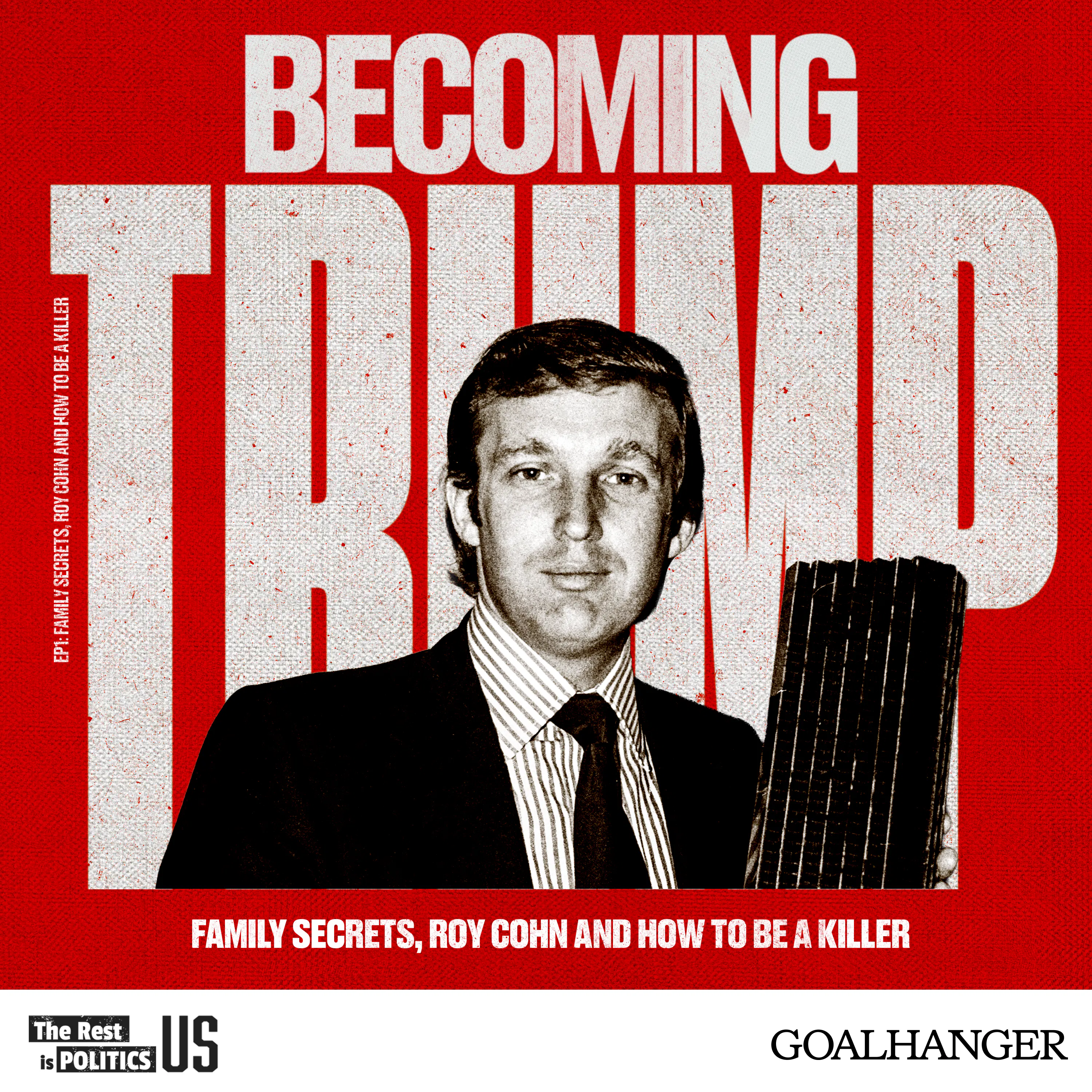
Loading summary
Transcript37 lines
- [00:00]
A
Hi, guys. Anthony and Catty here. We're jumping on to tell you about something very exciting, which drops today.
- [00:08]
B
That's right. Anthony and I are releasing a four part series all about how Donald Trump became, well, frankly, how he became Donald Trump. We're winding back the clock on Donald's early life. We're looking at his family, his mentors, the battles and the decisions that shaped the man who would go on to upend American politics and all of our lives. The this series is going to lay out the world that built him and the worldview that still drives him.
- [00:35]
A
And guys, me and Katty spoke for a while about which series to make, but this is the one we landed on because it really gives you an understanding of Donald Trump and to understand the world that made him. This is Roy Cohn, Caddy. This is Fred Trump. This is Roger Stone. But it's also the fight with Ed Koch and it's also the fight with the tabloid media.
- [00:58]
B
And it's all of the marriages, too. The series stretches all the way from his childhood, his years in military school, his building years in New York City, all of the women, the affairs, the scandals, right up to his attacks on Barack Obama and the birtherism conspiracy, and finally his decision to run for president in 2015. So here's a taster for you and, and to hear the whole story, sign up@therestispoliticsus.com.
- [01:31]
A
Be a killer, work hard, and under no circumstances do not be weak. Now, whose words are those? Well, actually, those are the words of Fred Trump. It does sound like Donald Trump. But that is Fred Trump, Donald Trump's father. And he's the only man that, that Donald Trump truly feared. To understand someone as polarizing as Donald Trump, you have to start with the people around him and you have to start with his origin story. Those are the ones that raised him. Those are the ones that showed him the ropes and then stood back as he rewrote the rules of business, imagery, public relations, and ultimately politics. Let's face it, Donald Trump has reordered the world in the process. But it's important for us to understand how he became who he is.
- [02:25]
B
And that's exactly what we're going to do for all of you. We're going to rewind the clock to a time before Donald Trump's name demanded global headlines, before it sparked outrage, devotion, back to the moments that shaped the man who would become this global phenomenon. Anthony and I. Over the course of the next couple of episodes, we're going to take you through the life of Donald Trump, from his earliest lessons in power and performance to that famous 2015 moment where he descended the golden escalator with his hired crowd cheering him on, a script in hand that he would almost immediately abandon. And a nation glued to their screenshots, all watching history in the making. So in this series, we're going to cover how Donald Trump became Donald Trump. How that child grew up, learned all of the things that he learned that would make him the most extraordinary president of modern times. How he had his first encounters with anti establishmentism, how he took on New York State and authorities and lost, but claimed he had won. How he learned these lessons of never backing down, of never apologizing, of always saying he had won. All of those things that you saw, Anthony, when you worked with him, which had actually been formed in his childhood and in his early 20s, right? Yeah.
- [03:55]
A
But even, I think even earlier than that, because remember Caddy, he got sent to a military school for some of his wayward status as a youth. And so it all fits in. And also, we're going to have to talk about his older brother Fred, who was playing with alcoholism, who probably got hit the hardest by the father in terms of the physical and mental abuse, and was many ways a shield for Donald Trump and some of the younger siblings. And so there's a fascinating, complex story here. It's rooted in racism, just being honest with everybody. It's rooted in anti establishmentarianism. There's a hostility to government and the state, and I don't mean New York state, I mean anything that you would think of as a state. And then, of course, the never apologize and the obsession with building the brand and becoming a politician, that would shake up the traditional political playbook. So it's all of that. Everything is here. And since we love founding members, Caddy and I sat down and said, what kind of special can we bring to people where they would be like, okay, guys, I now understand the full machinations of Donald Trump. And so we thought we would put this together for you.
- [05:11]
B
He's the man you think you know everything about. Billionaire Donald Trump. Donald Trump.
- [05:16]
A
Donald Trump.
- [05:17]
B
But most people only met him halfway through his story.
- [05:20]
A
I am officially running for President of the United States. The manifestation of Donald Trump's personality. President comes with a lot of complexity. A parent like Fred Trump, it's my way or the highway.
- [05:34]
B
There were two paths. Work hard, go into the family business, or the path of his brother, who was an alcoholic.
- [05:40]
A
He goes to this military school, but he takes none of the community stuff because he's A selfish dude.
- [05:46]
B
He had this whole carousing playboy background, which in a way was a bit of a sham. He leaves early and he doesn't drink anything.
- [05:53]
A
What Trump learns is that self image is going to work for him throughout his career.
- [05:58]
B
He meets Ivana Marie Zelenkova.
- [06:02]
A
Ultimately, Ivana does exactly as I tell her to do.
- [06:05]
B
The way that Donald Trump sees the world today.
- [06:09]
A
This is Liberation Day.
- [06:11]
B
You can see where it comes from. We let Japan come in and dump everything right into our markets and everything. It's not free trade. We'll explore the events.
- [06:19]
A
Trump has been saying that he will run it as a Republican, which is surprising since I just assumed he was
- [06:24]
B
running as a joke.
- [06:25]
A
And the people he happened to meet. Roy Cohn, the ultimate dirty trickster who made Donald Trump into the man we see today. I alone can fix it.
- [06:42]
B
So in today's episode, we're gonna start with where Donald Trump came from and go back to his childhood and his family and his origin story. He was born in 1946. He was the fourth child of a New York real estate tycoon, Fred Trump, and his mother was Scottish, Mary Ann. Of his dad, he liked to say, he taught me everything I knew. He's a master builder and a very hard worker. And I think it was Fred, as that clip right at the beginning suggests, that instilled in Donald Trump that killer instinct that there are basically winners and losers, it's zero sum, and that there isn't room for everybody to win. If somebody else is winning, you're losing. If you're winning, somebody else is losing. And I think that zero sum view of the world is so important to understanding Donald Trump's view of power and how he's implementing the presidency. But it really comes from his dad, where he got that killer instinct. He would describe how his dad never took a day off. And even on a Sunday, instead of taking Donald and his brother Fred around to play, played baseball in the park or something, he would take them to the building sites, his own building sites, and they would go around scrabbling on the ground, looking for unused nails. His mother was more emotionally reserved. Marianne. She loved the British royal family. Again, Anthony, we see Donald Trump's love of the British royal family that Keir Starmer played on so successfully when he came to try and negotiate a better tariff deal. What did he do? He knew that Donald Trump loved the royal family because his mother had loved the royal family, and he played on that. He, Donald himself, credits Marianne with being the one that gave a kind of central casting Facade of, of life that kind of was obsessed with things looking great. Like the royal family looked great. Like the royal family was straight out of central casting. And again, you see it when Donald Trump is making an announcement. He just did it about his, literally just did it in the last few weeks about his nomination for the Federal Reserve Board. Kevin Walsh, who he said looked at a central casting. I think we see Marianne in that side of Donald Trump who likes to look at television and see people that look the part. Like his mother saw the royal family and saw that they looked the part. So those are his mom and dad. But then of course there's his brother, as you mentioned, Fred Jr. Not quite the golden sheep of the family.
- [09:06]
A
Well, interesting. So, you know, obviously I've lived in New York my whole life. I guess Donald Trump came into my field of vision when I was in high school. He was building the Trump Tower. And this was a cause celeb for all the tabloids. And if you were a sports reader like me, and I'm sure in the British tabloids, we always started at the back page Caddy. I would get out my bowl of checks or Life cereal and you'd go from the back to the front. But as you got towards the urban part of the tabloids, there was always Donald Trump. Donald Trump knocking down the bomb with Teller Building. He's going to build the Trump Tower. Donald Trump taking over the hotel site by Grand Central Station, knocking it down, renovating it. His first project in New York City, creating the Grand Hyatt. But I want to step back because there's a lot of complexity to this story that most people don't fully understand. And I'm going to talk to you now as a New Yorker. Donald Trump's father was a very cautious, conservative guy and he was generally well liked by the community of people that he was in. And he was a quiet philanthropist. And so I'm talking to you from my home in my studio, but about a mile from here is the Presbyterian church that his sister was a member of. And Fred Trump, if you go into that church, into the congregation center, it's called the Fred Trump Congregation center is that in the 1960s, he made a quiet donation to build that. And so it's 60 years on Caddy and the church is still being used by the Congregationalists. I can go down the block to Spinny Hill, which is a urban housing development. Guess what? Fred Trump made a donation there to help that lower income housing project go off. If you go down into the Jamaica Estates area, which is down by John F. Kennedy Airport. Fred Trump owned what I would call blue collar, lower middle income, working class housing, however you want to define it for our UK listeners, he owned a whole big batch of that and he used to send Donald Trump to collect coins from the laundry facilities in those buildings. And so imagine the 16, 17 year old Donald Trump with the key, the master key, going into the coin boxes of the laundries, collecting them and bringing them back to the house, putting them in little rolls and sending them to the bank. Fred Trump was a brass knuckled sort of a guy. He was a tough guy, but he had a heart. And I'm going to tell a story that I have never told, but I'll share with you what one of my friends who I went to college with grew up in a Fred Trump apartment in the Jamaica Plains area and his father lost his job. And on a Saturday, Fred Trump was knocking on the door and standing behind him was Donald Trump, who was very much taller than Fred Trump. The door opened, my father answered the door. And, and by the way, I heard this story in the 1980s, this is not a revisionist story or any of that nonsense. And Fred Trump opened the door and my friend's father looked at him and said, I'm out of work. I know I'm behind on the rent. And Fred looked at him and said, hey man, you've been here for 15 years. I'm going to give you two months to catch up. I'm not going to bother you for two months. Go out and find a job. Focus on your family. Him and Donald Trump shook my friend's father's hand and closed the door. And the reason I'm saying this, Katie, because we're going to get into a lot of different things, okay? They blocked the African American community in those projects. They had racial discrimination lawsuits going related to that.
- [13:17]
B
We're going to talk about how he was arrested during a Ku Klux Klan rally in Queens.
- [13:21]
A
We're going to talk about that. We're going to talk about the grandfather of Donald Trump. We're going to talk about all of this stuff. But I want people to understand the complexity of this. There's good parts and bad parts. And it's very, very important to understand that because the manifestation of Donald Trump's personality comes with a lot of complexity. There are dark parts of the story, there are bright parts of the story. And when you step back from that mosaic, okay, you can see a lot of different things. And I want to tell people this, if you're a Detractor of Donald Trump's, by the way, which I am, if you are somebody that supports him, by the way, which I once did, when you step back from that mosaic, you pick and choose what you like in the mosaic, which suits your narrative, if you will.
- [14:13]
B
And I think also that different parts of our backgrounds come out at different moments of our life. And you also had Marianne, his mother, who was a mitigating factor against some of the harshness of his father. And I think the story you tell about Fred Trump giving two months reprieve to somebody who couldn't pay their rent, that is one story. But it's also true that Fred Trump was known to be very tough on his tenants. He was the one, because he had a lot of Jewish tenants who actually pretended that his ancestors came from Sweden. They didn't. They came from Germany. His father Friedrich came from what was then the Kingdom of Bavaria back in Germany, and he pretended they were Swedish because he didn't want to put off the Jewish tenants that he had. And there is this incident where he was at a Ku Klux Klan rally in Queens in 1927. The event was a protest against the Roman Catholic Church. Interestingly, they were accused of assaulting native born Protestant Americans. Fred was amongst several people who were rounded up with the police and were told to disperse and they didn't disperse. And so they were rounded up and charged. It's not exactly clear what role Fred Trump played in the brawl, but he didn't always have the image of somebody who was particularly open to minorities, whether they were Jewish people, whether they were people of color, whether they were Catholics. And he didn't always have the reputation of being touchy feely. Clearly, when it came to his own son, he was and could be very tough. And when it came to his other son, Fred Trump Jr. Who was an alcoholic, he was pretty dismissive of him. He didn't hide the fact that he was disappointed in him. Right. Fred Trump Jr. I think is an important figure in Donald Trump's life. And we talk about the influences on Donald today. This is the reason Donald Trump doesn't drink. I mean, he had this whole carousing playboy background, which in a way was a bit of a sham because he would go to these New York nightclubs, but actually he didn't touch a drop a drink. And I think that was because in the effort to please his own father, you don't have to be a pop psychologist to see this. In the effort to choose his own father, there were two paths. You could go the Donald Trump path, work hard, go into the family business, try and be tough like your dad is. Or you could go the path of his brother who was an alcoholic and died at the age of 42. And I think that made a huge impact on Donald Trump.
- [16:38]
A
Yeah. So I want you to see the complexity of this. Right. So humanity was I just represented. But I want you to also see what Donald Trump has told people privately, which is out in the public domain. So this is not stuff that I'm just saying. Okay. Fred Trump was criticized and demeaned by his father. Okay. And he was also teased, and Trump regretted this himself. Donald Trump has told people privately that one of his regrets in life is that he joined in the teasing of his older brother for choosing to be a pilot as opposed to going into the family business. Okay. His father used to call the older brother a bus driver. Here's my son, a bus driver in the sky. Okay. And so you have to think of the pain that that was. Okay. And there was a dynamic in the family where you did it, do exactly what I say. And if you don't do exactly what I say, well, then guess what's going to happen. I'm going to label you as the black sheep.
- [17:46]
B
Question for you. Why did Fred Trump, the father, so disrespect the son for going into a profession which is a perfectly respectable profession? I mean, it's not like he needed him to go and make a ton of money. The family was wealthy. They had a chauffeur. They grew up in Queens, but in a 23 room mansion in Jamaica Estates. It was an affluent oasis. Why didn't he just say to his son, being a pilot's perfectly respectable. You want to be a pilot, go and be a pilot.
- [18:17]
A
Well, okay. Everything you just said is the reason why you're the most popular podcaster at Goal Hanger. Because you are a human being and you have a sense of humanity about you and love of people and you're willing to accept the varying vocations that people would choose in life. But a parrot like Fred Trump, it's my way or the highway. And you've met those types of parents, caddy, and so have I. And I just want to go to Mary Trump for a second. This is Fred Trump Jr. S daughter. She's a contemporary of ours. She was born in 1964.
- [18:53]
B
Donald Trump's niece, who's very critical of her uncle.
- [18:56]
A
Yep. And she writes in the book, which is a best selling book. Too much and never enough. Watching Fred Trump Jr. Be belittled likely taught Donald to suppress his vulnerability and view kindness as weakness. This is right out of the book, okay? And this is the adoption of Donald Trump's leadership style. Now, I'm a middle child and my father was rough on us, and my brother was almost in many ways like a Secret Service agent for me. He shielded me from the roughness. But I guarantee you, Caddy, that my personality adopted different traits to protect myself, perhaps from my father, but also to learn from what was going on between the dynamic between my father and my brother. And guess what? As I've often talked about, and my brother and I have often talked about this with others, my brother has struggled with cocaine addiction throughout his life and he's clean today, thank God. But I'm bringing this up because I want people to have empathy for the situation. You're in a situation with old school parenting, corporal punishment, lots of heavy abuse, lots of heavy retribution. And this is, I'm going to protect myself. And Trump goes to the first sentence here. I'm a killer. I'm going to be a killer. I'm going to work hard, and under no circumstances I'm not going to express any vulnerability and I'm not going to be weak. And this is a very important part of this young man, Donald Trump's lifestyle and Donald Trump's personality dynamic. And when we talk about nature and nurture, it's this part of the nurturing that I think has had a long term psychological influence on President Trump.
- [20:57]
B
I think it is that incredible fear of weakness and disdain for weakness. And it wasn't just in his family, of course, that he was hearing this because the family went to church every Sunday. And you might think that that would be a place of love and kindness. But had a family pastor who had a similar kind of tough view of the world, Norman Vincent Peale, who wrote a book, the Power of Positive Thinking, that actually helped shape Donald Trump's own worldview. He was a Protestant clergyman. He was the pastor of Marble Collegiate Church in New York for almost half a century. You can see Donald is getting this from all sides. He had a sort of similar view in a way to Fred Trump the father, because he had this belief that doubt is a weakness, that negative thoughts of any kind can invite failure. That confidence, even when you don't earn it, confidence just by having it, sort of bragging, braggadociousness, as Donald Trump himself now likes to call it, is actually a moral virtue. And that you can kind of will success into existence if you refuse to accept defeat. And when you think about those kinds of messages that were coming from Pastor Norman Peel. You can hear echoes of Donald Trump today. He can make you think differently.
- [22:16]
A
No longer negatively defeated, but positive, hopeful, optimistic,
- [22:28]
B
victorious. There you can see from his dad this very robust view of the world, this very black and white view of the world. You're either winning or you're losing. You're either weak or you're strong. And then, of course, this all plays out. You mentioned the military academy, but in a way, it plays out in his education. He goes to his local school and he's remembered Donald as being kind of sweet, but other students have remembered him as having quite a temper from quite a young age. And some point in his time at Q, the local private school, Kew Forest School, he gets into some kind of a classroom altercation. It's not quite clear exactly what precipitates this. Maybe he throws something at a teacher, but his dad pulls him out of the local school and decides to send him to the New York Military Academy. It was a very tough environment. There was physical discipline, there was corporal punishment, as there was in many schools. Back in those times, there was a lot of sports. You had to thrive and you had to be good at sports, you had to be popular, you had to be tough. Obviously, it's a military school. At one point, he's labeled as a ladies man in his senior year high school book, but that may have been because a classmate said they needed to say something nice about him. But here's the weird thing about Donald Trump. He actually kind of thrives in that military academy environment. Somebody like his brother, I think Anthony, if he had been sent to that school, would have been totally crushed by it. But I think Donald thrives in that environment because it plays to something he's already learning. It plays to this very Darwinian view of the world where you've got to be a shark or else you're going to be the minnow that gets eaten and he's going to be the shark. Naturally, that type of environment that is not nurturing, doesn't promote touchy feeliness, is very harsh, promotes this kind of power. View of the world is something that he thrives in, but it also plays into his personality and shapes him even further.
- [24:30]
A
Guys, the story doesn't end there. We have so much more to get into. To hear it, sign up@therestispoliticsus.com.