Loading summary
Transcript420 lines
- [00:16]
Jessica Defino
Hello and welcome to the Review of Mess, a podcast dedicated to discussing the highs and lows of pop culture every month. I'm Jessica Defino. I write the newsletter the Review of Beauty slash Flesh World.
- [00:28]
Emily Kirkpatrick
Oh, update. And I'm Emily Kirkpatrick. I write a newsletter called I Heart Mass. And we're back here. We are. Yeah, we're doing it again. It's another month as a blown on by. It's our birth month.
- [00:40]
Jessica Defino
It's our birth month.
- [00:42]
Emily Kirkpatrick
It's like Leo season.
- [00:44]
Jessica Defino
The hot, hot heat of summer. I feel like my brain is cooked.
- [00:48]
Emily Kirkpatrick
Mine as well. So that makes for a good. A promising beginning to a podcast recording.
- [00:54]
Jessica Defino
Maybe not the best way to lead into the episode, but I just feel, like bored of the beauty industry right now. It's like that typical summer slowdown where I'm just like, nothing is exciting me.
- [01:04]
Emily Kirkpatrick
Yeah, the summer is always a weird time for fashion as well, because it's just kind of a lot of bikinis, you know, that's like kind of what the celebrity fashion of the summer is. And it's always just so boring. And. Yeah, I've also just. I don't know, I felt like. I always feel like fashion's in a rut, but particularly at this moment, I've just felt very uninspired. But what I've seen, I'm seeing out there. But it'll pick up.
- [01:24]
Jessica Defino
It'll pick up. September's coming soon, and Fashion Month is Fashion Month. September is when we are launching the Lowbrow Book Club.
- [01:31]
Emily Kirkpatrick
That's right. We have a name. It's Lowbrow Book Club. I think last time we were recording, we were still.
- [01:36]
Jessica Defino
We didn't have the name yet.
- [01:37]
Emily Kirkpatrick
Yeah, yeah. It's Lowbrow Book Club, everyone. You can go follow it. Actually, it's. The substack is already up. There's nothing on it, but it's. I think it's lowbrowbookclub.substack.com.
- [01:47]
Jessica Defino
Yeah, I'll put it in the show notes.
- [01:49]
Emily Kirkpatrick
Yeah. And we're going to start in September. We're going to announce the book at the beginning of September. Oh, yeah. And maybe just to let people know kind of the setup of how the book club is going to be. It's like if you want to be a free subscriber, we'll announce the book at the beginning of every month. And you're welcome to read along at your own accord. But then all kind of like group discussion questions. And the actual zoom for the book club itself is behind a paywall. So if you want to be part of that, it's a different tier, but yeah, I'm excited.
- [02:18]
Jessica Defino
I can't wait. I think it's going to make me feel, like, alive, you know?
- [02:24]
Emily Kirkpatrick
No, no pressure on the book club, but, like, just need you to feel alive.
- [02:28]
Jessica Defino
I need you to give my life meaning.
- [02:32]
Emily Kirkpatrick
Yeah. She needs purpose, and you're going to provide it for her. No, no worries. Yeah, no, I'm excited. I feel like it's going to make me have deeper thoughts than I usually have, and I'm looking forward to that.
- [02:42]
Jessica Defino
I feel like another thing that's been, like, kind of a problem for me is that I've been reading so much theory, whether it's like, directly beauty related or something that I can apply to beauty. And in my mind it's just been jumbling around and I'm like, oh, I'm gonna save this for my book. And the book still has not materialized.
- [03:00]
Emily Kirkpatrick
Right, right.
- [03:00]
Jessica Defino
I'm not writing the book.
- [03:01]
Emily Kirkpatrick
No, it's coming, though. It's coming.
- [03:03]
Jessica Defino
It's like, okay, this feels like, to like, start, you know, actually working with that material in a way that doesn't require me to, like, sit down and write a chapter. You know, it'll be more generative discussion with like, so many people, for sure.
- [03:17]
Emily Kirkpatrick
And I also, I just always think that, like, it's one thing for me to read theory, but it's like in the process of, like, speaking it out loud or like, teaching someone else about it that I'm like, oh, I understand this. You know, I found that in our ways of seeing book club for sure, like, answering other people's questions, I'd be like, oh, I do understand this, actually. And this is how it applies. And that's incredibly helpful, I think.
- [03:40]
Jessica Defino
Yeah. And I think it helps with recall too, because, like, I've been just thinking of so many ways. Ways of seeing in particular is relevant to things that I'm, like, seeing or thinking about. And it's like, why doesn't that happen with the shit that I read by myself as much?
- [03:54]
Emily Kirkpatrick
Totally. Aura has been weighing heavy, heavy on my mind and my spirit. In a good way. Mm.
- [03:59]
Jessica Defino
Oh, my gosh. Aura is everything.
- [04:01]
Emily Kirkpatrick
Aura is everything. It turns out we're John Berger girls.
- [04:05]
Jessica Defino
Honestly, I would love to. To see, like, a think piece about John Berger's Walter Benjamin's aura and the aura ring.
- [04:18]
Emily Kirkpatrick
Mechanical reproduction of your own data. I was not expecting that. No. Yeah, I'm open to that. No, I was thinking, I mean, I brought it up in our book club, but the applications of it on AI and AI art, I think are like, really fascinating. And I would like someone like a real philosopher to unpack that on my behalf. Just putting it out there. If you're out there listening, please.
- [04:39]
Jessica Defino
Well, I believe in you, but no, thank you.
- [04:44]
Emily Kirkpatrick
That's. That feels above my pay grade, but yeah, I'll ruminate.
- [04:47]
Jessica Defino
Let's get into. What is your pay grade?
- [04:49]
Emily Kirkpatrick
Yeah, let's get into my real pay grade. I'm going to start with. There's just like two. You know, I like to keep you updated on my. My previous fashion theories and trendlets and yeah, there's been more period fashion since we last spoke. Um, if you missed the previous podcast where I mentioned it, Julia Fox went to the Mien event, which Jess was also at, and she was wearing some visible white underwear that was stained red to look like menstrual blood. And I was very taken with it. I did think, you know, I'll just reiterate. I think it could have been pushed further either in a real blood, either in a natural direction. Yeah, I'd like to see some real period blood out there, which we'll get to in a second. I got what I wanted. Or I'd like to see a really bedazzled and really gorgeous and really like haute couture, like Schiaparelli treatment. You know what I mean?
- [05:43]
Jessica Defino
Yes, I can picture that.
- [05:45]
Emily Kirkpatrick
I think could be really gorgeous and powerful. Anyway, so we had the Julia event. That was good. And then a bunch of people actually sent me clips about this news story about a Kenyan senator, Gloria Orwoba. I'm probably not saying that. Right. But she was protesting period poverty by wearing blood stained pants to Parliament and she was actually kicked out of Parliament for what she was wearing. Yeah. And I was, I just, I mean, I was really struck by it. It's obviously such a powerful. It's like so simple and such a powerful, direct form of protest that's like. It reminded me actually of. Have you ever seen the Intactivists? Are you familiar with the Intactivist movement?
- [06:22]
Jessica Defino
No. No.
- [06:23]
Emily Kirkpatrick
Oh, wow. Wow. Okay. Wow, wow, wow. Everyone needs to dive deep. I'm obsessed with the Intactivist movement. My parents live in South Carolina, so there's giant billboards that these guys put up around kind of in rural South Carolina and maybe just in the south in general, but it's, it's about anti circumcision.
- [06:39]
Jessica Defino
Oh.
- [06:40]
Emily Kirkpatrick
And so they call themselves Intactivists because they're intact. Yeah, it's pretty powerful wordplay. But anyway, it's so part of Their form of protest is all the men who go to these rallies and these protests wear all white and then they stain their crotches with red blood.
- [06:56]
Jessica Defino
Oh my gosh.
- [06:57]
Emily Kirkpatrick
Symbolize the circum. Yeah, it's really like visceral. But I've always thought like the, you know, whether or not you agree with their position, it's the visual of what they do is like so performance art. It's like so crazy. You. Everyone should go to their. Maybe we'll link in the, in the show notes. But you should absolutely go to their website and just look at the. The visuals that they're producing. Anyway, so, yeah, it reminded me of that. And it's like at a time when women's rights are being attacked so viciously, both in terms of like abortion and gender affirming care and stuff. It's like, why not make people upset with, you know, like, if you want to police the stuff, if you want to control this stuff, you need to face the real physical reality. Yeah. Like, look at it. Deal with what you're actually dealing with. You're not in the abstract, you know, not in the policy, but in the, in the corporeal. And Yeah, I don't know. I was really struck by that. And then, and then randomly also we get Brooks Nader, which people, I assume probably don't know who Brooks Nader is. It's just my sick Daily Mail brain. Who. She's like such a Daily Mail sidebar. Classic Rooksinator is a, you know, like a Sports Illustrated swimsuit model.
- [08:12]
Jessica Defino
Okay.
- [08:14]
Emily Kirkpatrick
She did Dancing with the Stars. I think people probably know her from that because she, I, I believe she started dating her dancing instructor, her partner.
- [08:21]
Jessica Defino
Ooh.
- [08:22]
Emily Kirkpatrick
So there's that intrigue. And then most recently, she attended the Bezos Sanchez wedding. Why, you might ask. No one knows. Literally no one knows.
- [08:32]
Jessica Defino
It seems like they have no friends, Right?
- [08:34]
Emily Kirkpatrick
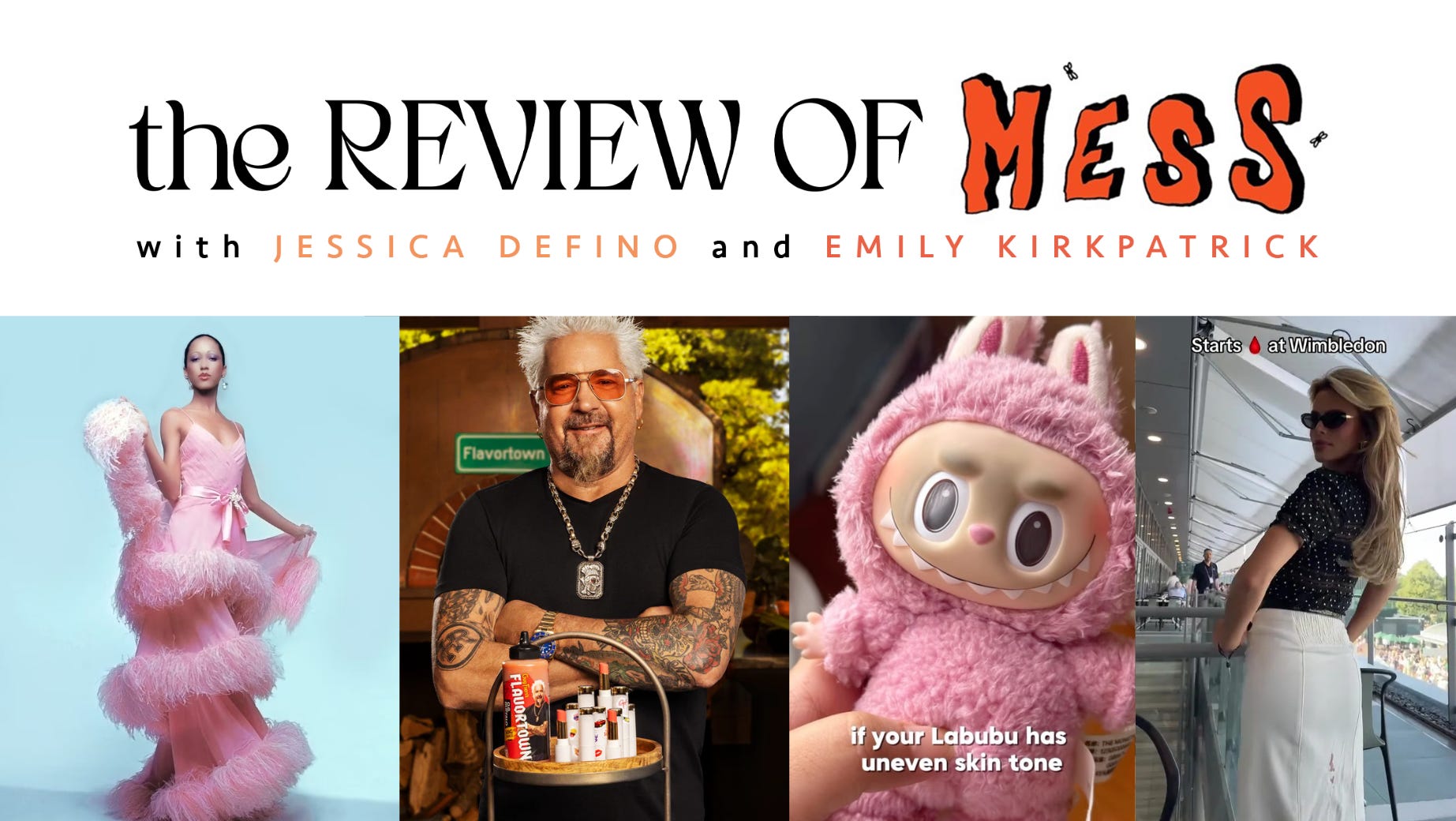
They have no friends. They're losers. And so they hired a bunch of like any famous person they could get to attend their 200 person wedding. Yeah. So she was there. So that was her most recent claim to fame, but she went to Wimbledon and she posted this TikTok that she had bled through her skirt on her like white skirt at Wimbledon and there she showed the bloodstain on camera and I was just like, wow. I don't know. A very impactful.
- [08:56]
Jessica Defino
Yeah, I love it.
- [08:57]
Emily Kirkpatrick
Very punk rock. I don't know. Something ends and transgressive. I don't know. It feels like so much of what celebrity fashion is about is shocking and outraging the Public. Right. And like, so for a long time we were doing that with women's bodies and nudity and stuff. And obviously that's kind of faltered that no longer does what it was always intended to do. And it's like here we have this other. You know, it's like.
- [09:19]
Jessica Defino
Right. Well, it's very embodied.
- [09:21]
Emily Kirkpatrick
Yeah. Embodied body.
- [09:23]
Jessica Defino
It's kind of like the opposite of this, like false construction of the body. Like a lot of fashion is about constricting or changing the shape, like visual illusion.
- [09:32]
Emily Kirkpatrick
Right now, all the big shape clothing and stuff and like non body bodies inside of fashion. Yeah. To go back to this very, like animalistic, like very primal life for. Yeah. And people don't. I say this as someone who's been rewatching True Blood. People really don't like blood. You know, like we do have. But it is this, like, it's this incredible. It's like it's life force, but it's also death. Like to be, to. To see blood, you know, I don't know. It contains all these contradictions that are like. So at the base of like what being human is and what being alive or dead is. I. I don't know. I think it's such a interesting, powerful medium that like, we're not using in fashion at all and all. And also ultimately I was like, is this not my goop fantasy? Like, is this not, you know, like a changing, ephemeral, physical material that like evolves over time completely? Is it the answer to all of my prayers, perhaps?
- [10:24]
Jessica Defino
I think so, yeah. I love it.
- [10:27]
Emily Kirkpatrick
Yeah. So I've been really moved by period fashion lately. If anyone sees any more, please feel free to. Feel free to tag me in it. And then something else. Well, I have not really been moved by this, but something else that ties into everything else that I talk about always. Is Kim Kardashian doing Elizabeth Taylor drag. I don't know if you saw.
- [10:49]
Jessica Defino
Oh, I saw.
- [10:51]
Emily Kirkpatrick
I don't know if anyone in the world didn't see. You know, I'm just so torn about the stunt because it's like so boring. But it is also like, so the meta text of it is very rich to me and I do understand what Balenciaga is like gesturing at and it. But like her as a figure is so deeply dull. And I don't know that she really has the impact that she needs to be having, like within pop culture in order for like these sorts of ideas to feel really salient.
- [11:22]
Jessica Defino
Yeah.
- [11:23]
Emily Kirkpatrick
If that makes sense. I guess I'm talking very abstractly, but I'll get into some details of it. So Demna, who's the infamous creative director of Balenciaga, he's about to go to Gucci. And so he staged his final haute couture Runway show, and he cast Kim Kardashian in it. He also cast Isabel Hubert, who's another face, longtime face of the house. But with Kim, he put her basically in an Elizabeth Taylor cat on a hot tin roof outfit. I mean, just kind of one to one, it's the exact, exact white slip that she wore in the film. And the diamond jewelry that she's wearing is literally Elizabeth Taylor's diamond earrings from Lorraine Schwartz private collection. Lorraine Schwartz is, like, one of the biggest jewelry designers in Hollywood. Most successful, for sure.
- [12:12]
Jessica Defino
Mm.
- [12:14]
Emily Kirkpatrick
And, yeah, I don't know. It's like, on the one hand, the casting is, like, kind of obvious. He's done this before. He stunt cast Kim in his last hocator collection, I believe, last year. And there's like, he has these band T shirts, like, you know, just, like, have her face all over it multiple times. Like, Stan. Stan. Culture stuff that you can buy for, like, $800. And so it's like. Yeah, it makes sense. And also, I think, you know, what Demna is interested in is kind of like the emptiness of American iconography. And in that way, Kim is, like, such a powerful figure of that. I mean, I don't know. I often think about the first campaign he cast her in, which was, like, it would be these, like, images of her, like, sitting on a couch on her phone or something. But the soundtrack was like a soundtrack from a red carpet of people screaming her name. Oh, do you remember that? No, and I don't. That, to me, is kind of, like, the core of, like, why their dynamic is interesting and works is because he's, like, interested in the artificiality of fame and that even to be, like, there is no naturalism anymore. Like, fame robs you of that. Like, even the. Your most private, simple moments become, like, weird. Especially a reality star. Right. Someone who films exactly everything. It's like, where does the version of Kim that the public consumes end? I guess. And where does the real Kim begin? And is there any Even a distinction? Yeah, yeah. And he plays with that a lot. I mean, he also. He invites the drag queen Alexis Stone to all of his collections. If people don't know, Alexis Stone is an incredible prosthetic makeup artist, like, performance artist, like, Cindy Sherman type stuff.
- [13:59]
Jessica Defino
Okay, cool.
- [14:00]
Emily Kirkpatrick
They first became famous during the pandemic because they basically created this elaborate hoax on their instagram that they were getting, like, more and more extreme plastic surgery and documenting it all for their followers until it became this, like, totally warped, insane thing. And then Alexis kind of revealed. Yeah, so that's all. That's performance art. It's not real.
- [14:19]
Jessica Defino
Right, right.
- [14:20]
Emily Kirkpatrick
And so, yeah, she made her name off of that. And then, yeah, Balenciaga has invited her to the Runway show every season. And every season she arrives as, like, a. A different, like, iconic pop culture figure, but one that also, like, weirdly fits into the world. Like, the branding world of Balenciaga. I'm trying to think there was one that she really tricked people, and it's not. I mean, maybe it was Jocelyn Wildenstein. You know Jocelyn Wildenstein, she's like the. She's called the Cat lady of New York, which is not very nice, but it is about just the extreme plastic surgery work she had done in the 80s. And she was incredibly wealthy. She died recently. But Alexis Stone attended the Balenciaga show as her, and people really thought it was her. The drag is quite, quite good. And she attended as Anna Wintour, I believe, just this haute couture collection. So, yeah, it's always kind of a pop culture commentary, but it is kind of that thing about, like, the real, the artifice, like, which one is more fun, which one is more interesting in Balenciaga, like, kind of, I think always leans towards. The artifice is more fun.
- [15:20]
Jessica Defino
Yeah.
- [15:21]
Emily Kirkpatrick
But, yeah, I don't know. And just Kim as figure of, like, you know, I've written at length about kind of pop culture's obsession with Marilyn Monroe and how we, like, use her as this, like, blank template of fame and aura. And, like, I think for Demna, he sees Kim in, like, a similar way. She's like this weird, warped projection of, like, 21st century fame and, like, our fantasies and, like, our values. And, like, I think that also explains why we hate her so much. You know, it's like she is such a reflection of our time and, like, what we put our energy in and our interest in, and we hate that, right?
- [15:58]
Jessica Defino
No, totally. I feel like that's something that, like, doesn't necessarily get talked about enough. Like, people are so fed up with the state of pop culture, but, like, we make these people famous. Like, this is a reflection of us and our desires and our interests as much as anything else.
- [16:14]
Emily Kirkpatrick
Man. I've been saying this since I worked at my first job at People magazine, and we would get all the mean comments about the Kardashians. I was like, stop clicking, like, literally to leave that comment you had to click into the article, like, scroll through the article. That's all time spent on the page. You know, that all counts towards our advertisers.
- [16:29]
Jessica Defino
Like, said that I, like, went to this college and I spoke at this Feminism 101 class, and they were, like, asking questions afterwards, and they were like, what can we do about, like, beauty culture, celebrity culture? And one of the thing, you know, I had many suggestions, but one of the things was, like, stop clicking on stuff. Like, when I was an editor, obviously, we would only create content for things that already had SEO, that already had search value that people were already clicking on for. And it's like, you do have some sense of agency in that. Like, you do have some power there. And I remember the teacher of the class being like, no, no, no. Like, that's not an option sort of thing.
- [17:12]
Emily Kirkpatrick
Like, what do you mean? Course it's an option. Don't.
- [17:15]
Jessica Defino
I know, but it was kind of like. It was like the. The idea was like, no, like, we're not blaming ourselves for the state of the media. And it's like, of course there are these huge power structures that are at play, but, like.
- [17:25]
Emily Kirkpatrick
But our attention shapes coverage.
- [17:27]
Jessica Defino
It's also a reflection of our. Yeah, our attention.
- [17:30]
Emily Kirkpatrick
Why do we write clickbait headlines? People click on them.
- [17:33]
Jessica Defino
Exactly. Exactly.
- [17:34]
Emily Kirkpatrick
Why does people write about the Kardashians at the rate they do? Because people click on it. It doesn't matter if you're hate watching. It all counts the same. It's the same as hate watching a bad tv. Like, why do we have three or four seasons or whatever of Emily in Paris is Because y' all are watching it. Even though it makes you want to claw your eyes out, like, it doesn't matter. The ratings are still the ratings. I think it. I think where you put your attention really does matter, and you really are in control of that. So why not exercise? And also something I always thought working at tabloids is, I was like, you know that if you really like these celebrity, like, you could just follow them on Instagram and you would get the exact same content that we're publishing.
- [18:10]
Jessica Defino
I get all of the time. Literally everything that's, like, in the mainstream media is a regurgitation of someone's Instagram pictures and captions.
- [18:17]
Emily Kirkpatrick
Just go.
- [18:18]
Jessica Defino
Follow your face anymore.
- [18:19]
Emily Kirkpatrick
No, Cut out the middleman. It's so crazy. I always thought that was so crazy. I'm like, just go to the. Go right to the source of the people you like. Get rid of this.
- [18:28]
Jessica Defino
Oh, my gosh.
- [18:29]
Emily Kirkpatrick
Anyway, my. Anyway, the main Reason I bring up Kim beyond kind of like the meta stuff that I'm interested in about her is it's just kind of another example of the Horcrux theory that I've always talked about with her, you know, aligning her branding with these American icons as a way of like consuming them and becoming them. And it's funny just for a major fashion house to kind of be aiding, aiding and abetting in that. And also because looking it up, I was like, wow, I can't believe she didn't already own these Elizabeth Taylor earrings, to be quite honest with you, because she always owns all this type of stuff. And I was just like googling around and I was like, oh, she actually does already own Elizabeth Taylor's jewelry. It was one of the first things she ever bought at auction in 2011. She was purchasing this woman's jewelry. So this is a long time standom fixation, some might say. But yeah, I just thought that was very interesting.
- [19:20]
Jessica Defino
Wow. To. To switch gears and talk about another iconic celebrity, please, let's talk about Guy Fieri.
- [19:26]
Emily Kirkpatrick
Love to. Always ready to talk about Guy.
- [19:29]
Jessica Defino
So Revlon has partnered with Guy Fieri of like, what's his show?
- [19:34]
Emily Kirkpatrick
Diners Drive Ins and Dives.
- [19:37]
Jessica Defino
Dives, yeah, you know, you know, he.
- [19:39]
Emily Kirkpatrick
Has many, I think he has many shows.
- [19:41]
Jessica Defino
The spiky blonde hair, the food shows, the fire shirts. The fire shirts. Iconic. But anyway, Revlon has partnered with him to create a lip balm called Flavortown. And I don't know if it's just my mood, but I find this so like particularly depressing. I'm like, who wants this? Like, who is the audience for this? Who is buying this? Is anyone? Is this just gonna end up like as landfill? I mean, of course all of it will, but I'm just like this seems like manufacturing literal, just garbage, like more than future garbage.
- [20:18]
Emily Kirkpatrick
Isn't it just part of this like weird new food marketing strategy of like trolling sort of and like making something disgusting and being like haha. Like this is gonna go viral on the Internet.
- [20:28]
Jessica Defino
Well, there's so much more that's happened like this month alone. And I'm like sick of talking about the food beauty thing. It's been happening for years. It ha. There's like a million new collabs every month and I write about them and I'll link some stuff in the show notes to talk about like why this is happening because I'm sick of it. But like just in the past couple weeks, we've also got in Sprinkles, Cupcakes collaborating with Patchology to do, like, cupcake themed under eye patches.
- [20:55]
Emily Kirkpatrick
I kind of can't believe sprinkles cupcakes still exist. I really haven't thought about them since, like, I don't know, 2007.
- [21:01]
Jessica Defino
Ugh. I used to get a sprinkle when it was, like, trending all the time. I worked at the Grove Mall, outdoor mall in Los Angeles. And when we got a sprinkles, I was like, okay, this is my lunch every day.
- [21:12]
Emily Kirkpatrick
Wow. Yeah. My best friend in college, her friend worked, worked at the first sprinkles when it was like first popping off and they had lines around the block. So he would, like, sneak us out a box of sprinkles. It was pretty elite vip.
- [21:25]
Jessica Defino
They are good. Do I need an eye patch inspired by.
- [21:28]
Emily Kirkpatrick
No, I think I'm good on that. Yeah.
- [21:31]
Jessica Defino
Would take a cupcake. There's also Laneige and Baskin Robbins doing a, like an ice cream lip sleeping mask.
- [21:40]
Emily Kirkpatrick
Okay.
- [21:42]
Jessica Defino
Glossier. And Magnolia Bakery did like a banana pudding bomb dot com. And then like, the disgusting ones are Panera. And this brand called Holler and Glow did a Mac and cheese flavored lip gloss. And I'm like, who? Who wants?
- [22:01]
Emily Kirkpatrick
I feel like Velveeta already did that. Also did some beauty product.
- [22:06]
Jessica Defino
Yes, they did. I know. Velita definitely did like nail polish.
- [22:09]
Emily Kirkpatrick
Yeah.
- [22:09]
Jessica Defino
Like, I think it's like scratch and sniff nail polish.
- [22:12]
Emily Kirkpatrick
Yes. Yes, that's exactly what it was.
- [22:15]
Jessica Defino
And now it's like, okay, your lips can taste like Mac and cheese. I don't know. Chipotle also has that weird lip stain.
- [22:22]
Emily Kirkpatrick
Is it because we're, like, not eating the food?
- [22:24]
Jessica Defino
Yeah. Honestly, I do think that there's a lot to do with like, skinny talk and, you know, sort of like general obedience food, obedience culture. And I think there's a lot in these food brands wanting to appeal to like a beauty focused consumer in a way that doesn't require them to consume their sort of like unhealthy or high calorie wares. It's like, okay, you don't have to eat the Mac and cheese, but you can get a lip gloss of it. Like, you don't have to buy the Annie Anne's pretzels. You get the perfume of it or something.
- [22:57]
Emily Kirkpatrick
Right. And it being kind of like the guilt free version almost. Which also is like, very interesting when you think of kind of like, I don't know, just the lineage of our, like, relationship to like, food and diet food and health and stuff. And it's like, right. They kind of can't keep selling you like the weird fat free lies anymore. Like, that's been kind of. So they're like, okay, well you can still like get our product, but in this like lip gloss. So it's like you're not even like 0 calories.
- [23:21]
Jessica Defino
Beauty collabs are like the snack wells of today.
- [23:25]
Emily Kirkpatrick
Yes, exactly.
- [23:26]
Jessica Defino
You know. Yeah, yeah. It's disturbing. But I think what I've just been like focusing on this month with all of the like so many of these just sounding like so disgusting and so useless is like, like, is any. Like, none of this is worth the plastic. None of this is worth the energy and time and money and waste that goes into production. Like, I'm just like picturing all of the materials used, all the petrochemicals that are in the lip balm, the packaging, the testing and development, the formulation, the distribution, like shipping the boxes. Like there's. I don't even think it's would be worth one packaging, one individual lip balm. Like, I cannot fathom a reason to do that.
- [24:10]
Emily Kirkpatrick
Yeah. And it also just seems is like something that's gonna live and die in the PR box. You know what I mean? Like, it's gonna be funny when they send it out to all the influencers and stuff and they like post it and then no, absolutely no one's gonna purchase that. So you've just done a weird Internet stunt. But right, like, right, you said the.
- [24:25]
Jessica Defino
It's gonna live on in like the tiktoks and it's never going to be like.
- [24:30]
Emily Kirkpatrick
And again, it's like not a new idea. So is it even going to live on in the tick tocks? Like it's not that like a novel of a concept. I don't know. Like, unless you're putting the Mac and cheese lip balm in the bottle of a bowl of Mac and cheese that you're like, and delivering to invite. I need to stop giving them ideas. I just, I just caught myself, I.
- [24:47]
Jessica Defino
Caught myself in the middle of saying.
- [24:48]
Emily Kirkpatrick
It and I was like, don't give them a concept. Lip balm, taking it back. You can't do that. Don't do that.
- [24:57]
Jessica Defino
Yeah, but yeah, I mean, unlike the flip side of this, a couple of beauty brands, say Henry Rose Crown Affair and in Beauty just like announced this project that they're calling Planet Beautiful. And they're like joining together to like collect 1 million pounds of plastic waste around the world. And like, okay, cool, admirable. But I'm just like, how many millions of pounds of plastic waste is the beauty Industry just like creating every year on these stupid ass products that, like, nobody needs and wants.
- [25:29]
Emily Kirkpatrick
To me, it's like carbon offset stuff where it's like, oh, we bought carbon offsets. It's like, do they offset how much we're using? Like, just barely, maybe?
- [25:38]
Jessica Defino
No. My stance has always been, if you care about the environment, you should shutter your brand. You need to close your business.
- [25:44]
Emily Kirkpatrick
That's very popular. I'm sure people love to hear that.
- [25:49]
Jessica Defino
So that's my message to Revlon and Guy Fieri just like, just stop, stop, stop.
- [25:54]
Emily Kirkpatrick
Guy Fieri's betrayed me anyway. So upset Trump Guy. And it makes me embarrassed now that I have his bumper sticker on my water bottle.
- [26:02]
Jessica Defino
Oh, my gosh. Yeah, no, we gotta cover that up. We gotta get you like a. I.
- [26:08]
Emily Kirkpatrick
Need some Flesh World merch asap.
- [26:11]
Jessica Defino
But, yeah, no, that's. That's my, like disgusting cheese flavored lip gloss rant. I can't. I can't handle it anymore.
- [26:19]
Emily Kirkpatrick
Delish.
- [26:21]
Jessica Defino
What do you want to talk about?
- [26:22]
Emily Kirkpatrick
What should I talk about?
- [26:24]
Jessica Defino
Take it away.
- [26:25]
Emily Kirkpatrick
I don't, I don't. I don't want to talk about it, but I'm gonna talk a little bit about the thing everyone's been talking about all week, which is the Coldplay TV show.
- [26:33]
Jessica Defino
Oh, my gosh. Okay. I am excited to listen to you talk about this.
- [26:37]
Emily Kirkpatrick
I just. Well, I just wanna. Yes, I just wanted to raise some questions to. To just take a temperature check with someone whose opinion I trust because I've been a little like. I both understand the Internet's reaction to it, and I'm a little baffled by what we're doing with the kind of memeification. Anyway, so I guess for those who have somehow missed just the. The social event of the century is what it feels like is there's a Coldplay show in Boston. And during it, first of all, I also learned this yesterday, which I think gives a whole new perspective also on what's going on here is that before this couple gets caught on camera, that Chris Martin announced that it was like a couple camp, basically that they were sending the cam around the audience. So it's not like they were not given a heads up that, like, fair warning, was looking for cute couples in the crowd. And also when I've seen this clip from other angles, you realize how alone the couple was and that they were standing up against like a. Against like a banister.
- [27:42]
Jessica Defino
And so they're quite prominent, easily, easily spotted.
- [27:45]
Emily Kirkpatrick
I'm not, you know, I not pick sides. I'm just saying there's a lot of warnings leading up to this. Anyway, so the kiss cam, the couple cam is like, panning around this concert. It lands on a couple, and these two people absolutely panic dramatically panic, just, like, turn their faces away and shape, hide behind a chair. And I. And I, again, I have to say, not to their credit. They did kind of bring a lot of attention to themselves. That was unnecessary, like, because think about, like, if. Sure, they don't. They're having an alleged affair, you know, but, like, if they had not reacted like that, would this footage even be anywhere on the Internet? Like, would any of their partners have ever seen this?
- [28:28]
Jessica Defino
Yeah, no. They're, like, extreme reaction of, like, getting down on the ground and hiding from.
- [28:33]
Emily Kirkpatrick
The camera was him really him throwing himself to the ground? Because even her reaction, it's like, okay, you know, like, maybe she's shy. She doesn't want to be on camera. She turns her back to the thing, like, okay, fair enough. You know, but him throwing himself to the ground is when you're like, okay, well, now something is happening between the two of you.
- [28:50]
Jessica Defino
Well, and then, like, Chris Martin said it immediately, he was like, okay, those two are having an affair, or they're really shy or whatever.
- [28:56]
Emily Kirkpatrick
He said, yes. And then he said, I hope we didn't do something bad.
- [29:00]
Jessica Defino
Oh, my gosh.
- [29:01]
Emily Kirkpatrick
Yeah, it turns out he did. So basically, the Internet, of course, went nuts with it. And then we find out who this couple is. It's turns out the CEO of some company called Astronomer Indy Byron and his and his company's HR chief, Kristen Cabot, who are both married to other people and they are holding one another. In this clip. Maybe I didn't say that before. And then since then, it's like Byron has stepped down as CEO, Cabot has been put on indefinite leave. And it's like, I. I don't know. I'm just so torn about this event because on the one hand, it's like, I do think the memes that are like, america must succeed, sacrifice a CEO every summer is like, part of our new annual, like, end of capitalism tradition. Right? I do think that's very funny. That's a very funny point. And we have been doing that. But I just, more broadly, it's like, what is kind of fun about kind of ruining these two people's lives? I don't know. I don't. I feel, like very Debbie Downer about it, but it's just like, what are we really getting out of this? Like, why is it so fun? Why is it so funny for people like, of course their reaction is funny, but like, kind of the degrees we take it to and like the relentless pursuit of these two people who are like consenting adults having an extramarital affair again, in marriages that we. Maybe this is my dance. Yeah. We don't know their situation. We don't know their, like, circumstances or what their partners may know about or not know about. You know, it's. I don't know, it feels very weird to me and it feels very like Panopticon. Like.
- [30:33]
Jessica Defino
Yeah.
- [30:34]
Emily Kirkpatrick
Like we already live in a fascist regime that like, wants to monitor us and know everything about us. Like, why play into it? Like, why help them? I don't know why. Why help them document everyone and everything around you and all of their misdeeds and misbehaviors and like, make sure they get punished for it? Like, Right. I don't know. I don't think these people need to get punished, honestly.
- [30:51]
Jessica Defino
No.
- [30:51]
Emily Kirkpatrick
For having an affair at work. How many people have affairs?
- [30:54]
Jessica Defino
Yeah, it's the most banal thing you could think of. And also just. Yeah, the, the like, level of surveillance culture.
- [31:05]
Emily Kirkpatrick
Yeah.
- [31:05]
Jessica Defino
Creeps me out. Like, I don't want to be a part of it. I don't want to be ever be the subject of it. So I try never to like, participate and it's like, of course it's entertaining to see the tweet, but on another level I'm like, I. This feels. And yeah, I don't know, it's sort of like co opting some sort of like, moral framework to justify an immoral thing. So it's like, oh, he's a CEO, he's rich, he deserves this. Eat the rich and capitalism.
- [31:31]
Emily Kirkpatrick
Yes.
- [31:31]
Jessica Defino
And you're using that sort of like, moral, ethical thing to sort of justify this, like, really disgusting, like, deep surveillance behavior. Yeah, like deep state surveillance. Like, I don't know.
- [31:44]
Emily Kirkpatrick
Yeah, I don't know. It weirds me out.
- [31:47]
Jessica Defino
No, me too.
- [31:48]
Emily Kirkpatrick
And yeah, it also just feels like a misguided attempt at like, Like, I think what, what we really want and the reason why events like this go viral is we want that feeling of being in a monoculture is kind of my take on it is like we like the feeling when we all have a joke together, you know, like, that is kind of like the joy of Luigi Mangioni, honestly. Also is like, here is a folk hero figure that we all kind of agree about. We can all riff about and make jokes about and we all get it, right. Like, we're all in on the joke and we like that Feeling. And the Internet has made that feeling, like, increasingly rare. And so I think we, like, seek it out through kind of moralizing events, like public cancellations, public shamings, because we like the sensation. But it's like, we could just have fun. We could just find more genuinely fun ways to do it. I don't know.
- [32:37]
Jessica Defino
Yeah. I mean, the world is so divided, and it's like, okay, here's one thing we can all get back on.
- [32:43]
Emily Kirkpatrick
We can all get behind.
- [32:44]
Jessica Defino
Yeah, yeah.
- [32:45]
Emily Kirkpatrick
And it can kind of transcend. And I also think what we haven't reckoned with is that, like, the monoculture that we're nostalgic for of our memories is not the monoculture we're experiencing on. On the Internet. Because the Internet takes those and blows them up to a completely different degree. You know, like, it's one thing. I was trying to think of my. A monocultural moment for me, which is like, charlie bit my finger. And it's like. It's one thing for everyone, you know, to watch Charlie bit my finger. It is a very different thing to be able to, like, look up that child's name and, like, find his parents and, like, send his parents direct messages about their children. You know what I mean? I think that's kind of like send.
- [33:23]
Jessica Defino
His parents, like, death threats or something, which is the level we're at now.
- [33:26]
Emily Kirkpatrick
Right. For abusing his brother by biting his finger.
- [33:29]
Jessica Defino
Exactly, exactly.
- [33:30]
Emily Kirkpatrick
And I think we, like. So we can't rectify that tension of, like, you know, like, fun thing, taking the fun thing too far. Because the Internet just makes taking it too far too easy.
- [33:41]
Jessica Defino
Well, it's like a struggling for the word, but it's just like a place for extremes. Like, extremes are sort of rewarded.
- [33:48]
Emily Kirkpatrick
Totally.
- [33:48]
Jessica Defino
And it conditions you to take things to the most extreme route.
- [33:52]
Emily Kirkpatrick
Totally. And you see that in, like, every conversation happening on the Internet. Right? Like, no one wants nuance. No one wants subtlety. They want to be right or wrong, black or white. And it's like. Right. So it's like, because. I don't know. Because we got these people doing something wrong, we have to take it to the extreme all the way of, like, now they must be punished and lose their job and lose their livelihood and, like, not be able to exist on the Internet anymore. And, yeah, it was just making me think of. There's this reporter who I love, John Ronson, and he wrote a book called so youo've Been Publicly Shamed, which is excellent. I highly recommend it. But it is kind of. It's about dealing with people who we've publicly shamed off the Internet and who it's had like, real ramifications on their lives and in many cases, like, made them unemployable, you know, like, made them pariahs in their societies. But super interesting is also interesting because it was published in 2015 and he was largely talking about Twitter specifically. And to think about how radically public shaming has evolved in the last decade. I don't know, I would love him to do some sort of like, update or write a new introduction or epilogue or something because it's just evolved so much. And even in prepping for today's podcast, I went back and read a review that was in the Guardian from 2015 of this book. Cause I just wanted to refresh my memory on what was in it. And it was very interesting to read because essentially the reviewer's like, main complaint about the book was that, like, she said that Ronson's central flaw is that he forgets that most people aren't on Twitter, so they. So basically they don't need to be afraid of stuff like this.
- [35:24]
Jessica Defino
Oh my gosh.
- [35:25]
Emily Kirkpatrick
And I was like, wow, like, so naive, honestly, you know, like, not how the Internet works. And especially today, it's like Twitter is just one tiny arm of this like, massive machine that's like coming to. To dox you and cancel you.
- [35:39]
Jessica Defino
I'm sure the, you know, astronomer CEO and his head of HR were not like, super active on Twitter.
- [35:45]
Emily Kirkpatrick
Not Twitter mega users. Yeah, because she was basically saying like, this is John Ronson's like, own paranoia. Because he was what? I don't believe he still is, but he was for sure like a Twitter mega user. And so she's like, this is his own kind of delusional fantasy of like, fear. Because he was interviewing people mostly who had been canceled from. From bad tweets. And that once he interviews them, you kind of find out it's like most of them were kind of like tasteless jokes.
- [36:08]
Jessica Defino
Yeah.
- [36:09]
Emily Kirkpatrick
You know, like an attempt at humor that just landed wrong. And now they literally like, can't be on the Internet. They have to hire services to like wipe, like when you search result them, like kind of what comes up. Because it's so bad.
- [36:22]
Jessica Defino
Damn.
- [36:23]
Emily Kirkpatrick
Yeah. And I don't know, I just thought that was very interesting and very funny that a decade ago they're like, well, this isn't, you know, a problem like the average person has to face. And yeah, and her, her implication was also that, like, that basically there's just like a handful of bad actors online who have this desire to be outraged and morally indignant, and so they're, like, seeking things out, and it's like, honestly, I think that's all of us online.
- [36:46]
Jessica Defino
Yeah.
- [36:47]
Emily Kirkpatrick
You know, I don't think that's limited to a few bad. You know, we. There's something about something. We can get all worked up over it that all of us are drawn to.
- [36:56]
Jessica Defino
Right. Well, and it's like that bad apple metaphor or saying or whatever it is, like, spoils the whole bunch.
- [37:03]
Emily Kirkpatrick
Yeah, right, Totally.
- [37:04]
Jessica Defino
It could start out with a handful of, like, bad actors who.
- [37:07]
Emily Kirkpatrick
Until it becomes the norm.
- [37:09]
Jessica Defino
Yeah. That becomes, like, normalized and very much infiltrates.
- [37:12]
Emily Kirkpatrick
Anyway, I highly recommend the book, and I just think it's becoming increasingly interesting as. As time goes on and what he was talking about becomes more kind of a. I think, a central problem for, like, a much larger portion of the popula, especially, I guess, after TikTok, you know, and kind of just the way normies, for lack of a better word, you know, gravitated towards TikTok and started to become content creators of a sort and whatever that means for them of all ages. I think that's very interesting.
- [37:38]
Jessica Defino
Yeah, it is. I mean, it's like, there is this compulsion to, like, look and be like, oh, that's somebody else, or that's a CEO, so this could never be me, and so I can, like, enjoy this. And at the same time, I think a lot of people want that kind of success, you know, like, are pushing to be influencers, to be seen to be successful in their fields. And it's like, okay, this might be the flip side of that coin. I don't know.
- [38:01]
Emily Kirkpatrick
Yeah. And I think Jon Ronson makes a very persuasive case that, like, it could happen to you.
- [38:07]
Jessica Defino
Yeah.
- [38:08]
Emily Kirkpatrick
You aren't immune in the way that you think you are. And.
- [38:10]
Jessica Defino
Yeah, this is not helping my paranoid writer's block.
- [38:14]
Emily Kirkpatrick
Yeah. So sorry. You're like, so I'm gonna log off forever. This is the last episode of the podcast. I'm never coming back.
- [38:24]
Jessica Defino
I'm tempted, but, no, I persevere. I persevere. My next topic is I want to talk about, like, I feel like Heat Damage is really hot right now. The biggest thing in beauty is, like, frying your hair, so then you can repair it.
- [38:44]
Emily Kirkpatrick
Well, that's really interesting just because I recently rejoined TikTok, literally, like, two days ago.
- [38:49]
Jessica Defino
Okay.
- [38:50]
Emily Kirkpatrick
And one of the first videos I saw was Sofia Richie talking about how heat damaged her hair was and that she had to cut it off into a lob or A bob.
- [38:56]
Jessica Defino
That's my literal first point. That's my literal first point of how damage becomes a trick. Oh, my God. Yes. Okay, so my first piece of evidence for how damage is hot right now is Sofia Richie's bob. I mean, she cut her hair into a bob. I've seen an insane amount of articles and TikToks about how the bob is now the cut of the summer.
- [39:19]
Emily Kirkpatrick
It was fed to me with, like, TikTok knowing nothing about me. Like, it had completely forgotten my algorithm and, like, who I was since the last. And it was just like, that was one of the first pieces of content. It was, like, testing out on me.
- [39:29]
Jessica Defino
Yeah. It's like the BOB is the it girl haircut because of Sofia Richie. And then I was really intrigued by her reasoning and how, like, damage enters into the trend cycle. And so, yeah, she said she did one too many keratin treatments and she'd just been cutting and cutting her hair, hoping to get the dead away, and it was still damaged. And she said, I know what I have to do to make this hair healthy again, and it's to start over. So we're cutting a bob. It's gotta go. It's fried. So I think it's really interesting that, like, what's hot right now is a response to over process super damaged hair.
- [40:04]
Emily Kirkpatrick
Yeah.
- [40:05]
Jessica Defino
And then. Okay, my second point is Pantene launched a new campaign called Country Fried Hair. And the campaign stars, like country singer Kelsey Ballerini. And so the idea of the whole campaign is that the country look of, like, big hair, lots of hairspray, teasing, bleaching, like, damages your hair. It's country Fried. And these new products from Pantene are the fixins that will repair it.
- [40:28]
Emily Kirkpatrick
Okay, I don't like this language.
- [40:30]
Jessica Defino
No, there's like, a very funny quote from Kelsey Ballerini in People magazine when she's talking about the campaign. And she said it's great to be able to show that side of hair damage, that things that aren't perfect don't have to be heavy. It can be fun and cheeky. And I just think it's so. Just so funny. Like, yeah, let's talk about our damage. Girls, like, yeah.
- [40:53]
Emily Kirkpatrick
Also talk about food. Food integration.
- [40:55]
Jessica Defino
Right, Exactly.
- [40:58]
Emily Kirkpatrick
Your hair is kfc.
- [41:00]
Jessica Defino
Yeah. But it's. Yeah, it's just, like, funny and interesting to me that this whole Pantene campaign, Pantene being like, one of the biggest names in hair care, is completely based on the idea of how, like, the hair care industry ruins your hair. And so then you can Buy these other products.
- [41:16]
Emily Kirkpatrick
Isn't that always the way?
- [41:18]
Jessica Defino
It's always the way. Obviously it's nothing new, but it's like there's a couple of just like really strong examples right now. Another one is the brand K18 just launched a product called Heat Bounce. And it's like a heat protectant. It says it offers protection for up to 450 degrees Fahrenheit and it reduces breakage by 85% when you're blow drying. So, okay, what's like so fascinating to me in this marketing language is just like, so we're saying that heat styling damages your hair like pretty badly.
- [41:49]
Emily Kirkpatrick
Yeah.
- [41:50]
Jessica Defino
You've created a product so that people can continue to heat style, damage their hair badly and damage their hair 15% badly. Yeah, it's like we only damage 15%.
- [42:02]
Emily Kirkpatrick
The suggestion isn't stop. It's. I know, moderate.
- [42:05]
Jessica Defino
Yeah. And then I mean it even translates to skin. I was thinking this week, I don't know if you saw, Hailey Bieber posted a picture of her perioral dermatitis flare up. As someone who has had perioral dermatitis, it's, you know, can kind of flare at any time, but there's like a lot of factors that go into it. Can like hers actually looks gorgeous. She has the most beautiful perioral dermatitis I've ever seen. Naturally mine was just like horrible skin peeling, redness around my whole mouth, like, like, you know, damaged clown makeup. But hers is like a couple of little pimples or whatever. But so she writes on this picture of her, you know, she's sharing her vulnerable moments. Her skin is breaking out. And she, she wrote that her skin always flares when I'm traveling a lot. Sleep deprived, hormones, the wrong spf, new products, stress. And I just think that's like, like obviously she gets points for like being vulnerable from her audience and like showing like the messy side. I'm not. My skin's not always perfect. But like coming from a product founder, it's interesting because it is basically like an admission or an advertisement for what I, I call like non skincare skincare, which is the idea that like managing your sleep and your hormone health and your stress levels are all much better ways of protecting your skin than any topical product that you can put on. And that also too many topical products often cause these skin issues. Like she freely admitted, I was using too many products. The products that I sell to you, whether through my own brand or from influencing on my like get Ready with me videos, I used too much of Them. And that gave me perioral dermatitis.
- [43:40]
Emily Kirkpatrick
Right. Because the one product she is mentioning in there, she's like, oh, yeah, I break out. Like, this can flare up because I use product.
- [43:47]
Jessica Defino
Exactly.
- [43:47]
Emily Kirkpatrick
It's like, okay, so why are you selling me product? Or also, I'm surprised. I'm always surprised when celebrities are vulnerable and honest about something like that without selling you something off the back of it.
- [43:56]
Jessica Defino
Oh, she did, though. She did.
- [43:58]
Emily Kirkpatrick
Oh, she did. Okay. Because I was gonna say, like, Kim Kardashian did the same thing, but then she's like, and here's the body. Make the KKW beauty body makeup to hide it well.
- [44:05]
Jessica Defino
And that's exactly what Haley.
- [44:07]
Emily Kirkpatrick
Oh, my bad. I spoke too soon.
- [44:09]
Jessica Defino
And she goes. Her next slide was literally, you know, when she's going through a flare, she keeps her skincare minimal. She goes, just water. She listed a couple prescriptions that she. She has. And then she said, glazing milk.
- [44:22]
Emily Kirkpatrick
Yeah, classic.
- [44:23]
Jessica Defino
One of the road products that she sells. It's like, okay, if all you use is the glazing milk, not any of the other products I sell, this will help calm your flares. And, yeah. So it's just, again, this, like, very obvious but always worth noting cycle of, like, damage from using too many products and repair using even more products.
- [44:45]
Emily Kirkpatrick
Yeah.
- [44:46]
Jessica Defino
And it's also just like, with the Hailey Bieber thing, like, what is. Okay, you're talking about getting into a minimal routine to heal your skin. And, like, what is the point of that? For her, the point is to get it to a state where it can handle more products.
- [44:59]
Emily Kirkpatrick
Right? Totally.
- [44:59]
Jessica Defino
And will then break down again. And it's like, it's just insanity to me.
- [45:04]
Emily Kirkpatrick
Right. And there's an implication that that cycle is, like, mandatory. Like, there is no way off. Like, you're on this carousel ride. Right. And you just have to ride it and, like, deal with the highs and lows.
- [45:14]
Jessica Defino
And I think that's why these things don't, like, register as completely bizarre, which they are to, like, most people who are seeing these posts. Because it's like, we're not even thinking, oh, I could just not be doing any of this. Like, it doesn't even enter into your mind to, like, stop the, like, ouroboro cycle of damage and repair.
- [45:35]
Emily Kirkpatrick
And I. I think that is kind of. You see that also in, like, beauty ads. It's like, there's this language of inevitability. Like, you have to do this. It has to be like that. And it. And it tricks you into just being like, oh, right. Like, that's just the way. That's the way it has to be. But also, you. It makes me curious, you talking about, like, all these different, like, damage tanks, heat hair products. It's like, are we. Are. Are we doing that much, like, hot hairstyle? Like, is hot hair styling coming back in a way that I'm. I'm not witnessing? I don't know. I guess, like, there's always a baseline, but just for a spike in products like this, I'm like, are people doing stuff that I'm just, like, not clued into? I don't know.
- [46:16]
Jessica Defino
I think so. I mean, I wouldn't necessarily say Love island is indicative of, like, the general population, but, like, they're all using, like, heat styling tools when they're getting ready.
- [46:25]
Emily Kirkpatrick
Of course they're doing a lot of stuff to get ready.
- [46:27]
Jessica Defino
They're.
- [46:28]
Emily Kirkpatrick
They're putting in more work than I've ever put in in my life into getting ready.
- [46:32]
Jessica Defino
Like, also, now that you mentioned it, I mean, I think a huge other trend on social media lately has been, like, how to get heatless curls. Like, there's so many heatless styling treatments.
- [46:41]
Emily Kirkpatrick
Right. That's. I feel like. And there's so much talk about what is the. The morning shed and stuff. Yeah, this kind of, like, natural, quote, unquote natural, you know, like, I don't know, I. I just thought they were kind of headed in this sort of, like, fake natural direction versus, like, getting a tool and really, like, going after making a hairstyle.
- [47:00]
Jessica Defino
But it could be that, but it could also just be, again, part of this cycle of, like, it could be indicative of a lot of heat damage. So it's like, oh, I'm gonna take a break and stop heat styling my hair for a week and then go back to my straightener, my curling iron or my whatever. But, yeah, no, it's the moment damage. Damage is the moment damage is in.
- [47:18]
Emily Kirkpatrick
The image is so hot right now.
- [47:19]
Jessica Defino
So hot.
- [47:20]
Emily Kirkpatrick
The last thing I wanted to talk about is really. It's more of just like a vague musing that I've been having. Tell me that. I was curious if you had any thoughts on. Basically when I recently went to Oregon to visit my friend and. Hi, Hannah. I've read the book the Battle of Versailles by Robin Gibbon, and it was incredible. Obviously, she's a Pulitzer Prize winning fashion critic. She's like an unbelievable writer. And also just like, the casual way she'll deliver, like, a hundred years of fashion history to you over a couple pages. I'm like, I wish I am so jealous of this ability for clarity and succinctness and delivery, synthesizing so much. Yes. Her writing style in general has been just very inspiring to me. But also, she basically, she's talking about one specific event in 1973 that was this fashion show at the palace of Versailles that basically, like, put American fashion designers on the map for the first time as, like, you know, worthy competitors of, like, French hocateur. And so to get to this night, she basically has to explain to you the entire history of the fashion industry, from its origins with, like, monarchy and then, like, American factory workers. It's like, how did we get here? But I don't know. Part of it that was just really striking to me is she. And that I never thought about before. She talks about the models that were chosen for this battle of Versailles, and basically, it was, like, very uneven competition because you're talking about, like, young, upstart American designers who don't have a lot of money, and they had to bring all this stuff over to Paris to, like, do all of this or to Versailles to do all of this, versus the French designers who are, like, literally the most famous French designer. It's Hubert de Givenchy. It's Yves St. Laurent. It's like Marc Bohan, who is the head of Christian Dior at the time. It's literally the biggest houses in the world with the most money and the most, like to invest in this. In this, like, frivolous thing. So anyway, they didn't have a lot of money to bring models over, so the Americans created the system where basically, like, three of the five designers had to cast the model in their portion of the show in order for them to confirm the model and bring them to Paris. And because they didn't have a lot of money, a lot of those models ended up being black women.
- [49:36]
Jessica Defino
Oh.
- [49:36]
Emily Kirkpatrick
And so it actually creates this, like, crazy diversity proportion, where I believe it was 30 models who are brought over and 10 of them were black.
- [49:44]
Jessica Defino
Wow.
- [49:44]
Emily Kirkpatrick
Which is unheard of by today. I know, unfortunately, like, that is a diversity number that, like, today we are aspiring to on runways. And according to Givon, it was like, it was literally these black models who won it for the Americans because they were so, like, they were personalities. Like, they were entertainers. Like, they were dancers. They were, like, spinning and dancing and moving. And, like, all these girls were, like, used to going out and being at the disco. A lot of them got discovered at the disco. And so it's like, they. They didn't just wear these clothes. They brought them to life. Versus the French hired a lot of famous haute couture Runway models who are used to walking and posing and turning around. And so you have, like, Halston, who. For people who don't know Halston, Halston is, like, the. He's the definition of fashion in the 1970s. Like, if you are thinking about a dress in the 90s, he probably designed it or it was based off one of his designs. Like, anyone you're thinking about at Studio 54 literally wearing Halston, like, big, flowy moo moos, one shoulder built to spin around in. And. And they were saying that, like, if they had put this on a regular model who's just staying there, like, it would look like a shapeless sack, but because these girls knew how to move. And so one of the people, Pat Cleveland, was one of the most famous models at the Battle of Versailles, who obviously is very much known for spin dancing, being a dancer. And she. They said that Givon said that she also, like, encouraged the other models, specifically the other white models, to, like, be more expressive and to, like, follow their lead. And. And anyway, so just so that alone I was very interested in. But then she kind of goes on to talk about, like, the legacy that these models, these black models at the Battle of Versailles created within the modeling industry, which is this idea. Like, so the French were incredibly taken with them as well, because of the movement. And not just the movement, but this feeling of, like, being tapped into the youth culture at the time, which the French were, like, woefully disconnected from just by the nature of, like, what haute couture is and, like, who your client is. And Yves Saint Laurent specifically, like, thrived off youth. Like, he was dressing all of his friends, like, he was dressing for the nightclubs. Like, he wanted. He's the first guy to put women in suits in Paris. Like, he's the first guy to put pockets. Pockets in pants for women.
- [52:00]
Jessica Defino
Really?
- [52:01]
Emily Kirkpatrick
Yes.
- [52:01]
Jessica Defino
Wow.
- [52:02]
Emily Kirkpatrick
Yes. Because his. Because his girlfriends didn't want to carry purses at the club. And he was like, oh, just have a pocket, like a man. And I. I do believe there's something that was, like, that was illegal in France until, like, weirdly recently, anyway, so he was, like, very interested in. In being modern and being of the times. And he saw that in these models. And so they became these kind of, like, international sensations and personalities. But out of them, we have a handful that, like, go on to have really famous careers, like Beverly Johnson, Pat Cleveland, and Bethann Hardison. And Bethann Hardison is actually, like, she's pretty much the reason that we know about the Battle of Versailles today, like, she made it really her mission to make sure that it was like the story was continued on. And specifically Stephen Burroughs, who was the one black American desire who's included specifically, that is, contributions were, like, not lost to time. But I don't know. Kivon connects basically these models to the rise of supers in the 1980s. And it's these models who are personalities, you know, like, they aren't just wearing clothes, they are full fledged celebrities personalities, like powerful women in a field where there aren't usually powerful women. And who's the most powerful of all the supers? Naomi Campbell, of course.
- [53:19]
Jessica Defino
Yeah.
- [53:19]
Emily Kirkpatrick
And. And I don't know, she goes on to connect it. I don't know. I've just been really thinking about this because she goes on to connect it to, like, we get this backlash to the supers. And. And to me, what it reads as is like we're getting this backlash to these powerful black women who are, like, making their own future, like, shaping their own agenda and future and in control of their own careers. And out of the 90s we get the rise of heroin chic.
- [53:42]
Jessica Defino
Right.
- [53:42]
Emily Kirkpatrick
Which is all white models.
- [53:44]
Jessica Defino
As you're talking to me now, I'm thinking too, of just like a backlash to, like, aliveness and embodiment and very much like, personality. And then the 90s heroin chic look was very disaffected, Right. Like detached, dissociated almost.
- [53:59]
Emily Kirkpatrick
And also like a control of the body. Right. Like, so you go from these girls who are curvier, who have hips, who have boobs to, like, fully. Yeah. An obedience, a control. Yeah. These very straight up and down, emaciated, like, young, prepubescent bodies, honestly. And she was saying that. So you go from 90s heroin chic to. Then you get this like just a parade of kind of what she calls indistinguishable white Eastern European teenagers, where we're going into kind of all of these post Soviet countries and taking these young women and bringing them to America and treating them terribly and churning through them and. And not having those big supermodel names really out of this period, like, when there's a. Of course, there's a handful that I think if you work within the industry, you know their names, but, like, certainly no Kate Moss, certainly no Naomi Campbell is coming out of this period. And then from Toles models, you then move into white Brazilian models. So your Gisele Bundchen, your Adriana Lima, which is also more of a Victoria's Secret Physique, But I don't know. I think there's something. I'm still teasing it out, but I just think there's something interesting going on there. And. And then all of this kind of culminates in July 2008. Bogatalia puts out the black issue under Franco Zozani, which is an issue that entirely features black models and black talent. And she said that she put it out because she was bored to tears looking at the white, indistinguishable women on the runways that she was going to. And she just could not understand why she was not seeing any diversity at all. And it. And I don't know, I just. It struck me as, like. It seems almost like a punishment. It seems almost like a backlash to these women becoming household names, becoming, like, leaders in this industry having agency and control that we needed. Yeah, it feels like a punishment of white supremacy.
- [55:47]
Jessica Defino
Right.
- [55:48]
Emily Kirkpatrick
Honestly. And then again, it's like, I don't think it's an coincidence either that, like, all of our biggest models today are Nepo babies. You know, like, they. They almost exist in a separate category from model because it's like they are celebrity and the children of celebrity. And so, I don't know, they exist to me in, like, a different subcategory, if that makes sense.
- [56:09]
Jessica Defino
No, it totally makes sense. And I'm trying to, like, wrap my mind around, like.
- [56:13]
Emily Kirkpatrick
Yeah, I don't have any, like, answers or, like, theories or any. It's just like. It's something that struck me sort of.
- [56:18]
Jessica Defino
Represent another type of, like, institutional power.
- [56:23]
Emily Kirkpatrick
Right. Like, we know what to do with a Hollywood famous person. We don't really know what to do with a model who kind of has enough lever and power to, like, dictate what photographer she works with, like, how she's portrayed in those photographs, like, what brand she works with. Like, that is threatening to the fashion industry in a. In a serious way versus, like, when we can be like, oh, well, they're. You know, she's a supermodel, but she's a reality star. She's a supermodel, but she's a cowgirl.
- [56:47]
Jessica Defino
Right.
- [56:49]
Emily Kirkpatrick
I don't know. There's, like, something different. You know, she's a child of a real housewife. You know, like, we can put them into a safer, a marketing category, I guess.
- [56:59]
Jessica Defino
Yeah. Wow.
- [57:01]
Emily Kirkpatrick
And the women I'm naming are white. Well, right. Bella Hadid. I guess it's not fully white, but.
- [57:06]
Jessica Defino
But no, there's like, that kind of. Kaia Gerber, Kendall Jenner.
- [57:10]
Emily Kirkpatrick
Yeah.
- [57:11]
Jessica Defino
Well, I guess she's like.
- [57:12]
Emily Kirkpatrick
Or even Amelia Hamlin now?
- [57:16]
Jessica Defino
No, totally.
- [57:17]
Emily Kirkpatrick
Is Kaya Gerber a Nepo baby? Yeah, Yeah.
- [57:19]
Jessica Defino
I was gonna say she's a nepa, but she's like a modeling Nepo baby. It's not like.
- [57:23]
Emily Kirkpatrick
Yeah, she's a modeling. Well, she's also a Casamigos Nepo baby.
- [57:27]
Jessica Defino
Oh, true.
- [57:28]
Emily Kirkpatrick
She's a Tequila.
- [57:30]
Jessica Defino
Yeah.
- [57:34]
Emily Kirkpatrick
I don't know. Just food for thought.
- [57:35]
Jessica Defino
No, I need to read this.
- [57:37]
Emily Kirkpatrick
She does a lot of kind of like, tying in these events to today in a way that is, like, really. Yeah. Interesting. And also this book came out in, like, 2016, I believe, so Also has quite evolved since then.
- [57:48]
Jessica Defino
I do find it really interesting to read, like, sort of recent history and seeing how these, like, seemingly separate events of, like, you know, this battle of Versailles, the 90s, heroin chic, like, connecting them, like, in the recent past. And then I feel like it's. It's easier to make these kind of connections today, I think. Another book that does that, like, pretty well. I mean, of course, it has its issues, as almost all books do, but Girl on Girl by Sophie Gilbert is sort of like a recent history of, like, the late 90s, 2000s, 2010, and sort of post feminism and beauty standards and the diet industry and all of that. And it is really interesting to be like, oh, these things that seemed maybe disconnected are completely connected. And where does it connect into today? Like, we're still in that cycle.
- [58:39]
Emily Kirkpatrick
That's how I felt. Yeah, totally. Because it's like, I know about all these different modeling movements, but I'd never kind of thought about them feeding into one another, their relationship like that. And when you start painting a larger picture, you're like, oh, yeah, of course. I see how all these related to one another and were in response to one another and all of that. Yeah, totally.
- [59:00]
Jessica Defino
So something I thought I could avoid talking about. I thought I could avoid the Labubu discourse.
- [59:06]
Emily Kirkpatrick
You can never escape the Labubus.
- [59:09]
Jessica Defino
Well, the excuse I was giving myself is that it's more of, like, a fashion accessory than a beauty thing.
- [59:15]
Emily Kirkpatrick
Labubus are everything.
- [59:16]
Jessica Defino
But then the beauty industry had to go and get involved with Labubu.
- [59:20]
Emily Kirkpatrick
They're everything, and they're anything you want them to be. And also, I had to explain what a Labubu is to all of my, like, late 30s friends. And it was very.
- [59:28]
Jessica Defino
Well, how did you explain it?
- [59:30]
Emily Kirkpatrick
Explain it? Oh, my God. Well, first of all, I bought a knockoff one at my grocery store. My grocery store is selling knockoffs. I don't know. Why are they.
- [59:37]
Jessica Defino
The Lefoufu's?
- [59:38]
Emily Kirkpatrick
Yeah, they're Lefoufu's. And I think they're quite funny. And I'm certainly not going to pay for a real Labubu. So I bought my friend one for her birthday, just thinking it was a funny gag. And then I brought it and no one knew what it was. Everyone was confused. And I was like, yeah. And I was like, you know how we have, like, Beanie Babies and like, Furbies? It's that, you know, it's that so much more. It is so much more. But, like, in the simplest of terms, it's just like a Beanie Baby with a clip so you can put it on your. Your keys.
- [60:08]
Jessica Defino
Yeah, totally. I mean, the strategist describes them as, like, kind of of ugly, but huggable, with a devilish grin. Like, it looks like this tiny little thing almost in like a. A fuzzy suit, but it has, like a scary face with, like, sharp teeth.
- [60:23]
Emily Kirkpatrick
Kind of like next gen ugly dolls. Do you remember ugly dolls?
- [60:26]
Jessica Defino
Yeah. Yes, yes, yes, Totally. And I think, like, I was trying to explain to my boyfriend this morning what sets them apart from like, Beanie Babies or a Furby. And I think the evolution is that this is like, like wearable. It becomes part of your outfit and that's part of you. Like, it's an extension of self that you carry around with you more than like a Beanie Baby really.
- [60:48]
Emily Kirkpatrick
Ever was a little Tamagotchi in that sense.
- [60:51]
Jessica Defino
A little Tamagotchi? Yeah.
- [60:52]
Emily Kirkpatrick
Because I feel like Tamagotchi was an accessory like that too, where you were like, flashing.
- [60:55]
Jessica Defino
Totally.
- [60:56]
Emily Kirkpatrick
You know.
- [60:56]
Jessica Defino
Yeah. Tamagotchi is a great example. But so anyway, Labubus are taking over. Everyone's got the Labubu keychains, Everyone's got the knockoff Labubus. They're like. Like, it's not just for children. I think children are into them, but it's like an alarming amount of adults.
- [61:10]
Emily Kirkpatrick
I often wonder if how much children are actually into them versus because it feels the same as with Beanie Babies. Because I remember as a child, like, I liked my Beanie Babies, but, like, literally I had two and I was like, I'm good. Like, I'm. And it was my mom and my sister who were going insane for the Beanie Babies and could not stop compulsively purchasing them. So I do wonder how much kids actually like Labubus versus they're adults around them, like Labubas.
- [61:37]
Jessica Defino
I mean, I would say there's a lot more media coverage of the adult Uses of Labubus for sure. But yeah. So an elf cosmetics, I guess a couple weeks ago, partnered with a Tiktoker on, like, a Labubu inspired Get Ready with Me video. Like, this person was dressed up as a Labubu and did, like, their skincare and makeup.
- [61:55]
Emily Kirkpatrick
Oh, that's disappointing. I thought the Labubu was putting makeup on.
- [61:59]
Jessica Defino
Well, I want the Labu, boo. The other thing that I saw was the cosmetic chemist for Hailey Bieber's rose. His name is Ron Robinson. He has his own brand. He posted a skincare routine for your Labubu as well, for the actual doll.
- [62:13]
Emily Kirkpatrick
See, that's content. That's content.
- [62:15]
Jessica Defino
Yeah. That is content. And so I was like, okay, now there's, like, enough of a beauty connection that maybe I'll get into this. So I, like, started googling to see because obviously a ton of think pieces have been written about Labubus.
- [62:27]
Emily Kirkpatrick
It's.
- [62:27]
Jessica Defino
They've been.
- [62:28]
Emily Kirkpatrick
They've been around.
- [62:29]
Jessica Defino
They've been in the zeitgeist.
- [62:30]
Emily Kirkpatrick
Yeah.
- [62:32]
Jessica Defino
And for how much, like, discourse they're generating, I was, like, very surprised to see, like, very few, almost no references to C.N. nye and her theory of cuteness from her book, our aesthetic categories, which I have talked about on the POD before and in my newsletter, but I'm obsessed with her. A whole third of the book is a theory of cuteness. Like, what is cuteness? Why are we drawn to it? What makes something cute? And, like, so much of it applies to Labubus and end this, like, cultural moment. So I just kind of wanted to, like, talk through some of it. So basically she says, you know, cuteness is an aesthetic of smallness, helplessness, vulnerability, and deformity. And it's, like, defined by this dialectic between power and powerlessness. Like, we like the object because it looks powerless. It looks vulnerable and small, but it actually holds a lot of power over us. Like, it has the power to make us want it, to buy it, to care for it, to carry it around, to make it part of our personality. Like, it's actually exerting a ton of power over us.
- [63:35]
Emily Kirkpatrick
Also very Gremlin. Is that that movie where you get them wet and then they turn into mozzare gremlins? Like, they're actually very scary, but they're so cute.
- [63:45]
Jessica Defino
Completely.
- [63:46]
Emily Kirkpatrick
The gremlin theory.
- [63:48]
Jessica Defino
Super Gremlin esque. And so she says in the book, too, like, the cute commodity, for all of its pathos of powerlessness, is thus capable of making surprisingly powerful demands. The purchaser is often seduced into the feeling that buying the product is, in fact, carrying out the wishes of the product itself. So one of, like, okay, the really interesting examples that she gives about how these, like, cute things exert their power, she talks about, like, babies and puppies and, like, little stuffed animals, things that make us go, like, aww. And she says, like, resulting in a squeal or a cluck, a murmur or a coo. The cute object seems to have the power to infantilize the language of its infantilizer. And I just. Yeah, I just find that all so relevant to the Labubu discourse.
- [64:40]
Emily Kirkpatrick
It also makes me. Do you remember the small bean discourse? Yes, because it really makes me think about that. And even just the language of, like, calling this group of women like small beans, like, that is infantilizing the infantilizer, like, hardcore completely. And, like, the powerlessness of them, the small. Yeah, I don't know.
- [65:01]
Jessica Defino
I know. I wish I had read this book, like, when we were more in the era of millennial performative infantilization, I think. I mean, we're obviously still there with girlhood and everything. Now.
- [65:14]
Emily Kirkpatrick
What was the coquette core, you know?
- [65:17]
Jessica Defino
Yeah, completely just very that.
- [65:19]
Emily Kirkpatrick
Adult babies. We're still seeing adult babies.
- [65:21]
Jessica Defino
Totally. Oh, my gosh. The diaper. The diaper movement.
- [65:24]
Emily Kirkpatrick
Diaper, Absolutely. I just saw Lizzo in a diaper this morning. You just reminded me really well, it was like a bloomer, but it was reading real diaper.
- [65:32]
Jessica Defino
Reading diaper. It's giving diaper.
- [65:34]
Emily Kirkpatrick
It's giving diaper hard, but small beans.
- [65:37]
Jessica Defino
And the other thing that I think is relevant to all of that, and especially, like, the evil little Labubu face, is that Cyan Nye says that, like, violence is sort of inherent in this aesthetic of cuteness. She says a cute object's exaggerated passivity seems likely to excite the consumer sadism or desire for mastery as much as the desire to protect and cuddle. So it's like you have, like. Like, control over this object. And I was trying to think about, like, why this moment, like, what in this political moment is drawing us to this aesthetic of, like, smallness and vulnerability and engendering this aesthetic in ourselves.
- [66:16]
Emily Kirkpatrick
Yeah.
- [66:18]
Jessica Defino
And she talks a little bit about, like, political events and timelines where, like, cuteness has been, like, more relevant in different parts of the world. So she says, like, it wasn't until after World War I that, like, cute toys really took off in the US for children. Like, prior to that, they had not been particularly, like, cute or cuddly or soft. And she was, like, saying that you Know, there's a reason, like, a nation that's so invested in images of its, like, own strength and bigness would sort of not indulge in this sort of, like, small, vulnerable, cute aesthetic.
- [66:55]
Emily Kirkpatrick
Well, also, like, a nation using children as laborers.
- [66:58]
Jessica Defino
Completely.
- [66:59]
Emily Kirkpatrick
Right. We can't treat them like that because that would soften them and they'd be like, oh, maybe we shouldn't, like, have them working. In effect.
- [67:06]
Jessica Defino
Yeah, we were adultifying infants. We weren't gonna, like, evangelize them, coddle them. Yeah, yeah. And then on the other side of that, she talks about how, like, the Kawaii aesthetic in Japan took off, like, after World War II, and sort of relates it to the diminished military and economic power that Japan was experiencing at that time, after the war, after the atomic bomb. And, yeah, she's like, says, like, there are historical reasons why an aesthetic organized around, like, these small, helpless, deformed objects that, like, foregrounds violence in its production would, like, take off in one nation at one particular time. Um, so, yeah, I was trying to think of, like, it's interesting that this, like, evil Labubu aesthetic for adults is big in the US Now. And I'm, like, trying to put my mind around it because I think, you know, the United States is obviously still very invested in these images of its own bigness and strength, but I don't think citizens are necessarily buying into those images right now.
- [68:10]
Emily Kirkpatrick
Totally.
- [68:10]
Jessica Defino
Like, I think there is a big feeling of political, like, helplessness in us that is mirrored in our, like, choice. Our consumer choices.
- [68:19]
Emily Kirkpatrick
Yeah. But also, like, interesting. I mean, who are these mostly popular with? It's, like, millennials and Gen Z, like, two generations who have been really infantilized just because, like, the nature of capitalism has made it impossible for us to, like, become adults. Right. We can't hit the milestones that we're supposed to be hitting. Right. And we, like, don't believe in marriage the way we don't believe in children. The same way, you know, the nuclear family doesn't hold the same standards for us.
- [68:43]
Jessica Defino
So it's like, well, okay, that maybe.
- [68:45]
Emily Kirkpatrick
The labuba's our family.
- [68:47]
Jessica Defino
Okay, listen to this. I loved this part of. Of Cyan Nye's theory of cuteness. So, okay, there are, like, a lot of sort of mommy issues, I would say, inherent in the aesthetic, which I think is really relevant, as you say, at this moment, as we're seeing, like, the fall of Roe v. Wade, rise of tradwives, protonatalism, this, like, biological destiny argument that, like, women are meant to be mothers.
- [69:14]
Emily Kirkpatrick
Yeah.
- [69:15]
Jessica Defino
So, you know, in her theory of cuteness, Cyan Nice's cuteness revolves around the fantasy of a commodity addressing its guardian in this one on one intimate manner. The cute commodity flatteringly seems to want us and only us as its mommy. Conversely, in a perfect mirroring of the its desires, if we had already put ourselves in its shoes, we as adoptive guardians seem to choose it. And so, yeah, she talks about cuteness, the cute commodity. There's an anthropomorphic thing happening and so we want to protect it and care for it. A cute object is somehow always a commodity that is looking for its mother.
- [69:59]
Emily Kirkpatrick
Yeah. Wow. Red for filth.
- [70:02]
Jessica Defino
And then she says it like grafts the commodity desire onto a middle class structure of familial, expressly maternal emotion. It's like a pastoral fantasy. And I just think it's so fascinating reading this now, like as the right is moving towards like sometimes forced motherhood, as like this end all place for women to be in. I would say like these vaguely liberal left leaning millennial Gen Z Labubu fans are, are moving toward commodity motherhood. Like we're exercising some of those same instincts, but on possessions and in the consumer market rather than in the nuclear family.
- [70:39]
Emily Kirkpatrick
Yeah, a thousand percent.
- [70:40]
Jessica Defino
And I mean, I don't. This feels like above my head a little bit sometimes, but I do want to think about it more because I'm just like, oh my God, there's so many, so many parallels in this moment for why this particular type of cuteness is so compelling to us.
- [70:56]
Emily Kirkpatrick
Yeah, extremely interesting points. And also when you think about like the dog culture that has like risen and like how people treat their dogs and like where they're inappropriately bringing their dogs or did you see the story in the Wall Street Journal this week about women who are buying hyper realistic baby dolls?
- [71:13]
Jessica Defino
I did not.
- [71:14]
Emily Kirkpatrick
I haven't read it yet. But it's, it's like they're buying real dolls. You know, if you've seen those.
- [71:18]
Jessica Defino
Yes, I've seen real dolls.
- [71:20]
Emily Kirkpatrick
And that it's just like, it's all these theories like, like put to the weird most uncanny Valley extreme, you know, or these look like hyper realistic. They seem like real babies until you're told they're a doll.
- [71:31]
Jessica Defino
Oh gosh, I need to read that. I'm writing interesting about dog culture right now. That ties into all of this as well, so.
- [71:38]
Emily Kirkpatrick
Well then get into the real dolls. Man, they're scary. They're really intense.
- [71:43]
Jessica Defino
The last thing that I want to add is like there is a part in this chapter where it's like, this is not necessarily, like, a harmless thing. She has this really compelling quote where she says, like, cuteness or this child cult aesthetic reflects and seems to, like, legitimate by aestheticizing, like, saying no to one's political power. And there's a quote that says, like, cuteness thus seems to be part of the solution to the problem of power. Since to make everybody like unto little children is not such a bad way to start with. Of disposing of them totally. Which I think is something. Yeah. To keep in mind as we, like, lean into this powerlessness and infantilization of ourselves as a way to cope with, like, a loss of rights and a loss of power. Feeling of helplessness, like, what is it actually doing to us?
- [72:34]
Emily Kirkpatrick
Yeah. And I've also always thought, like, part of the infantilizing is, like, it's easier to regress than to figure out how to deal with reality. You know what I mean? Like, whether we pretend we're children or not, like, we are still aging and we are still marching forward in our lives, and. And these problems aren't going to go away just because we all have labubus and, like, real dolls or whatever, you know, Like, I don't know. It feels like a. It feels like just putting a band aid on.
- [72:58]
Jessica Defino
Yeah.
- [72:58]
Emily Kirkpatrick
On like, a serious. Like, a night or something.
- [73:02]
Jessica Defino
Yeah. Yeah. Oh, my goodness. Totally. Okay. I'm excited to read this. This doll article now.
- [73:09]
Emily Kirkpatrick
Oh, yeah. Get into. Well, also Labubu. Satanic panic. You know, the labubus are Satan. I don't know if you've seen those headlines, but they are the devil.
- [73:17]
Jessica Defino
Yeah. Which does fit into this theory of cuteness. Like, violence is inherent.
- [73:22]
Emily Kirkpatrick
That's.
- [73:23]
Jessica Defino
Devilishness is inherent.
- [73:24]
Emily Kirkpatrick
There's just many. There's many reasons to fear them is all I'm saying. And Satan is one of them.
- [73:30]
Jessica Defino
Should we get into the mess of the month?
- [73:32]
Emily Kirkpatrick
Yeah, let's get into the mess of the month. Should I go first, or would you like to.
- [73:36]
Jessica Defino
Yeah. No, take it away.
- [73:38]
Emily Kirkpatrick
My mess of the month is a little unorthodox, I suppose, and I would like to preface it by saying that I am Schiaparelli's biggest fan. I am Daniel Roseberry's biggest fan. But my mess of the month is this dress that he made for his new haute couture collection. It was shown at the beginning of the month, and I don't know, I've been just mulling it over ever since. It was pretty viral on social media because basically he built a beating heart into the back of this dress, and it's like, I don't know. I'm very torn. Like, I guess I should describe the dress before I get into my feelings about it. But it's like a bright red dress, and he built into it. So the top of it is like a reverse torso. So he's created this molded woman's physique that is on the back of the actual wearer. So it's like the front of her body is also the back of her body, if that makes sense. And so you have this, like, fully articulated breast, nipple, ribs, and belly button that has been constructed out of this fabric into, like, a hard exoskeleton that's coming off of her back. And it's very. Death becomes her. If people have seen that when her body gets twisted around, it is extremely that. And then on top of this trompe l' oeil body, he's then placed this large bejeweled necklace that features an animatronic heart that is, like, beating as the model walks down the Runway. Apparently, the piece is paying homage to both. Schiaparelli's history is, like, very invested in surrealism. Obviously, that's a big part of the house's fashion codes. And also, Elsa Schiaparelli worked a lot with Salvador Dali on her original collections. And so this piece is also a reference to Salvador Dali's 1953 piece the Royal Art, which is a ruby encrusted heart that looks like the organ that is embedded within a gold heart. Like the shape. Like the cartoonish shape. Yeah. And I don't know. I really don't care for this dress. I appreciate the stunt of it, I guess I don't really like the reality of it. My first problem with it is just I showed it to my friend Hannah, and her first reaction was like, well, that's not how hearts beat. I was like, okay. That is. That is, like, a foundational issue with the dress, for sure. It does seem like if you're gonna put all this effort into it, like, do just make it beat. Like an actual heart beats, you know, I would think that would be kind of like, step one of what you would be interested in recreating about that. That is kind of a problem. And then. Yeah, I don't know. I think that this look just kind of echoes something that's been, like, troubling me about Roseberry's recent collections, which is that, I don't know, A lot of his work, to me, always felt like very much a celebration of women's bodies. And lately, it Feels like we're pushing it into, like, these kind of gruesome fantasies of, like, subjugation and, like, warping and manipulation and, like, what can be done to the female body. And it's like. Right. Of course, like, twisting a torso around is, like, one way of doing that. It's, like, pretty. It's a little disturbing, you know, to see, but. But then when you add that with, like, elsewhere in that collection, you have, like, a corset that's made to look like a saddle, so it looks like you can, like, ride the wearer, essentially. And then I start to be like, oh, I don't know. Like, it's cool. Like, again, I don't know. Like, he's technically such an incredible designer that you're like, all of these are, like, feats of fashion and design. But then when you start to think about, like, what's being communicated to me as the viewer of these designs, I don't know, I start to feel a little queasy and uneasy about it. I think I've brought this up before, too. About his last collection. I think it was spring 2025 couture maybe, but Kendall Jenner modeled in it, and she wore a dress that looked like it was kind of dropping off her body, revealing, like, the boning underneath. And so it created this illusion, and it had these really extreme protruding hips that, because they was all done in, like, nude, it looked like it almost might be her real body. And I don't know, something about it made me, like, very uneasy. Yeah, I can't really put my finger on it, but I really don't care for the direction that this is taking. And, like, just because you can do stuff doesn't mean you need to do stuff or that it's a good message that you're sending through what you're doing. And I don't know, the heart, the backwards torso with the heart, really, beyond it being technically incorrect and that being annoying, it's like, there's something about it that's communicating to women. I don't know.
- [78:28]
Jessica Defino
No, I agree. I bookmarked that saddle, that piece as well.
- [78:33]
Emily Kirkpatrick
I think Amy Odell posted it, and that's what I was like. Oh, yikes.
- [78:37]
Jessica Defino
And I have been thinking a lot to. To go back to the dog piece I've been working on forever. Um, I mean, I think the horse fits into it, too. And I think there is, like, a lot. There is a lot to be said artistically looking at, like, this thing that's happening in the Zeitgeist with animal imagery. Dogs, horses, particularly with animals that have been domesticated and tamed. And what.
- [79:02]
Emily Kirkpatrick
What.
- [79:03]
Jessica Defino
What do women relate to in that?
- [79:05]
Emily Kirkpatrick
Right.
- [79:05]
Jessica Defino
What is the domestication.
- [79:06]
Emily Kirkpatrick
Right.
- [79:07]
Jessica Defino
Of women? What is the taming of women? Why are we feeling that so much at this particular moment? And I do think there's a lot there, but, yeah, I don't know who. Who is saying it. For what purpose are we. Are we perpetuating this idea of, like, woman as domesticated animal who needs to obey or something? Or are we challenging it? Are we just saying, like, oh, this is how I feel in this moment as a means, as like a precursor to some sort of liberation? It's like, I don't feel like that's.
- [79:37]
Emily Kirkpatrick
A good enough explanation. You know what I mean?
- [79:39]
Jessica Defino
I don't think the Schiaparelli works there.
- [79:42]
Emily Kirkpatrick
Yeah. And I don't know. And there's also something about the backwards body of, like, beyond, like, let's talk about unattainable beauty standards, you know? But it's like, beyond that. There's something about, like, the artificial body being the preferred body of the designer. You know what I mean? Like, you're putting this real woman in it, but, like, you're prioritizing this, like, fake constructed shell you've bought. I don't know. It just sits wrong with me. I. I've been having a really. The reason I don't. Haven't really talked about it is, like, I have a hard time putting my finger on exactly, like, what is so troubling to me about it. But, yeah, I don't know his. His work lately, and there's been a. A couple of pieces. Every collection that I'm like, that just doesn't sit right on my spirit.
- [80:21]
Jessica Defino
Mm. I feel you.
- [80:23]
Emily Kirkpatrick
Yeah.
- [80:23]
Jessica Defino
And I agree.
- [80:24]
Emily Kirkpatrick
Thank you. That's why I come back.
- [80:26]
Jessica Defino
I think you're right.
- [80:27]
Emily Kirkpatrick
I think you're correct, and that's exactly why I keep coming back to this podcast.
- [80:30]
Jessica Defino
And I know you'll agree with my mess of the month. Obviously, my mess of the month is David protein bars. Very famous protein bars that have, you know, the statue of the David on them.
- [80:41]
Emily Kirkpatrick
They're disgusting.
- [80:41]
Jessica Defino
Which I've been thinking. Are they?
- [80:43]
Emily Kirkpatrick
Yeah, they're grotesque. I can't believe they taste like power bars from the 90s. Like, they are. There's just. We've come so far in protein bar technology. I know. And it's just marketing, dude, I don't get it. We've come so far in protein bar technology. I can't even. It's, like, ridiculous to me that we're even talking about David. They suck. You can buy better ones. Even those, like, barbell ones. Better.
- [81:06]
Jessica Defino
Really?
- [81:07]
Emily Kirkpatrick
Perfect bars. Perfect bars. A million times better.
- [81:10]
Jessica Defino
Really?
- [81:10]
Emily Kirkpatrick
Forget about David. Why are we all talking about David?
- [81:13]
Jessica Defino
I know. Well, that's what. Having never tried the product, I assumed they must be incredible because they're bad. So much fuzz. Okay, well, they're dry as hell. Well, maybe you will be, you know, happy to hear that they've sort of pivoted a little bit away from their protein bars and they're now selling just frozen cod.
- [81:29]
Emily Kirkpatrick
Yeah, I did see this. Happy is the wrong word for what I am, but yeah.
- [81:33]
Jessica Defino
$55 worth of frozen cod, 23 grams of protein each. There's lots of uproar about it. And I am upset too, but only because this was my idea first. I have been talking about partnering with a fishmonger for a long time to get people their omega 3 fatty oils.
- [81:53]
Emily Kirkpatrick
Well, now you have a. Now you and David can partner up. Now, if I ever do beautiful cod filets.
- [81:58]
Jessica Defino
No. Now, if I ever do it, I'm gonna seem like I'm copying David. And I think we have it on record on this podcast. We do for sure that I have been dying to. To partner with a fishmonger for quite a while.
- [82:10]
Emily Kirkpatrick
So absolutely. No, you were doing it first. I do think the. The imagery of this frozen cod, it really was striking to me. It's like such a creepy little lump. You know what I mean? Like, they're selling you such a creepy little fleshy lump, and they're like, like packed with protein. It's cod, don't you. It's like.
- [82:29]
Jessica Defino
No, I'm, like, sort of surprised with their, like, you know, statue of David imagery. They didn't do something with, like, a cod piece.
- [82:39]
Emily Kirkpatrick
That's a great point. Not enough people are thinking about cod pieces is what I've learned. It's like, maybe just me. It's just me thinking about cod pieces all the time and wondering why no one's doing them. Yeah. Oh, my God. They should do a red carpet. Okay, I'm gonna stop. They should do a red carpet stunt, though, with cod pieces that are made of cod.
- [82:55]
Jessica Defino
That would be fantastic.
- [82:56]
Emily Kirkpatrick
Just putting it out there. David.
- [82:58]
Jessica Defino
They might be listening. You know, maybe that's where they got this idea.
- [83:01]
Emily Kirkpatrick
David, do not send me any of your protein bars. I don't want them. I will have to throw them away.
- [83:05]
Jessica Defino
I kind of do wanna try them now, just. Cause, like, I don't know, I have this odd compulsion when someone says like, oh, this tastes like shit. I'm like, I need to. I need.
- [83:12]
Emily Kirkpatrick
I need to taste the shit.
- [83:13]
Jessica Defino
I need to know. I need to know. So maybe I will be trying, David, but only once.
- [83:18]
Emily Kirkpatrick
Okay, well, also, please try his frozen COD then, if you're at it. Nothing. This sounds so unappealing to me. Just a little lump of plain, unseasoned little cod.
- [83:29]
Jessica Defino
You could also just get that. Like, you can get that easily, right?
- [83:33]
Emily Kirkpatrick
I'm already not buying that for a reason.
- [83:35]
Jessica Defino
Yeah, yeah.
- [83:36]
Emily Kirkpatrick
This marketing of it doesn't change that.
- [83:39]
Jessica Defino
Yeah, unseasoned COD could be a staple in my diet. It's easily accessible.
- [83:43]
Emily Kirkpatrick
But also, it just seems like there's this, like, the 23 grams of protein each thing. Like, there seems to be an implication that, like, the bar or this chunk of cod are, like, interchangeable. You know what I mean? It's like, I could have a snack of a bar or I could have this lump of cod and the same thing. I'll get exactly the same amount of protein.
- [84:00]
Jessica Defino
Like, neither of them sound very appealing.
- [84:03]
Emily Kirkpatrick
No, it's just a very interesting, like. Like, I don't know, in the pursuit of protein, like, all food is equal. Like, you have a little chunk of fish, you have a little tasteless dry bar. Like, whatever. You just gotta get those macros in, you know, Bro.
- [84:15]
Jessica Defino
No.
- [84:16]
Emily Kirkpatrick
What if we turn into a. A weightlifting.
- [84:19]
Jessica Defino
Oh, my God.
- [84:20]
Emily Kirkpatrick
Let's get those macros in, bro.
- [84:22]
Jessica Defino
I mean, I do support macros. I support macros. Not thinking about them, you know, just let it natural. Let the macros happen naturally to you.
- [84:32]
Emily Kirkpatrick
Is my stance perfect? Brilliant.
- [84:36]
Jessica Defino
All right. That's it. That's all we got.
- [84:38]
Emily Kirkpatrick
Okay. We did it. Yeah, we did it. You know, we'll see you back here next month with more opinions on the cusp of the launch of our book club. We'll see you again.
- [84:48]
Jessica Defino
Yeah. Okay. Bye.
- [84:50]
Emily Kirkpatrick
Bye.