Loading summary
Transcript33 lines
- [00:01]
Narrator
You're listening to a long crime series available exclusively on Wondery. To listen to the remaining episodes, join Wonder plus and enjoy ad free listening to over 50,000 episodes, including more thrilling law and crime series like Karen and Sidebar with Jesse Weber. Join Wondery in the Wondery app, Apple Podcasts or Spotify.
- [00:22]
Kristin Thorne
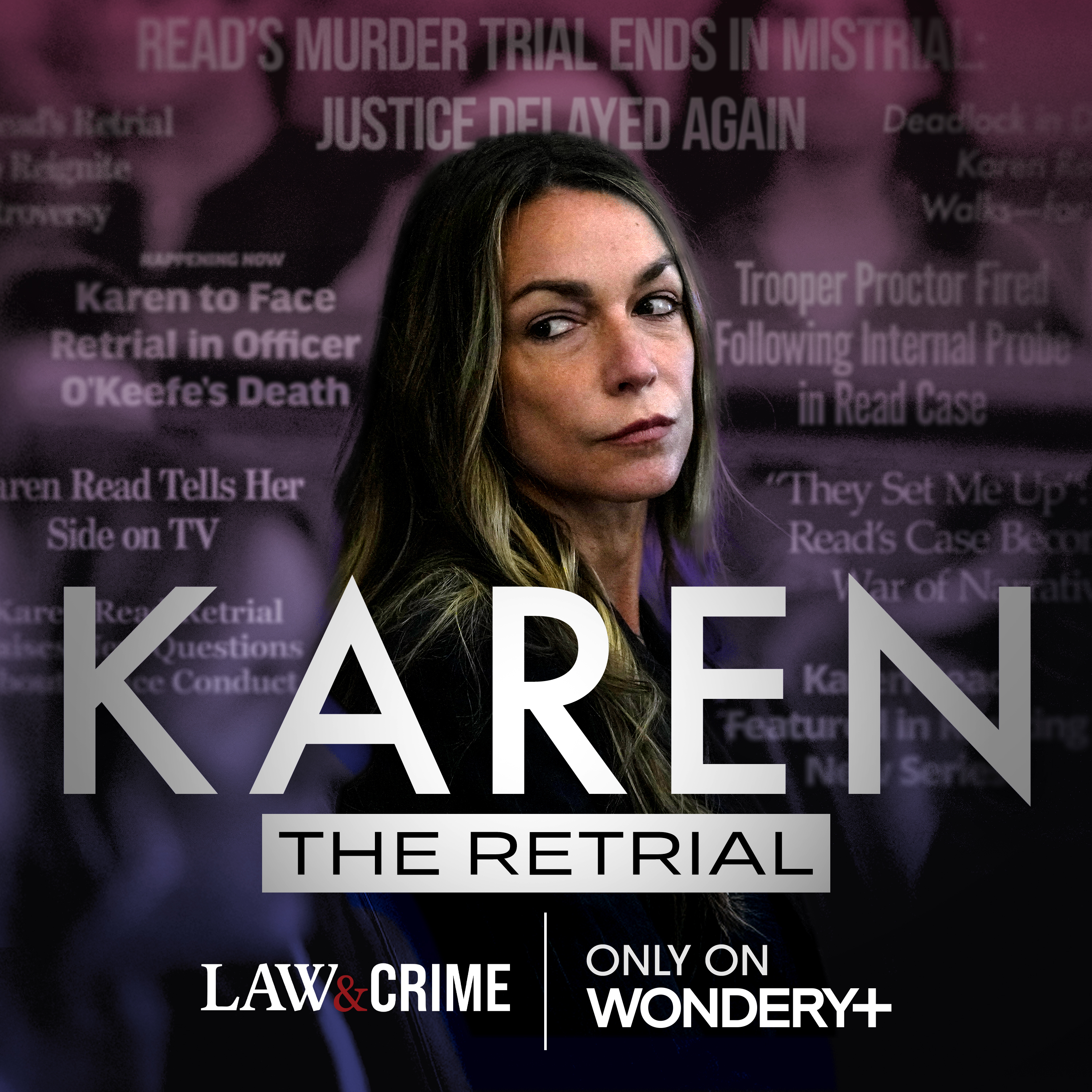
A blizzard in Massachusetts. A Boston police officer found dead in the snow. He, his girlfriend Karen Reid, accused of murder. After last year's mistrial left the country divided, the courtroom drama is back in the spotlight, this time with higher stakes, new prosecutors and explosive evidence emerging as the case unfolds in real time. Law & Crime's hit podcast series returns with a brand new season, the Retrial. Hosted by Emmy Award winning investigative reporter Kristin Thorne. Each episode delivers exclusive analysis, behind the scenes acts, and expert interviews you won't find anywhere else. With both sides fighting to control the narrative and new revelations coming to light, the search for truth is more urgent and more complicated than ever. I'm about to play a clip from Karen the Retrial. Follow Karen the Retrial on the Wondery app or wherever you get your podcasts. In his opening statement, prosecutor Hank Brennan didn't just lay out a narrative, he let Karen Reed tell it herself, using her own voice, her own words from her own interviews.
- [01:33]
Karen Reed
I mean, I didn't think I hit him, hit me, but could I have clipped him? Could I tagged him in the knee and incapacitated him? He didn't look mortally wounded as far as I could see. But could I have done something that knocked him out in drunkenness and in the cold, didn't come to again? And this would have been the moment.
- [01:55]
Kristin Thorne
You dropped him off at the party?
- [01:57]
Karen Reed
Yeah, yeah. Would have had to.
- [02:00]
Legal Analyst
The prosecution has played one clip of an interview that Karen Reed gave, and I guarantee they're going to play more throughout the trial because they're helpful to the prosecution. I think the defense was banking on her being acquitted and then it would have been this phenomenal story of, hey, here's a behind the scenes everything that happened. And look at we were right the whole time and she's acquitted. Whoops, mistrial coming back again for a second time. All that stuff is now fair game for the prosecution.
- [02:31]
Kristin Thorne
It's an extraordinary opportunity for the defense, a glaring vulnerability. Here's why.
- [02:38]
Prosecutor
Because not only do they reflect Karen's changing story that night, from dropping John off at the waterfall to seeing him outside the home to et cetera, but it also goes to show something far more damaging to Karen, which is consciousness.
- [02:54]
Kristin Thorne
Of guilt and it's not just the message, it's the delivery. Matt Timpanic puts it bluntly.
- [03:00]
Defense Attorney
The documentary is probably going to go down as one of the worst decisions made by a trial team because the worst witness in any criminal case is yourself. And what's even worse, when you're not even on the stand, to be able to be cross examined and explain that Hank Brennan is able to air I don't know how many hours of footage of the defendant's own statements without having to be cross examined. He gets to show the video and move on, essentially have the defendant narrate her own murder trial and plug the holes wherever they are.
- [03:36]
Kristin Thorne
In a case already defined by blurred lines between courtroom and media circus, Karen Reed's decision to go public may be one of the most consequential of all. Her voice was meant to tell her side of the story, and now it's being used to tell the prosecution's. But while the Commonwealth used Karen Reed's own voice to open their case, the defense struck a very different tone. The defense's opening statement was always going to carry weight. After all, this wasn't a cold start. Jurors knew about the mistrial. The public knew about the controversy. And the courtroom had already become a battleground long before opening arguments were even heard. But on day one, things didn't go entirely according to plan.
- [04:22]
Prosecutor
Ten minutes before openings were supposed to begin, Judge Kanoni ruled that the Reid defense had failed to comply with reciprocal discovery rules under Rule 14 and banned them from mentioning ARCA in their opening. So not only was Reid restricted this time by a formal written order on the third party culprit which exonerated Colin Albert, but Reid was banned 10 minutes before opening started from mentioning Arca.
- [04:47]
Kristin Thorne
If you aren't familiar with who the ARCA witnesses are, Matt Timpanik's got you covered.
- [04:52]
Defense Attorney
They were independent accident reconstructionists hired by the federal government to investigate this crash. They are vital, whatever word you want to use for Karen Reeves defense, because you need somebody saying that this was not a pedestrian strike.
- [05:07]
Kristin Thorne
Here's the catch.
- [05:08]
Defense Attorney
It turned out that's not entirely accurate and that they weren't paid for their services. That kind of came out in pre trial proceedings during discovery that there was communication between Alan Jackson and the ARCA witnesses. So there's going to be a real question about credibility either way.
- [05:27]
Kristin Thorne
That ruling drastically narrowed what the defense could say and how they could say it. Most critically, it blocked them from raising the possibility of a third party culprit, a cornerstone of their broader theory that John O'Keefe died not from being hit by a car, but inside the house at 34 Fairview Road.
- [05:47]
Defense Attorney
Alan Jackson was, in my opinion, playing with one arm behind his back because the judge said he couldn't mention third party culprit and he couldn't mention the arc of witnesses that's their whole case.
- [06:00]
Prosecutor
That I thought really shifted the tone. It put Alan Jackson into a position where he had to read from notes and be far less effective than Hank Brennan, who could go up there with a memorized set of facts and law and looked a lot more polished even if he walked away from the microphone a few times, which made it hard to hear on the stream.
- [06:17]
Kristin Thorne
Alan Jackson, Reid's hotshot out of state attorney, did what he could with what he had. He attacked the integrity of the investigation. He pointed to inconsistencies in the timeline. He emphasized that O'Keefe's injuries didn't align with a car strike.
- [06:33]
Expert Witness
The evidence will establish that John did not suffer from a single injury on his body consistent with having been hit by a car. Not one. There was no collision with John O'Keefe. There was no collision. There was no collision. John O'Keefe did not die from being hit by a vehicle, period.
- [07:00]
Kristin Thorne
But the narrative wasn't clean, and some argue neither was the delivery.
- [07:06]
Defense Attorney
Alan Jackson came off a little combative during the opening statement. He was almost at times yelling at the jury. People were saying he was being passionate. He really believes in the innocence of his client and that's fine. But the truth is you can't go from the laying, the soft spoken, laying it out, facts, data, evidence of Hank Brennan to basically yelling and overpowering the jury, which is what Alan Jackson did during his opening. He became more subdued after the first witness he crossed and realized that you don't need to do that to everyone.
- [07:40]
Kristin Thorne
Worse still, according to Grant Ellis, Jackson may have made a tactical misstep claiming he'd show O'Keefe went into the house, a claim not fully backed by the digital evidence.
- [07:51]
Expert Witness
The scientific evidence and the medical evidence will establish that John O'Keefe had to be injured somewhere else, somewhere warmer, and his body had to have been moved out into the cold.
- [08:05]
Prosecutor
Every piece of the evidentiary record, John's cell phone, GPS data, et cetera, shows that. And even jurors who were sympathetic to Karen in the first trial that gave media interviews said John's phone data showed that John hit that lawn around 12:32am and never move again. And so now Alan Jackson has put himself in an untenable position where Hank Brennan is going to be able to show evidence after evidence and maybe every juror, all 12 will agree that phone never left the lawn. And if John never left that lawn, Karen doesn't have a defense, and I think she struggles to get an acquittal on all three charges and a compromise verdict on oui manslaughter, involuntary manslaughter, or motor vehicle homicide. OUI is very likely.
- [08:53]
Kristin Thorne
Still, the defense leaned on what they believe is their strongest angle.
- [08:57]
Expert Witness
You'll find when you hear the evidence that the Commonwealth case is the literal definition of reasonable doubt.
- [09:03]
Prosecutor
There was not a word about Karen Reed was framed. The defense has absolutely abandoned that entire line of inquiry and seemed to suggest more that the investigation wasn't good enough to confirm Reed's guilt.
- [09:18]
Kristin Thorne
A challenge not just to the Commonwealth's theory, but to the investigation that built it.
- [09:24]
Expert Witness
You'll see from the evidence in this case that this case carries a malignancy, one that is spread through the investigation. It spread through the prosecution from the very start, from the jump. A cancer that cannot be cut out. A cancer that cannot be cured. And that cancer has a name. His name is Michael Proctor.
- [09:44]
Kristin Thorne
Listen to episodes of Karen the Retrial exclusively and ad free right now on Wondery. Plus. Start your free trial in the Wondery app, Apple Podcasts or Spotify.
- [09:55]
Narrator
Follow Law in the Rise and Fall of Diddy on the Wondery app. You can listen to more episodes exclusively and ad free right now on Wondery. Join Wondery in the Wondery app, Apple Podcasts or Spotify and get ad free access to more thrilling law and crime series like Karen and Sidebar with Jesse. We start your free trial today.