← The Rosary in a Year (with Fr. Mark-Mary Ames)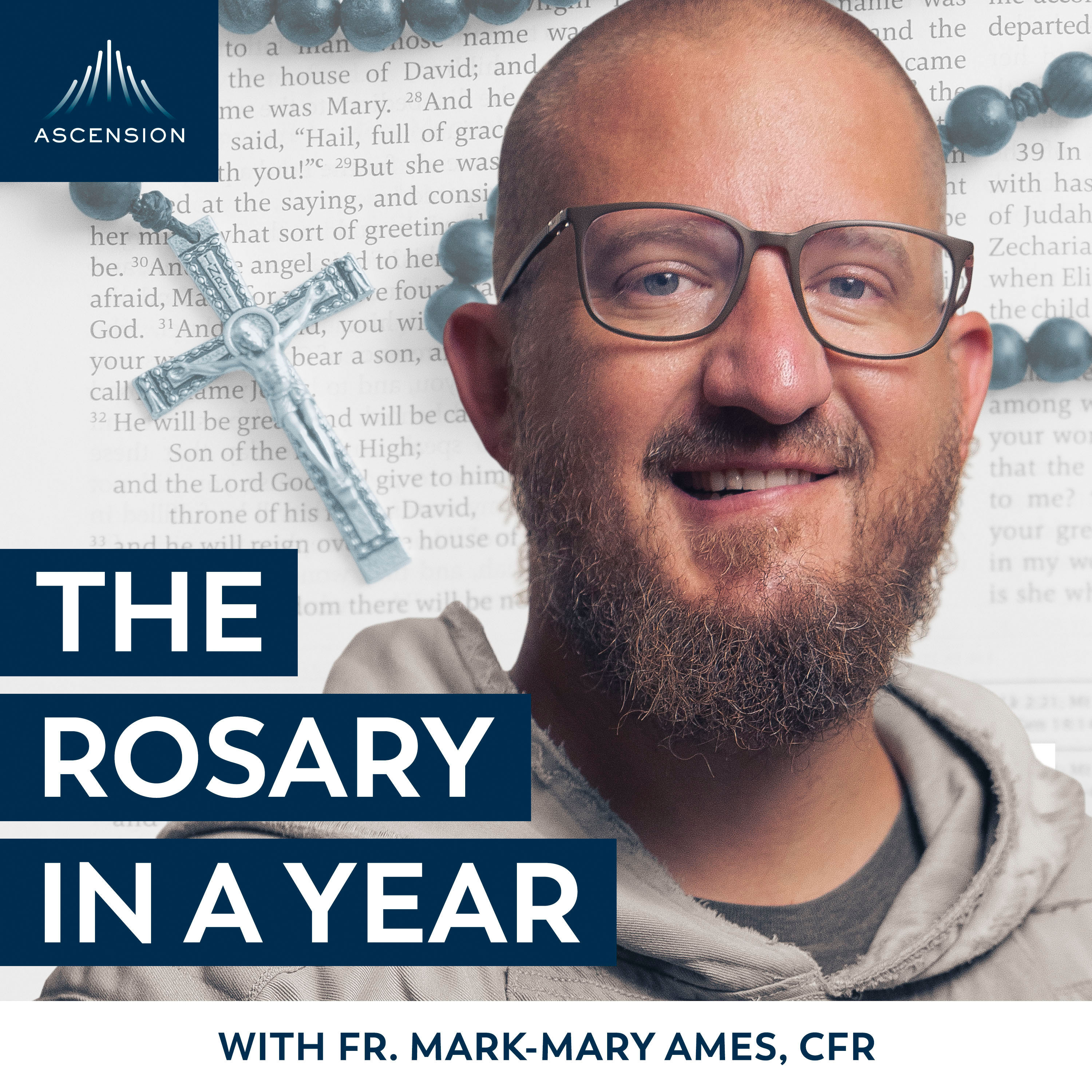
The Rosary in a Year (with Fr. Mark-Mary Ames)
Day 1: Responding to God
00:12:40
Welcome to Day 1 of the Rosary in a Year! Today we begin our journey with Fr. Mark-Mary, as he leads us in a guided meditation to help us find the presence of God as we pray. This first phase, Forming the Relationship, will set the stage for your rosaries all year as we begin deepening our relationship with Jesus and Mary in prayer. Today’s focus is on finding the presence of God, and we will be praying one Our Father, three Hail Marys, and one Glory Be. For the complete prayer plan, visit https://ascensionpress.com/riy.
Loading summary
Transcript1 lines
- [00:00]
A
Foreign. Mark Mary with the Franciscan Friars of the Renewal. And this is the Rosary in Year podcast where through prayer and meditation, the rosary brings us deeper into relationship with Jesus and Mary and becomes a source of grace for the whole world. The Rosary in a Year is brought to you by Ascension. This is day one. I am profoundly humbled and overjoyed that you're joining me on day one of this year long journey. What we're going to be doing with Rosary in the Year podcast is learning how to pray with the truths of our faith. This is all going to be at the service of receiving the fullness of the grace that they offer, including, but not limited to entering into a profound union with the Most Holy Trinity, Father, Son and Holy Spirit, and all of this with the Blessed Mother, Our Lady. In the announcement episode, the very first episode that we released, we talked about why this podcast exists and how it's like taking the time to absorb all that a major basilica like St. Peter's in Rome has to offer. Today I want to give a quick overview of how we're going to do that and then dive right into talking about prayer and what we call practicing the presence of God, really encountering the Lord and really encountering Jesus in prayer. The Rosary in a Year podcast will have a six phase structure. The first phase is called Forming the Relationship. And that's what we'll begin discussing today in greater detail, working this basic movement of prayer, like raising the mind and the heart to God. The second phase is called the Biblical roots of the Rosary. And this will be like a guided tour, again, a pilgrimage through St. Peter's Basilica multiple times, beginning with, you know, art history professor, then a priest. In other words, there's going to be formation regarding what the prayers or the scripture passages associated with the mysteries actually mean. Like, we'll answer the question, like, what's actually happening? Why is it important in general? Then another movement like homilies through all the mysteries, which explain, okay, why is it important to me and how do I apply this to my life? The third phase is called Meditating on the Mysteries and we'll have an introduction and guided practice of lectio divina. We'll pray with writings from the saints on the different mysteries and then do what's called visio divina. We'll look at and pray with sacred art depicting the different mysteries of the rosary. The fourth phase is called Finding Focus. And here we're going to pivot a little bit and we'll begin really applying what we have been receiving. We're going to build up our capacity to recall and to pray with the different mysteries, beginning with just one decade at a time. Phase five is called Building up the Decades. And we'll be doing exactly what it says, slowly adding the amount of decades we're gonna be praying together at once, from one decade to two decades, three decades, four decades. And then finally, we'll have built this muscle of prayer for phase six. In this phase six, the last and final phase, we'll be praying the full rosary together, applying what we've learned together, receiving the graces for ourselves, and even more importantly, praying together for an outpouring of grace upon the whole world. That's the pilgrimage we'll be making together with the Rosary in Year podcast. But now, today, I like this episode, Day one of the Rosary in a Year podcast to be more than just an introduction to the syllabus, as you might have in the first day of class. Like, let's actually get started with a basic introduction to prayer and prayer as practicing the presence of God, the Catechism of the Catholic Church. In a section on prayer, it says it is most important that the heart should be present to him to whom we are speaking in prayer. Whether or not our prayer is heard depends not on the number of words, but on the fervor of our souls. Praying the rosary, it's not just about saying prayers. It's about raising our minds and our hearts to God. So what does this mean? Like, what does it mean to raise our mind to God? To raise our mind to God in prayer? It's an act of faith. It's an act of faith by which we look at him, who is always looking at us. It is a moment of recognizing that we are not alone, that God is with us, looking at us, listening to us and loving us at all times. Prayer and raising our minds to God is our response to this reality. To raise our minds to God in prayer. It also includes just looking at him, pondering who he is and what he's done for us and what it means for us. And this is what we're going to be doing for a large part throughout the Rosary in a Year podcast. But today we're going to. We're going to focus on what we could call, like, practicing the presence of God, just recognizing who he is and that he is with us. Sometimes when we pray, we. We move like, really quickly into saying our prayers, into our reading, into our meditating, and it can too easily become just a personal, solitary project. But prayer is always, we could say, a group project at the Very least between me and God, with God in his grace, doing the heavy lifting. So when we pray, we begin by looking at him, by acknowledging him and recognizing his presence. For example, like, you don't just pick up a phone, dial the number, and then start talking. You pick up the phone, dial the number, wait for the other person to say hello, and then you start talking. But too often, like, we don't take the time to wait for God to say hello, to connect with Him. We just start talking and it becomes again, a monologue, sometimes just to ourselves. And so practicing the presence of God, beginning prayer by raising our mind and heart to God in one way could just be looking at him, hearing him say hello. And then we enter into our prayer or meditation as we have planned it for that moment. Okay, so how do we actually do this? What does it look like? First, we need to just slow down for a second, maybe take a couple of deep breaths, and then we're going to receive his presence. We don't produce his presence. He is always present to us, so we receive his presence. And there's a lot of space for personalizing this for what works for you. Traditionally, we begin with the sign of the cross. And as we're making the sign of the cross, we're recognizing that Father, Son and Holy Spirit are present to us. This can be looking at some sort of sacred art, religious image of our Lord. Or maybe in your imagination, you have a place of prayer that you go to. This could be a chapel. For some, it's a garden. For some there's like a. What we call a hermitage within. Or one of my favorites is to use a word of scripture, like making your own Jesus own. Words to his father in John 11. Father, I thank you for hearing me. I know that you always hear me. And again, all of this is at the service of receiving his presence, which what we classically talk about as practicing the presence of God. And this is something that as we are praying the rosary, we do at the beginning and we receive his presence, we recognize that we are not alone. Immanuel. God is with us, looking at us, listening to us, loving us. And we also raise our minds to God by meditating on the words we're praying and by contemplating the different mysteries of the rosary. And I'll just quick note on raising our hearts to God. Giving our heart to God is to give our very selves to God. Like the heart, it's the whole self. If we're to get a little bit particular for a moment, though, it's more a Movement of our will than our emotions, though it may affect our emotional life. Looking at Jesus, maybe using art, there's this movement of the heart, of the will, of I love you, Jesus. Thank you, Jesus. Help me, Jesus. Save me, Jesus. Or maybe you might be making this prayer, this movement of the heart on behalf of, of the world or of a loved one. Like, have mercy on us, Jesus. Help us, Jesus. Heal us, Jesus. Give us your peace, Jesus. And so, in short, to raise our minds and our hearts to God is to receive his presence, to look at him, to recognize him, to receive that he knows us and is looking at us, than to give our hearts to him, to give our needs to him, to give our deepest desires to him, our fears, our hopes to him, and receive his love, his peace, his care, his own heart for us. And my brothers and sisters, this. This is what prayer is about and this is what praying the rosary is about. I recognize there's a lot of moving parts to prayer and praying the Rosary and at first trying to do this, well, it might make you feel like somebody who's never danced a day in their life, who's now in a dance class. Like, you might feel a little uncoordinated. It might feel kind of a little difficult or awkward to like, move my heart to God. Like, how do, how do I do that? To raise my mind to God and doing them both at the same time. But over time, we'll build this habit together. We'll find the rhythm and we'll come to experience for ourselves why the rosary has become such a popular and long standing form of prayer. Source of grace and maker of saints. So, my brothers and sisters, an ending each day of phase one. We're going to end with the sign of the cross in Our Father, three Hail Marys, the Glory Be and the sign of the Cross. And let's end today by practicing what we've just talked about, raising our minds and our hearts to God. Like, let's simply find Jesus, like, receive his presence and tell him we love Him. And then let's find Mary. Let's receive her loving presence, her loving gaze. Now let's tell her we love her too. Let us pray in the name of the Father and of the Son and of the Holy Spirit. Amen. Our Father who art in heaven, hallowed be Thy name. Thy kingdom come, Thy will be done on earth as it is in heaven. Give us this day our daily bread and forgive us our trespasses as we forgive those who trespass against us. And lead us not into temptation, but deliver us from evil. Amen. Hail Mary, full of grace. The Lord is with the. Blessed art thou among women, and blessed is the fruit of thy womb, Jesus. Holy Mary, Mother of God, pray for us sinners now and at the hour of our death. Amen. Hail Mary, full of grace. The Lord is with the. Blessed art thou among women, and blessed is the fruit of thy womb, Jesus. Holy Mary, mother of God, pray for us sinners now and at the hour of our death. Amen. Hail Mary, full of grace, The Lord is with the. Blessed art thou among women, and blessed is the fruit of thy womb, Jesus. Holy Mary, mother of God, pray for us sinners now and at the hour of our death. Amen. Glory be to the Father and to the Son and to the Holy Spirit. As it was in the beginning, is now and ever shall be, world without end. Amen. In the name of the Father and of the Son and of the Holy Spirit. All right. Thanks for joining me and praying with me today. I look forward to continuing this journey with you again tomorrow. Poco. Poco. Friends, God bless y'. All.