← The Rosary in a Year (with Fr. Mark-Mary Ames)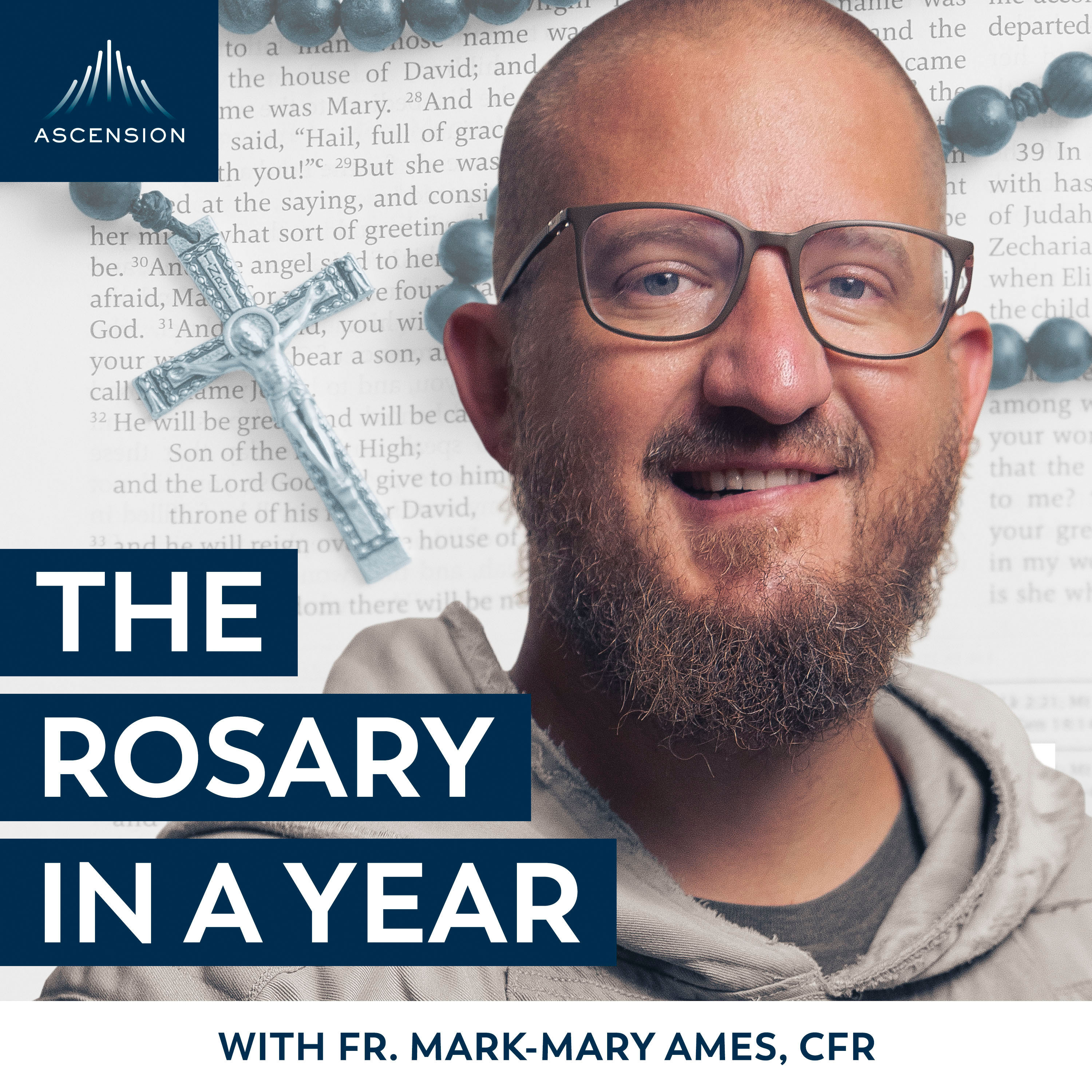
The Rosary in a Year (with Fr. Mark-Mary Ames)
Day 101: Glory and Indignity
00:13:09
Instead of a crown of glory, they imposed on him a crown of indignity, St. Thomas Aquinas writes of the Crowning with Thorns. Fr. Mark-Mary recalls a learning experience on a trip to Nebraska, explaining the true nature of indignity, and relating it to Jesus’ experience during his passion. Today’s focus is the mystery of the Crowning with Thorns and we will be praying one decade of the Rosary. For the complete prayer plan, visit https://ascensionpress.com/riy.
Loading summary
Transcript27 lines
- [00:00]
A
Foreign Mark Mary with the Franciscan Friars of the Renewal and this is the Rosary in Year podcast, where through prayer and meditation, the Rosary brings us deeper into relationship with Jesus and Mary and becomes a source of grace for the whole world. The Rosary in a Year is brought to you by Ascension. This is day 101. To download the prayer plan for Rosary in a year, visit ascensionpress.com rosary in a year or text RIY to 3 3. You'll get an outline of how we're going to pray each month and it's a great way to track your progress. The best place to listen to Podcasts in the Ascension app. There are special features built just for this podcast and also recordings of the full rosary with myself and other friars. No matter what app you're listening in, remember to tap, follow or subscribe for your daily notifications. Behalf of myself and the whole team here at Ascension, we wanted to take this opportunity to thank everyone who's helped support this podcast financially. Your generosity is so appreciated and helps us to reach as many people as possible. If you haven't already, please consider supporting us at essentialpress.com forward/support. Today we will be reflecting on and praying with the third Sorrowful Mystery, the Crowning with Thorns, aided by a reading from St. Thomas Aquinas from his work Cometary on the Gospel of Matthew. Okay, as mentioned, today's reading is from the Angelic Doctor, the great Dominican St. Thomas Aquinas. Interesting fact about St. Thomas Aquinas. Allegedly. Allegedly, he's quoted as saying his favorite philosopher and favorite theologian of all time are none other than Saint Bonaventure, the great Franciscan. By allegedly I mean he never said that at all. But having fun with my Dominican counterparts here while doing the Rosary, which they helped, did so much work in popularizing. So thanks to Dominican brothers out there, St. Thomas Aquinas pray for us. St. Thomas Aquinas was born in 1225 and he died in 1274. Like St. Augustine, his contributions to the Church are really too extensive to fully cover here, but of course he's well known for his theological writings such as the Summa Theologiae. As I mentioned, St. Thomas Aquinas was Dominican friar and priest and is a Doctor of the Church with the title Angelic Doctor. Pope Benedict XVI tells us in a general audience that St Thomas was called the angelic doctor, the doctor angelicus, perhaps because of his virtues and in particular the sublimity of his thought and the purity of his life. So here's a short reading from St. Thomas Aquinas from his Commentary on the Gospel of Matthew Our focus will be Instead of a crown of glory, they impose on him a crown of indignity. And the reading begins. And plating a crown of thorns, they put it on his head. Hence, instead of a crown of glory, they imposed on him a crown of indignity. He will crown you with the crown of tribulation. These thorns signify the prickles of sinners which prick their consciences. And Christ received these for us, for he died for our sins. Or it can be referred to Adam's curse, where it was said, thorns and thistles will it bring forth to you. Hence, it signified that this curse was undone. The end of the reading thanks be to God. Again, our focus here. Hence, instead of a crown of glory, they imposed on him a crown of indignity. Let's begin by looking at the definition of indignity. According to Merriam Webster dictionary, it means an act that offends against a person's dignity or humiliating treatment. Reading and reflecting on this definition takes me to a pretty tough memory, to be honest. It takes me back to a time that myself and a fellow friar were traveling to Lincoln, Nebraska. The reason we were in Lincoln, Nebraska, is a couple of us were there because one of our our brothers was just ordained a priest, and so he was out there for what we called the Mass of Thanksgiving. So there's a bunch of us out there, myself and the other friar, who's a good friend of mine, we were being hosted by a young couple. This young couple would go on to become lifelong friends of ours. But early into the trip, the other friar, myself, again, like, we're close friends, and probably because of that, we're a little bit too immature for our own good. We started to play a game with the mom, like with the host mom. And it's a game where two people who know what they're doing, they try and only ask the third person questions. So you're trying to have a conversation going on as long as possible where two of you are only responding, only asking questions until the focus of this prank realizes it. For example, like so friar one says, oh, so what's for dinner tonight? The mom answers, oh yeah, spaghetti and meatballs. It's easy with all the kids. So then Fryer two has a ton of options. You can go a thousand ways. So are the kids old enough yet to have favorite foods? Do you try and cook most nights in the house? Do you learn to cook when you're growing up or as a mom? And the mom answers, and you just kind of keep going as long as possible, just with questions. Well, here's the thing. The mom we were playing the joke on was from Lincoln, Nebraska. And she was innocent and she was warm hearted and she was trusting, and she was just a good, wholesome Midwest mother. So what happens is the Friar and myself, we're just, we're having a great time and we're enjoying ourselves and it just like, she just isn't picking up on it. And so we have this game going for like 20 or 30 minutes, literally. And we learned all type of stuff about, you know, the violin and the violin classes that our kids were taking. Finally, the two of us, we realized this little prank, this little game, is not going to end organically. And with our immature, childish laughter, we tell her what we were doing. And the look that she gave us, the way her face just dropped with disappointment and hurt and sadness, it just crushed me. It pierced me to the core. This was like 10 years ago. And just thinking about it now, still, I feel it. And then her first words, just like, push the sword deeper. It's like, oh, oh, I thought you guys were just interested in our family. Crushing, Crushing her look. Her reaction said, I trusted you. I thought this was safe. I trusted you and you took advantage of me. Like, I rolled out the red carpet for you and you tricked me. I gave you a place in my home and even in my heart. And you guys hurt me. Like, in a small but, like, parallel sense, you can see the comparison. It's like I deserved a crown of glory and you gave me a crown of indignation. It was right for you, like, to honor me and to celebrate me. And you humiliated me. And I called to mind that look and her response and how it hurt me and how it immediately, like, revealed what I was doing and just, it led me to like a really, really deep, immediate contrition and repentance, like, right away. How much more so here, as we were reflecting on and praying with the third sorrowful mystery, when the Lord looks at us and he says to us with his eyes, I gave you everything. I trusted you. I gave you life and freedom and a beautiful creation. I created for you a home. I loved you. And this, this crown of thorns, this is how you repay me. I trusted you and you took advantage of me. I loved you and you humiliated me. Just look at the ways in which we have hurt him by our sin and our selfishness. And how many times, instead of giving him a crown of glory, have we given the Lord a crown of indignation? So as we conclude today's episode praying one decade of the most holy rosary. I'm just going to invite you to focus on the face of Jesus as he stands before you crowned with thorns. And notice his eyes which say like, why all this? Why do you treat me so? All I did was love you. And now with Mary. Let us pray in the name of the Father and of the Son and of the Holy Spirit.
- [09:40]
B
Amen.
- [09:42]
A
Our Father, who art in heaven, hallowed be thy name. Thy kingdom come, thy will be done on earth as it is in heaven. Give us this day our daily bread and forgive us our trespasses as we forgive those who trespass against us. And lead us not into temptation, but deliver us from evil.
- [10:02]
B
Amen.
- [10:03]
A
Hail Mary, full of grace, the Lord is with the blessed art thou among women, and blessed is the fruit of thy womb, Jesus. Holy Mary, mother of God, pray for us sinners now and at the hour of our death.
- [10:17]
B
Amen.
- [10:19]
A
Hail Mary, full of grace, the Lord is with the blessed art thou among women, and blessed is the fruit of thy womb, Jesus. Holy Mary, mother of God, pray for us sinners now and at the hour of our death.
- [10:33]
B
Amen.
- [10:34]
A
Hail Mary, full of grace. The Lord is with the blessed art thou among women, and blessed is the fruit of thy womb, Jesus. Holy Mary, mother of God, pray for us sinners now and at the hour of our death.
- [10:48]
B
Amen.
- [10:50]
A
Hail Mary, full of grace, the Lord is with thee. Blessed art thou among women, and blessed is the fruit of thy womb, Jesus. Holy Mary, mother of God, pray for us sinners now and at the hour of our death.
- [11:04]
B
Amen.
- [11:05]
A
Hail Mary, full of grace, the Lord is with the blessed art thou among women, and blessed is the fruit of thy womb, Jesus. Holy Mary, mother of God, pray for us sinners now and at the hour of our death.
- [11:20]
B
Amen.
- [11:22]
A
Hail Mary, full of grace. The Lord is with the blessed art thou among women, and blessed is the fruit of thy womb, Jesus. Holy Mary, mother of God, pray for us sinners now and at the hour of our death.
- [11:37]
B
Amen.
- [11:38]
A
Hail Mary, full of grace. The Lord is with the blessed art thou among women, and blessed is the fruit of thy womb, Jesus. Holy Mary, mother of God, pray for us sinners now and at the hour of our death.
- [11:52]
B
Amen.
- [11:54]
A
Hail Mary, full of grace, the Lord is with the Blessed art thou among women, and blessed is the fruit of thy womb, Jesus. Holy Mary, mother of God, pray for us sinners now and at the hour of our death.
- [12:08]
B
Amen.
- [12:09]
A
Hail Mary, full of grace, the Lord is with thee. Blessed art thou among women, and blessed is the fruit of thy womb, Jesus. Holy Mary, mother of God, pray for us sinners now and at the hour of our death.
- [12:22]
B
Amen.
- [12:24]
A
Hail Mary, full of grace, the Lord is with thee. Blessed art thou among women, and blessed is the fruit of thy womb, Jesus. Holy Mary, mother of God, pray for us sinners now and at the hour of our death.
- [12:37]
B
Amen.
- [12:38]
A
Glory be to the Father and to the Son and to the Holy Spirit. As it was in the beginning, is now and ever shall be, world without end.
- [12:46]
B
Amen.
- [12:47]
A
In the name of the Father and of the Son and of the Holy Spirit. Amen. All right, well, thank you so much for joining me and praying with me today. I look forward to continuing this journey with you again tomorrow. All right. Poco Poco. Friends, God bless.