← The Rosary in a Year (with Fr. Mark-Mary Ames)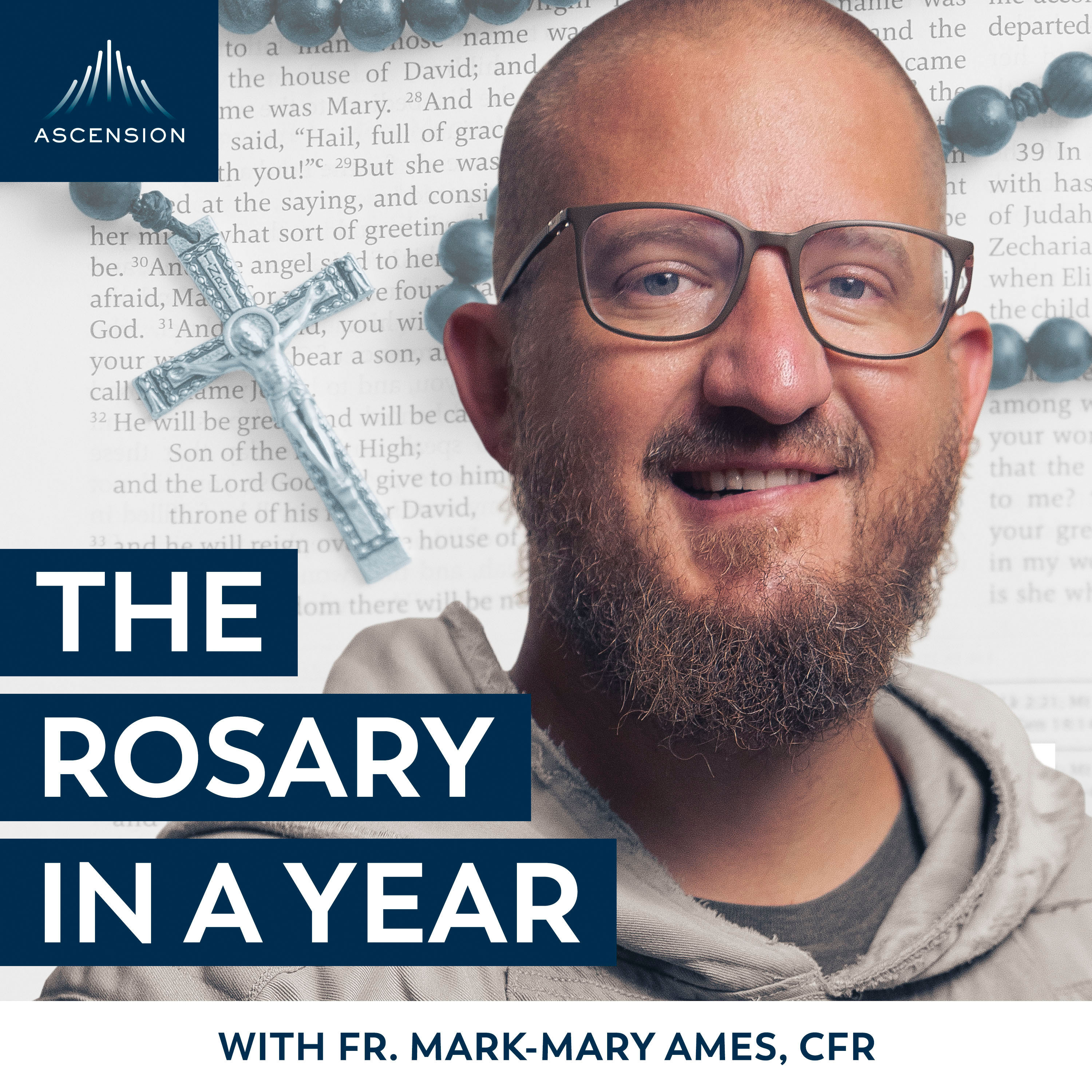
The Rosary in a Year (with Fr. Mark-Mary Ames)
Day 11: As We Forgive
00:10:54
We are to forgive as we have been forgiven. Today, Fr. Mark Mary leads us in a meditation upon the forgiveness described in the Our Father, taking inspiration from a parable in Matthew 18 and a personal experience with a delicious plate of nachos. As we come to the Lord in prayer today, Fr. Mark Mary invites us to allow God’s mercy to flow through us. Today’s focus is “and forgive us our trespasses as we forgive those who trespass against us” and we will be praying one Our Father, three Hail Marys, and one Glory Be.
Loading summary
Transcript1 lines
- [00:00]
A
Foreign Mark Mary with Franciscan Friars of the Renewal and this is the Rosary in a Year podcast where through prayer and meditation, the Rosary brings us deeper into relationship with Jesus and Mary. It becomes a source of grace for the whole world. The Rosary in the Year is brought to you by Ascension. This, my friends, is day 11. To download the prayer plan for Rosary in a year, visit ascensionpress.com rosary in a year or text RIY to 337 7. You'll get an outline of how we're going to pray each month and it's a great way to track your progress. The best place to listen to the podcast is in the Ascension app. There are special features built just for this podcast and also recordings of the full rosary with myself and other friars. We want to take this opportunity to thank everyone who has helped support this podcast financially. Your support is so appreciated and helps us to reach as many people as possible. And if you haven't already, please consider supporting us@ascendantpress.com forward/success support and forgive us our trespasses as we forgive those who trespass against us. Here it is, my friends, the height of the gift and the height of the call to be merciful, as our Heavenly Father is merciful. And here's the thing right how our Heavenly Father never tires of forgiving us. His mercy is new every morning. And that mercy, like, never ceases to flow freely from the heart of God. And so we need not fear our sin, we need not fear our weakness like we can bring it to him again and again and again. And he will receive us again and again and again as if it were the first time. Such is the heart of God, such is his mercy. My brothers and sisters, you and I by our baptism have this sublime call to share in the life of God, to have the life of Christ lived and living within us. Therefore it is proper to the Christian that as mercy never ceases to flow freely from the heart of God, that mercy never ceases to flow freely from the heart of Christians that we are to forgive as we have been forgiven. To root this in Scripture, I'm going to take us to Matthew, the Gospel of Matthew, chapter 18, verse 23 I'm just going to paraphrase this. Therefore the kingdom of heaven may be compared to a king who wished to settle account with his servants. When he began the reckoning, one was brought to him who owed him 10,000 talents and he could not pay His Lord ordered him to be sold, and his wife and children and all that he had, and payment to be made so the servant fell on his knees, imploring him, lord, have patience with me, and I will pay you everything. And out of pity for him, the Lord of that servant released him and forgave him the debt. But that same servant, as he went out, came upon one of his fellow servants who owed him a hundred denarii. And seizing him by the throat, he said, pay what you owe. So his fellow servant fell down and pleaded with him, have patience with me, and I will pay you. He refused and went and put him in prison till he should pay the debt. When his fellow servants saw what had taken place, they were greatly distressed and they went and reported to their Lord all that had taken place. Then his Lord summoned him and said to him, you wicked servant, I forgave you all that debt because you pleaded with me. And should not you have had mercy on your fellow servant as I had mercy on you? And in anger, his Lord delivered him to the jailers till he should pay all his debt. So also my heavenly Father will do to every one of you if you do not forgive your brother from your heart. Mercy is beautiful and incredible and such a gift. But also with it comes this great responsibility. If any of you have kind of heard me talk before, I often share about my love of nachos. And there's this story of I was visiting, like, a family friend down in Pensacola, Florida, and there's a group of young adults. And one of the young adults there knew that I really like nachos. And she was going out for the afternoon to run some errands. And so she said, hey, do you want me to pick up some nachos? Like, yeah, sure, of course. Awesome. So she offers it. She goes runs her errands, goes through the drive through at Taco Bell, picks up some nachos, brings them back to the house. And we're around the dining table where the family is, and there's a couple seats between us. She's at the end, and I'm like two seats in on one of the sides. And I get out the nachos, and I'm kind of getting ready to eat them, saying grace. There's a couple other kids there, right? And so I say to them, hey, would you like a nacho? And they, being upstanding citizens, knew I didn't really want them to have the nachos. But it was the right thing to do to offer it, and it was the right thing to do to decline it, right? So I said, do you want a nacho? They're like, no, I'm Good. I'm like, oh, okay, great. And then, of course, I had to get to the young lady, the young adult woman who bought the nachos. It's like, hey, would you like some nachos? And then immediately she went from sitting on the seat to kneeling on the seat and kind of leaned over the table and put her elbows on the table, and she took up what would be a permanent place over the nachos. It was at that moment that I realized these were not my nachos, but our nachos. And it's funny, reflecting on the story, because it was so hard for me to be like, no, I wanted these. These are all for me. It's a special treat. But here's, like, the thing. She offered it, she went and got it. Like, she paid for it. Like, if anyone deserved right to receive some of these nachos, it was her. And if I would have said like, no, you can't have any. These are mine, everybody would have been like, that is ridiculous. Like, that is just not right at all. And I think this is something of what's going on with the gospel. There's the one servant who's forgiven his debt, and it's a great debt, and what a gift of the mercy of this, of the king. But then he goes to the person who owed him a little bit, and he says, no, and right. All the other people around are like, that's crazy. Like, that is just not right. That is just not right. Not just. You have been forgiven so much and yet you're not willing to forgive. And my friends, like, this is. This is what the Lord's Prayer holds before us. The Lord created us, he gave us life. We rebelled, we sinned against him, and yet he comes in pursuit of us to forgive us by ultimately dying for us. And what does he ask us to do? He asks us to share what we have been freely given. We who have been freely given mercy at the cost of the blood of the lamb are asked to forgive as we have been forgiven. If mercy is going to flow through our hearts, like, our hearts need to be connected to his heart. Because ultimately, like, forgiveness is more than just a human thing. It's a supernatural thing. It's a God thing. To be able to forgive as God has forgives is to allow God to forgive through us, to live his life through us. And so we don't do it all in our own strength, but we have to go to him each and every day asking to be reminded of how we have been forgiven. I think a beautiful way to do this is to have the daily practice of meditating upon a crucifix, or at least looking upon a crucifix, kissing a crucifix, just remembering again how God has forgiven us, and then asking for him the grace to forgive as we have been forgiven. And mercy. It's not just an on off switch. It's often going to have the characteristics of a journey if we're on the journey. But each and every day we come to the Lord asking more and more for the grace so that we can forgive those who have trespassed against us, that our trespasses may be forgiven. My brothers and sisters, let us bring our hearts to the Lord. Let us be bathed again in his mercy. Let us be moved to awe and adoration at the heart of God, of how he loves us. Let us continue to ask, to receive the healing we need and the grace we need to forgive those who have forgiven us. Lord Jesus, may your mercy flow through us. In the name of the Father and of the Son and of the Holy Spirit. Amen. Our Father, who art in heaven, hallowed be thy name. Thy kingdom come, Thy will be done on earth as it is in heaven. Give us this day our daily bread and forgive us our trespasses as we forgive those who trespass against us. And lead us not into temptation, but deliver us from evil. Amen. Hail Mary, full of grace, the Lord is with the. Blessed art thou among women, and blessed is the fruit of thy womb, Jesus. Holy Mary, Mother of God, pray for us sinners now and at the hour of our death. Amen. Hail Mary, full of grace, The Lord is with the. Blessed art thou among women, and blessed is the fruit of thy womb, Jesus. Holy Mary, mother of God, pray for us sinners now and at the hour of our death. Amen. Hail Mary, full of grace. The Lord is with the. Blessed art thou among women, and blessed is the fruit of thy womb, Jesus. Holy Mary, mother of God, pray for us sinners now and at the hour of our death. Amen. Glory be to the Father and to the Son and to the Holy Spirit. As it was in the beginning, is now and ever shall be, world without end. Amen. In the name of the Father and of the Son and of the Holy Spirit. Amen. All right, friends, thanks for joining me and praying with me again today. I look forward to continuing this journey with you tomorrow. Poco. Poco. All right. God bless y'all.