← The Rosary in a Year (with Fr. Mark-Mary Ames)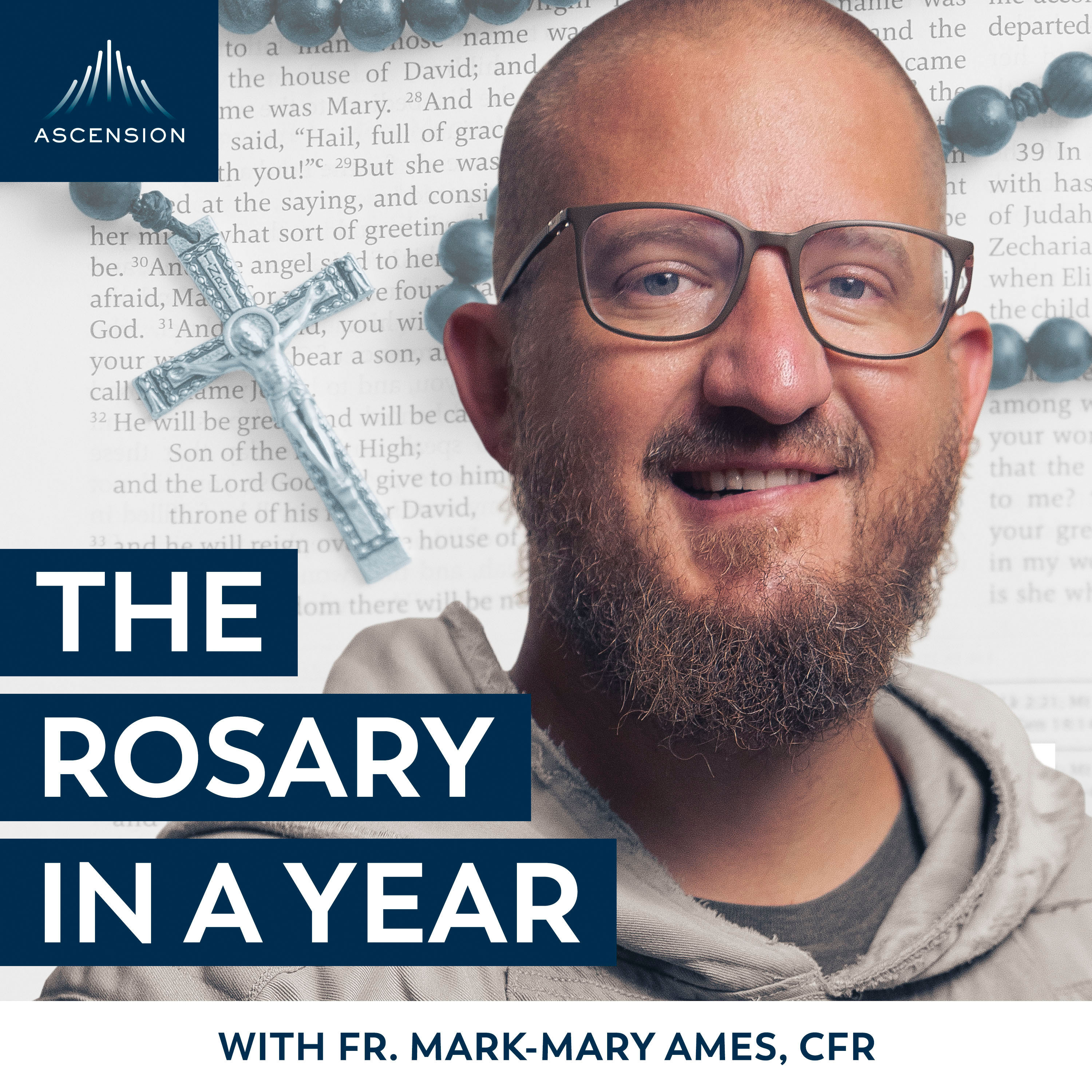
The Rosary in a Year (with Fr. Mark-Mary Ames)
Day 115: Wedding of the Lamb
00:12:55
Two weddings are being celebrated at the wedding feast at Cana. As the divine bridegroom, Jesus’ relationship to his bride, the Church, changes here. Fr. Mark-Mary reads from St. John Newman, revealing the similarities of the beginning of Jesus’ ministry and the wedding happening in Cana. Today’s focus is the mystery of the Wedding Feast at Cana and we will be praying one decade of the Rosary. For the complete prayer plan, visit https://ascensionpress.com/riy.
Loading summary
Transcript1 lines
- [00:00]
A
Foreign Mark May with Franciscan Friars of the Renewal and this is the Rosary in your podcast where through prayer and meditation, the Rosary brings us deeper into relationship with Jesus and Mary and becomes a source of grace for the whole world. The Rosary in a Year is brought to you by Ascension. This is day 115. To download the prayer plan for Rosary in a year, visit ascensionpress.comrosaryinayear or text RIY to 33777. You'll get an outline of how we're going to pray each month, and it's a great way to track your progress. The best place to listen to the Podcast in the Ascension app. There are special features built just for this podcast and also recordings of the full Rosary with myself and other friars. No matter what app you're listening in, remember to tap, follow or subscribe for your daily notifications. Today we will be meditating upon and praying with the second luminous mystery, the Wedding Feast at Cana, with help from St. John Henry Newman and his writing sermon three, found in his larger work, Sermons Bearing on Subjects of the Day. And the point of our emphasis is going to be the wedding feast of the Divine Bridegroom. So a little background on our author, St. John Henry Cardinal Newman, born in the year 1801, and he passed from this life in 1890s, so somewhat recent. He was a convert from Anglicanism to Catholicism and really one of the 19th century's most influential theologians. His conversion to Catholicism was largely influenced by his study of church history and the Church Fathers. After becoming Catholic, he'd go on to be ordained a priest. He'd eventually be made a cardinal. One of the main focuses of his writings and his one of his major contributions was his very, very, very thorough work discussing, like a proper understanding of the development of doctrine over time. I think a lot of people have heard his name without really knowing it's in reference to him, because sort of a popular name for like Catholic campus ministries at colleges is the Newman center, which is named after our author today, St. John Henry Newman. He was canonized in the year 2019, and he's not a Doctor of the Church, at least not yet. But he has been called the absent Father of Vatican ii. Vatican ii. It took place after his death, but his writings had a profound influence on the Council documents. All right, and now our reading from St. John Henry Newman. Nay, may we not say that our Lord Himself had commenced his ministry, that is bade farewell to his earthly home at a feast. For it was at the marriage entertainment at Cana of Galilee that he did his first miracle and manifested forth his glory. He was in the house of friends. He was surrounded by intimates and followers, and he took a familiar interest in the exigencies of the feast. He supplied a principal want which was interfering with their festivity. It was his contribution to it. By supplying it miraculously, he showed that he was beginning a new life, the life of a messenger from God, and that that feast was the last scene of the old life. And moreover, he made use of one remarkable expression which seems to imply that this change of condition really was in his thoughts. If we may dare to speak of them, or at all to interpret them. For when his mother said unto him, they have no wine, he answered, what have I to do with thee? He had had to do with her. For 30 years she had borne him, she had nursed him, she had taught him. And when he had reached 12 years old, at the age when the young may expect to be separated from their parents, he had only become more intimately one with them. For we are told that he went down with them and came to Nazareth and was subject unto them. Eighteen years had passed away since this occurred. St. Joseph, as it seems, had been taken to his rest. Mary remained. But from Mary, his mother, he must now part for the three years of his ministry. The end of the reading. Thanks be to God. Again, the point of our emphasis is going to be the wedding feast of the Lamb. And spoiler alert, I think this is a really good episode. John Henry Newman here. He offers us, I think, a really unique insight into the wedding feast of Cana. Essentially, he proposes it to be a type of going away party. And these are his words. He writes, nay, may we not say that our Lord himself commenced his ministry, that his bade farewell to his earthly home at a feast. And he goes on to say he was in the house of friends. He was surrounded by intimates and followers. All right, let's. Let's kind of look at the details here. A couple of notes. The setting is a wedding feast. Jesus is with friends and family. It's here that he works his first miracle and manifested forth his glory. And it's here that he says goodbye to Mary. Not in the sense of like a total exodus from. But he's. He's beginning a new type of life, a new form of life. And so he says goodbye to the particular expression of her motherhood and his sonship. Up to this point, all of this seems, at least to me, to be dramatically consistent with what happens at each and every wedding between the bride, bridegroom and their families. Obviously, except for the working of a miracle, manifesting of one's glory. But, right. Look at the commonalities, the parallels. There's a celebration with friends and family, like in most American weddings these days. Like, so the weddings that I'm familiar with, the father, the bride walks the bride down the aisle and hands her, entrusts her to her soon to be husband, right? There's this type of like a changing of relationships. He'll always be her father, she'll always be his little girl. But it's as if the dad here is saying, hey, I up to this point have been tasked as being your original caretaker, provider, protector, honor. But now I entrust this to your husband. It is his work to continue what I've started. You know, it's a really beautiful moment, but there's something that changes there. There's a change in the dynamic of the relationship or the responsibilities in the relationship. But also, like the bridegroom, the groom, he leaves his own family and he also begins a new life with his bride. And in doing so, his relationship and his duties to his parents change. Genesis chapter two, it says this, right? This is why a man leaves his father and mother and he's united to his wife, and they become one flesh. So keeping all of this in mind, I think it brings us to a deeper understanding of what's happening at the wedding feast of Cana. Could we say here that two weddings are being celebrated at this wedding feast? One, according to the custom of time, would last a few days, but the other would last for eternity. Jesus is the divine bridegroom. And it is here at the wedding feast of Cana that he begins his new mission as bridegroom. It's here that he himself lives this. Genesis 2:24, leaving behind his mother to. To become one flesh with his spouse, the church, his mystical body, into which all of the baptized are incorporated. Jesus, the divine bridegroom, now takes upon himself the responsibilities of providing for his bride, of protecting his bride, of caring for his bride, of loving his bride, and of ultimately laying down his life for his bride, all at the service of the ultimate call of a bridegroom to help bring his wife, to help bring the bride to heaven. So I think all this, it makes a lot of sense of what's happening here at the wedding feast of Cana and of the change of relationship between Jesus and Mary and that exchange. But also it offers us, I think, a really beautiful lens by which to reflect on all that Jesus would do during his public ministry. Like, it's all the Work of the divine bridegroom, loving his bride like freely, faithfully, fruitfully, sacrificially. And his bride, of course, being the church. So, as we pray today, let us contemplate Jesus, the divine bridegroom, who saves us through his own blood, who gives us the new wine of the Holy Spirit and who has come to bring us home to the eternal wedding banquets of the Lamb. Now with Mary. Let us pray. In the name of the Father and of the Son and of the Holy Spirit. Amen. Our Father, who art in heaven, hallowed be thy name. Thy kingdom come, thy will be done on earth as it is in heaven. Give us this day our daily bread and forgive us our trespasses as we forgive those who trespass against us. And lead us not into temptation, but deliver us from evil. Amen. Hail Mary, full of grace, the Lord is with thee. Blessed art thou among women, and blessed is the fruit of thy womb, Jesus. Holy Mary, mother of God, pray for us sinners now and at the hour of our death. Amen. Hail Mary, full of grace. The Lord is with the blessed art thou among women, and blessed is the fruit of thy womb, Jesus. Holy Mary, mother of God, pray for us sinners now and at the hour of our death. Amen. Hail Mary, full of grace. The Lord is with the blessed art thou among women, and blessed is the fruit of thy womb, Jesus. Holy Mary, mother of God, pray for us sinners now and at the hour of our death. Amen. Hail Mary, full of grace. The Lord is with the blessed art thou among women, and blessed is the fruit of thy womb, Jesus. Holy Mary, mother of God, pray for us sinners now and at the hour of our death. Amen. Hail Mary, full of grace, the Lord is with thee. Blessed art thou among women, and blessed is the fruit of thy womb, Jesus. Holy Mary, mother of God, pray for us sinners now and at the hour of our death. Amen. Hail Mary, full of grace. The Lord is with the blessed art thou among women, and blessed is the fruit of thy womb, Jesus. Holy Mary, mother of God, pray for us sinners now and at the hour of our death. Amen. Hail Mary, full of grace. The Lord is with the Blessed art thou among women, and blessed is the fruit of thy womb, Jesus. Holy Mary, mother of God, pray for us sinners now and at the hour of our death. Amen. Hail Mary, full of grace. The Lord is with the blessed art thou among women, and blessed is the fruit of thy womb, Jesus. Holy Mary, mother of God, pray for us sinners now and at the hour of our death. Amen. Hail Mary, full of grace, the Lord is with the Blessed art thou among women and blessed is the fruit of thy womb, Jesus. Holy Mary, Mother of God, pray for us sinners now and at the hour of our death. Amen. Hail Mary, full of grace, the Lord is with the Blessed art thou among women and blessed is the fruit of thy womb, Jesus. Holy Mary, Mother of God, pray for us sinners now and at the hour of our death. Amen. Glory be to the Father and to the Son and to the Holy Spirit. As it was in the beginning, is now and ever shall be world without end. Amen. In the name of the Father and of the Son and of the Holy Spirit. Amen. All right. Thanks so much for joining me and praying with me today. I look forward to continuing this journey with you again tomorrow. Poco poco. Friends, God bless.