← The Rosary in a Year (with Fr. Mark-Mary Ames)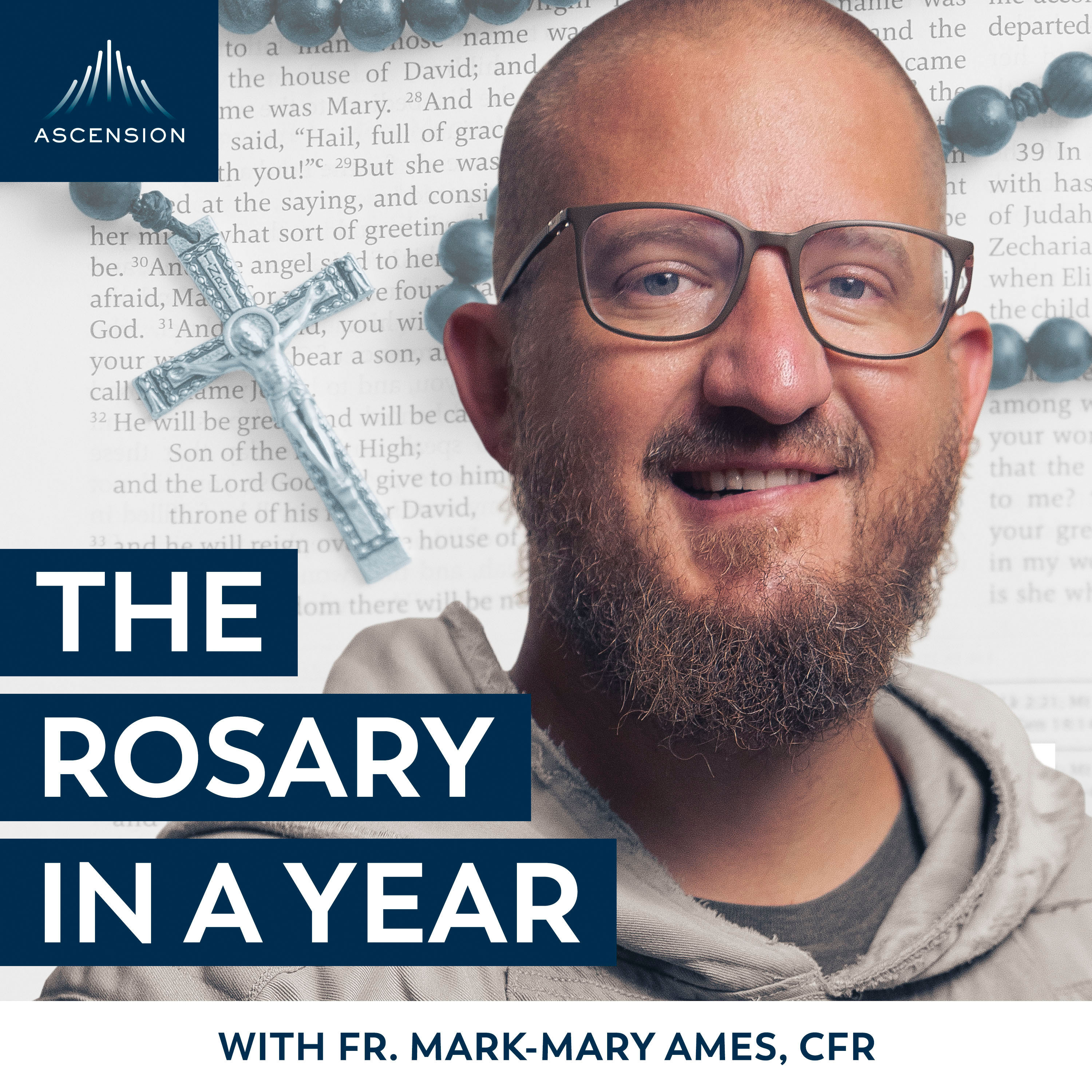
The Rosary in a Year (with Fr. Mark-Mary Ames)
Day 6: Prayer is a Battle
00:10:45
How is prayer a battle, and what role does the rosary serve in this fight? Fr. Mark-Mary explains the various struggles we may experience while trying to grow our prayer life, and how we can use the Rosary as a weapon to defeat temptation. Today’s focus is on prayer as a battle and we will be praying one Our Father, three Hail Marys, and one Glory Be. For the complete prayer plan, visit https://ascensionpress.com/riy.
Loading summary
Transcript1 lines
- [00:00]
A
Foreign Mark Mary with Franciscan Friars, the Renewal and this is the Rosary in a Year podcast, where through prayer and meditation, the Rosary brings us deeper into relationship with Jesus and Mary and becomes a source of grace for the whole world. The Rosary in a Year is brought to you by Ascension. This is day six. To download the prayer plan for Rosary in a year, visit ascensionpress.com rosary in a year or text RIY to 33777. You'll get an outline of how we're going to pray each month, and it's a great way to track your progress. The best place to listen to the podcast in the Ascension app. There are special features built just for this podcast and also recordings of the full Rosary with myself and other friars. With today's episode, we're going to move our focus from looking at prayer as encounter with another to a general reflection on prayer as battle and the role that the Rosary has in this battle. In a section on prayer, the Catechism of the Catholic Church, paragraph 2725 says, Prayer is both a gift of grace and a determined response on our part. It always presupposes effort. The great figures of prayer of the Old Covenant before Christ, as well as the Mother of God, the saints, and He Himself, all teach us prayer is a battle. And against whom? Against ourselves, and against the wiles of the tempter who does all he can to turn man away from prayer, away from union with God. So how does prayer battle against ourselves? In part, there's just always something that's going to feel more urgent, easier or be more interesting to do than to pray. And a fruit of us having, like a common, fallen human nature is that we have this internal attraction, this internal inertia towards the path of least resistance and least effort. But my friends, this is just not the path to God. And so like choosing another path, like choosing the harder path, choosing the graced path of prayer, it's going to be a struggle. It's going to be a battle within ourselves. It's going to cost us something. And at first, like if we haven't developed the habit, like it may cost us a lot if we're not men and women of prayer like to become, to have the change to become men and women of prayer, it's going to require struggle and it's going to require sacrifice. Now, this battle, while having many natural and human components to it, it's not just a human struggle. Ephesians 6, chapter 6, verses 11:12 says this put on the whole armor of God that you may be able to stand against the wiles of the devil. For we are not contending against flesh and blood, but against principalities, against the powers, against the world rulers of this present darkness, against the spiritual wickedness of the heavenly places. The devil, he's doing everything he can to turn us away from union with God. So there's a real spiritual battle happening, and we are in its very midst. Personally. Like, where I believe the tempter, the devil has been most effective, at least in, like, modern times, is his work of keeping us from prayer, which can be seen as cutting us off from our supply lines. To use war imagery, right, there's really two key ways in which one army can defeat his opponent. Firstly, through some direct action or violence. And this is what the devil is trying to do when he tempts us to sin. Like sins of commission, do violence to the life of God in our soul. But secondly, an army can defeat its opponent by simply cutting off its supply lines. Like, if an army can't get nourishment or hydration, it's going to lose. And this is what the devil is doing by keeping us from prayer, he's cutting us off from our supply line. Going back to the catechism, quote, it's a battle. Prayer is a battle against the tempter, who specifically is trying to do anything he can to turn us away from God. And this includes just cutting us off from the supply line of grace, which is prayer. The catechism, it refers to prayer as a vital necessity. It says, like, prayer and the Christian life are inseparable, for they concern the same love and the same renunciation. You can't live the fullness of the Christian life. You can't live the Christian life without prayer in general. And in catechism, quoting St. Alphonsus, Liguri says, those who pray are certainly saved. Those who do not pray are certainly damned. And, yeah, this is intense. Like, it's serious, it's heavy. It's also just a matter of fact. Like, if a life, plants or animal or human life, if it's not fed, if it's not nourished, it dies. And what the catechism is saying is this is the same for our spiritual lives. Our spiritual lives are not nourished. If we are not praying, we will die. But if we do pray with God's grace, if we persevere in the battle of prayer, if we go to battle with our concupiscence, our internal inertia for the easy, if we go to battle in creating space in our lives for prayer, our victory In Christ will be sure. Those who pray are certainly saved. Those who pray will be victorious in Christ. A great number of saints, including Padre Pio, refer to the rosary as the weapon, as a spiritual weapon, or as his weapon. I'm going to take a look at that in two ways. Like, admittedly, when Padre Pio's saying this, this isn't exactly what he's speaking about, but praying the rosary, it is a weapon against our fallen nature. Practicing praying the rosary, mental prayer for about 15 minutes at a time, like, works the concentration muscle, which is this natural foundation on which prayer builds. I want to invite you for a moment just to take a look at your own attention span, because there's a war going on against this muscle and to practice mental prayer on a regular basis, like we do. When we pray the Rosary, it is to fight back. Praying the Rosary is also entering into the battle against principalities and powers that we touched on when we read Ephesians chapter 6, October 7, which is currently the feast of the most Holy Rosary. It used to be the feast of Our lady of victories because Pope St. Pius V attributed the victory of the battle of Lepanto, a battle which defended Christian Europe, to Our lady and the Rosary. And so, as we enter into this battle of prayer, as we take up the Rosary, as we enter into the battle against ourselves and our fallen human nature, we are also doing our part in the greater spiritual battle taking place throughout the world. The dates and the history of the feast of the Most Holy Rosary, it commemorates the fact that the faithful like you and I praying the rosary changed the course of world events. It literally changed history. It was the spiritual weapon that affected the outcome of a real war, the war at Lepanto, the battle of Lepanto. And my brothers and sisters, now you and I, like, it's our turn. And so let us pick up our spiritual weapon. Let us take up the rosary and let us on a daily basis, let us enter into this spiritual battle not only for our own salvation, but for the salvation of the whole world. Let's do so with, like, a radical faith and a radical hope and a radical confidence that our prayer truly is an effective weapon against the devil in all of his works. So, my brothers and sisters, as we do this rosary in a Year podcast each day, we're going to be entering into this battle as we pray, as we become men and women of prayer, this will be a source of grace for us as individuals, but also right for our loved ones, our families in our world. And so, my brothers and sisters, let us pray in the name of the Father and of the Son and of the Holy Spirit. Amen. Our Father, who art in heaven, hallowed be thy name. Thy kingdom come, thy will be done on earth as it is in heaven. Give us this day our daily bread and forgive us our trespasses as we forgive those who trespass against us. And lead us not into temptation, but deliver us from evil. Amen. Hail Mary, full of grace. The Lord is with the. Blessed art thou among women, and blessed is the fruit of thy womb, Jesus. Holy Mary, mother of God, pray for us sinners now and at the hour of our death. Amen. Hail Mary, full of grace, the Lord is with thee. Blessed art thou among women, and blessed is the fruit of thy womb, Jesus. Holy Mary, Mother of God, pray for us sinners now and at the hour of our death. Amen. Hail Mary, full of grace, The Lord is with the. Blessed art thou among women, and blessed is the fruit of thy womb, Jesus. Holy Mary, Mother of God, pray for us sinners now and at the hour of our death. Amen. Glory be to the Father and to the Son and to the Holy Spirit. As it was in the beginning, is now and ever shall be, world without end. Amen. In the name of the Father and of the Son and of the Holy Spirit. Amen. All right, everybody, thanks for joining me and praying with me today. I look forward to continuing this journey with you again tomorrow. All right, Poco poko. Friends, God bless you all.