← The Rosary in a Year (with Fr. Mark-Mary Ames)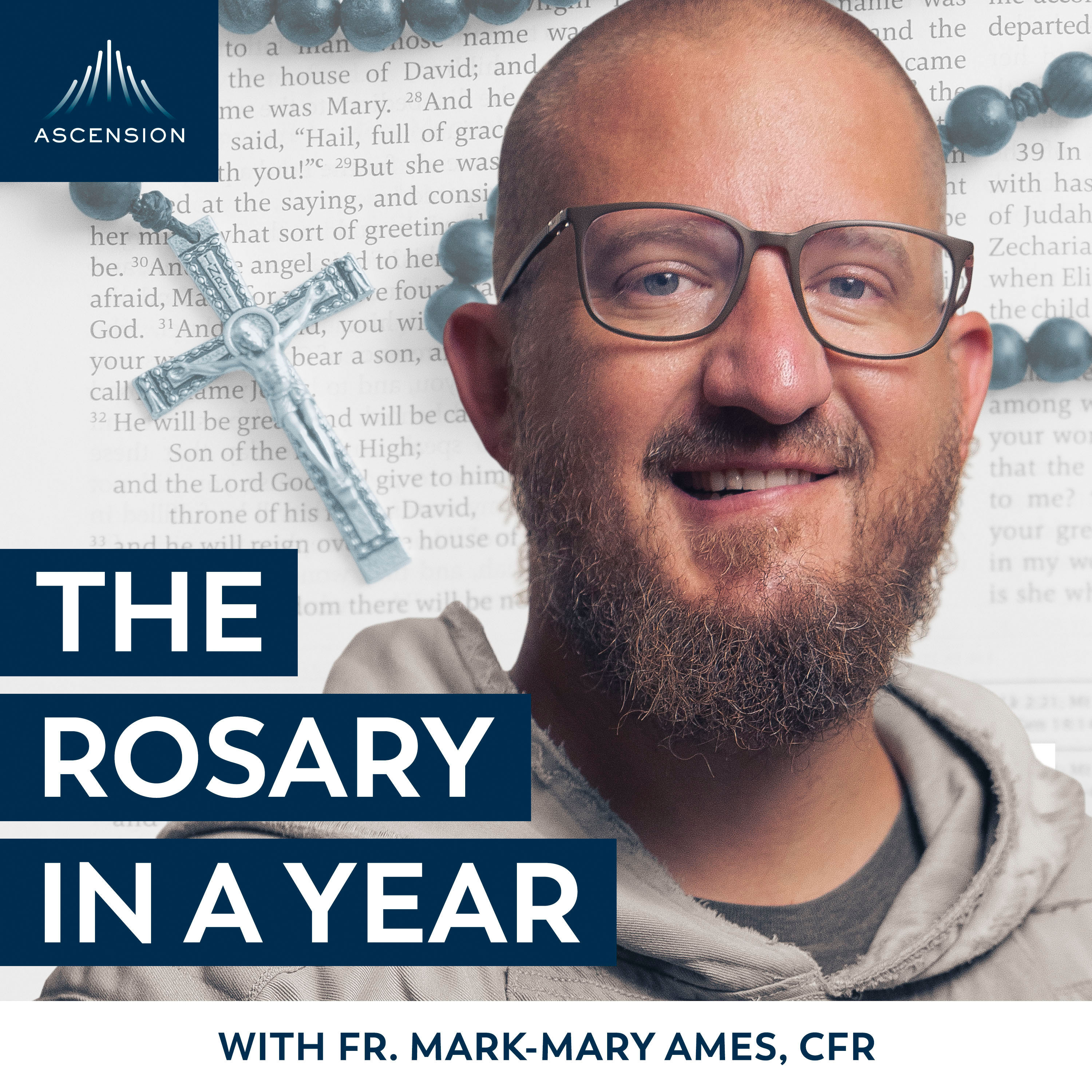
The Rosary in a Year (with Fr. Mark-Mary Ames)
Day 9: Thy Will Be Done
00:08:16
Fr. Mark-Mary continues meditating on the Our Father, exploring the concept of the kingdom of heaven through Matthew 18:1-4. Jesus instructs his disciples to become like children in order to enter the kingdom of heaven, and Fr. Mark-Mary shares how we can have more child-like faith in God as we pray the Rosary. Today’s focus is “Thy Kingdom come, thy will be done, on earth as it is in heaven” and we will be praying one Our Father, three Hail Marys, and one Glory Be.
Loading summary
Transcript1 lines
- [00:00]
A
Foreign Mark Mary with Franciscan Friars of the Renewal and this is the Rosary in Ear podcast where through prayer and meditation, the Rosary brings us deeper into relationship with Jesus and Mary and becomes a source of grace for the whole world. The Rosary in a Year is brought to you by Ascension. This is day nine. To download the prayer plan for Rosary in a year, visit ascensionpress.comrosaryinayear or text RIY to 33777. You'll get an outline of how we're going to pray each month and it's a great way to track your progress. The best place to listen to the Podcast in the Ascension app. There are special features built just for this podcast and also recordings of the full Rosary with myself and other friars. No matter what app you're listening in, remember to tap, follow or subscribe for your daily notifications. I encourage you to pick up a copy of the Rosary in a Year Prayer Guide, a book published by Ascension that was designed to complement this podcast. You'll find all the daily readings from Scripture, Saint reflections, and beautiful full page images of the sacred art we'll be reflecting on. Thy kingdom come, Thy will be done on earth as it is in Heaven. I like to frame and form our approach to this part of the Our Father with a reading from the Holy Gospel according to Matthew. This is chapter 18, verses 1 4. At that time the disciples came to Jesus saying who is the greatest in the kingdom of heaven? And calling to him a child. He put him in the midst of them and said truly I say to you, unless you turn and become like children, you will never enter the kingdom of Heaven. Whoever humbles himself like this child, he is the greatest in the kingdom of Heaven. I'd like to begin this reflection by just looking at, you know, the children of Heaven, like in the lens of, you know, rooted in just natural children. Like kids are really poor, like literally, you know, they don't have money, you know, they can't feed themselves, provide for themselves, etc. They're also just poor in self knowledge. Often they're poor in understanding, they're poor in ability to solve problems. If children, you know, have a healthy sort of context, a healthy family, they're going to be rooted in these realities. Like they're just objective realities. But they're not going to experience them with like great discouragement or shame or self hatred. There's not going to be a temptation towards self reliance. What they do is they just come to their mom and dad. They come to their parents and say help me, like take care of me, provide for me? Can you help tie my shoe? Can you help make dinner? Yeah. Children, they're needy, they're poor, they're vulnerable, they're dependent, but also they're joyful. There's a levity to them. There's this freedom, and this is authentic humility, particularly Christian humility. And this is where we as children of God can experience the kingdom of heaven on this earth. It's when in humility we recognize and we accept that we are dependent, that we ourselves are poor and vulnerable and limited and needy before God. And so instead of this leading towards again, self reliance or self hatred, self accusation, like what we are called to do is just to bring it to our Heavenly Father. Here I am, Lord, Here I am again. Here I am in all of my reality, my limitations, my poverty. And this, my friends, is the experience of the kingdom of heaven. Here now. It's when our dependence meets his perfect promise, Providence. And the fruit of this is peace. And so when the Lord is saying or teaching us to pray, thy kingdom come, thy will be done, when he's teaching us to turn and become like children, it's to face, to accept our actual reality, but not with fear, not with frustration, but with faith and confidence to bring this to our Heavenly Father. A little example of this is I just, for whatever reason, I have this super, super distinct memory of being a kid and going to restaurants. The waiter, the waitress would ask me, like, okay, what do you want to drink? You know, And I look at my mom and dad and they'd be like, oh, he'll take, you know, a Sprite, or he'll take a Diet Coke, or he'll take a water. And I'm looking at them not for permission. I'm looking at them because I don't actually know what I want or, you know, I remember just very distinctly being at like a Mexican restaurant. And like, okay, do you want flour or corn tortillas? And I look at my parents, you know, it's like, I don't know, what's the answer to this? Like, which do I like best? And they say, okay, he'll. Yeah, he'll take some flour tortillas. Like, awesome, great. And I think this is kind of what we're going for. This is what it looks like. It's like, yeah, I don't actually know what I want for myself. I can't pay for it. But I also, I can't choose, you know, I don't. I don't know. But again, I'm not frustrated. I'm not ashamed of it. I just look at my mom and dad and say, like, what do I want? You know? But under this is just this confidence like, that they know what I want. And also they, like, love me. And so they're gonna give the answer that's best for me, even though I can't, you know, give the best answer for myself. The difficulty, right, is while we are always children of God, as we become adults, we start to try and, you know, have shame or frustration around these experiences of our poverty. And so we try to figure it out all by ourselves. And when we're not able to do it all, it bears fruit. And, like, instead of peace and joy, of just kind of frustration and angst and shame. And what the Lord's invitation to us is to become like children, to not fight the poverty, not fight the need, not fight the dependence. But again, just to bring it to him, to bring it to the Father. And what this looks like for Jesus is kind of the high point of this is going to be in the garden, right? Like, Father, let this cup pass. But not my will, but your will be done. And that is the prayer of the Son. And as we enter into and as we pray the Our Father, like we are praying in the same relationship that Jesus has with his Father. Thy will be done, Father. And so today, the invitation is to continue just to reflect upon this, like, are there ways in which we are no longer children before God? Ways in which we feel the burden of providing and taking care of ourselves? And is the Lord inviting you to just the freedom, the confidence, the joy, the peace of a child by saying, hey, give it to me. Let me take care of you with these loose grips. Say, like, father, you know thy will be done. Thy will be done in all things in my life. Because, Father, I trust that you know what is good for me. And the more we live this, my brothers and sisters, the more here and now we experience the kingdom of heaven. So let us pray in the name of the Father and of the Son and of the Holy Spirit. Amen. Our Father, who art in heaven, hallowed be thy name. Thy kingdom come, Thy will be done on earth as it is in heaven. Give us this day our daily bread and forgive us our trespasses as we forgive those who trespass against us. And lead us not into temptation, but deliver us from evil. Amen. Hail Mary, full of grace, the Lord is with thee. Blessed art thou among women, and blessed is the fruit of thy womb, Jesus. Holy Mary, Mother of God, pray for us sinners now and at the hour of our death. Amen. Hail Mary, full of grace. The Lord is with the. Blessed art thou among women and blessed is the fruit of thy womb, Jesus. Holy Mary, Mother of God, pray for us sinners now and at the hour of our death. Amen. Hail Mary, full of grace. The Lord is with the. Blessed art thou among women and blessed is the fruit of thy womb, Jesus. Holy Mary, Mother of God, pray for us sinners now and at the hour of our death. Amen. Glory be to the Father and to the Son and to the Holy Spirit. As it was in the beginning, is now and ever shall be, world without end. Amen. In the name of the Father and of the Son and of the Holy Spirit. Amen. All right, thanks, friends. Thanks for joining me and praying with me today. I look forward to continuing the journey with you tomorrow. But. Poco, Poco. All right. God bless y'all.