← The Rubin Report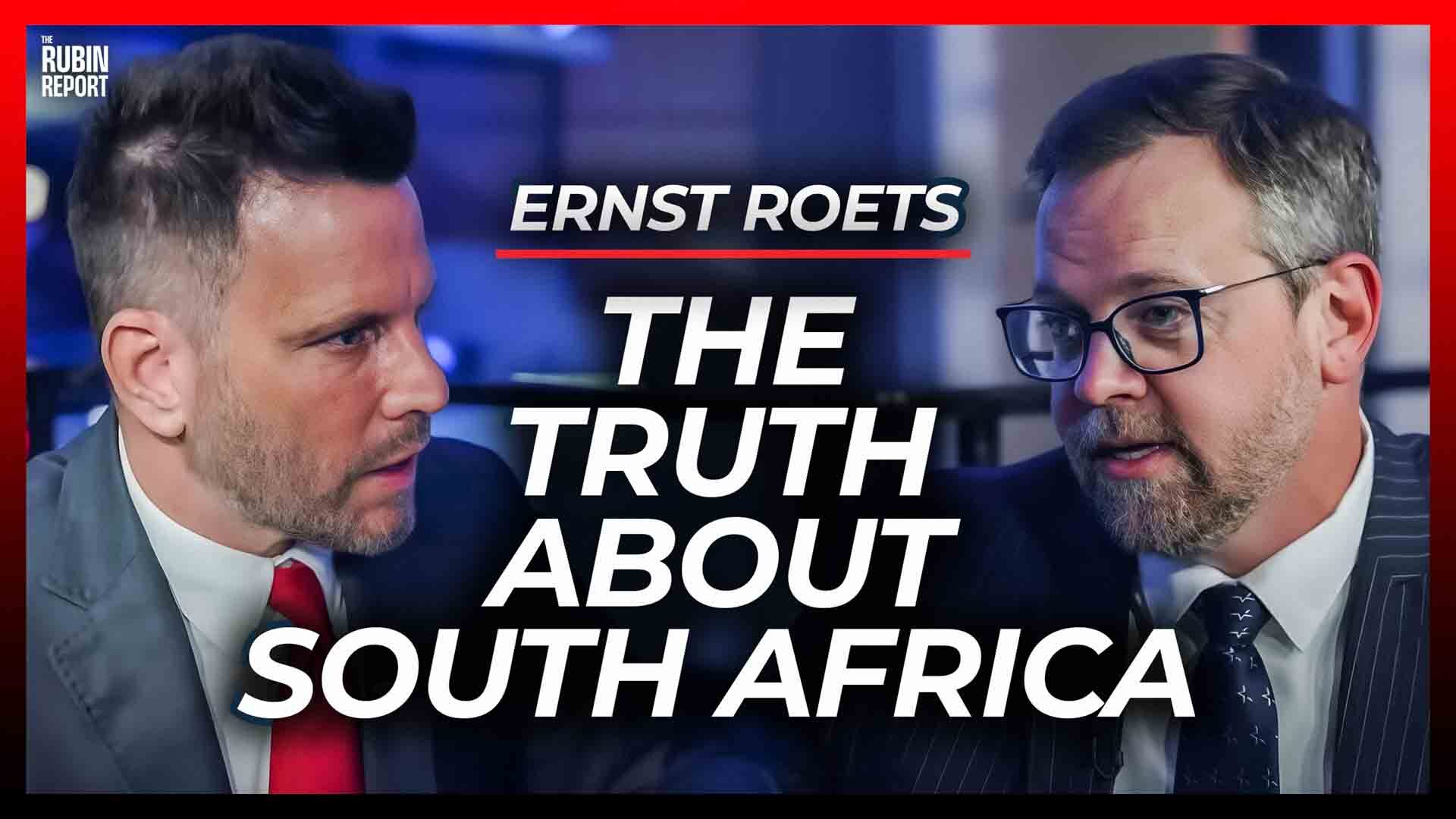
The Rubin Report
Exposing the Truth About South Africa’s Collapse | Ernst Roets
00:06:16
Dave Rubin of “The Rubin Report” talks to Ernst Roets about South Africa’s growing racial tensions; the government’s push for land expropriation without compensation; the global reaction to chants like “kill the Boer”; the role of media...
Loading summary
Transcript19 lines
- [00:00]
SoFi Advertiser
High interest debt is one of the toughest opponents you'll face unless you power up with a SOFI personal loan. A SOFI personal loan could repackage your bad debt into one low fixed rate monthly payment. It's even got superspeed since you could get the funds as soon as the same day you sign. Visit sofi.compower to learn more. That's s o-fi.com P-O-W-E r loans originated by SoFi bank and a member FDIC. Terms and conditions apply. NMLS 696891.
- [00:38]
Dave Rubin
Okay, Ernst Ropes, the author of Kill the Boar, which I think is somehow the number one song in South Africa right now. This is a topic we've been discussing a lot on my show lately.
- [00:50]
Ernst Ropes
Thank you. It's great to be here.
- [00:52]
Dave Rubin
It's good to have you talk to me a little bit about what's going on in your country. It's something that we're obviously talking about a lot in America. As you know, I had Rob Herzog on the show recently and there is a real conversation about what's happening in South Africa and actually how it relates to some of the wokeism and hyper racialization that we now have on our shores.
- [01:10]
Ernst Ropes
Yeah, well, we're very grateful about the fact that the world is starting to take note and also for what you've been doing to talk about South Africa. I was just telling Someone back in 2012 was the first time I went to America to speak to people about South Africa and it was at a UN event and someone called me to the side and said, listen, don't do this because we want to believe South Africa is this great miracle story and it's this poster child of the United Nations. So we don't want to be talking about what's going wrong in South Africa. And I'm very happy that now it's gotten to the point where, especially through people like you and other podcasts and people like President Trump, of course we're now at the point where you cannot ignore it. But it is really bad. And recently polarization has worsened, especially with this continued chanting of Kill the Boer, Kill the farmer. With the South African government now just recently signing a new law to empower the state to confiscate private property without compensation and then denying that they are doing it. So they go to America and they deny doing it, and then they go to South Africa and they say we will not stop doing this. And so we have. So we have the farm attacks, we have the threats to property rights, we have the hate speech. And then an overarching problem in South Africa is just government collapse. We have a very serious problem with the government not able to fulfill its most basic duties.
- [02:29]
Dave Rubin
Right. So separate from some of the terrible things that you just mentioned, and there are, I think it's 141 race based anti white laws in your country, but separate from all of that, you seem to also have a complete government incompetence problem that I was discussing with Rob as it pertains to building infrastructure and proper policing and all of these things. But I'm guessing those things kind of go hand in hand.
- [02:50]
Ernst Ropes
Yes. So the anc, that's the ruling party in South Africa, they still say we're not a political party, we're a liberation movement and we are committed to revolution. So their ideology only knows one thing, which is destruction. So there's something that is an enemy that is identified as the enemy or the work of the enemy, and we need to destroy that. And the assumption is once we, once we are finished with the destruction, then somehow a phoenix will rise from the ashes. But the phoenix never comes.
- [03:20]
Dave Rubin
I mean, it's what's happening with our progressives in the United States.
- [03:23]
Ernst Ropes
It's the same thing. Yes. And it's interesting, you could say, the overlap between what's happening in South Africa and what's happening in the States, because a lot of the ideology, this critical race theory ideology has come to South Africa and now these leftists in South Africa are using people like Robert Diangelo and all these Americans were so much on the left trying to implement their ideas in South Africa. And a lot of what's happening in South Africa, like the targeting of the statues, burning down of heritage sites and so forth, has sort of spread to America from South Africa. So there's a cross overlap that isn't, that isn't good.
- [03:58]
Dave Rubin
So when you saw your prime minister come. President, I should say, when you saw your president come to the Oval Office and Donald Trump puts the TV right in front of him and plays the videos and then quite literally pulls out the paper and starts reading the headlines. Yep, this must have been quite a relief. Or were you amazed? Were you saying, my God, it's finally, it's finally a moment is finally here.
- [04:18]
Ernst Ropes
I think it's both. A lot of people are really grateful for the fact that no one can ignore this anymore because of the fact that it was played in the White House during a press conference. But what surprised me, or I guess I shouldn't have been surprised, but what is astonishing is Just how unprepared the South African delegation was for that meeting. They came in and they were completely shocked when this footage was shown. They didn't know how to respond.
- [04:43]
Dave Rubin
Even the President beforehand, these big smiles. It was as if he had no idea what was about to happen. And I guess that is the truth.
- [04:49]
Ernst Ropes
And he made a joke. He said, if I had a plane to give you, I would give you a plane. And so. And it's really crazy, but. And so. And then he denies it during the meeting. He says, no, no, this is not our policy. And then he goes back home to South Africa and he says that there's nothing wrong with chanting Kill the Boer and our courts will protect you if you chant it. And we're going to expropriate private property. So he goes to the White House, he denies it, and then he flies back to South Africa and he acknowledges that this is their program.
- [05:17]
Dave Rubin
So what do you want to happen right now? So people are focusing on South Africa in a different way. What do you want to happen? I mean, I assume you believe the change has to come from within your country. You don't want it coming from without. Even though the PR campaign is probably helpful.
- [05:31]
Ernst Ropes
Yes. So what needs to happen is we need to rethink the political system in South Africa because I think it's important to understand that the crises that we are talking about are symptoms of a deeper rooted problem. And South Africa is much more diverse than Europe. It's almost as big as Europe. It's very big, it's very diverse. But we have this very strong in quotation marks, central government trying to rule over everyone with a, and they call it themselves a race nationalist socialist project. That's how they define their own ideology. And so the only sustainable solution could be to rethink the political system, to decentralize the political system to and to give the various communities that are in South Africa higher levels of self governance. That's the only way forward for the peoples of South Africa.
- [06:14]
Dave Rubin
And are you hopeful at this moment?
- [06:16]
Ernst Ropes
We are hopeful. We are optimistic. We are used to difficult times in South Africa. And as the Afrikaner people, we've had many existential crises over the years and over the decades, and this is one. But we've overcome some in the past as well. So we are hopeful, we remain hopeful.
- [06:33]
Dave Rubin
And you'll be taking your message to America in July. So hopefully we'll do this in a more long form to speak with you.
- [06:39]
Ernst Ropes
About that in July. Thank you very much, Dave.