← The Rubin Report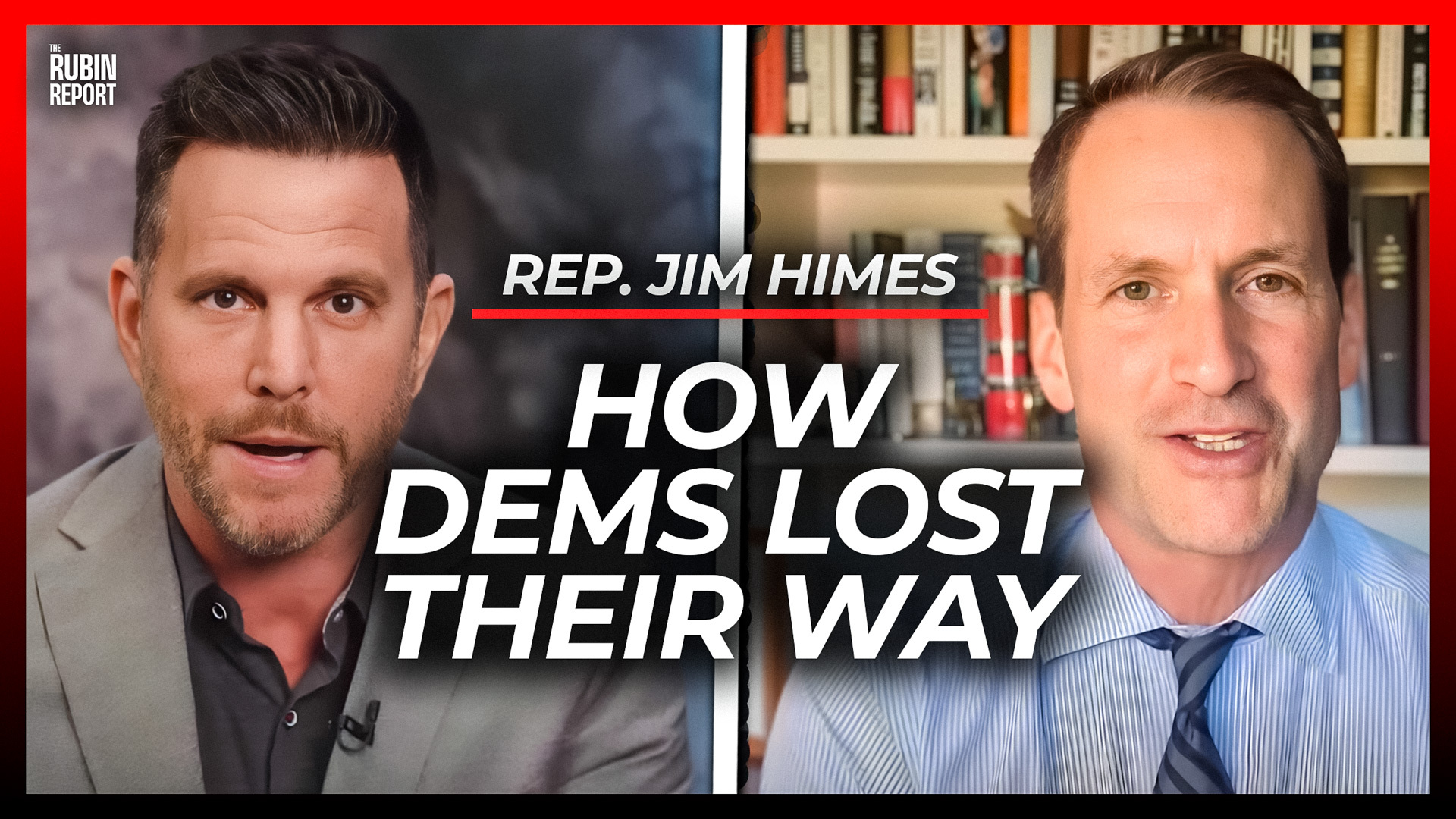
The Rubin Report
This Democrat Is Willing to Be Honest About How They Lost Their Way | Jim Himes
00:37:19
Dave Rubin of “The Rubin Report” talks to Rep. Jim Himes about the evolving identity of the Democratic Party; the importance of government programs like Social Security and the GI Bill in addressing economic inequality; the role of government in...
Loading summary
Transcript101 lines
- [00:00]
Jim Himes
Foreign.
- [00:08]
Dave Rubin
Joining me today is a congressman from Connecticut's 4th district, Jim Himes. Representative JIM Himes, I should say. How are you? Representative DAVE I'm well.
- [00:18]
Jim Himes
Thanks. Thanks for having me.
- [00:20]
Dave Rubin
I'm glad to have you. We only spoke for about 10 seconds before the recording started, and I said to you, look, it's tough for me to get Democrats on this show. Ro Khan is the only guy who will talk to me, and I have to give credit where credit is due. Your guys reached out to us, so this, this should be a fruitful 20 minutes or so.
- [00:39]
Jim Himes
Hey, you know, it's like I tell both my staff and my constituents, I learn nothing when I go to a town hall meeting, and everybody agrees with me. When I learn is when I get to engage with smart people who disagree with me. I don't know why. I mean, I do know why we reject that, but that's important to our dialogue.
- [00:54]
Dave Rubin
All right. Well, let's see what we agree on and what we disagree on. Let me start with something broadly, because I'm guessing you know a bit about me, and I was a Democrat most of my life. I've started, you know, about a decade ago, started seeing a lot of the identity politics stuff with the left, which I think is now morphed into a series of other things. What I'm struggling with right now when I cover the Democrats is I don't know what the Democrats stand for anymore. I think we have a sort of very radical left version, you know, the really sort of progressive woke base. And then there's, I guess, some sliver of what I would call moderate. I don't know exactly where you consider yourself within that or if you think that's a fair prescription, but just maybe lay out first what you think the Democrat Party stands for at the moment.
- [01:38]
Jim Himes
Yeah, yeah. And, and, and let me answer that question, both as what I believe to be true, but there's going to be a little bit of aspiration in what I tell you, and I'll explain that. What I believe to be true, and certainly it's true over the 17 years, believe it or not I've been in the House, is that the Democratic Party stands for lifting up people who need a hand.
- [01:57]
Unknown
Right.
- [01:58]
Jim Himes
So I go back to the Affordable Care act, which was in my freshman term, which covered 20 million Americans who didn't have coverage, Dodd Frank, which straightened out a lot of the gunk in the financial system to, you know, under in the first two years of Biden, you know, negotiating the drug prices for the top 10 most popular drugs which by the way, you know, hasn't been finished yet. But anyway, it stands for helping people who need a hand up right now. Why do I say that's aspirational? And this gets to, I think your intro. We do other stuff too, right. So I would also say that we're the party that is defined by standing up for the socially marginalized and very cognizant of what Democrats were in the civil rights movement, but taking the mantle of civil rights, pushing for things like marriage equality. And I will acknowledge, and I think this is where you're coming from, which is that sometimes we let those identity politics not be just about making sure everybody has access to full equality in America, but we make a fetish of it and we get down a path that is exotic to lots of Americans. And so look, Bill Clinton had it right and we just do and need to keep coming back to it's the economy, stupid. You know, so when candidate Harris is making a very big deal about Constitution and the challenges to our democracy and women's reproductive rights, I think most Americans are with us. But if those are the first two things we say and we don't acknowledge the inflation that is, you know, setting them back, we've got a huge problem.
- [03:36]
Dave Rubin
So do you consider yourself on the more progressive wing? I mean, I heard, I heard, I sort of heard two versions there. So one is you're sympathetic to the, to the march to equality, which I am. That's, that's actually a liberal principle that's different than sort of the identity politics woke version of this that much of the Democrat party, I would say, has been captured by. Do you consider yourself more on the progressive wing of it or. I'm not even sure what the other wing is anymore because it doesn't seem like there's many of those Democrats left.
- [04:05]
Jim Himes
Well, look, it's the wing that passed the inflation Reduction act, which I will concede was a silly name because it didn't do much to reduce inflation. But again, it resulted in for the first time ever, the 10 most used prescription drugs being the price being negotiated.
- [04:22]
Unknown
Right.
- [04:23]
Jim Himes
It actually made an investment in. And some of the investments were silly and all of them took too long to, to manifest themselves. But it made an investment in climate change in a way that had we not seen a sudden U turn on this would be creating a lot of employment. So I'm not going to concede that the party. Look, the Butch Lewis act, right? Americans haven't heard of the Butch Lewis act, but the Butch Lewis act rescued labor unions, pensions that were insolvent. So there I am sitting in an AFL CIO meeting, hearing from a guy, 20something, who works for one of the unions, saying, you've become the party of coastal elites. And I will acknowledge that when we get into the more esoteric elements of gender and the march towards civil rights, we can sound that way. But I said to this guy, wait a minute, wait a minute. Everything I ran for you, the Affordable Care act, the Lilly Ledbetter act, which made it harder to pay women less than men, I could go on about these things. Don't tell me we may appear to be elitist.
- [05:25]
Unknown
Right.
- [05:25]
Jim Himes
But don't tell me that our record certainly compared to the Republican Party, is a record of not standing up for the economic interests of people who struggle.
- [05:35]
Dave Rubin
Right. Listen, when it comes to the march towards equality under the law and that the Democrats have been right on certain civil rights issues, of course I would agree with that. It's sort of where it's gone off the deep end now. So would you say there. Is there any group in the United States right now that you do not think has equality under the law? Like when they talk about marginalized group, I mean, is there. Is any group actually marginalized right now? Marginalized or discriminated against based on an immutable characteristic? Because I think this is a little bit of confusion amongst some of the base that, yes, there might be some bigotry out there, but there's nobody that's. As far as I know, there is no law in the United States that discriminates against anyone based on the color of their skin, their creed, et cetera, et cetera.
- [06:21]
Jim Himes
Yeah, no, and I mean, I would go further than that to say that, you know, over the 250ish years of our history, we have tried to change the, what you're the law, the de jure, you know, segregation and racism. And, you know, we've done a really good job. And in fact, today most laws will say that you can't be discriminated against based on an immutable characteristic. So. Absolutely. Now, you know, I'm sure we could get into the fact that, you know, if you compare a thousand African Americans who are convicted of shoplifting versus a thousand white Americans who are convicted, there is a disparity there. But rather than going to the law, I would say that, you know, generations of the discrimination which has not been stopped, but on which we've made dramatic and tremendous progress, don't go away at the snap of a finger. And that is indicated in pretty much any social metric you want to look at, if you want to look at homeownership between blacks and whites, Latinos, blacks and whites, if you want to look at achievement in education, but none of those social indicators are what they are because blacks or Latinos are less capable. I mean, I hope nobody believes that. And if you believe that, by the way, we have a word for it. But those are echoes of history. And while I would never say that we need to violate the principle that every American should be treated equally, I don't think that efforts to try to mitigate the echoes of the historical segregation and racism going back to slavery should be obliterated the way the Trump administration is trying to do that.
- [08:07]
Dave Rubin
What do you mean by that? I mean, what, what would you be. Well, first off, I mean, I'm not totally, I don't necessarily agree with the premise, which is fine, but the idea that there was past discrimination, I don't think you solve it with current discrimination. But what program would you want that would equalize things that would not then discriminate against somebody else, like Asians, for example, who get in, you know, score well and get into schools and things of that nature?
- [08:32]
Jim Himes
Totally fair question. Totally fair question. And I actually think that, you know, given the swing back we have had from the place that we were right after George Floyd, I think that's the key question. And it's a question that requires us to grapple, by the way, on the progressive left to grapple with the idea that in America, we don't judge you based on your skin color. So my answer, there's probably some complicated answers there, but my answer is a lot of these programs that we hope will address the fact that your and my grandfather could get a mortgage to buy a home in 1930, whereas our African American friend's grandfather probably could not, should be economically based rather than racially based.
- [09:17]
Unknown
Right.
- [09:18]
Jim Himes
That's not an immutable characteristic. And we have a long tradition in this country of providing economic uplift. So to me, the answer feels like, let's have those programs, many of which, by the way, have been slashed in the one big beautiful Bill. Let's have those programs be economically oriented and let's make sure that we're working extra hard to make those resources and the possibilities associated with those programs available and known about in those communities that have traditionally been left behind. And, and by the way, let me, let me close with this. Yes. I mean African American urban areas. I also mean white Appalachia.
- [09:58]
Dave Rubin
Right. So it seems to me that much of this putting aside, like the racial stuff, which I think the Democrat Party has just become too obsessed with, comes down to just role of government stuff. Like when I hear. Say those things, like, I, I under. I absolutely understand the intent, but my personal feeling would be that this just has nothing to do with government. That the role of government is to get out of the way and, you know, create the basic conditions so that, you know, you know, I don't know, things like we have things like borders and we can have some interstate trade and things like that, but not do that much more where it seems to me. So it's just a solution problem. Right. We're. We're both saying, okay, there's an issue. There are issues where the Democrats tend to think the government is the answer and Republicans broadly think that government is the problem. Do you think that's like, ultimately what it all whittles down to?
- [10:46]
Jim Himes
No, I don't. I just hope we don't think about it that way because, you know, Dave, let me. Let me say, Let me offer three ideas to your notion that it's not government's role. Those three ideas are Social Security, GI Bill, and government investment in R and D. Social Security transformed the country because we, you know, back in the 1920s, the poorest element of the American population were seniors. You know, they ate dog food. They didn't have retirement security. Social Security changed all that. Now, by the way, seniors are actually demographically the wealthiest people in the country. Generally speaking, the GI Bill, I think you would acknowledge that the GI Bill was really essential to creating the middle class in this country after World War II. So there's two examples of radically transformative government programs. And believe me, just because I hold up those examples doesn't mean that I think all government programs are okay.
- [11:38]
Dave Rubin
Right. I would also say the government was radically different and much smaller at the time that, you know, the country was also much different because you're talking, you know, 50 plus years ago.
- [11:47]
Jim Himes
Yeah, yeah. No, you're right. Prior to the 1930s, the federal government was a very different place, but largely the growth in the federal government, if you believe. Let's talk about what the federal government actually is.
- [11:57]
Unknown
Right.
- [11:57]
Jim Himes
I mean, some wag had a funny saying, which is the federal government. Are social insurance programs, Social Security and Medicare protected by a standing army? That's kind of what the federal government does. I mean, yes, we spend a little tiny bit of money on foreign aid, 1% of the budget or something, but those are the things that we do at the federal level. And I think most people would say hey, that Medicare thing again, 65 year olds plus can get access to healthcare and Social Security pretty good things. So the question is not so much is government the problem or the solution? The question is where can government intervene in an impactful and efficient way weight. That's the question we need to be answering. And I don't, and I don't want to let the moment go by without talking a little bit about this thing.
- [12:37]
Unknown
Right.
- [12:38]
Jim Himes
I hold this up for school kids and I say pretty much everything that is cool about this device. And this gets me to government investment and basic research. Got everything that's cool about this device. You know, the voice recognition, the semiconductor, the satellites that are cruising over our heads right now to allow for location services. All of that stuff was initially investigated by federal agencies like darpa, iarpa. And to me that's another critical role for the federal government. You know, lately Google and Facebook and the massive tech companies have gotten into some basic research and are making tremendous strides on things like AI. Now, whether that plays out well for us or not is no good question.
- [13:18]
Dave Rubin
Probably not.
- [13:19]
Jim Himes
But my point is that, I mean, I offered you three areas where I think government's important. Investment in basic research, Social Security and GI Bill. All three of those things are a big part of why this country is economically a behemoth that it is today.
- [13:33]
Dave Rubin
So let's, all right, let's say for just for argument's sake, let's say I could get on board all of that. Or putting aside like the historical differences to where maybe the government size is now and everything else, what do you do with the identity politics part of this? Because to me that is the simply most toxic thing as it relates to your party. Even if post, you know, post doge, the government, if the government became slimmer and trimmer and all the things that maybe I would want. The identity politics thing, to me that is kryptonite as far as I'm concerned as it relates to joining a party. And I think I speak for a lot of people when I say that. So even if we could say, okay, you're gonna get what the Democrats want, you'll get it to be efficient and good and it actually will help. Whether these programs help, I think is a separate issue. But if you could get me on all of that, what do you do with the identity politics thing?
- [14:23]
Jim Himes
Yeah, yeah, I mean, look, I'm going to, I'm going to engage you at your strongest question. I'm not going to say, you know, come on, Dave, identity politics, there's like 12 you know, transgender women participating in women's sports. I could. I could sort of dismiss it as small, but I'm not going to do that. What I'm going to do is acknowledge that it had huge political sway. There's a reason why Donald Trump invested hundreds of millions of dollars in an ad that ended with the tagline, she's for they them, he's for you. It has political sway. So I think it's fundamentally. And look, I'll acknowledge that there are on the margins some really tough issues, like participation in athletics, where it matters. I'm going to tell you that most of the problem today with respect to transgender or identities is just doing our part to make sure that people who have been marginalized over time are welcomed in where I think we.
- [15:18]
Dave Rubin
What's your. What's your position on a biological boy playing in girl sports?
- [15:24]
Jim Himes
I have real trouble with the lack of fairness to cisgender women who are asked to compete with a transgender woman who, like me, grew up bathed in testosterone with the inevitable biological characteristics that that generates. And by the way, I wouldn't care if this is, you know, sandlot Little League bass baseball, but the truth is that our society puts great value, things of great value on Ivy League swimming, for example. Now, whether it should or not is a different question, but as long as we are going to allocate things of great value, scholarships, college admissions, future jobs, there has to be an acknowledgement that transgender women who grew up as biological males have an impossible to dismiss advantage in some sports. And I think we got to grapple with that. Now, it's also, again, Dave, I would say, famously, when the head of the NCAA was asked how many transgender athletes there are in the NCAA, he said something like 10 or 11. So I'm going to acknowledge to you that it's a problem. But let's not say we're going to toss aside the entire Democratic Party because some of its affiliates. And I would say affiliates, because I'm not even hearing the squad get Amherst faculty lounge crazy over biological sex differences. I think it's unfair to say because on the fringes, people are a little exotic about denying biological differences. We should throw aside the whole party, right?
- [17:00]
Dave Rubin
I mean. Yeah, it's interesting you see that as a fringe thing. I see it as central to the party. I mean, you know, I don't think that most Democrats. Well, you acknowledge there's biological differences between boys and girls, right?
- [17:13]
Jim Himes
Yeah, yeah, yeah, yeah.
- [17:15]
Dave Rubin
Right, right. No, you did. So I. Well, I just. But I think. I think a lot of Democrats, including the squad and some others do not acknowledge that. I don't know that it's about, I don't know that it's about how many are in the ncaa. I think it's about more about what they're teaching young people in school, which is why there's a social, a social contagion portion of it that if I, that parents should justly be concerned about.
- [17:38]
Jim Himes
Yeah, look, I don't know a single Democrat in Congress anyway or probably in general. And I understand that out on the fringes of academia there's some crazy stuff going on. I don't know a single Democrat in Congress who would deny that there is a difference between a biological man and a biological woman. Now when you get into the fringes of my colleagues, they might say, but it just doesn't matter. For collegiate athletics, what that is doing is it's dismissing the legitimate claim to justice and fairness that a cisgender athlete has. And they would say what I said, which it's 10 or 11 people. Well, you know, okay, but you know, injustice or unfairness to 10 or 11 people shouldn't be just dismissed like that. That's not what we do in this country. But I think it's unfair to say, at least amongst my colleagues, you know, let's, let's take this in a different direction.
- [18:27]
Unknown
Right.
- [18:28]
Jim Himes
Defund the police. Another absolutely toxic thing. Latinx. I've seen the polling on Latinx. Absolutely toxic, by the way. Something like 80% of Latinos don't like, don't like the Latinx.
- [18:40]
Dave Rubin
Of course, I live in Miami. I assure you, if I went up to the guys I play basketball with and say, let's play, you know, my Latinx amigos, let's go like, come on.
- [18:48]
Jim Himes
Exactly. Madness.
- [18:49]
Unknown
Right?
- [18:50]
Jim Himes
But, but what I would tell you, and I guess what I'm trying to persuade you of is two things. Number one, I spent a lot of time with my Democratic colleagues and I would tell you that it is single digit Democratic colleagues who get obsessed about Latinx or these particular issues.
- [19:05]
Dave Rubin
But then why, so, so, but then, so why don't we ever hear Democrats. I'm hearing you do it now, so that is refreshing and that's why I'm glad to have this conversation. But why don't we hear Democrats just put down the trans stuff? Why don't we hear them put down all of the fringe, the defund the police. There were a lot of Democrats for that and I very rarely heard Democrats saying, boy, they're really, you know, out, out of the norm here. Where are those Democrats? That's the question to me.
- [19:34]
Jim Himes
Let me answer that in two ways. Number one, I don't think I've changed my tune. And you know, again, for me, success as a party, it always falls back on. It's the economy, stupid. Which is why when somebody asked me a question about transgender swimmers at University of Pennsylvania, I'll give them a quick answer along the lines I gave you, and then I'll say, but, hey, you know, there's millions and millions of Americans who can't afford food, so can we please talk about that? So I continue to believe that it was a relatively small thing, but I'm also going to tell you that there is no question that after the July of George Floyd, that changed the world. And I, you know, I'm not a sociologist or whatever, I can't explain to you why that so changed the world, but it did and it absolutely made the left broadly. And by left, I'm not, I'm not even talking primarily about the Democratic Party. I'm talking about activists in colleges and universities, professors in colleges, universities, amongst other things, it created such a wave of revulsion that it caused a lot of people to give up both logic and what I mean by logic is the statement, I shouldn't even say the word logic. Let me use the word objective truth. There is a difference between biological males and females, and that is the size of the gamete held by each and, you know, irrefutable biological fact. And yes, I know that there is whatever, you know, sometimes people who are somewhere else. But anyway, it caused a lot of people to give up objective, you know, truth and commitment to liberalism, commitment to the idea that, as the Chief justice put it, the best way to stop discriminating by race is to stop discriminating by race. And by the way, I'm not sure I agree with him 100 but it did cause this upwelling of fervor which on the extreme became illiberal. And I think that a lot of bastions of illiberalism are, are struggling with that now. Harvard University, for example.
- [21:37]
Dave Rubin
Right. Well, Harvard, which has instituted, I would say, neo racism in its policies, it does believe in discriminating when it comes to admissions, which actually is now against.
- [21:46]
Jim Himes
Use the past tense there.
- [21:47]
Unknown
Right.
- [21:48]
Jim Himes
Use the past tense.
- [21:49]
Dave Rubin
Well, thankful. Thankfully the Supreme Court did something about it, which, which is great. So, so it seems to me that the old school liberals, which I wrote a book defending classical liberalism, which in it just to me has nothing to do with the Democrat Party anymore. You know, if you take the Tulsi's or the Bobby Kennedys or the Elon Musk's. I mean, these are all just kind of moderate liberals. It seems to me they are now far more welcomed in what I would say is a wide tent MAGA movement than in the Democrat party. Am I, am I on that?
- [22:23]
Jim Himes
Wow, that's quite a diverse set of people.
- [22:26]
Dave Rubin
But that's the point. Yeah. And, and rfk, I mean these were all two of them ran for president as Democrats within the last, you know, couple years.
- [22:35]
Jim Himes
Yeah. And I mean I'm, I'm not sure whether to take that as a criticism or as a compliment.
- [22:39]
Unknown
Right.
- [22:39]
Jim Himes
You know Tulsi Gabbard who went from being a, by the way, you were talking about congressional progressives. She was as progressive as they came. I mean she wasn't squad, but she was progressive. So much so that she spent three hours with, you know, Bashar Al Assad in her, I think, wrong headed attempt to try to stop some war there. And you know, Bobby Kennedy, you know, what more need I say? Bobby Kennedy is not a Kennedy in the classical Kennedy mode. That is a guy who has subscribed to conspiracy theories. So when you say Tulsi Gabbard and Bobby Kennedy are no longer welcome in the Democratic Party, I'm not sure I have a problem with that. These are not people who are deeply principled, thoughtful, left leaning liberals.
- [23:16]
Dave Rubin
But, but who is Elon Musk?
- [23:18]
Jim Himes
I don't even know how to think about Elon Musk. I mean.
- [23:21]
Dave Rubin
Right, right, right. Okay, so we're definitely not gonna see eye to eye on how you feel about them. But then who is, who is a thoughtful, decent liberal? Now that is in the Democrat Party, you can't say yourself besides you. Who's a thoughtful. Who is a thoughtful, decent, old school liberal that believes in individual rights and laissez faire economics and logic and reason and is against identity politics and doesn't want the government to solve everything. Those are the liberal principles that I know of. Those are the truly classical liberal principles. Who are those liberals if not those guys?
- [23:55]
Jim Himes
Let me pick two from a deep, deep blue state. I could go on, I could name for you 100 plus. But let me just for fun, pick two from one of the bluest states in the country. And those two people are Seth Moulton and Jake Auk and Klaas.
- [24:07]
Unknown
Right.
- [24:08]
Jim Himes
Both deep private sector experience. Seth got his head blown off because he was one of the first people to say, hey, there are some issues with transgender women participating in women's sports so, anyway, you asked for names. There's two names. I know them both very well. They are deeply, deeply committed, both to classical liberal principles. But they also, like me, would say we've got to do more for people who are economically dislocated in this country.
- [24:38]
Dave Rubin
So. Okay, so let's. Let's shift then. Because you said, it's the economy, stupid, a couple of times. And I agree with that, actually. So when you voted against the big, beautiful bill, I was kind of. My position on it was sort of like, I want all the tax cuts. I want all the cuts in spending. I think that's all great. I think we should slash most of these programs. But I was also sympathetic to what Elon was saying, which is that you're still spending an awful lot and we're raising the. The debt ceiling. What was. So. So I'm sort of ambivalent. I kind of want to see where it lands, I guess you would say. But I do like the idea of people keeping more money in their pocket. That's, to me, how you get growth. What were your major issues with it? Because you obviously did not vote for it.
- [25:16]
Jim Himes
Well, I mean, I'm. I'm struggling with what was good about the bill, you know.
- [25:22]
Dave Rubin
Well, tax cuts for virtually everybody, I would say, is good.
- [25:25]
Jim Himes
Yeah, but, Dave, you know exactly who got the most tax cuts? It's the people who pay the most income tax, many of whom I represent in Greenwich, Connecticut, New Canaan and Daria. And with all due respect, I know these people very, very well. Nowhere on the top 20 list of problems in the United States is it. Is there a problem that says rich people don't have enough cash? And so when the bill takes. In order to maintain the tax cuts that benefited the very wealthiest people in this country, which costs in the bill about 1.3 trillion. When it takes that out of food stamps and Medicaid coverage, to me, that is, again, not just morally repugnant, but, you know, here's my. Here's three of my top 10 problems in this country. Income disparity. If you're below the 60% mark in income in this country, you're really struggling. If you're in the top 5% in this country, you're doing really damn well. So the disparity is a huge problem. The deficit and the debt is a huge problem.
- [26:25]
Dave Rubin
Well, wait, let's do one of those. So do you want to raise taxes on your people in Greenwich?
- [26:30]
Jim Himes
I want to see.
- [26:31]
Dave Rubin
I mean, they all are making a ton of money. I've been to Greenwich. I've been to the community center over there where LeBron announced he was going back to Cleveland or going to Miami or wherever that was. I mean, they make a lot of money. Should your constituents have their taxes raised?
- [26:44]
Jim Himes
I believe. Well now, mind you, when you say my constituents, you know, yes, I have New Canaan. I also have Bridgeport, Connecticut, the largest city in the state of Connecticut, which is a very, very poor. I do believe that the top 10ish percent in this country can afford to pay more. Yes. Now why do I not say raise? Because if you're going to do this smart, you're not going to raise marginal income tax rates. That's not. And I spent a lot of time telling my Democratic friends, let me tell you why. The wealthiest people in this country don't pay what I would define as their fair share in taxes. And I make that fair share point by comparing what the top 1% in this country pays compared to the top 1% everywhere else in the world. We can get into that if you want to, but if you're serious about this, you know what you're going to do? You're going to go after some really, truly crazy loopholes that are taken advantage by the very wealthiest people in the country. Capital gains, treatment of carried interest. Let me use a bunch of words that are really boring, but step up in basis on death. Dave, you know this. If you're an early employee at Microsoft and you got $10,000 of Microsoft stock 40 years ago, today, when it's worth $50 million, you leave it to your children totally tax free. If they.
- [27:53]
Dave Rubin
That's great.
- [27:55]
Jim Himes
Well, it's awesome. So long as you're comfortable with a much smaller military, much smaller Medicare, and much smaller Social Security. So pick one of those three things that you're willing to do to reduce taxes or tell me that you're okay blowing the deficit up.
- [28:07]
Dave Rubin
Well, I mean, I'm just not for the government. So like an estate tax, basically. I wouldn't be for the government taxing someone just for dying after they've paid money on that their entire life either. I would be for cutting virtually all of these things. I mean, as much of it as could be cut.
- [28:23]
Jim Himes
Yeah, okay, and that's fine, Dave. Look, I don't like paying taxes either. And I'm a left leaning Democrat.
- [28:30]
Unknown
Right.
- [28:31]
Jim Himes
I don't like paying taxes either. But there has to be a second part to that sentence because it's so easy and I've run now nine or 10 times, it is so easy to say I'm cutting Your taxes. But the second part of that sentence after the semicolon has got to be either and I'm comfortable exploding the deficit, or I have meaningful cuts, meaningful cuts to the programs that consume the money. And there are three of them, Medicare, Social Security and Defense. So I need to hear the second part of your sentence there.
- [29:00]
Dave Rubin
Sure. Well, I would say there were meaningful cuts in the big beautiful bill as it pertained to work requirements, for example, to be on Medicaid. So cutting people that are not up to going and showing that they've at least attempted to work twice a year, that was all they were being asked. I think that's completely fine. These programs were supposed to be temporary, where they've become perpetual and sometimes intergenerational. Right.
- [29:26]
Jim Himes
Okay. So you would rather cut people from health insurance than get rid of capital gains, treatment of carried interest or the stock inheritance thing. I said you would choose let's throw people off of Medicaid rather than let's require somebody to pay stock taxes on their $50 million of appreciated stock.
- [29:48]
Dave Rubin
Well, people who need it. I don't think they removed the social safety net altogether. It was just making sure that there were requirements as it pertained to who was going to be on Medicaid. Is that not correct?
- [30:01]
Jim Himes
Well, you know, two things to say about that. Now we're going to go down the Medicaid rabbit hole, which is fine. But I again, I want to come back to the necessity of, of being honest about if you're going to cut taxes in the face of massive, massive deficits, you better either acknowledge the deficits will get bigger or say, I'm willing to cut this stuff, but let's go down the Medicaid rabbit hole. 17 million people estimated to come off their insurance. And don't, by the way, don't listen to this Connecticut Democrat. Listen to what Thom Tillis said when on the Senate floor. And here's the problem. Look, there's great appeal to the idea that you don't get to sit around on your couch and collect welfare benefits. Arkansas tried this and it didn't help. It didn't help. And let's just imagine a lot of lazy people no longer have health insurance because they're sitting on their couch. Are those people not getting sick? Of course. In fact, they're probably getting sicker because now they don't have easy access to preventative care. And when they get sick, instead of going to the couch, well, they're also.
- [30:58]
Dave Rubin
Probably getting money from the Democrats. Right. They're also probably on welfare programs, programs that keep them in perpetual states of poverty and, and keep them in low income housing that then becomes intergenerational. Etc.
- [31:10]
Jim Himes
Well, all right, let's, let's put that in the parking lot for a second and just focus on this because the point I want to make, we'll come back to that. I think I can address that. Yeah, but, but throwing people off their health insurance for whatever reason, that may be morally satisfying like you lazy video game player on your sofa. Now, by the way, that's not the people. It's not not lazy video game players that are going to be cut off their health insurance. What I'm interested in is. Let's set aside the moral question. What I'm interested in is the economic effect. Now you're not getting preventative care and when you get sick, you're showing up in the emergency room, the single most expensive venue in which to get health care. So again, I've seen the polling. I understand that Americans like the idea of you getting benefits if you go to work, but the end result is going to be much sicker people getting treated in the emergency room.
- [31:59]
Dave Rubin
But, but I just don't understand why the gu. It should be the government's responsibility if people don't want to work. I mean, Bill Clinton famously was for work requirements. That was an extremely moderate Democrat position, you know, basically in 1992. And I don't think anyone, as far as the big beautiful bill was kicked off Medicare just because they were being kicked off. It was related to work requirements.
- [32:22]
Jim Himes
Well, you're using the past tense here. Remember these things interestingly, and we might explore why this is true, that the cuts to Medicaid kick in after the next midterm election. I'll just leave that right there. But you're using the past tense here. Now look, I don't pretend to know the facts. Lots of people, lots of institutions and think tanks and CBOs say 17 million people are going to lose their health insurance. It's not just Medicaid, it's the subsidies for Obamacare that are going away. But it's also, you know, Dave, I, I won't pretend I didn't grow up in poverty. I grew up, you know, middle class. But in my job now, I do see the challenges of folks that maybe don't have a higher, you know, a high school education. And I would tell you that the notion that it's laziness that is driving, that is, is a misdiagnosis. You know, the problem is we have a rapidly changing economy where we have a lot of people without the hard skills and soft skills to take the jobs that are good paying. Today we have a massive housing problem where people who do get jobs, you know, are paying 50% of their income in rent. We have a massive problem in the availability of childcare. So moms who want to work can't now. And I'm not going to say. And government needs to solve all of those things. Frankly, on housing, I think government needs to get the hell out of the way. But I do want to dispel this notion that there's some moral achievement in beating up on the couch surfer who's playing video games rather than looking for a job. That's just not what poverty looks like in this country.
- [33:54]
Dave Rubin
Sure. I think you could probably argue it has far more to do with the breakdown of the family, actually. And then government programs that keep people in a certain amount of poverty regardless of their skin color. Right. If you give somebody just enough to survive on, it doesn't matter if they're black or white, they're basically going to take it. Unfortunately, we're out of time here. We barely did anything here. But I really enjoyed this and I think we should continue this conversation. But let me ask you one other thing to fully, since there's a lot of pieces here, will you support you? You are in the greater New York area. This will be the true litmus test of what I think of you. Will you support mom Donnie for New York City mayor? Because you got a lot of people in Connecticut that are going to go there for work.
- [34:40]
Jim Himes
I, I am, I am worried about Mamdani as mayor. And if I were a New Yorker, I would not vote for him. And I'm not a New Yorker, so I haven't had to think hard about this. But there is a lesson, there's two lessons of Mamdani because you opened this whole conversation around the nature of the Democratic Party. He may have crazy ideas to address affordability. I mean, municipally run grocery stores and rent, rent caps, not good ideas. Lots of, lots of history to show that. But you know what he was doing when Cuomo was out there, first of all, being Cuomo, secondly out there talking about going after Trump. Mamdani said, and he may, his ideas may have been crazy, but he said, I hear you and I see you on the affordability issue. So back to the first point I made to you. It's the economy, stupid. So I'll tell you, there's a hell of a political lesson there. Lesson number two that I alluded to before was the guy was just authentic.
- [35:36]
Unknown
Right.
- [35:36]
Jim Himes
You know, it wasn't bullet points.
- [35:38]
Dave Rubin
It was authentic.
- [35:40]
Jim Himes
He stood in like the waves and, you know, did social media again.
- [35:45]
Dave Rubin
It's so fake. It's so fake. Come on. That fake smile, his 18 accents. Come on. Come on. You had one accent here the entire time.
- [35:55]
Jim Himes
I don't know about that. But look, his social media. And look, I started this by saying I wouldn't vote for him because I think his policy prescriptions are bad. But there's no question that he captured the imagination, particularly of a group of people who don't show up at my town halls or at my rallies or whatever. And those are young people.
- [36:11]
Unknown
Right.
- [36:11]
Jim Himes
And so, again, as a practitioner here, I'm kind of interested in the fact that this guy won, even though I wouldn't vote for him.
- [36:19]
Dave Rubin
Well, I have thoroughly enjoyed this. I hope we can do it again. We'll do it longer next time when we have a little bit more time and perhaps we'll do it. I will come to Connecticut and maybe go to one of those. I don't know that I can afford those fancy restaurants you guys have there in Greenwich, but maybe you could pick up tab and could go, you know, get a nice steak done.
- [36:36]
Jim Himes
Done. You know what we do? We actually tape this in an auditorium, you know, and dinner afterwards.
- [36:43]
Dave Rubin
Let's do it. Let's do it. I was once, because I. I also was broke at a time in my life. I was working at a little catering company that did catering in Connecticut. Little private events. And what was the. What is the. It was the gym or something there that LeBron gave the big speech when he was going to Miami. I'm taking my talents to Miami. It was the. It was the ymca, Right? It's a big YMCA in Greenwich. I did a fundraiser there.
- [37:05]
Jim Himes
Wow, Nice. Okay.
- [37:07]
Dave Rubin
They drink a lot of white wine spritzers. That's what the ladies of Connecticut do. Thank you, Congressman.
- [37:13]
Jim Himes
Thanks for having me.