← The Rubin Report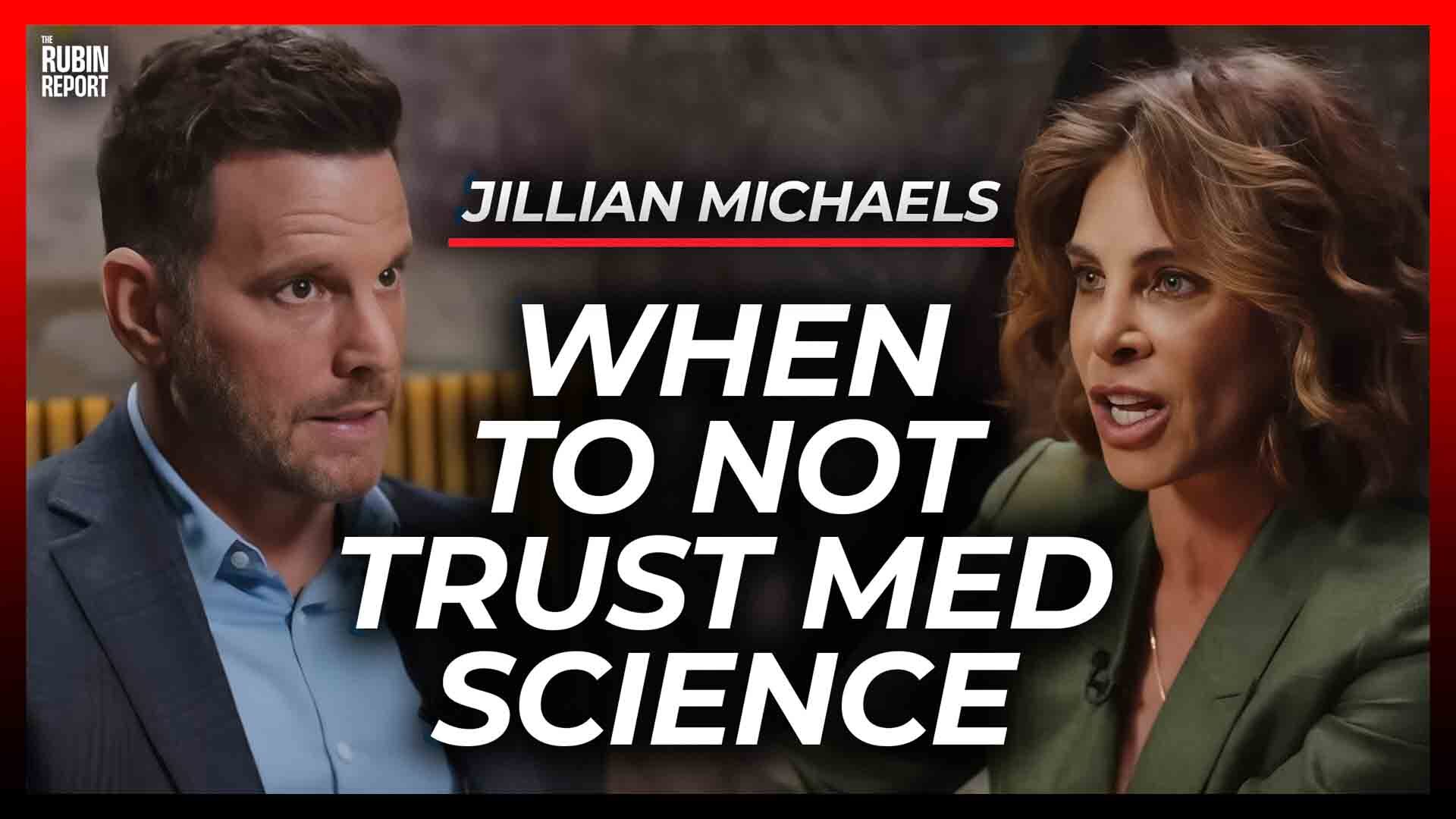
The Rubin Report
Who to Trust with Your Health in an Untrustworthy World | Jillian Michaels
00:56:17
Dave Rubin of “The Rubin Report” talks to Jillian Michaels about society’s obsession with youth and cosmetic procedures; the importance of healthspan over lifespan; the dangers of extreme anti-aging therapies like stem cells and peptides; the...
Loading summary
Transcript244 lines
- [00:00]
Jillian Michaels
Health has become a political football.
- [00:02]
Dave Rubin
Yeah.
- [00:02]
Jillian Michaels
Who funds these NETWORKS? It's like 70+% pharma. CNN had crowdsourced studies and they said Kennedy's lying. We have a ton of placebo controlled trials on vaccines. He's lying. Of those vaccines that are on the schedule, despite the fact that none were pre licensing, how many of them were designed to look at long term safety? Very, very few. So they manipulate this.
- [00:29]
Bobby Kennedy
What do you make of how the mainstream media is still Bobby Kennedy now?
- [00:34]
Jillian Michaels
Oh, my God. Hold on. The people who get the worst health care are not just the poorest, but the richest. And this is one of the reasons I actually love Brian Johnson, because he's a scout. He's like, I'm gonna do all this crap to myself. If it goes wrong, you'll know. I could tell you three guys that injected them into their spine and almost died. When you have that much access to newer therapies, it can go wrong. You are the science. You crazy. Like, argue with the science.
- [01:02]
Dave Rubin
Yeah.
- [01:09]
Bobby Kennedy
All right. Jillian Michaels, lady with abs and amazing. What shade of green would we call that? Moss.
- [01:16]
Jillian Michaels
Perhaps you might nail that one better than me. I like things.
- [01:21]
Bobby Kennedy
Spectacular.
- [01:21]
Jillian Michaels
Pants, dresses me. The Gabriella Hearst suit, though. Then I found out they dressed Kamala. Kamala. I still can't pronounce her name right. Thank you.
- [01:30]
Bobby Kennedy
Don't worry, it's not a. I actually.
- [01:31]
Jillian Michaels
Cannot recall because we've been through so many iterations of don't call her this or that that. I forgot which one is PC and which one isn't. And then I'm like, oh, no, should I be wearing that designer?
- [01:40]
Bobby Kennedy
This is not the Kamala, is it?
- [01:42]
Jillian Michaels
No, but they did dress her. But I love the designer, so I just outed myself.
- [01:47]
Bobby Kennedy
Is that a pants suit? We call that a pantsuit. It's a beautiful pantsuit. You would have been better qualified to have been president Kamala or Kamala.
- [01:56]
Jillian Michaels
Can you imag.
- [01:57]
Bobby Kennedy
Anyway, I can thank you. I actually can imagine because you've got a decent head on your shoulders. That's why you're back in studio with me right now. It's good to see you, my friend. We're just gonna talk about a little bit of everything that's going on in the world. But before we started, you asked me how I'm doing, and we were just going through both of our kind of fitness routines, which is. That's your thing.
- [02:14]
Jillian Michaels
Mental fitness as well.
- [02:16]
Bobby Kennedy
What are you on, Jill?
- [02:17]
Jillian Michaels
What am I. Yeah.
- [02:18]
Bobby Kennedy
Cause everyone. Everyone sees you like, oh, my God, she looks amazing. The energy's There, she's happy and glowing all the time. Okay, I'll have what she said.
- [02:28]
Jillian Michaels
Okay. I take a methylated B. I take pharmaceutical grade fish oil morning and night. I take 5000mg of D3 and K2. I do occasionally take a multi. There's a brand, actually, that is not my company, but they have. This is. This is controversial. It has, I think, lithium orotate in it, but a very low dose. And there's some data to suggest it can actually help with cognitive function and be neuroprotective over time. But it's. It's obviously a controversial ingredient. Extremely low dose. Um, let's see. I take collagen peptides, I take creatine. Uh, and then I like. I cycle tons of other peptides. Yeah, so I was on like the Wolverine pack, like bpc.
- [03:19]
Bobby Kennedy
What's that? Oh, you've got Ad mantium in your blood.
- [03:22]
Jillian Michaels
I've got.
- [03:22]
Bobby Kennedy
That would be very.
- [03:23]
Jillian Michaels
No, ad mantium.
- [03:24]
Dave Rubin
Yeah.
- [03:25]
Jillian Michaels
BPC 157.
- [03:26]
Bobby Kennedy
Yeah. What are you doing that for? I was doing that for. For my knee a little bit.
- [03:29]
Jillian Michaels
I was doing for a shoulder and an elbow. But then also I find that it helps me recover more quickly.
- [03:37]
Bobby Kennedy
And you were injecting yourself all that.
- [03:39]
Jillian Michaels
Stuff and I was going to do TB500. I haven't done it yet. I think when I cycle bpc, that's when I'll start the little pack of it. I cycle cerebral lysine for cognitive function that I have shipped in from Austria. So I do that quarterly. I mean, it's like a whole fricking thing. Nobody can. Like, this is. Nobody can do this. That's where you just kind of, you know, have nicotine gummons, try to keep up with you. And every time people do it.
- [04:03]
Bobby Kennedy
Is it in right now?
- [04:04]
Jillian Michaels
Oh, yeah, it's in there right now. Packed in there right now. And people think like, oh, I didn't know she was a smoker. Yeah, and not a smoker. It's great for actually potentially preventing the onset of Parkinson's, which runs in my family, delaying the progression of Alzheimer's, which I have a gene for. Unfortunately, it also helps with people who have ADD because it facilitates recall and processing speed. So I do 2 milligrams of that five times a week in particular in your mouth.
- [04:36]
Bobby Kennedy
So that's what you're doing right now. You have 2 milligrams. So it's just wedged in there. And that's okay for your teeth and all that. I know everyone's on this now. Everyone's Taking it.
- [04:45]
Jillian Michaels
Nothing else in it except nicotine. Two milligrams. I have one with no preservatives. Chew it 10 times, put it in the side of your mouth.
- [04:52]
Dave Rubin
Yeah.
- [04:53]
Jillian Michaels
And you do. I hate to tell you, I do notice a significant difference. And now when I have very long days.
- [05:01]
Dave Rubin
Yeah.
- [05:01]
Jillian Michaels
And you get to that interview, at the end of the day, you're like, oh, my God, you feel it. Caffeine has always been my, like, cognitive enhancer of choice.
- [05:12]
Bobby Kennedy
Yeah, me too.
- [05:13]
Jillian Michaels
So I utilize that and. And the creatine and the nicotine to try to do these days that just go for 12 hours.
- [05:19]
Bobby Kennedy
Wait. Am I allowed to ask you how old you are? I think. I think I'm 51. You're 51. Okay. So I just turned 49. So we're. We're basically the same age. It's not a crack over there.
- [05:28]
Jillian Michaels
Well, this is an occasional Botox shot. Let's.
- [05:31]
Bobby Kennedy
Oh, okay.
- [05:31]
Jillian Michaels
Let's not get too crazy, Dave.
- [05:33]
Bobby Kennedy
See, but that's why.
- [05:34]
Jillian Michaels
Still defer and still get, like, the chemical acid peels on my face and all of that stuff. But I do.
- [05:39]
Bobby Kennedy
But that's why people like you, because you'll admit that stuff where all these people pretend they've done nothing.
- [05:43]
Jillian Michaels
I avoid some things, though. Like, I hate filler.
- [05:47]
Dave Rubin
Yeah.
- [05:47]
Jillian Michaels
Hate kills your face. Literally. And I've had great dermatologists and plastic surgeons just say, like, do not touch it. Don't go away.
- [05:56]
Bobby Kennedy
You're not afraid of Botox, which is basically, like, deadening your nerves, right?
- [06:02]
Dave Rubin
Yes.
- [06:02]
Jillian Michaels
In small doses, but filler really is hideous. And if you talk to a plastic surgeon, they'll tell you how they open up faces, and it's just a disaster in there, and I need to be able to open up my face at some point. That'd be a disaster.
- [06:17]
Bobby Kennedy
Wait, what, are you gonna open up.
- [06:18]
Jillian Michaels
Your face for 60 years, one of these?
- [06:21]
Dave Rubin
Yeah.
- [06:22]
Jillian Michaels
Yeah. But you gotta be so careful with that stuff, man. Yeah, So I. I really try to do very little when it comes to, like, food.
- [06:29]
Bobby Kennedy
I've never done Botox. I have one wrinkle that I mentioned, but I'm like. But it's also. I think for a man, it's easy. It's just easier.
- [06:38]
Jillian Michaels
The only man who's done plastic surgery and looked incredible is Brad Pitt.
- [06:43]
Bobby Kennedy
I was gonna say it's Brad Pitt.
- [06:44]
Jillian Michaels
That's it. Every other one, you're like, oh, no.
- [06:46]
Dave Rubin
Yeah.
- [06:47]
Jillian Michaels
No, yeah, don't do it. Men look so much better with, like, the lines. And just.
- [06:52]
Bobby Kennedy
What do you make of the psychological condition related to all of that, that we are always chasing the fountain of youth and that we'll never really attain what we've once lost. And that even someone like Brad Pitt. Yeah, he does look great. And he's. I don't know, they can check. How can you guys check how old he is? He's got to be about 60, I would guess, at this point. And he's really. And if you look at pictures of him from five years ago, he looks significantly better. Now he's 61, but always chasing that thing or what's her name, Jenner. The mother who just had.
- [07:21]
Jillian Michaels
Oh my gosh, yeah, Steve Levine did that job. Isn't that wild? I know. I was like, who is that guy? Because in 10 years he better be alive. I'm like, make me an appointment.
- [07:30]
Bobby Kennedy
But is it an interesting thing? Because as long as you feel good, it shouldn't matter that much whether you've got the wrinkles or a couple extra creases. And yet we all of us disagree with you.
- [07:41]
Jillian Michaels
However, with everything I always say, it's, it's a U shaped curve. So it's like you could do something. You could do something, you could work on it, you could, you could maintain. Then there's that Goldilocks zone of just the right amount of tweaking and supplementing where you're, you're really holding your own. You're aging well, right? We're looking at health span, not just lifespan. How long can you feel good for? Like, the reality of living to 200 for you and I is not there, but living to 90 and picking up your grandkids at 85, I mean, that, that's what I'm hoping for when, you.
- [08:22]
Bobby Kennedy
Know, I damn well better be able to get there because I started late with kids. So I really feel the pressure on that. Which is partly why I made my health a priority in the last two years.
- [08:30]
Jillian Michaels
When it starts to go wrong, you can see it, you know, when people deform their faces. Um, and there is a saying that not just aesthetics, but also health. The people who get the worst healthcare are not just the poorest, but the richest. And this is one of the reasons I actually love Brian Johnson, because he's a scout. He's like, I'm going to do all this crap to myself. If it goes wrong, you'll know. And if it goes right, you'll know. Because a lot of it is controversial. Like as I'm playing around with these different peptides and you know, you and I were talking about stem cells before it is.
- [09:04]
Bobby Kennedy
I'm playing ball, sister.
- [09:06]
Jillian Michaels
I mean, it's pretty incredible.
- [09:07]
Bobby Kennedy
I'm playing ball. It's absolutely amazing.
- [09:09]
Jillian Michaels
A month and a half later, I could tell you three guys that injected them into their spine and almost died. And they're affluent, intelligent leaders in the health space. So you. When you have that much access to newer therapies, at least in this country, and people are leaving the country, they get the. You know, it can. It can go wrong. So I would say find that Goldilocks zone where you feel good, but you're not. You're not going so far that you're compromising your health in one way or another, or you're disfiguring your body.
- [09:43]
Bobby Kennedy
How do you decide who to listen to when it comes to all this stuff? Because you're on the short list of people I listen to when I've had a few things, or David had something he called you. Like, it's getting, I think, almost increasing. Like, we went from this period where there was the expert class that was kind of lying about everything. Now we have, like, the. The new online expert class where every time you open Instagram, everyone's got a new theory on everything and everyone's pushing something and telling you the secret to this and that. And I'm finding it, in some sense, it seems more difficult now, even though we definitely have better information, or at least we have more information. You got to figure out that's the issue is you.
- [10:19]
Jillian Michaels
You almost have too much information, and it's conflicted information. So for me, I always go to a variety of MDs and PhDs, depending upon which discipline is more relevant. In nutrition, I speak to PhDs in nutrition science. There are a handful of experts that I defer to and, like, listen, I. I happen to love Lane Norton. He's a controversial character in my line of work, and he'll give you a pass on things like artificial sweetener. This is. You know, he and I have been back and forth on the research, but Lane, you know, come on. Like, common sense would dictate no to aspartame, right? But I. I generally think his advice is good. He looks at human randomized control trials, and then I'll back it up and talk to a group of other people. And if there's consensus and I trust the experts and they're not conflicted, I make my decisions. And generally, at the end of the day, if it doesn't pass the gut check, like chemical sweeteners made in a lab, like, my common sense on this one is a no so another one that I just, I sat out completely. I sat out the whole metformin game as a longevity therapy. And I Listen, I love Dr. Peter Attie. I think he's brilliant. I've read his book, I've interviewed him three times. But Peter is one of those guys like Brian Johnson, who will try rat myson, who'll try metformin. And I'm gonna sit it out because I don't see why as a healthy person, metabolically, I would need this pharmaceutical, like, I don't really get it. And I let them go down the path. And then later Peter got off of both and he's like, eh, diminishing returns. So I kind of like, oh, you know, I'll wait a little bit. Like methylene blue. It's a fish tank cleaner, Dave. I mean, you know, I, I understand.
- [12:11]
Bobby Kennedy
So I'm not supposed to gargle with it? Is that what you're telling me?
- [12:13]
Jillian Michaels
Listen, if you had cancer or a very specific condition metabolically that they were utilizing this for, then I would say, okay, speak to the relevant MD about this. Look at the data. What is it doing? But as a healthy person, I'm like, I am not putting. I just, no matter how many experts, it does not pass my sniff test at this time. At the same time, if I had advanced stage three breast cancer and they said I needed chemo, I would do chemo. Now is chemo. No. Chemo kills everything in the body. But when you're sick, it's a completely different cost benefit analysis. So I, I do go to the PhDs and the MDs. I don't, I don't do the influencer thing. And in fact, the only advice that I've ever given people, I can cite the PhD or the MD and then tell you why I listen to that person and how many of them that I utilize to come to a conclusion and form a decision. But there, there's something to be said for traditional education. Without question, a lot of that research is paid for by the big pharma companies. That'll give you another example. They injured my back. Andrew Hecht, who ran HSS in New York, he may still the top orthopedic surgeon at hss, worked on the world's most incredible athletes. And I was like, well, I'll just put, I'll just put stem cells in my back. And he was like, no, we will not be doing that. He's like, I have never seen one good thing come out of that. Quite the contrary. Only for me to then interview Josh Axe I don't know if this other doctor is. Is out there with regard to what happened to him, but there's a very prominent, well respected Pete. I'm sorry, Maryland. Out there made the same mistake and almost died. And if hex.
- [14:04]
Bobby Kennedy
Were these stem cells not from their own body, I'm guessing they were not.
- [14:07]
Dave Rubin
Yeah.
- [14:07]
Bobby Kennedy
And it's like I did. I did adipose from my own fat.
- [14:10]
Jillian Michaels
Okay. Which can potentially be less effective. Right. And then if you're using cord blood and meenal stem cells, but there's greater risks of where you going and that they get. There's so many different factors. And you inject this stuff into your spine and it can go really wrong. So this is where I had thought I was going to do that. And then consulted with one of the best orthopedic surgeons whose specialty is lumbar spine. And I took his advice. I weeded it out and tried everything else first.
- [14:44]
Bobby Kennedy
And what solved it?
- [14:46]
Jillian Michaels
So it was a combination of rehab with a PhD named Dr. Stuart McGill, who's incredible. He has a great book for anybody with back problems called the Back Mechanic. And then I also did. Oh, my God, Jill. See, this is where the gum's not serving.
- [15:04]
Bobby Kennedy
Come on, you need a second.
- [15:05]
Jillian Michaels
Come on, come on.
- [15:06]
Bobby Kennedy
Name dropping left and right. It's in there somewhere. Come on.
- [15:09]
Jillian Michaels
I know it.
- [15:09]
Bobby Kennedy
The.
- [15:10]
Jillian Michaels
Oh, my God. Epidural. The epidural anti inflammatory. And that helped get me standing. And then over time, working with McGill, I was able to rehab my spine. And then I learned how to practice really good spine hygiene. So people with back problems, they still bend over all the wrong ways and twist and turn and do I. I die when I see it. I'm like, no, no, no, look, you're.
- [15:36]
Bobby Kennedy
Sitting nice and upright. I'm always fidgeting. I'm. My back's fine, but I'm always sitting in different positions. And this.
- [15:42]
Jillian Michaels
I'm telling you, 80% of people will experience a discogenic issue. And I have never in my life felt painful quite like that. I would reserve only third degree burns. I would rather get bit by a great white shark. I'd rather be shot. I think I'd rather be stabbed. And it is relentless pain. And you can very quickly understand why so many people became addicted to oxycontin and that's who they targeted right off the bat. Back pain.
- [16:11]
Bobby Kennedy
Right? I mean, that's what happened to Brett Favre, basically, and many others. So how much of this? All the stuff. So you're 51 year old, in great shape, obviously. Take care of yourself, all of that stuff. But if we were to go back, say 70 years ago, a 51 year old probably would not have been worried about their cognitive health. Meaning it wouldn't have come up. Is that, do you think that would have been just pure like naivete, or that they didn't know enough? Or that now in the modern world we're so slammed with information and endless scrolling that it is somehow breaking our brain so that cognitively, without doing some extra stuff, perhaps we not are not as sharp as we were way back then.
- [16:53]
Jillian Michaels
So if you look at the way we were living 70 years ago, or maybe a little farther back, it was more ancestral, so it was more blue zone diets. It was the polyunsaturated fats, things like olive oil. Hence the, hence the reason.
- [17:07]
Bobby Kennedy
Right. So pre saturated foods or pre processed.
- [17:10]
Jillian Michaels
Foods, basically you didn't have chemically extracted canola oil.
- [17:13]
Dave Rubin
Yeah.
- [17:14]
Jillian Michaels
You had olive oil and you had wild caught fish that wasn't farmed and loaded with dyes and heavy metals and antibiotics. So the food functioned as medicine. I think people got farther along into life with better health. They weren't obese, they didn't have all of these environmental and lifestyle factors that were aging them in an accelerated pace. And there just wasn't the understanding of what Alzheimer's was or Parkinson's was. And dementia ultimately in old age would be a foregone conclusion. The issue is what's going to determine if you get it at 60 or 70 or 80 or if you're 90 and sharp as attack. There are definitely genetic factors that play into that as well. And I happen to have a ton of them, which is so unfortunate. Leah. I'm just a genetic disaster. Like I, I, I think both of them. I'm two feet tall, I've spent tens of thousands in laser hair removal. I had my nose fixed, my teeth were growing out of my eyeball, like, like there's no reason that I genetically needed to reproduce.
- [18:20]
Bobby Kennedy
You tied it all together quite nicely.
- [18:22]
Jillian Michaels
Thank you. But like no small sum, you know. So I, I think that the more aware we are now of genetic predispositions and the ability to intervene, those of us who can arguably do. And I also notice, work wise, I don't rely as much on my quads anymore, but I need to be much quicker mentally. We're constantly now getting in these debates with people on varying ends of the spectrum. Politically, health has become a political football.
- [18:58]
Dave Rubin
Yeah, yeah.
- [18:59]
Jillian Michaels
And you know when you can't remember not just epidural, but you're trying to make a point. And tomorrow you're like, ah, damn it, I could have smashed that guy if I just remembered that one study. So I really try to preserve my cognitive function and be neuroprotective in light of all those things.
- [19:18]
Bobby Kennedy
Just as an interviewer, one thing I've definitely noticed over the years is that people do lose their train of thought more than they used to. A lot of times people will say something like, oh, I've got two things to say about that, and they'll tell me one, and then they have no idea what the second one is. And I'm not saying I'm immune to it either, But I have noticed that, having done interviews for so long, that. That kind of thing. And that may be just a. So it's. I get it, the genetic portion of it and whatever, but I think there's a modernity portion of it that we still are not grappling with properly.
- [19:47]
Jillian Michaels
It Just preparing for a week of work. It. I'm like, oh, my God, hold on, Let me go back and review all of those studies that corrupted the food pyramid, because I'm going to have to speak about that on cnn. And they're not friendly, you know, so it's like you pack your brain with all of that and then, oh, you know, we're going to want to talk about what Kennedy did here, here, and here. And we're so mad that he wants to remove fluoride from the water. So then I'm like, okay, hold on, let me go back and pull up all the research on, you know, fluoridated water, for better or for worse. And how does that. It just. You're constantly filling your brain every day, and there's. There is a certain element of fatigue. Like your eyes start to cross in your head because you're trying to hold all this different information about so many things. When you're giving interviews on it, it's one thing to learn it, note it and say, like, okay, you know what? I don't need fluoridated water. And keep it rolling. But when you have to answer questions about that and 50 other things, and I think we are packing our brains for the scroll is endless.
- [20:50]
Bobby Kennedy
Right? And also, people have other things going on. So if you're an expert in this, you can put a lot in your brain, but people can only take in so much of it, which is why I try to do, like, yeah, this bite size, bite size. And, like, we don't need to go into, like, every little granular thing of everything. Or when people ask me about what I'm doing. Like, for me, it's sort of what you said about the sniff test with aspartame. Like, I'm just eating more whole foods now. Like, I'm eating, you know, more organic protein and veggies, and I'm just staying off the other side. And it just. I'm not a doctor, but I just kind of was working for me. And I think if more people start doing that.
- [21:24]
Jillian Michaels
But do you need to be in many of these cases, if you came down with ms, I. This would not be like a, hey, let's defer to common sense.
- [21:33]
Bobby Kennedy
Right? Right.
- [21:33]
Jillian Michaels
Find the right doctor. And we would obviously try to utilize the most intelligent, progressive, but safe therapies for you. That's not something you and I are gonna defer to common sense on, but when it comes to raising your kids or, you know, strengthening your relationships with your parents, your partner, your friends, taking care of your mental health and your physical health, we've been doing this innately for tens of thousands of years. As a species, we should have, like, a general consensus on what works and what doesn't. And I think this is where people get taken down rabbit holes due to conflict. And I would simply try to say, these are the things you. If you're interested, these are the things you should do more homework on. And I'm just trying to tell people what to think about when it comes to their health and where to get the right information. Just a hepatitis B vaccine can literally just take people, throw them into such a spin about vaccines and this and that. So it's like, how can you give them enough information that if they want to, they can effectively research it on their own and empower themselves to make the right decisions across the board and health. That's really the goal.
- [22:51]
Bobby Kennedy
What do you make of how the mainstream media is still treating Bobby Kennedy?
- [22:55]
Dave Rubin
Now?
- [22:55]
Bobby Kennedy
I don't know if you saw, but over the last couple of days, there was a clip of Bill Nye the Science Guy. Oh, yeah, because he wears a bow tie. And he went on CNN and basically was going after Bobby again for vaccines and basically saying there's no correlation between vaccine scheduling and autism.
- [23:12]
Jillian Michaels
It's. That's. It's not that. It's not that there is or there isn't. It's that we do not have the data.
- [23:20]
Bobby Kennedy
That's exactly what I said.
- [23:21]
Jillian Michaels
We don't have it. And.
- [23:24]
Bobby Kennedy
And yet. But we do see some relative. What seemingly looks like a relative connection. But I get your point, that that doesn't necessarily prove anything.
- [23:31]
Jillian Michaels
It doesn't. And this is again so nuanced, like maybe you saw RFK1 on Tucker. Then he talked about a hepatitis B vaccine study back in 90s maybe, I think it was. And there was like an 1135% increased risk for children who were vaccinated with hepatitis B. Now okay, so they were looking at the collective impact of an additive called thimerozole, which was 50% mercury by weight. That's no longer in the hepatitis B vaccine. Nobody mentions that. There are other adjuvants that are of concern, like aluminum. And aluminum is put in certain vaccines to essentially alarm the immune system when the pathogen like hepatitis B is dead, not alive. So how do you wake up the immune system and get it to pay attention to a pathogen that's dead? Well, how about a little bit of aluminum? Honestly, Dave, we don't know. And CNN actually. Now let's see if I can remember this because I did a whole thing about this. CNN had crowdsourced studies and they said Kennedy's lying. We have a ton of placebo controlled trials on vaccines. He's lying. So here are the different factors that you need to think about. First of all, none of them were pre licensure licensing of the vaccine. They were post. How many of these vaccines are actually on the childhood vaccine schedule? Because there's stuff like just random diseases out of Japan on there.
- [25:09]
Bobby Kennedy
Right.
- [25:09]
Jillian Michaels
I don't even think it was half, if I recall correctly. Of those vaccines that are on the schedule, despite the fact that none were pre licensing, how many of them were designed to look at long term safety, not efficacy? Like how long does it work for? Not in eugenicity, meaning how effective was the body in mounting a response to it? But long term safety, Very, very few. So when you end up going through all of these variables, Kennedy is still 100% right that none of the vaxes on the schedule used. Oh, and I forgot to mention this. How many of them used in inert placebo? So this means saline. Many of them used a placebo that was a previous vaccine. It's called an active comparable. So they manipulate this bullshit this way because the average person's like, oh, CNN crowdsourced and there's the study and it says placebo. It doesn't say whether it was done pre licensing. It doesn't say whether it was done for long term safety. It doesn't say if it was done against inert placebo or active comparable. So he's telling the truth. He's telling the truth. And the reality is we don't know. And there should be nothing wrong with asking the questions and doing the research.
- [26:25]
Bobby Kennedy
Well, that's the thing. I'm always amazed by their lack of curiosity because let's say that Bobby's completely wrong about. Just for the sake of argument for a second, let's say he's. Bill Nye is completely right. CNN's right. There's no connection between vaccines and autism. Why is it that you guys are not curious at all about the rates of autism?
- [26:43]
Jillian Michaels
Right.
- [26:43]
Bobby Kennedy
But they're not. They don't do another episode. They're only interested in doing an episode on something that makes Bobby look bad. Not on an episode. Not doing an episode on. Why do we have these strange.
- [26:55]
Jillian Michaels
Who funds these NETWORKS? It's like 70+% pharma. So I mean, it is everything from New Kennedy said that the fluoride by the chemicals, the chemical form of fluoride being added to the water to fluoridate it comes from industrial waste. It does Google it just Simply put into ChatGPT. Who makes money off fluoridating water? It is a byproduct of fertilizer. When they make fertilizer, instead of having to dispose of the waste, they add it to the water, which is a complete. We can go on and on and on from that. That is the truth.
- [27:44]
Bobby Kennedy
Isn't it kind of crazy, like, when you see how they do those things, you see the byproducts or you see how they make chicken nuggets or how they make even just candy bars or whatever. When you see like the complex crazy ways that they do it, that so much of this is a byproduct of something or something that should have actually been thrown away or something. And that's the stuff.
- [28:02]
Jillian Michaels
Hazardous.
- [28:03]
Bobby Kennedy
But it's kind of crazy to think that anyone even formulated this idea in the first place to put all this stuff in our food. There's so much like, I'm gonna make a chicken nugget. I don't really need much chicken. Right? Like, was the chicken nugget guy nuts Crazy?
- [28:19]
Jillian Michaels
And it just, it overwhelms people. And then when they're like, if you paint this guy with a crazy brush enough and you have these legacy sources of news that so many older individuals, arguably a lot of Gen X, all the boomers, and there's even a few of those silent generation people that are still alive. My dad's the silent generation, which came before the frigging boomers that have depended on the New York Times and CNN for so long that for you to say it could be compromised is blasphemous to them.
- [28:55]
Dave Rubin
Yeah.
- [28:56]
Bobby Kennedy
What do you think? So if we don't have a particularly reliable set of people, let's say at the mainstream level, which we are all on board that now we have the thing that we're in, and what do you think the responsibility is for those of us that do this to be truthful? I'll give you an example that'll be a little personal to you. I was watching a clip that you did on a different show where you were sitting with a couple ladies and one of the ladies, I won't even mention her name, was spouting some complete nonsense about the Gaza aid situation and it was completely debunked later in the day. I'm guessing that there was no correction issued or anything. I knew when I saw the clip I was like, I know this is not true. It's so obviously going to be debunked. It was fully debunked. What do you think the responsibility is in general? And I mean this for everybody. I mean it for me, I mean it for Rogan, I mean it for you, Dave.
- [29:45]
Dave Rubin
Yeah.
- [29:45]
Jillian Michaels
Of Israel. Here's the problem with this one. For me, for me personally, I don't.
- [29:50]
Bobby Kennedy
Even, I don't even mean this specifically about Israel. I know in general what is our responsibility towards the truth.
- [29:55]
Jillian Michaels
But if I was to answer that honestly, that one is so deep and so complex and it is tied up with so much hatred and you have to be so erudite to combat it. Like, I watched the clip that you posted of the lady on Piers last night and who was so eloquent and articulate at explaining, okay, D. I can't fight back. I don't know. And for me to go down that rabbit hole, I could never, I'm like, Jill, like, interview experts. I had Barry Weiss come on my podcast to give some context. But when I get, I personally get caught up in those moments, you're thinking like, well, I trust this news person.
- [30:36]
Dave Rubin
Yeah.
- [30:36]
Jillian Michaels
You know, Dave Smith has said the same thing. And I happen to love Dave Smith. I think he's a great guy. We disagree on this issue, but he's so well versed. And I'm not that when he tells.
- [30:46]
Bobby Kennedy
You, I mean, he's not particularly well versed.
- [30:48]
Jillian Michaels
So, okay, that's, you know that. I don't know that. And this is one where I'm like, I am not going to become an expert on this. I'm going to go to the Bari Weiss's, I'm going to go to the Dave Rubins and say, give me the counter argument. I do think that corrections need to be issued, but people are so caught up in their bias that they simply don't. I try to.
- [31:08]
Bobby Kennedy
Yeah, it's a problem. There's just no mechanism for now, you know, we have community notes that's doing some version of it, but for the podcast world, that's. Now that now is the teacher. What could the mechanism be? Like we decentralized, and then we would need some kind of centralized fact checking apparatus. And that's. That's not really what people want. So it's just kind of the wild west, and we got to accept it.
- [31:28]
Jillian Michaels
It is, but I think you have to take agency. And, you know, recently I. God knows what this is going to look like. The New York Times is doing a piece on me. I'm sure it'll be a hit piece, but then at least I could like, oh, yeah, I'll feel like I'm accomplished.
- [31:41]
Bobby Kennedy
Welcome to the club. Front page of the New York Times. Head of the alt right.
- [31:45]
Jillian Michaels
Oh, my God, I'm so excited. Okay, good. I feel good about it. Like, I did one on humor and so it's. It's my turn. And I. And I knew it.
- [31:51]
Bobby Kennedy
Probably maybe, you know, it's incoming because.
- [31:53]
Jillian Michaels
You agree to it.
- [31:55]
Bobby Kennedy
Oh, you agree.
- [31:55]
Jillian Michaels
I agreed to it. And. And maybe it won't be, you know, maybe I've done.
- [31:59]
Bobby Kennedy
I've been part of those, too. That one I was not part of. Sometimes I'm part of one.
- [32:02]
Jillian Michaels
Maybe I don't do it anymore.
- [32:05]
Bobby Kennedy
No, it will be one way. It has to be one way or another. They're not looking to.
- [32:08]
Jillian Michaels
Right. They're not going to elevate a dissenting voice.
- [32:11]
Dave Rubin
Yeah.
- [32:12]
Jillian Michaels
So nevertheless, this journalist showed up and to a few of my podcasts because I had recorded a couple same day, and she criticized the fact that I didn't push back on different things. And I said, but I'm not professing to be an expert here. I'm learning from these guests. I can't push. I'm not a geopolitical expert. I'm not an economist. You know, I'm getting different perspectives. And I will put people from different sides of the spectrum on. I'll have Barry Weiss and I'll have Dave Smith. And then the goal for the audience is to turn around and like, you're gonna have to do your own work on it. And at the end of the day, you're gonna hear different things. For example, if we go back to the hepatitis B conversation, Kennedy said they did this research. They found 1135% increased risk of autism with hepatitis B vaccine. And then they did five iterations of the study to bury the results the way they buried the results. They kicked out older kids and used only younger kids who were too young to be diagnosed with autism. Now the CDC and the study's author came out and said, no, no, no, no, no, no, no. We expanded this study so significantly, we looked at 140,000 kids. We made it better. Was all so, so much better, and found no causal link. Who are you going to believe now? You know what you need to do right now? You need to look at the freaking study. How old were the freaking kids? What were the. How did they do the study? Blah, blah, blah. And you'll get the answer. If I.
- [33:48]
Bobby Kennedy
You could see why some people just check out.
- [33:50]
Jillian Michaels
If I had an incoming baby, though.
- [33:52]
Dave Rubin
Yeah.
- [33:52]
Bobby Kennedy
So that.
- [33:52]
Jillian Michaels
That I would do the. I would take the frigging time. And if I had a time machine, I would not have given my son. My daughter was born in Haiti, but I would have not done the hepatitis B vaccine. Except the issue, of course, is that once it's on the CDC schedule, it's essentially a federal mandate, because most schools are like, we're gonna need those vaccination records. Your kid can't come to school. And now you're starting to see conservatives who are homeschooling their kids. And that. That's one reason. Indoctrination is another, but it's. It's a wild period.
- [34:26]
Bobby Kennedy
So actually, that was my next question. So if you were having kids right now, if you had a child that was going to be born tomorrow.
- [34:32]
Jillian Michaels
Yeah.
- [34:33]
Bobby Kennedy
What would you be doing or not?
- [34:36]
Jillian Michaels
Minimal. So. So what I would do is look at each of the vaccines and what are the pathogens that they're meant to immunize my child against? Having had whooping cough at this point, which I was supposed to see you for dinner when I was getting over it. Oh, my God. And thought it was reacting until. Yeah, having had that. A newborn getting whooping cough. There's a reason a child would die from this. Adults have died from this. I would 100% say, you know what? The cost benefit analysis here of my child getting whooping cough is going to be a pass. Please vaccinate the kid. Hepatitis B is a sexually transmitted disease that you also get from intravenous drug use, so that's not gonna happen. And my ex, who gave birth to our son did not have hepatitis B, so it's gonna be a hard pass for me. So that's the first.
- [35:31]
Bobby Kennedy
Right. So that's the one that's very confusing to people because basically, if you're in a monogamous relationship and there's no reason to think that the mother has hepatitis B, there's really no way this kid's gonna get hepatitis B. Unless the argument is, oh, when they're four, like they're gonna.
- [35:45]
Jillian Michaels
The argument. Here's the argument, because I've really tried to understand it.
- [35:48]
Dave Rubin
Yeah.
- [35:49]
Jillian Michaels
They could step on a needle at a playground. Okay. They could interact with a family member that has hepatitis B and an open sore who will then put the open sore on the child's eyeballs. I'm actually dead ass serious. And I looked into. Because of course I have to, I have to speak on this now, despite the fact that I'm not a vaccine scientist, but at least tell people what to look for. You know, I'm not going to tell you what to think. I'm going to tell you what to think about and where to do the research. How many kids used to get in America used to get hepatitis B? 18,000 a year. Okay, well, 18,000 kids, we don't want them to have hepatitis B. And obviously that number has been virtually wiped out. But how many tens of millions of kids are in this country with that said, of those, 18,000, arguably they got it from mom. Could you test mom?
- [36:48]
Bobby Kennedy
Right.
- [36:51]
Jillian Michaels
Yes. I mean, yes. So.
- [36:54]
Bobby Kennedy
So in this case, the argument isn't necessarily there's something wrong with the vaccine or something damaging with the vaccine. It's just kind of like, why is there just like another thing?
- [37:02]
Jillian Michaels
No. Yeah, we don't know, Dave. And when you look at, when you actually did a whole video on this, there's a package insert for the vaccine and it will tell you what pre licensing studies were done. And the amount of days that they monitored the child for adverse events was five days. Five days. We don't know.
- [37:26]
Bobby Kennedy
Do you?
- [37:26]
Jillian Michaels
It just, we don't know. And when you're taking this kind of a risk with a disease that your kid is probably never gonna get, and if there is a risk, we can test for that risk before vaccinating them. What ended up happening was Merck created the vaccine. This is, this is. I don't have concrete proof of this. This is what I've heard. This is my opinion on, on the matter. But Merck was asked to create it, and it was initially, this is fact, recommended for intravenous drug users and sex workers. But that group of people, that tomography is not really interested in preventing Disease. So they didn't get it right. And Merck's like, we're losing our ass here. Just FYI, we're getting killed. So they lobbied the World Health Organization to make it a mandate. They lobbied the CDC to get it on the schedule. They funded the Every Child Buy 2 campaign, which I think was headed by Rosalynn Carter. This is all true. And now it's a guaranteed sale once it's on the schedule. It is an $8 billion a year business projected to reach $13 billion by I believe it was 2032. I. We don't know.
- [38:42]
Bobby Kennedy
So like even I remember like the vitamin K1 for kids to get their blood to coagulate. But your blood does coagulate by the eighth day. So as long as they are not going to bleed in those first. In that first week, it's like, why are they rubbing this on their eyeballs? And just like. And that just feels so strange.
- [39:01]
Jillian Michaels
But see, it feels so strange.
- [39:03]
Dave Rubin
Yeah.
- [39:03]
Jillian Michaels
Now. Now, mind you, if throughout history, you and I survived the plague and we were watching people lose babies left, right and center and somebody came out and said, we've got a vac. I mean, common sense would dictate, okay, this is killing kids. It's killing kids right? Now there's a vaccine, right? A kid's gonna. The cost benefit analysis, even if it's a new vaccine, my kid's gonna die. Let me jab the kid for sure. That is a choice that I would make. Covid. Kids don't die from COVID The data is there. We know it was it Burks even came out. I think it was on Peters and was like, yeah, I should have followed the science on that one. You are the science, you crazy bitch. Like, are you the science?
- [39:48]
Dave Rubin
Yeah.
- [39:48]
Jillian Michaels
And still, even after that, even after we have all of the data, we know it won't protect the grandmother, it doesn't stop transmission. Like we know there's a greater risk of vaccine injury in youth than the risk of them dying from COVID And still people bash Kennedy for suggesting it should be removed from the schedule. And it is still available for any frickin parent who wants it.
- [40:12]
Bobby Kennedy
You know, I was pretty. I'm very proud of my Covid track record. And after two weeks to stop the spread, I was like red pilled from that moment. But the thing that really like solidified that there was no way in high hell that I was going to get the vax, even though everyone was under every pressure from family members or whatever it might be, is when they really were going after the kids, to me, I was like this, this makes no sense because not only are kids not dying, but. But I was trying to take it. So what's really going on here? What I felt was if they could get you to inject your kid with something that you don't know what it is, they own you forever. Because try to imagine the guilt that a parent would have and how many parents. I know a lot of parents now that have a lot of guilt about they injected their kid with something because of social pressure.
- [40:56]
Jillian Michaels
We didn't have a choice. My ex didn't want to do it. I'm like, they need to go to school. Like California, they weren't, you know, they got to go to school. We have to be able to have them travel. They need a vaccine, passport. Can't walk into a restaurant. I mean, you've seen Fauci famously brag about forcing people into the decision. I never got them boosters, but we. We didn't have a choice.
- [41:18]
Bobby Kennedy
And, well, they're. Well, that's like. That's 90% true, right?
- [41:22]
Jillian Michaels
Yes, you're right. You're right. You could have picked.
- [41:24]
Bobby Kennedy
It felt like they would remove them from the system.
- [41:27]
Jillian Michaels
Yes. Yeah. It felt like they would make life so incredibly difficult.
- [41:31]
Dave Rubin
Yeah.
- [41:31]
Bobby Kennedy
Which. What a unbelievably horrific position. So do you think that basically we're either gonna head to or maybe are in now some sort of brave new world version of all of this? Well, there. There will be a certain set of people that will have the knowledge and the means and the community and support to live a certain more, let's say, healthy or holistic way. And then there's just going to be this other set of people which is going to be the bulk of the people. So this is very brave new world or sci fi that are just going to be in the system and they're just going to keep listening to the machine that's giving them vaccines, and they're going to keep getting sick and they're not going to fix diets because they'll take the pill to do it. And then they'll find out that the Ozempic shot is going to do this and all of that stuff. And that really, that will be the great divide of what humans are. I think that's kind of. Then you throw in a little AI stuff. Now I'm going real sci fi and robots, but, like, that's kind of really what I see the divide, the incoming divide of humanity to be.
- [42:27]
Jillian Michaels
Okay. There are incredibly intelligent people who have pushed back on the Most common sense things. I was doing an interview with a person from MIT and she was talking about how you need a truckload of red number three for it to have any deleterious health impact. And I said, okay, first of all, have you considered all of the other toxins in your water, in your air, in your food? And are you looking at the cumulative load of these things? I mean, as a scientist, did you.
- [43:05]
Bobby Kennedy
Ever see the incredible shrinking woman with Lily Tomlin? Like, that's what happens to her. She's using all of the cleanser. You never saw it from, from like 1979. It's amazing movie. She's just a housewife and she's using all of these things, the soap and the, and the hair stuff and all these things. And then she starts shrinking and she ends up this tall and starts GI Joe cancer.
- [43:24]
Jillian Michaels
Yeah, that's the shrinking cancer. That's the, that's the equation right there. And then the, the case then became, let's just say I'm wrong and you've detoxified every other chemical from every other aspect of your life. If there's beetroot powder, why are you arguing for petroleum based food diet?
- [43:43]
Bobby Kennedy
You'd be very, you know, I'm taking you to the fridge after so you can see what, making cupcakes for the kids. It's beetroot powder. It's wheat protein to be blue.
- [43:50]
Jillian Michaels
Like, you know what the answer is? Never Trump. That's the answer.
- [43:53]
Dave Rubin
Yeah.
- [43:53]
Jillian Michaels
I have fought with very intelligent people who have thyroid conditions over filtering fluoride out of their water because there's a potential link. And you know why they won't do it? Never Trump. So people are going to dig in because of Kendi and Trump because they've made it political. Right. And then the one thing that does alarm me, and you'll, you'll know this better than me, you know, you, you had put on the kind of topics we were going to discuss a lot of the transgender athlete stuff going on, like UPenn and California. But the thing is, like, all of these executive orders mean nothing. In four more years, where are we again? None of this is settled law. So while you and I can think, well, yeah, well, na, na, na, na, we're not gonna get the booster and we're gonna have beef tallow and you can have your chemically extracted soybean oil until when the next president mandates it all over because none of it is moving through Congress.
- [44:51]
Bobby Kennedy
No, that's why the executive action thing, I'm happy with what Trump's Doing, but it is not a way to legislate.
- [44:55]
Jillian Michaels
What are we gonna do?
- [44:56]
Dave Rubin
Yeah.
- [44:57]
Bobby Kennedy
So at that point, you just hope. You hope that. I think what the answer to that question is is you hope culture has changed enough, that enough people have come around so that at the end of the day, if you see Froot Loops with red dye or you realize that you can do it another way, you're going to do it the other way. That eventually that these things get.
- [45:14]
Jillian Michaels
We vote with all.
- [45:15]
Bobby Kennedy
Yeah. That these things get disconnected from the government. That you can't assume that the government, because they pass legislation on beef tallow, is suddenly looking out for you.
- [45:24]
Jillian Michaels
I mean, that's my hope, is that it's shows like yours putting out this information. People can take agency and corporate America will respond if you can impact their bottom line even by a small percentage. So, you know, Skittles doesn't want to remove the red number 40. I mean, it's not frigging Nazi Germany. If they're not going to remove it, they're not going to remove it. You know, and in all fairness, you know, one of the spokespeople for the company was like, well, you sell tobacco and you sell cigarettes. You do. Okay, you want to poison yourself with this, no problem. But if another company and others are remove these things, hopefully a parent will go, well, hold on. Like, there's still crap in this, but there's less crap, so I'll buy this one. Well, then Mars is going to change like that, right?
- [46:08]
Bobby Kennedy
Well, that's also the beauty of capitalism because the other one will be more expensive for a little while. But then hopefully people shift and then it starts going like this and then next thing you know, you're making actual proper. Well, that's another strange misnomer that people have that somehow if you don't have a lot of money, you cannot eat in a healthy way. And look, I'm blessed, so I'm not worried about that for myself. But when I go to the grocery store, like, if you just buy like organic ground meat and you buy organic eggs and you walk out of there with, you know, organic arugula or something, like it's not expensive and you can walk out of there and eat well.
- [46:44]
Jillian Michaels
They'Re going to tell you, yeah, we don't have access. I just recently read a bunch of studies on the fact that food deserts are based on supply and demand. People in that part of the country are not demanding those things on mass. And it is also rigged. So one of the things that Kennedy is doing is working to remove what's going. We have, like, I think, six states that have done waivers to remove soda and junk food from snap.
- [47:16]
Bobby Kennedy
And then you see this crazy pushback against that. By the way, don't tell me what I can do. And it's like, well, actually, if you're going to be on the government dole and now we're also going to have universal health care for everybody, then it kind of is our business. That's. I. When Obamacare was coming out, that's what I kept thinking. Well, all right, you want everybody to pay into something for everybody? Well, then, fat guy over there, I.
- [47:35]
Jillian Michaels
Don'T want to pay for your cancer treatment or your diabetes medication. So how about no soda? You know, you. You can do this on your.
- [47:42]
Bobby Kennedy
At least on the government dime.
- [47:45]
Jillian Michaels
Exactly. Yeah, exactly. But the reality is that, you know, as we were talking about the food pyramid, when you look at what made refined grains the basis of a healthy diet, well, the USDA was lobbied by the wheat lobby, the Corn Refiners association, the vegetable oil lobby, because again, chemically extracted soybean oil is far more profitable than grass fed beef tallow. That's. That's not gonna work. So these guys make hundreds of billions on big ag subsidies, our tax dollars. They are big ag makes. I'm sorry, hundreds of billions off of our money in our subsidies. Tax subsidies. But then big food grabs these contracts, and that's the part that's so nuts. They're like, you can't mess with this food pyramid. This is how we feed our kids. This is how we feed our soldiers. I'm like, oh, my God, you're admitting that you feed them pure, processed poison. So they lobby the USDA to say, this is the way it goes. And then food stamps. I think Coke, I think 40% of its income is from food stamps.
- [48:58]
Dave Rubin
God.
- [48:58]
Bobby Kennedy
I mean, even if you're doubling that accidentally, that's.
- [49:02]
Jillian Michaels
Is that wild? Yeah, that's. So they get.
- [49:05]
Bobby Kennedy
And it's not even real sugar in our Coke. You have to go to Mexico for the real sugar.
- [49:10]
Jillian Michaels
It's the corn syrup.
- [49:11]
Bobby Kennedy
You'll love this one. Just as you were saying that. It reminded me. So there's a new restaurant that opened up that's quite close to your little spot here in Miami that Phoenix and I went to the other day, and it's a steak joint, and they tell you when they bring you the steaks, that the steaks are finished in beef tallow. And that sounds pretty good.
- [49:27]
Jillian Michaels
Okay.
- [49:28]
Bobby Kennedy
So then he asked, what do you make the fries in? And they make the fries in canola oil and it's like even that sort of thing right there. It's like we're in this weird in between process where they're like, here's your steak finished in a beef towel. And also here's your bowl of evil. Enjoy.
- [49:44]
Jillian Michaels
They know you're not going to ask that. It's. And it. And that one's also conflicted because they're like seed oils aren't that bad. Seed oils into themselves aren't bad.
- [49:55]
Bobby Kennedy
It's the heating situation.
- [49:56]
Jillian Michaels
Chemical extraction, processed.
- [49:59]
Dave Rubin
Yeah.
- [49:59]
Jillian Michaels
Some people are like, I saw somebody say they're not that bad. And it doesn't make sense. It's just canola. It. That's the part where it's. There's so many levels of. Because people will tell like their version and omit the facts and then these guys will tell their version and omit the facts. Like, sure, canola seed is not the devil, but the process they use to extract the oil is bad for you watch a. And then watch a video of it on YouTube and you'll just. You'll like throw up in your mouth and never want it again.
- [50:30]
Bobby Kennedy
That's why I can only have the pure chicken tenderloin now and not a chicken nugget. I want a tenderloin. It is just the tenderloin. And you want to fry it, fine. Hopefully in beef tallow, but I'll eat that. But the nugget, I just.
- [50:44]
Jillian Michaels
I know.
- [50:45]
Bobby Kennedy
Let me ask you something else altogether. I guess it's ancillary. Related. We're holding this interview for a couple days, but tonight you are going on cnn. We talked a little bit about the mainstream media. What? So I've never been invited to go on cnn.
- [50:57]
Jillian Michaels
This is my first time.
- [50:58]
Bobby Kennedy
Yeah, I used to try to get on for my books and things like that. I don't care to go on at this point. I'd rather mock them and everything else. But what do you like, what's your angle in the idea of someone that's outside of mainstream going back in. Because there's this weird moment where they realize we're bigger than them so they kind of need some of us. Then you have some of these people that cross over the other direction too, meaning they'll suddenly do some podcasts. But it's that tension between the old and the new there. But like, what's your reasoning?
- [51:25]
Jillian Michaels
I will talk to anyone.
- [51:26]
Dave Rubin
Yeah.
- [51:27]
Jillian Michaels
Not only will I talk to anyone, I come from legacy media. So I still appreciate it. I still think there's value in It. I still think people are showing up there. I think that they're taking those clips and putting them in new media, posting them on YouTube, posting them on X and so on. So I think there's value for the people who watch it. I think there's value for those of us who contribute to it. Is it a necessity? No. Both of us have come this far without it. But it does feel a bit like you're fighting for souls now. The game can definitely be rigged in those environments. I did do CNN one time, and it was about Ozempic, and I had, like, they blacked out the screen and I thought it had something to do with, like, pants sales going down. So I was prepared to sort of discuss the economics of obesity, but then it ended up being a debate. No one told me, and I couldn't even see the person I was debating. And I was completely caught off guard. And I was like, oh, man, this a freaking setup. Fully. Now, I. I'm not suggesting that's what's going to happen. I. I've watched Abby Phillips and she has Scott Jennings on and Bajan Gar Sargon. And you named a few awesome people that are Michael's great center or, you know, conservative. My only hope is that you. Look, the setup will come if, if you ask me questions about Putin, I'll give you an opinion.
- [52:47]
Dave Rubin
Yeah.
- [52:48]
Jillian Michaels
Like, I, I'm certainly not an expert on the subject matter, so if you, if you catch me so far out of my lane, you know, I'm a little. I'm wondering how that's going to go. If it's something within my wheelhouse, I can speak confidently. I can crush anybody. You know, that, that steps to me with a counter argument. That said, all I can simply do is say, this is not my wheelhouse. I'm not an expert in this as a citizen of the country, like, if I get roped into the world rights citizens.
- [53:18]
Bobby Kennedy
Most of them are, by the way. I mean, most of those people are not experts in anything. They're political pundits or.
- [53:23]
Jillian Michaels
D. Like, honestly, if you wrote me into this whole birthright citizenship thing.
- [53:27]
Dave Rubin
Yeah.
- [53:28]
Jillian Michaels
As. As a, as an American citizen, common sense is gonna tell me that anchor babies and, you know, birthing tourism is, Is exploiting our system here and we should revisit it. Like, I, I can't sit here and argue if Trump has the executive power to do this. It seems like he doesn't. And then there is that loophole of like, okay, you pulled the class action thing. You did that fast, and you undermined The Supreme Court here on these nationwide injunctions, but legally, you can do it. So smart, cynical, but you can do okay. Like, I think if you. If you ask me to be a constitutional political, I'm gonna lose. Yeah. But. But as a citizen, like, I don't like it. Yeah, I don't think it's cool. You know, you didn't see me taking my ex over to Europe 13 years ago and having her drop the kid there for dual citizenship. And I would love to be able to live in Paris, although I don't know what the politics are now. Certain places in Europe, I'd love to move freely, get a. Get a second home. Like, it sounds great, but, you know, I can. I can only address it that way. So it remains to be seen if it's like a smear campaign, kind of like the New York Times, or if it'll be an open and honest conversation where we're listening to different ideas.
- [54:41]
Bobby Kennedy
Right.
- [54:42]
Jillian Michaels
And I don't know. I'm somewhat nervous about praying Scott Jennings is there.
- [54:47]
Bobby Kennedy
Yeah. I mean, I hate.
- [54:48]
Jillian Michaels
So I can tap. Can I tap out? I'd like to phone a friend on this question regarding tariffs. Can I. Do you mind if I. Yeah, we'll see.
- [54:58]
Bobby Kennedy
Yeah. I hate to tell you, but it's probably the former. I know, but the other thing is, I mean, I think what's happened with them also is that because they're so purging views, viewers, they need some of us to be let in because that then gets some action going online. So it's not like they're necessarily bringing you in to take you out, because it's like, oh, bring her on. Because people like her, she has traction online.
- [55:21]
Jillian Michaels
You know, I. I hope not. There's certain things where I. I feel confident because I have done so many interviews with people about it could be tariffs. Like, I feel like I'm ready to have that one. I'm like, okay, I've done my homework on the reshoring and the national security stuff and, like, this and that, and I think I can hold, like, on a scale of 1 to 10, I can do a 4, which I. You know, but I think everybody else might be like, a six or a seven. So, you know, I'm not the person you should be asking, but if you're asking me an opinion as an American citizen, I'm gonna. I'm gonna give it to you. And I think that's where I have value in anything outside of my wheelhouse.
- [55:57]
Bobby Kennedy
Did we do everything we were supposed to do?
- [55:59]
Jillian Michaels
I hope so. Did we. We didn't smash the trans athlete thing. But I definitely. I alluded to it. Do we need to again? Do you have eyes? Does it seem fair?
- [56:06]
Bobby Kennedy
Real?
- [56:06]
Jillian Michaels
No.
- [56:07]
Bobby Kennedy
Boys are different than girls.
- [56:09]
Jillian Michaels
They are all right.
- [56:11]
Bobby Kennedy
And communication.