← The SaaS Revolution Show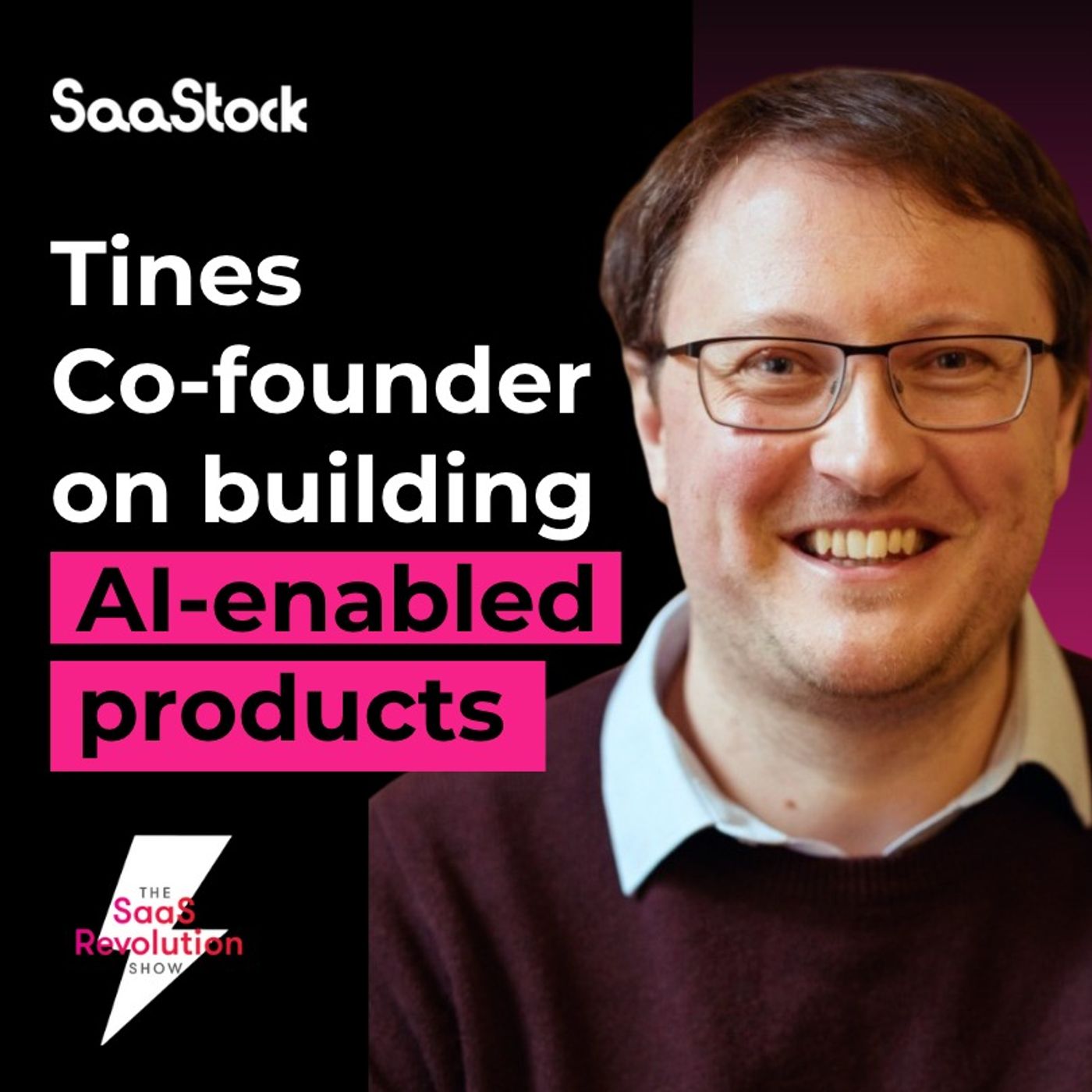
The SaaS Revolution Show
Building AI-enabled products: Lessons from Tines Co-founder Tom Kinsella
00:21:03
This is a special episode from the Centre Stage at SaaStock Europe 2025. Áine Mulloy, Account Manager for Startups at AWS, sits down with Thomas Kinsella, Co-founder and CCO of Tines, to discuss what it really takes to build AI-enabled products. From navigating trade-offs to rethinking workflows, and the tactics that truly work when scaling in the AI era. In this episode: - How Tines approaches AI product development and automation - The biggest trade-offs when embedding AI into existing workflows - Why user experience and trust still matter more than hype - Lessons on scaling AI responsibly and iteratively - What’s next for AI-enabled SaaS tools Guest links: LinkedIn - https://www.linkedin.com/in/thomas-kinsella Website - https://www.tines.com/
Loading summary
Transcript22 lines
- [00:01]
A
Some of the most high profile startups in Ireland. So the likes of Intercom or Stripe or Wayflyer or a whole lot of others. Intercom, the founding team, they had another startup, they founded Stripe, that was their second startup. Wayflyer was Aidan's second startup. It's the same with Bobby from Mana, it's the same with Pat from sisu. But not only that, it's the companies now that have exited, built that experience and that muscle of expanding, of building leadership teams, of building like recruitment teams, building like massive customer support and customer success teams.
- [00:36]
B
Welcome to the SaaS Revolution Show, a podcast by SaaS Doc. Here we interview SaaS founders from around the world who've been there and done that. They share the ins and outs of how they built their businesses, their operations, their path to securing investment and more. Our mission with the podcast is to help you, the founder, learn how to scale your SaaS, maintain your wellbeing and navigate the complex complexities of this ever changing industry. I'm your host Alex Diemer and together we'll explore the good, the bad and the ugly in the journey to SaaS success. This special interview from the center stage at SAS Stock Europe 2025. Anya Malloy, startups account manager at AWS, interviews Thomas Kinsella, co founder and CCO at Tynes. In it, they discuss the successes, trade offs and lessons that come with building AI Enable products. Enjoy the show.
- [01:34]
C
Thank you Stephen so much for the introduction. Thomas, I might just get you to recap quickly in terms of who you are at what Tynes do and we can go into it from there.
- [01:40]
A
Yeah, thanks so much. It's a, it's a real pleasure to be here. It's a real honor to. Yeah. To be on stage. Yeah. I'm Thomas, I'm one of the founders of Tynes. Tynes is a VC backed business to business software company. We're an intelligent workflow platform. So we allow businesses of every size, from small startups all the way up to the Fortune 10 to power their most important workflows. So we combine AI automation and integration to drive real business value across our customers. And yeah, we're Irish and we've got hundreds of people all across the globe.
- [02:15]
C
Perfect. We're going to keep this kind of fairly punchy just given the time that we have. And the goal really is to understand how Irish companies are developing, positioning and selling sort of world class and world leading AI products. So I suppose in terms of setting the scene for where you guys are at now, just to kind of give a little Bit of context back from that VC back piece. Any kind of key product launches or when people are thinking about how they apply tines, what are kind of the critical problems you're solving?
- [02:38]
A
Yeah, I think like everybody else, like AI has transformed the way Tynes works and transformed the way, like businesses work. So as a. A workflow automation platform or an intelligent automation platform, we, for the last like seven or eight years, we've allowed businesses to automate their repetitive manual tasks. Suddenly AI came in and like, changed how people are able to do business. And the good news is that like, AI is able to do pretty much anything. It's a little bit scary and there's a lot of people that will be like, yeah, okay, but you know, what should I use AI for? And that's the question that we've tried to ask and tried to answer and that everybody in the room should be trying to answer, like, what is it best at? And the way we think about it is that there's really prior to AI, like two different ways of doing things. Like human beings doing things or pure code doing things. So those like deterministic workflows. Human beings exceptionally good at strategy, like good at judgment, good at understanding business decisions. Code scalable, fast, reliable, will happen the same way or do the same thing every single time. AI and like agents. So giving an LLM access to tools, it kind of provides a combination of. Yeah, both of those. But it's not necessarily the best at judgment and it's not necessarily the best at like, certainly scale. It costs a lot of money and it won't necessarily do the same thing every single time. So you have to decide, like, hey, what is it good for when we're thinking about it in our product and when people should be thinking about it in their products, it's about understanding, like, yeah, where to plug it in. And rather than thinking about it as a product, thinking about it as another tool in that trio of the types of workloads that you can, that you can use. So in science, yeah, we've, we've built it in a. Built it, built it to allow you to leverage all three. And increasingly the products of the future, they're not going to be like Salesforce, but AI. It'll be, you know, a product with AI where it's appropriate.
- [04:28]
C
And I know in terms of the times, context, obviously there's pieces that it can just do autonomously, end to end in terms of connecting either via an API integration or whatever the case may be. But for people who are maybe a little bit earlier in their AI journey. How do you determine where AI can be an accelerant versus a gimmick or just overhyped?
- [04:44]
A
Yeah, totally. So it's exactly that. It's an understanding what it's best for. So if you examine like the type of process that you're trying to help with and the value that you're trying to solve. If you're value based selling, you understand like okay, what is the exact process if it needs to be. So we've like a framework which is like creativity, scale and safety. So if it needs to be creative AI or human being, you shouldn't be using code for that. If it needs to be fast and scalable, you probably shouldn't be using a human being, you should be using code or AI. If it needs to be safe and you need to happen the exact same way every single time, then you should be like using code. You should not be using like a human being or you should not be using AI. So when you're thinking about it, it's about like understanding a framework for understanding what AI is best at. And there's fortunately tons and tons of business challenges and tons and tons of ways. Like customer service is a brilliant example, marketing is a really good example. Like tons of processes like, but doesn't have to be exactly right. There's tolerable like guardrails, there's like toleration of error. But if you're preparing a business like proposal, yeah, maybe that's okay. If you're onboarding a customer and you know, doing KYC checks, you definitely shouldn't be using AI for that. It's too, it's too risky. So it's understanding the process and understanding what AI is good at.
- [06:02]
C
We're obviously seeing a lot about AI in the news every single day. And we're also seeing some of the, let's say mistakes is maybe good analogy, but I'm hesitant to use that word on this stage. But some of the instances where maybe it was oversold, let's say I can think of one in particular that has been, you know, quite a sort of a bit of a snafu even right up to a federal level in, in terms of selling then into large legacy incumbents which are still SaaS products or maybe quite conservative when it comes to data privacy security. How do you go about sort of pitching a product like Tynes when it's unfamiliar territory?
- [06:34]
A
Yeah, I think the very first question is to understand whether you should be pitching a product to those like legacy like, like I'm not sure any company would like to be called a legacy company. But to, to like large organizations is understanding like what their risk tolerance is and how fast, like how forward thinking they are and if they, if you should be like you should always be selling to your customer profile and like the process of selling to a Bank of America is going to be absolutely a nightmare compared to selling to a drata or an auth0 or something like that outside who are a lot more I suppose cloud first, tech forward, tech savvy. Having said that, if you are trying to approach and we do have tons of those, those like large, large enterprises, it's about bringing them a little bit along the journey. First of all, AI is scary to everybody. AI doesn't have to be scary. So we use like bedrock, that's an AWS tool. But it means that we can make claims with AI to say look, there's no training, there's no logging, there's no storage, your data stays in region, it's tenant bound, it's scoped just to you. And all of a sudden their compliance team are like oh okay, that sounds a little bit more reasonable. Realize that you're selling the same way that you're selling another like tool or another product you should be selling based on value. So you should never be saying hey, I'm going to sell you AI. You should be doing your standard sales process so you should be understanding the pain, understanding the decision process, understanding like what they actually want to buy, what the criteria are and like building your relationships with those stakeholders. And then the third part, there is still a little bit of, there is still a little bit of like there's no, there's a lot of excitement about AI but there's an expectation that it's going to work like magic. So realistically you're going to have to do a little bit more work under the, under the hood to make it feel like totally seamless so that when they get it, they do get that delight that you got the first time you use ChatGPT. You're like, why? This is incredible. They should still feel that. But you're going to have to do some of the work. So that might involve like saying, hey, we're going to do the implementation, we're going to do the migration, we're going to do a ton of professional services to make sure that you're, make sure that this is successful for you and that you feel that this is actually going to give you value because ultimately you want them to, you want them to land and you want them to.
- [08:43]
C
Expand can you talk to us a little bit more about that land and expand piece? We obviously heard from the previous speaker about building these sort of monuments and it's almost sort of what you guys have done internally within your customers, obviously starting that kind of cyber space. But now looking across other business functions, how have you kind of gone about that in practice and what can people maybe take from those learnings?
- [09:00]
A
Yeah, totally. So the good news is there's a lot of frameworks out there for that. So if you're around, there's like the bowtie method is pretty much typically what we use, which is thinking about the land as just the start of your relationship with that customer. Beginning with like awareness, decision making process and then expanding. But the most important part is like understanding that if you want to expand, if you want to like get into some other parts of the organization, it has to begin with value. So you have to work so hard to make sure every single customer is a champion and every single customer is a success. And that could be just by making your product like 10x better, or it could be by making sure that your support team are fantastic. Or it could be by saying, actually you know what, we're going to run a full onboarding process with a project manager who's going to understand your goals with the ultimate aim of like with times, the ultimate aim of saying, okay, the first team that we land in, that's just the tip of the iceberg. And if you're landing in a, you know, a large organization, frequently you can have, you know, a good land. But realistically the expansion opportunities are enormous and you want to, you want to tap into that. The other part, that's the first part. Just like just in general, just make your customers wildly successful. They'll be your advocates and they'll share. The second part is when you're building your product, try to just think about the TAM from the very start. So that total addressable market that. So we started out in cybersecurity and maybe there's like in cybersecurity automation, $2 billion in spending in enterprise workflow automation, there's like hundreds of billions of dollars in spend every single year. So if I decide to like pigeonhole myself a little bit too much in cybersecurity automation, I can do very well. But I'm never going to expand in those enterprises and I'm never going to, yeah, like hit those like million dollar multimillion dollar deals. So yeah, from the very start we became like a secure platform. We had like that foundation, but we also knew that actually, when we're building, don't build two specifically. Make sure your product, if that is your goal, make sure that your product can fulfill the needs for those other teams so that when you do get that opportunity, they have a good feeling about it, that other teams trust it and they can grow with you.
- [11:20]
C
Do you mind if we just kind of double click on that a little bit? And just how do you actually turn a customer into a champion? Particularly when you're working with maybe teams that are a little bit more privacy conscious, a little bit more conservative in their thinking, very rigorous around their compliance. Because you're starting in cyber. So how do you get somebody who works in cyber to champion a product like Tynes publicly and happily and freely? Ideally?
- [11:42]
A
Yeah, yeah, absolutely. So, like, I spent 10 years working in cybersecurity before starting Tynes. The job is hard. Like, genuinely, you've got, like, too much work. You've got alerts coming in from like, thousands of different. Thousands of different alerts from probably a dozen different tools. There's, yeah, like, not enough staff. I don't know any organization that says, hey, we've got enough, we've got enough staff. But there's also that sense that something bad is going to happen and inevitably something will, you will get, you will get compromised or you will have a, have, have a large incident. For us, it was about then, like those people. When you're, like, when you're a goalkeeper, that's kind of the job of a lot of cyber security teams. Your job is to defend. You don't really get a lot of credit. You, like, nobody is like, oh, man, very rarely, like, yeah, yeah, sometimes goalkeepers get a lot of credit, but like, very rarely is it like, hey, they absolutely, they absolutely won the match. So as a result, like, when a cybersecurity team can come in and say, check this out, I've just automated this entire process and I've just, you know, freed up a whole load of time. That's a win, and that's a win that those analysts and those managers and the chief Information Security officer can brag about. And if they're able to say, look, hey, here's the tool that I'm using. And like, this is an innovative process that I brought in. They're like, that allows them to get promoted, that allows them to, like, celebrate. And that's not something they get to do a lot that like giving them also, like working, you know, understanding their problems and helping them do it, but giving them the ability to brag about their job. If you're able to do that, like that's a surefire way for that person. Like sharing your. Yeah, sharing your product and telling people what a joy it is. The other part was that like with Tynes we allow people to automate but we also allow people to like to share so they can, you can share a service with other teams and there's a lot of like in a security incident for example, you might be like locking the accounts of 20 or 50 people. That's relatively easy to do but a lot of the IT team will just be like whoa, hold on a second. How did you lock those like 50 accounts? And we'll be like where the customer will be like well we use tines. And then the IT team are going to be like well how, how do I do that? How do I get my hands on that tool? It takes me like an hour to offboard every single employee. Can I just do it in 10 seconds? It's like of course you can. So that natural use of the product can, yeah, can be, it's, it has massively accelerated and massively helped us like if that lands and expand motion.
- [14:14]
C
Can you talk us maybe about some of the challenges then? Because it sounds like from the outside it's easy to look at a company like Tynes and just see this sort of rocket ship growth. Obviously you guys have made a strategic decision to co headquarter Ireland US can you talk to us a little bit about that global expansion, what that looks like like and maybe some of the trade offs you've made along the way?
- [14:31]
A
Yeah, absolutely. There's, yeah, there's lots. I think if it wasn't for Covid we probably would be completely headquartered in the U.S. but yeah, about 80, a little over 80% of our customers are the U.S. and more of our revenue is from the U.S. or from North America. So like it's, it's definitely a trade off to, to, to stay here but like building a software company in Ireland, that's part of the reason we started Tynes, so that we could build a, you know, a company that employs and is has the ambition that we have. I think a mistake that startups always make or certainly I don't want to generalize, I've made a lot of times is believing that like if you build it they will come do something, build something great and you're going to be like wildly successful. It's never about that. It's always about getting like 1% better every single day and like improving. But as a result like when we I suppose at the start when we didn't have some great advisors and some great leaders, we made one or two decisions to like be a little bit more tentative. So we like dipped our toes into decisions. So good example of a challenge. Like we, some of our earliest customers were yeah, the likes of like Canva in Australia and we made them like incredibly successful. And yeah, we had a couple more customers out there. We had a small team in the US we had a small team in Europe and we were like, okay, seems like the next, the next step is to expand to Australia. But in, we hired two or three, two or three salespeople and that was good but we actually weren't like wildly successful because when you're expanding and you're growing, you actually have to invest. So you have to invest in like a marketing team, a partnerships team, a like field team, a business development team. And then you also have to develop like invest in a customer success team so that when you're telling customers like a large bank, we're going to be able to support you, their question is how many people do you have? And you say three. Like it doesn't sound like you're going to be able to support me. So we, yeah, we, we, we made some, I think, yeah, we made some, we made some mistakes I suppose. And yeah, we definitely, we've definitely learned from those. But it's about, there's lots of trade offs but it's about like making sure that if you're making those, making those big decisions that you're, you are actually like believing in yourself and you're backing it up correctly.
- [16:52]
C
I think that piece when kind of coming back to the belief, I know we were talking about it earlier, just this idea of sort of the transformation that we've seen in Ireland over the last couple of years and this elevation of ambition also obviously we're seeing, you know, deeper ticket sizes when it comes to investment and things like that and really kind of Ireland punching above its weight. How excited are you about the Irish tech landscape when you look at it now?
- [17:12]
A
Yeah, incredibly excited. It's amazing and I think there's a few things. First thing I'll say is that if you're a startup, don't let any. I've heard the word success used a whole lot of times. Don't let anybody else define your success. Literally just starting a company is like that's incredible. And you should be massively proud of yourself for doing that. And if you start chasing the VC's version of success, you'll always be chasing the next the next round or the next exit. And that's, it's a, it's, yeah, it can be worth it. But don't, don't let, don't let a VC or another founder or anybody else tell you that you're successful. Having said that, the ambition of some people right now, it's like really incredible to see people are, they're not satisfied in saying, hey, I just want to, I want to do this, I want to expand to America, I want to expand Europe, I want to land these massive enterprise clients. But the other part about it is like five years ago or 10 years ago we had some people with that ambition, but we didn't have that experience and we didn't have that people that had done it a couple of times. So if you look at, if you look at the, like some of the most high profile startups in Ireland, so the likes of like yeah, Intercom or Stripe or Wayflyer or yeah, like a whole load of, a whole load of others like Intercom, like that team, the founding team, they had another startup. They founded Stripe, that was their second startup. Wayflare was Aiden's second startup. It's the same with Bobby from Mana, it's the same with Pat from sisu, like, but not only that, it's the companies now that have exited. There's companies that have built that experience and that muscle of expanding, of building leadership teams, of building like recruitment teams, of building like massive customer support and customer success teams. What that means is that, you know, now when you're saying, hey, should I expand to Australia? People are like, no, don't, not yet. Or they'll be saying, hey, should you, you know, like, what's the process to like expand to the US or what's the process to sell to a large enterprise? There's now teams in Ireland that have done that and it's amazing to see that those executives like go on and start finding their own companies and they won't fall into the same mistakes that we've made. They'll like learn from those and they'll grow and hopefully some Tynes founders or Tynes folks will even find their own companies, as hard as it will be to see them leave. But it's amazing to see the ambition of their ambition of some of them and I suppose that, yeah, the confidence they have that they're going to be able to take that next step.
- [19:42]
C
Yeah, I know it's fascinating whenever you do a little bit of stalking, let's say on LinkedIn, just to see where people have kind of bounced around. I'm conscious that we're at time, so just, I suppose a very last piece for yourselves. What's next with Tyence?
- [19:54]
A
Yeah, it's an incredibly exciting time. Like we just saw, we just saw OpenAI release their own workflow builder and like, where we believe we're the leader in like, workflows. So we're. Yeah, it's an amazing time to be a workflow platform. We're hiring like crazy. We just in the last like three months, landed our three largest deals in the company's history. We're hoping to like almost double revenue this year, double revenue next year and yeah, expand enormously. It's a, I'd love to say, hey, here's the like 20 features that are coming out. There's loads of features that were coming out, but realistically it's just about. So yeah, it's strapping in and strapping in and executing, but it's a really exciting time to be in towns and we're hiring like crazy as well. So come join us.
- [20:34]
C
Fantastic. Thank you so much. Thomas. Thank you for your time.
- [20:39]
B
Thanks for listening to the SaaS Revolution Show. If you enjoyed this episode, please leave a review and follow the show. It helps more SaaS and AI founders to discover the podcast and keeps us bringing you the leaders who are shaping the the future of the industry. For more insights and to join the Sastock community, head to SAS talk dot com.