← The SaaS Revolution Show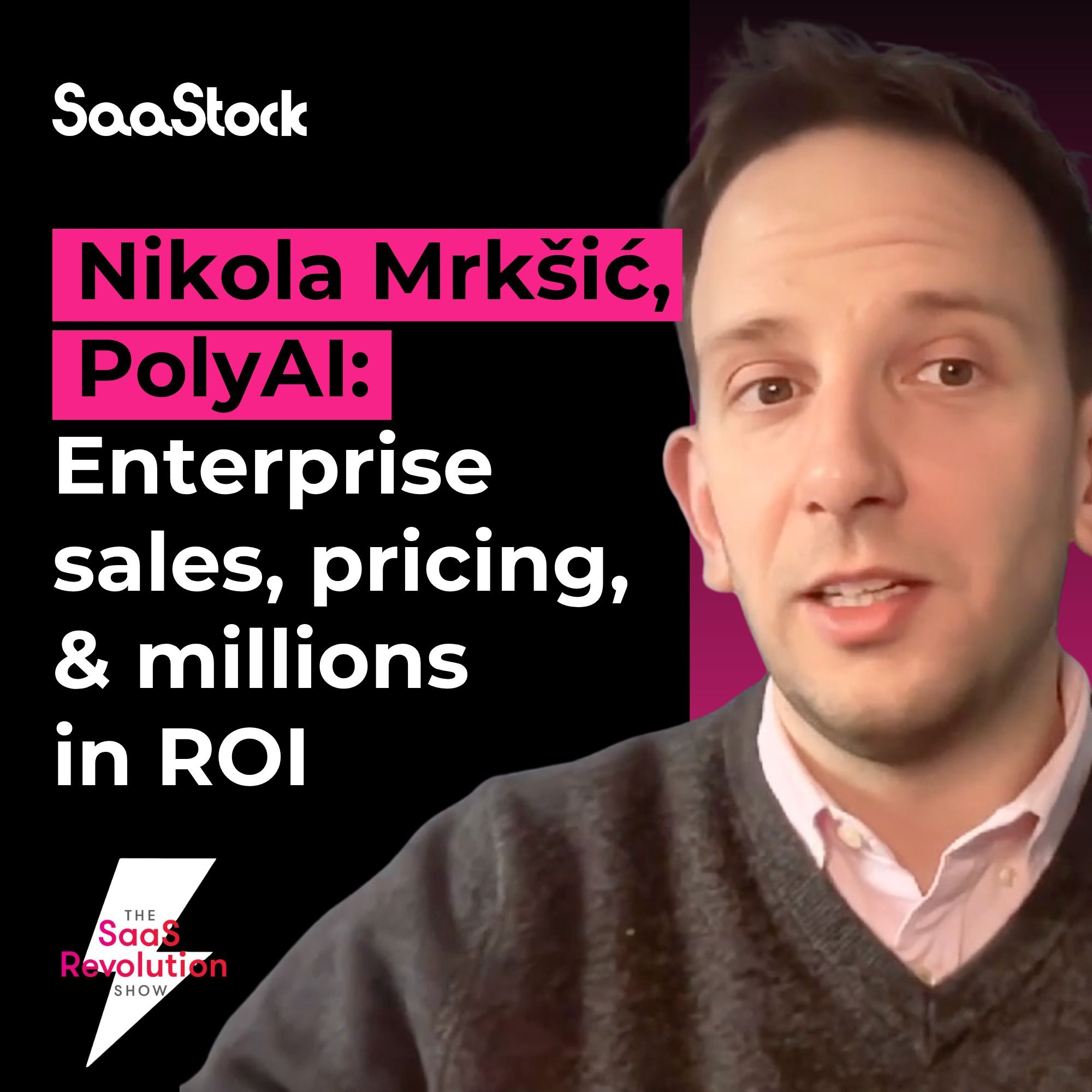
The SaaS Revolution Show
Nikola Mrkšić, PolyAI: Enterprise AI sales, pricing, & millions in ROI
00:30:36
Nikola Mrkšić, Co-founder and CEO of PolyAI, joins Alex Theuma on the SaaS Revolution Show to reveal how voice AI agents are driving millions in revenue for its enterprise customers. Nikola shares his journey from competing in math olympiads to building a leading global AI company. They discuss the evolution of AI, its role in social mobility, the impact on customer service, effective enterprise sales and AI pricing strategies, and more. This episode covers: - Nikola's background and how it shaped his approach to AI. - Why AI has the potential to transform customer service even further. - Why building a successful company requires delighting customers and improving products. - The challenges and opportunities that come from rapid AI development. - Sales strategies that align with enterprise customers. - The challenges of outcome-based pricing and why it’s powerful. - How AI voice agents can deliver significant ROI for businesses. - The future of PolyAI focuses on scaling impac...
Loading summary
Transcript30 lines
- [00:02]
A
What kind of software to buy from what kind of people. Right. And you have to match that and that will reduce the friction. Of course, maybe you are the God of sales and you've come up with a genius thing that's immediately obvious to everyone. If so, proceed. If not, you're probably going to have to learn about how software tends to be priced in what you're doing and you're going to have to mirror a lot of it, if not all of it in the first instance.
- [00:25]
B
Welcome to the SaaS Revolution Show, a podcast by SaaSdoc. Here we interview SaaS founders from around the world who've been there and done that as they share the ins and outs of how they built their businesses, their operations, their path to securing investment and more. Our mission with the podcast is to help you, the founder, learn how to scale your SaaS, maintain your wellbeing and navigate the complexities of this ever changing industry. I'm your host, Alex Diemer and together we'll explore the good, the bad and the ugly in the journey to SaaS success. Welcome to the SaaS Revolution Show. I am your host, Alex Sumer, CEO, founder of SASDOC, also general partner at Back Future Ventures. Delighted to be joined today ahead of his appearance and speaking at SASDOC Europe, which is on the 14th and 15th of October in Dublin by the co founder and CEO of PolyAI, Nicola Merksich. How are you doing, Nicola?
- [01:19]
A
I'm great, I'm great. Thank you for having me.
- [01:21]
B
Yeah, yeah, good to have you on the podcast. Obviously now having a, I guess a virtual conversation but soon we'll get to meet in Dublin and very excited for you to come over and all the great, I guess kind of like AI first and AI native founders and companies that will be there and getting together in person. Ahead of that we have this opportunity to learn more about you and your story and building Poly AI, which is I think certainly one of the most exciting AI companies, you know, in, in Europe and you know, coming out of the the uk. Nicola, I'd love to know because I think you've got quite a, an interesting background from, you know, coming from Belgrade, you know, thinking, I think, understand that you, I think wanted to be a writer, perhaps science fiction, you know, maths and going into Cambridge and how this spun out. So I'd love you to kind of share that story a little bit.
- [02:25]
A
Oh for sure. Look, yeah, I think I said that in one podcast and now it's become like the main theme. No, no, look, I mean I had a very classical Kind of like Eastern European upbringing that, you know, math sold away, STEM and nothing else exists. Competing in maths programming and all of those things. I think in that episode, you know, like, I think the other fun part is, you know, there's classical Eastern Europe and then there's like former Yugoslavia, Serbia in the 90s, which is, you know, civil war land, country falling apart, a lot of instability. So I think point, I wrote five kind of like Star Trek inspired tribute sf, sci fi stories, right? And I had this idea of just going around like cafes and trying to like sell them to people, see if someone reads them. I don't really know what the end game was, to be very honest with you, but I came up with this like packaging where basically you could like buy three or five at different prices. And I remember distinctly there was a day where I made like I think 2 or €300 on the average Serbian salary that year. The monthly salary was like 2, €300. So that felt like I was walking around with this bag full of money and I was like, there's a way to hack it. And I think, you know, a lot of startup growth and all of that almost feels the same in that there's a lot of theory and you know, what the averages are and what's slightly better is. And then sometimes you just have these breakthroughs and sometimes it's way harder than the textbook says. And sometimes it, you know, you just find an opening and then you got to use it because God knows it's not easy building those things as well. So I ended up at Cambridge doing computer science maths towards the end of kind of like my master's and I met a guy who was starting a company called Vocal iq. He dropped out of Cambridge lectureship to do that and he was starting with another Cambridge professor. So a very classical Cambridge story where it's kind of like a spin out of people who were among the first to do deep learning for voice assistants, back when no one cared about it, right. They had been working on it before Siri was a thing, right? So that company ended up acquired by Apple a year and a half later. And I ended up doing a PhD with Steve Young, one of the two co founders and a legend in the field. And then deep learning really took off, right. So whatever you were doing, it just started working 10 times better every year and it hasn't really stopped ever since. But what got me interested in building a company that would kind of like do B2B agents for customer service, which, you know, I wouldn't have Told you I was going to do 10 years before, right? Was the fact that, you know, when Apple acquired us, people would ask, where do you work, Apple? What do you work on? Siri Serious. And you'd go, okay, like fair. Some things didn't work, some things did. But there was more than just, oh, I said this and it wasn't understood. I think the mismatch between our sci fi style expectation of what this assistant would be and how we would use it and the actual reality was so wide that you could be nothing but disappointed and should be told it was less to do with Siri herself and more to do with the expectations. So to me, kind of like the methodical approach was, let's narrow the problem down to something a bit more manageable where we can both hopefully do it way better relative to expectations and measure whether we're doing well, improve every year. So to build a company you need like to delight customers, get more usage, get paid for it, get data, improve the product, delight them even more. So the cycle there, that was very obvious was customer service. Because believe it or not, today as well as five years ago, about 2% of the working population in the UK and the US works in contact centers. So despite all the automation, all the deflection, all the chatbots, it hasn't really shifted all that much. And that's ignoring the probably equal amount of labor done offshore support enterprises in western societies around providing customer service. So takes a village to provide a customer service to your customers. And most companies today are doing it quite badly. And AI has a lot to give there, but you know, it has yet to give a lot right in, in, in terms of just transforming that whole state.
- [06:42]
B
Is that 2% you think going to become 1% and 0.5% because of AI? Is that how you would see it potentially?
- [06:49]
A
Yeah, I think so. I think it will lead to definitely a 5x reduction over some span of time. Whether it's 3 to 5 years remains to be seen. It's not that important. I think what I'm really excited by and that we're witnessing in a lot of our deployments is that it creates a new generation of knowledge workers. It gives like social mobility to the best, brightest, hardest working people in the contact center. That's historically been quite hard for companies to do, to identify people there and you know, promote them up and extract talent. Because to get, you know, wherever you get a lot of people going through your company, there's a lot of talent going through, whether you're identifying it and moving it to the place where you need it most? Probably not. But if you have them, you should identify them. And I think that with the context center transforming into this place where you have humans and AI not working really side by side, but working on different things, the best paid job and the most exciting job becomes that of the future air traffic control for AI. Because if you have AI doing 80% of the work, any mistake, well, like, the upside is huge, not to mention the cost savings and the ability to pick up the phone or answer a chat request any time of day or night, in whatever language. You know, the spiel. It's really that if something goes wrong, it goes wrong at a scale that humans could never pull off. Right? So there it really will start to resemble air traffic control, where it's, you know, like you're gonna. It's gonna pay to have levels and levels of supervision and just, you know, continuous improvement, both for the sake of improvement, but also for the sake of having assurances that you don't start, you know, issuing product returns to people who called you about, you know, an upsell or something like that.
- [08:39]
B
You started the business in 2017, is that right? Yeah, And I think perhaps, like back then, we call it like machine learning. Deep learning is like, you know, conversational intelligence. Perhaps still. Would you say, though, that over the last couple of years, I mean, obviously with this fast pace of, you know, the new AI, like, developments, like, has there really been, like an inflection point, like a. A wave that has, you know, in a positive way, like, impacted you as a business? You know, are you able to correlate that 100?
- [09:12]
A
Look, I think the first three, four years we were building prototypes, and really it was. We were what you would look at as a classical research lab. Right. When the ratio of PhDs and postdocs to employees is over 50%, it's a fake company when it comes to really being a company. Right. It's something else, really. It's around 21, only that we had, like, the first pilots and things running, and then it kind of like really started growing. And it was growing fast, even pre the chatgpt moment. And then it exploded when, you know, samwolfman and Ilia did their magic, because not only did the capabilities start evolving, they both jumped. And like, what an LLM could do is very different from what you could do with the previous machine learning approaches. But more importantly, the. Well, I don't know if it's more important. It's equally important the interest of enterprises and their belief that this can be done. With technology has changed profoundly and it shifted from early adopters pressing and finding for wiggle room inside their organizations to buy this kind of software and implement it into boardrooms screaming at people about not implementing AI already, as if they themselves knew how. But that's good because it just gives you a way to not do pilots in the fringe of a company and then look for other ways and other backers to kind of sponsor a wider rollout, which we have at this point gotten really good at doing. And there's still a level of it. Right. But now when the CIO is banging on the table and demanding that AI be implemented and you are a credible vendor with case studies, you know, things are never easy for a growth stage startup, but man, it's a lot easier than it was.
- [10:50]
B
What about, I mean like the, maybe some of the challenges around the pace of development. Right. Because I guess what is true today won't necessarily be true in a couple of months time. It's just going so fast. So you may have to rewrite, you know, parts of the product and I don't know how are you finding that internally within the organization and for yourself, you know, as the challenge building on something today and then, you know, in two months time it could be something else. And you've probably already experienced that this.
- [11:14]
A
Oh, absolutely. Look, on the one hand it's what we've been preparing for our whole lives because I think we are unique among our broader set of competitors and there were actually researchers who worked on this on the model front and then we went into kind of the enterprise trenches. Trenches fighting for adoption and clients and wide rollouts. So I think we have a better intuition than any of our competitors around how every change will impact the stack. Now, you know, I was at the OpenAI launch party at NIPS long ago and spoke with Ilya about like, you know, how much structure you should have in neural nets and he of course insists that you should have none. And it's all about data. And you know, even though I was a deep learning sellot, I thought he was like really out there in terms of the ambition. He was right about everything. Right. So to say that we know what's going to come next would be foolhardy. We do not. Right. I think we can talk about fine grained assumptions and what we think will happen, but at this point we might as well be talking about tonight's football game and how I think it's going to go. Right. So I think you just have to be agile. The challenge, I think in a B2B company and frankly even for OpenAI, you saw it with the GPT5 launch, is you try to tie your user base to your new model and to the next thing and the next thing, but it will always break some assumptions that are important to different parts of your customer base. And then you know, it's a one by one transition for all of them. Sometimes it's a flip of a switch, sometimes it is not. Sometimes you need their buy in, sometimes you don't, sometimes it's really hard to do and you have to reimplement the whole thing. So the bigger the business, the slower you get. And that's where you know the heart of disruption always lies, where you have to be as fast as you can be. And it is inversely correlated with how big you are as a company. So you know, we're sizable but still quite small. So we're managing but you know, it gets harder, harder the more clients we have.
- [13:11]
B
What about for yourself personally is I guess kind of coming out of, you know, the research labs, being this technical founder creating very technical product, then going to have to sell this to, to enterprise. You, you know, what were you, some of your learnings, you know, from that, that you could share.
- [13:28]
A
Yeah, listen, I think in Europe we have this learn helplessness. Tech founder la la. Like you get treated far worse in Europe being a tech founder and everyone assumes that you're this moron who can't sell, talk or do anything else and you're expected to stay in your hole. In America they like celebrate tech founders and they like them more as they should because those are full stack people who you know, if they can't sell, they can't sell. They shouldn't be like CEO or whatever. Right. I never really thought of myself as, I mean I obviously am a deeply technical founder. Right. But equally, you know, if you're investing in any one of these like Eastern Europeans that went to these specialist schools and moved on, know that they had to do that to get to where they were. Right. That was the, the ticket. So much like in America you get a lot of people who play like college football and then never look back. You know, I think like competing in maths for a lot of the former Soviet bloc is literally the same thing as Americans playing sports to get a scholarship. So I was never really, you know, had that hell bent on being technical. Obviously I know a lot about it and enjoy it. But yeah, to learn how to do it I think like you know, someone who studied something non technical has to learn how to build and scale an enterprise software company all the same. You know, I don't think there's a college degree that will teach you that. Key insights. I don't know, I think it's just like founder sales all the way. You have to lean in because you are initially like a one man, then maybe a two, three, not very large group of people that is at the heart of looking for that product market fit. Right as you're selling, you're tweaking the product and the product offering half of it is probably not even built at the time that you're selling the first thing. So you have to have a very quick iteration loop and the best way to have that is to have a single person or a few of them tightly integrated owning the whole thing. And I think a cardinal sin, especially in Europe is this whole like oh look, technical founder now let's hire them killer head of sales. The truth is the killer head of sales who can really sells any software easily, A, there aren't that many of them. B, they're working at very large companies making seven figure like you know, paychecks every year. And why would they, you know, go through basically being co founder with that person early on? So there's no silver bullet. You're going to have to do it on your own and you should do it on your own. That's actually where the fun is in terms of.
- [15:51]
B
So you're selling to the enterprise in terms of coming up with the pricing for, for Poly AI. You know, have you done this based on like outcome based, you know, pricing looking at like these are the savings that we're going to make you as a customer by you know, replacing human labor and perhaps software in that like how have you come to the price points which you are at at the moment?
- [16:15]
A
That's all very nice and theoretical, right? Like if I knew everything about your business, I could price it fairly if you were willing to share it all with me, if you even knew it yourself and if you were the decision maker in charge of making that decision and betting on the right outcome based thing. There are companies that think that way and they love it price that way and we love pricing it that way because we make way more money, right and the incentives are aligned then it will make sense. A lot of others look at it as, you know, an analogous thing to the picks and shovels they can buy from the hyperscalers and others and have their IT teams build. And those guys you will like the customer is always right. So you will sell in the way that the Customer wants to buy like about half of our contracts, if maybe even 60% are consumption based, the rest are outcome based. And you know that outcome is so heterogeneous that I think there's a bit too much excitement about it now. As if it's just a silver bullet. It is not. It is really hard to price outcome based things the right way when you can do it. It's magic. But equally, I think you would be mistaken to be an early stage company who thinks that, you know, just saying that it's going to be outcome based so you don't pay when it doesn't work, it's like they're paying you and spending time with your worthless little company. That has proven nothing yet. Right, so. Or proven very little. So you know that your enterprise, like the respecting an enterprise is to understand that I'm spending time with you and going through all this is an investment, a serious one, that they've prioritized over many other things that they probably need to do. Right? So they're already paying for working with you and they've already put you ahead of many other things that they're no doubt being asked to do. Not just your competitors for your single thing, but many other things. Right. So understanding that is I think, where a lot of early stage guys really just are narcissistic and it's like, but me, me, me, if I give it to you for free and it doesn't work, why will you not work with me? Because I could be outside cleaning my shed instead, right? And maybe that will give me higher roi. Maybe changing my ERP system or my CRM or God knows what else will be higher roi. So I think there we just really have to think about what is your product and how do people like the people you're selling to? What kind of software do they buy from what kind of people? Right? And you have to match that and that will reduce the friction. Of course, maybe you are the God of sales and you've come up with a genius thing that's immediately obvious to everyone. If so, proceed. If not, you're probably going to have to learn about how software tends to be priced in what you're doing and you're going to have to mirror a lot of it, if not all of it. In the first instance.
- [18:54]
B
Your talk at saasdoc Europe in a couple of weeks time is Lessons in scaling enterprise AI how PolyAI made voice agents deliver real ROI. Can you give a couple of insights? Because we obviously don't want to give the whole talk away. Here, nor, nor do we have time. But on, you know, some of like how you've been able to use voice agents to deliver ROI and also what people can expect from your talk.
- [19:21]
A
Yeah, yeah. I mean, look, I think one of the main insights has been that people that are going to use AI to make their company the best version of itself are not starting with that whole, oh, I'm going to cut some costs because in the hierarchy of needs, when selling cost is like a distant fourth. Right. A dollar earned is a lot better than a dollar saved. Compliance and risk also rate I rank more highly because you get fired if you mess something up. And then cost savings are nice to have. So our explosive product market fit started in hospitality. First we sold to restaurant groups and casinos. One in two groups in Vegas runs poly right now. Why? Because if they don't pick up the phone and it's someone calling to make a booking, you either they will not make the booking or they'll make it online through an online travel agency and they'll lose 20 to 30%. So we're just helping them make more money and that just like all the money, Right. So there we've had outcomes like you know, per casino site we increase like annual revenue by like 5 to 10 million for large restaurant groups. Again, like tens of millions of revenue uplifts. And that's just like it stops being negotiated. Like if it works, it works. It's worth trying to. The other part maybe that's interesting for that audience is just it happens a bit more easily in America, both because there's a lot more money sloshing around and because culturally Americans tend to be a bit more, you know, free thinking. They allow mid to kind of like mid high level executives to make calculated bets and just see whether it works or not. And if it does, great, and if not, so what? Whereas I think in Europe there's a bit more of the consensus blame game around. Why did you spend that money? Did we all sign up to it? And that just creates friction. Now when you look at our largest deployments and beyond hospitality, it's really about improving customer experience in one shape or another. It's large enterprises whose customer service collapsed because they just can't have enough agents. They can't train them well enough. Right. So their CSAT dropped, their waiting times got elongated and they were like, what are we going to do? Let's throw AI at it. Especially today when AI is a lot more, it's more culturally accepted. AI will work and will continue to improve. Right. So it's easier for them to make this bet. That's one piece. The second piece is like just improving NPS scores. Right. Once you show that for a bank, for instance, we improved NPS score by 14 and that moves them a whole category of like what kind of bank you are to your customers. And that's just so valuable that all the bait falls off. Right. And I remember one of my early guys had this magic sentence. He would walk in and just say, we're going to cut 20% of your OpEx. And I think the guy expected everyone to just go, oh my God.
- [21:56]
B
Wow.
- [21:56]
A
Yeah. Where do I sign? And that's where I just learned that. That whole cost cutting and the way that I think the media and everyone just thinks of AI as an evil CEO and cfo. Sit down and say, we're going to cut the agents. Like, that's not how the real world works. The real world is struggling to hire enough agents already. So if you give them a button to click to have more agents and if all it took was to pay them 10 or 20% more and they didn't have to hear about it every day, they. They've probably pressed that button. Right. So the problem is not what people think. It is like these overcrowded contact centers where people are fearing for their lives about AI automating their livelihoods. No. Like in most places where we implement, people are excited, they start using it. And you know, those that are excited are the ones that were there for a long time and they tend to stick. The others are just kind of like tourists. They come in for a few months, they leave. And. Yeah, like, will there be fewer of those in the future? Yep. Will it mean that someone might not have a job they need for a few months? Potentially, but they'll probably have a job annotating stuff for other companies, building on models to do something that we're not even thinking about yet.
- [23:01]
B
Well, looking forward to watching the full talk in Dublin at SaaSDoc. I'm curious to know as a CEO, what AI tools you're using maybe like on a day to day basis to, you know, help you do your job, make you more efficient, make you more productive.
- [23:22]
A
Yeah, I mean, look, I think that like ChatGPT has become like my operating system for like absolutely everything. I was thinking this morning, I use Google for some reason I was like, oh, I haven't used it in days. Right. So I think six months ago I was talking to people and thinking that I'm probably like 50, 50. I literally don't even use Google anymore. I don't think it's very controversial statement. I think other good tools, I didn't do a lot of coding but I think Lovable is great and I think it's great for illustrating kind of like the prototypes and things in product discussions. And then obviously as you know you implement you need a bit more. But I think it's really powerful and the team uses it like amazingly. Cloud code is good. Granola is a fantastic tool. You know, I've been a fan of GONG for a long time, but I think granola is like where and this is quite close to what we do. So I know the kind of things they have to do to make things work and I appreciate them. Right. Because GONG has not made some of those things work even though we've been captive to them. And Gong's quite heavyweight me joining a one on one with you and they're like a poly notetaker joining and it's always been this pomp and unnecessary was with granola and the ethos of just notes and stuff. I think it's a really, really good tool. And then yeah, I think yeah, I no longer write many lines of code but like cursor is like really heavily.
- [24:46]
B
Used internally and yeah, on ChatGPT, like what would be some of the use cases like are you using it to draft emails, you know, social posts, like memos. What would be like a couple of recent use cases that you've used it from a business CEO perspective.
- [25:04]
A
Perspective, yeah, look, I think that outlining long memos of things, you know, Amazon style has never been my forte because I'm a talker. I'm not, not bad at writing. But it requires a context shift that I tend to find very difficult to do. So it's allowed me to look with, you know, 30 minutes instead of three hours right out. I don't know, complete new pricing. What, why? How like 20 pages. I think that's really good. I think in different kind of presentations and stuff like that, it's, it's phenomenal for wordsmithing and all that. Social posts and stuff. It definitely accelerates you. I think there's a definite kind of like degradation in the level of content you see on LinkedIn and stuff. And when I write I'm quite serious about doing a good job. It's very obvious when the tone of the person is not coming through. So in those posts and stuff I tend to not use it all that much because I think the algorithm will punish you for being yet another, you know, sentences of da da da da you know, like, it's all sensationalist. It looks. Reads like a Daily Mail article and, you know, it's. The number of hyphens, bullet points and weird emojis is just kind of like, whatever. Do you use it for that?
- [26:16]
B
You know, I've experimented for sure. So I try and post daily on LinkedIn. I would say most, but not all. If I, if, if I've used chat GPT to, like, I'll draft the post, ask it to, like, you know, create a more polished, you know, AI version. And yeah, I think you definitely. I. I would say I definitely still that feel that I'm punished by the LinkedIn algorithm from doing that. So it, for me, when I read it, I'm like, oh, yeah, it has improved my post. And again, I don't know if this is like this, like, sort of, you know, psychological, like, effect there, but. But in general, I would say they don't perform as well. But I have seen, like, people I don't know if you're familiar with, like, Adam Robinson, who runs RB2B, and he's, like, quite popular on LinkedIn. He would write, you know, spend a lot of time as a CEO writing like, three posts a week. But now he's trained and he's open about this. Trained ChatGPT to write like him to then buy back all the time that he was spending as a CEO on writing. And, you know, still seems to be performing pretty well, but he has a large audience now. Right? So I think that's what.
- [27:34]
A
Listen, I think that it improves for most people, it vastly improves their content. Right? I think actually it's fairly uncontroversial for everyone. It can improve it. Right? But there is just like this, like, stream of GPT thought where it's like, Asians talking to Asians, and it's like, okay, you know what? Like, there's a part where you kind of are hungry for, like, your voice or, you know, a grammatical error here and there to just know that someone actually, because, you know, why do we post daily? Do you have, like, you know, we know why, because we're doing the manchen and all that. Right. But do you genuinely, every day have something worthwhile to share with the world? I don't. And that's where I think it's just, you know, like, the consistency versus, you know, I think, like, the best people at that get excited to the dopamine rush of getting a thousand likes. And honestly, welcome back to high school, right? You're just waiting for someone to poke you on LinkedIn.
- [28:32]
B
What's, what's next for Poly AI? Like what's, you know, over the next sort of like 612 months and again in this rapid pace of the AI era, what's next for you guys?
- [28:42]
A
Yeah, my North Star is the number of companies for whom we do the work of a thousand people or more. Right at the moment we've got three. I'd like that number to be at least double in six months and double again in another six months. And that's really, I think, the most important growth trajectory because you know who's paying you what and all of that or like how many you captured in the long tail of some kind of like plg, Zerg, Rush. It can be great, it can be a leading indicator for great things or it could just be noise. Right. I think that we're a B2B company and the only real measure of it is like the impact it's had on those companies that decides how sticky they are and really just how good our product is. Right. Whether it deserves to be used and to be used by more companies. So, you know, we're on track for those things and it's really the goal is just to have a bigger impact on the world. And yeah, that's mostly large enterprises, mostly in the us, some in the uk, a few in continental Europe, and I think that shape is likely to remain similar for the next kind of like two years.
- [29:48]
B
Well, Nicola, thanks so much for coming on the podcast today. Looking forward to seeing you in Dublin on the 14th of October. And yeah, really appreciate you sharing with the SaaSDOT community your journey or parts of your journey so far in lessons and looking forward to seeing more at saasdoc.
- [30:06]
A
Absolutely. Well, thanks for having me and I look forward to seeing you there.
- [30:09]
B
See you there. Thanks for listening to the SaaS Revolution Show. If you enjoyed this episode, please leave a review and follow the show. It helps more SAS and AI founders to discover the podcast and keeps us bringing you the leaders who are shaping the future future of the industry. For more insights and to join the Sastock community, head to sastoc.com.