← The SaaS Revolution Show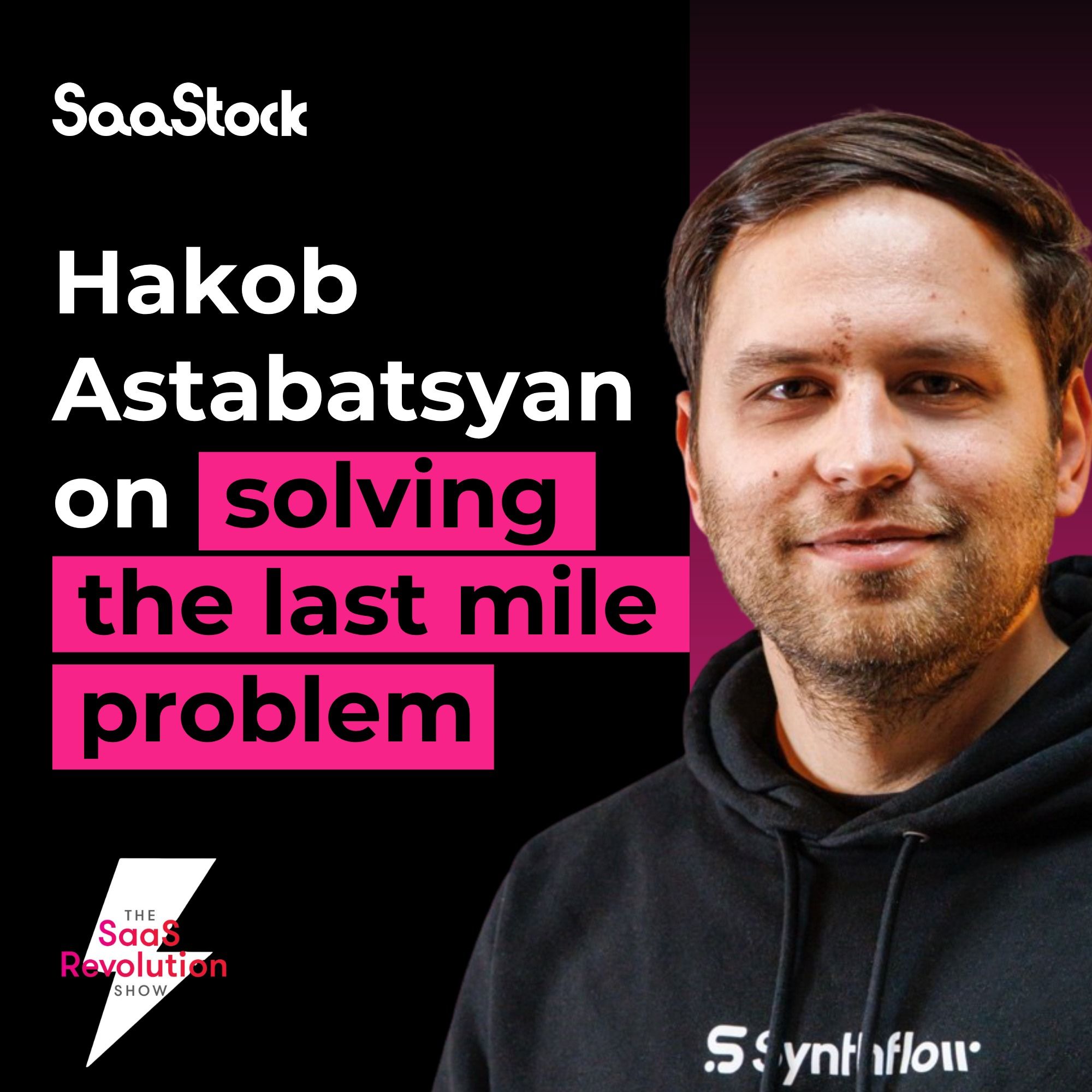
The SaaS Revolution Show
Voice AI that delivers: Synthflow AI’s Hakob Astabatsyan on solving the last mile problem
00:21:09
Live from SaaStock Europe 2025, Alex Theuma speaks with Hakob Astabatsyan, Co-founder and CEO of Synthflow AI. Hakob shares how Synthflow grew 15x revenue in its first year and how it now powers millions of business calls every month. He explains what it takes to move beyond AI hype and solve the “last-mile problem”, delivering real, measurable value through end-to-end automation and RPA 2.0 (voice + task completion). They also discuss Synthflow’s US-first GTM strategy and the rise of forward deployed engineers. Listen to learn: - How Synthflow AI scaled from 0→15x in a year. - What the “last mile” really means in AI. - The role of forward deployed engineers in customer success. - How RPA 2.0 makes AI agents truly useful. - Hakob’s AI stack. - Why voice AI has crossed the cusp, and what comes next.
Loading summary
Transcript32 lines
- [00:01]
A
This is also, I think, one of the buzzwords now in Silicon Valley and everywhere. And basically it's not different from solutions engineers or sales architects from before AI, it's just they are a bit more specialized and basically these are folks who work on solving the last mile problem. Basically, crossing that river of the last mile is for a deployed engineer's job.
- [00:30]
B
Welcome to the SaaS Revolution Show, a podcast by SaaS Doc. Here we interview SaaS founders from around the world who've been there and done that as they share the ins and outs of how they built their businesses, their operations, their path to securing investment and more. Our mission with the podcast is to help you, the founder, learn how to scale your SaaS, maintain your well being and navigate the complexities of this ever changing industry. I'm your host, Alex Diemer, and together we'll explore the good, the bad and the ugly in the journey to SaaS success. All right, welcome to a live episode of the SaaS Revolution Show. We're here@SaaS.europe 2025. Delighted to be joined by Hakob Astabatyan, who is the CEO of Synflow. How are you doing, Hakob?
- [01:13]
A
I'm great, thanks for having me.
- [01:15]
B
First time in Dublin, I understand. Yeah, yeah.
- [01:18]
A
It's my first time and I love it.
- [01:19]
B
Enjoying it now? It's your favorite European city.
- [01:21]
A
Yeah, it has the potential to be the first one.
- [01:24]
B
Yeah, it's very cool, especially this time of year. Also your first time at a SaaSDoc event?
- [01:30]
A
Yes.
- [01:30]
B
Initial impressions?
- [01:31]
A
Yeah, I love it, honestly. And it's so relevant for us at this stage of the company. And as I mentioned previously, when I go to other conferences, sometimes it's not very relevant. They're like very large companies or corporates, but here just come meet peers especially and share insights and talk to other startups. I think it's a perfect conference for that.
- [01:55]
B
And you just spoke on the founder track stage. Talk about your journey from startup to scale up using. Well, you can tell us a little bit about what SyncFlow AI does and maybe like what were some of the key takeaways from your talk for those that are listening that weren't at the event?
- [02:12]
A
Yeah, absolutely. So I structured my presentation to fit to the team here at SAS Talk actually, like sharing our growth that we had this crazy growth in the AI era with peers. So it was more like sharing the experience and lessons learned. And at Synflow, what we do is we build voice AI agents on the phone. Basically you can think of an AI contact center on the Phone automating, customer support, like business calls mainly. And we started in 2023 and one of the first companies to actually deploy the first conversational product based on the LLM. And we grew very fast. So we grew like from 0 to 15x revenue growth in the first year. We're processing millions of calls per month right now. And I would say one the most important takeaway probably is that the rules of growth have changed. However I also mentioned at the end of my conversation the rules of building a company haven't changed. So it's very interesting to understand actually what has changed now with AI, right? You know like the marketing, right? The demand and the product technology. But no one has changed the roles of building great companies, hiring great people, right? So I think that was what I really wanted to convey today so that especially startups building up starting right now, pay attention to this aspect.
- [03:49]
B
What has changed? What can you share around marketing? So like this, let's say new era of gtm, like what are you doing that work that works. What have you seen that has changed?
- [04:00]
A
Yeah, absolutely. I think AI is very interesting because the demand generation especially in the beginning was very like, I would say virality driven or very say product marketing driven, right? Because I think there is an inherent demand in the market right now for AI solutions because it's new and the promise of AI is huge. Right? Many companies look at the value proposition of many startups and they're like this can't be true, right? Because if it's true, this is insane. Like are you going to automate my sales completely and give me like 10x results than I had before for a fraction of the cost in our case? Are you going to automate our entire customer support? Basically we have hundreds of agents on the phone. So you're saying we can put AI on the phone working 247 answering these phones at the fraction of the cost, Right. So I think the value proposition is extremely appealing. And another aspect is that many companies know it's a new technology and they have already allocated large amount, large budgets, experimental budgets. That's why especially I know it's like from the us companies are very willing to purchase the solutions and see if it actually works for them and that creates this huge demand that you can tap into. But that's I would say only first phase of the movie, first part of the second part when we're delivering the value. Right, okay, can talk about that. But I think that's what drives AI and just being on the map of these customers that have these budgets is already I would say probably 80% of the job so that they will consider you as a vendor, right. Just being out there making your name is the most important thing.
- [05:56]
B
As you said, the AI value proposition is incredibly strong and it's. Some people will think this is too good to be true. There is Sam Jacobs from Pavilion spoke earlier and he showed which I think the it is like a headline but I don't know if it's clickbaity statement. You know the MIT sort of like report 95% of AI POCs are not providing any values. A little bit sort of out outdated. What are you seeing yourself, you know, with your company in terms of whether it's the POCs but in your customer case of like the value driving and the feedback that you're getting.
- [06:36]
A
Yeah, excellent question actually. And this one of my slides was about this, the last mile problem, right. And I think it has become a thing now, right? It's everywhere on LinkedIn, etc. And yeah, you can debate the sort of the validity of that report, right? The sample, etc. But let's be honest, it's a fact that. And that actually goes in line with what I just said earlier, right? There is like a strong marketing market fit, right? As this most recent crandum chart, I like it, it shows like iterated product market fit definitive and it shows there is a marketing market fit. But how many companies actually deliver value? And for us, basically very quickly we realized we need to focus, right? We need to focus and deliver end to end value. That's why we transitioned very quickly from being a generic voice AI technology API provider. We not pivoted but kind of focused more to being AI contact center on the phone. So that already brings a lot of clarity. We work only with businesses and contact centers. This could be external contact centers like BPOs, etc. But this could also be internal in house contact centers, let's say for insurance companies, retail companies. But basically, and we said look, if we focus here, we're going to build an amazing product, not only having the voice AI component but also the important task is what happens after the conversation. We call it RPA 2.0 basically, right? The agent following up with tasks, let's say capturing some information in the call and updating a ticket in Salesforce for example. That's a task that AI has to do to be considered as an agent. Because there are also human agents nowadays and that's what they do. They take the call but then when they end the call they go into particular tasks, right? Update something so voice AI component, the conversational component plus RPA 2.0, finishing the tasks and all contact center operations around it, which actually goes beyond I would say even AI part. What we are building is what we decided to build and we call it Voice AI operating system for contact centers. And we have been focusing on that and serving that particular group of customers. And by doing that we started seeing strong value from our customer. Right? And at some point I also just mentioned in the presentation, one of the hardest things for me as a founder was to start saying no to some customers, right? Because when the revenue comes in the beginning you're so happy, but then at some point you have to start saying no because this is not what we're doing. And honestly I've told that to some customers in the calls will not be able to serve your use case properly. So I don't think it actually makes sense to do that. But for those that we focus on contact centers, right, we're building a solution and we also build our organization tailored towards these customers, right? We have a very strong post sales team, we have forward deployed engineers, we have sales engineers that actually make sure that our customers pass that last mile. And if you can't do that, you will never have that iterated product market fit and companies may run into serious problems in terms of retention.
- [10:12]
B
Can you explain to those that maybe don't know what forward deployed engineers are?
- [10:17]
A
Yeah. So this is also, I think one of the buzzwords now in Silicon Valley and everywhere. And basically it's not different from solutions engineers or sales architects from before AI, it's just they are a bit more specialized. And basically these are, these are folks who work on solving the last mile problem. Basically crossing that river of the last mile is forward deployed engineer's job. And generally it consists of two parts like solving that last mile problem for FDEs. One is integrations. Because think about especially enterprise companies having that broad text tech, right? Sometimes they use very specific tools and this agentic part that you're offering to these enterprises has to integrate into the existing ecosystem or in a simplified manner. I always say, where is the data? Where is your data? Right? So you have to tap into the data so that the job that the AI agents do actually makes sense, right? So solving that integrations part one thing. And the second problem that FD solve is the agentic part. It means agents like humans, which is very, very interesting to me, actually have to be trained. Right there is the prompting part, right? And then you have to, for example, in voice AI, you also have this calibration part and with Synflow we have built this no code layer basically UI UX that makes it very interactive actually to fine tune the agents. Like do you want the agent to speak faster, do you want it to speak slower, do you want it to maybe have a bit higher latency or lower depending on the case. And then you have to set up the custom actions. Right. So there is some. The same way as if you would have hired, let's say an intern, you would have to debrief the intern on the tasks and the job. Right. Similarly you have to do with AI and the forward deployed engineer's main job is to help customers both with the gentic pipe and the integrations part so that they can go into production and actually it can work end to end.
- [12:33]
B
And you mentioned earlier in terms of like how from an AI perspective, like the marketing GTM is changing but there's still in terms of building a business, a lot of the things haven't changed. One of the things that you're looking at is most of your customers are in the us but you guys are like based in Berlin. You do have a head of sales in the us so from an internationalization perspective, what are the considerations that you're looking at as to how do you grow and scale in the US Yeah.
- [13:07]
A
So although we're based in Berlin, but I would like half of our, almost our commercial team is entirely in the US and we started with the US market and there were also like in the very beginning there were also considerations about other languages for AI speaking. It was a bit trickier, especially the speech to text models. Right. Where we're not that sophisticated. So it was a bit more difficult to serve like German market or French market. So we're focused on US and Western Europe and that's why we started with English and it was US and UK basically. But now we also serve German customers like in our home market because we now have very sophisticated models that actually are very good at capturing information and data in German. But I would say focus has always been on the US and our account executives are there, our forward deployed engineers are based in the US And I would say nowadays. So before AI there was this classical playbook I would say for companies starting your core market and then expand to adjacent markets. And some I don't think it's valid anymore because if you're building basically what we're building, it's a fundamental technology. Right. What we're building, we're one of the first ones. So there is no reason to restrict to. To certain geographies especially. I'm talking about like the western part of the hemisphere, I think APAC, etc. I don't know much, so I can speak about that part. But there's no reason to restrict to some geographies. You can go global from day one if you have the technology. You just need to be smart about building up the teams. It may be costly. Yes. That's why we actually in the last two years raced three rounds basically, most recent one being 20 million from Accel. And for that particular reason, right, because we needed that capital to invest and basically build up the team to be able to scale this technology. But for me there was never, I would say in the beginning, a reason not to sell in other countries.
- [15:32]
B
Well, as CEO of the company, what are some of the AI tools that you're using on a day to day basis that are helping you be a better CEO 10x yourself?
- [15:42]
A
Yeah, it's a very good question. Right. And my list has been evolving since the last two, three years. I would say probably on a quarterly basis. I've been reshifting. So I'm still very big on ChatGPT, just on basic stuff because it's just so immediate, right. I don't have to log in anywhere, etc. I would just go. And especially for writing purposes and I would say storytelling and all these components. Right. So I use Synthflow for a couple of things especially. It's funny, when we started the company then we didn't have a lot of budget, right? And we didn't have phone number for the company. So I put my own phone number basically on the website. And then I didn't know that I was getting bombarded by the sales calls, etc. And at some point it was like unbearable. I was getting probably every five minutes my phone was ringing. So at some point I just put like Synflow AI Assistant on the phone to answer. And then I stopped actually checking. Maybe I should log in and check the results. But at least the people calling have a great experience of talking to an agent rather than going into voicemail. And another couple of things we used is for LinkedIn, etc. I think there are some outreach tools that work really well. I think we experimented a lot with Clay. I'm a big fan of N8N. We actually have a Synthflow native integration now with N8N and we have a lot of customers actually building the workflows with N8N and Synthflow embedded into workflow. And they would do like do this RPE2 part that I mentioned earlier, actually doing the task end to end with combining synthlone and Net N, we're going to release some more content on this. But it's a very interesting combination, actually. Yeah. And I would say these are like mainly the tools that I'm focusing on now.
- [17:54]
B
And final question, as you look towards like the next 12 months or maybe even a shorter period, what are the, what would you say, like the challenges and opportunities ahead that you're. You're thinking about sort of right now?
- [18:07]
A
Yeah, I think one of the questions. So if you asked me this question last year, I would say, what keeps me awake at night? It was, will voice AI, this technology work at all with humans? Will it resonate with land? Because when we started building this in 2023, one of the biggest problems we had and everyone had this technology was the latency and these basic problems, I would say. And it was questionable. It's actually, is it good enough to do tasks that humans do? And honestly we didn't have a definitive answer for that. So I was still like really impatiently waiting. But good News is in 2025, like early this year, we crossed that cusp. The industry crossed that cusp. So everyone knows now, okay, voice AI works, especially the speech to speech models are very strong, so they're not commercially viable yet. But like for me, it's like this question is answered, we have crossed the cusp. It's going to work. There are a lot of details that was in the detail, but it's gonna work. And now if you ask me that same question, then I'm thinking a lot about the long format. So the calls so far have been, at least in our market in the B2B space, have been relatively short, between 60 and 90 seconds. Because these are mainly FAQ, customer support, human life transfer use cases where the conversation generally go like for 90 seconds and not longer. But now also is the question, can you have like a 30 minute or one hour conversation actually with AI, the long format? And of course, the longer these conversations go, the higher is the probability that something can go wrong. Right. And I think this is one thing that I'm observing very closely. What counts we will cross this year. The RPA 2.0 is very important because it's still this last mile problem. There is a lot of effort and work involved into that and we work very closely. We have forward deployed engineers, work very closely with our customers to actually make them successful. But we're also working on a couple of things that I will not disclose yet, but we will release that very, very soon that we actually try also to productize that components that the workflow automation part actually becomes way more seamless for the customers.
- [20:30]
C
Awesome.
- [20:30]
A
Awesome.
- [20:31]
B
Well Jacob, thanks so much for joining us@SaaS.europe this year, joining us in Dublin and being a guest on the SaaS Revolution Show. Really appreciate it.
- [20:39]
A
Yeah, thanks for having me.
- [20:40]
B
Enjoy the rest of the day.
- [20:41]
A
It was great. Thank you.
- [20:44]
C
Thanks for listening to the SaaS Revolution Show. If you enjoyed this episode, please leave a review and follow the show. If like you, it helps more SAS and AI founders to discover the podcast and keeps us bringing you the leaders who are shaping the future of the industry. For more insights and to join the Sastock community, head to sastoc.com.