← The SaaSiest Podcast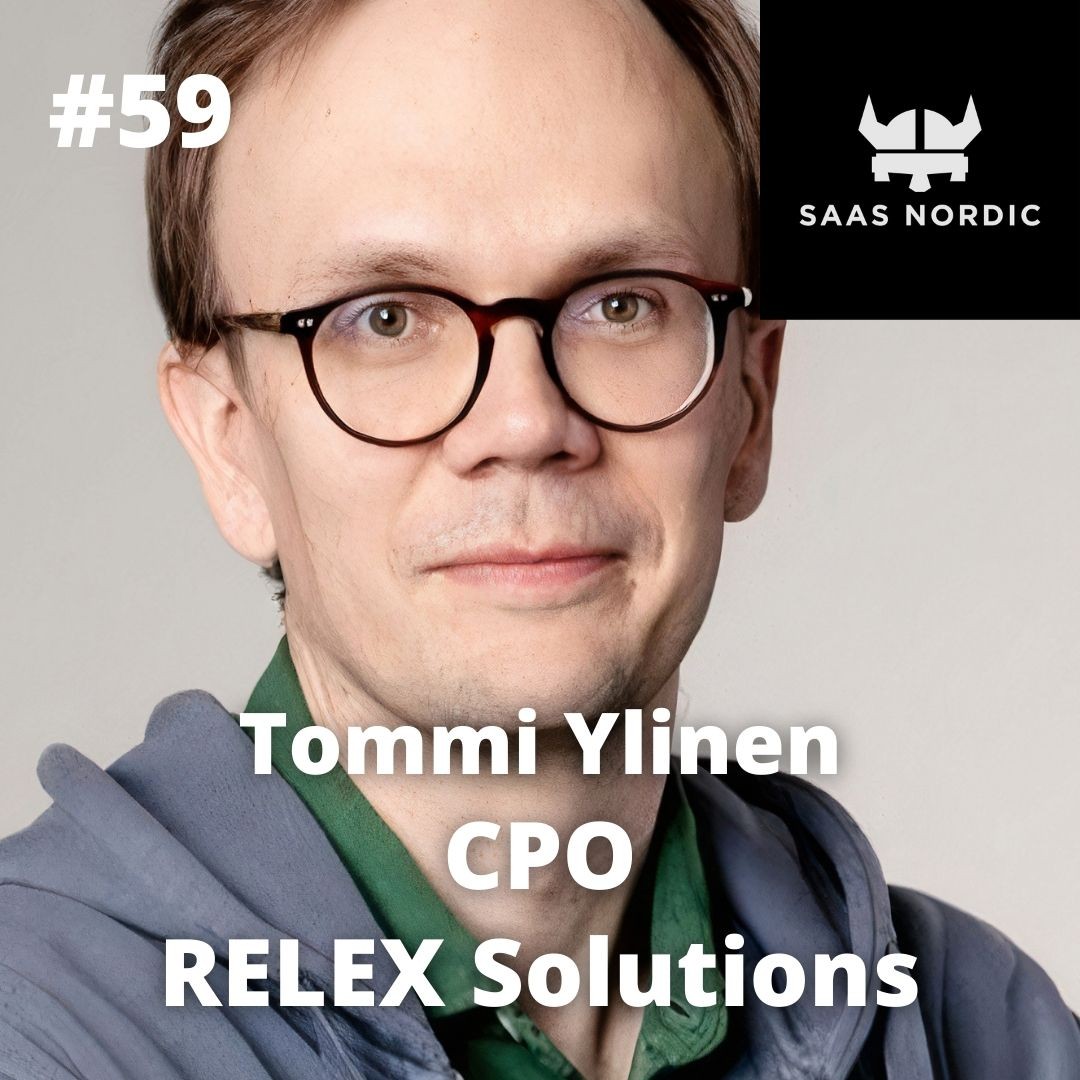
The SaaSiest Podcast
59. Tommi Ylinen, CPO, Relex Solutions - There is no playbook for B2B Enterprise product teams!?
Loading summary
Transcript131 lines
- [00:02]
A
You're listening to SAS Nordic, the saasiest
- [00:05]
B
podcast in the Nordics.
- [00:08]
C
Hi, I'm Daniel.
- [00:09]
A
And I'm Thomas. And we are experienced SaaS professionals that are curious about how other successful SaaS companies go to market scale, build winning teams and great products.
- [00:18]
C
Join us on our journey as we speak to Nordic SaaS leaders trying to get hold of their secret sauce.
- [00:23]
A
And today's guest is Tommy Ilinan, the Chief Product Officer at Relec Solutions.
- [00:29]
B
If you are going to be the first employee of a company or even a kind of certain country, or if you're going to be the first customer of that company in that country, it calls for a bit different character or personality than those who then join when there's hundreds of customers or thousands of people already. So that's very much visible in both the people who've been with us a long time, but also those first early customers.
- [00:57]
A
Hi there. Welcome back to the podcast. And this time we're going to talk about product and especially how product is affected when you work with B2B Enterprise customers.
- [01:09]
C
Yeah, definitely. And I think all product owners out there and CPOs and CTOs working for these kinds of solutions in general, they need a shout out great products make the world run here. But I think what's particularly interesting for me to hear in this one is like what is it that's unique in building and selling enterprise products? What is the big challenge that you might not see in call it SMB type of setups? I'm curious to hear what Tom is going to talk about.
- [01:40]
A
Yeah, and I think this is something that maybe you don't hear about that often. You often hear about these PLG companies that they have self onboarding, they move really fast and they scale really fast and so on. And it's a little bit different beast when you work with these super big companies. And this is a company that from a Nordic perspective is really, really big. But they have high ambitions. So join us for this interview
- [02:18]
B
today.
- [02:18]
A
We are joined by Tommy Uhllenen, the Chief Product Officer at Relex Solution. So welcome Tomi.
- [02:24]
B
Thanks Thomas. Nice to be here.
- [02:26]
C
It's great to have you with us here, Tommy. So tell us a little bit here on this fine Friday morning, like who is Tommy?
- [02:32]
B
Yeah, so my background is pretty much equal to Relex background. So I, I studied in Helsinki Technical University and then I actually had a chance to join either Nokia or in 2006 when they were fairly big for a summer training or this new startup that basically had no office almost. Wow.
- [02:51]
C
You Went against the stream. Like everybody in Finland that we've spoken to has at some point in their career spent some time at Nokia. But you're the exception to the rule.
- [03:01]
B
Wow, good for you. Even a bit older people like me, I think that applies. But then it starts to be a bit different at my generation and younger because they started to go on decline. But yeah, you have a huge amount of people, people in this sector that has some background with Nokia. I just thought it was much more exciting to go for a company that first thing you need to do is to buy your own laptop and then next thing is to kind of figure out what you need to do, then go for a big corporation. And I think I've since learned that that is really something I enjoy much more.
- [03:34]
A
And what did those early days look like for you when. When you got your laptop and yeah, you got going.
- [03:40]
B
I think the first task was to build a user guide for our then first product and then do a lot of kind of software user testing that does it work and other corner cases where it doesn't work and things like that.
- [03:55]
C
Yeah.
- [03:56]
B
Okay.
- [03:56]
C
So what was your like, official role like when you interviewed? What did you interview for? What did the founding team tell you? Like, this is what you're going to
- [04:04]
B
do, Tommy here, I don't think official role is something that.
- [04:08]
A
All right, but moving forward a little bit. So you did the manual user testing and so on. So moving forward a year or so, how had that developed then?
- [04:17]
B
But throughout my studies we did also kind of consulting and also the simulation analysis that went nicely with my studies. So I think I did almost all the projects that you had to do for the uni studies. I did them for Relex as part of the. Part of the work.
- [04:34]
A
And how long time did you study and work at Relex? Sort of simultaneously, three years, two and
- [04:41]
B
a half years, something like that. Wow.
- [04:42]
A
And after that, when you're ready with your studies, was it, you know, were you convinced that relics were the right place for you to continue or now you were done with the studies, you had this side job and then maybe, yeah, there was something else that you
- [05:00]
B
wanted to do at that point? Yes, still very much so. So I spent two years implementing RealX solutions to the, at that point, already quite big Finnish customers, but still, still only in Finland. But. But after two years I. I had never seen any other real company. So I actually left for a year to go to the other side of the table to work in grocery retail in Finland. But. And I enjoyed that too. But Then just feel like my heart never left. And then the guys asked me back to move to uk. So I came back. And it's nice to see nowadays that we have, we discussed that we should form a club of kind of people who return to Relex, because there are some of people already. So if there are, the average age is young, many. For many people, it's the first company they join. And then it's quite natural that you want to see something else, but then it's also quite natural to find out that it's not necessarily better right then. And then they return fairly soon or a bit later.
- [06:00]
C
Once you go Relex, you never go back, I suppose.
- [06:03]
B
Well, that's the aim, of course. You go back or you go back. Exactly. You go back.
- [06:08]
A
But can you tell us something about your adventure in the uk? How was that? Like, were you the only one moving over and how long did you stay? What happened in that market?
- [06:18]
B
Yeah, that's of course, because I was an engineer who never worked in English and never sold anything. So it felt natural to move to UK to start selling a product of a company of at the time, less than 30 people. So first 18 months it was just me, and then during that time we accidentally found a couple of customers. And so I kind of run the process, sales process for those, and pretty much implemented the first one too. And then when we started to see that, okay, there's some business here, then we hired a few local people and it made a difference, especially in the sales side, that you have local people who know some people and know the market and know which football club to vote for in each conversation and so on. So then the second 18 months I was there roughly three years in total. So that was then more about kind of hiring the first few people who are still all with us, which is extremely nice to see, and then kind of making sure that we continue growing and scaling.
- [07:21]
A
All right, so two more questions here before we go on and talk about the company. So how long did you spend in the uk?
- [07:29]
B
That was three years in total.
- [07:30]
A
All right, and what can you say about your current role? What does that look like?
- [07:35]
B
So currently I'm Chief Product Officer and more or less the same role I've had now since I returned from UK 2015. But when I returned from UK, we did not have a product function and I was more or less tasked to build one. And now it's 200 people. So you cannot really say it's the same role. It's been kind of every year figuring out that okay, what do we need to do this year and what is the next problem to solve and how to scale. But more or less product has been the topic for the last eight years.
- [08:06]
C
Awesome. Hey, tell us a little bit about Relex. Like what are you guys all about? Like what do you do and for
- [08:13]
B
who do you do that? Where we started from was purely supply chain planning, forecasting, automated replenishment, inventory management for retail, wholesale manufacturing, consumer packaged goods companies. And over the years we've expanded to kind of COVID a broader set of planning tools for the retail value chain. So how do you, starting from the forecast that what are the consumers going to buy and then based on that, making decisions like how much to order, how much stock to hold, what products to put in assortment, how to merchandise them in the store. So building panograms and floor plans, what products to promote, how to how much labor you need to do all that work. So. Right. In a way we call it unified retail planning. So it's sort of the planning layer of. For retail and retail value chain.
- [09:09]
C
Right. And do you approach all types of retailers as long as they are of a certain size or how does that work?
- [09:16]
B
More or less. The biggest exception is fashion, which tends to operate very differently. So they that's more about trying to come up with what's going to be the next big thing in next season, ordering that one year in advance and then getting rid of what you ordered a year ago. Whereas the rest of retail is a bit more continuous forecast and replenishment and the logic is quite different. So we, we have some fashion customers, but that's not a focus area. Everything else is gotcha, gotcha.
- [09:47]
C
And I know that we've had two of your founders participate in some of our other shows and events and so on. So we know you guys rather well here and it's like it's an amazing Finnish startup story and you guys even got an award from the Finnish Export Minister for being so amazing. But let's put some numbers on this here. Like how big are you guys today, Tom, in terms of what is your ARR and how fast are you growing?
- [10:14]
B
Well, ARR was I think Johannes said early in the year that it's north of 100 million and we kept growing ever since. Right. As of figures today, last year the revenues for Elex was 130bit over 130 million euros. And of course we're expecting to continue growing this year.
- [10:34]
A
Does that make you the largest SaaS company in Finland?
- [10:37]
B
That's a bit difficult to say. I would say the one maybe bigger is Bosware, which is. That's where. Which is much older company and they've been going through a transformation to SaaS. But I would expect that if we're not bigger this year than next year, we are.
- [10:56]
C
There you go. And how many customers do you guys have today around the world?
- [11:00]
B
It is somewhere around 400. And the thing is that it took us maybe 10 years to kind of steadily grow the ladders from a bit smaller customers all the way to the biggest retailers in the world. And now we. Now we are the average sizes. Of course, nowadays much, much bigger. We have something around six out of top 15 retailers of the world as customers. And we're looking to get the rest, of course, in few cars.
- [11:27]
C
And what are the core markets for you? Like these 400 customers, where do we predominantly find them?
- [11:33]
B
US is already biggest market since we went there some seven years ago, I think, and it's been a good start, but of course it's a bigger market than Europe in total, so there's still much room to grow.
- [11:47]
C
Did you use the same winning concept there to send a Finnish engineer to run sales?
- [11:52]
B
Yes, it's worked quite well.
- [11:55]
A
Listen and learn, people. Listen and learn.
- [11:57]
B
Nicky, one of the founders, spent a couple of years there and got the door opened.
- [12:01]
C
Engineers are all about sales. I like that. I like that. So tell us a little bit from your own perspective. We know Relx has raised a decent amount of funds. Maybe you can share how much that is. And we'd also like to know, as the first hire an employee, how much of a stake do you have in this operation?
- [12:22]
B
Yeah, the last fundraise we did was earlier this year where Blackstone joined us as investor. We raised 500 million and company was valued at 5 billion. That's the latest on that. And so we now have three investors in total, three main investors, and then the founders still have big stakes.
- [12:43]
A
All right, so we have reached the segment where we go into the main topic. And I mean, you're an example of a SaaS company working with huge enterprise companies. And we would like to talk about how this affects the product organization. And I mean, is there a playbook in this situation when you work with these enterprise companies? But first, I think it's important. If you just could give us your definition of a B2B enterprise product, what would that be?
- [13:18]
B
Yeah, I think for me it's the fact that what we sell is. It's big. The ticket size is big. So customers pay relative to their size, of course, but all of them it's meaningful money. So they spend a lot of time in the purchasing process. It's a big decision for them. The implementations can take even thousands of days nowadays across multiple years because it's so complex and phased out. And it's also, in our case, it's business critical for the customer. So they are really careful on selecting it and making sure that whatever happens there, it's stable and run smoothly.
- [13:57]
C
All right, that makes a lot of sense. And knowing all of this, what you just mentioned here, like what does that actually do to the internal product team? Like, how does the product team needs to be structured in order to tackle these specific characteristics?
- [14:13]
B
Yeah, I think the first thing is that product in this kind of setup is not just the technical product, but the whole package. So in a way, if you think of the sales space, actually the technical product plays a minor role because we're not selling to the users, we are selling to the director, VPC level people who are never going to use or almost never going to see the product even. Of course, there's demos and stuff like that. But some, some companies out there don't even show the real product, that you can mock it up or use some kind of wireframes to do the demo. So finally, the product technically plays a small role in the sales cycle, but where it of course comes into play is that having happy customers and references is very important and always been our biggest strength. And you can't have that unless the users and the customers are happy and get results. So I mean, to your original question, I mean, the product is everything from the kind of how you pitch it, how you position it, how you implement it, all the way down to what technically the product is and does and how that then impacts the product teams. Of course, we need to have people who look after all those things. So what I talk to, maybe smaller SaaS companies tends to be the founders and slash people who sell it in the early stages, who actually do all the commercial side and decide on the vision and what should we build. But in a bigger enterprise that's not possible anymore. So we kind of need to have people that are deep down in the technical stuff of the product, but also people who think of the product marketing strategy, positioning, all those things. So I would say that it makes the remit of the teams broader.
- [16:07]
A
So looking at your organization or looking at relics, how many people are on, on the product side, that is like product managers, product marketing or other roles compared to the engineering side, what is the ratio there?
- [16:22]
B
Yeah, if I look at top down first, we have 1700 people in total, out of which closer to 600 are in R and D. So product and engineering, okay, the engineering side is closer to 400 and product is 200. But out of that 200, roughly maybe one third is what you would call product managers, product owners, and then the rest is different roles, product marketing, strategy, design, data science, solution architects, and all a host of other roles.
- [16:55]
A
So I know when you Talked at the CEAS 2022, I understand that. I mean, you're not doing like daily releases. You release quite in big cycles. So does that also affect how you work with the teams or are you still working with fast sprints, like two, three weeks, or do you work with longer cycle in your development teams?
- [17:25]
B
Yeah, the actual work depends a bit on teams and products, but the actual work is in sprints. But within release roughly maybe four or five times a year, even a bit less with some products and we want to do a bit more often. There are some things that we can do internally to make it more often, but in the end it's the fact that customers don't want to upgrade very often, even if the upgrade is such is fairly painless. But it's business critical for them. Every change is a risk. So especially the bigger end of customers, they first of all never want to take a fresh release. They want to see it being trialed with other customers for say six months and then they maybe take it once a year or something like that. So it definitely that then has a big impact on how we operate because it's even a bit boring for some of the product folks because if you do something today and even kind of the code freeze is there, we release it before you actually see results from many customers, it could be a year, if not more.
- [18:29]
C
Yeah.
- [18:30]
A
How do you keep them motivated in such a situation? Because it's always nice to get things out there and get the feedback for the customer and so on.
- [18:37]
B
You see results from customers, but it just. There's a bit bigger lag. So maybe, I mean, you don't see what you did today, you don't see the results tomorrow, but you see the results of what you did some time ago now. So I mean, there's still constant feedback on what customers are doing.
- [18:54]
A
All right.
- [18:54]
B
They just come a bit more behind than maybe in some kind of B2C companies where you can actually release like multiple times per day. Right.
- [19:05]
C
So, Tommy, here's a question from me as a commercial guy, and maybe I missed something here, but does that mean because you said something, some customers don't want to upgrade or patch up and so on. And they want to see how some of the smaller ones do. So is this some kind of a single tenant setup where each one can decide when they take the upgrade? So you have to manage them separately somehow, all these 400 customers?
- [19:31]
B
Yes, yes, that's exactly the case. So even with some of our products we're more on the multi tenant world. But even with those products, we're looking to make it possible for the customers to have at least a bit of leeway when they upgrade. Maybe not as much as with single tenancy, but it is not feasible to say to 10/plus billion retailers that you all upgrade tonight.
- [19:55]
C
Right.
- [19:55]
B
There will be nine of them that have some issues doing it this week. Okay.
- [19:59]
C
And you might know this or not notice, but is this specific for Relex or anybody selling business critical solutions into these 10+billion enterprise? That's just the name of the game. They have to have separate instances.
- [20:15]
B
That definitely has been the name of the game. If you think of the reputation of big erps and how difficult it is to upgrade something like that used to be a very big pain to do that. I think that is changing. Everything is going to cloud, even the products that were not on the front line of cloudifying themselves. So I think there might be gradual change, but I still think it's gonna be a bit different than what it is with Facebook or that sort of product.
- [20:47]
A
Is there other aspects of delivering this business critical nature to these huge companies that you need to think about?
- [20:56]
B
I think that's the biggest one in terms of the business criticality. So that we need to do our work well, we need to have good quality and we still can't dictate when they want to upgrade because for instance, Christmas in retail is already ongoing. So Q4 is something that not a lot of retailers want to upgrade or touch anything during that period. So that's definitely a big one. Maybe the other which is not just linked to that business criticality, but more in general that we're working with huge companies who know how to buy software, that they will have more strict requirements than what you would maybe as an idealistic product person like to have. So you need to make in the sales spaces sometimes some commitments because they are buying something that needs to operate in that business critical environment and they can't change everything just because of the software doesn't support it. So they at least often push faster than develop stuff.
- [22:00]
C
Right. I have another question related to this then. So how much pressure is put on the product and engineering team to actually support these customers when they're live. So is there a professional service arm that ends up with you or do they sit there and ask for specific features and so on? How does that work?
- [22:20]
B
Roughly half of the people at Relex are within the professional services side of things, so there's quite a lot of that. And customer success, service, delivery, support. They are the first and second line of support for any questions the customers might have. But then we of course come after that. So difficult questions or new requests, then we need to be there to support those. And of course we want to be there to talk to the customers regularly to understand that what are they seeing as issues and how can we help them.
- [22:55]
C
So let me ask you this. I'm a 10 billion plus retailer and I come to your team and say like hey Tommy and guys, I need this specific integration or function like I ask you to build something specifically for me, something customized that nobody else has asked for so far. Are you going to build it or are you going to tell me like no, maybe we'll have it as a general product in the next release or
- [23:18]
A
you're thinking wrong, you should do it this way instead.
- [23:21]
B
We'll of course look at what, what are they after, but there is no way we can just say that of course we'll do it. I think the trick is that let's make sure that customers want the right things and we then build those things when they come to us with those requests. So that is kind of win win that we know that this is going to be important for everybody and now we have a customer who's willing to work with us on that. And if they want something that we see no broader value, then we should do it. That's for sure the case. But timing wise we sometimes need to adapt to such requests.
- [23:58]
C
Right? Are you tired of communicating with prospects
- [24:01]
B
through PDFs and slide decks that get lost in long email threads? Get Accept's digital sales firm empowers revenue teams to increase their win rate by engaging and understanding buyers from opportunity to sign Deal A microsite easily shareable to all stakeholders by a link.
- [24:19]
C
We can share sales content and quotes
- [24:21]
B
and communicate to get the contract signed. A collaborative buyer experience that wins the deal. We call it a digital sales room.
- [24:29]
A
Alright, but I mean one thing you already mentioned a little bit that is special here, that the person that sits and actually use the solution on a daily basis is very far from the one that you are selling to and that are purchasing this solution. So how do you manage that to stay close to the users?
- [24:51]
B
Yeah, that's a really big question. In a way you have, well, let's say a bigger retailer. The typical setup is that you have tens if not hundred plus end users, then you have a host of super users and then you have a lot of other roles like IT development people and then the sort of various layers of the decision making makers. So I think that the thing is to stay close to all of those and then it's a bit of balancing act of what do you, what do you do and who do you listen most? And because we are in automation then I would say that often we kind of need to understand what the higher ups are looking to do. So I mean users might want more features to, for them to do more stuff, but the management might want actually less users, more automation.
- [25:41]
A
But I mean you must have thousands and thousands of end users, right?
- [25:46]
B
Yeah, yeah, we do.
- [25:47]
A
And do you have some process of collecting feedback from them or how do you work with getting feedback from your customers or your sort of users?
- [25:59]
B
At the customer side we have a couple of channels where we can just collect insights and feedback. But then of course we do not so much about quantity but also quality that we do user research and we talk to the various different stakeholders at our customers to really understand that what are they looking to do with the end users? The challenge is that the company might have restricted what they can do with Relex and what they're asking for is something that is completely possible already, but the higher ups just don't want the users to do that.
- [26:32]
A
All right, is there other things that you see? I mean again, comparing yourself with a SaaS company that works mostly with SMBs, that is different from how you operate sort of things on the product side.
- [26:47]
B
I think with SMBs it's also a question that what sort of product you have. I think that plays a big role whether it's very business critical and big in terms of the business or not. But, but, but one thing that comes from big customers is that they know they're big. They know they have purchasing power and negotiation power and they have professional teams too, especially in the sales space. They have professional procurement teams dealing, dealing with us. That, that has a big impact, of course.
- [27:13]
A
All right, so there are different aspects here. One is sort of on the scale, if it's business critical or if it's nice to have something that, I mean if it goes down for, for a few hours it's not, you know, a catastrophe and on the other end it's you know, working with many small customers that don't have that big saying compared to have these billion dollar revenue customers that can come in and have, you know, a lot of demands on you as an organization. So. And you're sort of in the extreme on two of those. Yeah, sort of coordinates you could say. Or would you agree on that?
- [27:50]
B
Yeah, I think that's exactly the case. And if you think that you'd be our size of company but sell a bit smaller software, that would mean that you have thousands or tens of thousands of customers. So the role of individual customers would be completely different. So 400 is still not a lot. And especially on the bigger end, of course every single big customer is extremely meaningful to us. Whereas if you would have 10,000 small customers, it's pretty close then to B2C almost.
- [28:20]
A
One thing that you talked about more in detail when you spoke at Cesius 2022 was about being a multi product company. And I know that you are also doing acquisitions, so could you just say a few things about that as well and how that impact you as a product team?
- [28:38]
B
Yeah, I think with any growing company, and especially once you start to have investors on board and so on, you need to look pretty far into the future to make sure that the total addressable market is there for your growth for the next 10 plus years, not just for the next few years. And that then often leads into wanting to grow that market and build new products to new type of use cases or new type of customers or something like that. So we've been doing quite a lot of that and it's an interesting journey in many ways because that leads into situation that you have very different products in your portfolio. Some are really mature and that those 10 plus billion retailers use in volume and then some are much more in a startup phase where we have five, 10 customers and we're looking to get the next five and iterate much more rapidly on the product market fit than what to do next. So it calls for quite different people, processes and also customers. You cannot go to the biggest ones with something that is fully immature. They won't want it or we don't want them to want it because it's a bit risky. So you kind of need to have different processes and different customers for.
- [29:56]
A
Yeah, but I guess you're such a big organization so you can manage these different processes and different teams and different customers. I mean it would be harder for a smaller company to do both things at the same time, right?
- [30:11]
B
Yeah, I think you're right. Then again, of course it's not only easy to have a big corporation or big organization, it comes with its challenges too. When you have like close to 2,000 people globally spread out.
- [30:26]
A
Yeah, right, right, exactly. And I can imagine it's a big change. I mean comparing to when you were in the UK as a one man show doing like three or four different things yourself and now you're the head of 200 people organization. It must have been quite the journey and for you these years.
- [30:48]
B
Yeah, I think that's been the nicest thing, that it's constant learning.
- [30:53]
C
Yeah, for sure. Yeah. So listening to this Tommy, I think it's very interesting and one thing that strikes me like if that I'm curious to understand how you guys solve it and other big enterprises like yourself. It's one thing if I sell an SMB solution where the user is the marketeer and the economic buyer is also the marketeer. So it's one and the same person that makes it easy for me to pilot and test new products. It's this one person I need to get the feedback from. But as you described it here, like you have your users, you have the economic buyers, you have a bunch of people that are involved that have an interest in staking this. How does piloting and conceptualizing new products look to get that feedback in from these big customers where there's so many stakeholders?
- [31:38]
B
Yeah, that is really something that it's not particularly easy with larger customers and larger organizations because you might find that one person who would say that yeah, that sounds really cool, let's do something. But it's probably other people who decide on that one person's priorities. And even if we kind of go in that we want to pilot very lightly and the cost is minimal, if anything, and so on, it's still a lot of effort for them. And they're constantly looking to prioritize that. Where do they put their kind of limited capacity to do things? So it is a lot of work. What we're looking to do more and more is to have a group of customers that are more agile and quick in nature and like to do new things and like to move quickly so that we can then kind of have a direct phone line that with these companies we can try new stuff out and mature and iterate that stuff and then go to the other customers once we've done that.
- [32:36]
C
Right. So it's identifying those champions and ambassador customers that are willing to spend the time and take maybe sometimes a little bit of a risk to help you guys figure out the next big thing.
- [32:47]
B
It is Interesting to kind of look back from my time in UK and from the first customers we've had in each market, but also the first people we've hired in each market. It's a bit same thing that if you are going to be the first employee of a company or even a kind of certain country, or if you're going to be the first customer of that company in that country, it calls for different character or personality than those who then join when there's hundreds of customers or thousands of people already. So that's very much visible in both the people who've been with us a long time, but also those first early customers. Yeah.
- [33:23]
C
So I have a question for you. Like there's probably a lot of listeners here that are, you know, CPO CTOs in one way or another, representing a product and engineering team that maybe today are serving a smaller segment but are planning to move into these enterprise sales. Like what would your advice be to them? Like what do they need to figure out internally from a product perspective and product organization perspective before they take on these big giants?
- [33:53]
B
I think for us it was always a journey, not one of change. And I think that's how it likely will be. You might get lucky and you might get one huge customer on top of the smaller ones, but most likely you'll grow kind of bit by bit because let's say you serve companies that have revenue in the 10 million tens of millions, then you don't have credibility to sell into the 1 billion plus companies at that stage. So we need to grow that credibility. So I think that the good thing is that it's going to be like that. It won't happen at once, but it will happen over time. And what we definitely see as you then grow is that you need to put more and more focus on things like scalability and like something that you could easily fix for one customer, whatever way, even in a very hacky way, then if you have hundred, that's not going to be applicable. So as the volume grows, as the size grows, so needs the kind of quality level and maturity needs to grow.
- [34:54]
A
All right, so what is in the future for RayLX and for you here?
- [34:58]
B
Yeah, I was just thinking that I've been here 16 or so years and I don't see any reason why I wouldn't be here for the next 16 years. I mean being in a growth company, I think that's extremely nice because then you never stop learning or if you stop learning then you have problems. I mean, our plan is to continue on this path. We have good. Our CEO likes to say that this has been a good start and now the work starts. So we definitely have growth ambitions. We are very early stages, deal with many of our products that we want to grow as big as the bigger ones. In many of the markets we have a good start. But like I said in US it's been a really good start for a European company, but it's still like very, very early in the bigger picture. So we're just gonna continue growing and that probably means that we're gonna continue growing organically, expanding to a bit new hydro verticals. Like we work increasingly more with the manufacturers and then we're gonna expand the product portfolio as well. So all those things will continue.
- [36:05]
C
Interesting. So tell me, I'm curious, you mentioned earlier that you're at 130 million euros in ARR. Have you ever discussed when you break the 1 billion mark?
- [36:18]
B
There's all sorts of predictions, of course, which we need to have for planning purposes, but that's not like, that's not a public forecast. We look to continue to grow with this rapid 30 to 50% growth.
- [36:32]
A
Yeah, you have high ambitions for sure. We like that. Especially for a Nordic company that wants to take over the world. We sympathize with that. But is there anything particular that you are looking for right now for yourself or your organization?
- [36:48]
B
I guess as always, we're hiring quite a lot in many markets, in many roles in my teams and other teams. But that's for sure, I would say the main focus for us and what we're looking to do more and more is to kind of really still double down on US growth. And also the other big thing for us is that we have nice starting with some 10, 10, 20 Nordic consumer packaged goods manufacturers. But that's a big thing for us too. Get out of retail alone. Okay.
- [37:21]
A
So Tommy, is there anything particular that you are looking for right now?
- [37:24]
B
Well, as always, and I think that's the case with most of your visitors here that we're hiring, we're growing, we're looking to hire in many different roles in my product teams, engineers in multiple locations. We now have an office in Lisbon as well for the tech side of things. And then the big focus is us, for us. So we continue to double down on that growth that we've already built over there. Okay.
- [37:53]
A
A lot of opportunities there for all golfers. There is a spot in Lisaban. So we are at the end of the hour. It was great having you here, Tommy. And yeah, we'll see you around. And thank you also for contributing with articles for the website as well. So we can follow your thought leadership.
- [38:13]
B
Thanks both extremely nice to be here.
- [38:15]
C
Yeah, thanks for joining us, Tommy.
- [38:20]
A
Daniel, I'm curious to hear what are your takeaways from this episode?
- [38:25]
C
I bet you are. I mean, obviously this is, you know, I'm from the commercial side. It's always interesting for me to dip my toes on the product side. One thing that really stuck, stuck with me here was and people might underestimate that if you're selling an SMB solution, you might be selling to the user which also happens to sit on the budget. So it's like one and the same person or the circle is smaller. But when you're selling like an enterprise type of setup like this to a large company, he mentioned somewhere, you know, 10/billion type of businesses, there's so many different stakeholders and the user is so far away from the economic buyer and you need to somehow please them both and that affects how you build product. You know, I thought that was an interesting perspective to see. Like here's a big change. How do you tackle that and how does that affect you internally? I don't have the answer for that, but I thought it was an interesting insight that clearly is very different from what some of the other companies are used to. So that's my big takeaway. What about you, Thomas? What's your big takeaway here?
- [39:30]
A
I think it's just about understanding what if you sell this kind of products, how that affects your organization because you will have a high complexity, you will have a business critical solution that will mean that you can't deploy as often. It will mean that you will have a big professional service operation and you need to have a team that also are satisfied with, you know, the big lead time. You can go, you can work on a solution and then it will be launched maybe six months later or eight months later. And we didn't get deep into it, but I think you need to find a way of celebrating those things that you do. And yeah, you have a lag time, right? You will always come out with new things, but there will be a lag maybe around six months before, before it really hits the customer. But yeah, it's another way of working. But what I think is so refreshing and with the whole relic story, I mean in the beginning the founders did everything, you know, Tommy is almost right out of school, was sent to the UK and just, you know, figured it out and did everything himself on the ground there. And being able to start from that point and now being the head of 200 people. Product organization, I think that's fantastic. And also the ambition that they have at Relex to really be the number one in the world and being just in the beginning of the journey, I think that's very inspiring to hear. Go relics.
- [41:08]
C
Definitely the Finns have figured something out. Apparently you put engineers to do sales in new markets. Yeah, that is the way to go.
- [41:17]
A
Okay, so what else, Daniel, do we have in front of us here?
- [41:21]
C
Well, we're working a lot with our networks. As you guys probably know. We have a CEO network and we also have what we call executive networks. Executive network is if you're VP level or higher of an organization that has 2 million euros in arrival, you are now officially welcome to apply. We're putting those groups together and the first cohort starts in January. So if you are keen to exchange ideas, to learn from your peers in the same discipline like you, now is the time to sign up and you can do that via the sasnordic.com website. And if you go to community, you see a drop down list there of the different networks that you can join and partake in. So that's one of the big things we work on. And another big thing that we've also hopefully you've seen it is that we're planning for Sasius 2023. What can you tell us about that, Thomas?
- [42:12]
A
Yeah, so Cesius 2023 will be an in person two day event or almost a three day event considering all the side events on the day before down in mountain Sweden. We will be around. We need to cap it at 1200 attendees. These, it's gonna be very content driven. We are looking at providing you with great content, both keynote speakers and we're gonna have a number of different tracks like last year we're gonna have or this year we're gonna have a product track as well. So if you're interested in product, you will also get your piece of the cake. And. Well, what else? It's a community event. We're gonna, you know, design it. So we have a lot of time getting together, get to know each other, exchange experiences, you know, and just have fun together as well.
- [43:03]
C
Yeah, and where do, where do people that want to buy tickets so lock in their seats, where do they go, Thomas? And also if there is people and companies that want to help us, that want to be part of the event or some sponsorship and partnership alternatives, how do they reach out?
- [43:17]
B
Yeah, exactly.
- [43:18]
A
So if you want to learn more about the event, you head over to sassiest2023.com and if you want to contact us, if you have ideas on speakers or want to be a partner at the event, you can reach out to us@contactsasnordic.com or if you want to ping us on LinkedIn or if you find us somewhere else, feel free to do it. And really happy that you spent your time listening to the episode today. And if you want, you can head over to Spotify or itunes and give us a five star review. That would mean a lot to us. And yeah, besides that, hope to see you around soon. Glad to have you within the community. And what do you say?
- [44:00]
C
Daniel?
- [44:01]
A
Last words?
- [44:01]
C
Thank you for supporting us. We love building this together with you guys and we'll see you around in all the other channels. Bye.