← The SaaSiest Podcast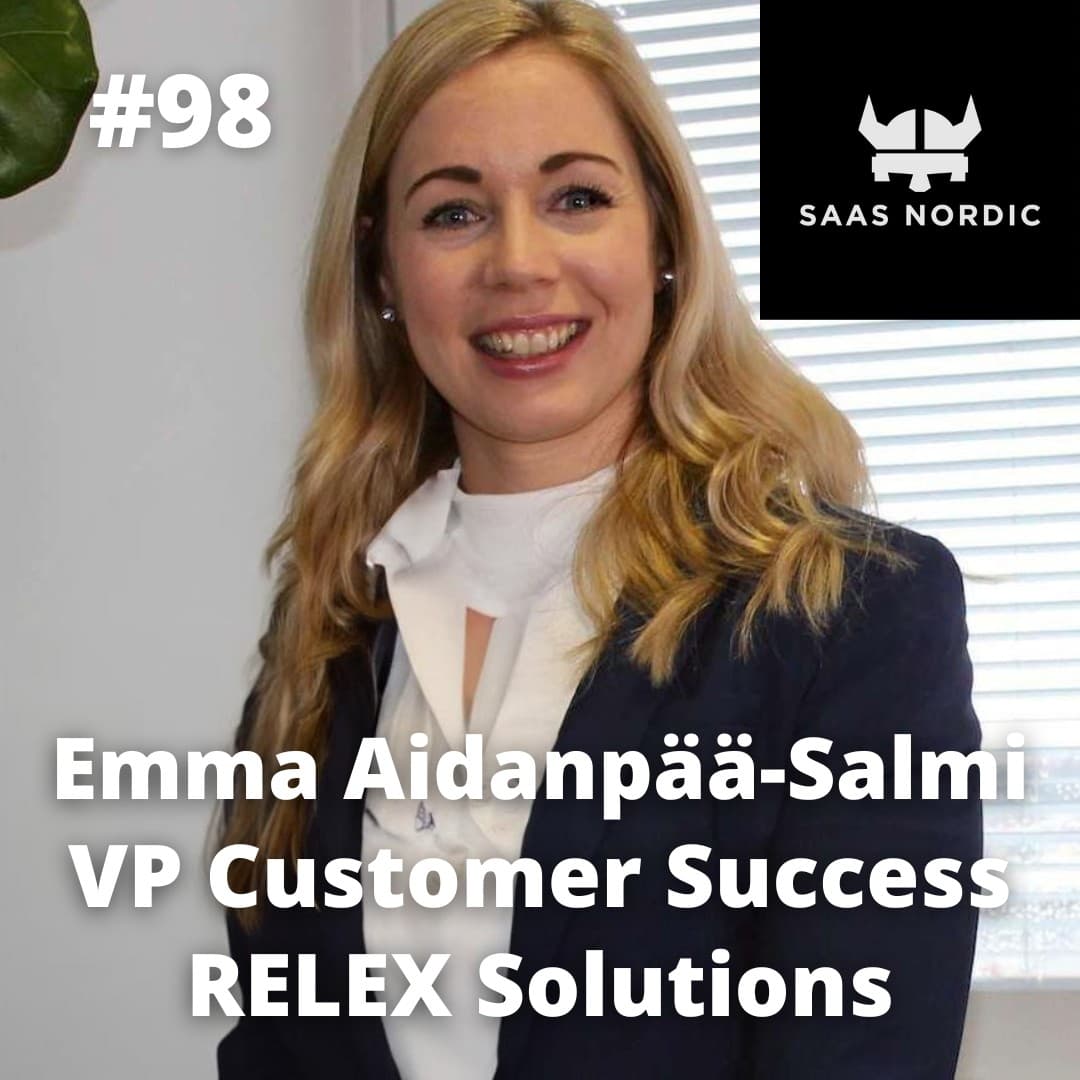
The SaaSiest Podcast
98. Emma Aidanpää-Salmi, VP Customer Success, Relex Solutions- How should CSMs be measured?
Loading summary
Transcript138 lines
- [00:02]
A
You're listening to SAS Nordic, the saasiest podcast in the Nordics.
- [00:08]
B
Hi, I'm Daniel.
- [00:09]
A
And I'm Thomas. And we are experienced SaaS professionals that are curious about how other successful SaaS companies go to market scale, build winning
- [00:17]
B
teams and great products. Join us on our journey as we speak to Nordic SaaS leaders trying to get hold of their secret sauce.
- [00:23]
A
And today's guest is Emma Ayden Pe Salmi, the VP of Customer Success at Relex Solutions.
- [00:30]
C
Customer Success is the 2.0 account management. You're taking it further, you're taking it a bit broader into the solution. You focus on value, you focus on measurable benefits for the customer.
- [00:44]
A
Hello there, SAS Nordic here. Welcome to the SAS Nordic Podcast. Once again we are hoping that you are enjoying your summer. If you're in the Nordics, probably you have been off for a few weeks. We sort of shut down the countries here in July. So Daniel, how are you?
- [01:04]
B
Very good, very good. Just spent one week in Spain with the kiddos and wife obviously as well. Craziness, but lots of sun, lots of ice cream. I feel re energized, believe it or not. I feel re energized. How are you guys? I know you guys are. Where are you? Like, are you done with your road trip or still on it now?
- [01:26]
A
We are just, just in the middle of our road trip. So we've driving up the east coast of Sweden for the first time and we were before we thought about if we were going to leave the country and fly on a vacation to Greece or something. But we didn't manage to get solutions that were nice. All the good hotels were full and we realized that, you know, the family is the most happy when we sit in the car and sing together to Taylor Swift and other songs. Doing some Eminem raps.
- [02:00]
B
So all of you guys are swifties?
- [02:02]
A
More or less, yes.
- [02:03]
B
Can we hear, can we hear the tune? What does he say? It's me.
- [02:08]
A
I'm the problem. It's me.
- [02:09]
B
There we go.
- [02:11]
A
I don't know if it's me or if it's you, Daniel, but here we are again for another podcast. And today we have the pleasure of revisiting a company that we are so much impressed of. It's the big giant in the east.
- [02:25]
B
The humble Finnish giant.
- [02:27]
A
The humble Finnish giant Relic solution. And this time we're gonna, we're gonna dive into customer success. And I think it's really interesting. Have sort of expanded the scope of their customer success organization.
- [02:42]
B
It's all about being customer centric. Customer focused. And that's what we also try to be. But we're going to talk a little bit more about that after the episode.
- [02:49]
A
Here we go. Today we are very happy to have Emma Ayrampe Salmi, the VP of Customer Success at Relic Solution, here as a guest in the SAS Nordic Podcast. Warm welcome to you, Emma.
- [03:03]
C
Thank you, Thomas, and thank you, Danya, for having me. I'm super happy to be here today talking to you guys.
- [03:08]
B
It's really nice having you here and I know there's lots of stuff going on in your life. You told us a little bit. There's a baby incoming. There's a house renovation. How do you manage everything?
- [03:18]
C
That's a good question. You know, I try to see myself as an organized person, so I just try to time schedule everything from morning to evening and then try to have some slack time in between as well. But yeah, it's quite busy now, both on the personal side and the professional side for sure.
- [03:34]
B
All right, so what are you normally up to? So people that don't know Emma, Who's Emma?
- [03:39]
C
Well, you know, I think my identity is a bit of a mix because, you know, I was born and grew up in Sweden, but I have now lived in finland for almost 15 years. So when people ask me who am I? I always see myself as a hybrid between a Sweden and a Finn. So. So definitely more Finn than I used to be before when living in Sweden. I'm definitely a sports nerd. Try to be a professional athlete at some point, but then I figure out that maybe it's better I just focus on my professional career instead. Really enjoy sports, play a lot of golf, go to the gym, go running, cooking and things like that. And that would probably kind of like explain me who I am on the personal side more.
- [04:21]
B
So which, which sports was this that you were trying to go pro in?
- [04:25]
C
I used to do track and field, so I used to run sprints and hurdles. You know, the 100 meter hurdles where you go really fast over those hurdles and try not to fall.
- [04:33]
B
Wow.
- [04:34]
C
That was basically my sport because it was perfect, because it was quick, it was a bit, you know, dangerous situations and a lot of speed. So I think that represents myself as a person really well as well.
- [04:44]
B
Living on the edge.
- [04:45]
C
Definitely.
- [04:46]
A
And what can you tell us about Relex, the company you work for?
- [04:49]
C
Yes, very excited about that. You know me and relax. We have started already eight years back. And I guess when I found the company, I found my perfect match, I would say. So I found a fast paced, innovative company with really smart and ambitious people and that also had a product that I really can stand behind because it has, it makes an impact on the environment and it has an impact that is just more than a product. And just maybe shortly about our background. So we are a tech company founded in 2005 by three supply chain scientists. So Mikko, Johanna and Michael. And I think the ultimate goal of our company is basically to try to make consumer goods value chains more efficient and adaptive to change. So before Relex was founded, we could see that there was a lot of basically enormous volumes of food waste, time waste and wasted money in the operations of retailers, wholesalers and CPG manufacturers, consumer packed goods manufacturers. And basically how we're trying to tackle that is then to offer a global supply chain and retail planning platform so that we can help these retailers, wholesalers and CPG manufacturers to become more efficient and avoid food waste. That's our ultimate goal.
- [06:09]
B
I guess that also to some extent addresses like obviously who your ICP is, but like is there a particular vertical or size of operations? So who is really the ideal customer for Relex?
- [06:21]
C
Yeah, I would say we have customers of all sizes, but I would say that the bigger the customers are. So these really enterprise, even global scaled companies, because they have enormous amount of data, they have very complex operations. And when you start to have, for example, thousands of stores, tens of DCs, it's just those supply chains become really complex and difficult to manage. And that data amount and transaction amount is just so big. So I would say like the bigger scale of operations that our customers have, the more benefits they can see. Because then the automation level and kind of like the benefits that we can bring them are also bigger.
- [07:01]
B
Gotcha.
- [07:02]
C
But we do generally work with all size of customers for sure.
- [07:06]
A
All right. And to better understand, you know, relics and the size of the operation, what can you tell about the ARR, the amount you grow and a bit about number of customers and employees?
- [07:18]
C
Yeah, absolutely, that's a good question. Maybe I start from when I joined Relex eight years ago. I think I was employee 130. So we were quite small. And I think our revenue at that point was around 12 million euro. And now in 2022 we reached an ARR figure of 150 million approximately. And we have a bit over 350 customers globally today. Roughly 1900 employees and 21 offices globally. And we're active in more than 19 markets at the moment. And our growth rate on the ARR side has been approximately closer to 50% for the last three years. So I think it's fair to say that it has been quite rapid growth story and we're super happy to see the impact that we have been able to do during these years.
- [08:13]
B
You should just drop the microphone now and we end this conversation.
- [08:17]
A
Mic drop.
- [08:20]
C
Yes. No. We're super humble and we're super honored that the customers have been believing in us and we have been able to scale and grow so quickly. And I think the main recipe have definitely been the customers trust us, we deliver measurable value and I think we have a partnership that is built on on trust and mutual benefits. So we're super happy to see the success that we have had during the last years.
- [08:44]
B
Yeah. And speaking of trust, at least in my world, you represent an organization that is a lot about trust. Customer success organization is that bond between the organization and the customers. And we wanted to chit chat a little bit today about the specifically the rise of the customer success organization, but also a topic that has been discussed a lot in our community.
- [09:12]
A
And actually yesterday in one of the network groups where we discussed what topics should be covered moving forward, we talked about the digital event and so on. And one that came up was how to measure success of success. And that falls in line, I think a lot with the topic we have here. How should the CSM be measured?
- [09:33]
B
Exactly. So we hope that over the next 20 minutes here that you can demystify this topic and we'll see what answers we get and we'll see if the community will be happy with it. But at the end of the day, we're not here to please people, we're here to find some insights. So from your perspective, obviously CES as a practice has evolved massively over the past few years here. From your perspective, what do you think? How should a successful CSM team be measured in 2023 and onwards? And is there anything that you feel has changed compared to how it used to be?
- [10:07]
C
Of course, I'm building a lot of my opinions based on how our story at Relex have been, but also have been networking a lot with customer success leaders for the last years, especially in Europe. I do strongly believe that customer satisfaction and CSMs, being a trusted advisor to the customers, always has to be in the core of what CSMs do. So really focusing on understanding the customer's needs, understanding that whatever product or service you're offering to your client has a value add to to that client. At the same time, for me, customer success has always been about business growth. So I think that we shouldn't shy away as customer success organizations to also be in the center of growing the company's revenue and to ensure that we can also work with revenue expansion, especially on those existing accounts. And what's the reason for that? Well, for me, customer success has never been about so much support or basically about working with operative tasks, but it has really been about that forward looking vision. So where are we today? What value are we added and how can we build on top of that? And to be able to do that successfully, you have to know your client really well, but you also have to know your product really well. So I think CSMs are just generally really well positioned in having an expansion conversation, which is not about. We don't have to argue and explain why we are a good collaboration partner because we're already in that relationship. We already know the customer. So we can go quite in depth into those conversations and talk about what's the added value of looking into new functionality or new processes for you guys. And that's why I think that that's a really natural part to then grow a pipeline and build growth opportunities with existing customers. So putting that into a summary, don't forget about the core so customer satisfaction and trusted advisorship, but definitely being the part of expansion of revenue and growing that revenue with your existing accounts should be the focus area of CSMS in 2023.
- [12:16]
A
All right, so I think I have two questions here. How do you measure customer happiness? Do you have a certain way or KPI that you are looking at there?
- [12:28]
C
Yeah, definitely. I think like historically a lot of people talk about nps, so Net promoter score. But of course that's not all. But I think that is important that you are measuring NPS as a part of your customer satisfaction journey. But then I think what's super important as well is to expand that so that we know that in each and every touch point that we have with the customer, is it in service delivery or support? Is it on the more tactical level where we do a deep dive into the configuration or improve that or in that strategic relationship or in the collaboration, you have to be able to measure those satisfaction points and understand why your customers are happy, why they are not happy and how we can impact that. So I think having NPS as a driver for sure a couple of times a year is important. But in addition also measure that continuous satisfaction in those touch points and store that data and be able to follow up and see trends. Why is my customer more happy or less happy than before?
- [13:28]
A
Does that mean that you have continuous surveys or do you do in app questions or is this more one to one inter conversation that you also keep track of?
- [13:44]
C
I would say it's both. So it's definitely touch points with single individuals in the organization, but also surveys that are sent out. So if we end for example a project with the customer, we send out surveys asking for feedback on how that project went or if we have ended some product development or product collaboration with the customer, we of course ask them for feedback there as well. In addition to then also asking for feedback on more service delivery and support related topics which is handled by our service delivery organization. But I would say it is both. With that said, these are massive amount of data points and I think all companies today still a bit struggle to how do you actually gather that data, how do you find the right kind of insights and how do you incorporate that to your development roadmap so to stay on top of that feedback And I would say we haven't cracked the code fully for that yet, but a topic that is important for us to
- [14:43]
B
develop and I was just about to ask, I think I'm assuming now you know, with the type of solutions you guys are selling, there's so many different stakeholders within your customers that is affected by the solution. And I think the danger with having these surveys and interviews, you might get the person closest to you in that project say like I love Emma and her team, but maybe somebody further down the chain doesn't love it or doesn't get a chance. So how do you ensure that you get the aggregated view of the entire company and not just maybe these two people that you interacted the most with?
- [15:21]
C
I mean I think that is definitely important that the CSMs are top of their, let's say power maps and understand the organization that they are operating with. And I'm not saying that actually the CSM should be the one that who has the best relationships with everyone in the customer organization, but you have to orchestrate your team internally at the company. So at relex in our side and ensure that there are people from it, from business, from the different levels of customer operations, from sales, from product that are interacting and gathering that feedback from their conversations. And then when we do send out the service like the customer satisfaction service, the NPS that we actually have track on, who are these different people and we can fine tune the questionnaires towards their kind of input and what they can offer to us so that we can actually then collect the data because a decision maker or an IT person is going to review our collaboration and the Business differently than a super user or an end user of the system. And then we have to fine tune the feedback towards them so that they feel it's valuable to answer.
- [16:32]
A
Yeah, and how do you then balance these satisfaction value metrics with, I mean the growth metrics and so on that you also said was a very important part of how you evaluate the measure cs.
- [16:46]
C
Yeah, and I mean it is difficult to balance because I think you want to see customer success essentially as an extended arm to the, to the sales organization. So you maybe don't want to position yourself as a person actually driving sales, but you want to position yourself as a person who knows the solution and knows what value added pieces you can bring to the customer. So I think it's very important that CSMs focus quite broadly on the existing product suite. And of course this depends on how your product is built. Is it very modular, do you have a lot of functionalities or is this just a one time purchase, so to say. But for us we're working with enterprise customers, large scale, high touch customers, we have a very modular product. For us it's very important that the csms can do a really deep dive into the current product suite and work with the pieces that we call upsell, which is basically extending the existing functionalities with the customers and all of that work, which in the end of course we're aiming for satisfaction, we're aiming for growth, we're aiming for good business results. It has to be value driven. So always work from a business case perspective with what benefits are we bringing to the table? And I think this is something I'm very proud of for working for Relex for many years, that that value add piece have always been in the center of what we do. So if we don't add value, if we have a solution that isn't working for our customers, then we stop that process. We don't take it further just because we need to get a result. And I think that's quite unique nowadays that you actually only deliver on what's adding value. And when the customers get the trust that that's how we operate, then they trust also that whatever we bring to the table is important for them. We don't waste their time on talking about things that are irrelevant for them.
- [18:40]
A
Yeah, but I guess it's quite a big operation for one of your clients to do a full implementation or doing implement of your olution. And US CSMs, you join the journey, I guess quite early. Right. You get introduced to the customers or.
- [18:58]
C
Yes, that's correct.
- [18:59]
A
So my question Here is, when is it time to start having the upsell conversation? Is that something you do like a year? You have a happy customer for a year and then you feel, okay, now we could start talking about this other stuff. Or is that something that sort of you start talking about earlier?
- [19:17]
B
What are the trigger points?
- [19:18]
C
Yeah, exactly. But I think that's an excellent point and that's actually a topic that a lot of CS leaders think about as well. That when do we introduce customer success to the customer? And for me, optimally, that kind of introduction should happen already in the, in the end part of the initial sales cycle. So when you're maybe 97% there with your initial sale, I think it makes sense to already at that point introduce the CSM to the account because I think it's very good for the customer to understand that there will be a person who will oversee the full lifecycle with them. And I think you say that, okay, when does that expansion start? I think it can actually start sometimes already after the initial sale, immediately, sometimes later. But I think it's about having your eyes and ears open for what is the customer telling you and having those interactions with both the client, with your project team. Because our CSMS doesn't do the implementations, we have separate professional services teams for that. So having those touch points and understanding what the customer is telling you and then being able to turn those conversations into, okay, I noticed this and that. Can I ask you a few questions and let's follow up and see if this is value add for you. So I think the trigger point there is be involved as early as possible and then have the right touch point and the right kind of conversations, both with the client, but also with your internal teams, and then be able to gather those insights into a system where you can then use those insights to create your account plan with the client.
- [20:52]
B
All right, that makes a lot of sense. So if we try to quantify this a little bit or pinpoint a little bit, looking at your CS teams, what are the key metrics that you measure them on when you sit there at the end of the year to say, like, we were successful, not successful, what are the top three, five metrics you measure?
- [21:11]
C
Yeah, that's a good question. So we try to balance, as I said in the beginning, we want to have the traditional CS metrics like customer satisfaction. You want to ensure we deliver measurable value. We measure CSMs on ARR and. Net retention and stuff like that. So that's definitely in the core of what we do. But in addition, we also see that or I see that it is valuable for CSMs to have a bookings target, which means that you also measure them on, on, on sales revenue that they generate. And of course that can be billed in a bit of a different way. So how much do you focus on those pure sales metrics versus the more traditional CS metrics? And I think the optimal model should actually come through the compensation model. So in, in my experience I would see that having a three folded compensation model for the CSMS where you have base salary and then you have an annual bonus model where you maybe pinpoint and focus more on those CS traditional metrics and then as a third component you actually pay sales commissions if the CSMS are generating revenue in terms of upsell. And I think that is the way of balancing between these metrics, having enough focus on those long term customer success satisfaction metrics versus then those revenue growth metrics. And I think building that balanced compensation model and metrics dashboard for the CSMS is just super important.
- [22:40]
B
Okay, I think that's very interesting. Let's see if I understood this right. So it's the traditional stuff, the csat, the net retention rates and then the booking targets and then you tie the bonus model to that. Beyond the base salary, there's two flexible or variable incomes, one tied to the traditional CSM metrics and then a sales commission.
- [23:02]
C
Yes.
- [23:03]
B
How does that affect the balance between the CS team and the sales team or the account management team? Do you not need account managers anymore?
- [23:15]
C
That's a good question. I have to say I don't see that account management is needed in 2023, at least not in our business. I think there is one role too much and it becomes very confusing for the customer customer that in one hand you have a salesperson, then you have an account manager who is kind of like a csm and then you have a csm. So who is actually doing what and what are all of these people adding value to me as a client. So my recommendation there would actually be that, you know, customer Success is the 2.0 of account management. You're taking it further, you're taking it a bit broader into the solution. You focus on value, you focus on measurable benefits for the customer. So maybe just have sales that then run what we call cross sell, which is like new sales cycle to new product verticals with new decision makers and CSM supporting that. But then when you talk about the upsell component which is expanding the current product suite into new functionality there I think the CSMs are at their best and they can really do that value added selling piece that is just so important and then the customer doesn't perceive that necessarily as someone just pushing your sale, but someone that is actually trying to add you value. So we think that is the balance and if you can get that right, then I think there is quite a natural collaboration and task sharing between the sales organization and CS and then you don't get those conflicts in the same way. But that demands strong, I would say we have to be aligned between the different functions that we have, the same kind of targets and the same kind of view, because otherwise that collaboration won't of course work as well as we want it to.
- [24:56]
A
But doesn't that mean that it's even harder to find the right qualities in a customer success manager? Because suddenly you need to have someone that knows the product that's sort of also the space that can make sure that the customer gets the full value of the product and also have the commercial party being able to close upsell deals. So seems like a hard person to find. Or do you train this internally or. Yeah, enlighten us.
- [25:29]
C
Yeah, I think it's an excellent question. And if you ask me what is the thing that I'm thinking most about today, that is exactly the topic. Because I think on paper it can sound like we're trying to find this like super humans, these aliens that doesn't exist because, you know, the list of things you need to know and be capable of is just massive. But I think how we have tried to solve that is basically I don't see that each and every individual in the team has to be good at everything. So I'm not seeking a superhuman who have these five capabilities perfectly built from scratch. But then when you have identified that these are the capabilities I need in my team, then you can allocate some people to work more on certain areas and some on others. And then internally these people upskill each other. And we have, you know, mentorship programs where people then share those learnings with other people in the organization. And some topic that I have been thinking about is creating this kind of customer success, kind of like evangelist roles, which is not like a title but more like a tag or like some kind of skill tag that you get. And then when you have that, you can use your skill to then maybe 10% of your working time actually educate and upskill other CSMs in the organization. So I think we definitely try to do upskilling and then just balance the team with different kind of skills, but we don't aim for perfect superhumans. Because those don't exist.
- [26:58]
A
But do you still have account managers at Relics?
- [27:01]
C
No, we don't actually. And that was one of the decisions we made when we ramped up. I don't know if everyone agrees with my opinions, but I think it has been a good path for us because that has also I think if there would be a third role, the role of the csms would be very unclear. So what do they actually focus on? And they would easily become quite operational, quite support focused.
- [27:23]
A
Yeah.
- [27:24]
C
And that's not what CS is for me at least.
- [27:27]
A
But once upon a time there was something called account managers at Relics.
- [27:32]
C
Yes, you're correct. But then we didn't have CS in this shape and form as we had today. So when we ramp the other up, we kind of changed the other.
- [27:41]
A
Okay. So I just wonder where these people ended up. Did they ended up in the customer success team or in the sales team or did they go somewhere else?
- [27:52]
C
Actually, both.
- [27:53]
A
Okay.
- [27:54]
C
Actually both. So some of them went to the sales organization, some of them came to see us. And then when we built our new CS Org, which was. That's one of the main tasks I started doing three years ago. So basically starting to look at the strategy, the team building, what kind of organization do we need to have, we redefined the roles, the requirements, and by doing that, we also hired a lot of people outside Relex as well so that we can get those new core skills that we're looking for. But we're definitely trying to balance because our product is quite, I mean, it is complex, it's quite technical. You have to have a lot of experience also from the retail domain itself or wholesale or CPG manufacturing, and then understand the product because we're running business critical operations. So definitely for us, hiring from outside and not having that relaxed knowledge is quite challenging. So we try to balance between having people growing inside from other functions and then hiring external talent.
- [28:54]
D
PR and communication are the keys to building awareness for your company. You want to make sure you reach the right people with the right message at the right time. My newsdesk is a smart PR platform where you can manage all your communication efforts in one place. My newsdesk makes it easier for companies of all sizes to create awareness and build relations with the people that matter the most to you. Don't make PR harder than it needs to be. Visit mynewstesk.com to start your free trial.
- [29:32]
A
So when you want to grow a customer account, when you're looking to upsell opportunities and so on, how do you work with that in a structured way, process wise, tools wise.
- [29:44]
C
Yeah, yeah. And I think in that case also that collaboration with the sales organization and maybe having a mutual tech stack is actually super important. And I think the tech stack part of our job and what tools do we use and what tools are shared tools and processes with sales is something we're still trying to figure out and find the optimal solution for. But what we have done so far is that we're trying to extend Salesforce as our CRM to cover also a lot of that, like customer data and some of those customer management processes. And what we're then trying to do is obviously we gather a lot of different data points related to the customer, to the sales case, to the organization and so forth in that initial sales. So we want the salesperson to enter that of course, into Salesforce and then when we introduce the csm, then they can take over and start building their account plan that we call a customer success plan, actually that we then go a bit deeper into. What kind of solutions do we have in place, have the customer adopted to them? What kind of business value or results do we see from the initial implementation? So it's really a lot about building on top what's already created in the initial Salesforce and then evolving and scaling that. And I think on top of our mind right now is that because we don't have a customer success tool. So all CS tool providers out there, give me a shout because we're still trying to figure out that which tool is the optimal tool for us. And also since we are enterprise high touch, we have quite few customers customers. It's like we want to automate and digitalize, but that's not the kind of like core case for us because we don't have that many customers per csm. So I think it's more about how do we manage those processes. And I think since we want to have those mutual touch points with sales, we don't want to have too many tools either. So I think there is a balance between using tools and using processes and having people collaborating, which we're still trying to find out and find the optimal path for us.
- [31:52]
B
And one thing that I was wondering, this is probably from personal experience as well. So again, I'm assuming here and I can imagine, but sometimes new sales, the people that are responsible for new sales, acquiring new customers and so on, they know that there's a potential in this customer to go really big with the setup. But sometimes customers feel like I'm probably gonna go really big. But in the beginning I'm going with a smaller setup. And how do you then manage a scenario where you have Josh bringing in this fantastic customer? And I don't know exactly how you charge, but let's say that they start with a smaller footprint with 10 users, but the customer, Josh and entire relics organization know that if we're successful with this initial project for six months, those 10 users are going to grow into 100 users or thousand users. I'm pretty sure that Josh would feel a little bit, that's a little bit shitty that I didn't get commission for the upsell of that. But I just handed it over nicely on a silver plate to the customer success team. Is there ever a conflict like that and how do you manage that balance? Because I've seen it in real life and it was difficult to manage.
- [33:09]
C
I think we have mechanisms in place to prevent that. And maybe in our use case it would be more about expanding the product suite rather than adding users. And I think when we talked a bit about this earlier, but this distinction between upsell and cross sell for us is I think the leading indicator there. So when you do a big expansion into new product areas, that kind of sales cycle is very much like a new sales cycle. So it's very natural that the person who have the best expertise in running big complex sales cycles, which is the sales organization, that they take the lead of that. And then of course, if you have product expansion within the current product suite and it just becomes a deal value that is massive also in that situation, I think it's fair to let the sales organization take the lead on that because also those kind of cycles can take a lot of time and be quite complex. So we at least try to balance between what kind of expansion are we seeing, is it a cross sell or an upsell, what is the deal value and who is best equipped on running that process. But of course, as said, CS is an extended arm to sales. We don't want to position ourselves too heavily as a sales organization. So I think it's just fair that sales also have a first take on those bigger cases and we should be there supporting them. And we also actually compensate our CSMs for supporting the sales people to become successful. So definitely I can see the dilemma in the question that you're asking. And I'm not saying that it is perfect probably anywhere, but I think with goodwill and clear processes and clear guidelines, you can actually mitigate a lot of that and ensure good collaboration.
- [34:58]
B
Right.
- [34:58]
A
So, forgot to ask you in the beginning, how big is the CS organization at Relex?
- [35:03]
C
Yeah. So we approximately have 75 people now globally working in customer success and out of that approximately 60 are working in the CSM role. Then of course we have regional local leadership reporting into myself and then we also have a couple of centralized teams. So we have a solution success team that is like a dedicated pre sales team for us that helps the CSMs with business case calculations, really that value added piece. So how do we ensure that if the customer is looking into a new functionality that the value out of that functionality is clear? They act like in the delta between the product and the customer success organization. And then we have CSOPs who work on tool and process development for us and CS development who work more on career paths, training curriculums, e learning platforms and things like that so that we can constantly upskill and train our CSMs. And then a newly added piece is actually the community team. So we have added the Relex community team where we then try to share a lot of our thought leadership in terms of product releases, new functionality and also just make our customers aware about there is a strong community of users and super users that you can connect with and share best practices. And that team is also now under customer success as of two months back actually.
- [36:27]
A
Okay, and since your responsibility for upsell, does that mean that you report to the CRO?
- [36:34]
C
No, I actually don't. I report organizationally to our CEO, so our chief operating officer. But I would say regardless of where customer success report in general, I think it's very important for a CS team to have almost like a strong dotted line into the sales organization. And I think that is something what we have tried to accomplish so that we are basically signing up for following certain processes and procedures and you know, reporting and committing to certain results to our sales leadership as well. At the same time I think it's quite wise to also have the strong reporting line now into the customer operations because there the key focus is really the customer satisfaction and ensuring long term happy and satisfied and referenceable customers. So I think it's a good balance again between the satisfaction and the growth.
- [37:25]
B
Okay, okay, so we open up here by saying how should CSMs be measured? I think you got that covered. And obviously every company is different and so on. But from your perspective, if you would just try to sum this up, if there's a bunch of CEOs leaders, obviously CSM leaders listening to this and thinking about going into 2023 and soon 2024 here, how should I measure my CSM theme? How would you summarize that?
- [37:54]
C
Definitely Keep the traditional CS metrics in the core of what you do because you cannot forget about that. But there has to be a strong element of revenue growth as well in the customer success work. So it should be strategic, it should be forward looking. The CSM should not just work on sales but they should actually have the responsibility and accountability of creating results in terms of sales as well. But please keep the balance and we shouldn't just go in and try to sell, sell things, but really focus on delivering value and understanding the customer and then use that knowledge and that expertise to build extension possibilities. So that would be my advice to, to my dear CS leader peers out
- [38:41]
B
there, I have to ask you, so can you share with us percentage wise what the upsell target is for your CSM team? So if they get a pool of customers that's worth let's say 1 million in ARR, what should that be 12 months later?
- [38:58]
C
I think that's maybe an information that I won't share with you but I think if we look at maybe some data, I think that it is possible for a CS team to maybe contribute with, with half of all of the upsell that we're doing on a company level. So I think there are, especially in our type of business, a lot of expansions in upsell in the current product suite. So I think if not like a bigger share or even the majority of those opportunities are either generated or closed by the CS Org then we're maybe not doing something fully correctly. So I hope you Daniel, can get satisfied with that insight from me.
- [39:45]
B
Yeah, yeah, definitely, definitely.
- [39:47]
A
But it's good to come to that part where you know, it's not really that we can enclose it then we know that we have penetrated the topic or the questions in a good way. So thank you for that Emma. But if we look here in the future for relics, what. What's the plan for the next one
- [40:10]
B
to three years or eight?
- [40:13]
C
Yeah, definitely. If I need to put that down in a couple of words. We just want to continue with our humble world domination. So we are really striving to become a global market leader. So we're not satisfied with being just in some regions and I mean as said, we are already in, we have 21 offices in 19 different markets. So we are truly global already.
- [40:36]
A
So are you the top dog already globally or where are you number two, three, four?
- [40:41]
C
Yeah, I guess it depends on who you ask but we feel that we are on a good way to become a global market leader. Okay, it depends on who you ask but I want to say as well, humble world domination for us really means that we always keep our promises to the customers and that is in the core in what we do. So we never kind of like over promise and under deliver. And if we do that, we need to stop doing that immediately because that's not in the core of what we do and how we want to function as a company.
- [41:13]
A
All right, is there any particular thing that you're looking for right now? We have the community listening, so you can make a shout out.
- [41:20]
C
Yeah, I think as we maybe touched upon a bit earlier, I think just finding the kind of like best partners for us in customer success when it comes to helping us organize and lead our processes. So basically a customer success tool provider is something we're scouting for at the moment and then just in general, as said, trying to really find the long term optimal recruitment profiles for our business and try to fine tune that and find new talent and different talent as much as possible. That is I would say always on top of our mind. So those two topics I would say are, are the ones that keep me busy now before going on maternity leave.
- [42:00]
A
All right, so now you have opened the floodgates. So CES providers out there, she's up for grabs. When do you go on maternity leave?
- [42:10]
C
So mid August. Mid August is the time for me to go.
- [42:13]
B
So that gives somebody two month sales cycles to close a deal.
- [42:17]
C
So I just want to emphasize we are looking for talent. Okay, I'm not up for grab, but we are looking for talent. So if someone want to join Relex, we are more than happy to have a conversation with these people.
- [42:27]
A
Yeah. And is there anyone that you would like to see on the show? If you got to decide a guest that would make you excited to listen to an episode, who would that be?
- [42:37]
C
Yeah, I was thinking about this actually and there was one person that I want to see. But then I noticed you already had him on the show last year. So that was one opportunity. But I think in general that was Alex Farmer. Alex Farmer, the COO at Nejaza, really good guy. But you already talked to him. So I think that opportunity went. But something that I was thinking about that I think would be super beneficial for the CS community. So now being a bit egocentric and considering that from my perspective, I think it would be good to get.
- [43:10]
B
That's totally fine.
- [43:11]
C
Yeah, it would be good to get an investor either investing in startup or scale up. So to come to the show and talk about how them as an investor view customer success functions in SaaS companies and how they see the futures and the trends for the CS functions. Because I think more and more customer success is in the center of businesses growing. And a lot of these investors also play important roles sitting in the boards of these startups and scale ups. So how do they influence that, that company strategy? How do they see CS in the center of that strategy? And what are they advice to the leadership teams and how they should think about customer success? I think that kind of angle would be super interesting and fun to listen to as well. So if you get that happening, that would be great.
- [44:02]
B
Definitely laughing out a little bit. Thomas here. Emma, that's a very interesting angle. And Thomas, now you and I should be preparing to be hunted down by investors that will want to share their expertise on the topic. Yeah.
- [44:17]
C
So if someone is listening, contact Daniel and Thomas.
- [44:20]
B
Yeah, definitely.
- [44:21]
A
Yeah.
- [44:21]
B
Emma, this was great. Thank you so much for coming on the show. I know there's a lot of stuff going on on your end. Once again, congratulations to the soon to be. Is that your first baby coming or.
- [44:33]
C
Yes, it's my first.
- [44:34]
B
Oh, wow. So congratulations to your firstborn soon and best of success with the renovation of the summer house.
- [44:42]
C
Thank you so much. I was really honored to be invited to join the show and I really enjoyed the conversation. So thank you both for having me.
- [44:49]
B
It's our pleasure. Speak to you soon. Bye. Bye now.
- [44:55]
A
All right, Daniel, what's your main takeaway from the episode today?
- [44:59]
B
I know exactly what you're going to say, so I know what you're taking.
- [45:04]
A
So you're going to take that one from me.
- [45:05]
B
No, I'm going to be very kind to you.
- [45:08]
A
Okay, thank you.
- [45:09]
B
No, I think just like Emma said here that, that the CS team should have a revenue responsibility and a revenue focus, or I think she referred to it as revenue and growth. I think in my humble experience, there's been too much of CS teams out there, at least back in the days, that have been some kind of a coordinating function, you know, towards the customer and in between the customer, basically, and the company. Or you need some product expertise, Let me bring that in. You need somebody to sell you something, let me bring that in. And so on. And we see that the CS organization and the CES profiles are becoming that hybrid of somebody that understands the business and the product very well and somebody that also can drive a commercial relationship. So I think that every CES organization should be driven by a growth and revenue mindset. What about you, Thomas?
- [46:12]
A
So apparently we don't need account managers anymore.
- [46:16]
B
I knew you'd Say that, tell us more.
- [46:19]
A
No, but I think, I mean it also falls into, into a little bit what you're saying. But I think you can come in a strange situation where we're sort of, you have a customer success person that is the one that is closest to the customer and you have all these touch points, but as soon as something needs to be bought, they want to have a new module or anything and they need a price. You have to get this other person into the room that has the mandate to, to get, get a price. And so I guess in some cases it could work like that. In other cases, I mean an account manager maybe more tries to determine what customers could be a potential upsell and then they have to, you know, call the CSM manager and say, okay, here I have a number of 30 companies that we should be able to do in Upsilon and then they need to collaborate on some kind of operation. And I think it makes sense to have that in customer success. But as I sort of also said that it's, it's not super easy to have this person that can, you know.
- [47:30]
B
Yeah.
- [47:30]
A
Do all these things.
- [47:31]
B
I think that's the biggest challenge to find that hybrid talent.
- [47:34]
A
Yeah. Because either you have like a solution person, sort of the pre sales role, a CSM and an account manager and you bring all three or you have a super CSM or so that can do all of them.
- [47:54]
B
Yeah, exactly. Because you know, if we, you know, speak of old sales terms, it sounds like you have to find a person that is both, you know, has farming capabilities, but also has hunting capabilities. You need to make sure the customer is happy here, right here, right now with what they have and make the most of it. But you also need to make sure that you enlighten that customer to buy something more new.
- [48:18]
A
But another thing I think it can have, you know, also show your intention when it comes to the customers, both internally and externally. When you talk about customer success, it's about helping the customer get more value of the product. And you know, one part of that is that if you want to expand into the product, it's going to cost you more money. But it is within that customer success motion.
- [48:46]
B
Yeah. Well, interesting topic. Let's hear your reactions. If you agree or disagree with Emma or for that matter Thomas and myself, we'd love to hear either way, you know where to, to find us. And obviously on that topic, if you'd like us to further deep down in anything CES or for that matter, other topics, let us know, suggest speakers topics we'll Be happy to pick that up. And speaking about speakers and topics, Thomas, obviously we're not that far away now from Sassiest Digital 2023. What can you tell the listeners?
- [49:19]
A
Sure. So we are roughly two months away, nine to 10 weeks away. The speaker roster is growing all the time. I think we will end up with probably the best speaker roster we have had so far on any event. So don't think that just because it's a digital event it can't bring enough value to you. I think this is an opportunity for everyone, no matter if you can travel or how much time you have to get access to really good content and also to meet your peers also in the breaks in the speed networking or in the topic driven discussion tables. So I think really you should head over to cessistdigital2023.com and check out the agenda. It will go on throughout all the day and you will also be able to see the replays of the sessions. So the only thing you need to get access to the that is go and register. So don't miss out on that. And if you see any topic that you think is missing, if you have a person that you would like to get on stage, it's still possible to influence that. There is a form on the website where you can suggest a speaker. And let's see what we can do.
- [50:37]
B
Yes, it will be lots of fun. All right, on that happy note, we wish you all a continued great summer. Thomas, buddy, keep sending those pictures. I want to see how far up east and north you guys are going to end up. We're following it here. The Nakovsky's are following the Fledajs.
- [50:56]
A
Absolutely. We're gonna pass Stockholm for sure, but not by much.
- [51:02]
B
So a third up the country.
- [51:03]
A
Exactly. Staying in the so.
- [51:06]
B
Yeah, exactly. Excellent. All right, thank you so much all. Take care now. Until next time.
- [51:10]
A
Bye bye.