← The Sales Lab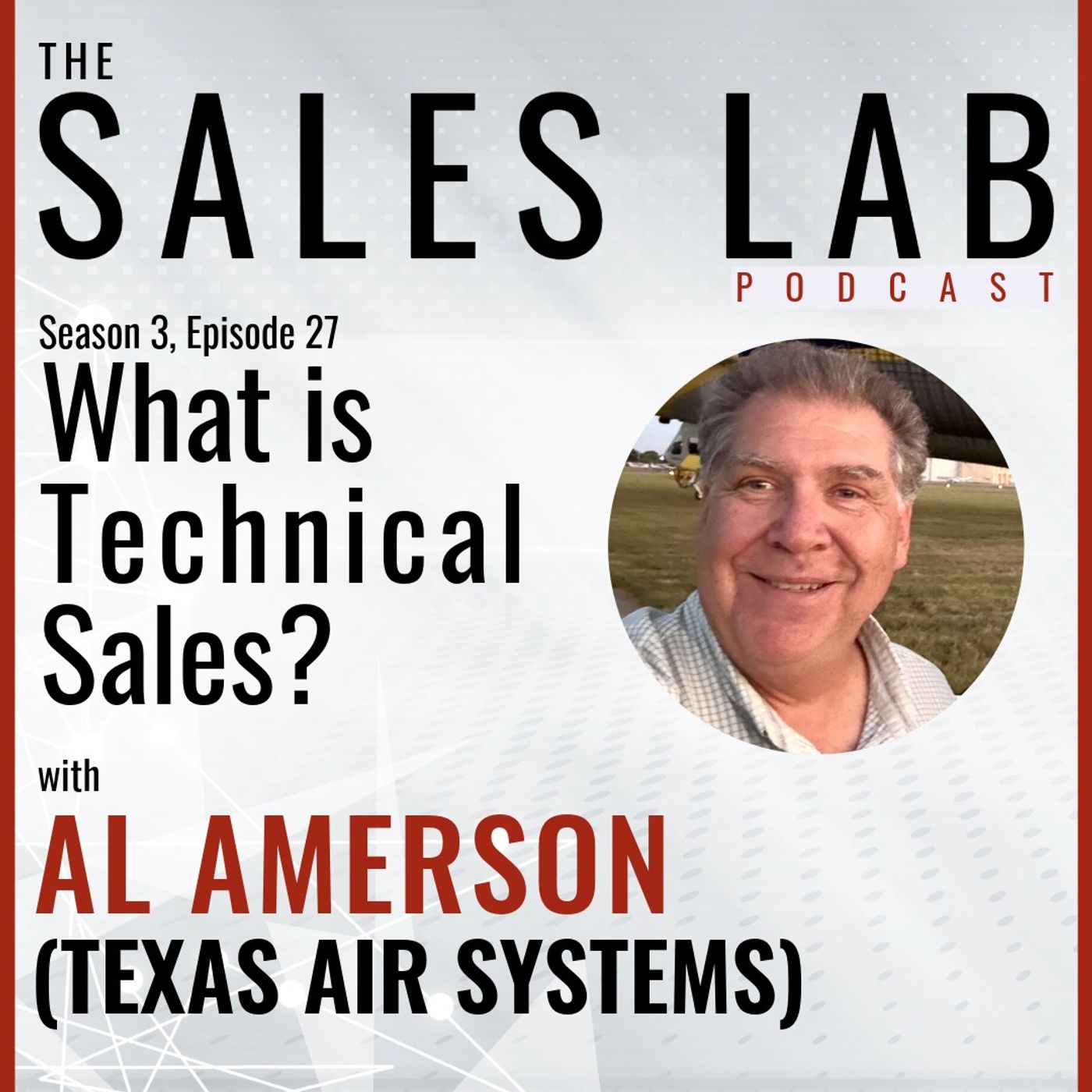
The Sales Lab
TSL S3E27 - "What is Technical Sales" - Al Amerson, Texas AirSystems
00:55:10
Al Amerson joins Dr. Willy Bolander in The Sales Lab to answer the question: "What is Technical Sales?" from the perspective of his company - Texas AirSystems. All episodes of Season 3 will address this important question. What do we mean by technical sales? What is so technical about it? Is it ever not technical? What competencies are needed for success? Join us!
Loading summary
Transcript49 lines
- [00:01]
A
My name is Willy Bolander. I study influence, persuasion and leadership in selling and sales management. And I teach people how to sell. In this podcast, we'll talk to some of the world's top sales leaders and see what we can learn from them. Welcome to the Sales Lab. Well, I'm here with Al Amerson from Texas Air Systems. Al, thank you for joining us today.
- [00:21]
B
Yes, sir, thank you for having me.
- [00:23]
A
And you know, we are having all of these conversations and attempt to try to understand the different ways that technical sales manifest across different organizations and industries. I think maybe a nice starting point would be to ask you what Texas Air Systems does, what solutions you offer, who your customers are. If you could just kind of paint that picture for us, that'd be great.
- [00:46]
B
Sure. Texas Aerosystems. We're in the H Vac space, but as we've grown, our customer base has grown. So originally we started out as a boutique rep firm providing customer solutions just on the air side. That's why we're air Systems. And we've evolved through the years to not only provide air systems, we provide hydronic solutions, air distribution solutions. We do turnkey solutions, meaning that's replacement of existing equipment. We do everything now from H Vac to electrical. If our customers have a need, we want to be the go to provider. Meaning if they say, hey, can you build us a playground? We say yes. Who are some of the subs that you like to work with and and have on your projects? And we'll become that general contractor for them at the end of the day. So, you know, we want to make sure that we can take care of our customer in a. In a confident manner. So we don't just say yes freely, but we're also saying yes to things that we know that we can actually do and perform and deliver.
- [01:55]
A
This content is brought to you by the TYE Sales Showdown. That's the technical Industrial and Engineering student Sales Showdown hosted right here at Texas A and M University. We have over 200 engineering students taking sales classes every semester and a growing minor program in technical sales. These students are smart enough for STEM and savvy enough for sales. And the TIES showdown allows them to demonstrate their selling skills in a roleplay competition where industry partners like you serve as judges and provide them coaching feedback. If you're hiring for technical, industrial or engineering sales roles anytime of the next couple of years, this is an event you can't miss. Learn more at TX AG Ties. That's TX AG Ties. Hope you can join us. So really, whatever, whatever you can do to provide Some value to the customer. Now, let me ask you, you mentioned air systems. You mentioned, was it hydraulics or hydronics?
- [02:51]
B
Yeah, hydronics, the water systems.
- [02:54]
A
Okay, so the water systems. And then you mentioned air distributions. What's the difference between an air system and air distribution? What does that mean?
- [03:02]
B
So just in simplistic terms, if you think about your house, you have the. The grills that. Where the air is coming out from. And then you've got the. The air handler itself that's sitting in the attic space. So the air distribution would be the GRDs, meaning slot diffusers, some fans, the actual applied systems, which gets a little bit more technical when you get into that technical sales piece. That becomes the systems. That's where you get into psychometrics, really, the dehumidification. How do you actually take a heat load and remove that heat load and then provide good, clean, quiet, dry air that's good for the occupant?
- [03:51]
A
Okay. All right. And you are selling to building owners, contractors, builders, who are your customers?
- [04:04]
B
Typically, yeah, our customers have gotten broader. Let's. Let's take it from the top. So obviously, the person with the purse, that's usually the owner. It could be anything from a American Airlines, a Jerry's World, I like to say, for the Dallas Cowboys, you could have developers that are cbre, hospitals that are the Methodists or the MD Andersons, the UT systems of the world. So you've got that. And then usually they would hire the architect and the general contractor that general contractors then get a higher subs. Electrical contractors, mechanical contractors, plumbing contractors, and everybody in that, plus the engineer, the actual mechanical engineer that's designing the systems. All of those are our customers. All of those can at some point influence the buying decision. So we've got to make sure every one of those elements and aspects are covered. You may think general contractors, they actually ever buy anything. No, but they have a heavy influence. And sometimes general contractors, due to schedules, actually also buy equipment. So we could have a lot of different customers. And, you know, if you like to call it the game, the game is being the salesmanship game. You can't discount anybody. And you got to have every one of your bases covered. And that's why this business is so unique and fun, is you never know who that. That dark shadow, we like to call it, or that figure that's sitting in the background that has heavy influence in the decision process. You got to make sure every person that could potentially be sitting around the table when all the prices are laid out on the table and they Say, hey, who do we want to buy from? Well, we want to make sure we got everybody at that table covered.
- [05:56]
A
Absolutely. Well. And so, you know, you're touching on some themes that come up in a number of these conversations, right? That sometimes it's the product itself, the solution itself, that is the thing that's technical. And then sometimes it's just the navigation that goes into making a deal happen. Right? That there's so many people involved that you have to almost project manage and diagram out the different relationships of the customer and figure out how to get the thing to happen. Right. So how would you. What percentage of the complexity of your business comes from the, the systems themselves versus the kind of complex buyer situation that you just described?
- [06:43]
B
It depends on what customer you're calling on. So you know, when we're working with an engineer directly, the technical components, you know, really you can be a great person, friendly, you know, go drink beer with this guy. But if you can't protect him, keep him safe and offer solutions when he's got problems, you know, this engineer, he's got to design the entire building, the entire mechanical systems, ductwork, pipe, everything that goes along with it. And our job is to come in and help him to apply the respective manufacturers and the equipment that we're selling. That's the highly technical piece. But if you're thinking about mechanical systems, you got an airside system, you got a water side system, you could be talking about variable primary hydronic systems with him. You got to understand all of that in order to help him because he's got to control all that equipment and we got to tell him how does it run? You know, if, if it doesn't run when it's time to start it up and his system, his sequence doesn't operate properly, he's going to look to us and go, hey, you got to help me out. And that's where the value prop that we bring to the table is, is making sure that our customers look good. And they get hired again by that owner and that architect. When you get to a mechanical contractor, their needs are less technical. Unless you've got a design build contractor, they want to make sure the mechanical contractors you're providing service. When something comes from the factory and it's broken, then that's where the technical piece can come in, that you can go to the field and troubleshoot that equipment, help them to say, here's the problem and here's what we're going to do to help you. We all have human made mistakes, whether it's from the factory or sometimes equipment gets damaged in transit. We got to be able to be nimble and come up with creative solutions. And that's why, whether it's the technical engineers that we hire, you got to be able to come up with problem solving on your feet. There's never a playbook that you gotta, hey, let me just check these boxes. And it's gonna work. You know, if you want a job where every day it's gonna be different and you're looking for ways to challenge yourself, to think outside the box, to get creative. That's why the technical sales is a, is a great career for someone that doesn't want to sit behind a desk every day and, and just churn out mechanical drawings.
- [09:23]
A
And I always tell people about half of our students here in the industrial distribution program are coming because they know somebody who works in ID and told them, hey, you need to do this program. They have a neighbor or an uncle or somebody. The other half are sitting in their other engineering classes just realizing, man, I don't know if I can sit at this desk all day, every day. And that, that monotony will, will, will destroy some of us. But so about how long does it take to execute a sales process? How long does the sales cycle take to unfold?
- [09:57]
B
It really depends on the project. And we, we've got different levels of projects. You know, if you think about go and build a whataburger, that sales cycle could be nine months. It's real fast. They're throwing those up. But you also could have a hospital that it's conceptualized two year before they break ground. So all the different players, and I call them players, meaning the owner, the general contractor, engineer, mechanical contractor, they can influence who wins that job. So you could invest two years of design efforts budgeting the job, and then when the final decision is made to move forward, you know, there's somebody that's, we call again the dark shadow figure that comes in and says, no, we want to use this person. You couldn't work in two years on that. That. And somebody makes a decision that goes another way and you lose the job. You put two years of work in there and you get nothing out of it. But you know that two years where they're designing that, and now you're going to have another two years to actually build it. And then you got one year of warranty. So you could have a five year where you're working on a project from cradle to grave. Then you know, the owner owns it from that point forward. But you can have A lot of things that go wrong that you have to fix all along in that process. So if you think about a hospital and all the different components and the construction cycle, you're not getting every piece of equipment on the job site at the same time. That's where the hydronic systems may go in first so that they can get chill water to the rest of the building so they can get some cooling, so they can get their fixtures and paint done. You know, all that equipment's operational during that time. So any of those type of failures and issues that come up, you got to go out there and work the kinks out and fix it.
- [11:53]
A
How did you get into the role that you're in now? What's your story? You went to school somewhere? You. You jumped right into Texas Air Systems or what did that journey look like?
- [12:04]
B
Yeah, well, I mean, some people say it's better be lucky than good. And I guess when I was coming out of Auburn, so I know the Aggies just beat us down a few weeks ago, and I was there to enjoy that. Beat down. Pretty loyal to Auburn. And so coming out of college, I knew I wanted to go into sales. And you may say, how did you know that? I just couldn't see myself sitting behind the computer all day. I wanted to have that personal relationship, but I also really wanted to solve problems and sit down and listen to a customer's issues. Problems and not come with a product to solve it, but really look at it and go, okay, I think I can take care of this problem for you. Here's. Here's some suggestions. And you know, the goal for every one of our salespeople is to become a trusted advisor to your customer. And what does that mean? That sometimes you're going to have to tell them, hey, I don't have the best solution. You need to go talk to this person or make recommendations to them. But. So I started out from Auburn, got an engineering degree, and I interviewed with several companies and York International at the time, who was bought by Johnson Controls. They gave me an offer. Could have stayed in Atlanta, live there, or in Florida and Dallas. Those were the three locations I was given as options to. To move to. I'd never been to Dallas, so I chose to move to Dallas and started out with York, worked for them for about five years. Johnson Controls bought York and worked for them for four years. One thing I knew about myself is I'm not a very good corporate guy. I like to be flexible. And so Johnson was a really big company who's still one of our Partners. Today York is, and there's a little, little company called Texas Air Systems. Again, pretty niche boutique rep firm. Our business was about $54 million. 54 people. But at the end of the day, they had a great culture. And that culture is ultimately what drew them, drew me to them. And they had a great reputation as well in the business. Some of my customers actually recommended that I go check them out. And I met a leader named Buddy Pace. You know, I'll say a leader versus a manager. I think that's a big distinction in this day and age. I had managers, but never had somebody that, that looked out for my well being as well as cared about, you know, work, life, balance, and make sure that I'm, I'm not working myself to death. And so I wanted to follow a leader and I chose to move to Texas Air Systems almost without any accounts, frankly. It was, hey, I was betting on myself. I could go over there with a phone book and make my way and figure it out. And so I started my career with them calling on one account. And it quickly grew. And then about six or seven years into my sales career, Buddy Pace pulled me aside and said, hey, I'd really like for you to consider going into leadership with us. I'd done my mba, you know, back when I was with Johnson Controls. And he said, I think you'd be a great fit. I was a high performing salesperson. So I was like, ah, you know, I think I'm good at this. And finally he kept pulling and kept pulling and he saw something in me that I didn't necessarily at the same time see in myself. You know, some people would look at me and say, man, you didn't even know what empathy meant when you were a sales guy. Because I just wanted to kill. I wanted to win. I wanted to sell no matter what. Wasn't about the money at the time. I wanted to win. Even if I had to write a check to win, I was going to do that because winning was what drove me. And I wanted to win for our team, I wanted to win for our manufacturers. And you know, when you want to win for your team, that's what Buddy ultimately saw to get me into leadership. And so starting the leadership path and he's kind of pulled me along the way from being just a sales leader to running our entire North Texas business. Up Here we got 350 people that work here, about one and a half billion. So now that you know that that weighs on somebody, when you've got to now think about all those families, decisions you make but love the team, love working for the team. It is a, is a team dynamic and culture that we have here.
- [16:25]
A
And what I'm hearing is maybe two big transitions. One, you were just talking about the transition from sales to leadership. I might think of some more questions to ask you about that. But going back a little bit further, you were in engineering, you were an engineering student. What type of engineering by the way?
- [16:44]
B
So I failed out of chemical engineering. And so who's now the president of Auburn, he was a professor at the time and he said, hey, you need to go down there and meet with some of our academic advisors and find a good engineering, I think you can make it. And so I went down there and I was talking to them and they're like, hey, we think you should do materials engineering. It's very hands on and professors will work with you. It's not as quantitative, meaning the chemical engineering, I made it through the organic chemistry and that side. But taking it to that next level, I just wasn't the smartest kid. I'd work hard. And they said materials engineering will be great for you. So again, materials engineering has got nothing to do with H Vac, but I'm a materials engineer and that's why we're looking at engineers. It doesn't matter whether you're aerospace, chemical, mechanical, if you've got the ability to, to learn and retain that and then apply it. Any engineer that can problem solve or the type of people we're looking for, Texas Air Systems and we think you can be successful.
- [17:51]
A
Right on. And so you're making that transition from materials engineer to sales. How did that work? Were there surprises along the way? Did you already know what you were getting into? Were you completely caught off guard? Maybe? Tell us about that.
- [18:09]
B
Yeah, I mean, I had no idea really what I was getting into, frankly. And I didn't understand H Vac, even what that stood for. When I was coming out of Auburn, we were more mechanical on the engine automotive side. We didn't spend a lot of time and frankly our professors, nor did our administration support people in technical sales. They actually told me I was wasting my engineering degree by going into technical sales. And that's why I've become even more passionate teaching people about the opportunity and how it is a good use of your engineering degree at the end of the day. And so when I came into York at the time, I mean we were just a little good old boy, five person office and we were all about a team partnering together, not saying, hey, this is mine, this is yours. Hey, how do we win? We're the small kid on the block versus the big trains of the world that's got 40 person sales teams. So we had a one guy that was a little bit of a mentor to us, and he said, hey, man, just go open your wallet and build relationships. And those relationships will help you in the future. You may not know anything, but go build those relationships. And so that was some great advice because that's really how I got my start. And, you know, I learned the technical side along the way, but the relationship pieces is so instrumental. People want to do business with people they trust, and you got to build that trust and you got to be in the trenches with them. And, you know, sometimes it means you got to go do some, some bird hunting and get to know them and understand, hey, here's what makes me tick. And get to know their family. And I built my, you know, my business on taking my family and getting to know my customers families. That relationship piece is key to success in our business.
- [19:58]
A
Now, I had an interesting discussion with some of our graduate students the other day that I think the topic was your positioning and your competitive advantage and your value proposition. And I find that it's very easy for companies to say, oh, one of our value propositions is our relationships. And I certainly understand the sentiment behind that, and I don't know that I disagree with it wholeheartedly, but I do like to press on people and say, like, you know, I don't think that's a sustainable value proposition. Right. Somebody nicer than you moves to town, somebody who's funner to be around with, you know, to go hunting with, or, you know, somebody brings a tool to them that saves them real dollars. Yeah, man, you know, maybe we're buddies, but, you know, this person's gonna actually save me money and, and help me keep my job and help me not have to lay people off. And, you know, there's, there's, there's some very tangible things, but, you know, but when you're talking about relationships, I'm guessing, I mean, to build that trust, it's not just, it's not just the, the personal stuff, right? I mean, they have to know that you're competent. They have to know that you have the technical capabilities to deliver on your promises just as much as liking you as a person. I would think.
- [21:22]
B
Yeah, there's no question. I mean, if you're just full of hot air and, you know, you're going over there shaking hands, kissing babies, slapping people on the back, good old boy. But at the end of the day, you. You. When you got a problem, you know, I think the biggest opportunity is when there's adversity. When a manufacturer's equipment's weeks late, how do you come up with solutions and, you know, communicating with. With those customers through that adversity and the issues and the challenges, that's where it's going to make or break you. Yeah, you got a relationship. Okay. That gets you an opportunity. Then when there's a problem and there's a challenge, if you run away and you hightail it and you don't return calls, they're going to find somebody else. And that's the part you talk about. Now you're costing them money to do business with you. They're going to say, I can go somewhere else and I can build that relationship. The relationships are important, but those trials is what really builds that trust. And that's where customers keep coming back. And that value prop that you referred to it, you know, they're going to be willing to pay a premium because at the end of the day, they know it's going to cost them less money. Because when there is a problem, they're going to pick up that phone and say, hey, man, Al, I got this issue. It may be an issue they created or caused. They just need help for you to come out there and solve that problem again. And when you solve that problem for them, they're going to say, hey, I owe you one next time the job's coming out. And, hey, you're not low on that next job. They're like, hey, man, you helped me out of this deal. I owe you one. I want to go with you. And, you know, they're going to start pushing that to their customers and say, here's why we want to work with Texas Air Systems. Here's why we want to work with Al Emerson. They're not buying, necessarily the manufacturers and the sticker that's on the side of that box, they're buying, you know, you as a person. So I think that relationship is important, but it's also that. That delivery and the execution of how you keep that relationship in the future.
- [23:30]
A
Absolutely. You know, I'm hearing a few answers to this question already that I'm about to ask, but I wonder if there's other things. So, you know, I always like to ask, what are some of the competencies, the ingredients that a person can bring to the table if they're going to go into a role like what you guys have at Texas Air Systems, what would make them incredibly successful? And I'm hearing some things like problem solving, right. Like being able to see a very unstructured problem, not a checklist problem. Right. Like you described earlier. But hey, we don't know what to do. Nobody knows what to do. You just have to figure it out. What other competencies are really helpful for somebody to succeed in this role?
- [24:19]
B
We like to say if you break up your day, the way that you should look at it is a third, a third, a third. So as a manufacturer's rep, we don't build anything. So we're dependent upon our manufacturers to trust us and give an opportunity to represent them. So they're a key component of this. So interpersonal relationships, we're always selling. And what I mean by that is if you spend a third of your time internal, you know, to do our job successfully, we needed our accounting department, we need our service department, we need our parts department. We may screw something up and we're going to go ask for a favor. So if we don't make sure first and foremost that we're selling inside our four walls and we're taking care of the people that are taking care of us, again, that goes back to the culture that you're not running people over, you're partnering with them every which way. Because we said, we got an owner salesperson, we got an engineering salesperson, we got a contractor salesperson. There may be three people working together on a team, collaborating. And you're going to be asking for favors. That's, that's a third of the time that you spend on a day to day basis on, on average. The second, second, third is, hey, you got manufacturers. We got over 60 manufacturer structures that we represent. Sometimes we're going to need favors to cut price or deliver something faster or you know, be creative and, and come upside with a new design so you can solve a project. So that's another third of the time that you, that you're going to spend. And then the final third is with your customers. You think, oh man, I gotta spend all this time with my customers. If you spend it with them and not the people inside, they're not going to help you. You're not going to get the support from the manufacturers. So, you know, just understanding that dynamic is essential to how to be successful. So I know you said, hey, what are some of the tools having those relationships, being able to go build those relationships, even if you're somewhat introverted, you got to go force yourself because you need that. I also want to say, hey, some people think of sales like you're always in front of the customer. Not true. I mean, you can sit at your desk and design in CAD and revit, you know, creative air handler solutions come up with unique solutions to, hey, how do we get this air handler that's 50 years old out of this building and a new one that's. Codes changed, Building codes have changed. So you got to have more components, more outside air. Now the box is bigger. So how do we get that into this space? So, you know, the creativity and a lot of times we just got a blank sheet of paper and the engineer says, hey, here's my load calcs, here's my sizing. You need to come up with the design, and you get to come up with a scratch piece of paper and come up with a solution that then it's got to be economical. You still got to think about the budget. And so, you know, that creativity is certainly an element that's important. And a lot of times engineers, they just look in the, you know, the black and white, and we got to think outside of that black and white and come up with unique ways to solve problems that 10 years ago, we'd solve it one way. Now we're solving a different way. And we call it being a lifelong learner. You can't just say, okay, hey, I'm good enough. I know what's going on today. Well, you know, you got the government that's out there and saying, hey, we got global warming potential. And so as a result, we got to change refrigerants as a change of refrigerants. Now we've got mildly flammable, A2L. You got to understand what that means for a building owner that now he's putting a mildly flammable product in his building. And, you know, you got to educate the engineers on, okay, how do you evacuate that system if there's a refrigerant leak? And so you've got to be a lifelong learner to, to really be successful in this role. And I think that's in life, you know, if you're not constantly looking to get better every day, whether it's, how do you be a better dad? Or how do you become a better husband? If you're just take a little bit of a mindset to say, hey, I'm going to get better today than I was yesterday. And every day you go out there with that mindset and you compound it to the point where you look back and you go, two years ago, where was I? To where I am today, man, that's. That's pretty Amazing. If you take it and slice it down into daily increments.
- [29:03]
A
Interesting. Yeah. And actually, I love the third, third and third. I've been telling a similar story, not as quantified to students for a while, and even in some of the research that I do, you know, that, you know, we can quantify the effects of relationships with these different types of stakeholders. I mean, we, I always describe them as internal team members, external partners, maybe somebody who's delivering what you've got, maybe a supplier, maybe, whatever, and then, you know, your customers. And yeah, we, we attribute often implicitly everything that happens in sales to the customer. They're an important, critical piece of the puzzle. But, you know, there are situations and, you know, we can come up with scenarios and convince our students of this that, you know, you can sell the customers and still not be able to close the deal, you know, Absolutely. Hey, they want to buy. I've influenced them. I've sold them, I persuaded them. They're excited. Yeah, but there are other factors that come in. And if you're not able to call the delivery people in your own firm and, you know, call in a favor and leverage your relationships with them to maybe get bumped up in the order of things to accommodate a specific customer's need, then, yeah, you don't make any money. Yeah, you did everything right with the customer. You asked great questions, you did a great discovery. You connected the solution to all of their problems, and you get nothing out of it. And it's, it's, it's, it's a very interesting thing, but. And I'm glad that you put a, you quantified it, because I've various times in the past enjoyed asking companies, you know, because a lot of them will say, they know this. You know, they'll say, oh, yeah, of course, yeah, we have to build inside, you know, strong internal relationships. We have to work with these other stakeholders say, okay, great. So, like, in training, how much of your time do you tell your new sales reps to be spending just networking and building relationships inside? Usually the answer is none. Okay, well, in your ongoing meetings, you know, once people are out of training, they're just working, you know, normal weeks. How much of their time do you advocate that they spend building relationships inside? You know, it's usually none. In fact, if I see them inside, you know, you know, chatting up their colleagues, I'm going to be a little annoyed because they're supposed to be outside talking to customers and say, okay, well, so we know this, this makes sense to us, that we need these relationships and yet we do an awful lot to discourage them building them. So I'm very refreshed to hear you say, not only do we know this, but we've, we've quantified it. Right. A third of your time is not negligible. I mean, that's a big chunk.
- [32:01]
B
Yeah, it is, but, but it makes sense to me.
- [32:05]
A
And with more confidence, you know, you gotta.
- [32:08]
B
Yeah, no doubt. Yep. And there's so much collaboration that goes on to a successful sale that, you know, there's. And the speed at which information is shared is so critical. You know, when jobs are happening, it's lightning speed that if you get some information and you're calling on the engineer, you gotta disseminate that down to the contractor salesperson, the owner salesperson, and then react accordingly and come up with a plan of action to go out there and sometimes respond to a customer's plans. And you know, they may be taking a, hey, we're going to be the low cost providers approach. And we see that quite often. And then you've really got to make sure that your owner understands that value prop of what you've been talking to him about, why he's got to stay strong and why the value is there. And if he doesn't see that value, then you may have to respond accordingly and say, okay, hey, we're going to have to take a different approach and we may have to be selling on price as well.
- [33:17]
A
So I'm hearing problem solving, I'm hearing lifelong learning. I'm learning an ability to balance not just customer relationships, but, but relationships with these other stakeholders. Are there any other ingredients that a, a young person, an early career salesperson can bring to the table to guarantee their success?
- [33:39]
B
When you got to have a, a passion, it's something that you really can't coach. I mean, you got to have that desire to win. It's got to be intrinsic in, in you. And you know, I tell my son every day, I go, hey, go win the day. And what does that mean? That means find something that you're going to dominate, you're going to, you're going to win. Whether it could be a test or hey, I want to go build this relationship with this individual customer. I got to push myself. He's not answering the phone. I got to find a creative way to get in front of him and a unique approach. We got this product here that nobody knows. How do we get it in the marketplace? If you get that person that says, yeah, I'll take your call, that's a win for the day. And so. But having that desire and we look for entrepreneurs, that's a big thing. We're recruiting students. Do you just have that entrepreneurial desire to run your own business? Because when you're a salesperson, you have that freedom. What gets you up in the morning. Hopefully it's not breakfast. I mean, you've got to have that desire to. To go out there and win and win for your team. You know, that's. That's a big thing we talk about here. Team first. You got to have that team approach and mindset that it's not just you. Yeah. You're the eye that's getting you out of bed to go on that sales call even when you lost the job yesterday. That I'm not going to give up no matter what, until. Until people have told me no enough times to move on to something else. But that's something you can't coach, and you got to have that innate inside yourself.
- [35:23]
A
Yeah, I'm really thinking about that. You know, personally, if I look back in my personal life, I, you know, I think there was a time when I was younger where I would have said, I don't know that I'm competitive. I don't know that I, you know, I'm driven by winning. And I think that I. At this stage of my life, I am very competitive and very driven to win. And I wonder, okay, was it always there? But it was sort of, you know, nascent and sleeping, or did I learn something or did I. You know, the best hypothesis I can come up with is maybe there was a moment where I had a win and I. And I felt how good it felt, you know, And I was like, okay, now. Now I've got the fire lit under me, you know, So I do. I. I understand what you're saying about. Yeah, I can't. I can't tell somebody who's not motivated, hey, let me coach you. To be motivated. Do you know, it's good to be motivated? And they go, yeah, I don't care, man. I'm not motivated. Right. But I. I do think there's something about, you know, it's like a. A kid learning to throw a football. Right? And in one, you know, two. Two kids, same age, learning to throw a football, same height, same build, same. Same basic ingredients. And one of them's learning to play with a older brother who picks on him and, you know, like, makes him think he's not very good. And the other's playing with his dad, who's trying to build him up and saying, hey, wow, look at the arm on you, kid. You're a natural. Yeah. And, and you know, what a, What a different experience. What a different sort of, you know, psychology going on there. And then. Or you know, a student, a kid who, okay, the first time he plays a game, they win. Well, that's a completely different experience than the student who's on a team with people who don't care. And the first game is a big loss. And I think about this in sales, you know, that, man, it's really important, if at all possible, to set these new salespeople up to get a win, make sure they know what it feels like. Not, not to make it easy, not. Not to like, hand feed them accounts that they can win. But if, if they don't get a taste for it, you know what I mean? It's gonna be really hard to say. I mean, hey, I'm competitive, I want to win, but it. I haven't gotten a win yet. I'm not, I'm not winning. That doesn't. That sucks. Not winning is. Is quite demotivating. Right? So I wonder, you know, can. Is there, is there wisdom behind make trying to make sure they can get a taste of this and keep that fire lit underneath them?
- [38:06]
B
You know, Willie, I'm actually going to disagree with you on the, the losses, demotivating. I think we learn the most from our losses, and the losses is what stokes that fire. Like, hey, I'm never going to let that happen again. I want to make sure the next time I learn from that, I talk to my partners better. How do we lose that? And you know, we always celebrate our wins, our successes. But the best opportunities to learn is when you have a lost and I mean, you feel that loss. I mean, I hear what you're talking about on the kids growing up, and we absolutely want to foster that winning feeling. And I think that's the team. The team puts their arms around somebody that loses and say, hey, man, let me help you up. Let me uplift you and let me, let me help you out through this. And. But we want to learn from it so we don't repeat that failure again. And sure, we're going to celebrate the wins and high five and be excited. And now it's, hey, now you're on a winning streak. Let's go win the next one. And it does motivate you to say, oh, I got that one. I can go get this one. But don't become complacent and don't just assume that we're ever going to win. Just because we showed up at the dance, you got to go earn it every day. And, you know, our people wake up realizing that nothing's going to be given to us and we got to go out there and fight for it. And because if we're not fighting for it, our competition is. And that's why that collaboration in the office, just to make sure that we've got every edge that we can get to best position ourselves, is very important.
- [39:52]
A
Okay, well, I can see that. And actually now I'm really wondering, now I'm going to start asking people, you know, your, your, your first sales call, your first month, your first quarter, your first year in sales, you know, did it, did it, did it feel like you're winning? Did you feel. Because I, I, I know, I know enough people with their, and I know their stories to know that, yeah, I can, I can pinpoint some people who took a beating in, in the first month, in their first year and were, you know, at the bottom of the sales rankings and just decided, nah, that that's not how this is going to go. I'm gonna, I'm gonna crack the code. I'm gonna figure this out. I'm gonna pivot and, and figure it out. All right, well, you got me doubting, you got me, you got me questioning
- [40:35]
B
now, well, that it's perseverance. I mean, it really is. When, when you're starting out, you're gonna lose more than you're gonna win, typically. But it's, hey, like you said, crack the code. What's that secret recipe? Every salesperson is different. Their approach, their style, their go to market strategies, you know, how much entertaining are they willing to do with customers? Some people are not as technical. So there's, there's no one exact recipe for success. And you have to go talk to other people, ask them, how did you become successful and listen to their stories and understand what was it that made them successful? And then you take it and apply it to who you are. And then you can go execute your sales strategy using little bits and pieces from a lot of people that are around you.
- [41:28]
A
You know, I do wonder about tips. I guess you've given us one in the third. Third. But are there other tips that you might have for early career salespeople, things you've learned in your journey?
- [41:41]
B
Always ask for the order. You know, when you're, when you're sitting in an interview and they're wrapping up. If you're not saying, what are the next steps, where do we go from here? And your desires to be A salesperson you're not trying to close. And, you know, we can joke about the ABCs of Always Be closing, but, you know, if you really want something, ask for it. You're not going to get something you don't ask for. So don't be afraid to say, hey, what's it going to take for you to hire me? I'd really enjoy working with you. Here's the reasons why I think I'd be a great employee for you. Hey, if you want to go on that first date, you got to ask it. So don't be afraid to go out there and put yourself out there. If. If you have that fear of rejection, find a way to overcome it.
- [42:34]
A
I sometimes like to ask about. I guess I used to phrase this question in terms of books, but realizing that, I guess useful content comes in a variety of forms. You know, it could be a book, it could be a movie, it could be a speech, it could be a show. Right. Is there any content along those lines that you think any sales professional should be aware of, they should have read, they should have watched?
- [43:02]
B
I got a lot of great books. That's why I was looking on my shelf to see all which ones that, that I like to. I mean, for me, Mindset, that's a great book. And it, you know, people talk about it your glass half empty, a glass half full kind of guy. But Mindset is a book that is just optimistic, you know, just fills you with, I can go do this, I can do that. I mean, for younger students, I love rich dad, Poor dad, you know, because it teaches you to be an entrepreneur, to, to build wealth. And I think if. If that's a goal, and some people say, why would you get into sales? I want my own freedoms, and I want no limitation on what I can make. As hard as I work, I can see a direct reflection in sales. Usually not every time, but if you're struggling, stop and ask somebody else. That's at the top of the list. What are you doing that I'm not? What are some of your secret sauces and parts of the recipe that make you successful? You know, if you're going to an organization, make sure that you're talking to the youngest people on the totem pole to understand what the culture is. Ask them, say, hey, can I talk to some of the people alone to see what it's going to be like in my first few days? I know you asked me about books, but, man, there's a ton of great sales books that are. That are out there that I would recommend. But those are the two that I think will help you in your, not only in your career, but in life.
- [44:36]
A
Yeah, well, and you mentioned work life balance earlier, and this is always an interesting conversation to have with young, early career people. What does that mean to you?
- [44:51]
B
Well, unfortunately, I'm a workaholic. And that was one of the reasons that my, my leader saw that, hey, maybe you shouldn't be in sales because I was a 70 hour week kind of guy every week, maybe 80. And he's like, hey, take some of those passions and pour them into other people. But now I get to see how you can have burnout in that, in that sales career and looking out for people. And so for, in our world, you know, we tell our people to be entrepreneurs, they're running their own business. Sometimes I have to protect people from themselves, meaning they're working 60 or 70 hours. And I see that constantly. I need to go encourage them to hire somebody to offload themselves and, and take some, some responsibilities off so that, you know, they can spend more time with their family, in their home. Early on in my career, the way that I balance work life was I got my, my wife to get to know my, my customers wives and we do trips together. I leverage that. Or I take my, my son to football games with another customer and his son. You know, not always the best work life balance, but, you know, I do love to get away. I love to go skiing a lot of times with customers. I love to hunt a lot of times with customers. But I integrate my family into those moments and into those times. I mean, heck, I went to a lot of a. M. Games again with customers. So, you know, earlier in my career I was having fun. I mean, we're really big into a work life balance that's, you know, work hard, play hard, and, and a lot of times we're playing harder than we're working, but we're having fun doing it.
- [46:31]
A
Yeah. I was told on a personality test years ago that, you know, it was a very standard, you know, four quadrants type of, you know, you've seen, you've seen these. And everything it said was very expected and boring and normal, you know, copied and pasted. But it said it had one bullet point that I found very funny. It said you have an inability to distinguish between work and fun. And I busted out laughing after reading. I was like, oh, well, you know, I mean, I think what I do is kind of fun though. I mean, it, you know, it's, I'm not, I don't know, digging ditches or something. You know, I'm, I get to do some fun stuff. So that's, it's funny to hear you say that. Well, you know, the, I think sometimes our young people hear that and they say I shouldn't have to work after a certain time of the day and I shouldn't have to think about work on the weekends. And I think they're correct that there are windows of time where that's probably correct and valid and they need to prioritize themselves. But then I think you're 22, 23, 25, 30. What are you doing that's so important on a Saturday morning that you can't go through your notes and do some follow up and make productive use of that time? You know, I think, you know, work life balance is, hey, my parents are getting older and I've got kids that are getting older and there's all these other new demands. It's not just that, like people don't say that, I think because they just want to sit around, you know, it's that like, hey, I need to leave work early to take my parent to a doctor's appointment. That's way different than there's a happy hour that I really like on Thursday nights. And I want to make sure I'm not working after five so I can go putz around with my friends. I mean that's, that's cool. Putz around with your friends. But if your phone rings and it's a customer, answer, answer that phone. That's a customer.
- [48:30]
B
It's usually opportunity is what that means. Yeah, even when there's a problem, you know that customer's calling. That's an opportunity to go. Maybe you get to it in the morning, but you pick up that phone and talk to him, say, hey, I'll jump on it at 7:00 clock and you get him an answer by 8:30 or 9. Man, that's a customer maybe for life that you just built because you got him, you got him out of a jam. You know, the work life balances. Take your kids to school and make sure you're there in the morning and, and dedicate that time and focus on that time. Be there for dinners. But maybe you open your laptop at 9 o' clock or 10 o' clock after your, after your wife's gone to bed and you get a few emails out and you do a few submittals or you know, things that are critical so that that next morning you can get out of the office and be in front of customers and talk about that next Opportunity. You know, you have that flexibility in sales and that's one of the big things, why I really was drawn to a, a career in sales. You know, if you think about just sitting at a desk all day, just crunching out designs. Love our engineers, but you know, they, they need to be there from that eight to five, just sitting at that desk. A lot of times they're clocking hours so they can billable bill them against a project. This is, sometimes you may work, need to work 10 or 12 hours and then, hey, you know what, at noon on Friday, I'm taking off and I'm going to go to the fair with my family and kids.
- [50:04]
A
Well, I'm keeping an eye on our time here. I see that we're getting close to the finish line. Any closing thoughts, any ideas you absolutely want to put out there for people to hear?
- [50:19]
B
You know, if you like to make money, definitely a career in technical sales is a great opportunity for you. It's one that can be fulfilling your whole life. There's no question that it can be technical. At the same time, if you're thinking that, well, you know, I'm just a sales position. Can you really have a, have a good firm foundation of the technical aspects of it? I like to tell my salespeople that, hey, you got to be smarter than our engineering customers because they're leaning on you to apply it and keep them from getting in trouble. So if you don't know it better than they do and they just, you know, blindly take your advice and put something on the drawings that don't work, you just got them in trouble, got them fired. So we got to be, we got to be better than who they are and what Texas Air Systems. I think we have some of the smartest people. We got a whole bunch of people that have pes. You know, you surround yourself with just great people at every position. We're, we're full of all stars and it's all stars that have an open door policy. And you could be the brand new person that just started from A and M a week ago and you can go sit down with the guy that sold 500 million. He drops everything he's doing to, to help you out and coach you and mentor you, you know, make sure you're out there looking for a culture that fits who you are and they can foster your entire career and they got your best interest at heart through development plans or whatever it is to make you successful. That, that's the important thing when you're, when you're looking for A company don't just think about what you can do for that company, but what that company can do for you. I mean, I tell people at least that we're looking to hire. Hey, we're not here to hire you. We're here to retire you. And in this day and age, people want to jump around, they want to move places, and we've got a really low turnover rate here because people love to be here, but also think it's an employer's responsibility to give you a reason to want to come to the office and want to show up at work every day. You know, that's the responsibility of an employer to make it fun to come to the office. And, you know, we struggle with that in this day and age to have people come in the office because they say, hey, I'm more efficient from my house. And yeah, sometimes you are, but are you teaching others? Are you, are you helping them to get better? How long does it take for you to actually learn the information yourself so you're more effective? And could you be more effective? Yeah, you could be more efficient from your house by yourself, but are you efficiently gaining the information, the knowledge to then go help your customers more? So, you know, those are type of things that I would say we, we create the reason why people want to come to the office.
- [53:15]
A
Yeah, no, that's great. Well, I guess there's a difference between kind of short term efficiency and long term effectiveness. Right. Are you learning the things you need to learn just by serendipity, just because you ran into somebody, just because you overheard a conversation down the hall? And then of course, you know, there's the individual in the unit. Right. Yeah, we, a person might be able to have a really good day outside of the office, but the rest of us need you here. There's things that happen in groups that are different than, you know, the sum of their parts, that, yeah, we can, we can grow and succeed in surprising ways together that you can't do from, from your home office.
- [53:54]
B
So, yeah, I think there's times where you have to put yourself in a position to be seen to be successful. And you got to be front of mind for your leaders, whether it's the account executives that you're working with or your sales leaders. If you're just out of sight, out of mind and you're wondering, why am I not getting the promotion? Why am I not getting that raise? It's because people don't know what you're really doing. And you could be doing a great job. But in our world, you got to always advocate for yourself. I mean, you should be the number one person that's advocating for you at the end of the day.
- [54:31]
A
Right on. Well, Al, thank you again. I appreciate your time today. And we're here to get this content out there in front of whoever is gonna listen to it and appreciate all your insights.
- [54:45]
B
Might just be my wife and kids, but, you know, they'll. They'll enjoy it.
- [54:49]
A
That's it for this interview. I hope you got something valuable out of it. Of course, if you did, be sure to subscribe and rate this podcast on whatever app you use to listen. Also, share this with your colleagues and friends, and let's continue to have a deeper discussion on all things related to selling and sales leadership. See you next time in the sales lab.