Loading summary
Transcript67 lines
- [00:00]
A
You know, I am not exaggerating when I say my coffee is my life. My brain doesn't come online until I've had that first amazing cup in the morning. And as writers who spend so much time and staring and thinking at a screen, you need that moment of ritual and focus more than anyone. For years I was chasing that perfect cup. But between messy presses and clunky pour over setups, I was spending more time on the brew method than at my desk. And if you haven't tried coffee made with an AeroPress yet, you are absolutely in for a treat. The AeroPress is a manual coffee maker, kind of like a French press, but frankly, it's just better. It uses completely unique brewing methods that combine the best of all the worlds. A little French press, a little pour over, and a little Espresso. This patented 3 in 1 technology gives you an exceptionally delicious and unique cup of classic coffee that you can only get with an AeroPress. And here's the coffee secret you need to know. AeroPress coffee is less bitter than coffee made with other methods because it brews faster. You can actually taste the delicious notes of the coffee you bought. Things like the roast and the country of origin. And that flavor profile instead of bitterness, you get incredibly smooth richness and body coming through that unmatched. This is the ultimate lifestyle hack for a writer because aeropress was designed to fit your life. For the audience who spends hours in front of their computers, here's why. The AeroPress Clear model is what you need. First, convenience. This is the fastest single cup coffee maker I've ever used. It takes about two minutes to brew and clean. That means less time futzing with gear and more time on your pages. Secondly, it brings consistently great coffee wherever you are. Maybe you're traveling for a conferencing a cafe cabin for a writing retreat, or just working out on your deck. The AeroPress is compact, durable and reliable. And it puts an end to bad coffee when you're on the road. It's the perfect, easy to clean solution for the office, your home desk, or anywhere your writing takes you. The AeroPress is shockingly affordable. Less than 50 bucks and we've got an incredible offer for our audience. Visit aeropress.com t s n o t y a w that's a e r o p r e s s.com t s n o T Y a W and use the promo code TSNotYa to save 20% off your that's AeroPress.com TSNOTYaw and be sure to use the code T S N O T Y a w at checkout to save 20%. It's time to ditch the drive thru, toss the French press and say yes to better mornings fueled by Better Coffee. AeroPress ships to the USA and over 60 countries around the world and we thank AeroPress for sponsoring our show.
- [02:21]
B
Have you been sitting on the fence about signing up for the beta reader matchup?
- [02:25]
C
Or have you signed up before but.
- [02:27]
B
Haven'T as yet found your writing soulmates? The next matchup is the last one of the year, so don't snooze on it. Get matched up with those writing in a similar genre and or time zone so they can critique your work as you critique theirs. Your manuscript doesn't have to be complete to sign up for this 3,000 word evaluation. This particular matchup will be open to registrations from now until 2nd November, with the match up emails going out on 3rd November. For more information and to register go to Biancamarae.com and look for the Beta Read a Match up tab. Please spread the word Even if you aren't signing up this time, the more writers we have registered, the better the matches will be, which means you'll be paying it forward to your fellow authors. Hi there and welcome to our show the shit no one tells you about writing. I'm best selling author Bianca Murray and I'm joined by Cece Lehrer of Wendy Sherman Associates and Karlie Waters of P.S.
- [03:34]
C
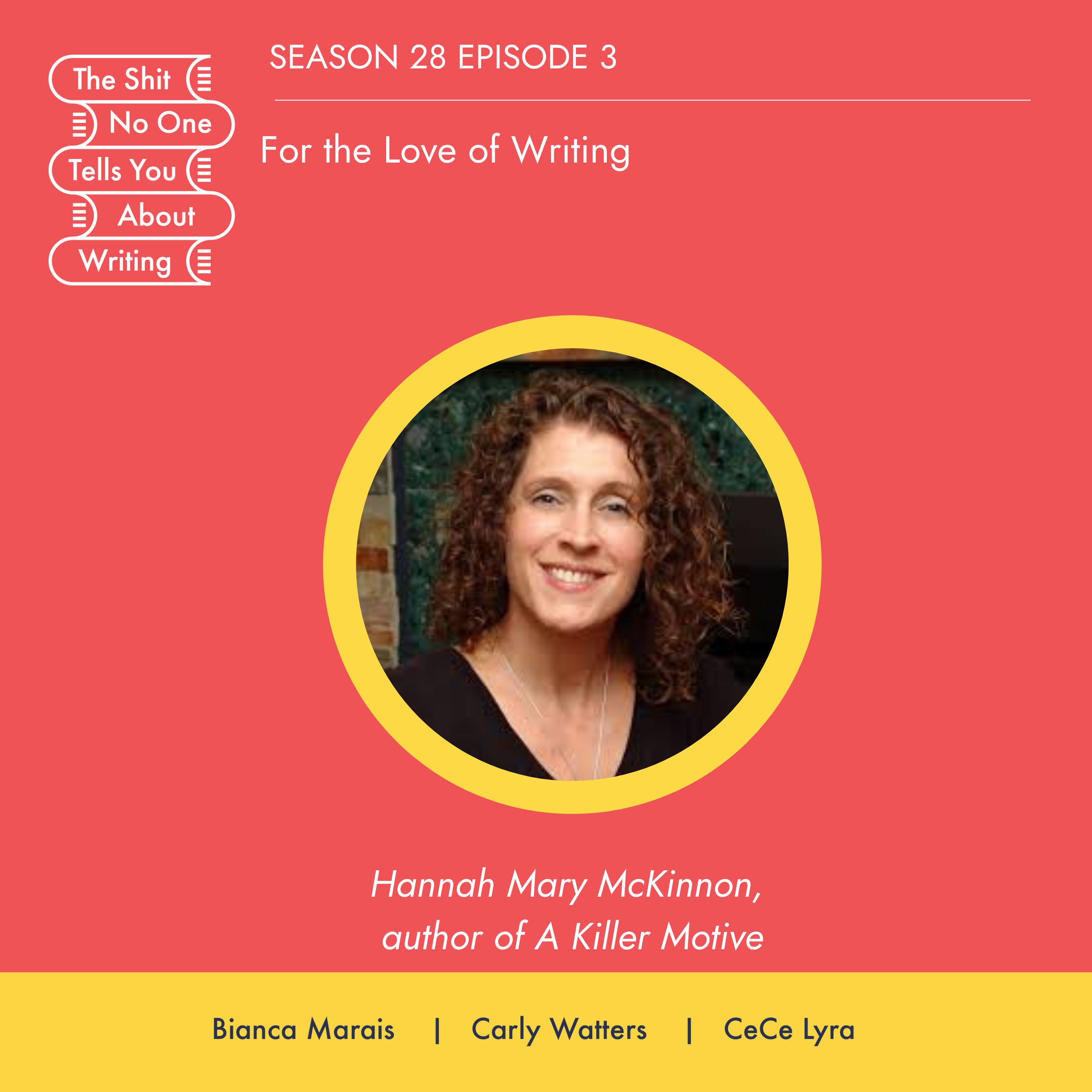
Literary. Hi everyone, welcome back to one of our author interviews. Today's guest is one who is returning I think for the third or fourth time because we love having her on the show so much. Hannah Mary McKinnon was born in the UK, grew up in Switzerland and now lives in Canada with her husband and three sons. Connect with her on social media at Hannah Mary McKinnon and visit Hannah Mary McKinnon.com Hannah, welcome back to the show.
- [04:03]
D
Thank you, thanks for having me again I to be here.
- [04:07]
C
It's always so lovely to chat with you. For those of you who are not watching on our YouTube channel, I'm holding up the COVID of the book A Killer Motive and I'm going to give you a quick read of the flap copy so that you have some context before we dive in. Right to Stella Dixon. Sneaking her teenage brother out of their parents house for a beach party was harmless fun until Max disappeared without a trace. Six years later, Stella's family is still broken and she can't let go of her gu. The only thing that keeps her going is helping other families find closure through A killer motive. Her True Crime podcast. In a bid to find new sponsors and keep making episodes, Stella goes on a local radio show. But when she says on air that if she had just one clue, she'd find Max and bring whoever hurt him to justice, someone takes it as a challenge. A mysterious invitation to play a game arrives with the promise that if Stella wins, she'll get information about what happened to Max. Stella thinks it's a sick joke until Max's best friend vanishes and she's given new instructions. Tell no one or people will die. Desperate and unable to trust anyone, Stella agrees. But beating a twisted, invisible enemy seems impossible when they make all the rules. So, Hannah, you and I have chatted a lot during our different interviews and in panels, et cetera, about your very detailed outlining process, how that takes a month, how you will put sort of vision boards and pictures of things, et cetera. So today, what I want to focus on is your characterization during your outlining process because you build these really real visceral characters, even your antagonist, which is so difficult to do. So you've said you have a 3 PA questionnaire in which you interview your main character. Sometimes it's protagonist, sometimes it's protagonist and antagonist. Can you take us through that process?
- [06:13]
D
Sure, sure. Yes, I'd love to. And thank you for the lovely compliment about my characters. I work very hard to make them seem real to me and I hope that translates into the reader's experience as well. So the three page interview or questionnaire, if you like, it's got the basic things and what do they look like, you know, how tall are they, that kind of thing. But then it's way more detailed. So there' questions where the answers to those questions don't actually feed into the book, but they make the character real, which is the whole point of this questionnaire. So some of those questions would be, for example, do they believe in ghosts? I don't write paranormal stuff, I don't write ghost stories. So one might think, well, what on earth does that have to do with anything? Well, it informs me about the kind of character that they are. Do they believe in ghosts? Have they ever seen one? And in what circumstances? Have they ever seen a dead body before? And again, what circumstances? What was their relationship like with their parents? Do they have a mentor? Do they still listen to them? Are they still around? Or have they. Maybe they've lost them and that's a big. A big hole in their lives. One of the questions that I really like is towards the end, there's Also stuff about money. You know, if they inherited 100 grand, what would they do with it? So, you know, is it. Is it someone who's a. Who's going to jet off to Vegas, or is it somebody who's going to invest, you know, conservatively? What informs me, again, about the character? But these two questions, a couple of questions at the end that I find really interesting is, where are they at the beginning of the story and where are they at the end, both physically and emotionally? But then also, why am I interested as the writer in this character? And why should the reader be? So those four questions actually really inform me about the arc and the purpose of the character. And I do these questionnaires for the main characters, certainly for the antagonist, the protagonist, but also some of the side characters, not all of them, because can you imagine that'd be exhausting. But for the supporting cast, if you like, so that each time I bring them out onto the stage, so to speak, I remember little details about them. Or I might go back and read the questionnaire again and think, what's the point of this character? What more can I do with them? So I find it really helpful to do this questionnaire, but then also for the main character, the protagonist and the antagonist, or whoever has a point of view, really, and whoever's messing with them, potentially to really build out their backstory bullet point, you know, what made them who they are when the story starts? Because at that point, I know them pretty well, and I feel I can start writing and discover them more as I write. But it gives me a really good starting point.
- [09:01]
A
Yeah.
- [09:01]
C
And do you find it's the same questionnaire you use with every book? So you open your binder and there is the Hannah questionnaire? Or do you find that the questions change from book to book and genre to genre because you write across different genres? Can you tell us a bit more about that and some advice for our listeners who are wanting to put together a questionnaire of their own?
- [09:23]
D
So I always use the same one. It has evolved a bit. I think it was something I found online and then something else I found online and kind of stitched together and then added in my own questions. Or when I've been on panels, you know, people. People say, oh, yeah, I interview my characters. I have this questionnaire, and I always ask them. I remember one that I didn't put in, and I can't remember who said it, and I really should. It's, what do they have in their fridge? I thought that was really cool. That's. You Know what? What do they have? Do they have anything? Or what do they. Do they have six bottles of rose? Or do they, you know, what is the block of cheese? Or was it really well stocked?
- [10:01]
C
Or.
- [10:02]
D
Because that, again, informs about the character. And I just remember that question. I'm going to add that one in. And as for advice, and there's plenty of stuff online, but if anybody wants to use mine, I'm happy to share. There's nothing proprietary about it.
- [10:14]
C
It sounds absolutely amazing. Hannah, is there any chance you would share this with our Substack subscribers?
- [10:20]
D
Of course. Absolutely, I would. No problem at all.
- [10:23]
C
Amazing. We love sharing these kinds of resources. So for those of you who get our Tuesday substacks, look out for this one. I can't wait to dive in and like what Hannah said, you can take that, but then you can build on it yourself. Because I love that part about the fridge because it's so true. Because it tells you whether this character plans. It tells you how structured their life is. Are they someone who's constantly on the run? Perhaps they're on call, emergencies. Perhaps they're someone who's more like a Carrie Bradshaw who uses their fridge for stor storage space then for cooking, etc. You know, or perhaps they're just someone who's got a complicated relationship with food. So such a simple question can really reveal so, so much.
- [11:06]
D
It really does. And I'd say the vast majority of this stuff that I imagine about the characters doesn't make it into the book, but it just makes them real as I'm writing them, and little things might filter in. And I find that really interesting, too. And what's really funny is I've noticed when I do these questionnaires at the beginning, when I outline and then I start writing, I might refer back and realize actually how much I, I guess subconsciously remember of the stuff I made up about them. And my. I might not look at it for a couple of months and go, oh, yeah, you know, I put in that they have whatever, siblings and, you know, this is their jobs or whatever. And. And I hadn't kind of maybe done it in a bit of a rush without overthinking it. That's the thing. When I do the questionnaire, I really, really don't overthink. I just make it up on the fly about who these people are. Except for the really deep questions there. I. I don't know what colors their sofa. I don't actually have that question, but that might be a good one. What color is their sofa?
- [12:08]
A
I Don't know.
- [12:08]
D
Just green. I don't know. You know, what color are their eyes? Blue. Okay, so I'll make the sofa green or vice versa. So it's not all the same.
- [12:16]
C
Right. But I love that even though you outline a lot and you stick to that, you've always said that you're not married to that outline. You are prepared to be flexible and you're prepared to change things. So are there times that you go back to the author questionnaire and perhaps say that somebody is very, you know, philosophical or spiritual or whatever, and then you decide, okay, no, they're not, and you change it? Or do you find yourself leaving some things blank and coming back to them later because you don't know the character well enough at that point?
- [12:45]
D
Typically? No, I don't. I don't typically leave anything blank. I normally fill it in, but you're right, I'm. I'm not married to it. You know, I might think that it's a good idea to give somebody I know a large family, but then it's complicated to write about them. Are they all dead? Because I don't want them all in the book. So I do change things as I go along. And sometimes, honestly, I forgot what I've written in the questionnaire. And it doesn't matter, because that particular thing, in that case didn't really serve a purpose. It's just I find it's a great way to get to know the characters. And it also helps procrastinate, honestly, before I start having to fill 300 blank pages.
- [13:30]
C
Yeah, geez, it is. I love how every writer's got their procrastination process. And for many writers, it's research. And they'll be like, no, no, I'm researching. And you'll be like, but you've been researching for eight years now. It might be time to actually start writing.
- [13:44]
D
Yes, exactly.
- [13:46]
C
Yeah. But I mean, it's the iceberg principle again. You know, the reader is going to see the tip of the iceberg on the page, but you as the writer need to know everything that's underneath because you need to know the threats that the reader doesn't see coming. They're just going to see the tip of the iceberg. But you know, the character's psyche, and you know that they're presenting to be really lovely, but you know that shit's about to happen and why shit's about to happen. So a lot of the time that stuff is so important.
- [14:13]
D
That's such a great point, because it's not just the protagonist that you need to know really well or the point of view, characters that you really need to know. Well, you need to know in crime, certainly.
- [14:24]
C
What?
- [14:25]
D
Well, also in romance, actually, come to think of it, if you have the antagonist or the love interest, if you like. Let's stick with crime for a minute. You need to know the antagonist just as well the author does, but your protagonist can't. And that's where I find it. So it can be so tricky because I know the protagonist. I know what's going on in their lives. Let's take Stella. I know who the antagonist is. She doesn't. I know their motivations. She doesn't. And I can't reveal both of them. So I have been known. I just did this recently, actually, to just get a notepad and write the antagonist story completely separately. And what they're doing, how they're messing with the protagonist and what the protagonist's reaction will be. And that's the part that you'll see in the book. You won't see necessarily the antagonist actually doing anything, but you'll see the reaction of the protagonist. So you have to know them well. You have to build that for me. Anyway. I say you. I mean, me as the author, I need to know what the protagonist is all about and why they're doing the things that they're doing, because otherwise I don't understand them. And that for me is fundamental. I need to understand my characters. I always say I don't need people to like them necessarily. I mean, the antagonist, you might not anyway. But some. Some do. But I need to. I want my readers to understand why they are the way they are and why they're doing what they're doing, even if it's just at the end where they get that they understand who the. The antagonist is.
- [15:57]
C
Yeah. And. And the antagonist is never the antagonist in their own minds. They're always the hero of their own story. They're always the protagonist of their own story. And so it's so difficult to write that as well because you're already trying to withhold the identity of that character.
- [16:12]
D
Yes.
- [16:13]
C
So that the reader is actively trying to figure out who it is while the main character is trying to figure out who it is. But it's still needs to be authentic. And it's a juggling act. And it was done really, really well in this book. So for those of you who are trying something like this, definitely take a look at how Hannah's done it, because, you know, there's so many chapters that are from the antagonist perspective. And we trying to find clues and figure out who they are, but she gives us enough so that we don't feel like we're being yanked around the whole time and manipulated, which is so important.
- [16:44]
D
Well, thank you.
- [16:46]
C
Yeah. You said that your agent suggested you change Stella's occupation. Yes. So interesting to me because it. Her occupation felt so essential to the story and who she is. Because an occupation, again, is not just a. Oh, so and so is a hairdresser or whatever, you know, so and so's a hairdresser because they like X, Y, and Z and this informs who they are. So it was so clear to me why Stella was, you know, a podcast host. And then that was something that came later. Can you tell us a bit about that? Yes.
- [17:20]
D
So originally, originally, Stella was going to have a company that provided fictional cold case murder boxes. So a game, basically. And I remember floating this idea to my agent, to Carolyn, and she said, a game in a what now? I said, well, it's a subscription box, you know, and then every so often you get clues or you could get the whole thing at the same time. It's a bit like clue. And she said, well, okay, but, you know, it feels a bit convoluted to it just. Just to describe, to. To convey this. Could she not just be a podcaster? And I thought, oh, yeah, that makes way more sense. Let's do that. So it was a really quick switch from early on. So I hadn't outlined anything at this point. It was just bouncing the idea around what I, you know, one paragraph idea. So I'm really glad that she suggested that and I hadn't already written goodness knows how much because I would have had to have, you know, undone that thread, and it would have gone all through the book. So I'm very happy that she's so smart and so brilliant. And she said, no, boo. Don't do the subscription box. That's silly. Just make her a podcast host. So I went off and researched that for a bit.
- [18:45]
C
Yeah, I absolutely love that. Let's just have a word from our sponsor, and then I want to come back to that.
- [18:52]
A
Hey, everybody, guess who's back from France? I was thinking of you guys listening to me talk about getting ready for the trip and practicing my French while I was doing my best order at the cafes. It went well. I was a bit nervous, but when we were in the countryside and I could take my time thinking about what I wanted to say, I was able to say it. Being a bilingual family is high on my list of things that are super important to me as a parent and a mom. If we're going to show them the world, we also need to appreciate and respect the language and culture by learning it. Imagine how much richer your travel experience could be if you could speak the local languages. When you travel with Rosetta Stone, you'll gain the confidence to have real conversations and create deeper connections wherever you go. Rosetta Stone is the trusted leader in language learning for over 30 years. Their immersive, intuitive method helps you naturally absorb and retain your new language on desktop or mobile whenever and wherever it fits your summer schedule. With 30 years of experience, millions of users and 25 languages to choose from, including Spanish, French, German, Japanese and more, Rosetta Stone is the go to tool for real language growth. You can learn faster and retain longer. There's no English translations, you truly learn to speak, listen and think in your chosen language. There's an intuitive learning process. You start with words, build the phrases and progress to full sentences. It's designed for long term retention so it sticks with you. You can work on your accent with the built in True Accent speech recognition technology so help you sound more natural. You can learn anytime, anywhere. It fits with your lifestyle with the flexible on the go learning style desktop or mobile app and there's incredible value. A lifetime membership gives you access to all 25 langu so you can learn as many as you want whenever you want. Don't wait. Unlock your language learning potential. Now the shit about writing listeners can grab Rosetta Stone's lifetime membership for 50% off. That's unlimited access to 25 language courses for life. Visit Rosetta Stone slash Visit Rosetta Stone.com today to get started and claim your 50% off today. Don't miss out. Go to Rosetta Stone.com today and start learning today. The holidays sneak up fast, but it's not too early to get your shopping done and actually have fun with it. Uncommon Goods makes holiday shopping stress free and joyful with thousands of one of a kind gifts that you can't find anywhere else. Uncommon Goods looks for products that are high quality, unique and often handmade or made in the us. Many are crafted by independent artists and small businesses and because they're made in small batches, best finds can sell out fast. I was on the site getting some ideas for my boys Christmas gifts and I spotted this bedside caddy for their books. Made of repurposed quilts which was stunning and so practical. It tucks in between the bed frame and the mattress has tons of pockets for notebooks and books and pencils and water bottles. All of us can go to any other old website and get something that was made quick and cheap, but a unique quilted item that is personality and is one of a kind because they're made of random fabric. That's on my list. My older son just learned how to fully read on his own. I know I'm obsessed with this and he needs a place to tuck his books when he's done for the night. Uncommon Goods has something for everyone. From moms and dads and kids and teens to book lovers, history buffs and die hard football fans, to foodies, mixologists, avid gardeners. You'll find thousands of new gift ideas you won't find anywhere else. When you shop at Uncommon Goods, you're supporting artists and small independent businesses. And many of these products are made in small batches. And with every purchase you make at Uncommon Goods, they give back $1 to a non profit partner of your choice. They've donated more than $3 million to date. So shop early, have fun, and cross some names off your list today. To get 15% off your next gift, go to uncommongoods.com tsntyaw that's uncommongoods.com t s n o t y a w for 15% off. Don't miss out on this limited time offer. Uncommon Goods. We're all out of the ordinary.
- [22:25]
C
Okay. So, yeah, Cece and I work in very much the same way. But the thing is, I don't outline and send her the outline because I can't outline. So I will write three or four chapters and then I'll send it to her and she'll also be like, why did we have to make this so complicated? Or, you know, or why is this so simplified? This needs to be a bit more complicated. And then you go back. But that's the wonderful part about managing to collaborate with an agent. Because sometimes we become so overly fixated.
- [22:57]
D
Yes.
- [22:57]
C
That we feel like, well, it has to be a subscription box.
- [23:01]
D
It has to be exactly.
- [23:02]
C
Someone's like. But it doesn't have to be exactly.
- [23:05]
D
Exactly. I found that. So it's just so eye opening. And the collaborative process, it's wonderful because Carolyn will see things or suggest things that I would never have thought of. I find that brilliant. And with my editor too, when the changes that were made. And I can't go into them because I'm gonna spoil a couple of things if I do that I simply hadn't thought of. And it was the same with only one survives. When I sent in the outline and we chatted about It, I mean, she really was instrumental in shaping that, that outline in that, that book. It was. It's just, you know, two brains are better than one. And I love that part. I think that's so I've really come to understand, as I was outlining the next book, that I really, really love the outlining stage, which is funny because you say you can't outline. It scares the bejesus out of me to just start writing because I just meander around way too much because the outlining when I outline, it's short and it's, anything's possible. Like, anything can happen. Just whatever pops in my head, oh, yeah, that's good. Or, oh, no, I can't do that. But I love that process. I find it so. It's so creative, it's so much fun.
- [24:21]
C
But for our listeners who are going, yeah, but you guys have got agents. We don't have agents. This is why I keep saying why you need beta readers and writing friends.
- [24:29]
D
Yes.
- [24:29]
C
Because again, it's just someone external who's not in your head, who's not 100% committed to something and who can just be more objective. So you don't need an agent to do this, but if you are looking for an agent and it's important for you to have an agent who you can collaborate with and work with editorially, remember to make sure that that's a discussion you have with them down the line. Now, something I want to ask. You've had what, 11 books now? Yes, Hannah. And what has been the most challenging aspect of the writing process for you? And has that changed across the 11 novels or has it stayed sort of the same each time?
- [25:11]
D
Oh, it's definitely changed. I mean, at the beginning it was, can I do this? You know, I've written a book, I've workshopped it, I've been to writing group. You know, how on earth do I do this again? That seems to have gone. I can't say it's gone away completely. The self doubt is always there, but it's just in a different form. It's, can I pull this story off? Can I write about a band? I know nothing about the music industry. That feels like a fun idea, but can I do this? So it's not, can I write the book? It's can I write this book? Can I write this particular story? So that has changed. I think at the beginning I went into this career pretty blind because I didn't know what it all involved. And it has changed and it has morphed. And with the rise of social media, which there already was of course, when my first book came out, but it wasn't as prevalent. TikTok wasn't a thing, Bookstagram wasn't. It was around, but it wasn't so prevalent. So there's a lot of things that I didn't realize that I would be doing. I didn't realize that I would be designing graphics. And honestly, art was not my favorite subject. Just like singing, no thank you very much really wasn't my strength, strong suit. So I had to dig into Canva and learn about that. And then of course on social media, the algorithms change all the time and nobody knows what the heck's going on. So that's a challenge. Honestly, the biggest challenge for me, coming from a high flying corporate background, is honestly the lack of control over my career. So in the past, in my former career, the harder I worked, the more I put into it, the bigger the rewards. Whether it was promotions, whether it was in terms of salary, My corporate career was always on an upward trajectory and I loved that and I wanted to feel successful. I needed that recognition. When it comes to publishing, specifically releasing books, that is completely out of my control for the very most part. I mean, it's not, it's not another Instagram post or a Facebook post that's going to blow something up, to be honest. I mean from me. I mean from me. And that is difficult because one book doesn't necessarily do better than the next and better than the one before. It's not necessary on an upper trajectory. It's more of this and you never know. I think now my books are better than they were at the beginning. Personally, I think I've evolved as a writer. I've been doing this for 10 years. I think the voices are better, the structure is better, I take more risks, I think. But you just never know what's going to hit. And I find that, I find that a control freak. This is going to come across as, but that the not knowing and not really being able to influence that in any particular way other than, well, write the best book you can, I suppose, is, is actually pretty hard. How do you see that?
- [28:29]
C
Yeah, I agree with you 100%. You know, everything in my life up until now has been the amount of effort I've put in equals, you know, what I get out of it. And writing. Certainly there's that, that level of satisfaction, personal satisfaction. Definitely there's that. And you know what's frustrating? And I think I want to discuss this especially because there will be debut authors who come out who don't necessarily have a network. They don't have a lot of writer friends or people who can help them blurb or who can help promote them. They don't necessarily have good literary citizenship because they haven't built that up. Whereas you, for example, do all your work with Hank Philippe Ryan.
- [29:11]
D
Yes.
- [29:12]
C
First chapter, fun. You've got a lot of writer friends. I've got the podcast. I have a lot of writer friends. You and I both are, I believe, very good literary citizens.
- [29:23]
D
I hope so.
- [29:25]
A
Yeah.
- [29:25]
C
We love for other people. We have whenever we can, we write the best books we can. We're not novices when it comes to promoting our work. Like you say, we do the canva, we do all the promotions, we get everyone to help with COVID reveals. And it's still really so up in the air as to whether the book lands or whether it doesn't, which is sometimes terrifying.
- [29:47]
D
It is. And sometimes it's all about timing, you know, I don't know. And we can't know this because we can't run the test. But, for example, one of my books in the past, if I released it two years from now, how would it perform? Would it be worse? Would it be better? Would it be. It's just the timing. What is the zeitgeist, I suppose, of the moment and the subject. And. And sometimes we know this. You know, we hand in a book a year before, at least before it publishes. We don't know what's going to happen a year from now. And we could write a book where the subject matter just fits with whatever's going on in the world and kablooey, it blows up. Or conversely, it could be the worst possible timing in the world. I tell you what hasn't changed. What hasn't changed over the past decade is how much I love writing. That is my happy space. I love going into my books. I always get the first skeleton draft out of the way as quickly as I possibly can because I hate that bit. Hate is a strong word. It's. It's my least favorite bit. And then go and edit so that I just. I love that part. I love it. I love seeing the COVID I love. I love all of that. But I get very, very nervous. It's on public. So this year, for the first time, I said to my husband, I don't want to be at home for pub day. Can you take the day off and we'll just go out? And we went to Toronto Islands, which I'd never done. Been here 15 years, can you believe, And I'd never been. We'd never been. I know.
- [31:21]
C
Ridiculous.
- [31:22]
D
Ridiculous. And off we went. I had a lovely day and then I went to get a cake and they asked me if I wanted anything written on it. I said yes, please write. Happy pub day, Hannah.
- [31:34]
C
I love that.
- [31:36]
D
It was great because the pressure was. The pressure was off because this, once the book is out, you know, it's out of our hands. You just have to see the tips fall wherever they fall and. And you work on the next one because always be writing. Right? Always be writing.
- [31:51]
C
Yeah. But it comes back time again to the love of writing and the reason why we. We ever picked up the pen in the first place. It's the reason why we escape to the worlds that we do. And there is so much that we don't have control over, and so much in publishing is changing, and you lose editors and you lose imprints, and, you know, from one week to the next, you're not quite sure what's happening. But what you do know is that this is the place that is your sanctuary. It's the place you've come to, to play, to engage, to escape. And for our readers, I just never want you to lose sight of that because the industry is filled with rejection. Even at Hannah and my stage of our careers. So much rejection, a lot of disappointment. But the writing is what makes you happy. And never, never, never lose the love of the writing.
- [32:45]
D
Yes, I completely. I completely agree. I think we can get lost in, you know, the numbers and, and the pressure of doing all of this promotion and, oh, I've got to go onto Canva. I've got to go onto social media. I've got to do this. And sometimes I like just taking a step back and saying, you know what? I need to get back to feeling good about what I'm doing, and that is being creative. And that's really, for me, what it's all about. And I hope readers love the books that I write and will find joy in them, and that's what makes me happy.
- [33:21]
C
Amazing. Thank you so much for joining us. Once again, I'm holding up the COVID of the book for those of you who are not watching on YouTube, a killer motive. We linking to it on our bookshop.org affiliate page. If you get the book there, you support an independent bookstore and the podcast at the same time. And please follow Hannah on socials. She is such an excellent literary citizen, so please follow her and share about her book news and engage with her there as well. We look forward to having you back, Hannah.
- [33:50]
D
I'D love to come back. Thank you. Thanks for today. It was wonderful. Thank you.
- [33:55]
B
And that's it for today's episode.
- [33:57]
C
I hope you'll join us for next week's show. In the meantime, keep at it.
- [34:01]
B
Remember, it just takes one yes.
- [34:08]
C
Have.
- [34:08]
B
You been sitting on the fence about signing up for the Beta Reader matchup?
- [34:12]
C
Or have you signed up before but.
- [34:14]
B
Haven'T as yet yet found your writing soulmates? The next matchup is the last one of the year, so don't snooze on it. Get matched up with those writing in a similar genre and or time zone so they can critique your work as you critique theirs. Your manuscript doesn't have to be complete to sign up for the 3,000 word evaluation. This particular matchup will be open to registrations from now until 2nd November, with the match up emails going out on 3rd November. For more information and to register, go to Biancamarae.com and look for the Beta Reader Matchup tab. Please spread the word even if you aren't signing up this time. The more writers we have registered, the better the matches will be, which means you'll be paying it forward to your fellow authors.