Loading summary
Transcript163 lines
- [00:00]
A
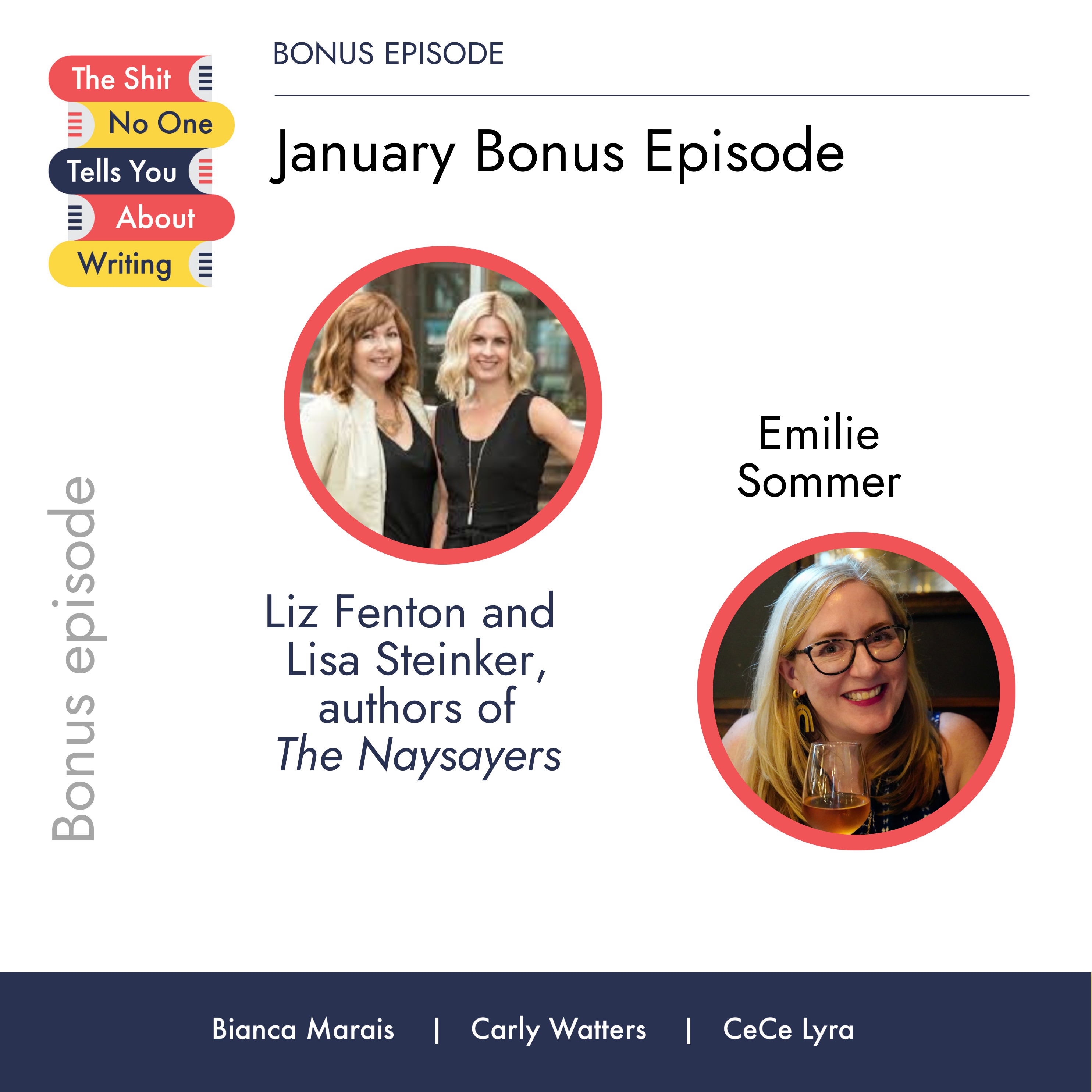
Hi there. We've got a lot we're really excited to tell you about, but I'm going to make this real quick so you can get to the episode. The Deep Dive is coming up at the end of January. The lineup of speakers is incredible and the range of topics is mind blowing. You do not want to miss out on the last Deep dive ever. Then the beta reader matchup is open once again with the matchups going out early in February. Sign up to kick your creative year off with a bang. Lastly, there's an amazing writer's workbook available which will make the perfect gift for you or the writer in your life. Head to our website the Shit About Writing to find out more. Hi there and welcome to our show the Shit no One Tells you About Writing. I'm best selling author Bianca Murray and I'm joined by Cece Lehrer of Wendy Sherman Associates and Carly Waters of PS Literal. Hi everyone. Today's guests have been best friends for over 35 years and survived high school and college together. They've co authored nine novels including the Good Widow, which is an Amazon Charts bestseller, and Forever hold you'd Peace, which is optioned for film. They both reside with their families and several rescue dogs in San Diego, California. It's my pleasure to welcome Liz Fenton and Lisa Steinker. Liz and Lisa, welcome back to the show.
- [01:29]
B
Hi Bianca.
- [01:30]
C
Hi. Thank you for having us.
- [01:33]
A
Thank you so much for joining me. We record these quite far out, so it's kind of late in December and most people have gone off on vacation and YouTube are kind enough to join me now for it. So thank you so much for that. So for our listeners who are not watching on our YouTube channel, I am holding the book Cover Up. The book we're discussing today is the Naysayers. Love the COVID Really. Really. It's simple, but it's really eye catching. Really. It's going to stand out on a shelf and I'm just going to read the flat copy so that you have some context and then we're going to go into it. What if your inner critic is real with their own agenda? At Naysay Inc. Rising star Megan's job is to whisper negative thoughts straight into the minds of clients. In the real world, it's all in a day's dirty work. In Naysay land, the parallel reality where your negativity is manufactured and self doubt is a commodity. But when she's assigned to sabotage a romance between lifestyle influencer Lily and author Jasper, Megan's carefully constructed reality begins to unravel. The project teams her with Ben, the smug but cute whisperer, in the next cubicle. As they work to tear down Lily and Jasper's situationship, Megan and Ben are catching feelings for each other and it's making them lose their negative edge. As the empathy grows and they start rooting for the relationship they're tasked with destroying, the dreaded HR is sniffing around. Now they're facing a choice. Keep crushing dreams for a paycheck or risk everything for their own fairy tale. Who knew professional pessimists could be such hopeless romantics? So, such a lovely premise. Before we go into it, though, Liz and Lisa, I love you both because you are both just so transparent about the struggles in the publishing industry, of which there are many and most times I will be going through a really rough time and I just kind of suck it up. I don't know why I should be more vocal, because I do run a podcast called the Shit no One Tells you About Writing. And this is part of it. But every time I see you two discuss the trials and tribulations of publishing, it just helps demystify so much of it. Because so many authors believe once they have the agent, once they publish their debut, they have arrived and they have it made. And they don't know that even after you've arrived, there is a bouncer in publishing who will keep kicking you out of the party and you have to keep, like, finding your way back in. So can we speak a bit about that?
- [04:01]
C
Yeah, I know. It's very well said. The bounce from the party. I love that.
- [04:05]
B
Yeah, I mean, I, I, I. One thing I always say to people is your past success in publishing does not ensure your future success, or I think in other careers, if you have past success, it does give you a professional equity that you, that lasts much longer, I think, in publishing, man. And it's so subjective. So it's just like the time and timing we talk so much about, like, the timing of things. Like, you know, I can't tell you how many times we've had a project or a book even that came out that maybe didn't do well or a project that didn't sell. And then like a year and a half later, almost that exact same premise will sell or come out and kill it. And I, I think it's timing.
- [04:52]
C
Yeah, timing is a huge part of it. It's just you have to wrap your head around all of that because, like you said it, just because you get your agent and your publishing deal and it doesn't mean that you're set for life I remember one point we looked at each other around the time of the Good Widow, and we actually said, oh, we've made it. We've made it. Now we said those words, or I said those words and you agreed with me.
- [05:20]
B
Named a drink after our book.
- [05:23]
C
It was a big party in New York, and the book did really well. And it just doesn't always mean the next book is going to do exactly what we did.
- [05:33]
D
We didn't.
- [05:33]
B
We were. This shit. We did around that time. We really did.
- [05:37]
C
And we'll be transparent about that, because why not? You know, And. And it was nice to feel that way. And I think that lasted like a. A year or maybe a little bit more. So it was nice to feel that way. But you do learn from that. And you do sort of. You don't want to be negative, to kind of bring it to what the book's about, but you also don't want to pretend it's not happening. So it's that really fine tightrope walk.
- [06:04]
A
I love that you said that there was a period that you felt like you were the shit, because publishing goes from you feel like you're the shit to you just feel shit.
- [06:12]
D
Right?
- [06:12]
B
Yeah.
- [06:14]
A
Yeah. It's like the high highs and then the low lows.
- [06:17]
B
I don't want to say smug because it's such a negative word, but I remember thinking, we worked hard. We've done this, and the book did really well, and, you know, they made.
- [06:28]
C
A big deal out of it, and it was our. Our fourth book, so we thought, okay, well, of course. Because it takes a minute. So we. We felt justified in being smug.
- [06:37]
B
I remember having an author friend of mine. I won't say who, but I remember talking to her. I think around the time Girls, we were working on Girls Night out, which was our next release, and I have a day job, and I was like, oh, you know, we're doing so well. I think I'm gonna. I think I'm gonna write full time. And she was like, listen, that is not guaranteed, and you should not do that. And I remember at the time thinking, okay, asshole. Like, you know, like.
- [07:05]
C
And you also. But you didn't listen.
- [07:08]
B
No, I didn't listen. And I actually think. I remember where I was sitting. Like, we were in a bar in la, and I remember thinking, man, she was the smartest person in the room.
- [07:21]
C
But that probably felt to you like, well, why can't I lean in, enjoy this moment? You know? Why can't I? You know, because it. Right.
- [07:29]
B
Because money.
- [07:30]
C
Because she knew more about publishing. She knew more about publishing than we did. We thought, oh, well, you just. Because I had worked in TV before and it's. And you have your day job, as you mentioned, and those both have, you know, tiers you can meet and then ways you can see you get a rating, you get this. And. And publishing, it just is so different. You just really can't ever.
- [07:50]
B
That's a nice way of saying it.
- [07:51]
A
Yeah. Yeah. I mean, we do this because we love it and because we can't imagine doing anything else. But, I mean, I read an article on career writers, how few there are today who can make a living entirely off of their writing. There are so few authors who are able to do that. The rest have to teach, they have to podcast. The hustle culture is real with all of this. So can we speak a bit about as well, the people that surround you when it comes to this? Because I've heard authors who've agents have dropped them if one of their books didn't do as well. And then suddenly it was like, sorry, you have to find somebody new. Or as you're trying to pivot and make yourself relevant, the agent's like, well, I don't want to represent that kind of work. So through all of this, have you had the same agent or agents, or how has that evolution looked for you as well?
- [08:45]
B
Well, we think of the agenting our author partnership almost like a marriage. Right. So, like, it can be two really good people, and maybe at the beginning of the marriage, things were great and, you know, they're having problems and it's just time to move on. So we're on, actually our third agent. We're with Stephanie Kip Roston. You know, our first agent, we were with for. For a long time, for eight years, and it just kind of had run its course. I think we needed a rebrand, and, you know, I think this agent just wasn't up for that. And I don't blame her. I mean, we had kind of after that success and then unsuccessful. We had kind of become a project, and I don't fault her for that at all. And then we moved on to someone else. And this person's also an amazing agent. Amazing person. It wasn't quite like what we needed. So we actually, you know, went back to someone, to Steph, who we had talked to in the second round, and we had gone a different direction, and. And we were kind of like, yeah, you know what? I think we should have come here. It's a better fit. So, yeah, so we're on our third agent. We love Steph. It's a good fit. But just like, you know, like, someone asked us, my husband and I are coming up on our 25 year wedding anniversary and someone the other day asked us for adv. And I honestly, I gave them this advice, but I think it's the same advice, like, you know, keep pivoting, keep changing. You're not going to be the same person in eight years that you are now. And sometimes you can't come back together, sometimes you can. And I think it's the same thing, like, as your career changes and you grow as a writer, you have different needs. Sometimes that agent can't.
- [10:18]
C
And we were changing, too.
- [10:20]
B
Yeah.
- [10:20]
C
And that's all very well said. And we were changing, too. We weren't writing the same books that we were originally writing when we got representation with our first agent. So then as we were kind of changing the books we were writing, I think that affects it too. You know, we like to bounce around. And I think I've heard you say this before too, Bianca. We like to bounce around. We're not always necessarily writing the same kind of book. We just want to write the book that matters to us in that moment or that we want to write in that moment. But that's not always the book your agent wants you to write. It's not always the book the public publishing world wants you to write. And so that plays in as well.
- [11:00]
B
Yeah, that's not great for your career.
- [11:01]
C
To do what you do.
- [11:03]
B
But I don't, I mean, listen, I don't want to write something I don't want to write right at this point in my career. And even if it, you know, in the naysayers, is a perfect example of something that we felt passionately about, it is a little bit of a left turn for us. But I didn't want to write anything else, and I don't think you did either. And, and so we wrote it for better or worse. But I'm kind of at the point in my career and I don't want to speak for you, but I don't. I only want to write books that if it doesn't sell, that I don't feel like I wasted my time writing it.
- [11:39]
C
Right. Yeah, that's very true.
- [11:42]
A
Yeah, I love that. And I mean, this is why I'm always saying passion projects, things that get you excited to put, you know, bum in chair. It's, that's never wasted because you have had fun writing it. You've learned writing it, you've been challenged writing it. And I'm the same as you guys. The fact that I can't stick in one lane, I think has actually negatively impacted my career because, you know, people are like, what the hell is this? Is it her historical fiction? Is it book club? Is it witches? Like, what the hell?
- [12:10]
B
I think it does. I think it does hurt.
- [12:12]
C
Does.
- [12:12]
B
I wouldn't go back and change it. I mean, you know, I had somewhat, you know, we're getting our Goodreads reviews right now on the naysayers, and there was like one or two people were like, well, it's not this book, you know, And I'm like, well, yeah, it's not. And I do think fans want you to read it.
- [12:29]
C
Yeah, there are readers that want to know what they're expecting from you. And that's okay. That's just a certain kind of reader. And then there are readers that will kind of move with us. And so you just.
- [12:43]
A
Yeah, because there's always like a golden thread between. Even when you change genres, there are things that people will care about. There are social issues that you will come back to. There are certain themes that you will explore, and the readers who pay attention will pick up on that. And sometimes you end up with readers who'll come back to your backlist based on a new book that they wouldn't have picked up if it was the same as your old book. But also, I'm becoming so disillusioned with Backlist because I really believe that backlist would be something that would be passive income generation scheme, you know, income generating. And now it's like my. My publisher, my first publisher has stopped printing my first two books. So it's like, okay, so I have these huge book launches, 400 people there, but they cannot purchase my backlist even though they want to, because the books aren't being printed. So I don't know how much of that you've been affected by or if your whole backlist is still available.
- [13:38]
B
Just the only one is I think your Perfect Life, which came out in like 2012. I think we were able to buy all the, like, the rest of the stock they had several years ago, but I think everything else should be in print. But, yeah, that sucks. And I agree. Yeah, it's not. It's just there's such a lack of. I think what you're speaking to, what we're all speaking to is. And I say this people all the time that don't understand publishing is like, we're the creators, but we actually have like the least amount of control. And it's kind of Fascinating, because the decision makers aren't creators. I mean, sometimes they are. Most of the time they're not. I think you see that in not just writing, but tv, like all those things. It's just the power dynamic is kind of off because the people making decisions aren't creators, and.
- [14:27]
A
They also don't communicate these things, which is the frustrating thing, because you would think you would get an email going, by the way, we are not printing your books anymore. Just so you know. And you'll be in an event and a bookseller will be like, I've been trying to get your books everywhere. And I spent two months speaking to, you know, Penguin Random House, and then we discovered that they're not printing it anymore. And you're like, oh, okay, I didn't know that.
- [14:48]
C
So that as well. Frustrating.
- [14:49]
B
Yeah.
- [14:49]
C
That you should have received.
- [14:51]
B
They let us, like, buy all of ours for like 10 cents. Remember we had all those cases of your perfect life. They let us buy them out.
- [14:58]
A
Did you end up selling them? What did. What happened to them?
- [15:01]
C
Did a huge giveaway, I think. I think.
- [15:04]
B
Yeah.
- [15:04]
C
I actually remember what you're talking.
- [15:07]
B
Her memory.
- [15:07]
C
I don't know. My memory always been better, but I remember wanting to buy the rights, get the rights back. Yeah, we couldn't do that because that's what I was going to say to you, Bianca. Maybe you can get your own rights on those. Sell them yourself if they doing it. But I guess I don't remember.
- [15:25]
A
Okay, so now let's dive into the naysayers. I want to know who came up with this idea, because I know that you guys work together, but I mean, somebody has to come up with the idea and then it'll start. Sparked the all the brainstorming and everything. How did this come about?
- [15:40]
B
Yeah, it's interesting story. We actually just talked about it. We have a new podcast called delete that later where we talk about this in more detail. But the Cliff notes basically is we had gone to a writers conference in San Diego, and I think any authors listening to this, like, you know, sometimes you go to writers conference, you get a really, like, crap panel at the worst time, you know, you're not in the book. Like, there was a lot of things going on that kind of mine effed us a little bit. And the way our dynamic works is sometimes if one of us is negative, the other person doesn't react really well to it.
- [16:16]
C
So in this case, I was the negative one. I tried not to call you out. Okay, but we should.
- [16:21]
A
Oh, one of us. I love it. How she says it's like the royal we, one of us.
- [16:25]
C
Yes, but it was me in this case. And I think generally it is more me to be more vocal, and I kind of narrate what's going on. I like to say it out loud and work through it. But then the person with you maybe doesn't want to say it out loud, and maybe they want to see the positive side of it or not get into it. Not, like, let those negative thoughts take over. And so I was just kind of in a funk because so many things happened, you know, that I couldn't kind of snap out of it. You know, I wanted it to be something that this conference to be something that it didn't turn out to be for me.
- [17:05]
B
Right. So we ended up kind of, like, bickering a little bit at the bar. It's just like, we felt dumb. So the next day, we had, like, a really long talk about. You know, we. As you mentioned, we've been friends since we were 14. Right? Like, so we've been friends, like, 38 years at this point. And so, you know, we're still figuring things out because of all these things that we do together. But really, it was a talk about how we interact, how we respond to situations. And long story short, I went to bed that night. Like, I left the conversation, and it was a great conversation, and I thought we were both really vulnerable there. And actually, I think we worked through a lot of things in that conversation that to this day benefits this friendship and business partnership. But I did go to bed that night thinking, where the fuck do her thoughts come from? Because there were some deeply, like, negative things in there. And I remember going to bed thinking, where does that originate? And I woke up, and this has never happened. I woke up with this idea and, like, wrote out the back cover almost exactly to what it is now. And I. And I waited, like, a week, and then I called her, and I was like, hey, I had this idea after our talk, and I. The name and everything, this book, it's called the Naysayers. It's about how our thought. And believe me, and I don't want to say this, I have negative thoughts, too. I have, like. I struggle with anxiety.
- [18:24]
C
Is it a different way of dealing with your thoughts? Like, you counter them internally and kind of turn them off. And I'm just more like, here they are. I'm going to tell everyone what they are. And a lot of people do not want that. They don't want you to put your negativity on them, especially if they're part of it because that might not be how they want to deal with it. So that. It was a really. We had a really. Once she said the idea for the book, I'm like, oh, this is great, and this is going to be really fun. And so we ironed out some more details of, like, you know, the characters and kind of how we could do it. And it was exciting, you know, to be able to take something that we deal with and kind of work through it. As we wrote the book, it helped me a lot to work through how I deal with a lot of my negative thoughts.
- [19:19]
B
Yeah. And I think for me, you know, I tend to be a pretty anxious person. I get in, like, a mental loop a lot about things. And I. And I think we really wanted to explore how do our negative thoughts reflect, like, the lens in which we see the world. Right. And our relationships with other people. And then there's. There's a couple other themes in there. It's. It's because it's about this place called Naysay Land. And then you've got this other place called the Island. So the Naysay Land is inherently very negative. The people that are negative, they make a business out of putting negative thoughts in our heads in what we call the real world. But if you aren't negative enough, they send you a place called the island, which is, like, toxic positivity central. And so another theme of the book that we talk about a lot is extremes. Like, we can't live in extremes, Right. You can't be overly negative, but you can't just pretend, put your head in the sand and pretend the world is positive. And so the book really, at the end of the day, is about, like, how do you learn to live in the in between?
- [20:19]
C
Right.
- [20:20]
B
How do you manage that? Because our world is so extreme right now, you see it in politics, and any opinions just like you're this or that. It's this or that is this. You know, there's no nuance with social media. All this stuff. Like, as a society, we have lost a lot of our critical and nuanced thinking. We are afraid to have conversations with.
- [20:38]
C
People if we don't pushing people farther apart, it's pushing them to the extremes of, like, the left and right politically.
- [20:45]
B
That.
- [20:45]
C
That idea of, like, well, I've got to cling to what I feel, but it's making us too extreme. So we got to, you know, it's a satirical book, so we got to poke fun at a lot of that. And, like, that was. That was freeing.
- [20:59]
B
The book's very funny. I know we're not making it sound.
- [21:01]
C
Funny, but it actually hilarious.
- [21:03]
A
It was really funny.
- [21:05]
C
It's actually all pretty much funny. We don't get super serious about anything because how can you, you'll get, you'll spiral. You can't.
- [21:13]
B
Well, and I think when you're talking about this stuff, you have to keep it. It is really a satire, unlike where our society is sitting right now. But there's also rom com elements and there's things, there's things to hold on to and then also just, you know, social media and how all of that like affects all of this. So, so that's how we came up with it is something deeply personal to us. And you know, I, I, we hope, I mean not worried but we think it might be one of those books that you either deeply resonate with or, or you won't get it. But I hope most people get it.
- [21:49]
C
There is something for everyone.
- [21:51]
A
I know and I love the genre blend. It was the funny parts but like you say, it was also, you know, sort of a rom comy element. It was delving into like social issues. So I thought it covered a lot of ground. The world building was excellent and that must have been so difficult. So as someone who's written two novels with fantasy elements, I've had to do world building. But there are some certain like commonalities, you know, you, okay, you have a magical world system, et cetera, et cetera. But the way people react to each other and what positivity is stays the same in those books. But here you had to go to the opposite extreme. I mean the interviewing scene where the, you know, where she's interviewing for this position but she can't, like in an interview, we're generally trying to put our best foot forward and we're trying to be optimistic and whatever, but that's not going to work for her because they don't want optimism. So like, how difficult was it calibrating all of that?
- [22:45]
C
I mean that scene was, that was actually one of the first, it's early in the book and it is one of the first ones we wrote because we do write in order and it was, we had to go back to it to be honest, once we got through the book because, you know, when as writers for us we just, we start and we go and we loosely outline but you know, we like to keep it really open and fluid. And so once we got to know that world better, the nuances of the world, the characters, we did go back and work on that more Just to make sure we were, you know, because it is difficult. You can't, you can't. In a negative company where you're known for being negative and what your job is going to be is being negative and putting skeptical, negative thoughts in the heads of the people in the real world. You can't come in there and be too optimistic. But she also didn't. You can't be optimistic at all, but you can't be also too negative. So she was walking this tightrope.
- [23:43]
B
We also did. We had turned in. Because I think this might be interesting to your listener. We had turned in a first draft, a pretty bloated first draft to our agent. We took about a year to write it. We had multiple narratives. We had like four narratives. We had all this stuff. And to her credit, I mean. And Steph used to be editor. Yeah. And this is another reason I think this book was a good fit to be with her is she came back and we did a full three month pretty serious edit. We got rid of almost all the narratives. Really now is mostly told from Megan's point of view. The main character. And she's like, we had to fix the world building. I mean, she almost wanted us to like completely change and put it in the real world. And we made a case for keeping it them separate. But we kind of said, okay, well we got. If we want to keep this, we have to earn it. Like, we have to do a better job.
- [24:33]
C
World building was not our thing. It was the really the first time we had done that. And so she was very helpful in, you know, giving us the guidance on to go. How to go back and really distinguish them. And yeah, we had to really deep.
- [24:51]
B
Dive in the training. You know, one of the ways that we did that is a, the interview. But also like, you know, she's a. Megan is a new employee that has to go through training. And we're like, okay, we're going to use this training to explain a lot of things to like, yeah, so we can explain the world. Like, because I, you know, when you're building, you know this. Bianca, when you're building a world, you can't just be like, well, the world is this and the world is this.
- [25:13]
C
Yeah. And then this happens.
- [25:15]
B
You have to create scenarios where it's, it's organically like. And so we were like, okay, let's have this training session where they're actually learning about the company and then we can kind of show the reader like how this world is set up, how this company is set up, what's important to them and why. But yeah, it was. It was hard.
- [25:35]
C
It was tricky. You also don't want to put too much of that too early, you know, and bog people down with, like, a history lesson. So we kind of threaded it throughout. And again, it was a good experience for us to learn how to do it. And hopefully we. Hopefully we did execute.
- [25:54]
A
Yeah, I think so. And I love what you said there about sort of disagreeing either with your agent or your editor, because, you know, a lot of the time, I think a lot of the time we're too close to the work. And so I generally will about 80% of what an editor or my agent says needs to be changed. I'm like, yeah, cool, it needs to be changed. But every now and again, there'll be something that I'm like, no, this is a non negotiable.
- [26:17]
B
Right.
- [26:18]
A
And sometimes I can't even verbalize why it's a non negotiable. So it's good to have that conversation and be like, no, it needs to be this way. I understand that I haven't pulled it off to earn its place there, but. But, like, let's figure out why it's not working, and then I'm gonna damn well make sure it does work. So it sounds like that was the process there.
- [26:37]
C
Yeah.
- [26:38]
B
We got on a call with her. We got on like an hour call with her, and Lisa had. Actually, this tells you about the dynamic of us. So I was pretty adamant that we just needed to fix the way it was set up. Lisa, this is how she works. She actually wrote up an argument for. For staying the same, and then an argument for. For going with Steph Snow and. And you.
- [27:02]
C
You. Yeah, I showed. I was kind of trying to see if we could actually do what Stephanie wanted us to do. And it turns out we could have, like, I went in and I was like, look, we can do this. And so that way, when we went into the call, we talked about it, but we went into the call and we were like, look, we want to do it this way, but we can do it this way. So let's explore. And then after talking it through, she's like, the way that you want to do it, I will support you, you know, if. If you're able to do X, Y and Z. But I did want to give her. Sure.
- [27:35]
B
Like a dissertation.
- [27:36]
C
I did. I. That's kind of how, like, I want. That's kind of how my mind works. And I do want to see. Because I wasn't sure. I actually wasn't as sure. As you. Because you dreamed the idea. I thought, well, maybe she's right. Maybe we could really take place all in the real world and then maybe travel there, but it will all be real world. And so I wanted to see if that could be.
- [27:59]
B
You know, it was really good because I was kind of like a, no, we're not doing that. And then she sent me her dissertation before the call, and I.
- [28:08]
C
And I actually.
- [28:09]
B
And it was better than you verbalize. I think if you had verbalized, you would have probably argued about it a little bit. But she sent it to me, and I had to read all of it. And I was like, oh, actually, you.
- [28:20]
C
Did say, like, actually, this could work.
- [28:22]
B
And I was like, God damn it. I guess I didn't want to do it.
- [28:26]
A
Yeah.
- [28:26]
B
I was honest. I was like, okay, we could do it.
- [28:28]
C
Yeah. Because it is really hard to rearrange your whole mindset. And we had to do that on a prior book. And I think we still have post traumatic stress disorder from that. So now when we write a book a certain way, we really would love to keep it that way. First of all, it's easier, you know, But I think because she was a new agent to us, it was our first book with her, and she is incredibly smart and talented as an editor. I thought, I really want to go in and see how this would look if we did it her quote, unquote, her way, and it would have worked. But then when we talked to her about it, she's like, you know what? I do like what you guys want to do. I think I do like that better now based on this conversation. So then we didn't have to do it.
- [29:13]
B
But it's.
- [29:15]
A
It's amazing, though, how the longer you work on something and you know it's fiction, it begins to feel like the truth. So that when somebody goes, can you change this? The fact that you can change it is more hindered by the fact that you like, but this is the way it is kind of thing. And sometimes you do need that external sort of view to make you completely unpack everything you think you know. And sometimes you need that challenge to make you double down and go, I know that this is the right way to do it. So it's balancing those two.
- [29:45]
C
Also, in fairness to Stephanie, she had said, if you want to send me pages. And we didn't want to. We wanted to write the whole thing first, just write it in our head.
- [29:55]
B
We didn't want anyone, like, telling us, executing we wanted.
- [29:58]
C
We were feeling really protective of the idea and Just not wanting anyone else in our head at that point. And she was really respectful of that. She's like. Because it was our. Again, our first. We had pitched her the idea when we signed with her, but she said, how do you guys want to work this out? I'll take chapters along the way. I'll take it all together. And we said, we really just want to write this thing and then give it to you. So we knew that was a risk, you know, so we were already prepared that she might have a big chance. It was a huge.
- [30:27]
B
And it was a huge rewrite.
- [30:29]
C
It was.
- [30:29]
B
She had amazing notes, and the book was a thousand times better.
- [30:32]
C
Right.
- [30:32]
B
I think the trick is, for anyone listening with those notes, is, as you do in some ways, need to do. What Lisa did was really place yourself. Okay. What is. In a fair way, what does it look like if I do it this way or if I make this change? And I think Lisa's better about that than me. I think sometimes I'm just like, no. And I think in that case. And maybe if I was writing by myself, it would be different because I know that it's important to do that. And I think I kind of know she's gonna do it.
- [31:07]
C
You do know I'm gonna do it.
- [31:08]
B
Yeah. So I don't worry about it. I'm like, oh, she's gonna send me how we could do that. I do think, as writers, like, like you said, Bianca, like, it doesn't mean you have to take the note.
- [31:16]
C
Right.
- [31:16]
B
But you owe it to yourself as a writer and to your editor and publisher agent to see it through first before rejecting it.
- [31:25]
C
Right.
- [31:26]
A
I love what you've said now about sort of knowing when you want feedback, and I think that might change from project to project. And sometimes you just need the idea to fully crystallize for yourself so that you know what the hell you're doing before you can defend it to somebody else. Like, I know I was. My latest book. I've been sending each chapter to cece as I go along, but I'm getting to the point now where it's becoming like a snake, a snake eating its tail. I'm like, I still don't really know what I'm saying, and I'm trying to defend this to you, and I'm still not quite sure. So I actually think I'm going to write, like, to the half point of the book, and then we can come back to having a look at it and. Whereas other things are like, feedback immediately was extremely helpful because I knew exactly what I wanted to achieve. So I think knowing when to seek feedback, whether it's from Beta readers or agents, et cetera, is so important.
- [32:24]
C
I think also the really important thing is just being open to it. I think if you're a writer and you're not, it's going to be a hindrance because the way we look at it is our. Our agent, she knows things we don't know. She has an expertise in an area we don't have. Our editors, same thing, you know, so we're typically going to defer to them, like, because you just. This is your. What you do. And so we want to respect you for that.
- [32:55]
B
But I think to your point, Bianca, like, I think you have. I think you can get over feedback. And I'm always sensitive to that. Like, hey, we want to keep this limited. And one of the reasons we did not. We wrote all the way through is like, you know, this world building. We really wanted to see it through. And then instead of saying, well, do.
- [33:17]
C
This okay in the world.
- [33:18]
B
This. Because it's such a. Like a world building. I think it's very, like, nuanced and personal. But I think in your case, yeah, every week that's a lot. Like, how can you even think, like, having this feedback? I think you need more like a train of thought to go on longer than that. Because I think if you're getting feedback in every chapter, this is my opinion. I don't know if you would agree this. I don't think you can really sit in the material when you have feedback constantly being given to you. With us, it's different. We have constant feedback. But we're both in the project, doing the project, right?
- [33:53]
C
Yes. Because I was thinking about us. We give each other feedback as we're going, but we're pretty much on the same page. So it's not.
- [34:01]
B
We're both in the project.
- [34:02]
C
And we're in the project, so it's not going to be. Actually, I think you should just say just not write that. It's never. Because we are on the same. So it's a little bit different. But when. And I think I heard another. You had another author team on talking about their process with this. But for us, it's. We've never actually had a fight about what we write. But if there is something that someone is just absolutely no on, then we will not do it. You know, if it's just a no. But we haven't come to that very much. But we just do reserve the right. Like if you've written it and you Want it to stay and you're that adamant? It can stay, then it can stay. Or if you've written it and it's a no, then it can be a no. If that. Does that make sense? Am I explaining that the person who.
- [34:50]
B
Wrote it has veto power?
- [34:51]
C
Yes.
- [34:51]
B
There you go. There's that.
- [34:53]
C
Thank you. See, I just let her edit. See how easy that was?
- [34:58]
A
Just get her to edit what you said. I love it. I love it. Well, I had so many more questions because this book is filled with like, it's like records and excerpts from conversations and the structure is just brilliant. So for our listeners, like if you're playing around with form and structure, if you playing around with world building satire, 100%, please, please, please get the naysayers. I'm holding up the COVID again. We're going to link to it on our bookshop.org affiliate page. If you get the book there, you support an independent bookstore and the podcast at the same time. Liz and Lisa, it was so lovely to chat to you again and yeah, I wish you just so much success with, with this book.
- [35:37]
C
Thank you. And can I just say one more thing really quickly because I listen to this podcast every single episode and as a published author, you help me so much like all of these episodes. So publish, not published. I just think you're podcast is excellent. You guys do a really great job. So I'm a huge fan and I wanted to just put that out there as well. So, so happy you had us on because I was like, you know, so lovely. You're doing great work out there.
- [36:09]
A
Thank you. Thank you so much. Hello everyone. It's bonus episode time, which means that it's time for our comps segment. Welcome back Emily Summer from East City Bookshop.
- [36:21]
D
Thank you for having me.
- [36:23]
A
My brain today is fried, people. So this is the day that I did four back to back interviews and I'm starting to feel it. So Emily's going to sound very eloquent and I'm going to be the one.
- [36:33]
D
But I don't know about that. I might be in exactly the same boat.
- [36:36]
A
But look, my T shirt says stay trashy and it's got a raccoon on it. So I'm, I'm channeling that energy.
- [36:42]
D
I love that. And I'm wearing my heated rivalry.
- [36:45]
A
Oh, stand up. Let's see it. Oh, yeah, there we go. Love it. You can see we're two nerds here. Okay, so we're going to kick you off with the queries. Here is the first request for your.
- [36:58]
D
Fantastic podcast and I hope you have comp ideas for me. My upmarket women's fiction manuscript follows a woman's journey to regain confidence after she leaves her domineering husband, taking their young daughters with her. Struggling financially, she and her children move in with the grandparents and she decides to become a surrogate mother. The intended audience is book club, those who've healed from trauma and anyone who has reclaimed their true self. The tone combines poignant relational and fertility ideas with single motherhood and relatable humor. None of what I've read has resonated. Example the Push is amazing but is thriller suspense and I'm awaiting the audiobook release of A Fine Layer of Dust. I thought of Loretta Rothschild's Finding Grace, but my story is more light hearted, no child death and is from the surrogate's perspective. I can't wait to hear your comp ideas.
- [37:50]
E
Thank you.
- [37:52]
D
Thank you for calling in. I think this sounds like a perfect fodder for a book club book and I appreciate what you've said about the tone and the audience. I agree that Push is definitely too much of a thriller. So I think you're right on the money that that is not the right tone. That's not what you're going for for There's a book called Family Law by Jen Phillips which investigates foster parenting and adoption and has some complicated family dynamics. There's no surrogacy in there, but I do think it hits upon some of the different ways we make a family and support a family and protect ourselves and open ourselves up to other people. I don't know if it sold enough to be a good comp, to be frank, but I do know that Jen Phillips is a very good writer. She wrote a book called Fierce Kingdom. Also not an appropriate comp for this, but it's a super, super read. So she's she is on my mind. So Family Law, take a look at it. At the very least, I think you would get a good read out of it. The book that you described sounds to me like a Jodi Picoult novel in that it is about, you know, someone figuring things out, rising to the occasion, being resilient and it has some very topical issues there with surrogacy. I think Jodi Picoult is the best at finding something really timely and topical and provocative and perhaps controversial and writing a really poignant, emotional book around it. I think that she's too big, but I'm just telling you where my how my thought process is working. But I'm so I'm thinking of other People who do something similar and write for the same audience but aren't as big. One is Heather Gudenkopf, so she might have a book that could work or the tone might work. I also thought about Jacqueline Machard, but I think she's too old probably. I don't know that she has a recent one that, that would work for recent books that don't have that sort of like timely, provocative surrogacy hook, but do write about complicated, well drawn families with great emotional depth. I thought about Bug Hollow by Michelle Hunnivan, which was one of my favorites of last year. It's incredible. Buckeye by Patrick Ryan, which probably veers on being too big at this point, but who knows, you know how that will last. Same as It Ever Was by Claire Lombardo and the books up by Ann Napolitano. All of those authors, I think even though they don't have the exact plot and maybe complete premise and hook that yours does, I think they have, they might hit the same notes for readers. So I would consider all of those any or all amazing.
- [40:28]
A
Most of them are my favorite authors and I just finished Buckeye and loved that as well.
- [40:32]
D
So I know it was so good, like such a slow burn. Lovely story. Loved it.
- [40:37]
A
Yeah. I hope I can get him on the podcast when he's recovered from all of his PR and and everything else. Here is our second request.
- [40:48]
D
Hi, I'm looking for comps for my dual POV historic fantasy novel. Here is the one second pitch. It's called 9 Waves 59 AD Isle of Man. When raiders attack Ashlyn's village and capture her older brother, she finds herself caught up in a conflict that reaches across England, Scotland and Ireland. Together, she and Liam, a captive from Ireland, must draw on their own faith and the deepest roots of their people to keep themselves and their culture alive. So it's got lots of action and adventure. Honestly, I feel like Outlander would be a really good comp because it's the right level of action and adventure. There is a romance in it and it's the right part of the world, but obviously that's way too big right now. I have Upon a Starlit Tide by Kel Woods, Wayward by Amelia Hart for the themes of like, female resilience and A Land so Wide by Erin A. Craig for the action adventure aspect of it. So let me know if you have any suggestions.
- [41:43]
C
Thank you so much.
- [41:46]
D
Okay, this sounds great. I think you're right on track. I said to Bianca before we started filming today it's going to be quick because Everybody knows what they're doing and everybody has great ideas. I think Wayward by Amelia Hart and A Land so Wide are terrific. I think they're not too big, I think they're not too old. I think they nail the feel and the vibes. I'm going to add one forthcoming book that I do think will work as a good comp, but also it's a great book that I want to put on everybody's radar and it's called the Lost Book of Lancelot by John Glenn and it is a Knights of King Arthur retelling. But you also can read it as just this wonderful medieval action adventure and romance. It's got everything. It's beautifully written. There are nights, there are battles, there is a beautiful romance. The setting is so vivid and rich. It's just fantastic. So putting that on every listener's radar and also suggesting that as a comp for nine waves. And Bianca, if you can get John on the podcast, he is wonderful. He has written a memoir. This is his first novel and he is the I don't know what his title is, but maybe the editorial director of Hanover at HarperCollins.
- [43:01]
A
Well, if you guys are listening, please reach out to me because often I reach out to publicists and I never hear back so I get ghosted as well. So if anybody is affiliated, please reach out. We'd love to interview him. Okay, here is our third request.
- [43:17]
E
I'm seeking comps for my YA action adventure Robin Hood retelling. Some comps that I thought of that are unfortunately too old to include are the Raven Boys by Maggie Stiefvater for its found family, woodsy adventures and mythical legend connection, and Sheerwood by Megan Spooner because it's also a Robin Hood retelling. I've also thought about Fable by Adrienne Young, but I'm not sure if that's too old or not. Depends on if the whole series counts towards whether it's recent or not. Fable is a good comp in that it has a leader who assumes the burden of saving everyone, a romance between leader and crew member, and a historical feel but made up world. Other tropes in my story include Touch him and Die, Fake Married, one bed, and there's lots of narrow escapes, torture and plots for revenge. Any comps you can think of would be appreciated. Thank you.
- [43:57]
D
Okay, so personally, I think as regards your question about Fable by Adrienne Young, I think that a series keeps a book current. If a series is still publishing or has published recently, to me that makes it current enough to be a useful comp. So I would say yes to that because you think it's such a good fit. But I am not an agent. We have agents here who know I am not one of them. So take that with a non agent grain of salt. The one I will suggest in addition to that is Travelers along the Way by Amina Mae Safi and I thought of that one. I don't know tonally if that works, but it is a recent young adult Robin Hood retelling, so that feels close enough that it would behoove you to at least take a look at it and see if it works. Or just as a just as a useful comparison.
- [44:48]
A
Thank you so much. Okay, number four.
- [44:51]
E
Hello and thank you so much. As Bianca says, let's dive right in. My fantasy novel is about an anxious half elf who joins a band of activist outcasts to destroy a stockpile of illicit drugs. But when she learns how deep the corruption in her city goes, she must learn to accept the monster within before the authorities catch her. There are messy family dynamics, themes of siblings and found family, female resilience, self acceptance, and living with your trauma instead of trying to ignore it. There are funny moments to balance the dark and even a little bit of romance so far found Burn for Me by Lona Andrews because it's squarely in the contemporary fantasy genre, but that's over 10 years old. Wayward by Amelia Hart for its female resilience and tone. Blood Over Brighthaven by Emma Wang for the political satire Sword Heart by T. King Fisher for my style of humor, but she's too famous and I thought also thought about the D and D movie Honor Among Thieves for its adventure, heart and humor. So any tips you have, I'd be super duper grateful. Thank you so much Andrea.
- [45:47]
D
I love it when the synchronicity happens and we have multiple different callers with different works in progress mentioning the same book for different reasons. So here we've got another mention of Wayward by Amelia Hart, which I think sounds great here as well. I also love the mention of Blood Over Bright Haven and the D and D movie. I think all of these are perfect. So I have nothing. Well, I have very little useful to add. What I will add is maybe take a look at Naomi Novik who might be too big, but she's great. I would take a look at her just because and Rachel Gillig and I mentioned those two because in the store I recommend those authors to readers who have already enjoyed Amelia Hart or ML Wang and if they're too big maybe look at who see who blurbs them and who they blurb. So that's just one more path to investigate. But I think, I think you've got it.
- [46:42]
A
So A plus amazing.
- [46:45]
D
Okay.
- [46:45]
A
Number five.
- [46:47]
D
Hi Bianca and Emily, thank you so much for everything you do for aspiring authors. You make this industry less opaque and I'm so grateful for all of your wisdom, Emily. I hope one day to be as well read as you. I'm searching for comps for my speculative contemporary romance about an anti romantic career woman who makes an unsettling discovery in her journal entries in her own handwriting dated two years from now that foretell the unraveling of her life as she knows it. I like to think of it as Jennifer Weiner's the Guy Not Taken meets Rebecca Searle's in five Years, but both of those are too old. I'm also considering Expiration Dates, which is a newer Rebecca Searle novel, and the Vanishing of Josephine Reynolds by Jennifer Moorman, but I'm not sure either really hits the mark. I'd love any thoughts you might have, including arcs you've read, because I don't plan to query until the fall. Thank you so much from Nikki Odin. Hi Nikki. Thank you so much for your kind words. Again, I think you're right on the money. I think Jennifer Weiner meets Rebecca Searle. Yes, like two big names and some in the specific books maybe too old, but that tells me sort of how the book is going to read and what its setup is going to be. Rebecca Searle, nobody writes the lightly speculative books the way that she does. I think readers she's done such a good job of every book is different. You don't feel like you're reading the same book over and over again. And yet she has such a distinct voice and such a distinctive style that you know exactly what you're going to get. Which I think is such a hard, that's so hard to achieve and she does it so well. So I would absolutely mention Rebecca Searle for sure. Either the most recent or just, you know, in the style of Rebecca Searle. I also, when I hear Jennifer Weiner, that tells me something too. Like that tells me sort of the voice and the style and the tone. I always mention Ashley Poston when somebody is writing speculative contemporary romance. So look at all of hers like Rebecca Searle. I feel like all of her books are different but they all have like just a, you know, a hint of she's doing the same. She's hitting the same beat in new and refreshing original ways. Every time. And then because you mentioned ARCs or forthcoming books, there was one, I thought of that. I just, I haven't read it yet, but I just read about it in my publisher catalog and as I was ordering for the summer for the store and it's a book called the Mashup by Laura Marie Myers. It seems very fun. It is also a contemporary speculative romance coming in July. I think this one is more like 13 going on 30 like Freaky Friday vibes. So maybe it might be, I don't know, too wacky or whimsical for you, but it seems really fun and has a very cute cover. That one is worth checking out, I think just, just as a good book to read, but also maybe a comp. And thank you again for your nice words.
- [49:37]
A
Perfect Number six.
- [49:40]
B
Hi, I'm seeking comp titles for my young adult fantasy set in a Canadian city similar to mine. Due to a magical toxin that triggers violence in teenagers, enchanted houses become their required guardians. 16 year old Lucas lives alone with sentient objects that feed, support and discipline him. While his bike is so protective it won't let him balance on his own. His friend is stuck with a house guardian that will throw knives when it's angry. Whistleblowers like Lucas's father have been driven into hiding because the company that creates enchanted houses has a damaging secret. It's a quirky story with some dark moments, but a lot of humor and a happy ending. The magic is comparable to Disney's Beauty and the Beast with that flavor of whimsy, but with a much stronger focus on coming of age, friendship and community. Thank you so much for all you do. I really appreciate it.
- [50:38]
D
Okay, this sounds so cozy and charming. I love the idea of like our objects in our house protecting us. That's not exactly what I read. You know, I read these gritty, dark, sad literary fiction books, but things are so times are so hard right now that like a cozy book about all my things in my house looking out for me, that is very appealing. So the cozy fantasy wrecks that I thought of are adults authors, but they have so much crossover appeal that I think they can work for YA as well. There's lots of crossover in that genre. TJ Klune is probably too big, but I would also look at Travis Baldry and Rebecca Thorne. All of those just feel right. Sometimes with these comps I'm just going on like, I don't know, gut instinct. So I would look at those. If you haven't already, you probably have, and see if any of those feel right. But to me, if I were reading a query letter that mentioned those, it feels like it would get me to the right place.
- [51:34]
A
Place perfect. And here is our last one.
- [51:38]
B
I would love help identifying comp titles for my speculative political thriller. It's called the Institute of Power and it's about a chief of staff who kind of infiltrates an institute that is tasked with investigating and studying and controlling a newly discovered element that may or may not be capable of magic and. And all of the sort of political and power wars that ensue from that allyships, loyalty and ambition. I have been thinking about some comps like Dark Matter by Blake Crouch, the Power by Naomi Alderman. Maybe a little bit of Project Hail Mary just in terms of the premise, but I would love your help identifying something newer that maybe I could compare it to from a sort of genre, cross genre perspective. Anyway, thank you so much. I love your show. Take care.
- [52:31]
D
Okay. You know, I always. Or maybe you don't. But if you don't know, now, you know. I always recommend Dark Matter by Blake Crouch because that is my number one favorite speculative thriller of all time. So thank you for mentioning it so I don't have to. Dark Matter, the Power Project, Hail Mary. I love all of those. They're all big, but they are all very good and it sounds like they hit the right notes. Two smaller authors, if you want to avoid the like, giant aspect, looming aspect of Blake Crouch and Naomi Alderman and Andy Weir. Project Hail Mary I think is only going to get bigger because the movie's about to come out. So two smaller authors that write the same type of books for the same audience that I recommend frequently. Rob Hart and Noah Hawley. So Rob Hart has several. But he does a really good job of writing about just ever so slightly futuristic things. Like you can see his book the Warehouse. You're like, oh, that reminds me of a giant company that's taking over the world. But he does very good, timely speculative thrillers. And Noah Hawley also has some that are just really on the pulse of what's happening. But I think that they. They appeal to the same readers and it's the same tone. So I would. But based on the ones that you mentioned, I would throw in Rob Hart and Noah Hawley and see what they have. That feels right.
- [53:50]
A
Thank you so much. I think we're getting fewer and fewer requests because you've taught everybody how to do it themselves, which is amazing.
- [53:57]
D
Also, I'm running out of things to recommend, so I'm glad that everybody is filling in the blanks. I can keep going with literary fiction and, you know, upmarket book club fiction all day long, but the sci fi and the fantasy is harder for me because that is not as much what I read. So. But I sell it, so I can still try my best.
- [54:16]
A
Well, maybe there's a bookseller out there who's listening and that's your jam. If it is your jam, reach out to us and we will give Emily some grace so that she doesn't have.
- [54:24]
D
To keep recommending more expertise. We want the people to hear from people who know what they're talking about in all genres.
- [54:31]
A
Yeah. So any booksellers out there, natural genre, please be in touch with us. Emily, as per usual, thank you so much for taking the time to do this. We really, really appreciate it. For those of you who want to get in your request for next month, make sure you get them in before the 10th of the month because we do record early. We will see you at the next bonus episode.
- [54:51]
D
Thanks, Bianca.
- [54:53]
A
And that's it for today's episode. I hope you'll join us for next week's show. In the meantime, keep at it. Remember, it just takes one. Yes, Hi there. We've got a lot we're really excited to tell you about, but I'm going to make this real quick so you can get to the episode. The Deep Dive is coming up at the end of January. The lineup of speakers is incredible and the range of topics is mind blowing. You do not want to miss out on the last Deep Dive ever. Then the beta reader matchup is open once again, with the matchups going out early in February. Sign up to kick your creative year off with a bang. Lastly, there's an amazing writer's workbook available which will make the perfect gift for you or the writer in your life. Head to our website the Shit About Writing to find out more.