← The Shit No One Tells You About Writing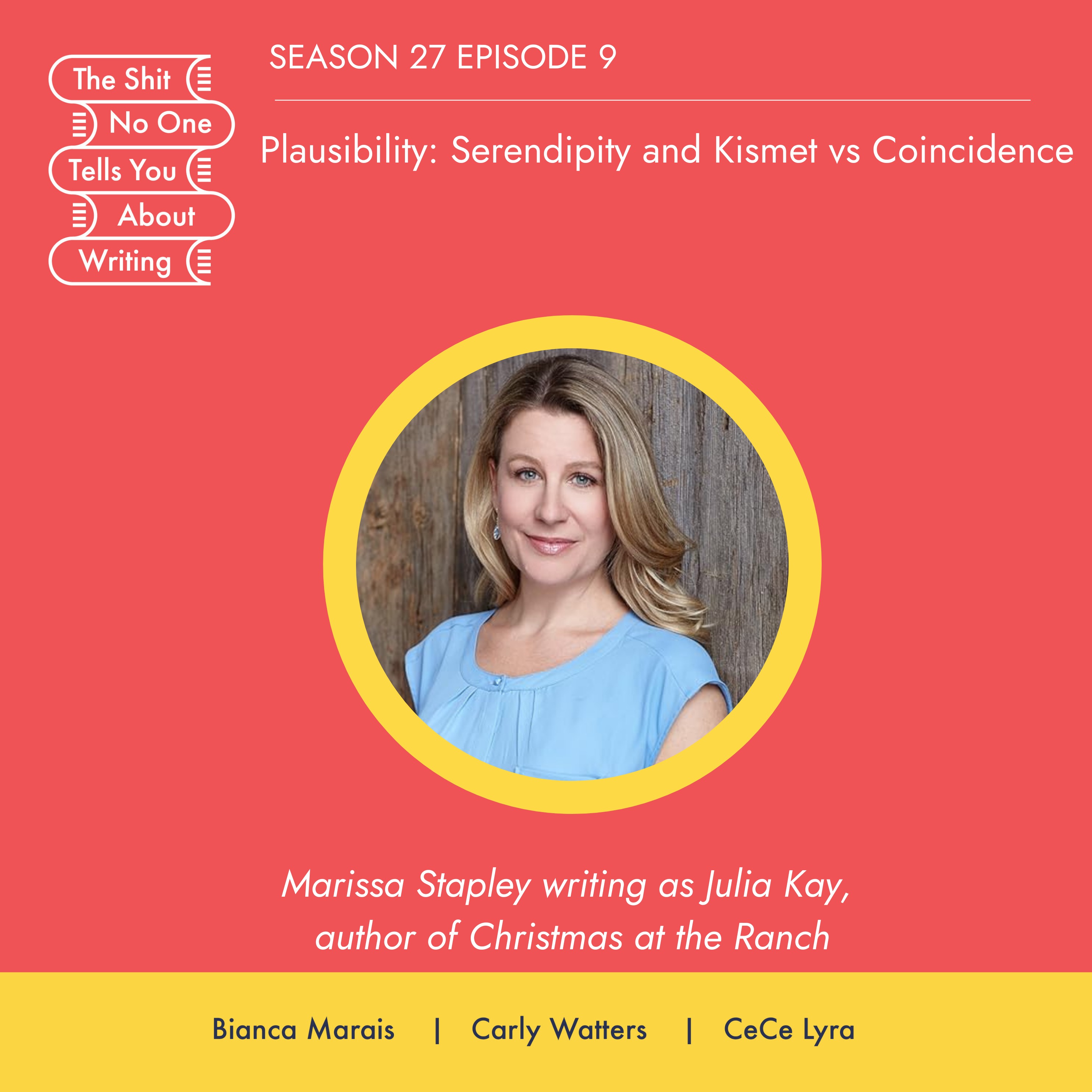
The Shit No One Tells You About Writing
Plausibility: Serendipity and Kismet vs. Coincidence
00:32:05
Author Interview with Marissa Stapley
Loading summary
Transcript59 lines
- [00:01]
A
What's up everyone? This is Cece. If you're a writer, then chances are you've wondered if your story is good enough. Maybe you're wondering that right now. I get it. Here's what I can tell you. As long as your story is making the reader curious, you're good. Now, I'm not saying you won't have to make edits when working with an agent or publisher, edits are part of the game. But I am saying that you will get ahead in your career if you know how to make the reader curious. The best way to do that? Infuse your story with plenty of tension, conflict and stakes. Which is why I'm so excited to invite you to join my four day course, Writing Tension Creating Tension, Conflict and Stakes in youn Story. It starts on October 13th. My favorite part about this class is that there are formulas. Yes, formulas for tension, for conflict, for stakes, and for the first time ever, we're having two optional interactive components including a query letter, studio and live critiques of select first pages. I'm super excited about this new format because I've seen it yield results in writers works and it works for writers of any genre as long as you're serious about improving your work. So if you're ready to take your writing to the next level, join me for this four day course. Don't worry if you can't attend live, the sessions will be recorded. For more information, check out my bio on Instagram or the podcast's website. I'm looking forward to seeing you there.
- [01:33]
B
Have you been sitting on the fence about signing up for the Beta Reader matchup? Or have you signed up before but haven't as yet found your writing Soulmates the next matchup is the last one of the year, so don't snooze on it. Get matched up with those writing in a similar genre and or time zone so they can critique your work as you critique theirs. Your manuscript doesn't have to be complete to sign up for this 3,000 word evaluation. This particular matchup will be open to registrations from now until the 2nd of November, with the matchup emails going out on the 3rd of November. For more information and to register, go to Biancamarae.com and look for the Beta Reader Matchup tab. Please spread the word even if you aren't signing up this time. The more writers we have registered, the better the matches will be, which means you'll be paying it forward to your fellow authors. Hi there and welcome to our show the Ship no one tells you about writing I'm best selling author Bianca Murray and I'm joined by Cece Lehrer of Wendy Sherman Associates and Carly Waters of P.S. literary. Hi everyone. Welcome back to another author interview. Today's guest is Julia McKay, which is the pen name of Marissa Stapley, a New York Times best selling author of numerous novels including the Reese's Book Club pick Lucky, soon to Be an Apple TV limited series starring Anya Taylor Joy. She has also co written several best selling holiday romances including the Holiday Swap and Three Holidays and a Wedding. She divides her time between city life in Toronto and lake life in Haliburton where she writes about love, second chances and the magic of the holidays. Welcome back to the show, Marissa. It's always so lovely having you.
- [03:30]
C
Thank you. I always love visiting.
- [03:33]
B
Yeah, yeah, we love having you back. So I get excited every time there's a new book. Right. So the book that we're discussing today is Christmas at the Ranch. For those of you watching on our YouTube channel, you will see the stunning cover. Just gives all the warm and cozy Christmas vibes. I'm going to read the flat copy so you have some context and then we're going to dive straight in. With the holidays around the corner and her father, recently imprisoned for financial fraud, disgraced journalist Emory Oakes doesn't know where to turn. She's only certain of one thing. She needs to get away. Fate takes the wheel, leaving her stranded in snowy Evergreen, the picturesque town where she spent her happiest Christmas as a teen. And chronicled every moment in her journal as she fell in love with handsome local Tate Wilder at his family's idyllic horse ranch. Until it all went wrong. Emery isn't ready to face Tate. But kismet and Christmas magic have other ideas. As the love they've denied for a decade rekindles, the betrayals that kept them apart resurface and Emory's family scandal reaches the small town. Even still, Tate Wilder and his ranch feel more like home than anywhere ever has. Will Emory and Tate's alchemy fizzle or will their Christmas wishes come true? Dun, dun, dun. A look at that kitty who always.
- [04:53]
C
Likes to be included.
- [04:54]
B
This is why those of you who listen to the podcast and don't always look at our YouTube are missing out because you miss out on author's pets and all sorts of other cool things. Things, Right? So, Marissa, you said in the dedication that this was dedicated to your daughter because this was her idea. Can you tell us a bit about that?
- [05:13]
C
So I'm sure that you know any family Member of an author will say, you know, dinner's out. Or either your author parent or, you know, spouse or sibling eavesdropping on tables, kind of looking for ideas. Not on purpose, but you can't help it. Or especially when I'm sort of brainstorming an idea I've kind of taken into floating things or brainstorming with my family and with the romances and rom coms, it can be so much fun. Like we've had extended family gatherings where we've sat around the table. My father in law actually came up with a really fun idea with an electrician main character I'd like to use someday. But Maya was like, you know, I just, I love the idea of, you know, the return to the small town and the Gilmore Girls vibe. And here's what this guy's entire personality should be. And it was just very captivating for me. And their kids are both so creative. So I loved seeing her little mind work. There have been so many changes to the idea. So now she's like, it's not my idea anymore. I'm like, but it is. You don't understand, like the, you know, the grain is there. And the book arrived yesterday, actually the finished copy. And she was so delighted. I have pictures of her looking at the little dedication and I think that it made her feel very special.
- [06:26]
B
So, yeah, I absolutely love that. And I see you named a character after your father.
- [06:32]
C
I did, yes. Bruce. Yes. Yeah.
- [06:35]
B
Did he ask for that or was that just a surprise?
- [06:38]
C
No, he didn't ask. He doesn't know. But yeah, I was writing A small town newspaper man and I thought, like, it just kind of put Bruce as a placeholder because I'll try to do that. I think you can probably, you know, understand this when you're writing. You just cannot get bogged down in figuring out the name of the small town newspaperman in the moment when you're trying to draft. So I just threw Bruce in there, which is my dad's name and he's a former small town newspaper man. And then it just really worked. So I left it. And that'll be a little Easter egg for him. I'm like Taylor Swift just dropping Easter eg eggs all through my romance novels.
- [07:09]
B
I love it. And Marissa, are you the horsey person or is your daughter the horsey person? Or did you have to do a lot of horsey research because, like, you really know what you're talking about.
- [07:19]
C
Yeah, that was very satisfying to know that I still do. So I and my daughter. So starting with me I started riding horses around, let's say 10 11. Just became absolutely horse crazy. Like it's just that sort of stereotypical, you know, horse crazy preteen. And rode probably till I was about 15 or 16, which is around when my daugh stopped as well. So she started around 10 11. And we go riding together still every year. This year I was. I think I'm still sore. It was last month. I'm like, dying. But that whole write what you know thing, you often don't know things that you think you know. But when I sat down to write about the horse component, it was like Charlie said, like, it's just like riding a horse. It is. Like there's so much that I remembered and even in copy edits, there would be a few. Oh, is this that? And like, nope, the girth is on this side and this and that. So you do still remember all of that information. So it was a lot of fun. And I think anyone who is an equestrian or knows anything about horses will be very satisfied with this read because they're not just thrown in there. Those scenes are very real.
- [08:26]
B
I want to recommend it to my niece, who's a big horsing person. She's going to love it. My experience with horses, unfortunately, was very traumatic. I was on a horse once. I think I was like 14. The horse threw me off so that it could mate with another horse directly overhead.
- [08:44]
C
That's really dramatic on so many levels. I'm so sorry to hear that. I. I'm very sorry.
- [08:50]
B
What was less traumatic was being thrown. And what was more traumatic was seeing a horse penis that close.
- [08:59]
C
When you're with your kid and everyone, it's like the literal elephant in the room. You're like, oh, that's out. Because they.
- [09:05]
B
Oh, that's out. Let's. Yeah. So, yeah, I still have nightmares. I wake up, scream. Yeah, this made me more inclined to ride horses. So that was great. So what I want to chat about is that you write across multiple genres. So a lot of it's women's fiction. And then you do your rom coms. And something I'm struggling with now at the moment is I'm going back to book club fiction. But my last novel, the Most Puzzling Murder, I used really like purple prose and overwrought language to create this gothic vibe. Now as I'm writing on the line level, I find myself doing that again and I'm like, oh, oops, no, this is book club fiction. Everything has to change. The tone, everything on a sentence level. So when you sit down to change genres. How do you, like, adapt that style?
- [09:50]
C
Yeah, I mean, sometimes it's easy, by the way, like, there's no. Oh, I just sit down and I tell myself X and Y. But I think that I've always told myself with the rom coms, you know, this is fun in as much as writing an entire novel can be always fun. And these characters are heading towards a happy ending and you can't be mean to them. But it honestly, it does not stop me from trying to give them the most heartbreaking backstories. And, you know, often with rom coms, the parents can't really be there and they can never just be. Like, the parents are on a cruise. Like, truly, I'm working on a novel now, another one. It's fall themed. And for whatever reason, like, the fall is just like nostalgia, melancholy. Her mom died in. In an avalanche, which I had to take out. Like, So I don't know, I think it just. You sit down, you try it about five different times until you're there and then you do get there. Like, I feel like I'm there. This morning I actually finally was like, oh, this is that. I'm feeling that fun relaxation that I do feel when I'm writing the rom coms. But it's not easy. And it always depends on the book you've written before or where you are before. Like, I found it weirdly easy to get out of the mindset I was in writing the Lightning bottles, even though, you know, it was epic sort of dark love story, but because I was in that, like, mode of love and so badly wanting a very simple happy ending. So I would sit down after the lightning bottles and be like, oh, this feels good. And for whatever reason, that did not happen. So I don't really think I have advice. Except you can't give up, which is always my advice. You just have to keep kicking at that can and realize that what you think you're about to write is never going to be. It's never going to sound the way you think it's going to in that first draft. So just keep going and edit and keep trying.
- [11:41]
B
Yeah, you'll sink into it, you know, it'll be like a warm bath. You'll sink into it eventually. So something I also want to discuss with you is, like, the differences in the genres, you know, because you can write women's fiction with romantic elements. How is that different to romance or rom coms? You know, because we sometimes see people who are pitching something as women's fiction, but the tone feels More like a rom com or the storyline feels more like a rom com and they'll go, no, but my women's fiction has romantic elements. How is that different?
- [12:14]
C
Yeah, I mean, I think with a rom comic there cannot be romantic elements. Like you have to come back to the love story. You have to make the, you know, romantic hero very multifaceted and it's, you know, his heart, his soul, the way he smells what he wears. Like, it can't just be glancing. That being said, I think in women's fiction, the love interest can be quite, you know, very well drawn, character wise. But maybe the love story plays second fiddle to other elements of the story and it often is a journey for that female character. I mean, as I say this, I feel like I try to do this in my rom coms anyway. And there's always, you know, an important best friend and a supporting cast that is key to the story. But, you know, you've got to throw in those moments of like the shiver and the frisson and, you know, a couple of sex scenes and it's all. It's like different kinds of cookies, you know, like a snickerdoodle versus, like a chocolate brownie Fudge delight. You're putting in the. The fudge chips and the brownies into the rom com to make it even more sweet, if that makes sense.
- [13:21]
B
I. I love it. And something that I really focused on this time is the physicality that needs to be brought to a rom com because falling in love is so physical. It's the person's smell. It's like noticing how their eyes glint in a certain light or how the hand moves or what their fingers look like and things like that. So, you know, and that's not something that you would necessarily bring to, like, women's fiction. So, you know, I was really focusing on that and how. Well, you accentuated that this time.
- [13:53]
C
Yeah, I think in women's fiction too, it would be, you know, more cerebral. Right. Like, how does he make her feel? How does she make him feel? How does this affect the rest of her life? Whereas. Yeah. And in a true romance novel, they're in the room together and their hairs are standing up and he smells like sawdust and saddle soap and leather and all of those things that. It's very evocative.
- [14:14]
B
Yeah. And it's their physical response to each other the whole time. And it was. Yeah. So for those of you writing in the rom com space, remember to evoke all of those senses. Not just, you know, the way someone looks, for example, but the Way they smell, how the character responds to that smell, the way they feel, how him touching her or her touching her makes the person feel. So really focus on the physicality.
- [14:38]
C
There it is a note that my editors would. They'd be like, what is she he feeling? How does his skin? You know, those are notes that. That romance editors and, you know, really good ones are giving. Like, I have Tara Singh Carlson and Deborah Sandela Cruz, who edit, you know, she edits Carly Fortune. So really top editors are just saying, like, okay, we need these sensory details. And that's a huge part of the process.
- [15:02]
B
I mean, sometimes I think what helps with me when I create that is like lighting a candle that smells like cedar or that smells like Christmas or whatever. Because when you yourself are experiencing all of those sensations, you're more inclined to bring them into your work. I don't know if you have to do that, Marissa, or.
- [15:18]
C
No, it's music for me, really. I put on. And there's always a song. Yeah, this one, there was a song called Books by a band called Camp. And it just got me in that mode every time to feel all those feels. And then I could see him in particular, Tate, and. And how he was feeling. Which I also think this is something else that sets women's fiction and rom com apart, that you perhaps are focusing on her for the women's fiction. And in a rom com romance, you really need to try to get in his head, even if he doesn't have his chapters, to really have this guy who's like Travis kelseying your main character. Right. Worshiping her. Even if he's a grumpy sunshine or it's enemies to lovers or we hate him, he has to really love her. So music is my way of setting the mood, and that works for me.
- [16:08]
B
I love how every writer's got their own rituals. For me, it's candles. For you, it's music. For other people, it'll be whatever. And. And yeah. So for our listeners, find your rituals, man. It makes it a lot easier. Okay, so for today's episode, Marissa, I really want to do a deep dive into serendipity kismet versus, like, coincidence. Because we're always saying in writing, things need to be plausible. You can't have too many coincidences, et cetera. But in this kind of book, and in fact, in a lot of books, you know, you need to have things aligning, falling into place when they get together. But then you need to have things that will also keep them apart. So can we speak a bit about setting up this idea of kismet and serendipity so that it all feels so authentic.
- [16:58]
C
Yeah, and I love this question and I think about this all the time and I know I'm not alone because Carrie Claire, one of my favorite people and authors, recently texted me because we talk about it so much and then posted like, you know, you'll so often get like that Goodreads review where it's like, I didn't buy this coincidence. And she's like, I told myself that I wanted to meet Heather Marshall, who's a Canadian author, another one of my favorite people and authors. And she was like, I was camping in, I don't know, somewhere outside of London. And I wish I could remember the name of the bookstore because it would make this story better. But I'll come back to you with that. And she and her family decided to leave their campsite and go to a independent bookstore in the afternoon. And she walks into this bookstore and there's Heather Marshall and they had a meet cute. And you know, the world sort of turns on these coincidences happening. Like that is what it's all about. Like, I, if I hadn't worked at a certain office and had, you know, a certain friend, I would not have met my husband. My husband was living in Australia at the time and had this moment where he was about to sign a contract to, you know, stay there. Probably it would have been forever. And he just, he was listening to a certain song and realized he couldn't do it, put his pen down and came and met me. You know, like these things happen and I've had in my life so many strange coincidences happen and I, I don't always know what they mean. I don't know what the universe is trying to do or if the universe is trying to do anything. But I feel coincidences and weird kismet is very realistic. But still you have to work so hard to put that on the page because truth actually so often is stranger than fiction. So it can't just be for convenience, you know, sake. It can't just be, well, I'm going to put this in because this works. So what I try to do is I always just try to have a deeper meaning if they're happening to bump into each other, that the one of them is doing something important or, you know, it's not just, oh, there he is, you know, or we see the other side and we see the what went into the decision making process to get them in each other's path. But I also, I believe in magic. I'VE had it happen with books so many times. And when I'm on the right path with a book, weird coincidences start happening in my life. Like when I was writing Mating for Life, this, like, soccer mom pulled up beside me at the grocery store with a white suv, a blonde bob, and her license plate was Fiona. And if you've read Mating for Life, you know that. And I. I swear she walked by me and I was like, I made her. Like, I made that when I was writing Lucky. I created her dog Betty, and then went out for a walk, and there was a woman walking on my street with a dog who looked exactly like I pictured her dog. And I asked what the dog's name. The dog's name was Hershey. But then the woman said her name was Lima. And then I told her about my book as you do. Just so weird. I was like, can I take pictures of your dog? And then she said, lima means lucky in latv. And it was, you know, these things do happen, and we don't know why, and we have to accept that. So I do feel sad for the reader and the person who's like, nope, this would never happen. Like, what world do you live in where these magical little coincidences don't happen? And if they're not happening to you, you need to, like, do some, you know, some deep breathing or. I don't know how to get yourself more into that flow.
- [20:16]
B
Yeah, I love all of that. We're going to dive into it a bit more shortly, but first, a word from our sponsors. Okay. Yeah, so that's the thing, because as you said, truth is often stranger than fiction. I remember reading a newspaper article about twins who had been separated from birth who ended up sitting next to each other on some bus, like, randomly, and turned to look at each other and was like, you look like me. You look like me. And then it went from there. And that can happen in real life. And we read about it in the newspaper, and we're like, oh, my God. But if you wrote that in a book, your editor would be like, there's no way. Like, forget it.
- [20:54]
C
No. I once was at a book club, and book clubs are, I'm sure you know, the best, and people will start telling their stories. And I do. Again, I talk about kismet and coincidence quite a bit. And. And someone said in their family, there was a woman who maybe a grandparent, who had ended up in one of those homes for unwed mother, pregnant, and had been sort of torn away from the grandfather. And he was on, like, a School trip downtown, the bus diverted, ended up going down a street where she ended up, she was. Happened to be sitting pregnant on a step. He didn't know where she was, he jumped off the bus. They were together forever and she had the baby, like, right? Yeah, me too. You know, these things do happen, but we as authors can say, wow, these things happen, but we still have to do that work. And I wonder too, if the work is making the goosebumps. So if you're giving your reader goosebumps and they are really along for the ride and enjoying themselves, then they are able to go, okay, well, I'm going to allow this. And if it doesn't feel like enough work has gone into it, then they won't allow it. And also, you're always going to get the person who's like, nah, I don't buy that. And that's just the way it is.
- [22:08]
B
Yeah. But like, with this, there was never a point at which I needed to suspend disbelief because what you do so well is you have the dominoes tipping, right? So her father is arrested, she wants to get the hell out of the city. She's freaking out. She just happens to drive. And it makes sense that subconsciously she's going to head towards the place where she was last happy. Once, you know, she gets there, there's like a series of things that happen that put her back at the ranch because she doesn't want to go there. Like a whole bunch of things happen and it's all plausible because they. There's bad weather, there's, you know, driving when she shouldn't be driving. There's all kinds of things, plus these other characters who are conspiring to actually get her back there. So each domino tips, it leads to the next thing. And it all comes together in a really authentic and organic. It feels so organic.
- [23:01]
C
I appreciate that. Yeah. And really a lot of that stuff is realistic. Like the. I don't know if it's a spoiler, the thing that she runs into on the road that happens. I haven't. You know, we all are like, terrified of. I'll just say there's a moose, but. And that would happen, right? Like, if you're driving in the dark around Halliburton, chances are something will happen that will get you to have to go back to your town. So. Yeah, but I think that's fun too. I mean, I love watching little coincidences and things come together when you see, you know, that something is inevitable, but just to kind of watch it, as you said, the dominoes falling is a lot of fun for me. And I do think it takes practice as well.
- [23:43]
B
And they're also like, in terms of romance rom coms, there has to be like, misunderstandings and then things that keep them apart as well. So there'll be serendipity and kismet that brings them together. But then they've got to face these obstacles. And a lot of these things are, you know, it goes back to almost like what Lisa Cron said about a character's misbelief, you know, maybe deciding you aren't lovable and so how could this person possibly love you? And so when they say X, they actually mean mean Y, but they actually meant X, but you misinterpret it. So, you know, it fascinates me how in this day and age where we can just text each other so easily to clear up misunderstandings, we still have so many misunderstandings. And in this day and age when we have more access to information than ever before, people are so bloody misinformed. So can we speak a bit about that as well? Yeah.
- [24:35]
C
I mean, you learn a lot about your readers as a rom com and romance romance writer because they're very, very clear with you and each other in discussions. You are privy to online generally about what they do not like. So I know now, you know, rom com and romance readers generally really effing hate the misunderstanding and the, you know, miscommunication trope. And it's so frustrating to them. And they'll often be like, why didn't they just talk to each other? Why didn't, you know, she could just say it. And I get that. I feel the same sort of frustration. And sometimes when you paint yourself into a corner with a plot to and you're like, oh, there's so much miscommunication. But I also then look around at the world and I'm like, oh, really? Like, I should just, you know, go downstairs right now and just tell my husband exactly how I feel about that thing we had a misunderstanding about. And he'll be like, oh, well, all you had to do was just explain it to me and everything would be fine. Right? Like, that's not really how it works. And some people are very communicative and I am. I don't tend to leave a lot of things unsaid, but. But I know a lot of people who do. And it just, it becomes, you know, it crystallizes inside. And my daughter, just for her. For grade 12 English, read that missed connection short story that I think every student has to read and look that up. And it's. It's about like. It's a metaphor really. Like a man sees a woman on a bus and he doesn't get the courage to speak to her and sits there for 60 years. And at the end of 60 years, she gets up and gets off the bus, bust. And that, like a romcom reader would be like, what? You know, but this is realistic. People do, and you get scared and you think you're unlovable. And you can't just be like, I love you, you know, or this is what this thing I.
- [26:17]
B
That means making yourself vulnerable. And if you say that to someone and they're like, well, thank you very much, that's great, you know, and then you're like, I want to die. I've just declared my love to somebody. So to me, that makes complete sense. But again, it has to be tied to that character's misbelief. It's got to be tied to their personal wounds. Right. It can't just be a miscommunication for the sake of it. It's. It has to authentically make sense.
- [26:42]
C
I know, and it's so true. So you've got to build your. You've got to do a lot of work to sort of break these rules or make it satisfying for your reader, and you've got to just build believable characters who have their flaws and are on a journey. We have to remember that too, because it can be easy, especially when you're trying to build this lovely, cozy rom com world to have these perfect, wonderful characters. But every character has to be on a journey. They have to change in some way throughout the course of the book. So what is it? Is it that they're too afraid? They believe themselves to be unlovable or, you know, they see something differently than the other person? And you do that work and you get there, but it is hard. And I find that I'm just as frustrated with the reader when there are miscommunications that I'm trying to. To get my characters out of, but sometimes they just won't too. You know, they won't. It's not working. And. And you can't get them to say it.
- [27:32]
B
Yeah. And something you did as well. And I don't want to give too much away. Is that, like there's a degree of shame, you know, and being unable to say, I'm so sorry for something, and I'm ashamed that I did this. And all of that feels deeply, deeply human. So all of this to say for our listeners when these Things happen, tie it to something within that character, whether it's shame or embarrassment, or believing they aren't lovable, etc. So that when they do these kinds of things, the reader doesn't get super frustrated, they feel empathy. They go, oh my God, you've damaged. And this is why you can't just say these things.
- [28:08]
C
And maybe, you know, if you know, but the main character doesn't know yet. Or I think approach every novel, no matter which novel you're writing, no matter which genre, create the characters, make them as deep as you possibly can know them so well. Because just because you're writing a romance that's intended to be light does not mean that you can really skip that step. And when you know that character, you can create a really believable love story for them. But that work does need to be done. And then you have to go back and take away all the horrible, devastating, heartbreaking, non rom com things and give them the.
- [28:43]
B
The happy ever after or the happy.
- [28:44]
C
For now, your parents are on the cruise. It's all fine.
- [28:48]
B
Yeah. Last question we have time for is you write such amazing secondary characters, but they aren't just fun and quirky and lovable, which is what you expect. But like, can we speak a bit about your approach to them and how their personalities or their professions or like life circumstances need to help advance the plot? So can you speak a bit about the best friend in the book? I don't know how to pronounce. Her name is Eleni or Lonnie. Yeah, Lonnie. Yes.
- [29:18]
C
So she is important because I think sometimes you, first of all, how can you get a reader fully on board with someone who actually doesn't have any friends? And then you know, you, you can very, you can get to know that character through how their friend sees them and how they treat their friends. So I think that's so important. And I always find in my romance and rom com novels, friendship is important because it's very important to me. And I think, you know, in order to be at that point in your life journey where you are ready for the kind of love that I'm building for my characters, you have to already have other things in place in your life. Like, sure, maybe you don't know what you're doing with your job and all that stuff, but you need to be emotionally mature enough to have friends, to have weathered some emotional storms. So I think that's what, what makes that best friend piece important. And then as far as the other characters, that's. I love that part you know, I think that so many people I have met, unfortunately, a few too many people who will say, like, they may be literary or in a different genre and say, you know, I'm just going to write a rom com, or, I'm just going to write a romance. Or there are people who say, like, I'm just going to write a thriller. And I think there are so many different challenges to being able to do it, and there are things that good at and another person will be better at it. Or, you know, there are just so many facets to being a writer and different strengths. But I think that definitely is one of my strengths. And I don't think that you can just sit down and go, you know what? I'm gonna do this. I'm gonna populate this world with these fun characters, and I really just love doing it. And I kind of move through the world looking for interesting little tidbits. Like, today, a high school friend. I'm in a group chat with a few high school friends, and she was sharing pictures of her husband, like, giant pumpkins.
- [31:00]
B
And, like, I'm so glad you said pumpkins. I was getting very nervous there.
- [31:04]
C
No, like, our fall fair from my small town. And I was like, oh, my God, Sue. Like, I have so many questions. I'm using this, like, for my fall book. It's going to be a cute quirk of the guy. Like, he would maybe needs to, like, grow a perfect tomato or he grows giant pumpkins. Although, yeah, I can see where this could be.
- [31:23]
B
Probably her husband's giant pumpkin. Yay.
- [31:29]
C
You know, for. For a romantic hero. And I just. You have to be constantly on the lookout for those. And I am constantly on the lookout for those, and then I'm able to make them meaningful. And really, I think you can't just have your two romance people in love or trying to be in love or really screwing it up. Are these islands in your book, like, the world that surrounds them? And especially with a Christmas romance where it's got to be a cozy world or a fall romance that I'm working on. It's really, really important.
- [31:57]
B
Yeah. And that's such a good point, because I tried to write a romcom once. Oh, my God. I was like, okay, no, this is too difficult for me. I can't. I can't do this. But also just coming back to Lonnie is that you gave her life circumstances that she had twins that were very young, which gave reason why she couldn't just drop her life and drive out, right. To, like, rescue, you know, Our main character. So it's important that those are the things that help move the plot along, because otherwise you're going, if she's her best friend, why can't she just come and help? And you go, oh, my God, she's dealing with twins. Of course you can't just drop everything and go out and help her.
- [32:34]
C
Yes. But you. You have to be careful. And I will say that at the beginning. And I know that every. There will be people nodding along. Like, you'll then sort of get caught up in the life of your secondary character. And, like, at one point, she was a single mother and her, you know, ex husband and didn't know he wanted kids. And then she got pregnant with twins and he walked out on her, like, when they were babies. And Deborah and Tara were like, well, I mean, we can't have this. Like, this is just too much for twins. That's enough. But don't again, don't go, oh, I've really screwed it up. If you get caught up in that, just keep that in mind. Like, it's important for them to be fully fleshed out human beings that they cannot take center stage with whatever their problems. Problems are.
- [33:16]
B
Yeah. I think of those plays where, you know, somebody would go up on stage and try and be the main character, and they'd use almost like a shepherd's hook to pull them back off the stage. And that's what we have to keep doing with our secondary characters. We've got to wrangle them.
- [33:30]
C
Yes. Or like, Coke. Was it Coco Chanel who said, when you get ready to leave the house, remove two items, two accessories. And I'm like, do that with your secondary characters, too. Be like, okay, we're gonna take out two life circumstances here. No ex husband, no him leaving her in the middle of the night. We're good. There's just twins.
- [33:49]
B
Yeah. Coco Chanel would have been confounded as me. I leave the house without any accessories. So then I'd be screwed.
- [33:55]
C
I'm like, if I do have that, they're all gone.
- [33:57]
B
They're all gone. Yeah. Marissa, this has been incredible. Thank you so much for taking the time. For our listeners, we're going to be linking to Christmas at the ranch on our bookshop.org affiliate page. Get the book there. You support a podcast and you support an independent bookstore and the author at the same time. We hope to have you back again soon.
- [34:15]
C
Thank you so much.
- [34:18]
B
And that's it for today's episode. I hope you'll join us for next week's show in the meantime, keep at it. Remember, it just takes one.
- [34:26]
C
Yes.
- [34:32]
A
What's up everyone? This is Cece. See, if you're a writer, then chances are you've wondered if your story is good enough. Maybe you're wondering that right now. I get it. Here's what I can tell you. As long as your story is making the reader curious, you're good. Now, I'm not saying you won't have to make edits when working with an agent or publisher, edits are part of the game. But I am saying that you will get ahead in your career if you know how to make the reader curious. The best way to do that that infuse your story with plenty of tension, conflict and stakes. Which is why I'm so excited to invite you to join my four day course, Writing Tension Creating Tension, Conflict and Stakes in your story. It starts on October 13th. My favorite part about this class is that there are formulas. Yes, formulas for tension, for conflict, for stakes. And for the first time ever, we're having two optional interactive components including a query letter studio and live critiques of select first pages. I'm super excited about this new format because I've seen it yield results in writers works and it works for writers of any genre as long as you're serious about improving your work. So if you're ready to take your writing to the next level, join me for this four day course. Don't worry if you can't attend live, the sessions will be recorded. For more information, check out my bio on Instagram or the podcast's website. I'm looking forward to seeing you there.
- [36:04]
B
Have you been sitting on the fence about signing up for the Beta Reader matchup? Or have you signed up before but haven't as yet found your writing soulmates? The next matchup is the last one of the year, so don't snooze on it. Get matched up with those writing in a similar genre and or time zone so they can critique your work as you critique theirs. Your manuscript doesn't have to be complete to sign up for this 3,000 word evaluation. This particular matchup will be open to registrations from now until the 2nd of November, with the matchup emails going out on the 3rd of November. For more information and to register, go to Biancamarae.com and look for the Beta Reader Match up tab. Please spread the word even if you aren't signing up this time. The more writers we have registered, the better the matches will be, which means you'll be paying it forward to your fellow authors.