← The Shit No One Tells You About Writing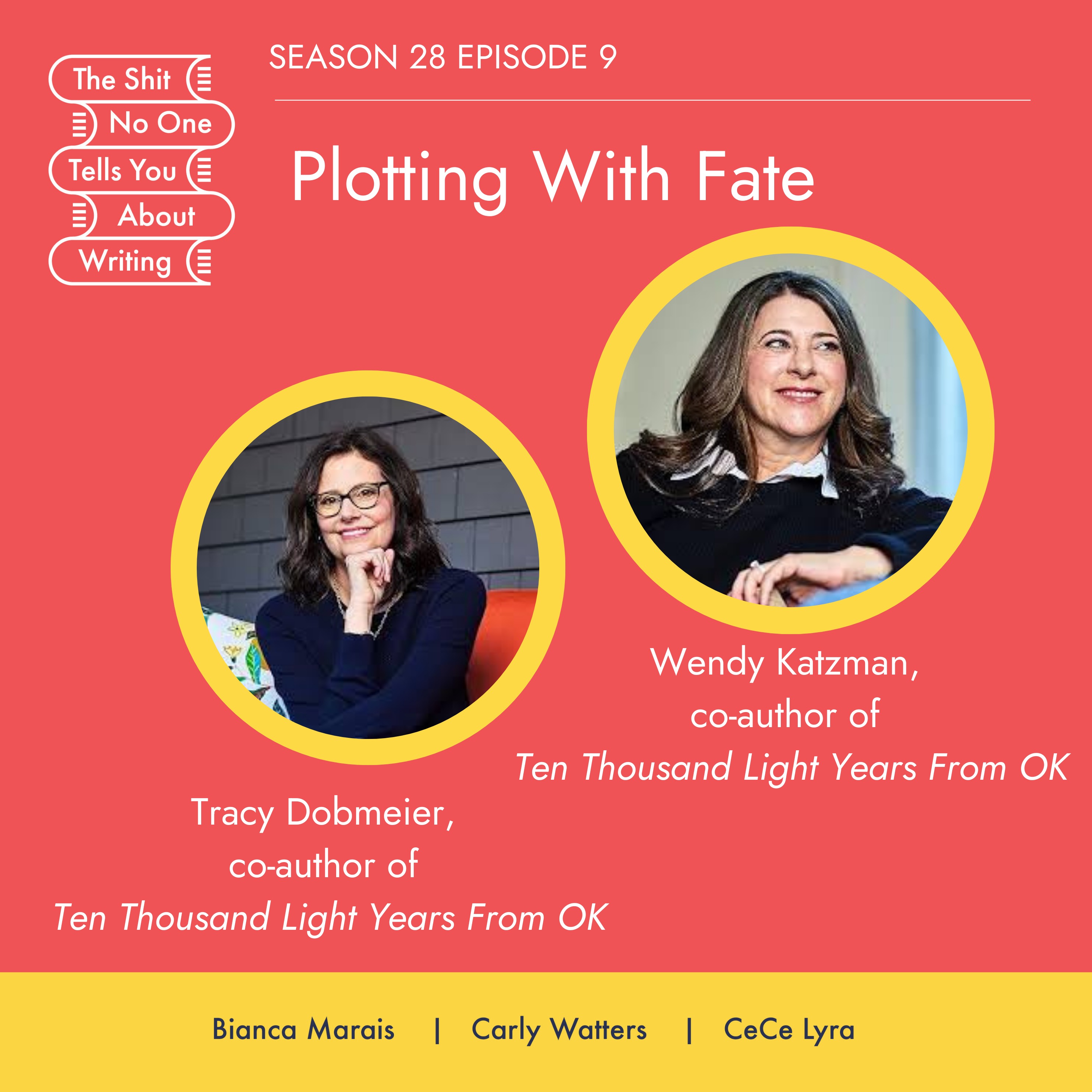
The Shit No One Tells You About Writing
Plotting With Fate
00:36:42
Author Interview with Tracy Dobmeier and Wendy Katzman
Loading summary
Transcript174 lines
- [00:00]
Host 1
The holidays are almost here and if you still have names on your list, don't panic. Uncommon Goods makes holiday shopping stress free and joyful. With thousands of one of a kind gifts you can't find anywhere else, you'll discover presents that feel meaningful and personal. Never rushed or last minute. Uncommon Goods looks for products that are high quality, unique and often handmade or made in the U.S. many are crafted by independent artists and small businesses, so every gift feels special and thoughtfully chosen. Unless I know our crowd would love the Book Nook Reading Valet. It's a wood holder for your book, your mug, your reading glasses, e reader and or phone so you can carry it from your room to your bedside to the bathtub. It has a 4.9 out of 5 rating on over 178 reviews. I also thought you guys would like all of you pet lovers out there would like the custom pet embroidered sweatshirt so you can have a custom portrait of your animal on your sweater and have them with you all day. Uncommon Goods has something for everybody. From moms, dads, kids and teens, book lovers, sports fans and foodies, gardeners, crafters, readers and writers, you will find unforgettable gifts that are anything but ordinary. When you shop at Uncommon Goods, you're supporting artists and small independent businesses. Every purchase is a chance to choose something remarkable and feel good about where your money goes. Because you can make your money go.
- [01:15]
Host 2 (Carly Waters)
Farther this holiday season.
- [01:16]
Host 1
Because with every purchase you make at Uncommon Goods they give back $1 to a non profit partner of your choice. They've donated more than $3.1 million to date. That is incredible stuff. Don't wait. Make this holiday the year you give something truly unforgettable. To get 15% off your next gift, go to uncommongoods.com tsnatyaw that's uncommongoods.com t s n o-t y a w for 15% off. Don't miss out on this limited time offer. Uncommon Goods we're all out of the ordinary.
- [01:52]
Host 3 (Bianca Murray)
Hi there and welcome to our show the shit no one tells you about writing. I'm best selling author Bianca Murray and I'm joined by Cece Lehrer of Wendy Sherman Associates and Carly Waters of P.S. literary.
- [02:07]
Host 2 (Carly Waters)
Hi everybody. We have clients with me today. I love it when I get to have my clients on the show. I know Bianca carries such a heavy load of doing all of the author interviews and I get to pepper in the schedule with my clients which is great. So I have two clients. As you will notice if you are watching us on YouTube, I have two clients because they co write together. My lovely clients, Tracy Dawson Meyer, Wendy Katzman, authors of 10,000 Light Years From. Okay, and again, if you're on YouTube, you can see it over their shoulder there in between. So we're going to talk about their sophomore novel. I guess we can call it Sophomore because it is the sophomore published novel. And as you guys know, on this show, we'd love to talk about the publishing experience. So we'll get into everything that these guys have worked on, everything going on with this book, and I'm going to throw it to these two to introduce the novel. So, Wendy and Tracy, what is your new novel about?
- [02:57]
Tracy Dawson Meyer
Great. Hi, I'm Tracy. And so yes, our novel is about a young writer. So several years after her husband's shocking death mirrored a plot line in her debut novel. She's very superstitious and she's on the verge of squandering her entire career when a bedtime tale that she spins for her young daughter convinces her to write a hopeful romance. So unfortunately, when a man bearing an uncanny resemblance to the novel's love interest suddenly walks into her life, she has to learn the difference between imagining happiness and fighting for it before it costs her everything.
- [03:31]
Wendy Katzman
So I'm Wendy, and I'm very excited to be here with you, Carly. And so this novel, it really dives into questions of connection, coincidence, resilience, and like, what it means to find your way in the world when it feels overwhelming.
- [03:48]
Host 2 (Carly Waters)
I love it. And obviously I love this book. I love all my clients books. So, you know, I'm. I'm a broken record when my clients come on. So I'm like, let's talk about all things I love about this book. But as you guys can see, it has a writerly hook to it which keeps it very on theme with our show. The shit no one tells you about writing because we have a novelist author as a character, which is so fun. There's lots of things I want to get into. Obviously, some of the themes that Wendy just brought up are all on point.
- [04:14]
Host 1
The first thing I want to get.
- [04:15]
Host 2 (Carly Waters)
To, because cece had one of her clients on, on the last author interview, and Dr. Tracy Daglish is an expert on in laws and she had an in law book. So I want to start off by linking the last author interview to this author interview, because there's a very interesting in law connection between our main character Thea and her in law. So I want to talk about in laws. You know, we obviously don't have to spill. Spill any, like family secrets. About your in law situation. I won't put you on the spot about your in law situation. I love my in laws and they're lovely. So, yeah, I think they're really interesting relationships. So could you walk us through what is our writer characters, what is her living situation and tell. Tell us about her in laws.
- [04:57]
Tracy Dawson Meyer
So, I mean, first of all, I will say that both of us absolutely adore our mothers in law. So it did. There's nothing autobiographical in the characters or what happens in the story, but it's an interesting. We needed a foil and we needed someone to kind of be reflecting back onto Thea, kind of where she was in her life journey and in her grief journey. And so we actually have, like, it's actually quite a close relationship in a lot of ways because Thea, when she starts out, so she's very young, she gets married young. She has this debut novel. Her husband is like a. An up and coming tennis player on the pro tour, and then he suddenly dies. And when he dies, they had been living in the guest house of his parents. And so it's a very close family relationship. And she continues living there because she's about to have a baby. And then so there's a lot of, like, really lovely kind of family connections that happen in the beginning. And then things kind of start to, you know, take some interesting turns as we go through.
- [06:06]
Host 2 (Carly Waters)
Absolutely. And we can't, you know, we can't spoil this novel on this show. That was one thing Tracey, Wendy and I were kind of emailing about. We're like, how much of the story can we tell, obviously, why did we read it? And there's lots of juicy stuff to happen. So we won't say why the in laws are the foil. We will just say the in laws are the foil. And you'll have to read the book to find out. But yes, I think that's lovely because.
- [06:26]
Host 1
The grandparents have such a nice relationship.
- [06:27]
Host 2 (Carly Waters)
With their granddaughter, which is really sweet. But then it gets that point of, you know, when do you have to spread your wings, right. And kind of. And move out after that big loss? So I just love how kind of.
- [06:37]
Host 1
Really complex that was.
- [06:39]
Host 2 (Carly Waters)
There is also a literary agent character in your book. And, and so, you know, I just, again, people read these books and they think, okay, wedding Tracy, have an agent. There's an agent in this, you know, in this story.
- [06:52]
Host 1
What are some.
- [06:53]
Host 2 (Carly Waters)
The connection? So let's talk about how this literary agent is maybe similar and, or dissimilar to me. And obviously we can talk about our, our working Relationship as well.
- [07:03]
Wendy Katzman
Well, first, we have been so blessed to have you as our agent and our partner. I mean, I think when you're going through this process, you so badly want an agent, but it is so important that the agent that you end up with is a partner who believes in you. And the number of times where you have told us you believe in us because this is a hard journey and things have not always gone our way, so we are eternally grateful to this relationship. There's a line in the book from you that kind of inspired some of this, where the agent tells Thea that she is the seer of contemporary fiction. And you had said that to us at one point after we were in the process of writing our debut novel, Girls with Bright Futures, that was based on a college admissions scandal. And we were almost done writing it when the Operation Varsity Blues college admissions scandal happened. And then we had another book idea that was kind of based on youth sports and a character had a health issue. And then something like that happened in the real world. And so that's when you said to us, you guys are the seers of contemporary fiction. And that kind of helped spur on this idea of, like, a writer being afraid that what she writes will come true, because we were already superstitious people. And that really played into it.
- [08:31]
Tracy Dawson Meyer
Right? And I'll also add, though, that, like, so you've always said to us from day one, and that was one of the things we've loved about you from the beginning, was that you're in it for our career. And you've proven that, like, time and again, because, you know, we've had some flops and we've had some successes, and you've always been there saying, you know, I believe in you. Keep going. And that is so meaningful. And in Thea's case, she's really pushing that to the limit because she's gotten so in her head that she's about to really throw away her entire career. And so it actually is, like, it's not. We weren't necessarily thinking about what would happen if that happened to us, and would Carly stick with us? But I think the fact that you have stuck with us through so much makes us feel like it was just an interesting thing to contemplate. Is there a point where, you know, the agent is like, okay, you know, if you're not going to write at all, you know, and you're. And you're basically completely at a dead standstill, then what are we actually doing here? So it was just kind of an interesting concept in the kind of publishing journey to think about.
- [09:32]
Host 2 (Carly Waters)
Oh, I love that.
- [09:33]
Host 1
Yeah.
- [09:33]
Host 2 (Carly Waters)
There's like, there's so many things that I want to touch on. One of the things is that what I think this book does so well, like the example of the in laws and the example of the literary agent character, is a lot of writers would just write their version of what they think. Oh, you know, this caricature of an in law is. Or this caricature of an agent. And you guys always come with such depth and heart, and you're like, okay, but also, how am I going to take this to the limit?
- [09:55]
Host 1
Because this is fiction.
- [09:56]
Host 2 (Carly Waters)
So it's not my job to create this necessarily exact reality. The job of the author and of the writer is obviously to contextualize it within the plot and kind of make.
- [10:06]
Host 1
It interesting as possible for the reader.
- [10:08]
Host 2 (Carly Waters)
So you guys did a fantastic, fantastic job on that. Okay, I want to switch over to the superstitions, because you kind of just. You touched on that a little bit. And that's such a obviously huge part of this book, this idea of, like, what can we manifest into reality? Is that even possible to manifest things in reality? And is that just, like, longing and hope enough sometimes to get us through when times are tough? So there's a number of things that, again, we're chatting about offline. And do you guys have your own superstitions, like your writerly superstitions or life superstitions? How do you feel about the super superstitions in your life?
- [10:44]
Tracy Dawson Meyer
Hang on, we're gonna show you one.
- [10:49]
Here are lucky dice. We take these with us everywhere. We always.
- [10:54]
Host 2 (Carly Waters)
They go on the writing desk.
- [10:55]
Tracy Dawson Meyer
They do, yeah.
- [10:57]
Wendy Katzman
Hanging.
- [10:57]
Tracy Dawson Meyer
They're in the office on the shelf right above our. Our desks.
- [11:00]
Host 2 (Carly Waters)
So those of you that aren't watching on YouTube, they're like dice that would go over your mirror. Yeah. Oh, I love that.
- [11:09]
Tracy Dawson Meyer
And that's only the tip of the iceberg for us.
- [11:11]
Wendy Katzman
We're.
- [11:12]
Tracy Dawson Meyer
We're quite superstitious. I mean, one example would be.
- [11:17]
So, you know, obviously Carly, you know, the rest of the world probably doesn't, but I had breast cancer. When we were querying you, we actually queried you from my chemo suite. So during that time, Wendy was like, my rock. And the way that we kind of got through this time and kept our hope and everything was. Wendy gave me this present, and it was just. It was like, I think there were 15 different Lucky Charms from all over the world. And it was just, you know, some little plastic figurines in the rabbit's Foot and like, you name it, and with a description of why each thing was lucky. And I, that I held that dear and it got me through a very tough time and it got us through a lot of, you know, challenges. And we have continued like all those lucky charms are still in our office and we kind of cling to that. So we are superstitious, I would say, in a very real way. And every time we send a big, like a manuscript off to you, we each touch one of the lucky dice and then we push send.
- [12:17]
Wendy Katzman
That was a big reveal.
- [12:19]
Host 2 (Carly Waters)
Very superstitious. And so I guess, like my, like, you know, gentle push to you is what happens if, like, how do you know? I guess the charms always work. How do you know?
- [12:32]
Wendy Katzman
You don't. But I think part of it is just. It's like just in case.
- [12:39]
Tracy Dawson Meyer
We're big on hedging our bets. Yeah.
- [12:43]
Host 2 (Carly Waters)
Oh, I love that so much.
- [12:45]
Host 1
Yeah.
- [12:45]
Host 2 (Carly Waters)
And so let's just stick with our superstition theme for a little bit because it's also one of those things where it is a bit, let's call it like more of a woo woo science or however you want to describe it. Do you feel like you want it to be grounded in science or do you like that it's more of like a what if thing?
- [13:03]
Tracy Dawson Meyer
I think it depends. I think I'm a very analytical person and I think I do want things to be grand. I want to understand the way the world works. But I also find it kind of just delightful and I don't know, it feels very, like, exciting when something really crazy happens and you think, well, what if there's something else? There's some invisible hand that's kind of, you know, controlling this. So, I mean, I can give one crazy story just as an example for how. I don't know how to think about it, but I love the story. So I'm from LA originally. We live in Seattle. Dodgers made us to the World Series last year. They're also in it, I think, against probably your team, Toronto right now.
- [13:44]
Host 2 (Carly Waters)
When this comes out, when this comes out, you guys will know the outcome. Right now we do not know the outcome.
- [13:49]
Tracy Dawson Meyer
We do not know the outcome. Yes, the series is tied, 1:1. But last year they played the Dodgers, got into the World Series against the Yankees. And it was a really big moment for someone who had grown up a Dodgers man. So I decided to head down to LA and see a game. I picked game one and I went with some family, including my son. And I had grown up kind of going to baseball games. With my dad, it was very special, like, special relationship. So I'm in Seattle, I just remembered I had this like box of memorabilia and I start digging through it and I find a World Series T shirt from the 1986 World Series, which for those who don't follow baseball. So game one, the Dodgers ended up winning the whole series, but game one ended with just an absolutely iconic walk off home run by someone named Kirk Gibson. And so Kirk Gibson's face is featured on this T shirt that's ancient. I bring it with me to la and my son looks at it and is like, tell me, what is this? You know, why is this special? And I was like, well, I thought maybe it would bring us good luck because the Dodgers won that World Series and I just had it. And so my dad, who was too infirm to go to the game, but we were visiting with him just before, and my dad tells my son the whole story about the Kirk Gibson home run and how it set the stage for the Dodgers to win that series. And my son said, that's really cool. Can I wear the shirt? And I said, sure. Maybe that'll bring us good luck too. So we went to the game and sure enough, at the bottom of the ninth inning, Dodger Freddie Freeman hits a walk off grand slam home run. That was just so epic. And it kind of mirrored the 1986 World Series. My son's wearing this T shirt and we just like, there were so many layers of things that had to happen and coincidences and it was so like, it kind of blew my mind, honestly.
- [15:47]
Host 2 (Carly Waters)
I know. And like, I, I love that.
- [15:50]
Host 1
I love.
- [15:50]
Host 2 (Carly Waters)
Okay, speaking of World Series T shirts, we're going very deep into baseball lore right now, but when the Blue Jays won the World Series, they did Back to back 92, 93 baseball wins. My dad went to one of the 93 games. I don't know which game it was, but anyway, he brought me back as a child, brought me back a T shirt and it was like bright blue. And then I wore it. You know, it went through the wash, obviously, but like, till you don't like.
- [16:12]
Host 1
The plastic that crinkles off of the light.
- [16:14]
Host 2 (Carly Waters)
Yes, the imprint. Anyway, so I also have like a.
- [16:18]
Host 1
Very old World Series original T shirt.
- [16:20]
Host 2 (Carly Waters)
That is long gone, but yeah, no, I love that. I think there's, there is like you said, just so much hope and there is so much connection between all these events in our life and we never really know, you know, obviously where this is all going to stem from and where it's going to pin From. But it's such a beautiful thing to think, you know, if this had happened or if I hadn't parked in this parking spot, we wouldn't have gotten to this time.
- [16:40]
Host 1
And then.
- [16:41]
Host 2 (Carly Waters)
Anyway, and so there's so many coincidences that happen in your book. Do you want to talk a little bit about the coincidence where Thea decides what her book is gonna be about, and then she meets the person that is connected to the book?
- [16:52]
Tracy Dawson Meyer
You wanna take that one?
- [16:53]
Host 2 (Carly Waters)
Is that gonna give it away?
- [16:55]
Host 3 (Bianca Murray)
Yeah.
- [16:55]
Tracy Dawson Meyer
We're looking at each other.
- [16:56]
Wendy Katzman
We have to think, how are we gonna say this without giving it away? Well, so she. She decides to write the role.
- [17:03]
Host 2 (Carly Waters)
Everybody's gonna read the book anyway, so we can tell. We can give them a little bit.
- [17:06]
Host 1
Yeah.
- [17:06]
Wendy Katzman
Okay. So Thea has a young daughter, Lucy, who is obsessed with. With princesses. So anyone with a little girl maybe has been through this, and it had never occurred to her to write something hopeful. And she just cannot bear to tell another princess story. So she ends up. Like, she makes up a story for her daughter one night, and it inspires her. What if I made up my own hopeful romance, imagining my husband returning to me and. Because, like, what's the worst that could happen? Like, maybe she can bring him back. So she does that. But her. Why?
- [17:42]
Tracy Dawson Meyer
She knows. In her logical mind, she knows she's not crazy. She's just. Yeah, right.
- [17:47]
Wendy Katzman
She's hopeful. But she's hopeful, right? Because, again, what's the worst thing that could happen? And it's a way to get her writing again and a way for her to spend time in that space with Sam, her husband, thinking about him, where she sometimes doesn't feel like she has permission in the rest of her life, because it's been several years. And I think sometimes people expect that you move on, even though that isn't really how grief works. And so it's giving herself permission to live in this world with him. So she writes this very hopeful romance about. Or she. She pitches this idea of a hopeful romance about a professional tennis player. And her wise agent says, too autobiographical. You got to come up with something else.
- [18:28]
Tracy Dawson Meyer
You need something larger than life.
- [18:32]
Wendy Katzman
So she. She has just gotten her daughter a dog. And the dog. I can say this part, right? Is this okay? I don't know.
- [18:41]
Host 2 (Carly Waters)
Tracy's, like, smiling, but she's like, please stop.
- [18:44]
Tracy Dawson Meyer
Don't say it. I don't think so. I think we should let the rest.
- [18:47]
Host 2 (Carly Waters)
Be, because there's some really fun.
- [18:49]
Tracy Dawson Meyer
There's a fun coincidence that happened.
- [18:52]
Host 2 (Carly Waters)
There's many, many coincidences. Such as the character, anyway. Yeah.
- [18:59]
No, no, I don't, I don't.
- [19:00]
Host 1
I don't want to spoil it.
- [19:01]
Host 2 (Carly Waters)
I think the book is so charming and everybody's gonna love all the, all.
- [19:05]
Host 1
Of the different twists and where it ends up.
- [19:07]
Host 2 (Carly Waters)
Okay, let's go back to the dog, though. So I want to talk about the dog. So there's this, you know, saying that goes around essentially that, you know, certain things in your life isn't going to fix something.
- [19:18]
Wendy Katzman
Right.
- [19:19]
Host 2 (Carly Waters)
It's like, you know, a child isn't going to fix a marriage or a dog isn't going to fix a grief. Right. But let's talk a little bit about your dog character, Sam, and explain to us how Sam gets Sam's name. And let's talk about, about, you know, the pet inspiration is there. Like, you know, because it was there a pet in your life that's very close to you and that got you through a tough time or, you know, how do you think about pets in your life?
- [19:43]
Host 1
Hey, everybody, guess who's back from France?
- [19:45]
Host 2 (Carly Waters)
I was thinking of you guys listening to me talk about getting ready for.
- [19:48]
Host 1
The trip and practicing my French while I was doing my best to order a francais at the cafes. It went well.
- [19:54]
Host 2 (Carly Waters)
I was a bit nervous, but when we were in the countryside and I could take my time thinking about what.
- [19:57]
Host 1
I wanted to, I was able to say it. Being a bilingual family is high on my list of things that are super important to me as a parent and a mom. If we're going to show them the world, we also need to appreciate and respect the language and culture by learning it. Imagine how much richer your travel experience could be if you could speak the local languages. When you travel with Rosetta Stone, you'll gain the confidence to have real conversations and create deeper connections wherever you go. Rosetta Stone is the trusted leader in language learning for over 30 years. Their immersive, intuitive method helps you naturally absorb and retain your new language on.
- [20:24]
Host 2 (Carly Waters)
Desktop or mobile, whenever and wherever it.
- [20:26]
Host 1
Fits your summer schedule. With 30 years of experience, millions of users and 25 languages to choose from, including Spanish, French, German, Japanese and more, Rosetta Stone is the go to tool for real language growth. You can learn faster and retain longer. There's no English translations. You truly learn to speak, listen and think in your chosen language. There's an intuitive learning process. You start with words, build the phrases and progress to full sentences. It's designed for long term retention so it sticks with you. You can work on your accent with the built in True accent speech recognition technology. So help you sound more natural. You can learn anytime, anywhere. It fits with your lifestyle with the flexible on the go learning style desktop or mobile app. And there's incredible value. A lifetime membership gives you access to all 25 languages so you can learn as many as you want whenever you want. Don't wait. Unlock your language learning potential. Now the shit about writing listeners can grab Rosetta Stone's lifetime membership for 50% off. That's unlimited access to 25 language courses for life. Visit Rosetta Stone. Visit RosettaStone.com today to get started and claim your 50 off today. Don't miss out.
- [21:26]
Host 2 (Carly Waters)
Go to Rosettastone do and start learning today.
- [21:30]
Host 1
The holidays are creeping up fast. At the time of recording I haven't bought a single thing.
- [21:36]
Host 2 (Carly Waters)
I'm a last minute gift giver.
- [21:38]
Host 1
I will admit that and I am not afraid to say it. And that is because I know Wayfair has me covered and I can get what I need fast with Wayfair. From last minute guest prep to gifts for everyone's home style what I love about Wayfair is when we were redesigning our main floor powder room, we were working with a really small space and I knew the dimensions had to be perfect. With Wayfair I could get a vanity that was exactly my style, warm and modern and exactly the perfect dimensions on their easy to navigate website. Our contractor didn't have to wait because the delivery was fast and hassle free. The new vanity is perfect and we get so many compliments, especially as we have guests flowing through the house this holiday season. I'm getting ready for the cozy guest season with fresh throw blankets, new towels, kitchen essentials for all the meals and dishes that will need to be done. The huge selection of items makes it so easy to shop for everyone in your life and make your house ready for hosting. There's something for every style in every home, no matter your space or budgets. Find all your must haves and get ready to be surrounded by love and family. This season, get last minute hosting essentials, gifts for all your loved ones and decor to celebrate the holidays. For way less head to Wayfair.com right now to shop all things home. That's W A Y-F-A-I-R.com Wayfair every style, every home Definitely.
- [22:50]
Wendy Katzman
Well, we each have a dog. Yep, this is really my first dog. Tracy's Tracy's been a dog person for a long time and I mean we happen to think there's like nothing better than dogs to get you through pretty much anything. Yeah, ours came to us during the pandemic and was a really important addition that helped bring a lot of joy to our family. So do you want to talk about how.
- [23:13]
Tracy Dawson Meyer
Yeah.
- [23:14]
Wendy Katzman
How the dog came to be? Yeah.
- [23:16]
Tracy Dawson Meyer
Yeah. So the dog we. So basically Thea. So Thea has a best friend, Franny, who we love. Franny's great, and Franny's no nonsense. She's always kind of there, like, supporting Thea, but kind of pushing her to kind of be real, grounded in the real world. And so Thea is reluctant to date again. It's been several years since her husband died, but she's still really stuck in her grief process. And Franny is encouraging her to, you know, to date. And as a way of kind of putting. She's like, you know, you're not moving forward with your life. You need to move forward. And as a way of kind of satisfying Franny, one day, Thea just blurts out, but I am moving forward. I'm getting a dog. And she had. She has no idea what to do with a dog. So she ends up getting this dog just because she can't, like, disappoint Franny because Franny will hold her to it and does. And. But then they bring the dog home and. And. And Thea's daughter Lucy, is three at the time, and she's. She's heard all these stories about her dad, who's no longer with them, and his name is Sam. And the minute the dog walks in the door, Lucy starts jumping up and down and saying, it's Sam the dog. That's his name. It's Sam the dog. And they try everything to talk her out of it, but she's just absolutely determined, as many three year olds are. And so Thea has to kind of deal with this name that's a little bit. You know, in some ways, it feels almost disrespectful to name her dog after her late husband. But at the same time, it's keeps. It keeps the memories right there in front of them and keeps. And kind of keeps that connection going.
- [25:01]
Wendy Katzman
It's also like, Lucy's so perceptive because part of the reason she chooses the name is she thinks it'll make her mother happy because she knows how sad her mother is, and maybe this is a way of making her happy.
- [25:17]
Host 2 (Carly Waters)
Yeah, it's the word Sam connotates that sadness.
- [25:20]
Host 1
Right.
- [25:20]
Host 2 (Carly Waters)
And it's like, can we make the name Sam give us happy feelings? So.
- [25:26]
I love our dog character. And I was thinking. I was making notes before the call because I have two Dogs in the house today because I have my in law. Speaking of in laws, I have in law's dog at the house and I have my dog. So yeah, we, we love pets on this show and they're such a. Such a great pet character in this one that, you know, again, won't spoil it, but, but helps bring some of the storyline together. So because this is a writing show, I want to talk about the writing process as well.
- [25:50]
Host 1
Right.
- [25:50]
Host 2 (Carly Waters)
So there are two of you writing one book. Do you want to walk our listeners through that process for you guys, how it works, maybe from conception to the logistics?
- [26:01]
Wendy Katzman
Sure. Okay, go ahead.
- [26:04]
Host 2 (Carly Waters)
Okay.
- [26:04]
Tracy Dawson Meyer
Yeah, I'll jump.
- [26:05]
Wendy Katzman
Okay. So this, this book is a little bit different than our first book, Girls with Bright Futures, which had three points of view. And we'll talk about our process, but by having three characters, it was easier to divide up the writing. So the way this. So our new book, 10,000 Light Years from okay has one point of view. So many things are still the same. Like, we brainstorm everything and we plot everything. That's probably where we spend the most time in our writing process. And then once we're ready to go, we divide up the actual writing. And because this was one point of view, we couldn't say, okay, you write this character and you write this character. We just divided it up based on the character chapter. And because we each kind of like to write, we have different strengths and like to write different types of things. And then as you finish a chapter and we always stay really close together, you put it into the master. And then we. And then we spend a ton of time editing and finding that voice, smoothing everything out. That's probably the second largest part of our time. The actual writing of bringing that first draft is definitely the fastest part of what we do.
- [27:23]
Tracy Dawson Meyer
Yeah, I love that. Yeah. And then I would say just kind of more on like a meta level in terms for the co writing process. It's, you know, we've been friends for 25 years, 25 plus years, I think, and we've always been really close. But I think that a writing partnership is. It's different on many levels. Like, you really have to make yourself so vulnerable to the other because you are, you know, you know, there when you're editing, for example, there are just things that have to go or, you know, and maybe it's your stuff and maybe it's your partner's stuff and you. And we just have to decide from the beginning that we're going to check our egos at the door and we're going to be honest and we're going to be loving and supportive, and it's just. It's really worked for us. But it's not to say that it's always easy. I mean, there are definitely moments where we have. I won't say fights at all. Like, never a fight, but we. You know, there are moments like when you get. Might get a little testy, when you're deep into a revision and. And you just kind of want to be woke up on the wrong side of the bed or like, in my case, just didn't sleep at all or so, you know, there are. Sometimes there are points where you just put a pin in it and you come back the next day.
- [28:34]
Wendy Katzman
But I think part of that. So there was. There's another writing duo, Ali Frank and Asha Yeomans. And they had a great rule that they imparted to us, and their rule was no always wins. So if there is anything, it could be a word, it could be a plot twist, it could be a name. Whatever it is, if one of us is not comfortable, you speak up. And we never compromise. So this is our new part that we added to this rule because compromise gets you mediocrity. And so what we do is you got to keep working on it until we both get to not just yes, but like, yes with an exclamation point. And that could. I mean, we might look up a word. This is.
- [29:19]
Host 2 (Carly Waters)
Okay.
- [29:20]
Wendy Katzman
This is a funny coincidence, actually, in the writing process. So we were having a conversation. We spent a lot of times, I'm sure a lot of writers do this, just looking up words. You're trying to find that perfect word. And there is the word phantom. Word is phantom. And was that the right word? And we must have gone 10 minutes looking up words, having a conversation. No, that's not the right word. That's not the right word. So every day we both do the New York Times spelling bee, and the next day after this, like, 10 minute conversation trying to find the right word. The pangram, where it uses all the letters. The very next day was fantastic.
- [30:01]
So that was a sign, right? How can you say that's not a sign?
- [30:04]
Tracy Dawson Meyer
Right. That we picked up?
- [30:05]
Wendy Katzman
Yeah, I love that.
- [30:07]
Host 2 (Carly Waters)
I feel like everybody needs to go, like, buy a lottery ticket today when they're listening to this episode. It's like, this is the lucky episode. Superstition.
- [30:16]
Tracy Dawson Meyer
Trust your guts.
- [30:18]
Host 2 (Carly Waters)
All the things. I love that. Oh, I love that. Like, totally. What you said is like, we can't compromise. Right? Because then that's like, neither is it's not that neither's winning, but more so that, like, the common goal isn't being achieved, which is having the best possible writing. Okay, I want to go back to one thing you said, which is each of you have different strengths, which is so interesting in the sense that, you know, maybe it's dialogue or this or that. Do you want to talk a little bit about which Each of your. Come back to our baseball metaphor.
- [30:43]
Host 1
Right.
- [30:43]
Host 2 (Carly Waters)
It's like, you know, on the team, you know, what strengths does everybody. Offense? Is it defense? What are your strengths? And how have you decided that they're your strengths?
- [30:52]
Tracy Dawson Meyer
You know, that's interesting, actually. And I think our strengths have kind of evolved over time. But I think. I mean, I'll go first. I think that I have. Well, let's see. I guess I'm going to start by saying my weakness is, is that I tend to overwrite. So, like, I'm the person who. The first draft. I mean, I. So I have. I'm a lawyer by training. I can write. I could write like the equivalent of three paragraphs. That's one sentence. You know, that's just kind of how my mind thinks. And so I've had to really work at editing myself and trying to, you know, so I. And trying to write shorter sentences and trying to only put the information in that we actually need. And so that's something that. And I've kind of learned from Wendy. Wendy's got a really, like. She's just got a really kind of succinct way of expressing ideas. And so over time, I think we've kind of like, I've gotten a little.
- [31:45]
Wendy Katzman
Less verbose and maybe I think I've gotten more. Because my problem is sometimes I assume facts are already in evidence. I was not a lawyer, but.
- [31:56]
Maybe that's why. So there's two. Sometimes I leave too much in my head and just assume that too many. The reader knows too many details. So I think we balance each other out in that way. So, like, like, I love to write dialogue that's like. Yeah. And your exposition is amazing.
- [32:19]
Tracy Dawson Meyer
Yeah, I think that's probably, I guess, like, emotion.
- [32:23]
Wendy Katzman
Yes. She's amazing.
- [32:24]
Tracy Dawson Meyer
Very emotionally attuned.
- [32:26]
Wendy Katzman
Yeah. And to be able to write about them. Yeah. But it just, it. It all comes together.
- [32:32]
Host 2 (Carly Waters)
Yeah, yeah, yeah, yeah. No, I was just gonna say it's also. Not only do you kind of have a writing partner, you also have an editing partner. Right. Because you get to, like. That's a built in, fully formed system. You know, you're the Otani of Of writing.
- [32:45]
Host 1
Right?
- [32:46]
Tracy Dawson Meyer
Like, exactly.
- [32:47]
Host 2 (Carly Waters)
You can hit and pitch.
- [32:49]
Wendy Katzman
Exactly. Oh, my gosh.
- [32:52]
Tracy Dawson Meyer
Yeah, yeah.
- [32:52]
Wendy Katzman
I mean, we have this joke, like, if she wants to use an advert, I have to sell her the advert. Like she has to convince me. Yes.
- [32:58]
Tracy Dawson Meyer
I have to convince her.
- [32:59]
Wendy Katzman
It's worth it. I'm very stingy.
- [33:01]
Tracy Dawson Meyer
So stingy.
- [33:02]
Wendy Katzman
The advert.
- [33:04]
Tracy Dawson Meyer
Give it to me. Just this time.
- [33:08]
Wendy Katzman
Gotta work for it.
- [33:09]
Host 2 (Carly Waters)
Put a quarter in the jar. You only get so much.
- [33:11]
Tracy Dawson Meyer
Yep. Right? Yes, you do.
- [33:14]
Host 2 (Carly Waters)
I love that.
- [33:14]
Wendy Katzman
Yes.
- [33:15]
Host 2 (Carly Waters)
You guys are so delightful. So let's talk about also just like the writing history. Like, obviously we've talked about, you know, you've published one book before, you've been friends for 25 plus years, and obviously this is your second novel. So obviously I am not going to ask you guys, your age, but this is not your, you know, the first wave of your career. You have done other things, as you guys spoke to and alluded to with your careers in law and in marketing. So let's talk about, you know, how you got to. This is in terms of the second act or third act or however you want to look at it with all of your life experience. Because I love when authors come with so much life experience. So it's when somebody queries me when they're like 20, I'm like, what kind of life have you lived? I mean, you could be a savant author, which is great, but, you know, there's life to be lived, to kind of again, have that experience and that emotionality to write, you know, fiction in a big way. Do you guys want to speak about how you kind of like brought that energy into your career?
- [34:07]
Tracy Dawson Meyer
Sure, definitely. So when we first decided to try to write a novel, it actually came later. We were about late 40s at the time. We're kind of mid, mid to late 50s now. We've been at this for a bit, but we, we had both kind of been coming off of dealing with sort of a grief situations in our families. We both had husbands at the time who had gone through major health crises. And while we were raising our kids.
- [34:35]
Wendy Katzman
We still have those husbands. We still do. Yes. Sorry. Yes.
- [34:39]
Tracy Dawson Meyer
That did not come out right.
- [34:41]
Wendy Katzman
They did great.
- [34:42]
Tracy Dawson Meyer
Yes, yes, they both, they both made it through, but it was definitely, it was a journey and we had kind of as good friends at that time, had done a lot of talking about what, you know, the meaning of life and how do we, how do we handle raising kids and friendship, the impact.
- [34:58]
Wendy Katzman
On your friendships when you're dealing with these issues. And our kids were the older kids were getting ready to apply to college.
- [35:08]
Tracy Dawson Meyer
Right.
- [35:08]
Wendy Katzman
That was also impacting friendships. Yeah.
- [35:11]
Tracy Dawson Meyer
So when we decided to actually try and write a novel, it was something that neither of us had ever done. We had no expectation in our lives that this was something we were going to do. It was kind of a second or third act, as you say. And we were thrilled with the idea initially and just kind of dove right in, trying to teach ourselves how to write a novel. We googled how do you write a novel? We didn't have any of the technical experience. We didn't have an MFA we felt like nervous about because of our age. We didn't feel like we had time to go back and get an MFA at this stage or we'd be like wasting, you know, valuable years when we could be trying to actually write. So we just sort of dove in. But we had a lot of self doubt in those early months, probably the whole first year, I would say. And one thing that really affected us and kind of changed the way we were thinking was that we had each kind of independently as parents. Read this book called Mindset by Carol Dweck. And she said, we did that whole video on it. But it was really, it's truly was one of the most impactful books that we'd ever read. Because as parents, what we realized was that we've been telling our kids how to kind of take chances and live in this growth mindset. But for us, we were kind of practicing, we were modeling the fixed mindset in that moment by doubting ourselves and feeling like maybe we can't do this.
- [36:34]
Wendy Katzman
And should we do this? What if we fail? What if we're terrible?
- [36:37]
Tracy Dawson Meyer
Right.
- [36:39]
Wendy Katzman
And so that was a huge wake up call when we realized, like, we weren't being the types of parents that we wanted to be. So we really had to reassess our situation and figure out how do we apply the growth mindset to our writing. And once we did that, we never had another conversation about, should we try this? Could we do this? We just decided we were going to just do our best, which is what we were asking from our kids. Just do your best, put in your best effort and control the things you can control. So whether it was reading craft books or getting your butt in your chair or becoming part of the community or reading, hitting your word count, like those are the things we could control, not what other people thought. I mean, you can never control what other people think. They're always bringing other baggage, their own perspectives, the business, whatever, to the table. And that changed Everything for us.
- [37:42]
Tracy Dawson Meyer
And that's gotten us through a lot of difficult times in the publishing journey, because I think we can share that the book that gained us your representation never actually got picked up by a publisher. And it was devastating at first because we thought we kind of had it made, and then we didn't. And you said, go write another book. And we said, oh, really? For a minute. But then we remembered this growth mindset, and we saw it as an opportunity. And we literally, like, we hit the books, Carly, right after you told us that, we kind of licked our wounds for a few minutes, and then we read more craft books books, and we read more, like, fiction in our genres, and we just worked really, really hard. And we always looked at it as something that we could grow and that. That we weren't just like, you know, kind of. We didn't just have a set amount of talent. We could. We could. We could improve. And then that led to Girls with Bright Futures. And then it all happened again. I mean, remember our sports book? You know, we wrote this sports book that we loved, and.
- [38:50]
Host 2 (Carly Waters)
But it.
- [38:50]
Tracy Dawson Meyer
It just wasn't.
- [38:51]
Host 2 (Carly Waters)
We will just say the timing isn't right. I, you know, I tell this on the show all the time. I'm like, books, there's. You never know when a book is going to come back around. I. Again, I think you guys were ahead of your time with the sports book. So. Any editors listening that you know how to find me? We got a great Women in Sports manuscript. And again, these ladies were ahead of their time. So, yeah, no, I. I totally love that. I love what you're saying about, like, the parenting element of it.
- [39:15]
Host 1
Right?
- [39:15]
Host 2 (Carly Waters)
Because it's like you want to demonstrate, you know, the type of, like, bravery that you hope that will inspire them. But then as adults in midlife, you're like, well, I'm. I have a fixed mindset in a certain way because we're just living our lives, raising our kids.
- [39:28]
Host 1
Right.
- [39:28]
Host 2 (Carly Waters)
But there's just. So there are opportunities to have growth mindset. And obviously, writing and starting a new career is. Is such a special one. And now I'm going to use that every time when clients. And I send clients edits. I'm like, you know, I'm not, like, critiquing you. I am trying to improve your growth mindset, obviously.
- [39:43]
Wendy Katzman
Obviously. I mean, it's kind of like, it's funny when you're writing and I don't. We don't know what it's like for solo writers because we have each other and we're editing and we live in this little world, and then when we share it with you and we do get your feedback, I mean, first of all, it's always insightful. It always makes us better. But it is a gift, right, to have other people read your work and really give you information. It's. I mean, it is kind of like being in school and having that chance to learn and improve. So we are all about that mindset for everything. Always trying to improve.
- [40:16]
Tracy Dawson Meyer
Yeah.
- [40:17]
Host 2 (Carly Waters)
Well, I love that. Well, I'm so excited about this book, guys. So at the time that everybody is listening, you can buy it. The book is out this week. It just came out. So everybody can go grab it. It is available. It is incredible. It's got, you know, it's got a huge heart. It's got love. It's got family, parenting, friendship, all the different things. And a huge superstition plot, as you guys heard, which, you know, I heard Wendy knock on wood at one point in this invitation. I have to knock on wood.
- [40:46]
Wendy Katzman
I did.
- [40:49]
Host 2 (Carly Waters)
Yeah. So it. It has it all, guys. So I really, really hope all of you guys go pick it up and engage with these guys on socials. Enjoy the book. The audiobook is great. Not only have I read this book multiple times as the agent, I just started listening to the audiobook because the. They sent me the link this weekend, and it's so good. So whatever format, audio, print, ebook, please grab it. You know, Wendy and Tracy, you did such a good job.
- [41:12]
Host 1
Congratulations on 10,000 light years from.
- [41:14]
Wendy Katzman
Okay, thank you, Carly.
- [41:17]
Tracy Dawson Meyer
Thanks for all your support as always.
- [41:19]
Wendy Katzman
Thank you.
- [41:20]
Host 3 (Bianca Murray)
And that's it for today's episode. I hope you'll join us for next week's show. In the meantime, keep at it. Remember, it just takes one. Yes.