← The Shit No One Tells You About Writing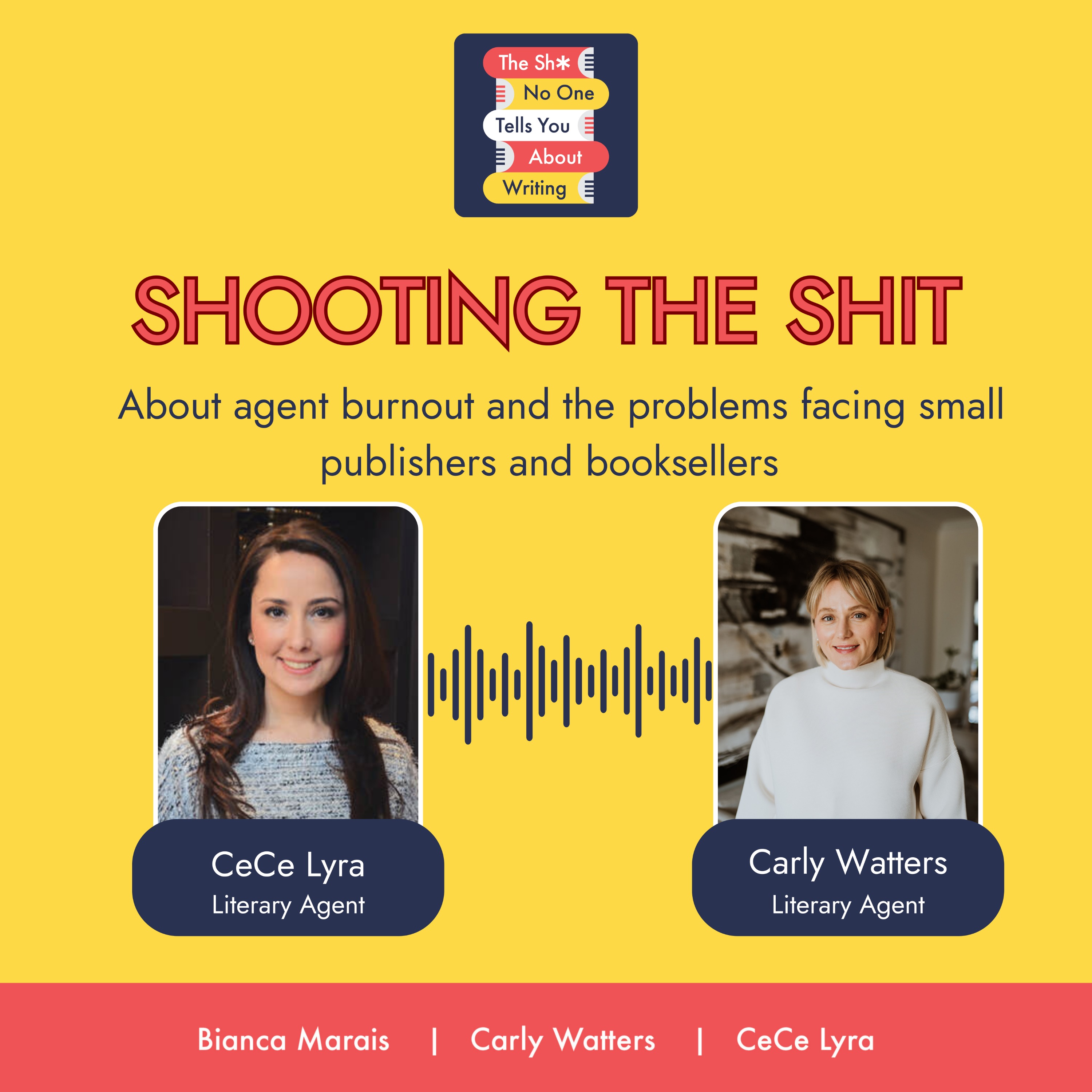
The Shit No One Tells You About Writing
Shooting the Shit: About agent burnout and the problems facing small publishers and booksellers
00:36:35
Shooting The Shit
Loading summary
Transcript93 lines
- [00:01]
Cece Lira
What's up everyone?
- [00:02]
This is Cece.
- [00:03]
If you're a longtime listener of this podcast, then chances are you've heard me talk about the importance of writing on a line level. And of course I have. Because while movies get to rely on lighting, soundtrack, acting and special effects, books rely only on words to make a story come to life. Which is why the writing matters so much. My question to you is, are you confident about your writing? Do you feel like it's at the level it needs to be to stand out in the competitive publishing landscape? If you're like most writers I know, then you're always looking for ways to improve. Well, what if I told you that there's a way to supercharge your learning experience by hacking Writing on a Line level? That's right, hacking it. I've developed an original four day course, Hacking Writing on a Line Level that will show you specific techniques to elevate your writing on a word level, sentence level, paragraph level, and scene level. This course begins on December 4th. My favorite part about it is that there are clear, specific examples in every single slide. No fluff, all actionable content. And for the first time ever, we'll have an optional interactive component. Students are invited to submit excerpts from their work for a chance to have them critiqued live during a class. I'm super excited about this new format because I've seen it yield results in writers works, and it works for writers of any genre as long as you're serious about improving your writing on a line level, and as long as you're a reader. So if you're ready to take your writing to the next level, join me for this four day course. It's a fan favorite. Don't worry if you can't attend live, the sessions will be recorded. For more information, check out check out my bio on Instagram or the podcast's website. I'm looking forward to seeing you there.
- [02:02]
Carly Waters
Welcome to another episode of Shooting the Shit with Literary Agents Carly Waters and CeCe Lira where we dissect publishing gossip, discuss book industry trends, and the overall state of the book business. If you've ever wanted to grab a coffee with two literary agents, grab your mug and pull up a chair. Foreign. Welcome to another episode with just me and CeCe shooting the Once again, CeCe is looking stunning. I would like everybody to open their YouTube app and listen to this on YouTube because I am already pasty white winter mode. I'm getting reflection off the off the snow outside my window. Cece is glowing and in Hawaii. Again, everybody you know Okay.
- [02:53]
Cece Lira
I don't know about gorgeous, because the lighting in here sucks. I actually wanted to record this outside, but it would be too noisy. But all I know is that I'm wearing a lei of fresh flowers, and there's a fresh flower in my hair, and it's so beautiful. Like, this place is paradise. I. Oh, my gosh. I'm in love. Like, I am in love. It's such a beautiful, magical place. And, yeah, I'm just happy to go.
- [03:18]
Carly Waters
Back two years in a row. This conference loves you, so. Yeah.
- [03:22]
Cece Lira
And I love it.
- [03:23]
Carly Waters
So great. I haven't seen a fresh flower in weeks, CeCe.
- [03:28]
Cece Lira
Yes.
- [03:29]
Carly Waters
Yes.
- [03:29]
Cece Lira
But you know what? You can live vicariously through me.
- [03:31]
Carly Waters
Usually it's the other way around, and I'm on vacation. I'm like, I'm totally going after you. I'm on vacation next week, so don't feel bad. So that kind of leads into one of the first topics I want to talk about today, so we can jump right into it. I want to talk about burnout. We don't really talk about burnout too much. I know. It was actually one of the kind of the first themes I brought up just as, like, agent careers and how we manage it on one of the very first episodes of Shooting the Shit way back when. But we just kind of made it through the busy season of the fall. And, yeah, I realized I read. I mean, I didn't keep track. I think I probably read 25 books in about 10 weeks minimum. That's just what I kept track of. And so it made me think about Agent Burnout. How do we manage what we read for fun, for work, all of the different things that pull us in different directions on social media. People were kind of asking me about this when I posted about it, and I said my answer was, essentially, we go through different seasons in publishing, and I'm somebody that leans really hard into the different seasons, whether it's been the different seasons of my life, whether it's been the different seasons seasonally for publishing or just. I know when a busy season's coming. I know when I have to just put my head down and work. Yeah, I just kind of wanted to see where you are at, cece, with your. Your levels of burnout and publishing and fall and how you survive.
- [04:45]
Cece Lira
You know, it's interesting because burnout is not. It's not a topic that's specific to publishing. I feel like every industry out there discusses burnout. However, I feel like when your job is fun. I remember people telling me this when I was Considering a move. You know, I kept telling people I love to read. I should be a literary agent. And people would tell me, multiple people. When you make your hobby your job, your hobby stops being fun. So be careful.
- [05:13]
I can attest that that is not true.
- [05:15]
These people have clearly never met a book in their lives. My job is still very fun. But when you work in a fun industry, when you work in a creative industry, an industry like publishing, there is a certain layer to the burnout that is special and unique. Which is. You just said it, Carly. Like how. Like, how do you balance reading for fun and reading for work? Like, the thing that recharges me is reading, but my work is reading. So how do you reconcile that, Right? Like, how do you square that? And that's really. I mean, I'm sure it's individual to each person, but I think it comes down. For me, it comes down to paying attention to energy and not so much to time. The mistake I used to make when I used to think about burnout was time. How much time am I spending on X versus Y? And I thought, you know, I had to balance it out a little bit better. But it's actually not so much about time, at least not for me. It's more about energy. Like, what are the things that drain me? What are the things that re. Energize me? I'm an introvert. I get my energy from being alone. When I'm around people, I am spending energy. Even people I adore, even people who, you know, stimulate me in other amazing ways. There's still energy being spent. And reading has always been my solace. It's always been my way of recharging. So I think it's really just being mindful of, like, each person's specific energy levels and what kind of energy you're getting from each activity. More so than time for me. Do you. Do you have that also? You're an extrovert, right? Like, you get energy from being around people. Or are you an ambivert?
- [06:49]
Carly Waters
I was going to say, I think I'm kind of a classic ambivert. I would say I am very. Like, as you guys know, I can get up on stage, I can talk to 400 people, you know, But I do, I think at the end of the day, recharge alone. But not always. Sometimes I really do crave, like, being out in other people. So I think I'm quite. I mean, I've never tested this, but I think I'm quite classic ambivert. But it depends on the thing. Is, my Life is very stimulating in general. I have two small children, and when they're in the house, they are, like, speaking at a decibel that you know is obnoxious. Love these guys, but it is so loud in my house. So I have a very, like, loud house when they are here.
- [07:27]
Cece Lira
Perfect baby obnoxious. Perfect baby obnoxious.
- [07:31]
Carly Waters
They play piano and that's not obnoxious. And they're playing sports, and that's not obnoxious. They're just very loud. So, yes, I do think I find that one of the things that I find challenging as a mom and as a worker and as a human is that people need me all the time. You know, from when I get woken up in the morning by one kid with them and my kids until school, my husband takes them to school, then I'm right into work mode. People need me all the time. I have 60 clients. Six. Zero. Yes, everybody. You heard that right, 60 clients. Not all of them are emailing me every day, but I am managing, you know, the different books and careers and existences of their literary endeavors. I obviously have this podcast. I have social media, I have my lovely husband that I want to spend time with. And then as soon as I am clocking off, kids are coming home and I'm with my kids until bedtime. So I don't have any alone time, which is one of the reasons people are always like, why do you work out so much? I'm like, that's the only time. That is my time.
- [08:28]
Cece Lira
So.
- [08:28]
Carly Waters
So that's really important to me. So I have to manage, like you said, I'm kind of getting to the energy levels things that you were talking about, which is I have to manage my energy levels and where I'm getting the stimulation from. And then coming back to the work stuff, I have found there's times when I totally feel this whole, I can't read for fun right now because that's not unplugging for me, and that's not a way for me to kind of right size how I'm feeling about, like, needing some downtime. So, as I just mentioned, I'm. I'm going to be off next week. So I was thinking about, what am I going to. What books am I going to pack while I'm away? And I've had a really hard time thinking about what I want to grab, like, what I'm gravitating towards.
- [09:07]
Cece Lira
Like, for pleasure.
- [09:08]
Carly Waters
Yeah, for pleasure. So one of the things that I make sure that I do is I end up buying a bunch of Magazines because, you know, I love those, like, long form articles. I like kind of the beauty of home design magazines. I'll grab, you know, like a walrus or, you know, some of those, like longer form political magazines. So yeah, I'll probably grab a huge stack of magazines. That's what's speaking to me right now. But yeah, I'll have to see what I feel like in terms of books at the time because right now I'm not feeling like books are downtime. And I also know this in the evenings when a lot of times everybody's like, I'm gonna read for bed. You know, read before bed. And that's gonna help me go to bed. But because I've been reading so much for work this fall, I'm not thinking I can't wait to wait to read before bed. I'm thinking I'm doing a bit more doom scrolling than I would like and I definitely need to put the phone down. There's a couple YouTube essay st style things that I like to watch sometimes instead. I also am not a huge TV watcher, as you guys know, unfortunately. But I will watch. I really like The Financial Diet YouTube page. She does, like hour long video essays and I really like watching her name's Chelsea. I like Chelsea's YouTube video essays for the Financial Diet. So that's my long winded way of saying reading for fun isn't my downtime right now. Which I'm like, I feel like I'm. I don't know, I'm. I'm being a hypocrite or something.
- [10:26]
Cece Lira
No, no, whatever. Whatever works, you know, Too much, Too much of burnout, I think. I mean, yeah, our culture, our world, all the stuff we can't control. But a lot of the times burnout happens because we're listening to what works for other people. You know, if this is working for you, that's. That's all that matters. I also wanted to say, so this is a huge misconception. Being able to go up on stage and talk to 500 people has nothing to do with whether you're an introvert or an extrovert. That has to do with whether you're shy or not, right? Because I don't have a shy bone in my body. Like, I will talk to a wall and the wall will tuck back. But being an introvert is about recharging. And I mean, my guess is that you're either an extrovert or an ambivert, but I don't know. I've traveled with you and you, you are Very. Like, you're always on, and it doesn't seem to drain you. Or maybe you're very good at hiding it.
- [11:19]
Carly Waters
I was just thinking about that. Traveling is one of those things, actually, where it does show your true colors. Right. Because if you're. Yeah, I need a minute. Yeah, but we also. We didn't share a hotel room, so we weren't, like, together every second.
- [11:29]
Cece Lira
No, but you were like, let's go grab a pint. Let's go to the theater, let's go to the restaurant. And I'm like, this person has endless energy. I mean, I loved it. It's nice. Oh, my flower fell. This is a tragedy. Listen, it was nice. It's nice to get me out of my comfort zone. But I remember you asking me, cece, do you drink beer? And I'm like, of course not. Like, what am I? No. And you were like, so, let's go to the pub. I'm like, I will go. I company, but I'm not drinking beer. And you very much wanted. Remember, you wanted the London pub experience because you lived there and all that.
- [11:58]
Carly Waters
I know.
- [11:59]
Cece Lira
And I. And. And I think. Yeah, I don't think. I don't think you're an introvert. I could be wrong. I am also a massive introvert. So sometimes, like, you are an introvert. You're just not so much on the spectrum like me, because my bliss is being alone. Like, it's actually really sad because when I lost Baba, it was the first and only time in my life that I experienced loneliness. Because for years, being alone meant being with him, you know, because he never drained me, ever, ever, ever. Being with him was always like. It was being. It was as wonderful as being alone, if not better. And after he passed away, I remember feeling this emotion, and I didn't know what it was like. I had no idea what it was. And then I recognized that after a while, I'm like, oh, this is loneliness. I'm lonely. And I told my best friend, her name's Kaylee, and she was like, oh, hon, I'll go be there with you. And I remember being like, no, thank you. Like, you're wonderful.
- [12:47]
Carly Waters
I adore you, but I don't need to fix this. Yeah.
- [12:51]
Cece Lira
And all. And also, you can't fix this. You know? Like, that's just not possible. I wanted him. And so, yeah, just watch videos, I.
- [12:59]
Carly Waters
Guess that's very introspective and very lovely. But, yeah, I'm gonna think about that now. Yeah, I. I think I'm pretty. I think I'm Amber verted. But because I think if I was a real introvert, my life would be too overstimulated.
- [13:11]
Cece Lira
That's true. That's true. I also think because you, like, part of your, your superpower is you're very adaptable. Right. Like, I've seen you, if someone puts you in a meeting and it's nonfiction, all really serious, all journalist y, all of a sudden you become Carly nonfiction mode. And then someone puts you in a totally different environment, like, to talk about. I don't know, I've just seen you adapt really fast. Like you can pivot really fast. And so that would make sense with the ambivert thing.
- [13:38]
Carly Waters
Yeah, you know. Yeah, that's my work in theory. Any psychologists that are listening are like, these two. Yeah. But we, we love psychology and CC love psychology. So pitch CC your psychology books. Okay. So we had a few things we were gonna, we were gonna chat about today. One of these is an article. So you guys always send us articles. And there's this was an article where I'm like, oh, my gosh, everybody's gonna send us this article. And then nobody sent us this article. So the article was in the Walrus. And last time there was a publishing article in the Walrus, you guys were all like, up in our DM. So this article came out November 13th. It is called how the Fight to Save Canadian Publishing from the American market shaped by 50 year career. And it's from Scott McIntyre, who is talking about his publisher, Douglas McIntyre. So it's a great history of Douglas and McIntyre in Western Canadian publishing. But there are some quotes that really stuck out to me and I kind of, I wanted to highlight because this is something that happens all the time within the industry, which is, you know, authors, they end up selling their book to a smaller publisher and then potentially the author grows or it's like a huge bestseller seller. And then that author. And I don't want to. I don't know what the right terminology is here, but it's not that they like, move on or up level or anything like that. It's just they get to a place where then they move the book to a larger publisher. And there's lots of pros and cons, you know, as agents. Often what agents, many agents will do is look for authors who are published with small presses, see which ones are successful, reach out to them, represent them, then sell their book to a larger publisher. It definitely does happen. And we know all about the economics of the industry. So there's one quote about this, because he experienced this Constantly as a smaller Western Canadian independent publisher losing titles to whether it's again, American publishers or larger Canadian publishers. And I thought this quote was interesting. He said, I was increasingly ground down by the constant drama, the paucity of working capital. It was also beginning to cost us authors who were moving to larger houses for more generous royalty advances. There was nothing surprising about authors of achievement asking for more money. In a world of literary agents, it is inevitable. The ironic curse of small publishing houses is always that the better they are at launching and nurturing talent, the more such risk taking pushes them into the wilderness of lost authors. So it's very interesting.
- [15:47]
Cece Lira
In the world of literary agents, this is inevitable. Excuse me, in the world of people who deserve to get paid, this is inevitable. Like. Like, yeah, it's our job to do that. But it's not like we exist because human nature wants that, not the other way around. Human nature doesn't want that because of us. Like what? In a world of literary agents, I'm offended.
- [16:10]
Carly Waters
ACC is taking offense on behalf of all literary agents. But like, what?
- [16:15]
Cece Lira
We. We make humans want more. No, like, that's human nature. Like we, we exist and this is a great part of our jobs. We exist because humans want more money and more freedom and more stimulation and more like humans want more.
- [16:28]
Carly Waters
I think we facilitate the free market part of capitalism and publishing. Right.
- [16:32]
Cece Lira
And we exist because of the wonderful thing about the humans barrack, which is people want to grow. You know, if people. People just complacent, then they're. No, there's no room for us. And that's not human nature.
- [16:44]
Carly Waters
Yeah, no. And I also think our. One of our jobs is also just taking care of the business side of things so that authors can write. You know, when authors are busy writing and publicizing and promoting and doing all the. So many things that they have to do. And like, how would they do their own contracts and negotiate sub rights? You know, just all these other things. The fact that we can take that burden off of them and we can help them manage the business side so that they can write, I think that's one of our greatest contributions to their career as well. So. Yes. Anyway, yeah, I thought that was an interesting quote about just that realization. When small publishers, you know, understand their kind of their piece in the, in the larger machine, but that doesn't stop them from, you know, pursuing these authors and growing them. And to him, that's how. How we proved that we did our job in the biggest way possible. Right. Was that they lose authors.
- [17:31]
Cece Lira
The sentence needs to read in A world of ambition. It is inevitable. The man needs to edit his sentence.
- [17:38]
Carly Waters
Another thing that I thought was really interesting and because this article actually gets into the weeds quite a bit with money and like just literal bottom dollar costs that it takes to run a publisher. And one of the things that I really liked was explaining how and this happens with all publishers, this actually isn't unique to small publishers, but how one book can make the difference in a season or a year for a publisher. And in this article he kind of explains this whole kind of long tail of something that happened to them where they were able to essentially do a business deal that was going to make them a great deal of money. So this quote says by Christmas we had shipped 130,000 copies, adding almost 1.5 million to our revenue for the year. That single book had rescued soft sales and solved DNM's financial issues for another year. Luck, decisive behavior and perfect timing had won again. One of the themes of this article is like, how many times can luck, decisive behavior and perfect timing save this publisher and save the business and save the industry. But essentially that's how a lot of these publishers work. It's like this one title is the one that rescues the soft sales and saves them for another year. Yeah.
- [18:41]
Cece Lira
And even with big publishers, I remember this before I was an agent and I was, you know, studying the publishing industry, being like this, does this make sense? Can I become an agent? I remember becoming by Michelle Obama, saved. I don't remember exactly what the situation was because again, this was a few years ago, but I remember reading that book sales, this is pre pandemic book sales were set to decline and then becoming was published and that meant that sales didn't decline. And I think that might, may have even had like a 1% bump overall. But again, it was one book that carries and this happens across the board. Publishing operates in a venture capital model. Tons of titles are published. We're going to talk about that in a second. Too many, potentially. And then one or two or like a select few, you know, are the ones that become the money makers. And publishers keep throwing their money behind those titles and like it, don't like it, have issues with it, don't have issues with it. I'm definitely in the camp of having issues with it. It is the economic business model that we all operate in.
- [19:43]
Carly Waters
All right, next thing we're going to do is throw to our sponsors and then we're going to hop into our next sub stack. The holidays are almost here and if you still have names on your list. Don't panic. Uncommon Goods makes holiday shopping stress free and joyful. With thousands of one of a kind gifts you can't find anywhere else, you'll discover presents that feel meaningful and personal. Never rushed or last minute. Uncommon Goods looks for products that are high quality, unique and often handmade or made in the us. Many are crafted by independent artists and small businesses so every gift feels special and thoughtfully chosen. I know our crowd would love the Book Nook Reading Valet. It's a wood holder for your book, your mug, your reading glasses, e reader and or a phone so you can carry it from your room to your bedside to the bathtub. It has a 4.9 out of 5 rating on over 178 reviews. I also thought you guys would like all of you pet lovers out there would like the custom pet embroidered sweatshirt so you can have a custom portrait of your animal on your sweater and have them with you all day. Uncommon Goods has something for everybody. From moms, dads, kids and teens, book lovers, sports fans and foodies, gardeners, crafters, readers and writers, you will find unforgettable gifts that are anything but ordinary. When you shop at Uncommon Goods, you're supporting artists and small independent businesses. Every purchase is a chance to choose something remarkable and feel good about where your money goes. Because you can make your money go farther this holiday season. Because with every purchase you make at Uncommon Goods, they give back $1 to a non profit partner of your choice. They've donated more than $3.1 million to date. That is incred. Incredible stuffs. Don't wait. Make this holiday the year you give something truly unforgettable. To get 15 off your next gift, go to uncommongoods.com t snottyaw that's uncommongoods.com t S N O-T Y A W for 15 off don't miss out on this limited time offer Uncommon Goods we're all out of the ordinary hey everybody, Guess who's back from France. I was thinking of you guys listening to me talk about getting ready for the trip and practicing my French while I was doing my best order at the cafes. It went well. I was a bit nervous, but when we were in the countryside and I could take my time thinking about what I wanted to say, I was able to say it. Being a bilingual family is high on my list of things that are super important to me as a parent and a mom. If we're going to show them the world, we also need to appreciate and respect the language and culture by learning it Imagine how much richer your travel experience could be if you could speak the local languages. When you travel with Rosetta Stone, you'll gain the confidence to have real conversations and create deeper connections wherever you go. Rosetta Stone is the trusted leader in language learning for over 30 years. Their immersive, intuitive method helps you naturally absorb and retain your new language on desktop or mobile, whenever and wherever it fits your summer schedule. With 30 years of experience, millions of users and 25 languages to choose from, including Spanish, French, German, Japanese and more, Rosetta Stone is the go to tool for real language growth. You can learn faster and retain longer. There's no English translations. You truly learn to speak, listen and think in your chosen language. There's an intuitive learning process. You start with words, build to phrases and progress to full sentences. It's designed for long term retention so it sticks with you. You can work on your accent with the built in Truaxent speech recognition technology so help you sound more natural. You can learn anytime, anywhere. It fits with your lifestyle with the flexible on the go learning style desktop or mobile app. And there's incredible value. A lifetime membership gives you access to all 25 languages so you can learn as many as you want whenever you want. Don't wait. Unlock your language learning potential. Now the shit about writing Listeners can grab Rosetta Stone's lifetime membership for 50 off. That's unlimited access to 25 language courses for life. Visit Rosetta Stone/Visit RosettaStone.com today to get started and claim your 50 off today. Don't miss out. Go to Rosettast and start learning today. All right, we're back. Cece, do you want to run us through the next substack that caught our attention?
- [23:28]
Cece Lira
Yes, absolutely. So the next sub stack is a Countercraft substack, which was really interesting. Like so, so interesting. So it reads. The title is Interview Fisher. The bookseller explains how bookstores decide which books to sell. The Ins and Outs of how books are Bought and Sold in Bookstores by Lincoln Michelle Published on November 6Carly shared this with me, but it was really, really interesting. And yeah, I think that we can definitely talk about it more. But it discusses the power that a book buyer has. Now we're talking about book buyer. We're not talking about the average person who walks inside of bookstores and buys a book. We're talking about the people who buy books for the store. And so this specific person buys books for a small independent bookstore. But you have book buyers who buy books for Target, for Barnes and Noble, and Before the Days of Amazon. The people who were, like, seen as having, like, all the power in publishing were the people who bought for the huge stores like Barnes and Nobles, you know, before Amazon became the giant that we now all fear and rely on. And I thought it was a really, really interesting article because, as you guys know, I'm obsessed with power dynamics. You want to understand the world, understand power dynamics. And the power that book buyers wield is really interesting. How do they decide what to buy? And so the article touches on that, and I thought it was really good. What did you think, Carly?
- [24:55]
Carly Waters
Yeah, I mean, I pulled out a number of quotes to kind of run through. I think one of the things that this really highlights, and I suggest everybody going to check it out, is just the volume of books. I think you guys all spatially understand when we talk about the volume of books that are being published in publishing. And all of these books are pitched to booksellers, but not all of these books are stocked in bookstores. And I think this is a disconnect because a lot of people think, oh, I'm going to get a book deal. And then once I get that book deal, of course my book is going to be in every bookstore that ever existed across the continental North American world and beyond. Right. But it's actually so much different than that. So here's just one quote that stood out to me. There are over 14k individual titles in these publisher catalogs combined. I'll see similar numbers when I buy for the summer and a bit more when I buy for the the fall. Meaning I see between 40 and 50,000 individual book titles every year. This is obviously an impossible number for any person or even a team of people to read. Meaning bookstores will often rely on factors like track, AKA past sales of books and comp titles, AKA sales of allegedly similar books. And so, end quote. Right. And so this speaks to the, you know, huge theme across our shows. Multiple, you know, between books with hooks, between shooting the shit when we talk about, like, comps and track and all of this stuff. Right. Clearly they can't read through all of this. And yeah, it's just very important. They did talk about blurbs, I don't think, unless I missed it, but I'm assuming blurbs comes into this as well.
- [26:18]
Cece Lira
Yeah. So in the article, in the original article, he mentioned, like, how he buys books, how he makes that decision. And I thought it was really interesting that. I mean, first of all, it's a decision that people make in microseconds because there are so many titles that if you were to spend even a minute on each one, that would be days and days of. Of work. And people don't have that kind of time.
- [26:39]
Carly Waters
I want to just chime in and say very similar to what literary agents do when we're going through all of your query letters, everybody back to you.
- [26:45]
Cece Lira
Cece, because there's lots of volume. That's true. And then, you know, the book buyer is making the decision of what to buy. One of the things they look on in the online catalog, called Edelweiss, is there's a section for marketing plan. And sometimes they don't have to click on the section because they already know they want the book. But sometimes they'll click on the section, and then they'll be like, okay, so I don't know who this person is, but they got a blurb from this big author, and so they have connections. And, you know, if anyone is listening, for the writers who are listening, I know there are publishing professionals who listen to us, but for the writers who are listening to us are going, cool. You're telling me there's more obstacles that I thought, what do I do? You know, something that can really make a difference in your career and it's something you can control, is building relationships with bookstores. You know, one of the things that they consider when buying books is who are their customers. So this is so interesting to me because the author actually said, I think of specific customers that come in all the time when I'm buying books. It's one factor of many, but it's still a factor. So, like, are you visiting independent bookstores? Are you building relationships with booksellers? And, you know, part of building a relationship is the give and take. It's not just the take. Right. So are you posting about that bookstore online? Are you spending your money in that bookstore if you're going to buy books? If you're able to buy books? Of course. I. I just think there's a lot to consider here and a lot that writers can control. We are talking about thousands and thousands of titles a year. I still remember there was one author, one of the first authors I became friends with. As soon as her book came out, she went to Barnes and Nobles to, like, see her book, right? And she saw and she thought that there was one copy, and she went to another Barnes and Nobles, and again, one copy. And she kept doing that. And there was one copy, sometimes there were two. And I remember her talking to me and being like, I'm so sad because there's only one copy, and I'm like, hun, there's someone out there who's going, there are no copies. I am not saying this so you can just be grateful and stop wanting more. I do not. I believe firmly that gratitude does not require complacency. But keep in mind that the fact that your book is in stores is already an amazing thing. There are too many titles out there. It's an ocean of titles. And so not every book makes it.
- [28:55]
Carly Waters
Yeah. And you have to sell that copy so that they order more. Right. So you have to demonstrate the demand. You can't just go into the bookstore and be like, so glad it's there. The goal is not for it to be there. The goal is it to be sold through again so they're ordering more, if that makes sense. Right. So you have to create the demand, not just be like, I'm so glad. What? This isn't an art gallery where we're just like so happy to walk in and see it on the wall. The goal is consumption. So we're hoping that somebody buys that copy and then they order another one. And, and you still might not get, you know, the next order might be one copy and so on and so forth. But maybe the next time it's two copies and then you sell through those two, and then the next time is three copies. Copies. That's how careers are built, literally. Yeah, it's. It's a really, really great article to check out.
- [29:35]
Cece Lira
Yeah.
- [29:35]
The original article that was linked has a quote that I'm going to read for you guys. It's. These quotes are always controversial and I think that that's why we have to talk about it. 50,000 new books a year in the United States alone, it sounds extreme, but I think that number should be halved. Maybe that's disheartening to authors or aspiring authors. Stopping to say that, yes, definitely for literary agents. But you don't see the 50k books I see every year, and those are just traditionally published books. You don't see how many look like the exact same book down to their forgettable covers. You don't see how many debuts of dragon romance there are, how many think pieces on AI, how many memoirs by the next en vogue, Marginalized identity. It's hundreds. It's not dozens, it's hundreds. And the market can't bear that many. It's just not feasible. Even the people who want to read every book on AI that comes out simply can't. And so you read that and this is a huge challenge of our jobs. But you read that and you Go, this is depressing. This man needs to shut up. Please stop saying these things. And you read that and you go, there is logic. To his point. Both things are true, right? You go, stop saying, we need fewer books, please. We need more readers, not fewer books. And at the same time, you can't argue with the fact that if the number of readers remains the same and the number of books just keep increasing and bookshelves can only carry so many titles, how else are you supposed to think about it? And so do I have the solutions? Absolutely not. Do I think it's a conversation we need to have without fear? Yes, I do, because we need to talk about it. We need to talk about the fact that. That there are a lot of books and a lot of them are the same or seem the same. Of course, they're not the same story. And that can be really scary to hear. But I think that talking about it makes it better.
- [31:28]
Carly Waters
No, I think those are. These are all great articles to read and we encourage everybody to check them out. You know, just because something is hard to read, as CeCe said. Right. Doesn't mean that we can't just put our head in the sand here. I actually also agree that we publish too many books, but one of the other issues is we also have these other markets, right? There's obviously an incredibly successful self publishing universe out there, which is very important. And there publishing tons of books, lots of places for people to go read. There's audio books, again, which are not stocked in stores, but that's a whole other marketplace. We know, again, there's these indie publishers, smaller publishers, whose a lot of their books are not going to be, you know, carried in major stores. So there's just. There are just a lot of books and then there's the whole AI we had a whole episode and how just there's just so much content out there. And so part of a publisher's job and a bookseller's job is to curate. Part of an agent's job is to curate, right, to curate our own list of clients that we work with. And. And this is. I always just come back to how relationship business oriented this is, right? As Cece was saying, you know, do you have an individual relationship with your bookseller that you, you know, buy books from? As an author, you know, what's your relationship like with the editor and then the sales team and how connected are you to kind of the universe in which your books are sold? It's just so personality driven as agents.
- [32:39]
Cece Lira
Right.
- [32:39]
Carly Waters
We are doing the pitching for the books and there's just, it's so personal and storytelling oriented that the passion really comes from the pitching. You know, for example, I know I've been regaling you guys with stories of being in la, right? But like, I can send them my catalog. That's fine. Lots of people do, and I send my catalog around. Or I can go book a meeting with them, sit in front of them and passionately share why this book was so meaningful to me and why I think they should read it. And even if they don't end up repping it as like a co agent of mine, they just, they've read a really great book, you know, and that's part of something they'll remember about me, that I have great taste, even though this wasn't the right fit. And that's, that's just an example of how relationship oriented this is and how important it is to curate all of.
- [33:17]
Cece Lira
Those relationships and how much time it takes. One thing that's really important to consider when building relationships is it's all about planting seeds. In this case, not curiosity seeds. And sometimes these seeds take a long time to bloom. You know, again, speaking about the Kawaii Writers Conference, I'm still, still wearing my lei. Like, one of the most amazing things about this conference is and many conferences, you meet people and then you know what they look like and you know their habits because you're spending time with them and you are sometimes unknowingly, sometimes you're not even aware of this planting seeds for a future thing. I, I met Wendy at the Kauai conference last year. Because of meeting her, you know, I decided to go work for her. And I met Meg Wolitzer at the conference last year. And this year I already knew who Meg was and we bonded over the fact that we know a lot of the same people.
- [34:06]
Carly Waters
People.
- [34:07]
Cece Lira
And I'm speaking as an agent, of course, but, but this logic applies to writers too. Sometimes when you're building relationships, it looks like you're not actually making any progress, but that's not true. You probably are making progress. It just takes time. You just need to just keep doing the thing of showing up and being your authentic self and, you know, transferring your energy and people will transfer theirs to you and eventually that pays off. It can be really challenging for writers because a lot of writers are like, I just want to do the writing. I just want to be alone in my room, you know, like writing, typing away. And that's just not the world we live in anymore. Some people do get to do that. There are exceptions. But most writers, I feel, have to put themselves out there in some capacity. And I think it's about finding out what works for them, what works for them. And that can be a challenge, but it can also be a joy once they find it.
- [34:57]
Carly Waters
Yeah, I think this is just also a great inadvertent ad just for writers conferences in general. Like, I can't tell you how many times I've been to the same writers conference. Cause I just really like the people and they have a great sense of community and they support each other. And everybody is so excited when that person in that community gets a book deal. You know, for example, coming up on the show, I'm going to be interviewing Katie Burnett, who was the current chair of the DFW Writers Conference, because she has a really buzzy book coming out. I'm really excited. So I'm gonna interview her. That's gonna be our first episode coming out in January. And, you know, she's just somebody where clearly, like, beloved by her community, incredible writer. Her agent was also at that conference. And there's just so many ways to just create community. And right away I want to have her on the podcast, you know, and that's just one example, right, of like, the relationship that can be built from just the ground up as an author at a conference.
- [35:43]
Cece Lira
Yes, yes. And again, it's time consuming, but it's also so important. And I also like just plugging something in here. There's also great gossip at these conferences. Now, I'm not going to be repeating the specific gossip because, of course, discretion, but the stories are just so juicy. I sat at a dinner where I got to hear all about affairs, scandalous publishing affairs. I got to hear about Frankfurt marriages, which are essentially same time next year arrangements that happen in Frankfurt. I got to hear about who doesn't like who. Who has a feud with who. Who has, like a secret nemesis. And it's not such a such a secret anymore. And I was just like, I would never know about these things. I'm always the last to know about stuff like this. And I'm just like sitting there cataloging all the information in my mind, going, this is so. I'm having so much fun hearing all the gossip. And yeah, it's. You know, we're humans.
- [36:40]
Podcast Narrator
We.
- [36:40]
Cece Lira
We like to gossip.
- [36:41]
Carly Waters
There might be some storytelling woven in there. And also, this makes my life seem very boring. Regaling you guys about how monotonous my. My life is. And it's like there are people having the same time next year affairs that we're publishing. Whoa.
- [36:54]
Cece Lira
Right? But I feel like, again, this is how we live vicariously through other people. Like, our lives might be boring, but we're like, ooh, tell me about this person. And it's never the people you would think. You know, it's never the people. It's always like, what this person? Like, who are you talking about? They seem. No, I was gonna say they seem so bunded up trying to think of a word.
- [37:17]
Boring.
- [37:18]
Carly Waters
Like, they just.
- [37:19]
Cece Lira
They just don't seem like someone who would have an affair. And they're having an affair. That's what makes it so. So juicy.
- [37:25]
Carly Waters
So one time I was at a conference. I won't say which one or how long goes anything like that. So I was at a conference one time where. So I have a policy. And again, feel free to everybody chime in on this or cece, I don't go into the swimming pool at the writers conference. I don't. I mean, Hawaii might be different, but, like, I don't. There's some sort of like, professionalism where it's like, I don't think I need all the writers in the world to see me in my bathing suit. Call me crazy. So I usually don't wear a bathing suit. I never really, like, if I'm going to like a three day conference in the middle of nowhere, somewhere in North America, I'm not bringing it. Bathing suit. Anyway, so I don't bring my bathing suit to this conference. All of the agents are like, let's go in the hot tub. I was like, I'll come sit beside you guys. But I don't know. Anyway, I didn't bring my. Didn't bring my bathing suit. And then I could see the shenanigans that were going on. I'm like, I am going to be leaving the hot tub now and I will just be headed back up to my room. Not here to witness any shenanigans.
- [38:21]
Cece Lira
Shenanigans in the hot tub. That sounds extra juicy.
- [38:25]
Carly Waters
So anyway, that's what I just. I don't know, I just don't think bathing suits and work environments always make the best match. Just, I don't know, maybe I'm being weird.
- [38:33]
Cece Lira
I mean, clearly it's making a great match for all these other people who are giving you gossip. Like, so I. I don't go in pools at all. Doesn't matter whether it's like, I'm so weird about water.
- [38:42]
Carly Waters
I know. Yeah.
- [38:43]
Cece Lira
Yes. I. I am not a fish. Like, why am I in water? I'm a human. I have Legs. I'm not Ariel the mermaid. I don't understand the appeal. I don't even like bathroom bathtubs. I will shower, obviously, and that's fine because it's a shower. But, like, why am I in water? And then you go in and you're wet.
- [38:59]
Carly Waters
Like.
- [38:59]
Cece Lira
Like, I don't.
- [39:00]
Carly Waters
I don't.
- [39:00]
Cece Lira
I don't understand the appeal of bodies of water. I'm in Hawaii. I have not gone in the ocean. I do not plan on going in the ocean. Everyone goes in the ocean. Everyone at the conference, like, takes a swim.
- [39:11]
Carly Waters
The.
- [39:12]
Cece Lira
There's pool, there's hot tubs. There's all the bodies of water. Do not understand the appeal. Carly and I were once at a hotel, and there was a rooftop pool. And Carly was like, oh, so do you go in the rooftop pool? And I looked at her and I'm like, what? No, I gotta go. This was not conference situation. This was a hotel without other people. You know, I'm like, no. Why am I going? Like, like, like, like, why? There's nothing good about. I'm weird. I know everyone likes water.
- [39:37]
Carly Waters
Okay? I think we're both weird. We're just, like, weird about bodies of water.
- [39:42]
Cece Lira
I know everyone. I know everyone like bodies of water. I don't see the appeal. Like, I don't get it. I will get my feet wet by the beach as I walk on the beach. Sure. That's it. That's as adventurous as I get.
- [39:52]
Carly Waters
All right, well, we don't have time to unpack Cece's weirdness about water again on this podcast of recurring themes of our weirdness.
- [39:59]
Cece Lira
The first time I've mentioned it. No, we've talked about it.
- [40:02]
Carly Waters
You and I have not. On the podcast, everybody. Cece and I have talked about this before. So now you are privy to CC's weirdness about water. Well, we will leave you guys there with our. With our fun, weird stories about conferences. But you should still go to them.
- [40:20]
Cece Lira
You should. You should, so you can hear all the gossip and so you can meet all the people and have all the fun. And if you do like the water, by all means, go. Go into the water. Have fun. I will not be going into the water.
- [40:33]
Carly Waters
Yeah, so invite us to your fun conferences because we're so much fun. Actually, we are. We. I mean, we can't give you all the details, but we are actually going to be at. At the same conference next year. And we haven't announced this yet, but it's. We're going to be having a reunion at one conference next year. So we will tell you guys about where we're going to be, but get ready. 2026. You guys can see us in the same place.
- [40:56]
Cece Lira
August, right? August. Yes, we can say that. We can. So we won't say the conference, but we'll say next year, 2026 in August. So get ready. There'll be a lot of juiciness.
- [41:06]
Carly Waters
Yeah. Because we just haven't planned out what we're doing, which is why we are being secretive about it. But yes, one conference in North America in August next year.
- [41:15]
Cece Lira
Don't say that it's because we haven't planned. Say it's because we're being, like, intentional about the curiosity. Carly. Like, what are you doing? Like, come on, let's, let's. Let's build the tension.
- [41:24]
Carly Waters
Okay, well, we didn't rehearse that, everybody, but you're getting the first scoop. But anyway, have a great rest of your week and we will catch you next time. Bye, everybody.
- [41:32]
Cece Lira
Bye.
- [41:33]
Podcast Narrator
Cece Lira is a literary agent at Wendy Sherman Association Associates. If you'd like to query CC, please refer to the submission guidelines@www.wsherman.com. carly Waters is a literary agent at P.S. literary Agency, but her work on this podcast is not affiliated with the agency. And the views expressed by Carly on this podcast are solely that of her as a podcast co host and do not necessarily reflect the views, opinions, policies, or position of PS Literary Agency.
- [42:10]
Cece Lira
What's up, everyone? This is Cece. If you're a long time listener of this podcast, then chances are you've heard me talk about the importance of writing on a line level. And of course I have. Because while movies get to rely on lighting, soundtrack, acting and special effects, books rely only on words to make a story come to life.
- [42:29]
Carly Waters
Life.
- [42:30]
Cece Lira
Which is why the writing matters so much. My question to you is, are you confident about your writing? Do you feel like it's at the level it needs to be to stand out in the competitive publishing landscape? If you're like most writers I know, then you're always looking for ways to improve. Well, what if I told you that there's a way to supercharge your learning experience by hacking writing on a line level? Level. That's right, hacking it. I've developed an original four day course, Hacking Writing on a Line Level that will show you specific techniques to elevate your writing on a word level, sentence level, paragraph level, and scene level. This course begins on December 4th. My favorite part about it is that there are clear, specific examples in every single slide. No flag buff. All actionable content, and for the first time ever, we'll have an optional interactive component. Students are invited to submit excerpts from their work for a chance to have them critiqued live during a class. I'm super excited about this new format because I've seen it yield results in writers works, and it works for writers of any genre as long as you're serious about improving your writing on alignment level, and as long as you're a reader. So if you're ready to take your writing to the next level, join me for this four day course. It's a fan favorite. Don't worry if you can't attend live, the sessions will be recorded. For more information, check out my bio on Instagram or the podcast's website. I'm looking forward to seeing you there.