← The Shit No One Tells You About Writing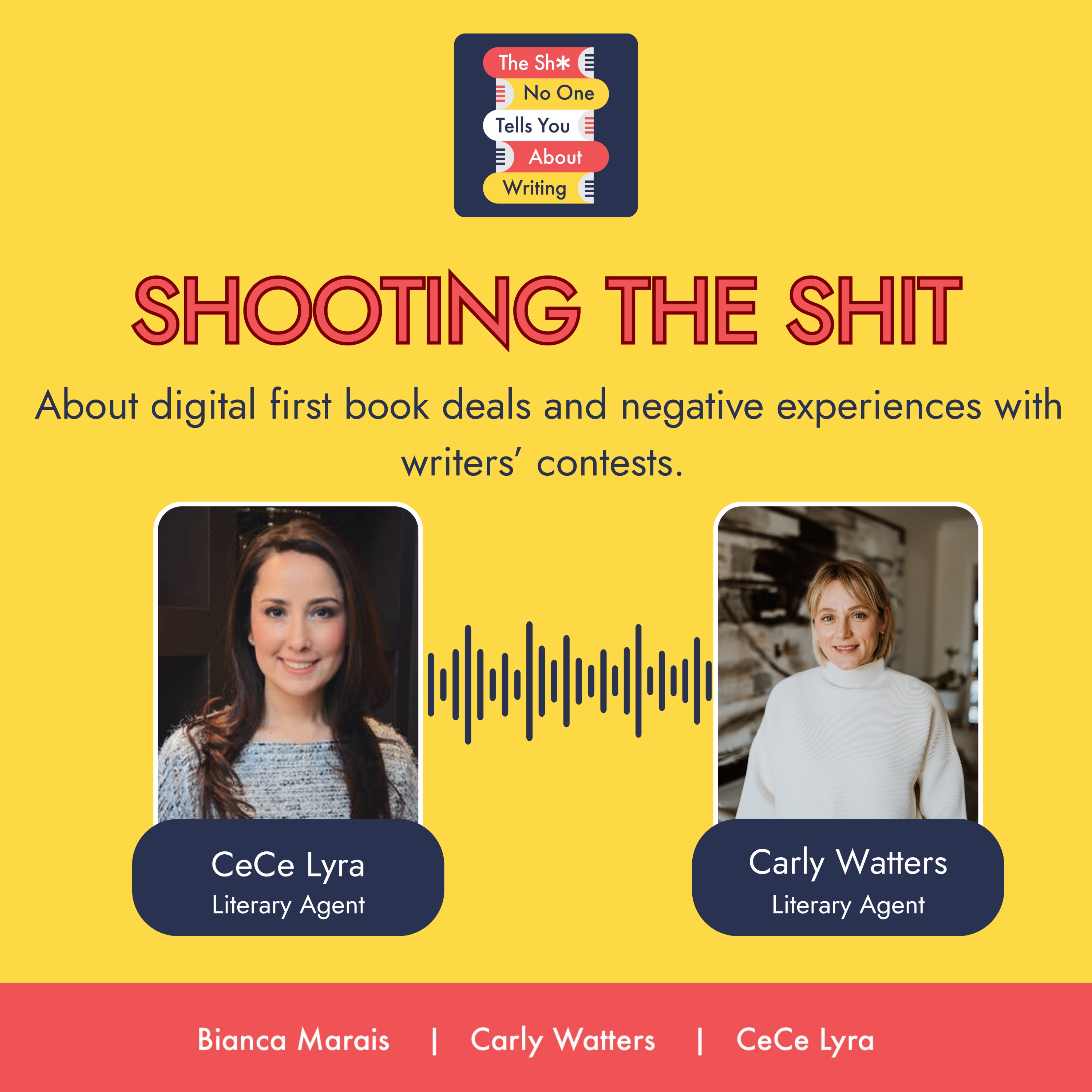
The Shit No One Tells You About Writing
Shooting the Shit: About digital first book deals and negative experiences with writers' contests.
00:34:25
Shooting The Shit
Loading summary
Transcript97 lines
- [00:01]
Cece Lira
What's up everyone?
- [00:02]
This is Cece. If you're a writer, then chances are you've wondered if your story is good enough. Maybe you're wondering that right now. I get it. Here's what I can tell you. As long as your story is making the reader curious, you're good.
- [00:15]
Now, I'm not saying you won't have.
- [00:17]
To make edits when working with an agent or publisher, edits are part of the game. But I am saying that you will get ahead in your career if you know how to make the reader curious. The best way to do that? Infuse your story with plenty of tension, conflict and stakes.
- [00:32]
Which is why I'm so excited to.
- [00:34]
Invite you to join my four day course, Writing Tension Creating Tension, Conflict and Stakes in youn Story. It starts on October 13th. My favorite part about this class is that there are formulas. Yes, formulas for tension, for conflict, for stakes, and for the first time ever, we're having two optional interactive components including a query letter, studio and live critiques of select first pages. I'm super excited about this new format because I've seen it yield results in writers works and it works for writers of any genre as long as you're serious about improving your work. So if you're ready to take your writing to the next level, join me for this four day course. Don't worry if you can't attend live, the sessions will be recorded. For more information, check out my bio on Instagram or the podcast's website. I'm looking forward to seeing you there.
- [01:33]
Bianca Marae
Have you been sitting on the fence about signing up for the Beta Reader matchup? Or have you signed up before but haven't as yet found your writing Soulmates the next matchup is the last one of the year, so don't snooze on it. Get matched up with those writing in a similar genre and or time zone so they can critique your work as you critique theirs. Your manuscript doesn't have to be complete to sign up for this 3,000 word evaluation. This particular matchup will be open to registrations from now until the 2nd of November, with the matchup emails going out on the 3rd of November. For more information and to register, go to Biancamarae.com and look for the Beta Reader Matchup tab. Please spread the word even if you aren't signing up this time. The more writers we have registered, the better the matches will be, which means you'll be paying it forward to your fellow authors.
- [02:28]
Carly Waters
Welcome to another episode of Shooting the Shit with literary agents Carly Waters and CeCe Lira, where we dissect publishing gossip, discuss book industry trends, and the overall state of the book business. If you've ever wanted to grab a coffee with two literary agents, grab your mug and pull up a chair. Hi, everybody. We're gonna play a fun version of this episode, including where are CeCe and I in the world right now? Where did we just come from? Are we prepared? Are we not prepared for this episode? We will see. It's a bit of a wild card today. Cece, where are you right now?
- [03:07]
Cece Lira
Is there even a thing as prepared in an episode called Shoot the Shit? Like, I feel like we're always prepared because we're just shooting the shit. I'm in New York right now, but I know you just came from Dallas, is that right?
- [03:17]
Carly Waters
I did, yeah. I just got back from dfwcon. I did the keynote on Saturday at lunch. I love doing keynotes. I think they're fun. It's a little bit nerve wracking. Of course. My stomach's, like, broiling a little bit, but it's totally. It's totally fine and normal and healthy to, you know, push ourselves into new directions and ourselves. So I. I love that for myself. Had a lot of fun. Everybody there is so nice. I'd been to that conference before. I'm trying to figure out. And you guys can obviously, like, comment on YouTube or GMS, but I'm trying to figure out how to use the keynote that I did. So the keynote that I did was on AI and authors and you know, just bringing everybody up to date about where everything is with the court cases and just strategy and philosophy about why I think that writers should not be using AI and kind of backing it up with data and information. So that was kind of the framework for the keynote. And so I was trying to figure out, should I potentially, like, record it again and give it to our Tuesday subscribers for our newsletter? That was an idea that I had. Yes.
- [04:17]
Cece Lira
I'm deciding yes.
- [04:19]
Carly Waters
Okay. Okay.
- [04:19]
Bianca Marae
Comment.
- [04:21]
Carly Waters
Send us a comment either The. The YouTube DM or the YouTube comment section. Sorry. Or DM us, but I. I think I'm gonna do that. I was thinking about doing it on Instagram, how you can do like a carousel kind of like essay style. I was thinking about that, but yeah, I might record it for us for our Tuesday subscribers. But anyway, yeah, let me know what you guys.
- [04:38]
Cece Lira
Send us a comment agreeing with me, because I'm right.
- [04:42]
Carly Waters
No. Yes.
- [04:42]
Cece Lira
It's gonna be great. You're gonna record it and I'm gonna have fun watching it. I didn't get to go, but I saw a bunch of people posting about it, posting, like, really cute pictures of you speaking. And it was fun. And, yeah, I saw even quotes that people posted. So, yes, do it.
- [04:57]
Carly Waters
I was quotable. Yeah. Somebody came up to me after. They were like, I was taking notes, and I didn't know this one word that you said. So I got up my notes and filled in the gap for them. So they're like, okay, great, I'm saving this. So, yeah, so it's a quotable keynote, I think, and very relevant. So, yeah, I'd love to get that to you guys. So that's what I did. So I flew out Friday morning. I was in Dallas, Fort Worth area by, let's say, 2:30pm Central Time. And so I, like, hung out on the Friday night, the Saturday night I was working at the conference. And then my flight was Sunday at 7am out of Dallas Fort Worth. So I was, like, barely on the ground 48 hours. But I checked out the Fort Worth stockyards with my client, Anna Mitchell. We had breakfast and kind of walked around and hung out, which was really great.
- [05:38]
Cece Lira
Did you eat good food?
- [05:40]
Carly Waters
You know, I did. Yeah, I did. This conference is really good about taking the agents, they call them like the VIPs, to offsite locations so that we can get great food and chat. We can also talk a little bit about, like, how it works from the agent side at conferences. Because usually somebody picks me up at the airport, you know, from the conference as an opportunity for volunteers to get a little bit of extra face time with the agents. John. John was my wrangler. John picked me up from the airport. He's like, I'm wearing a blue Mets hat. You know, tell me what he's wearing. He grabbed my bag, brought me back. So he brought me to In N Out Burger so I could eat some lunch. Cause I hadn't eaten lunch because my flight was a little delayed and brought me back to the conference. And so a lot of conferences like this do a great job of just giving the agents a wrangler, also to make sure that the agent shows up where they're supposed to show up, obviously. But I always appreciate it because they make sure I'm fed and watered and where I need to be. So, cece, do you have the same. When you do conferences, this doesn't apply.
- [06:29]
Cece Lira
To you, but for me, the wrangler is very important because I am very spatially navigationally challenged, as you know.
- [06:37]
Carly Waters
Yes.
- [06:38]
Cece Lira
Do not know where I'm going ever in my Own neighborhood. I get lost. It doesn't matter. So, yeah, Wranglers, we appreciate you.
- [06:45]
Carly Waters
We do, yes. And obviously, since it was in Texas, being called the wrangler was obviously just right on point. So it was great. So that was my experience. And so, cece, you're in New York. What are you up to this week in New York?
- [06:56]
Cece Lira
So I have a very meeting, heavy week. So we're recording this. It's 1:00pm It's 1:00pm yeah, I had a breakfast meeting and two coffee meetings. I am very caffeinated. No complaints here. Love being caffeinated. I do switch to decaf as of the second cup, but, you know, it still still has a little bit of caffeine. Also ate a lot of cookies. And my film and TV meeting was so much fun. I mean, we're not going to use names because. But you know who it was with, because it's the same person. Yoga.
- [07:21]
Carly Waters
Yeah, I know exactly who it is. And she's great.
- [07:23]
Cece Lira
Yes. And she's great. And it was so much fun. And yeah, we talked about the industry and we talked about how, you know, in, in publishing and in film and TV adaptations of books, you. You have this idea that, you know, this doesn't sell. Like, I'll just give you an example. Historical fiction doesn't sell. It's really hard to adapt. It's really tough. It's expensive. You have the settings, the costumes, the cars, you know, all these things to change. And that costs a lot of money. And then, of course, you know, she just had a huge auction for historical fiction project.
- [07:53]
Carly Waters
Of course.
- [07:53]
Cece Lira
So there's this idea where it's like, oh, this doesn't sell. And then it's does, but.
- [07:58]
Carly Waters
Except when it does, it does.
- [07:59]
Cece Lira
Exactly right. And it's like this whole huge industry of. What did she say? I'm actually going to look at my little notebook. She said, this is so funny. She's like, it's always the unsellable that sell for big numbers.
- [08:12]
Carly Waters
Yeah.
- [08:13]
Cece Lira
Because everybody's saying what they don't want.
- [08:14]
Carly Waters
And then all of a sudden somebody wants that and they're like, well, that's because nobody else wanted it, so now I can have it.
- [08:18]
Cece Lira
And then also, like, we might say what we want and don't want, but at the end of the day, a talented author will serve us what we did not know we wanted. Right. We had no idea. And I was actually thinking about this as I was like, thinking back of like coming back recording this and bringing my notebook. I think that if I were to lose this Notebook. Carly, your notebook is the same. Because I've seen it. People would think that we're like, psychopaths. Oh, yeah. Because there are things here like love's murder. Because we're writing about fiction, right? Love's murder. Really into psychotic voices.
- [08:49]
Carly Waters
What does this even mean?
- [08:51]
Cece Lira
Really into psychotic voices. I know what it means. But imagine someone picking up this notebook. Any literary agent's notebook. Oh, gosh. It would be really fun. It would be really beautiful.
- [09:01]
Carly Waters
Really hilarious. Yeah. So my notebook is, like, broken up by the days of the week, but I never write in the right day. I'm just like. It's. It's completely diagonal. I don't know what's wrong with me.
- [09:10]
Cece Lira
No, it's not wrong with you. You're a free thinker. You're a free thinker. It's wonderful. Yeah. I have a bunch of meetings. We're going to celebrate as an agency, everyone at Wendy Sherman. We're going to celebrate 25 years on Thursday. So I'm excited for that. Yeah, Just. Just very meeting. Heavy week. And it's a very sunny week today. Like, the sun is out. At least now I'm pretty sure it's going to rain on Wednesday. So I have my hats, my big hats, and I'm walking around with my big hats.
- [09:34]
Carly Waters
Yeah, like, when it's sunny, you're wearing a hat. When it's rainy, you're wearing a hat. You're just all just hats.
- [09:39]
Cece Lira
But I get to, like, look less weird. I think, when it's sunny and wearing a hat just looked a little bit less weird, you know, no one else is weird. I think you should bring back hats. Hats are fun and hats are cute.
- [09:50]
Carly Waters
I. Yeah, I agree. I've always been a hat person. We can't wear them on the show, obviously, because of these headphones. But if you see us in the wild, let us know how you feel about hats. So we got some really interesting DMs. So one of the reasons we didn't overly prepare for today's episode is because we had some juicy DMs in the vault. Let's just say that we'd kind of been holding back to chat about. And I'm excited about these juicy ones that we can kind of go a little. Go a little deeper on them, go in some different directions. And we love hearing juicy details. We were like, is this right? Is this in the gray zone? Is this ethical? Or, you know, how do you feel about this? Very, very complicated subject? And again, one of those things that we can't always tackle in a very specific Q and A type of episode. But we can kind of free freewheel a little bit.
- [10:34]
Cece Lira
Yeah, for sure. Which one do you want to do first?
- [10:37]
Carly Waters
Oh, I don't know. Why don't we start with the first one.
- [10:40]
Cece Lira
Alrighty. So I'm going to read this and I will make sure to anonymize anything in case there is anything to anonymized. This person says hi and says that we're really great and compliments us which thank you. My ego is very happy. And she's just saying she likes the new segment. A question Looking at the newsletter Great article re Digital first publication. My UK agent has told me my supernatural thriller based in a very specific location, which to me sounds very appealing actually may go direct to Digital first. Right? May go to Digital first. If I'm even lucky to get a deal, that is. I was hoping to debut with a traditional deal. I'd love to know your thoughts on Digital first. And this person says, we've met at a conference, so yay. And I didn't remember them when I saw their profile, but after clicking on their profile and going through their pictures, not in a weirdo way, this person has an open account. I did remember them from the conference.
- [11:39]
Carly Waters
Awesome. Yeah, this is a really interesting question. I think my answer to this has changed as things like this do over the years. It also depends on like who the digital first publisher is, right? I think there's a lot of like ifs, ands, buts to kind of link all of the different variables of this conversation together. So Digital first just so we can maybe start with some definitions so just everybody's on the same page, right? So Digital first means that you do a book deal with a publisher knowing that they are a digital first publisher, meaning they're going to do ebook or digital audio and not necessarily print. So this says Digital first, but kind of means like essentially digitally exclusively. Unless there might be a huge demand for the book to be done in a traditional print run or there's a POD print on demand component to it where people can still order a physical copy. But it is pod. It's print on demand. It's not actually like a print run that was done. Obviously this is a cost saving measure. I'm sure as you guys can imagine, some categories do a bit better in digital. Anyway, some of the things to run through about Digital first are the royalties are usually higher because they know that this is potentially a bit more risky for the author. You know, they're foregoing a traditional book deal Therefore, they're trying to incentivize authors a bit more. So the royalties can be anywhere. Again, depending on the publisher. I'm not going to name names because this person isn't either, really. Could be anywhere from, you know, 35 to 60%, you know, kind of in that frame, obviously, Cece, if you've seen or heard otherwise, let me know. But it depends on. Yeah, it depends on a few things.
- [13:11]
Cece Lira
I don't actually think I've seen higher than 50. It's great to know that sometimes 60 happens.
- [13:16]
Carly Waters
You know, obviously there's, you know, escalators and other things that can come into play. So again, really depends on the publisher. So just so you guys know, this is dramatically higher than traditional publishing, because traditional publishing does ebook royalties at 25% net, and this is all still net, but, you know, potentially up to 50 to 60% net, which is obviously double, potentially, of what traditional publishers are giving you. So it's riskier for you. Obviously, you're starting your career in a digital first space. So, yeah, there's a lot of different angles we can take with this conversation. It's like, is this the right choice for you? Yeah.
- [13:50]
Cece Lira
When it comes to the royalties, it's also important to know that, like, some digital first publishers, maybe even many, I don't know, I've never counted, they sell their ebooks at a lower rate. Like a lower price point, I should say.
- [14:01]
Carly Waters
Yeah, like a $4.99 exactly.
- [14:04]
Cece Lira
You know, so. So you're getting. Let's say you're getting 50% royalties. You're getting 50%. And you have to take into consideration, like, what the book is sold for. Right. Because it's 50% of something. And then it can be nut. It could be like, et cetera. So that matters too. Like, the price point's different. When ebooks became a thing, I mean, there was a scare. Ebooks are going to replace print books. All that. That didn't happen. But I remember reading an article way, way back before I was a literary agent. I was just always interested in reading. I remember reading an article about how, you know, if a book was sold for at the time it was $1.99. Certain categories could have great sales because people were willing to take a chance on a $1.99 ebook. Books are expensive. Not everyone wants to spend $30 on a book. And so that's another thing to consider when you think about the royalties. But again, I don't want us to get, like, too lost in the economics of it, because the question is I mean, this person who reached out to us. Thank you for reaching out to us. By the way. Thank you for, for sharing and for asking that question. You're saying, hey, I want a traditional deal. Right. Cause that's where your heart's at. And if I were speaking with you, which I guess I am in a sense, my first question to you would be like, have you examined this? I am not pro digital first, but I'm also not anti digital first because I think that it's. As agents, it's our job to learn what the market is doing, to always, you know, be aware of new forms of publishing and of getting the word out there on a. And not being, I guess, a blanket statement like pro or anti doesn't really work. I think what works is it depends on the case, it depends on the author, it depends on the book, it depends on the moment. It depends on so many things. And you're saying, I really want trad. And like, that's really cool. If you've examined this, my first question is, have you examined this or is it just like a knee jerk reaction? Knee jerk reactions are often unconscious reactions. Shout out to my fabulous client, Dr. Courtney Tracy, the truth doctor online for teaching me all about the unconscious. But no, seriously, like, we are first. Like, no, I don't want this. It often comes from a place that we haven't examined. So I would examine that. Maybe you do want it, maybe you don't want it. And to know you should research digital first. And of course we're going to talk about it here too.
- [16:07]
Carly Waters
Yeah, like a number of things we can do. Right? You can talk to other authors on that imprints list, either like through your agent or through the publisher or in dm. Ask for other people's experiences because every publisher is different in terms of these experiences. So just make sure you go in like super eyes wide open. That's very important. The other thing is you said that you're hoping to debut with a traditional deal. You still can. Like, this book can sit in the desk for a little while. You don't have to publish that book now. You can go work on something else and debut traditionally and then make another decision about this. If you feel like it's just so timely, then I think you need to ask yourself, what is that urgency telling you? Where is that urgency coming from? Is the urgency just you wanting to be published? And therefore this is the book that's available and the deal could potentially be digital first, and therefore that feels like the right choice when it's actually not the right choice. The right choice could be, let's put the brakes on it. Let's work on another book, traditionally debut with that, and then decide if potentially someday down the line that you might want to do that one digital first. So I would say also examine the urgency and where that urgency is coming from and what actually would be the right choice.
- [17:14]
Cece Lira
I think that is so wise. Thank you for saying that. I also encourage listeners to check out my interview with Marjan, author of the Lion Woman of Tehran. It hasn't come out yet, so by the time this episode comes out, it will not have come out yet, I'm pretty sure, but it will be coming out soon. She talks about how, you know, people say life is short. She's like, no, life is long. That's the mentality you have to have for publishing. Because life is short makes you anxious and it makes you need to. I must be published by 30 by 40, whatever. And like, no, you must be published when your story is ready to be published anyway. I love that you said that. I also think it's important to remember that this person does not have a digital first deal or offer in front of her.
- [17:53]
Carly Waters
Yeah.
- [17:53]
Cece Lira
I want to say a few things. I have seen clients, Carly, I know you've seen this too. Be like, I don't want digital first. And then after their book doesn't sell in traditional publishing, I guess they go, okay, digital first, fine. And then they still don't get an offer. I want to be really honest about this. It's still really hard to get a digital first offer. It's not a situation where it's like, oh, it's the easy route. Like, publishers are discerning publishers. They want great stories. They still reject most of the things they get because they get way too many things. They can't publish all these books. The fact that it is digital first does not mean that it's easy to get. And I really want people to know this.
- [18:27]
Carly Waters
Yeah, I just want to add on to that because I'm just, like, nodding along. If you're not watching on YouTube, I'm like, frantically nodding because a lot of people think, like, it is a, you know, second tier, third tier in their mind. Right. But these digital first publishers do want to be chosen by you for a reason. And if you have a track record, they also want to know about that. So I know this person's debut, but I'm just talking in general. And the other thing is a lot of imprints and publishers that are very digitally focused actually don't want A debut author because they don't have a track to then like support into the metadata and into the ecosystem to justify. Because we know how hard launching a debut is. And launching a debut in digital first doesn't really actually make it any easier. That's another point I want to make really clear. So like, debut is hard no matter what. There's obviously tons of upside, but in digital first they sometimes can see that as a bit of a challenge because there's no kind of like nothing sticky online to like gravitate to and pick up on, if that makes sense. Yeah.
- [19:24]
Cece Lira
And another thing I wanted to talk about, I think this question gives us this opportunity. This has always been on my mind. So this person says, my agent told me that my story may go to digital first if I'm even lucky to get a deal.
- [19:38]
Carly Waters
Yeah.
- [19:39]
Cece Lira
And you know, I think this is a really great opportunity to talk about like how agents set expectations with their clients. And this reminds me of a. It was a tweet. This was back when Twitter was still Twitter. This is many years ago. I was already an agent. I genuinely think this was like four years ago, maybe five. There was a tweet by a person who said, and again, their tone was ambitious, frustrated. Their tone was very much like, I'm a go getter, I'm gonna make things happen. I'm paraphrasing, but the tweet said something like, I just signed a contract that my former literary agent told me I would never sign. I would probably never sign. I don't know why agents do this. I don't know why you keep telling authors that. You know, it's hard. Stop saying that. Get out of the way and let success happen. Again, I'm paraphrasing. I do remember some parts of it very vividly. But the idea behind this person who was being vulnerable, right? Like she was being vulnerable. She wasn't naming names or anything, but she was saying, look, book deals happen. She didn't say what the deal was she had signed. Like, my mind went to film and tv, but whatever, it was great things happen in the publishing industry. But as agents, a huge part of our job is to manage our clients expectations, is to tell our clients, look, just so you know, you know, the stats are really hard. It's really hard. We just did it. We just said, just so you know, digital first is not easy. It doesn't mean you will for sure get an offer. And I think that it's really interesting how each agent approaches managing expectations. Because the truth is, and I feel very Strongly about this, Carly, and I'm so curious about your thoughts. So much of it depends on the person you're talking to. Obviously the moment too. But like, there are people who, if you tell them it's hard, these are the stats. This is how often things get rejected. This is how often an R and R turns into an offer versus doesn't. If you give them information on how competitive and hard it is, they take that as okay, gotcha. I'm readjusting and recalibrating. I'm still gonna go. Like, their drive will not change at all. It might even somehow increase. You know, their strategy changes, but their passion doesn't necessarily. I mean, if it does, it increases. And there are people who hear that and it almost feels like throwing a bucket of cold water on them. You know, they go, oh, that's really discouraging. And they become sometimes paralyzed, sometimes irritated and frustrated. And also caveat that you can have more than one reaction, you can feel frustrated and then pivot to the super ambitious growth. But I just mean like long term reaction. And I think that it really depends on the person. It depends on how you frame things, of course. But you know, when your agent says to you, hey, it might be digital first. I mean, one thing they might be doing too is having a conversation with you. You know, Carly and I are the same in this because we've shared works together. You know, before submitting to publishers, we talk to our authors about what are your expectations, what are your goals? We will not submit to digital first publishers if clients aren't interested in that. Fair. But sometimes when we manage expectations, what we're trying to do is protect you. Yes, but honestly, 90% of it is empower you. It's empower you with the knowledge that you need to succeed in this market. Because to often people, people approach publishing kind of like they do at school. They think if they work really hard, they'll get an A and if they follow the assignment, they'll get an A. And publishing is not school. Publishing is. And I'm not saying school is also always easy, but publishing is a competitive industry. Like more people get rejected than not.
- [23:02]
Carly Waters
Yeah, I think that's one of the hardest parts of our job is kind of what I call the code switching. You know, it's like we're constantly code switching between all of these situations and there's a lot of responsibility and pressure on an agent to like, this client needs to be talked to this way, and this client needs this. And this evolves over time with the amount of education and information that they get about the business, then I can start to talk to them in a different way the more information that they have. So all of this also changes over time. And this is also part of the trust building because I also, I can give them all this information and then I need them to trust me that we are making the collective decision together. And it's just. Yeah, it's something that you learn as an agent. Because I think one of the hard things is when a client really, really, really, really wants something and the agent's like, I actually don't think that's the best move for you as an agent. Do I do what the client wants to happen or do I say, okay, maybe it's time for you to have another agent? Because just because you want that, does that align with what my core values are as an agent? And so those are some. Where some really complicated conversations have too.
- [24:01]
Cece Lira
For sure. It's why it's so important to have like open communication. But like I guess our takeaways are examine your goals, make sure your goals are conscious and mindful. Talk to your agent. You know, and remember all of publishing is competitive. All of publishing is competitive. We work really hard to manage clients expectations and also like the writing community's expectations too. I think about that a lot when we record our or other segment. Right. Like books with hooks.
- [24:28]
Bianca Marae
It's.
- [24:29]
Cece Lira
I want to be honest and I want to say what works and doesn't and how hard things are, but I don't want to depress anyone. It's so hard. It's so hard.
- [24:37]
Carly Waters
It's a fine line. I. But it's one of those things like both. It's one of those both can be true things. Right. It can be really hard and also be great.
- [24:44]
Cece Lira
This is, this is really hard and great.
- [24:47]
Carly Waters
I know I was speaking earlier about the newsletter and how much great stuff is going in there and terms of things we have planned. Does cece do have the list in front of you? Because we have some awesome stuff coming up.
- [24:57]
Cece Lira
Yes. Okay. This is really exciting actually because there's a book called the Gallery Assistant by Kate Belli. So Kate is sharing how she got her yes. After like a two year submission process filled with rejection and she flipped genres to get to where she is now. I'm really excited to read this book. So thank you Kate for contributing to our newsletter and I really am looking forward to reading your work and I think you guys will like it too. Crystal Schuyler, author of A Most Peculiar Poisoning, is sharing an author video I love author videos. They're so fun. It's filled with advice about creating the kind of atmosphere that does more than just bring setting to life. Setting to life is really important and so is apparently persistence, because that's her angle in this author video. Also, USA Today and number one Amazon best selling author Tralina Pucci, author of One Killer Night, is sharing a ton of excellent advice in the author Q A, including how literary foreplay can get the reader in the mood for the good stuff. I like this. I'm always saying storytelling is seduction, so I am very pro this. And finally, Mark Waddle, author of Colin Gets Promoted and Dooms the World, expands on Friday's essay with a bonus tip about how to write morally great characters that readers will root for. I know our newsletter is good because as I am reading promos for it, I'm excited to read it and I'm impatient because I have to wait. This is how I know stuff is good.
- [26:21]
Carly Waters
All right. And with that, we're going to throw to our sponsors and we'll be right back to talk about another great dm. Hey everybody, guess who's back from France. I was thinking of you guys listening to me talk about getting ready for the trip and practicing my French while I was doing my best order at the cafes. It went well. I was a bit nervous, but when we were in the countryside and I could take my time thinking about what I wanted to say, I was able to say it. Being a bilingual family is high on my list of things that are super important to me as a parent and a mom. If we're going to show them the world, we also need to appreciate and respect the language and culture by learning it it Imagine how much richer your travel experience could be if you could speak the local languages. When you travel with Rosetta Stone, you'll gain the confidence to have real conversations and create deeper connections wherever you go. Rosetta Stone is the trusted leader in language learning for over 30 years. Their immersive, intuitive method helps you naturally absorb and retain your new language on desktop or mobile, whenever and wherever it fits your summer schedule. With 30 years of experience, millions of users and 25 languages to choose from, including Spanish, French, German, Japanese and more, Rosetta Stone is the go to tool for real language growth. You can learn faster and retain longer. There's no English translations. You truly learn to speak, listen and think in your chosen language. There's an intuitive learning process. You start with words, build the phrases and progress to full sentences. It's designed for long term retention so it sticks with you. You can work on your accent with the built in True Accent speech recognition technology so help you sound more natural. You can learn anytime, anywhere. It fits with your lifestyle with the flexible on the go learning style desktop or mobile app and there's incredible value. A lifetime membership gives you access to all 25 langu so you can learn as many as you want whenever you want. Don't wait. Unlock your language learning potential. Now the shit about writing listeners can grab Rosetta Stone's lifetime membership for 50% off. That's unlimited access to 25 language courses for life. Visit Rosetta Stone slash Visit Rosetta Stone.com today to get started and claim your 50 off today. Don't miss out. Go to Rosetta Stone.com today and start learning today. You know I am not exaggerating when I say my coffee is my life. My brain doesn't come online until I've had that first amazing cup in the morning. And as writers who spend so much time and staring and thinking out of screen, you need that moment of ritual and focus more than anyone. For years I was chasing that perfect cup. But between messy presses and clunky pour over setups, I was spending more time on the brew method than at my desk. And if you haven't tried coffee made with an Aeropress yet, you are absolutely in for a treat. The AeroPress is a manual coffee maker, kind of like a French press, but frankly, it's just better. It uses completely unique brewing methods that combine the best of all the worlds. A little French press, a little pour over, and a little Espresso. This patented 3 in 1 technology gives you an exceptionally delicious and unique cup of classic coffee that you can only get with an AeroPress. And here's the coffee secret you need to know. Aeropress coffee is less bitter than coffee made with other methods because it brews faster. You can actually taste the delicious notes of the coffee you bought. Things like the roast and the country of origin and that flavor profile instead of bitterness you get get incredibly smooth richness and body coming through that unmatched. This is the ultimate lifestyle hack for a writer because aeropress was designed to fit your life. For the audience who spends hours in front of their computers, here's why the Aeropress Clear model is what you need. First, convenience. This is the fastest single cup coffee maker I've ever used. It takes about two minutes to brew and clean. That means less time futzing with gear and more time on your pages. Secondly, it brings consistently great coffee wherever you are. Maybe you're Traveling for a conference, in a cabin, for a writing retreat, or just working out on your deck. The AeroPress is compact, durable and reliable. And it puts an end to bad coffee when you're on the road. It's the perfect, easy to clean solution for the office, your home desk, or anywhere you're writing takes you. The AeroPress is shockingly affordable. Less than 50 bucks. We've got an incredible offer for our audience. Visit aeropress.com T S N O T Y a W that that's A e R O P-R-E-S-S.com T S N O T Y a W and use the promo code TYA to save 20% off your order. That's Aeropress.comT Snotya and be sure to use the code T S N O T Y A W at checkout to save 20%. It's time to ditch the drive through, toss the French press and say yes to better mornings fueled by Better Coffee. AeroPress ships to the USA and over 60 countries around the world. And we thank AeroPress for sponsoring our show out. All right, I'm going to read the next one. It is a lengthy one. So again, going to have to paraphrase a little bit here. So this is kind of a larger topic around when somebody wins a package. You guys know what I'm talking about. When it's like, okay, a manuscript critique or an editorial letter or an A and a zoom or a brainstorming session. When there's a fundraising thing going on, I usually offer like a 30 minute AMA Zoom, that type of thing. It's usually to raise money for something or it could just be to pay, you know, or bid for this opportunity. So this person says they had an opportunity where they won a signet. They're calling it a significant package. So, and I'm looking at it here, it's like multiple of the things that I just mentioned since signing the contract. There's a contract. The start date had come and gone and this person hasn't heard back regarding this package. So I guess they won the package. A contract was signed and they haven't heard back from this person. They are worried that something happened to this editor and they're concerned about it. They reached out to the organization that put the pitch package together, asked if they were still working. The response from the organization was, thank you for reaching out. The organization hadn't heard from so and so in a few weeks. But also they aren't involved in the kind of professional business contractual element of this. Once it leaves the contest's hands. So they are kind of saying, like, that's where the line is. Once it moved out of their hands, it's not in their hands anymore, and they hope that it gets resolved, even though it was organized through this contest. So this person obviously has some questions for us. Basically, they want to know from us they understand ghosting on querying, but for a competition, is this normal? What do you think about the organizers of this? Do you think that answer was okay? You know, do they have a responsibility to uphold the contracts and kind of quote unquote prizes that are paid for or won, obviously through these organizations? So this is a kind of a juicy one. Yeah, I have a lot of thoughts, but, cc, why don't you kick us off here?
- [32:38]
Cece Lira
I will kick us off doing the CECE thing where I zero in on one word, and I would like to challenge this lovely word to the lovely person. I know you didn't mean it in this way, but, like, you're calling it ghosting on cold querying. It's not ghosting. It's not ghosting.
- [32:53]
Carly Waters
Okay.
- [32:54]
Cece Lira
If I send out my resume to a company and the company doesn't invite me for an interview and just has a very clear line that says, we thank all applicants for your applications, but only those who make it to the interview will be contacted. That is not ghosting.
- [33:09]
Carly Waters
I'm getting off topic. We. We understand it's not ghosting.
- [33:14]
Cece Lira
Okay. No, but seriously, I feel very strongly that the competition should make it right for you. You. I do. And they can't force this person to be a responsible human and get back to you. Also, something genuinely serious might have happened to this person. So they might not be able to literally substitute the prize, but they should give you a prize. Like, they should find a way to make it right. This actually has happened quite similarly with our business. We've had situations where a prize was offered through our. I don't remember whether it was podcast or media or deep dive. Like, I don't remember, but, like, through one of our channels and the person couldn't honor the prize and we gave them a different prize. I know it's not the same. Like, in this case, the person very, in a very lovely way said the second prize was even better, so she was really happy.
- [33:59]
Carly Waters
But, well, that's up to the business to go above and beyond to make it right for their quote unquote customer.
- [34:03]
Cece Lira
Yeah, but what if this is like their dream edit, like, whatever, right? Maybe it won't be just as good, but it should be similar you know, it should be similar. Like, I, I think that if they offered this as part of a prize, I feel very strongly that they have to make it right and it's not okay. And you know, them saying, like, we hope this gets resolved. Like, turn that hope around and resolve it. Oh, yeah, use that hope as fuel so you can resolve it. No, I feel very strongly they have.
- [34:31]
Carly Waters
To make it right. Oh, I totally agree. I think this contest made a poor decision in how they responded. And hopefully maybe somebody's hearing this and maybe knowing that they are part of this organization because yeah, to me this is a customer service and a brand issue. It's so much larger than this, right? Because now you have this person who has a negative experience with your contest and all of a sudden, you know, word gets, Word's gonna get around, right? If somebody has a bad experience with your brand or your product, word's gonna get around. I'm just, I wanna rewind a little bit. So when I do these types of things I kind of explained before, like, so people reach out to me all the time. Wfwa Women's Fiction Writers Association. I'll often, often give something for that. I'll often give something for like BIPOC people in publishing in Canada. They do a giveaway. I'll often do. The ALA will also do one as well. So there's like a few organizations that I really make sure that I give my time to. And what I always offer, because it's kind of just easiest in a number of capacities is I offer a 30 minute AMA Zoom. And why this is easy for me is because I have a link that I can send to the organization that says when this contest closes, you send this link to them. This person fills in all this information. Because sometimes, honestly we are so busy, you know, if somebody reached out to me being like, I won this, you know, I just need a proper channel, right? So there could be. And I'm not making excuses for this person that's been ignored. But the reason I choose things that are really straightforward is I never want anybody to get lost in this process because I know as an agent, the authors have this, you know, when they have an experience with me, whether it is querying me or whether it is winning a contest with me, that it's always going to stick in their mind about, like, how they felt and how that agent made them feel. And so I take that responsibility really seriously. So it worries me a little bit that this organization isn't taking this really seriously because it's reputationally for this company, for the industry anyway. I could go on and on about why I think they need to make it right, but I definitely think there's a responsibility if an organization offers something and it can't go through for whatever reason that they do offer something else. For sure.
- [36:32]
Cece Lira
No, for sure. And there are many things that they could offer that would again make the author feel like they were properly taken care of. So. Yeah, thank you for reaching out with that question. It's. This is a no brainer.
- [36:45]
Carly Waters
Yeah, this is no brainer. One thing I didn't get in that I wanted to was this word contract. This actually worries me a little bit because it says since signing the contract, our start date has come and gone and I haven't heard from them. That part worries me a little bit as well because I actually think that makes this organization even more vulnerable that they put this person in a situation where they then went. Had to sign a contract for winning something. So I, I don't know. Again, I'm not the. I'm not the legal person, but I think there is a liability here of again, you put this person into. In a situation where they had to sign a contract. And we don't know what the ins and outs of the contract are, but usually there's a. Like if there's somebody can't complete the thing, there's like an out of some kind. Right. Or anyway, I think this is a fair contract.
- [37:25]
Cece Lira
Probably would have that. Right. Like one. One feels that way. Yeah. There's just. I mean, also contracts aren't like I've. I've never, you know, entered into a contract for a prize that I've won. Like, I've never.
- [37:36]
Carly Waters
Right. That's weird to me. Yeah.
- [37:38]
Cece Lira
Yeah.
- [37:38]
Carly Waters
But.
- [37:38]
Cece Lira
But you know, maybe this. Maybe. Maybe it's a situation where a contract does make sense. Like, I could definitely see that there could be that. And. Fine. But we don't know any of the specifics. But we do know that when an organization offers a prize like that and the prize isn't honored, it's up to the organization to make it okay.
- [37:57]
Carly Waters
Yes, we are in agreement on that. Okay. So I think those were most of our juicy DMs. Cece, was there anything else that we hadn't chatted about?
- [38:05]
Cece Lira
No, we. We got, we got through it today pretty quickly. Today's gonna be a short shoot the shit episode. Just a reminder, you guys can DM us.
- [38:14]
Carly Waters
I think I scared everybody from DMing me, so everybody's DMing Cece.
- [38:18]
Cece Lira
I don't, I don't necessarily respond to everyone, but I see every single one of them. I take a screenshot, I keep it in a little folder, and when it's time for us to discuss the content, we do. And as you can see, we keep it anonymous. If anyone does want me to read out their names, you should explicitly say that. And we will. That's totally fine. And yeah, there's just a lot that we could talk about. Publishing is a very juicy industry, so that should be fun.
- [38:44]
Carly Waters
Yes. Well, hope everybody's having a great, busy, busy fall. Us in. Publishing are super busy. I, you hope. I, I, I tried this new thing. I know I'm not going to show you guys because it has information on it, but I, I got these, like, mirror markers. And so I've been using these mirror markers to write down, like, all of the reading. I have to do the contracts, I have the pitches, I'm working on who's under option, who's in acquisitions meetings. Anyway, so I have this, like, you know those, like, crazy boards with all the arrows? My reading list is 1, 2, 3, 4, 5, 6, 7, 8, 9, 10, 11, 12, 13 clients and referrals. And so I've been working through them throughout the fall. So I've stricken out 1, 2, 3, 4, 5, 6, 7, 8. My boards are just like, ah. So I have tons of clients and referrals waiting for me to read their stuff. Trying to finish closing a deal today, trying to work on a contract tomorrow. So, yeah, publishing is just bonkers. And next week is Frankfurt Book Fair. So that's another. Is it next week? Yeah, because it's after Thanksgiving. Canadian Thanksgiving. So it is. It's Frankfurt Book Fair next week, so tons of busy stuff going on around here. And Cece, enjoy your week in New York.
- [39:49]
Cece Lira
Thank you. Enjoy your week. Yeah, books. Books are fun. That is the biggest takeaway. I will now head into my endless, endless string of meetings, which I love, and I'll keep you guys posted on how many books I come back with, because that's the best part.
- [40:05]
Carly Waters
Make some bets, guys. Make some bets. I've seen her pile. So when we recorded in New York last time, we actually used her book stack as a pile to record. Put the mic on to record. Yeah, so that's how, how big the stack was. So, yes. And bets. How many books does cece come back with every New York trip. Yes. Well, have a great week, everybody. See you next time.
- [40:25]
Bianca Marae
Cece Lira is a literary agent at Wendy Sherman Associates. If you'd like to query Cece, please refer to the submission guidelines@www.wsherman.com Carly Waters is a literary agent at P.S. literary Agency, but her work on this podcast is not affiliated with the agency and the views expressed by Carly on this podcast are solely that of her as a podcast co host and do not necessarily reflect the views, opinions, policies, or position of PS Literary Agency.
- [41:01]
Cece Lira
What's up everyone? This is cece. If you're a writer, then chances are you've wondered if your story is good enough. Maybe you're wondering that right now. I get it. Here's what I can tell you. As long as your story is making the reader curious, you're good.
- [41:16]
Now, I'm not saying you won't have.
- [41:18]
To make edits when working with an agent or publisher. Edits are part of the game. But I am saying that you will get ahead in your career if you know how to make the reader curious. The best way to do that Infuse your story with plenty of tension, conflict and stakes.
- [41:33]
Which is why I'm so excited to.
- [41:35]
Invite you to join me. My four day course Writing Tension Creating Tension, Conflict and Stakes in youn Story. It starts on October 13th. My favorite part about this class is that there are formulas. Yes, formulas for tension, for conflict, for stakes, and for the first time ever, we're having two optional interactive components including a query letter studio and live critiques of selecting first pages. I'm super excited about this new format because I've seen it yield results in writers works and it works for writers of any genre as long as you're serious about improving your work. So if you're ready to take your writing to the next level, join me for this four day course. Don't worry if you can't attend live, the sessions will be recorded. For more information, check out my bio on Instagram or the podcast's website. I'm looking forward to seeing you there.
- [42:34]
Bianca Marae
Have you been sitting on the fence about signing up for the Beta Reader matchup? Or have you signed up before but haven't as yet found your writing soulmates? The next matchup is the last one of the year, so don't snooze on it. Get matched up with those writing in a similar genre and or time zone so they can critique your work as you critique theirs. Your manuscript doesn't have to to be complete to sign up for this 3,000 word evaluation. This particular matchup will be open to registrations from now until the 2nd of November, with the matchup emails going out on the 3rd of November. For more information and to register, go to Biancamarae.com and look for the Beta Reader matchup tab. Please spread the word even if you aren't signing up this time. The more writers we have registered, the better the matches will be, which means you'll be paying it forward to your fellow authors.