← The Shit No One Tells You About Writing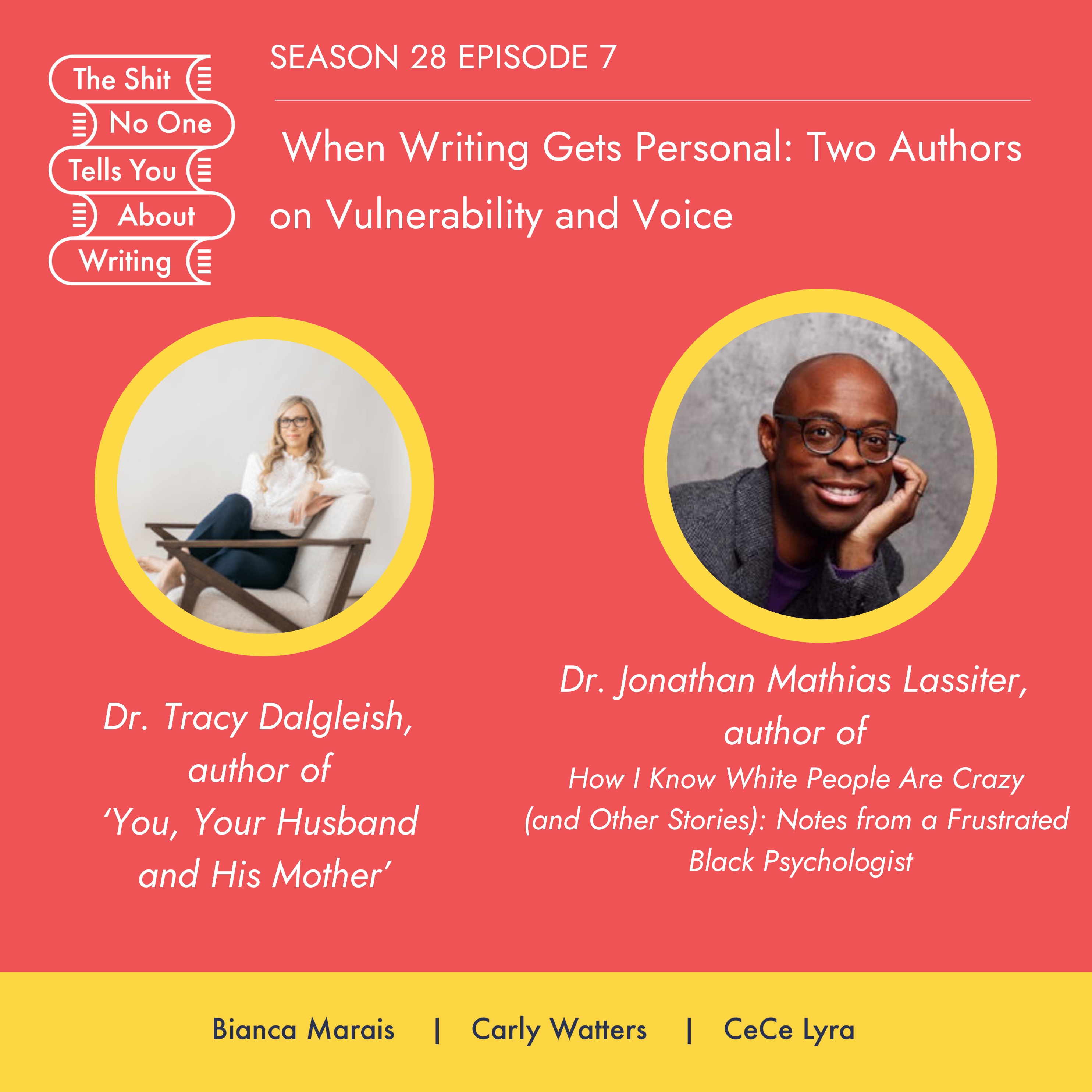
The Shit No One Tells You About Writing
When Writing Gets Personal: Two Authors on Vulnerability and Voice
01:19:15
Author Interviews Dr. Dalgleish and Dr. Lassiter
Loading summary
Transcript213 lines
- [00:00]
Wayfair Host
The holiday season is around the corner and I love hosting, but there's so much stuff needed and few places in my house to put it all. Wayfair's Black Friday sale is the time to get great deals on all things home, no matter what your style. Shop the can't miss Black Friday deals all month long and then you can sit back and relax because with Wayfair's fast and easy shipping, it's no problem at all. I ordered a new bookshelf cabinet where I can hide away my napkins, napkin holders, candlesticks, charger plates, and all the decorative things that I like to rotate between when the seasons change and different guests are over during the holidays. I found one that was the exact look I had on my vision board and my husband liked it too. So win win. There are so many to choose from and it's a breeze to find the right one that fits your style, size and space. So if you are also overflowing with books and seasonal items, you're going to love their selection of cabinets. If you're like me and love a loyalty program, you can earn rewards and get the best savings in the neighborhood with Wayfair's new loyalty program. 5% back on every item across Wayfair's family of brands. Free shipping, members only sales and more terms apply. Don't miss out on early Black Friday deals. Head to Wayfair.com now to shop Wayfair's Black Friday deals up to 70% off. That's W-A-Y-F A I R.com sale ends December 7th.
- [01:12]
Cece Lehrer
Woohoo.
- [01:14]
Bianca Murray
It's deep Dive time again where we host a two day virtual retreat attended by writers from across the world. And if you haven't been monitoring our socials or subscribing to our substack, you you won't know yet that we've announced that this will be our very last Deep Dive ever. Dun dun dun. So you definitely don't want to miss it. We'll be focusing on giving you access to a whole host of agents and editors who have worked on some of the last decade's best selling books, building a bridge between you and the so called gatekeepers of publishing. Subscribe to our substack or follow us on Instagram so you can be the first to be in the know as we begin to reveal our incredible lineup. Each week, mark these dates in your calendars. The Deep Dive will happen on 31 January and 1 February, with pre and post Deep Dive sessions happening the weekends before and after. And make sure you have 12pm Eastern Time on the 21st of November marked in your calendar for the early bird registrations. Hi there and welcome to our show the Ship no one tells you about writing. I'm best selling author Bianca Murray and I'm joined by Cece Lehrer of Wendy Sherman Associates and Carly Waters of P.S. literary.
- [02:42]
Cece Lehrer
Hello everyone. If you're watching us from YouTube, hi. I'm waving. Hi. If you're listening to us, hello. Welcome to. Welcome. Welcome. Today I have a very special guest. She is not just an amazing author, although of course she's that too. She's also my client. Dr. Tracy Dalgleish is here with us. I'm going to read you her bio straight up from her latest book. Dr. Tracy Dalgleish is a clinical psychologist, couples therapist and sought after relationship expert. She is the creator of Be Connected Digital where she teaches people all over the world how to have healthy relationships. Her work has been featured in outlets like the New York Times, Forbes and Time and her research has appeared in peer reviewed academic journals. She is the author of the book I Didn't Sign up for this and the host of the Top 100 Parenting Podcast. Dear Dr. Tracy, the owner of the mental health clinic Integrated Wellness. She lives in Ottawa with her husband and two children. Welcome, welcome, Dr. Tracy.
- [03:41]
Dr. Tracy Dalgleish
Hi, CeCe. Thank you so much. And it's always an interesting experience to have your bio read in front of you.
- [03:47]
Cece Lehrer
Right. How did that feel?
- [03:49]
Dr. Tracy Dalgleish
It's incredible. I mean, I remind people nothing happens overnight. What I've done did not just happen in the last two years. I think a lot of people see me publishing, see my online space and think, how many months have you been doing? And it's not months, it's years. And we're, we're looking at decades at this point.
- [04:07]
Cece Lehrer
Yeah. And also a lot of invisible work, I might imagine, right before the visible work happens.
- [04:14]
Dr. Jonathan Lasseter
Always.
- [04:15]
Dr. Tracy Dalgleish
And we're having this conversation. So for listeners, my husband and I are actually in business together. So in 2021 he joined behind the Scenes and he's been supporting my online work and all of the publishing behind the scenes pieces like pre order bonuses and things like that. In 2019, he's actually the one who initiated us opening our own mental health clinic here. So a lot of people see what I've created and what I'm doing and they think, oh, you're doing, there's two thoughts. One, you're doing this on your own, or two, you have this massive team behind you and it's in, it's in between, it's me and my husband. And there's so much invisible work that happens behind the scenes that a lot of people don't get to see. And I know we're going to talk more about it today.
- [05:04]
Cece Lehrer
Well, this is a really nice seg because you just said me and my husband. And of course, your new book, the title is you youu Husband and His mother. Again, our YouTube fans, I'm holding up the COVID It is a beautiful cover, in my opinion. I want to know how you feel about the COVID So please do comment on this. If you are watching you, your husband and his mother, I mean, the title says it all. It's about this triangle, right? Like this triangle in relationships. And whether you're a nonfiction author or a fiction author, relationships are at the heart of who we are as humans, of the human condition and therefore of writing about it. And so my question to you, my first question to you officially is we've been here before. I read your bio. You have a first book out. We worked on that book. That was the first time we ever worked together. And your first book came out a few years ago. And how does it feel to be back with your sophomore title? Like, not just here on the podcast, but you have now written two books. You know, like how, how do the experiences compare?
- [06:07]
Dr. Tracy Dalgleish
It's really interesting because I don't feel like the new kid on the block anymore. I've been here before. Things are familiar and, and also this really sinking into what it means to do something that you love. I love writing. I love sharing stories. I love peeling back the curtain and show what everyday lives look like and the real struggles. And particularly in this book and how different this one is from the first one because the first one read more like fiction and with more of a memoir feel to it. This one is very self help and there's stories in it, which I know people are just going to love to read the stories and see the very real struggles that people have in this dynamic. But to, to kind of sit in the seat and to say, oh, I'm doing this and it's thrilling and it's hard. And then at the same time, my brain is already on book three, you know that my brain is already going.
- [07:06]
Cece Lehrer
And I think that's the thing about publishing, right? Like what people see never matches what's actually happening behind the scenes.
- [07:13]
Wayfair Host
Yes.
- [07:13]
Cece Lehrer
Like what's happening behind the scenes matches what's happening now. But in with the time jump, you know, like, we'll be talking about book three when I Don't even know. Not now. But then you're thinking about book three.
- [07:25]
Dr. Tracy Dalgleish
Now. I saw this thread that said it was giving the Easter eggs from Taylor Swift's antihero video to then her Life of a Showgirl album out now. And someone's saying, wow, how far in advance has this person, you know, how's this creator, this woman done? And I thought about it. I thought about some of our early conversations. You knew this was going to be my second book a long time ago. I knew this was going to be one of my books back in 2011, in one of the first experiences I write in the beginning of the book. And so it's interesting being this creator and an author, because. So there's two thoughts I want to share here. One is, it's like the creative part that Liz Gilbert talks about in Big Magic, how it's like the universe is waiting for us to just grab it and pull it down. And both of these books very much felt like that. But this book came faster. I wrote it really fast. It was almost like the words were just hanging over me and I just had to pull it down. That was the first piece that. And I love that piece of. When we sit in our creative space and we don't let the front of the brain take over, and the front of the brain does all of the. Is this good enough? What are you doing? You're a fraud. Like, that's not perfect. That's not enough. And the front of my brain was so busy writing my first book. That was one. I had to really work through this one. It just felt like I was being. And the universe was providing me this book. I knew where it was coming from. And also, too for listeners, this also comes from my almost 20 years of working with people, the clinical work that I've seen, the everyday stories, and then how I integrate that together. So there's that element there. But, Cece, I think there's this other element here with this book where this time, more so than the first time, I feel like I am ready to release this to the world. And again, going back to what Taylor Swift had said about her album and about creating art and artists, it's that I don't get to control what other people do with this now.
- [09:41]
Cece Lehrer
Yeah.
- [09:42]
Dr. Tracy Dalgleish
And I'm going to put it out there and it's now yours. You get to decide what you do with it. I've given you this, this art, this piece. Now you get to decide what to do with it. And you and I have talked a lot about that. How other people's opinions of your work is none of your business. And that is something that I've really sunk into now as a second author versus the first author, first time author who was very caught up in am I good enough? Is this enough? Is it perfect? What are people going to think?
- [10:14]
Cece Lehrer
Absolutely. I love that. That's a really important message. And I feel like not only is it better for your mental health, it's also better for your creativity. Our brains waste energy when, I mean, I shouldn't say waste, but our brains spend energy when we are thinking about, am I good enough? You know, is this good enough? Are people gonna like it? That is. That is energy that we are spending on things. And so if we can not spend energy on those things, then guess what? There's more space freed up to do the great creative work that you do here. So for someone who is not familiar with your second book, give them the elevator pitch. Like, you know, someone asks you, imagine you're going through border control and you know, an agent's like, oh, you're an author. Like, what's your book about? What would you respond?
- [11:00]
Dr. Tracy Dalgleish
With nearly 20 years of experience, every single couple comes to my office wanting to get on the same page. And one of those biggest desires is about having healthy family relationships. And yet when you bring two different family systems together, sometimes, oftentimes this is a struggle. And the common theme I kept seeing for people is that women get stuck in this binary role. They're either the victim in the story, meaning that everything is happening to them, or they're the villain and they're scapegoated and they're called the bad guy, and all the problems are on them. And women today, especially women, know different and they want different. And we are parenting differently than previous generations. We're dividing mental load and visible labor differently. And we also expect more. And so because of this difference, there is this tension that's showing up between families not being able to communicate. And my goal with this book is so that you can pull your seat up at the table. You bring in your main character energy and you align yourself with your partner so that you can keep having those family events that are going to feel more aligned with you and have a strong marriage at the same time.
- [12:19]
Cece Lehrer
I love that main character energy. Love that. On the publishing side, you switched publishers for this book, right? So your first book, I didn't sign up for this, was with a different publisher and you made the choice and it was entirely your choice of going with a different publisher. This time could you share a little bit about that experience because I know that's something our listeners are, are going to notice and they're going to go like, huh, what's the story there?
- [12:43]
Dr. Tracy Dalgleish
It's a really interesting experience to take something that's familiar and then go to an unfamiliar space. And Cece, you know, and you've commented on this before of how therapists like of me that I describe experiences as interesting. And it is this curiosity on a lot of different things. First on procedures. Procedures are different. Processes are different. On opportunities also there's this sense of opportunity to try something different. And that's a risk. I think that's a risk like when we think about what our brains like. Our brains like familiarity. And so I knew what to expect with the other publisher. I knew what the process was going to look like and that was familiar. And then to go to somewhere else, it brings that skyded feeling scared and excited. How is this going to work? What will it look like? What's the editing process like? And I have nothing but positive things to say about making that change and having just this amazing team and full support behind that. And I think that as an author is exactly what we wish for. And to be able to say I've gotten that. It has just been amazing. I mean, and you've seen the behind the scenes emails and all the work that's gone into bringing this book. I had a really supportive editor who, you know, I think we communicated really well together.
- [14:17]
Cece Lehrer
Yes. And shout out to Lauren, Lauren o' Neill from Tartar. Yes. Big shout out. Lauren is, Lauren is one of the.
- [14:25]
Dr. Tracy Dalgleish
Good ones and she's been this right from the beginning when we first pitched the book, she was so excited. And I remember you saying like you could just see how excited she was for this book and for the concept and for the, the stories within it and how much we're gonna, how far we could potentially bring this book. And it really has been that just all throughout. And if anyone's ever kind of wondering, I, I think, I think of something that my dad had said to me when, when we were deciding whether to open our mental health clinic because it was a financial risk at the time. My family has this long history of entrepreneurship and business and he said without risk there's little reward. That's something I really hold on to in publishing.
- [15:17]
Cece Lehrer
Yeah. And you know, it's, I feel like when you are taking risks it helps to have someone in your corner and you have that with your husband who is someone who can help and obviously your family and I mean, I guess it just makes a difference to remember you're not alone, you know? And it's an amazing piece to have that kind of support. It's something you've developed and built over time, and it's really inspiring to see your answer. Makes me think that we need to tell listeners about the behind the scenes of pitching this book.
- [15:52]
Bianca Murray
So.
- [15:53]
Cece Lehrer
Okay, as Tracy's agent, I'll set the stage. She knew what her second book was going to be. She came to me and said, the number one reason couples are not on the same page has to do with in law behavior. And I was like, are you sure it's not money? She's like, no. And I'm like, are you sure it's not infidelity? She's like, no, those are things too. But the number one reason they're not on the same page and they're struggling has to do with in laws. And I'm like, okay. I don't know why I was so surprised, because I grew up in a house where my mom struggled so much with her in laws. Not at all her fault, by the way. I should say. Like, and this is not my mom brainwashing me, guys. This is just not who I am as a human. I'm a very critical person. That family was hard. My father's family was hard. Anyway, point is, as we know, that.
- [16:37]
Dr. Tracy Dalgleish
Many families are hard.
- [16:38]
Cece Lehrer
Yeah, yeah. But like, just saying, there's a lot.
- [16:46]
Dr. Tracy Dalgleish
Cece was also on my pre order bonus coaching call that I gave the other day. And so on the wall, just, just.
- [16:54]
Cece Lehrer
As a fun person listening in, I was, I had nothing official to do with it. I was just like, can I go?
- [16:59]
Dr. Tracy Dalgleish
You. You heard the stories. And Greg has also. I mean, Greg knows some of the, the stories that come in and he's, you know, just that, like, whoa. I. I. Don't interrupt the story. You keep going because I have something in there.
- [17:12]
Cece Lehrer
No, come on, let tell me.
- [17:14]
Wayfair Host
There's one.
- [17:14]
Dr. Tracy Dalgleish
There's one piece I want to add because I remember you saying this and you had said, I kept asking other agents or editors if they had a good relationship with their mother in law or no, how's your relationship with your mother in law? And you came to me saying, everyone keeps saying they have a good relationship with their mother in law. So I don't know about this book. And then when I ask my community the different question, and this is the key piece, this is the difference. Have you and your partner ever gotten into conflict because of his mother? 86% of people polled Said, yes. And that's the difference there. Because a lot of women, here's the power dynamic as a daughter in law, we want to be liked and accepted into their family. And so we are going to say, yeah, it's a good relationship. We're probably not going to tell you all of those little paper cuts that have been happening over the years.
- [18:06]
Cece Lehrer
I also feel like the bar is so low for what society considers to be a good relationship with in laws.
- [18:12]
Dr. Tracy Dalgleish
Right.
- [18:12]
Cece Lehrer
That often people say, oh, it's good, it could be worse. And then they think of like some other scenario where it's really, really, really bad. Like three reallys versus two reallys or one really. And then they say it's good, you know, because we, we, we have that tendency to like diminish. Anyway, point is, I was like surprised that it was the number one source of conflict, but I'm like, that sounds so great. So I started asking around to see which editors to submit this to. This is a very fluid process because you really want to target the people who have the vision for the book and who understand it. And yes, to a degree, that's a personal thing.
- [18:46]
Dr. Tracy Dalgleish
Meaning.
- [18:47]
Cece Lehrer
I remember one editor said, I get along with my mother in law really well, but my mom didn't, you know, like her mom hadn't. And so she understood the conflict because she had seen it between her mom and her paternal grandmother. I know another editor who said, this is someone who offered on your book, but. Or who was about to offer. We'll get to that story soon. Another editor said, I don't have a mother in law because her husband's mom had passed away, but her brother, she saw how her mom treated his wife, meaning her kind of sister in law, you know, like. And she was like, my mom is a terrible mother in law and she's a wonderful mom. I don't understand, like, how could she be a great mom and a terrible mother in law? And she often sides with her brother's wife and goes, stop. Like, stop, you're not being reasonable, mom. Anyway, point is, it doesn't have to be your relationship with your mother in law. Like, it just does not have to be for you to understand the appeal of this book. And so I was trying to find editors and so we did and we went out on submission. And again, I did have a moment where I was like, is this book going to be too niche? Because people keep telling me, I love my mother in law. Holy guacamole. Everyone wanted this book. Everyone. And their mother and their mother in law wanted this book, Everyone wanted this book. And we were all set to go to a major auction because everyone was telling me, like, I'm going to go to war for this book, et cetera, et cetera. We had lots of calls with editors, lots of calls with editors. And there was one editor, of course, who on all the calls, really stood out to. To you. And this editor decided to preempt. And so a preempt for listeners, if you're not familiar, is when an editor makes an offer, and it is understood that this offer is higher than they might normally go, with the intention of conveying the message, hey, take the book off the table. Don't go to auction. Come with me. Meaning accept this preempt versus whatever could happen at auction. And when, if an author says no, the editor might still go to auction, they usually do, but they usually make a lower offer at auction. And then it can go up or it couldn't go down. Like, obviously, many things could happen if you go to auction. It's a bigger risk. But do you remember where you.
- [21:04]
Dr. Tracy Dalgleish
I'm still right. I'm still. Still right in that chair. My. I lived that moment. I have seen that moment many times in my mind. And my only sad part is I don't have it on video, which I'm also glad because I fully live in my moments in life. I know exactly where I was. And I remember saying to you, I have no words, and it brings tears, actually, to. To my eyes to remember this process of what Are you sure? Are you. And when you had text me to talk on the phone, I thought, oh, no, what's. Oh, my goodness.
- [21:40]
Cece Lehrer
I also remember you said something really sweet. I don't know if you'll remember this, but you were. So. You were traveling when this happened, When. When we first got the preempt. And I remember you saying, you know, I shared all the details, and you were like, it's her. She's the one I wanted. Meaning the editor. Right? Because again, you. You enjoyed conversations with all the editors, but the preempt came from the editor you really wanted to work with. And what I always tell my clients is, listen, preempts are great, but if it's not from your dream editor, then it's up to you. But I wouldn't go. I wouldn't go for it, no matter how high it is, because you want to work with the person who gets your book. And of all the calls, Lauren was the person who was most. I don't even think she was the most enthusiastic, though. That's also True. Everyone was enthusiastic. I think she got your vision, like she understood your vision for this book to a different degree. Would you agree?
- [22:32]
Dr. Tracy Dalgleish
Yes. Yes, I would absolutely agree. And everyone was so lovely and I think everyone could have brought the book to whatever they had that vision to be. But Lauren really was the I'm going to sit beside you and you guide.
- [22:44]
Cece Lehrer
Yeah. And then anyway, that's what happened. Tracy took the preempt and we're here with this beautiful book in front of us. I'm gonna hold it up again just because I love holding up this. Up this book.
- [22:54]
Wayfair Host
Book.
- [22:54]
Cece Lehrer
I'm having a problem because usually so agents get copies of their clients books. This is normal. It's in the contract. I'm having a big problem because my DMs are blowing up with people being like, oh my God, I really need a copy of this book. I really need a copy of this book. And I'm like, I thought you really loved your mother in law. Like, what's going on? Why do you need this book? Well, I do, but I could also really use this book. And I'm thinking to myself, all these sneaky people kept lying to me all these years.
- [23:24]
Dr. Tracy Dalgleish
You were asking the wrong question.
- [23:26]
Cece Lehrer
I was asking the wrong question. Also they were lying to me. Honestly, I'm like, now I know, now I know who, who actually needs this book or not. And I will say, as someone who legitimately does have a great relationship with my mother in law, I am very lucky. My mother in law. This book has types of mothers in law and my mother in law is a wonderful type that's in this book. She is amazing. She is my biggest supporter. She texts me all the time to say, I hear you have this big thing coming up. Whatever the thing is, an auction or whatever. You're amazing. You're going to kill it. I love you so much. Like, that's all she, she doesn't expect anything from it. She's just very supportive and kind and I'm very, very lucky. And my mother in law was here when, when we were having the calls and I remember she wrote a little note. Do you remember that? And I texted you her note.
- [24:14]
Dr. Tracy Dalgleish
I loved it. Her note was just the best. Yes.
- [24:18]
Cece Lehrer
And do you see, like this is, this is like, I feel like the test of like, do you have a supportive mother in law even when your daughter in law is an agent for a book like this? You're like, this is amazing. I love you. Good job with the book. Like, it's just.
- [24:28]
Dr. Tracy Dalgleish
Oh yeah, yeah. The pieces. This is not A book about lighting your torch and going to burn down doors. We're not doing that. This is about helping women feel seen, helping to share stories and give voices to the painful experiences that have happened. But also I sat with someone else on, on the podcast and on the, on someone else's podcast and they had said, I have a great relationship with my mother in law. I had some bumps with my sister in law. We are now in a good place. But when I went through your book and using the vault method inside the book, I immediately yelled to my husband, we need a marriage summit. Because she wants to take all those exercises just so they can get really aligned. And that's, that's what that method is. And a lot of people have said this, I could easily use this with my father in law. I can easily use this with my own sister. And it is about putting the marriage at the forefront because let's be real about this. When you're, when you're connected, when you feel secure, you're more resilient in everything you do. You're going to sit down at your desk and, and be able to be in your body and let the creative energy come through you rather than feeling the, oh, we just had this fight again about the holidays and now I'm thinking about, oh, I should have said this. And we're on different pages now. This is you getting on the same page and feeling so deeply aligned. And that is about resilience.
- [25:58]
Cece Lehrer
And, you know, I feel like what I was going to say is as someone who gets along with her mother in law, I still really enjoyed reading the book as a reader because first of all, it helped me understand other dynamics in my life. Not just mother in law dynamics and not just in law dynamics, but it also really. I don't know how you're gonna feel about this, but I'm gonna be honest, it was really entertaining. Like there were so many stories and the stories are so juicy and interesting. Kind of like the stories that I heard, you know, during the session you had. I feel like as an agent, I'm fascinated with human relationships. And so hearing these relationship stories, it's also really great inspiration. Oh my God, that could be a novel. I would totally read that novel. Like, it's just, it's just a fun book to read. You know, I don't think it was designed as, as a fun book to read in it as, you know, the number one goal of the book, but it's still a really fun book to read.
- [26:48]
Dr. Tracy Dalgleish
So I'm gonna plug the book then for authors. Because I know, like, I think of all of the amazing webinars you do and all of the such beautiful, powerful conversations you have on this pod. And it is about teaching people how to write about the interiority of someone, to talk about emotions, to hit those core struggles. So in chapter four, you learn what relationship cycles look like. You have to show a relationship cycle between whoever it is in your. In your story. And then in chapter three, when I go through the inner children, those inner childs that are inside of us, that still need love, support, and whatever that need is, you're going to learn what 10 are. And then you can use that in your story, in developing your characters. And that I know from writing even the first one and from your teachings and pushing me along with that one with my first book. Loved it so much. That's important. I know that that really matters in the, in this work.
- [27:46]
Cece Lehrer
And I will say chapter eight is great for tension. Great for tension because it's not just the continuity and the emotionality. Right. It's the conflict. Great. No, it is like it has so many valuable nuggets. Oh my God. This creates tension. And yes, as a fiction author, you might be like trying to create tension versus trying to diffuse tension. But learning to diffuse is essential to also conflict resolution, which might happen in your novel. So something to think about, everyone listening. Hardest part of writing this book and easiest part, like, what was the rose? What was the thorn?
- [28:16]
Dr. Tracy Dalgleish
Oh, goodness. And I love rose and thorn. We do that at the dinner table with our kids all the time. The hardest part, the hardest part of writing this one cc is actually the timeline. I gave a really tight timeline with the belief that I could do this, knowing how ready this book was to come. And I remember speaking to someone who I was working with and they said, huh, four months. Well, most people write a book in 12. Most self help expert, you know, you're an expert in your field, write books in 12 months, a month, a chapter. And you know, she was hesitant that we were gonna do this. And I said, we're going to do this. I, I am going to do this. And I did it.
- [29:06]
Cece Lehrer
And you did it.
- [29:06]
Dr. Jonathan Lasseter
I did.
- [29:07]
Dr. Tracy Dalgleish
I think I even submitted a week early, which is always like my, my joy something in early. And that was hard because I sat down with my family and again, this is the invisible stuff that people don't see as authors. When you see my book launch happening, when you see the posts on Instagram, the email letters, you don't see behind the scenes that I sat down with my Kids. And I said, hey, I've got this book deal. I'm writing a second book, and I'm gonna really need you all to support me through the next four months. And they did. And the most beautiful thing is my daughter. She was seven. When I had shared this with her, she said, mom, we've done this before. We know how to do it. But it was just the support from family. So that would be the thorn. The rose of this really is the entire experience from Tartar and Penguin. The whole team has just really championed the book, stood behind it. Having you as part of this. I mean, this journey, it's so meaningful because of how much I know people need this book, just how much. And last yesterday on the coaching call, people saying, I feel not alone. I needed this. I feel so seen, and I'm so glad it's not just me. And to know that this is meeting people where they're at, that is the most meaningful and powerful thing about that. And I know that's not quite about the writing process, but.
- [30:36]
Cece Lehrer
No, but, you know, it's all. It's all creation. So I love that. If you had to fill in the blank of the following sentence, how would you fill in the blank? I am a blank writer.
- [30:47]
Dr. Tracy Dalgleish
Oh. The first thing that comes to mind is I am a spicy writer.
- [30:52]
Cece Lehrer
I don't know.
- [30:53]
Dr. Tracy Dalgleish
I don't know if you believe that or not. Am I a spicy writer? Why did I think spicy? Wait, but it depends.
- [30:59]
Cece Lehrer
Define spicy.
- [31:01]
Dr. Tracy Dalgleish
I want to bring forward conversations that people are not having.
- [31:07]
Cece Lehrer
Yeah. Yeah. In that case.
- [31:08]
Dr. Tracy Dalgleish
That's what I mean.
- [31:10]
Cece Lehrer
See, we think of spicy, like, sexy writing, like, actual erotica.
- [31:16]
Dr. Jonathan Lasseter
I'm like, what?
- [31:17]
Cece Lehrer
I'm, like, all for it if you want to add erotica or future books, but, like, there's no erotica. Okay. Yes, I definitely agree.
- [31:25]
Dr. Tracy Dalgleish
It's. It's the conversations that people want to have but are too scared to have. That's what. That's what I mean. It's like, I'm gonna. I'm gonna take these hard conversations and bring them forward. Let's do this.
- [31:36]
Cece Lehrer
Yeah. You're a brave writer.
- [31:38]
Dr. Tracy Dalgleish
You're a brave writer. I like that.
- [31:40]
Cece Lehrer
I also think you're a chameleon. You know, Like, I don't know if there's an adjective for that. Chameleonique. That's probably not a word. We can make it up. Yeah, you're. You're capable of. Of switching gears and writing in different styles and with different intentions in a very impressive and deft way, which is really hard to do so.
- [31:59]
Dr. Tracy Dalgleish
Thank you. Thank you.
- [32:00]
Cece Lehrer
It's true. What message would you have for someone who wants to write? Whether it's a memoir esque book, kind of like your first book. Whether it's self help, expert driven. Someone who wants to write in the nonfiction space, creative nonfiction space. Like, what advice would you have for them?
- [32:20]
Dr. Tracy Dalgleish
The belief that your story should be told, that you need to first sink into whatever that is for you, and to believe that your story needs. Needs to be told and shared, and then to just keep sharing and talking about it and writing it. And if you get stuck. One of the things I've really leaned into through writing is not sitting at a desk. I go for walks and then I voice note myself as if I'm writing, and I talk about concepts and ideas and I tell stories just through hearing my voice. And so it's not this traditional. You see me sitting at a desk writing. I'm doing it in so many different ways.
- [33:11]
Cece Lehrer
Yeah, I love that. You're always creating. You're always creating. It's not just pen to paper or, I guess, fingers to keyboard. Okay, to wrap this up, we're going to do a lightning round. I asked on social media, what advice or. Or comment did you grow up hearing about in laws in your family? So I'll share my own. Something I heard as a kid a lot, and that's how I kicked it off. I said, I'll share. I'll share mine first. Something that my mom would hear a lot, which I overheard because I was, you know, the child in a house was. Never complain about your husband doting on his mom because a good husband is a good son first. Now we're gonna go through all these examples and you're gonna tell me lightning round, if you've heard this before in session from your clients or not. Can we do that?
- [34:05]
Dr. Tracy Dalgleish
Yep.
- [34:06]
Cece Lehrer
Okay. I have a feeling you're gonna hurt all of them, but maybe there's an original one. Okay, number one, never marry a mama's boy.
- [34:13]
Dr. Tracy Dalgleish
I've heard it before.
- [34:16]
Cece Lehrer
My mother would advise me, cut the umbilical cord between her partner and his mother.
- [34:21]
Dr. Tracy Dalgleish
Yep, yep. Umbilical cord. It's a very powerful analogy for the enmeshment that occurs.
- [34:28]
Bianca Murray
Okay.
- [34:28]
Cece Lehrer
Oh, my God. This one I've heard before, too. A son is a son till he takes a wife. A daughter's a daughter for the rest of her life.
- [34:36]
Dr. Tracy Dalgleish
Oh.
- [34:38]
Wayfair Host
Oh.
- [34:38]
Dr. Tracy Dalgleish
I. I have heard of some other pieces around something like that, but no, I haven't heard that one. Say it again just so I can hold on to it.
- [34:46]
Cece Lehrer
A son is a son till he takes a wife. A daughter's a daughter the rest of her life.
- [34:53]
Dr. Tracy Dalgleish
Wow. I've never heard that before.
- [34:55]
Cece Lehrer
Interesting. Do you know what? I. I don't know, but I wonder if it's a cultural thing anyway.
- [35:02]
Dr. Tracy Dalgleish
But I. I believe that is exactly the struggle, though. This is right across cultures, right? Yeah, but. But this is the daughter, so I haven't heard that rhyme before. But the daughter turns to her family always. But then the son is more likely to leave his family and not seek out their support because he goes with wife. Yes.
- [35:24]
Cece Lehrer
Okay, another one. How they act around their family will influence how they act around you.
- [35:30]
Dr. Tracy Dalgleish
Mm. Yep.
- [35:32]
Cece Lehrer
Always meet them first before you marry, so you know what you're gonna be stuck with. Stuck is such a horrible verb.
- [35:41]
Dr. Tracy Dalgleish
I've heard that before, of course. Well, and in my book, I talk about, do you choose your husband or do you choose their family to be.
- [35:49]
Cece Lehrer
The bigger person and not argue with them? This is the advice this person heard.
- [35:54]
Dr. Tracy Dalgleish
Oh, gosh. Yeah, I've heard that. And that I think. I mean, we don't need to use the word argue, but I think that that feeds into this. Like, why is it that we get so stuck here? Because this idea that daughters in law should be obedient, and this generation is not following into that, and it's such.
- [36:10]
Cece Lehrer
It's such nonsense. Because, like, I mean, I am a very. I'm a deeply confrontational person. So, like, take this with a grain of salt, listeners, but, like, be the bigger person and not argue. I agree that argue is not the best verb, but, like, how. How are you the bigger person? By remaining silent and just not speaking your truth. Like, how is that being the bigger person? Like, I don't like this framing. I understand. The person's not advocating for this. She's sharing things she heard.
- [36:35]
Dr. Tracy Dalgleish
Yes, that's given.
- [36:37]
Cece Lehrer
Yeah.
- [36:37]
Wayfair Host
Oh, yeah.
- [36:38]
Cece Lehrer
100. Oh, my God. Look at this one. Be kind to your mother in law. She gave up her son.
- [36:47]
Dr. Tracy Dalgleish
I have actually heard mothers in law say, you stole my son. You stole my son from me.
- [36:55]
Cece Lehrer
This person said, doing the dishes is a perfectly legal escape from his or her family. Okay, this is what I want to know. If you've heard it before and if you agree, never say anything negative about his mother. Not even if he's saying something negative. Don't even agree with him.
- [37:14]
Dr. Tracy Dalgleish
I've heard it, and I don't agree. And it's not. There's a caveat in here. It's a nuance. You're allowed to Say, I don't like this behavior.
- [37:26]
Cece Lehrer
Yeah, yeah. But be that negative.
- [37:29]
Dr. Tracy Dalgleish
Careful, though. Right. And so, so my guidance to people, though, is do not attack your husband's mother because you instantly trigger defensiveness. In, in any child, you would trigger defensiveness. You want to talk about behavior that you don't like.
- [37:44]
Cece Lehrer
Yeah. You want to validate. I mean, assuming that validation is merited. But, but not. Yeah, not insult. You handle your family and let him handle his.
- [37:54]
Dr. Tracy Dalgleish
Yes, I have heard that one many times. And that also is a nuanced piece of guidance.
- [38:00]
Cece Lehrer
Watch how he treats his mother. That's how he'll treat you.
- [38:05]
Dr. Tracy Dalgleish
I've heard it before. And I, I. You didn't ask me what my opinion on it is, but I am going to, to share that.
- [38:11]
Wayfair Host
Please.
- [38:12]
Cece Lehrer
Always share.
- [38:12]
Wayfair Host
Always.
- [38:14]
Dr. Tracy Dalgleish
I mean, I think that really, like, that depends. And, and that's such a psychologist response to say it depends, but because we see the broad human behavior and it's not what one person does. Everybody does. Because there are many situations where mom is on a pedestal and then he asks you to just obey and the treatment's not the same. Mom gets permission, but you are not given that same treatment.
- [38:43]
Cece Lehrer
I feel like that's, I honestly feel, again, I am not the expert here, but like, again, as someone who's obsessed with human relationships, I feel like this sort of framing is actually feeding into the conflict because so much of the conflict comes from women feeling like it's an either or thing. Like you can either be loyal to your mother or your wife. You can like, either. And, and no one's stealing your son. When you marry someone, if you are, that means you are now the mother. Nobody wants to be a mother to your husband. Like, that is not designable. And so I think that this sort of framing feeds the. No one says, oh, watches how he treats, I don't know, his co worker, or that's how he'll treat you. They specifically go to the mother. And I feel like that just fades into the whole, like you are replacing the mother when you marry, which is just, I mean, first of all, ick. No, no, thank you. Nobody wants that. Also weird.
- [39:41]
Wayfair Host
Yeah.
- [39:41]
Cece Lehrer
Anyway, I don't know.
- [39:42]
Dr. Tracy Dalgleish
And also, just for listeners, if they are in this sticky point, what I say to couples, I say this to men very clearly. We're not asking you to abandon your family. And now you are prioritizing your chosen family. Those emotions and needs in your home have to come first, and then you. And that's where my vault method comes in. You're building this sturdy structure. Your marriage, it's supposed to be aligned and on the same team. And then you bring your mom in in a way that works for both of you.
- [40:12]
Cece Lehrer
Yeah, listen, I'm going to quote my husband here, my husband definition of love. We once had a discussion like, what is love? And he said, love is priority. And initially I was like, I don't know that.
- [40:22]
Wayfair Host
I.
- [40:23]
Cece Lehrer
And then later I was like, oh, yeah, I agree. Like, love is priority. Love is priority. You know, you need to know what the priority is. Anyway, so I love that. Thank you. Thank you, Dr. Tracy. Thank you for joining. Okay, I'm going to hold up the book one more time as a very proud agent. Isn't it beautiful, everyone? So please go check out you, your husband and his mother. Whether you're reading this because you really need this book, because you're stuck in a dynamic that you want to feel unstuck and empowered, whether you're reading this for help with writing your own fiction because it's filled with interesting relationship dynamics, or whether you're just reading this for entertainment because it's also super entertaining, please go check it out. It comes out on November 4th, and we're all so excited. Thank you so much for joining us.
- [41:09]
Dr. Tracy Dalgleish
Thank you, Cece.
- [41:11]
Wayfair Host
Hey, everybody. Guess who's back from France. I was thinking of you guys listening to me talk about getting ready for the trip and practicing my French while I was doing my best order at the cafes. It went well. I was a bit nervous, but when we were in the countryside and I could take my time thinking about what I wanted to say, I was able to say it. Being a bilingual family is high on my list of things that are super important to me as a parent and a moment. If we're going to show them the world, we also need to appreciate and respect the language and culture by learning it. Imagine how much richer your travel experience could be if you could speak the local languages. When you travel with Rosetta Stone, you'll gain the confidence to have real conversations and create deeper connections wherever you go. Rosetta Stone is the trusted leader in language learning for over 30 years. Their immersive, intuitive method helps you naturally absorb and retain your new language on desktop or mobile, whenever and wherever it fits your summer schedule. With 30 years of experience, millions of users, and 25 languages to choose from, including Spanish, French, German, Japanese, and more, Rosetta Stone is the go to tool for real language growth. You can learn faster and retain longer. There's no English translations. You truly learn to speak, listen and think in your chosen language. There's an intuitive learning process. You start with words, build the phrases and progress to full sentences. It's designed for long term retention so it sticks with you. You can work on your accent with the built in True Accent speech recognition technology so help you sound more natural. You can learn anytime, anywhere. It fits with your lifestyle with the flexible on the go learning style desktop or mobile app and there's incredible value. A lifetime membership gives you access to all 25 langu so you can learn as many as you want whenever you want. Don't wait. Unlock your language learning potential. Now the shit about writing listeners can grab Rosetta Stone's lifetime membership for 50% off. That's unlimited access to 25 language courses for life. Visit Rosetta Stone slash Visit Rosetta Stone.com today to get started and claim your 50% off today. Don't miss out. Go to Rosetta Stone.com today and start learning today. Yes, that's right. The countdown is on. Holiday shopping season is here. Uncommon Goods takes the stress out of gifting of unique, high quality finds that you won't see anywhere else. Don't wait. The most meaningful gifts get scooped up really fast and now's the perfect time to cross the names off your list. Stop scrolling endlessly for generic gifts. Head to Uncommon Goods. They do the heavy lifting, hunting down products that are not just high quality but genuinely unique. We are talking about items that are often handmade or crafted in the US and frequently sourced directly from independent artists and small businesses. It's the secret to giving a gift that is both perfectly made and truly memorable. I was on the site getting Christmas gift ideas from my boys when I spotted the perfect thing. A little bedside caddy for their books. Made of repurposed quilts. It was absolutely stunning and so practical. It tucks in between the bed frame and the mattress and has tons of pockets for notebooks and books and pencils and water bottles and more. My older son has just learned how to fully read on his own. I know I am absolutely obsessed with this. So so he needs a place to tuck those new books when he's done for the night. All of us can go to any other old website and get something made quick and cheap, but a unique quilted item that has personality and is truly one of a kind because it is made of random fabric. That is what I am looking for. Uncommon Goods has something for everyone from moms and dads to kids and teens, book lovers, history buffs and die hard football fans to foodies, mixologists and avid gardeners. You'll find thousands of new gift ideas that you won't find anywhere else. When you shop at Uncommon Goods, you're supporting Art Thunder small and independent businesses. Many of their handcrafted products are made in small batches, so shop now before they sell out this holiday season. And with every purchase you make at Uncommon Goods, they give back $1 to a non profit partner of your choice. They've donated more than $3.1 million to date, so don't wait. Cross the names off your list before the rush. To get 15% off your next gift, go to uncommongoods.com t snotyaw that's uncommongoods.com t S N O T Y A W for 15% off Uncommon Goods we're all out of the ordinary.
- [44:59]
Cece Lehrer
Welcome all listeners to a very, very, very special episode. I'm like the happiest person over here right now because today we have an author whose book is going to change the world. Like, I'm not kidding. I am not overselling it. So. Dr. Jonathan Lasseter is a polymath whose mission is to help others heal and thrive. He's a licensed clinical psychologist, author, speaker and educator. Dr. Lasseter has been featured on NBC, PBS, Cyrus, XM Forbes, and more. His psychotherapy practice is based in New York City. And this is not in his bio, but he's also my adored client. His book, How I Know White People Are Crazy and Other Stories, Notes from a Frustrated Black Psychologist. You know, all my books are special, but I just. I'm hugging this one. I'm hugging this one. I want you guys to know that I'm hugging this one. It is a very special book. Welcome, Dr. Jonathan Lasseter.
- [45:59]
Dr. Jonathan Lasseter
Thank you so much for having me. Cece, I'm so excited to be talking with you. I'm so excited to be talking on this podcast in particular, the shit no one tells you about writing. I don't know if I could go, maybe I could bleep it.
- [46:13]
Cece Lehrer
Totally do it.
- [46:14]
Dr. Jonathan Lasseter
Okay.
- [46:15]
Cece Lehrer
Totally do it.
- [46:15]
Dr. Jonathan Lasseter
It's in the percentage, right? So. But I. Because I've listened to, you know, I listened to the podcast and so I'm super excited to be on and I'm super excited to talk to you because as I've told you countless times offline, like, I just trust you so much and you are like the foundation for me in this whole process. So I'm excited to share with the listeners this journey that we've taken together.
- [46:44]
Cece Lehrer
And it's been quite a journey. Let's go all the way back to, gosh, 2021.
- [46:51]
Dr. Jonathan Lasseter
2021. I think so.
- [46:54]
Cece Lehrer
I think, yeah. So you sent out a query letter to P.S. literary, my former agency. But plot twist, the query letter wasn't for me. Tell us about that. Put us in that headspace of like, I'm sending out a query letter. How were you feeling?
- [47:09]
Dr. Jonathan Lasseter
Yes. So I'm gonna go a few steps back. So, I've always known that I wanted to write a trade press book. I didn't really know it was called trade press book, but I knew I wanted to write a book for the larger audience. I grew up reading, like, these black intellectuals like Cornel west, like bell hooks. And I was like, I want to write a book like that. So I was at the point in my career, I had already written an academic book, and I was like, I'm ready to do it on the big scale. Right. This is the trade press. And so I literally went to Google. Well, first I was like, I want to write a book, but I was like, but I want it to be on New York Times bestsellers. Which that's sort of changed now, but we could get there later. But that was the initial thought, right? Not only I want to write it, but I want to write this big book. And so I went to Google, and I was like, how do you get a book on the New York Times bestsellers list? And then it was like, well, it's a particular process, and you need a book agent. And I was like, well, how do you get an agent? So what's the next Google search? So it was like, thank you, Google. Yes. It's like, you have to do a query. And I was like, what's the query? So, literally, Google told me how to do this, and I'm really good at following directions most of the time. And so I just looked up some examples, and I sent out a ton of query emails. And I think I originally sent the letter I sent to P.S. literary was, I think was for Carly. Carly Waters.
- [48:45]
Dr. Tracy Dalgleish
It was.
- [48:45]
Cece Lehrer
Yeah.
- [48:46]
Dr. Jonathan Lasseter
And I think it was, like, three months later, I hadn't heard anything. So I was getting ready to go out on another round of queries because I hadn't heard anything. Then I got the email from Carly saying, hey, this isn't really for me, but I have this other person, cece, who I think might be really interested in this project. And it was admiration, respect, mutual vision at first sight with me and you. And so, yeah, we've been on this journal ever since.
- [49:17]
Cece Lehrer
I'm so grateful to Carly because she thought of me for this the second she shared the Pitch with me. I was like, now give it to me, Nembo. I went to read all of it. I was so excited. And then, of course, you and I hopped on the phone and, yeah, you know, it's all about the match. And I knew. I knew our styles would mesh really well right away because we just clicked. It was like, this is the best. I'm so excited. I really wanted you to sign with me. And I remember being really nervous that you wouldn't. But this just goes to show you that, you know, sometimes the stars align, and it's not necessarily the person, you know, who the letter's directed to, but the right person. I firmly believe as long as you put in the work and you keep the faith, the stars will align and what's meant to be will be. And, yeah, okay, so we matched. We became agent client, and then you set out to work on a revised proposal. How was that process?
- [50:10]
Dr. Jonathan Lasseter
So that was a huge learning process. But I was excited about it because, again, I was like, I have a New York City agent. It was a real thing. It was this thing that I've been dreaming about. And I was like, okay, I'm actually doing this. And I didn't know any of this book proposal. I just thought you wrote the book and you sent it. I didn't know that you did a proposal first for nonfiction. Right. And so you walked me through that, and that was. It was a great process. And you really were invaluable in, like, helping me even frame the book. Because, again, I was coming from. From an academic point of view because I was a professor, you know, and so I was, like, really research heavy. And you were like, center it around your stories. Think about stories and what are the lessons you learned from them? And how does this relate to your central thesis? And that was such a powerful refrain. And definitely, I think, has made for a better book than the one I imagined that I would write when I initially started the process.
- [51:20]
Cece Lehrer
That's really surprising to me because actually, the thing that most stood out in your work, I mean, I should say the two things. It's two pieces. One, it's your perspective. You have a very unique perspective. Only you could write this book. Only you could tell the story. But I know you come from an academic background, and I know that this is your first foray into trade publishing, but your voice as a storyteller, it's always been so strong. Like, even in your query letter, you're a very voicey writer. We live in a day and age where I feel like so many Things are level headed and there's no perspective, I think, because people have, I don't know, almost polished themselves too much. I don't, I don't know if that's the word, but you have such a sharp perspective, such a sharp point of view. I feel like that's something that's increasingly rare. And, and you're an entertainer, I think, you know, like you're a showman, you have that charisma, you have that ability. You've always had it, always in everything. Like I've watched your videos online, I've watched your interviews and like that storyteller voice. I love hearing that. I, that I encourage you to tap into it further. But it was always there, like always there. It was there, always there in your proposal. So, okay, proposals ready. And then we, we actually had a call. You, me and Brian. Do you remember that?
- [52:37]
Dr. Jonathan Lasseter
Yes. No, I don't. We've. You, me and Brian have had a lot of calls. So what was the one you think?
- [52:44]
Cece Lehrer
That's when I met Brian. So you wanted to make the. Because the proposal is usually a word document, but you really wanted to make it pretty. Do you remember? And you were like, yeah. Can you hop on a call and tell, tell our listeners who Brian does? Because people don't know. Yes.
- [52:58]
Dr. Jonathan Lasseter
So Brian is the love of my life. I always get mushy when I talk about him because, like, I just really love him. But Brian's my husband and he has a background in design. He worked on Wall street doing design brand for a ton of years. And so when I was doing the proposal, he was like, we should design something, make it more like an actual book with the COVID and stuff. Stuff. And so he had all these ideas. And by the way, Brian is also in love with you too because he's always like, what does Cece think? What does CeCe text CeCe? So he wanted to talk to you about that and he had design ideas. Yeah.
- [53:42]
Cece Lehrer
You know this, I feel like this is an interesting anecdote for our listeners because you know, when you write a book, definitely there's one name on the COVID cover, and that is Dr. Jonathan Lasseter. But you know what? You need a team behind you, A team of supporters or team of cheerleaders, a team of people who challenge you. And if you're lucky enough to have family, in this case your husband, who, who can bring, you know, an ear, if you need an ear, who can bring, I don't know, his talent, if you need his talent. Just, it's really helpful. I encourage everyone out There who's listening to this. And you're working on your book. If you are lucky enough to have people, whether it's family or not, it doesn't matter at the end of the day, but people behind you, it doesn't have to be lonely. Right. I feel like that makes a difference.
- [54:24]
Dr. Jonathan Lasseter
It's really true. And I. And I don't think I've done this on any other platform because no one's really asked me. So thank you for asking me. But, you know, I acknowledge him in the book. But I will say that he really, you know, like, behind the scenes. When we talk about the book, I'm like, this is our book. Because he was reading every single chapter draft, right? He was like, no, too many statistics in this one. It's too researchy. You know, go back, rearrange this, intersperse the story with. And so he really helped me shape that voice that you're talking about, because it is there. But I fear that I have a tendency to try to be too polished, because that's sort of the world I grew up in. Like, as an elder millennial. Right. Is to always be on your A game. And the vulnerability piece, too. So he definitely also helped me with the structure and tone and gave me tons of feedback. So. Yeah, so he's definitely a big part of it. Yeah.
- [55:25]
Cece Lehrer
Well, that's really exciting. Yeah. I just feel like there's always a village to support or there should be. Anyway. So. Okay, so, okay, so we have the super beautiful proposal. We send it out, and then of course, I remember texting you one day and being like, hey, can we hop on the phone? And we got on the phone and I'm like, we have an offer. And so. Okay, how did you feel? So this book's story is unique. The editor, the acquiring editor of this book ended up not being the editor that worked on you with this book. It's a complicated story, people. So tell us about that. Tell us about the first experience of receiving that offer and lot of initial call.
- [56:07]
Dr. Jonathan Lasseter
Yeah. So before that. So that very first offer, one, I was like, super excited. Real quick side note, I have other friends who are trying to publish books, and they're like, you know, this was super fast, right?
- [56:22]
Dr. Tracy Dalgleish
Yeah.
- [56:22]
Dr. Jonathan Lasseter
And I was like, oh, no, I thought I was. I was like. I was. I was over there dressing. I was like, no, I don't want it. And they were like, no. Like, they were like, people are like decades trying to get a book deal. So that was amazing. So the first one, we talked to the publishing house the editor. And again, all brand new for me, so it was a great learning experience. But again, you walked me through it. You told me what to expect. I remember the editor was like, I really want this book, but I have to take it back to, you know, the hits. And that one never came through because I think she couldn't get the big folks to sign off on it.
- [57:04]
Cece Lehrer
Yeah, but then maybe.
- [57:06]
Dr. Jonathan Lasseter
Yeah, but then. Yeah, it was. It was one prior.
- [57:10]
Cece Lehrer
I do remember that person who came in, but we didn't like the offer. There was one person who did not come in, and then there was the per. Anyway, I don't remember now all the details. It's been too many years.
- [57:19]
Dr. Jonathan Lasseter
Exactly. A journey. So. But when we did get at the offer that actually came through, it was very exciting. Again, oh, my gosh. You know, and I'll share with your listeners because I know that these are people who are in writing who are in this journey, a lot of them at the beginning stages, again, I didn't know anything. So you were like, this is a good offer. And I had to get out. And again, I thank you for that because I was like, oh, I don't know, like. And you were like, this is a. This is a really. This means that they're serious. This means that they are serious about the book. And so I was, like, really excited. But long story short, that editor ended up, I think, leaving the publishing house for personal reasons.
- [58:06]
Cece Lehrer
And then I got the industry. The industry, period. It wasn't going to another house. Like, she left publishing.
- [58:13]
Dr. Jonathan Lasseter
So then I got the book, was picked up by. Or assigned. I don't actually know what happened on the back end to another editor who did a couple of drafts with. Was very helpful. And then I think that imprint got something.
- [58:31]
Cece Lehrer
That imprint folded. So, yeah, we had to navigate quite a few things. Yeah, folded. And that editor was. I don't know what the situation was, because I don't want to misspeak. But no longer in that role. And so imprint gone, editor gone. And Johnson is all of a sudden in his third editor. Right.
- [58:49]
Dr. Jonathan Lasseter
Like, all of a sudden in my third editor. And again, I'm not a book person. I mean, I'm a book person. I read books, but I'm not an industry person, you know, So I don't. Again, I don't know. I know much more now, but at the time, I didn't know the ins and outs of, like, which imprint is which and which editor is editor. Right. And resources and things like that. Which is something else you taught me. Every imprint doesn't have the same resources. Right. And so I remember when we got to the third editor and I was like, oh, I'm excited because she's a black woman. Right? And that was exciting for me. I was like, but I don't know really anything besides that. And you were like, no, this is, this is good. So I really appreciate that.
- [59:34]
Cece Lehrer
For everyone who's listening, Krishan Trotman, that's Jonathan's editor. She is known in the industry, the Beyonce of books. Like, she is a powerhouse. She is someone who I don't like. Just Google Chrisean Trotman. I'm not going to do the work for you guys, for your listeners, because you just have to Google this woman and get to know her and follow her on Instagram. She has a wonderful Instagram presence. She totally demystifies the publishing process. And when Chrisean reached out to me, because Chrisean reached out to me first, I was like, already in my head going, I'm so excited that Jonathan's going to get to work with Chrisean. Like, it's. Yeah. Anyway, I was really excited. But of course it's still stressful. It's so stressful, right? To be like, wait, I'm on my third editor. My book isn't even out yet.
- [60:17]
Dr. Jonathan Lasseter
You know, it was very stressful and the book got pushed back because we thought we were gonna have an earlier pub date and then. But Chrisean came in and Chrisean was very hands on and I'm thankful for that. Chrisean was like, actually, again, I want to fine tune this. I want to make. It needs to be shorter. So we cut out five chapters from the book. And she was like, this needs to be sort of, you know, the through line. She really had a lot of great ideas and helped mold the book even more. But that pushed the pub date back. So I was like, really concerned about that. But then eventually I was just like, listen, I gotta accept this, right? This is as part of the process. But yeah, that was again, a big development that I was. Again, everything was such a learning process. I just felt like I just learned so much so quickly.
- [61:14]
Cece Lehrer
The thing about publishing is if you want to succeed in the traditional publishing space. Anyone listening? You need three things. You need a talent for storytelling, a talent for writing. These are two completely different things. And the third thing you need is a winning mindset. And part of the winning mindset, which by the way, is the hardest, hardest of all three to achieve, part of the winning mindset is being able to pivot and adapt and like life, life will throw you curveballs. Publishing will throw you curve boulders, you know, and so these boulders are coming. Yes, exactly. Handfill is much better. This is why you're the writer. So. And then you have to, like, you have to find a way to not only get out of the way of the boulder, but dance while doing it, you know, and look good. And so you do that. I know it was hard. I know you're saying it was hard, Jonathan, but the thing. The thing that makes you such a dream client to work with, in addition to your talent, is the fact that, you know, like, you just understand how the world works. There's so many people out there who are like, I want to have this.
- [62:20]
Wayfair Host
What?
- [62:20]
Cece Lehrer
You have a name on a book cover. You know, a book in bookstores, in the major bookstores with a major press. But they don't understand that in order to get this, which, yes, is very prestigious and amazing and. Oh, my gosh, amazing to be able to hold your own book, you actually have to. You have to play chess with. With boulders coming your way, with anvils coming your way, you know, and it's really hard. It's really hard. And you have that. And so my question to you is, throughout all this learning process that you've mentioned, what's something that you. If you could go back, like, you go back to younger Jonathan, you know, Jonathan, when he decided to first write a book for the white author audiences, like, what. What message would you convey, if any? Maybe you would want to not mess with the, you know, space, time continuum. I don't know.
- [63:01]
Dr. Jonathan Lasseter
I think I would want to know just how long the process could be and like you said, how many pivots there would be. And also, right. Size my expectations because I. I, again, I came into this, like, I want to be a New York Times bestseller, and trust me, I. That would be great if it still happened. However, everyone.
- [63:25]
Dr. Tracy Dalgleish
Yeah, right.
- [63:26]
Cece Lehrer
Yeah.
- [63:26]
Dr. Jonathan Lasseter
But I was putting so much pressure.
- [63:29]
Cece Lehrer
Yeah.
- [63:29]
Dr. Jonathan Lasseter
On myself. And it took away from being able to enjoy it. So I think I would tell that younger version of myself to enjoy the process more. Because you're right. Like, I'm a by any means necessary person. So that's why I'm like, oh, the game is chess. Okay. And I play chess. Right. Because I'm like, nothing's more important than accomplishing the goal. Right. My emotions, I'll handle them on the back end. Right. I'll cry to my husband, but, you know, I'm gonna do what's required. But part of that was, like, I didn't enjoy it. And I had friends who were like, you're on a major book deal with a top five publishing. Like, yeah. And you, you're miserable. Why aren't you enjoying it? And so I wish I would have told myself to not focus on, you know, being again. Cornel West, Race Matters and how that blew up. I mean, I know that was in the 90s, but that was sort of like the very first vision of what I had in mind. But that took away my ability to really be in each of those moments and enjoy them to the max. Not to say that there was no joy in the process. There was a lot of joy in the process. But I would tell my younger self.
- [64:47]
Cece Lehrer
That that's really wise. I love that. I feel like every author goes into this being, like, New York Times bestseller, and there's just something about that list, right? We spend a lot of time on the podcast attempting to. I hope we succeed, but attempting to educate people and say, look, this is the percentage of books that make it to the New York Times bestseller list. I don't remember the number now, but it's something like.0001%. Something like that. It's a curated list. It's not just based on numbers. If it were based on numbers, we would all be able to predict the list by looking at sales, and we can't. I. I use analogies. I say things like, if you decide to be an actor, you don't want to win an Oscar in your first audition. Like, I try so hard, but it doesn't matter. No matter what I say, it doesn't matter. Everyone has this goal. And I feel like, you know, if you're able to do what you seem to be doing, which I so admire, which is like, yeah, yes. It's still something I want. I'm not going to say I don't want it, but I'm not going to let it take away from the parts I can control and the joy of the process. Then I think it's a really awesome goal to have. I just feel like it can't be. I say this to authors all the time. Don't allow the rigidity of your goals to take away from the joy of your accomplishments. Because there's so many accomplishments, right? Like, it's so amazing. It's so hard.
- [66:00]
Dr. Jonathan Lasseter
And each of those steps that we talk about, we talked about in that journey is an accomplishment. And I think for me, and I've. And I've done this in other areas of my life, too, it's like, I'll achieve things and check Onto the next thing.
- [66:16]
Cece Lehrer
Interesting.
- [66:18]
Dr. Jonathan Lasseter
I found myself doing that with this project as well. And so.
- [66:23]
Cece Lehrer
Yeah, yeah, yeah, it's definitely okay. So we. You matched with Chrisean, you edited the book. How was the publicity piece of it? Because I know you have again, big goals and you're very charismatic and you're one of those authors who's very willing to promote the book. Let's talk about the publicity piece. What did you do? Like, what decisions did you make to promote your book? How have you been finding that your book isn't out yet? We are recording this on Halloween, guys. So the book is not out yet. But you know, hopefully by the time you guys are listening to this interview, you'll be like amazing.
- [66:58]
Dr. Jonathan Lasseter
Yes, hopefully you have the book and you love it. But in terms of publicity, I went big. At least I think it's big. As you said, I have big goals. And so I, in addition to working with the in house publicity at Legacy Lit, I'm a publicity and marketing team who are great. I also hired my own outside PR firm and they're doing amazing work. What I did not know, and I'll be honest because again, I want people to learn from, from my journey. It's so expensive. I did not expect it to be that expensive. But I also at the time felt like if I have any chance, I had to get outside because again, I'm coming from the academic world, I'm coming from a therapist world, being a psychologist doing therapy with people. I'm like, like I'm not huge on social, I don't have a huge name. So how am I going to get this book in front of anyone if I don't have this team, this part of the village that can amplify the book. So I went that route and I don't regret it. It's an investment. Like again, Brian and I, we're like, this is an investment and we're doing it. But it is, it's no small thing, I'll say that. But, but they are doing. I'm pleased with what's happening though.
- [68:33]
Cece Lehrer
The thing, you know, to keep in mind for our listeners since this is an educational resources, publicity is very expensive and it's not something that has guaranteed results. And when a publicist says that to you, they're not, they're not being a bad publicist. In fact, just the opposite. They're. Publicity doesn't come with any guarantees. You know, like if you pay for, I don't know, an ad in magazine X, then like you are guaranteed that ad. What that ad will do is a different story. But that's not how publicity works. Publicity is the efforts that a team will put into your book in terms of, like, free media space, I guess, is the best way to describe it that I can come up with right now. And there's no guarantee of that.
- [69:10]
Dr. Jonathan Lasseter
Yeah, yeah, there's no guarantee. But I'll also say in addition to that, that one of the things that I learned you asked me about publicity is how much I am responsible for. Again, I'm an elder millennial, born in 80s, grew up in the 90s. So I was thinking, oh, you get a book deal with a major publisher and they have this huge machine, and they do have a huge machine, but they're going to do all this work and they're just going to be like, they're going to blow you up. Like Stephen King. King, Right, exactly is what I thought. And it was like, oh, no, who are your contacts? I was like, is that why I'm talking to you? It's like, no fair.
- [69:52]
Cece Lehrer
It's a logical. It's a logical thought process. I wrote the book, you bring the contacts, right?
- [69:57]
Dr. Jonathan Lasseter
No, no, not at all. News flash. That's not how it works, buddy. So that was, again, a big learning moment for me. However, I found that I actually do know more people than I thought. And I learned to move past my fear of people being like, oh, why are you contacting me? Get out of here. That was the fear. I was like, oh, if I send this email, they'll be like, oh, you know, they don't know who I am. They'll think I'm silly or whatever, lame. And they're not going to want to promote the book or even be interested in reading the book to think about promoting the book. But actually, people have been so excited about the book and they've been so generous. People have been posting on their social medias. I've been in contact with book clubs and they're very excited about reading it and potentially sharing. And people have been emailing me even like, first chapter in. They haven't even finished the book, but first chapter in. They're like, oh, my God, this is so good. I've had one. One guy who's ahead of a book club was like, this book has changed my life in the past two days. And I'm like, oh, my God, someone else posted on their Instagram How I Know White People are Crazy and Other Stories. It's the beach read. I'm reading it on the beach right now. And so it was just, oh, my God, like, people are actually.
- [71:32]
Cece Lehrer
Yeah.
- [71:33]
Dr. Jonathan Lasseter
Excited about this thing that I've worked so hard on, and they're getting it. Like, the voice that you talked about, people are like, oh, my God, your voice is so clear. It's so accessible. And your intelligence shines through as well. And to me, that's not a boast. It's a relief, because I know how intentional I was, how many drafts it was, and how much of Killing My Darlings it was. Right again, I'm a by enemies, necessary person. So you, Brian, you know, my editors. I would be in love with something, and they'd be like, nah, this don't work. It's too academic, and it's too headache, whatever. And I would be like, okay, get rid of it. However, it still hurt. Right? There was a initial sting, and I was very. I'm a very disciplined person. So I was very disciplined. And to get that depth of emotion and voice, I had to really put myself back in those moments. And a lot of it was painful. And so for people to be reading it and say to me, oh, my gosh, this is so powerful. I feel the emotion. This is so clear. The insights are there. I'm like, oh, thank God. Because I was so focused on that meticulous work that that would be what happened and the fact that it is happening. I'm just so relieved.
- [73:08]
Dr. Tracy Dalgleish
Sure.
- [73:09]
Cece Lehrer
I love that. I love that takeaway. Something that our listeners always ask us about, particularly when they're writing memoir or any memoir adjacent book. And there is a lot of your story in this book. You know, this book. This book has so much vulnerability and intimate moments that you are sharing, hard moments to share, inspiring moments to share, growth moments that you're sharing. How did you handle the piece of. I'm gonna write a book, and my life's gonna be out there, and there are people in my life who, you know, they. They are in this book, too. From your perspective, like, how. How do you handle that? How? Emotionally, psychologically, and just practically. How did you handle that?
- [73:50]
Dr. Jonathan Lasseter
Yeah, I'm smiling, audience. Because it was a emotional rollercoaster, right? So many emotions came into play when thinking about putting my life out there and a vulnerability. And again, Cece, you're so great. You were like, no one likes a perfect person. You're like, people like messing people. I was like, oh, okay. Again, it was scary, but I'm a by any means necessary person. So I was like, I guess I'm putting it out here. And so in doing that, though, again, it did take an emotional toll. I remember I have sickle cell anemia, which I write about in the book, which is a, you know, congenital chronic illness. And I remember writing about a pain crisis I had, and it was a paragraph or two. And after writing that, I was done for the rest of the day. I couldn't write anymore. Luckily, I didn't have to teach that day, so I was like, literally on the couch for the rest of the day. But that was what was required to get that vulnerability. So that's a part of that journey of putting my life on display. The other part was that some of the people who I feel like perpetuated a lot of the microaggressions that illustrate the whiteness mindset that I write about in the book. I kind of wanted to put them on blast. So part of me was like, I want to say their name, but legal purposes, you can't. Right. So part of that was I took this in silence, but now I'm using my voice to highlight these injustices. So part of it was that as well, in telling my personal story. Yeah, yeah.
- [75:31]
Cece Lehrer
I mean, if it's not scary, you're doing it wrong.
- [75:34]
Dr. Jonathan Lasseter
Right?
- [75:35]
Cece Lehrer
Like, it's supposed to be scary. It's supposed to be emotionally draining. It's not fair that it is because you already went through so much. But that's the storyteller's burden to bear. I suppose if you had to pitch your book like you're in an elevator, okay. And you're with, I don't know, a major producer. You guys are in an elevator ride together, and he's like, oh, so what's your book about? Would you be able to do it? I test out every author, just so you know. I'm like, could you do it? Because sometimes published authors are like, I don't even know my book genre. So could you pitch your book if you had to?
- [76:10]
Dr. Jonathan Lasseter
I think I would. I hope I would be able to, but I don't see goodness.
- [76:15]
Cece Lehrer
Hear it? No.
- [76:16]
Dr. Jonathan Lasseter
So here's the pitch. A black male psychologist pulls back the curtain on the narrowness of mental health and psychology field. He tells stories from personal life about discrimination, but also triumphs of how he went from a young boy in Georgia with a chronic illness to this acclaimed and respected psychologist.
- [76:45]
Dr. Tracy Dalgleish
Love that.
- [76:45]
Cece Lehrer
You did it. Round of applause. No, you did it. That was amazing. Okay, so another question I have is about the title. I know there was for a moment, we almost didn't have have. So I am obsessed with this title. Okay. I want. I want to know from our listeners, and I want honesty. I Want honesty. I do not want you guys to say what you think. I want to hear, how do you feel about the title, How I Know White People are Crazy and Other Stories. Notes from a Frustrated Black Psychologist. I want to know how you feel about this title. I have no doubt in my mind that this is a title that can spark controversy because Jonathan was actually asked to change this title by two different editors, and the title is still here. The title did not change. I mean, I supposed in the original version, there was no Notes from a Frustrated Black Psychologist. But that also was not the controversial piece. The controversial piece was How I Know White People Are Crazy. How'd you feel about that request? And would you tell us the story of how this title came to be kept?
- [77:46]
Dr. Jonathan Lasseter
Yes. So I think from the very beginning, from the very first editor, there was talk about, oh, would you be open to changing the title? If it came to that? Right. And again, I'm a by any means necessary person. So I was like, sure, right. As long as the book gets out. However, I love the title. I thought it was appropriate. So if I could help it, I didn't want to change it, but again, I wanted to. The project was more important than the title, but we continue to keep it. And, you know, there is a concern about whether or not the title could sell, you know, the controversy of it and how I think mainstream organizations, companies, schools would feel about it. Would they want to bring an author to their organization or campus with a book, this title. But I felt very passionate. I still feel very passionate about. It's something that I stand behind because I think it's so appropriate. How I know White People are Crazy and Other Stories is exactly that. In it, I describe this whiteness mindset and how it makes us all crazy and how white people are the ones that benefit from it the most and how I know white people are crazy. That particular story was about me failing a diversity project as the only person of color from marginalized background. And so it was just so appropriate because in that particular case, those white people were crazy. So it really was a lesson in courage and believing in my vision and. And sticking to it. And again, it helped that you were so supportive of the title and you. And you love the title so much and, you know, also the election. The election too, because I was open to changing it. But then the election happened and I saw those post voting polls, you know, those statistics, and I'm like, oh, no, this is the white people, though. White people got us here, so we need to call it what it is. Again, this title is an act of courage. It's a. An attempt to call a thing a thing and to not shy away from the truth, or at least my truth.
- [80:16]
Cece Lehrer
So, yeah, I don't want to be ridiculous and get emotional, but it might be my most proud moment as an agent in terms of observing what my client has done. I remember it vividly. The title had changed to We're All Crazy Notes from a Frustrated Black Psychologist, which is not a bad title, but it is not the best title ever, which, in my opinion, is how I know why People Are Crazy is the best title ever. And then the election happened, and this was already done. Like, done. Like, we had updated emails about it. Our internal files at my former agency were updated. I updated my team. I was very sad about it. But I, like you, accepted that the book doesn't belong to Jonathan, only you, CeCe, are not the only member of the team. Like, this is a part of the larger good. Fine. Wasn't happy about it, but fine. And we were honest about not. Not loving the title change, but honest also about the strategy behind it and how, you know, everyone wants the book to succeed. And then the election happened. And I remember the email you wrote, which was the most brilliant, kind, inspiring email. I don't have it in front of me, but it essentially said it had other things. But one of the things you said was, I think in the aftermath of the election, it has become clear to everyone that we are not all crazy. It's not all of us who are crazy. So I think it makes sense to keep the title. What do you guys think? How could anyone argue with that? You know? Do you know, look at the brilliant chess playing situation that happened, right? You were like, I. I suspect it is not all of us, you know, And I was just like, round of applause. Can I please get a standing ovation for my client here, who's such a brilliant man anyway. And of course, everyone agreed because everyone was like, you know what? Excellent point. And you could tell that everyone had a moment of it wasn't that you did checkmate on them because. Because that could have been the case because it was so brilliant. But no, everyone had a legitimate epiphany where they were like, oh, yeah, we're not all crazy. And again, Chrisean is a black woman, Mahito, who. Who works under her, also a black. Like, we have a team of people of color. And people were like, yeah, yes, we. We do see what you mean, you know, and so, yeah, and the title became the title, and we have it today.
- [82:39]
Dr. Jonathan Lasseter
I'm so proud of it.
- [82:40]
Dr. Tracy Dalgleish
It.
- [82:41]
Dr. Jonathan Lasseter
So proud of it.
- [82:43]
Cece Lehrer
I'm so proud of the title of all of your work, of everything you did for this project. I could not be prouder of this amazing book and the brilliant stories in here. I want everyone to read this and tell me their favorite story. It's probably gonna be the diverse. I don't know. I don't know which one it's gonna be, but there are some stories here that make you go, oh, wow. Oh, wow. So as a last question, I always ask this of every single person on the podcast, please recommend us a book. Either a book you read and you love or that you want to read and you're excited for or anything else.
- [83:18]
Dr. Jonathan Lasseter
Okay, I'm gonna go fiction. I read a lot of nonfiction. I'm gonna go fiction. I read a lot of. Mm, romance. I'm not gonna recommend one of those, but one of the fiction books.
- [83:27]
Cece Lehrer
I totally recommend one of those.
- [83:29]
Dr. Jonathan Lasseter
I'm not gonna recommend one of those, but. But I tend to texted you about the book that I'm about to say.
- [83:36]
Cece Lehrer
Yeah.
- [83:36]
Dr. Jonathan Lasseter
And I don't know how old it is. It's new to me, but Yellow Face was so good.
- [83:42]
Dr. Tracy Dalgleish
Yes.
- [83:42]
Dr. Jonathan Lasseter
It was so good.
- [83:45]
Cece Lehrer
Oh, my God, it's so good.
- [83:46]
Dr. Jonathan Lasseter
It was so messed up. So messed up. Like, So I was like, I. I texted you about it. I was like, have you read like, this is amazing. Yeah. So if you just want, like, a really good. And it's almost like a thriller, and I love thrillers. So if you want something that's, like, you can really immerse yourself in, and it has a really good message about cultural appropriation and race relations, which. All things that are important to me. And one of the great parts about it. I'm sorry, I'm getting really excited.
- [84:20]
Wayfair Host
No, no, no.
- [84:20]
Dr. Jonathan Lasseter
One of the great things about it is the insight into the publishing industry. Oh, my God. That was so. I was, like, scary. It's scary, but so spot on. And I was like, oh, my God. So Yellowface is one of the best things I've read in the past year.
- [84:40]
Cece Lehrer
Yes, agreed. And to everyone listening, we are recording this on Halloween. So it is a spooky recommendation, not in the way people expect, but it is because it will make you afraid to break into publishing, but also will make you want to break into publishing. So, anyway, thank you so much. Thank you so much for joining us. It's been. It's been wonderful. I hope we get to do this again.
- [85:01]
Dr. Jonathan Lasseter
Yes. Thank you so much. Cece, you are amazing. And I just. I'm so grateful for you. I'm so grateful.
- [85:10]
Bianca Murray
And that's it for today's episode. I hope you'll join us for next week's show. In the meantime, keep at it. Remember, it just takes one.
- [85:19]
Cece Lehrer
Yes. Woohoo.
- [85:25]
Bianca Murray
It's Deep Dive time again, where we host a two day virtual retreat attended by writers from across the world. And if you haven't been monitoring our socials or subscribing to our substack, you won't know yet that we've announced that this will be our very last Deep Dive ever, so you definitely don't want to miss it. We'll be focusing on giving you access to a whole host of agents and editors who have worked on some of the last decade's best selling books, building a bridge between you and the so called gatekeepers of publishing. Subscribe to our substack or follow us on Instagram so you can be the first to be in the know as we begin to reveal our incredible lineup each week, mark these dates dates in your calendars. The Deep Dive will happen on 31 January and 1 February, with pre and post Deep Dive sessions happening the weekends before and after. And make sure you have 12pm Eastern Time on the 21st of November marked in your calendar for the early bird registrations.