← Strategy Hour | Online Marketing for Business Growth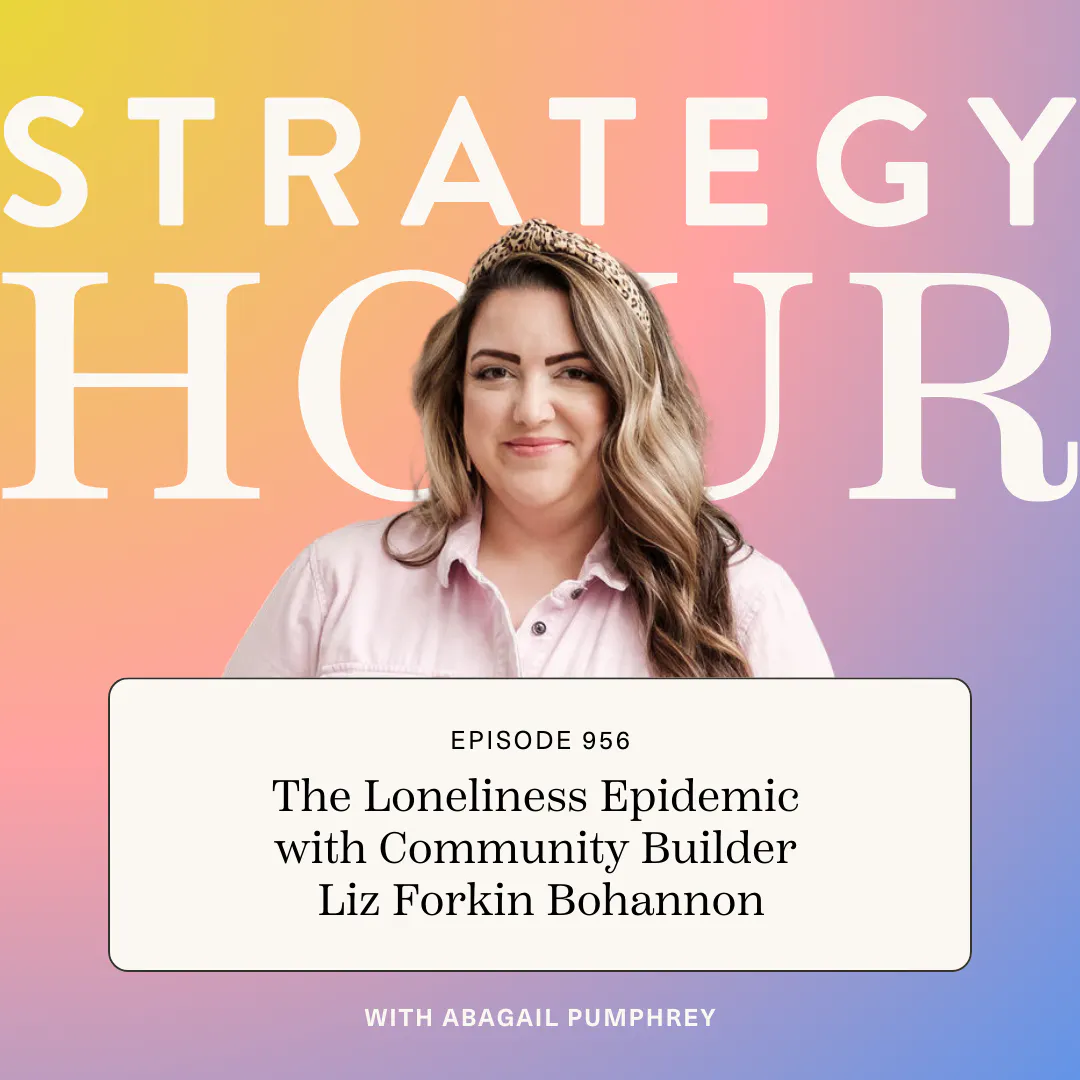
Strategy Hour | Online Marketing for Business Growth
956: The Loneliness Epidemic with Community Builder Liz Forkin Bohannon
00:57:53
If you’ve built a business, you’ve probably felt loneliness at some point. Today’s guest, Liz Forkin Bohannon, knows that connection isn’t just a feel-good value – it’s a radical, transformative growth strategy.
Loading summary
Transcript39 lines
- [00:02]
Abigail Pumphrey
Welcome to the Strategy Hour podcast brought to you by Boss Project. I'm your host, Abigail Pumphrey, and I'm dedicated to supporting online businesses. I don't believe in one right way to build a business. I'm here to help you build business your way. One that supports not only the life you have, but the life you want. I'm on a personal mission to help you become financially free. I'm taking all the lessons learned as I turned a layoff into a seven figure online business. I'm here to help you prioritize your life every step of the way. Whether you're creating your first digital product, growing an email list, or scaling an already profitable business. Settle in. It's time to talk strategy. Does working with your accounting software make your head hurt? That's why I'm here to talk to you about FreshBooks, the cloud accounting software designed to make the hard part easy. Lose the complicated process and switch to FreshBooks. Run your billing books and payroll on the same platform. They've made it easy to send invoices, get paid fast, save time on data entry, and keep your finances organized. No accounting classes required. With FreshBooks, you'll save time and get peace of mind. Imagine having all of your expenses neatly organized and a clear picture of your business health all in just a few clicks. FreshBooks automates your workflow year round. Snap photos of your expenses on the go, send professional invoices in seconds and track payments seamlessly. Feel more confident about your numbers. Switch to FreshBooks today. Get FreshBooks 50% off for 6 months@freshbooks.com that's 50% off for 6 months@FreshBooks.com I.
- [01:43]
Liz Forkin Bohannon
Really have a strong belief that one of the greatest investments that a small business owner or entrepreneur or really leader of any kind is, can make into themselves is a peer support group. And by peer support, I don't mean like you're sitting in a church basement with stale cookies and bad coffee. I actually just mean a friend group.
- [02:02]
Abigail Pumphrey
We are more connected than ever, but we're also lonelier than ever. And if you've built a business, you've probably felt that paradox deeply. Today's guest, Liz Forkin Bohannon knows that connection isn't just a feel good value. It's a radical, transformative growth strategy. She's built her business community and life around the idea that we're better together. And in this episode, we talk about what it looks like to build something that not only grows, but brings people closer. I hope you enjoy. Hey Liz. Welcome to the show.
- [02:40]
Liz Forkin Bohannon
Hi thank you so much for having me. I'm so excited to be here.
- [02:44]
Abigail Pumphrey
I'm excited to hear more of your story. I got the privilege of seeing you speak in person. But what struck me was not that you just built an incredible business. Business, fantastic. But I love the way you talk about community. Not like as a brand strategy or as a buzzword, but as a value that you actually live your life by. And I think that's really different and definitely something I want to be talking about today. But before we get into all of that, because I think there's a lot of layers there, can you share a little bit about your work and how it's led you to where you are today?
- [03:20]
Liz Forkin Bohannon
Yeah, absolutely. I would love to. Well, thank you so much for having me on the show in this 900th and something episode that you've done. That's truly, truly incredible. Yeah. So my name is Liz, as you just heard. And my journey. Let me see if I can try to condense this. That is not one of my greatest skill sets or spiritual gifts, brevity. But I grew up in Missouri in the Midwest, and I studied journalism in undergraduate. And I was really interested in issues that were facing women and girls that were living in extreme poverty and in conflict and post conflict zones. And I had a moment when I was in my first corporate job. So right out of college, it was actually the height of the Great Recession. So the fact that I was like, got a job at all was like kind of a miracle. And I'm about two months in to my first job when I have this realization. And the realization is I felt like I had something that I cared about. At the time, I probably would've said I was passionate about. What I didn't know is that I wasn't passionate about it yet. Because in order to be passionate about something, you have to actually like, live it and do it and know it. I don't think you can just think about it and talk about it. That's called having an opinion. We would be really well suited to be a little bit more nuanced in whether we're passionate about something, we've given our life towards it we've sacrificed, or we just have big ideas about it. So I realized my come to Jesus moment was like, oh, you think you're passionate about women and girls living in global extreme poverty? You're actually just really opinionated. If you want to be passionate about it, you have to have a life that reflects that. And what that meant to me was my friends, my community, my relationships should actually be reflective of the thing that I say I care about. And so it was this real kind of come to Jesus moment for me where I was like, okay, I can keep on kind of building my life and climb the corporate ladder and kind of build my like comfortable life here in America and run my mouth and be very opinionated about issues facing women and girls living in extreme poverty. Or I could go build relationships and community and make some friends that are actually girls who have experienced the things that you say you actually care about. And so what, really, when I say it was kind of like a pretty pivotal moment in my story, I really do mean it. I was like, okay, I think I want to do the latter. And that would mean how do you build community that feels very big and intimidating. I think like, I'm going to go build, you know, a community that's representative of what I say about in the world. And. And instead I set a very, very, what felt like at the time, small and achievable goal, which is go make one friend. Go make one friend with one girl who grew up in global extreme poverty and learn through the context of relationship and friendship, not through a Gates foundation report or the media, but through friendship. Learn more about the issues facing women and girls living in developing economies. And it was actually the smallness of that dream and kind of the achievableness of it that actually compelled me to do something with it. It was kind of like, okay, that is a small enough dream that I actually think, like I can wrap my head around it, I could do something with that. And that is what compelled me to take a pretty big step, which was quit my job, spend pretty much all of my life savings on a one way plane ticket to Uganda, where I knew really no one, didn't have a job, didn't have a plan, and didn't really have a goal other than making one single friend. That was going to be kind of like my main metric of success. If I go on this trip and make one friend, I'm calling it a success. And so I showed up in Uganda and that was literally what I tried to do, was just make friends and build relationships. I did come to realize that showing up in a place like Uganda with a goal of making a friend is actually so much easier than if the vice versa were to happen. And a Ugandan would come to America and say, I just have a goal of making one authentic friendship. So that was a first big pivotal moment for me is like, wow, making friends here is so easy. Like within days I Felt like I had multiple friends. I felt like that I was like already starting to kind of feel connected to a few different communities. There was an openness and availability, a curiosity. And also folks, I realized, just felt they felt so connected to one another. And I think once you feel like you're a part of a dense network of support, inviting other people into that actually becomes more natural because you have something to invite people into. If you're like lonely and disconnected and struggling, it can feel like it's all on you to like plan the coffee date or do this. Whereas when people are already just regularly gathering and they have habitual engagement saying to one outsider, we're already doing this, come along if you want, and kind of just get like swept in to community. So my first kind of realization was that was easy. That was way easier than I thought it was going to be to start making friends and to start just kind of getting grafted into community. And so I just followed that lead and made friends and built relationships. And I ended up getting connected to a community that was really focused. They had kind of a mission to find and to recruit the smartest girls in the country who showed incredible amounts of leadership potential, but came from backgrounds of very extreme poverty. So a lot of them have lost either one or both of their parents, either to AIDS or the war in northern Uganda. So find those girls, bring them to this very, very rigorous, academically challenging. Basically we would see it as kind of like a boarding school for their last two years of high school, equip them and then get them into, you know, the best universities in Uganda. And that's what they're doing. It was an incredible community that I just got to benefit from being a part of and their shared mission and value around really finding these young women and supporting them and launching them into the next stage of their education. And through being a part of that community, I realized that there was a problem. And the problem, or challenge rather, was that these young women were graduating from high school. Literally. I mean, at the time, it was the top five high school in the country. As of now, it's the number one. So it's the number one school in the entire country as it relates to academics. And yet these young women were graduating, they were getting into the colleges that they wanted to go to. But there's a nine month gap in Uganda in between high school and college. And so they were going back home to their villages. So remember, they came from kind of rural areas and they all came together and were like living in community with other like minded, ambitious young female scholars. And then for this nine months they kind of disperse and they go back to their villages. And a couple things happened during that nine month gap. One, it was really hard for them to find economic opportunity to pay for college the coming fall. And two, they kind of lost the community and connection with these other like minded female scholars that they had had over the last couple of years. And they face a ton of social pressure, a lot of them of them, but most of them, when they go back home to their villages and it's kind of like, okay, it's time to get married, start having kids, we're not going on to college. They might. Some of these female scholars are like the only girls in their entire village who have graduated from high school, let alone who have aspirations of, of going on to university and becoming leaders in their society. And so I was just like, oh my gosh, are you kidding me? 25 of the smartest girls in the country testing into college, like academics is not the problem. The problem is keeping them together and this income generating component. And so I started, I tried, actually several things that really failed pretty miserably. And then I ended up designing a pair of sandals that had like a leather base and these interchangeable fabric straps that I thought were cute and different enough that we could sell them in the US and taught three of the girls that were getting ready to graduate from high school and entering into kind of that nine month gap. And I taught them how to make the sandals. And I was basically like, okay, if you make these sandals for the next nine months, I promise that you'll go to college in the fall. And they were like, okay. And I was like, and then I came back home and started slinging sandals.
- [11:40]
Abigail Pumphrey
And then you had to figure it out.
- [11:42]
Liz Forkin Bohannon
And then I had to figure it out. And all of a sudden I went from a journalist who wanted to make friends to a sandal hawker. Yes.
- [11:49]
Abigail Pumphrey
Yeah, I mean, I've seen pictures of you selling them out of the back of your car. So literally that was not.
- [11:56]
Liz Forkin Bohannon
Yes, yes, yes, no joke.
- [11:59]
Abigail Pumphrey
You went back to the US and you're like, shit, I kind of figured this out. I got to support these people. Yeah, I know that that craving for community and being part of something isn't just something that you only crave once in your life. Like, it's always a part of us. We always want to be a part of something. And obviously being in community, being proximity wise, close to these people, that makes a huge difference in your ability to stay connected. But in my opinion, Small business owners, more than ever, are feeling incredibly disconnected, despite being surrounded, theoretically, by all these people online. But because we're not physically in the same spaces, it feels terrible. And I'm curious how you feel like genuine connection can be created even if you're not physically close.
- [12:56]
Liz Forkin Bohannon
Ooh. Ooh. I love this question. I have learned. So I started in Uganda, and I had this realization. I'm like, wow, it's so much easier to make friends here. And people have big challenges, like, let me. We are not. I will be the last that wants to kind of, like, idealize or minimize things like extreme poverty or war. And yet. So they're facing really significant challenges. And yet here was something that felt really different. Loneliness and disconnection did not seem to be one of those challenges. There was a sense that it was like, life is hard, but I feel like I have the friends and the support and the community that together we can kind of weather this storm. And that doesn't mean that life isn't hard. It just means I generally don't feel like I'm all alone in my pain. Even the suffering that we're experiencing or the pain that we're experiencing feels kind of like the shared experience that we're in together. And when people feel alone in their pain, that is actually what leads to sustained suffering. I think that there is a difference between pain and suffering. I think pain is an inevitable part of the human experience. You cannot live as a fully alive human without experiencing pain and grief and loss. Life is really hard, and it's really painful. Suffering, I think, is a sustained experience. And it often has to do with the story that we attach to our pain. And I think one of the stories that we attach to our pain that really sends us into kind of these, like, prolonged seasons of suffering is that I'm alone in my pain. I'm the only one who's going through this. I don't have help. I don't have support. If they only knew, I wouldn't be loved. I wouldn't be respected. I wouldn't be invited. I wouldn't be a part of the club. And so I had this experience of going like, okay, people are experiencing pain, but they don't seem to be suffering from thinking that they're all alone in their pain or attaching a lot of shame to their pain. And. And then for the next. Honestly, really, 15 years I spent as an entrepreneur, my life then took me on this path where I was building companies and teams and getting grafted into communities, not just in Uganda, but Then Ethiopia and then India and then Southeast Asia and then South America and Central America. So I had this interesting opportunity where I started to see America as the radical, different place in the world people. If you're a young American who's going to Africa, you will have no shortage of people who tell you to, you know, prepare for the culture shock. What that actually means is, like, you're going to see extreme poverty for the first time. And that's going to be really shocking. That's kind of what that subtext means. I experienced culture shock in my international travels. Kind of reverse of going. I am shocked because I am realizing that how people live in East Africa and North Africa and Southeast Asia and India and South America and Central America, that actually feels way more similar. There are similarities. America feels shocking. It feels extreme. It feels like this isn't normal in most parts of the world. And then meanwhile, what was happening is I'm learning that I'm realizing the impact the kind of lifestyle choices that we're making in America is actually having on us, which has resulted in. In us being in the midst of an epidemic of loneliness and disconnection. So what I started to do was go, okay, what are the things that I notice and pick up on? And it doesn't matter if I'm in, like, a rural village in East Africa or a city in India or a suburb in Sydney, but when I am a part of, or I get invited into, or I get to experience a dense network of support, people that feel like life is hard, but I generally feel like I have connection and support. What are the similarities and are there similarities? And I came to the conclusion that, yeah, it manifests different in every culture. And of course, experiencing community in a village in Uganda is very different than a city in India. But I started to try to. And this is probably where my, like, inner journalism kid came out of, just like, investigating and trying to see, like. But what are the similarities? And I basically realized that there are six things. There are six principles of community and friendship and social health that seem to be present in either broader cultures or these subcultures where people feel like they're kind of a part of this dense network of support. And then I came back home to the US and was kind of like, there's no good reason that I can't build a life that's based off of those six principles. So to go back to your question of. Especially for entrepreneurs and small business owners, the statistics show, you know, we all know, we all know, we've all heard the phrase Right. That it's lonely at the top. The reason that that is a phrase that we all know is because there's actually a lot of truth to it. So loneliness and disconnection is not a problem actually that can be solved with success in money. In fact, the. In the data on this is like, it's not super, super overwhelmingly clear, but we can say definitively that loneliness and isolation and disconnection is not a problem that can be solved with monetary success. There is data that would suggest it actually gets worse. But leaders and entrepreneurs specifically experience much higher rates of loneliness and also mental illness than the average population. So the statistics would show that 97% of small business owners would say they have felt really alone and unsupported in their journey at some point. About 65% would say, currently, that is their current reality. They don't feel like they have the community or connection or support that they need. And about 20% would say they just always feel that way. They feel like they've never had the community, community and the connection and the support that they've needed to really thrive. So what do we do about that? Well, here's where. And I'm not going to go through all six principles, but you talked about proximity. How do we build these dense networks of support when we don't necessarily live in the same city as one another? And I really have a strong belief that one of the greatest investments that a small business owner or entrepreneur or really leader of any kind of can make into themselves is a peer support group. And by peer support, I don't mean like you're sitting in a church basement with stale cookies and bad coffee. I actually just mean a friend group, but I mean friends. The phrase that I use specifically for leaders is that leaders need people who get their world but are not in their world. So what I mean by this is these can't be your employees, and they can't be your investors. They can't be your customers. Like, they can't be people that are so in your world that you feel a sense of like, I can't be vulnerable or authentic. Because if they only knew, you know? And then you start kind of calculating, what can I actually share? Because I have a certain perception that I need to protect. You need people who are not in your world, but they get your world. And that means they're running their own business. They're a leader in their own right. The specific challenges and the specific, like, blessings and opportunities that come with being a leader, they know because they have actually lived it so one of the core values to building community is proximity or environment. How are you like, designing the environment? And that can come in a couple different ways. You know, when you're talking about being in a rural village in Uganda or even frankly, how I've designed my life up here in Portland, Oregon, I literally share property with my best friends. Proximity and environment. That is a key of going like, hey, if I want to build a dense network of support, we have to have enough crossover in our lives that we are actually able to like get our reps in and rely on one another for support for leaders and for entrepreneurs and for small business owners. I actually think that proximity physically is less important because the types of things that we need to rely on one another for typically aren't physical. So like, I'm raising young kids together with my friends and the vast majority of needs that we have are physical. Right? Like, I literally. My husband's traveling for work today. My youngest is trying out for soccer and his soccer practice doesn't end until 8pm, which is after my two younger kids have gone to bed. So I'm like doing the mental math of tonight's either going to be a total because I have to keep my older two awake. So I sent a text message to my neighbor Alan. Hey, is there any chance you could get Theo from soccer tryouts today so that I don't have to drag the other two boys with us? You know, it's only five minutes away. And he immediately texts me back. He's like, yeah, no problem. I'm home five minutes out of my night. Really no big deal. And these are the types of things, like, I would never call a friend who lives 20 minutes away from me to be like, could you go pick up my kid? That'll be 20 minute drive for you. You'll have to go all the way back to your. You know, it's just like the convenience level. It makes it too hard for us to rely on one another for things like that. So for my personal life, physical proximity. I have a lot of physical needs and my friends have physical needs and we are able to help one another with that. For entrepreneurs and for leaders, oftentimes we need support of a different kind. We need help solving a problem. Like, we need a group of people that we can call and go. And I literally was just on a call with a group of entrepreneurs and it's like, I'm getting sued. So I fired somebody. It did not go well. It is wreaking havoc on our organization. Who has dealt with this before? I need a lawyer. I need some, like, HR resources. So I need some practical help, but it's not physical help. Right. And also the second thing, and I would argue that this is even the more important thing, I need comfort, I need connection, and I need encouragement. I am losing sleep at night. I am spinning out. I am regretting how I went about doing or saying something because I didn't think this was going to happen, and I can't. And they need a group of people that can hold that and people that understand it enough not to be like, oh my gosh, she's getting sued. You know, but rather the moment someone in the room is like, girl, I've been there. And maybe I haven't gotten sued by an angry ex employee, but I've had a hard HR situation or I've been in a legal battle where I fell over my head. Your regular friends probably aren't going to understand that, like, your regular friends are going to be like, I don't know what to tell you. That sounds really bad. And what you actually need in the moment is people that have some level of shared experience where they can actually offer practical help, tools or resources, but who are also are going to be the emotional support. Because you're not just in a bad place from a legal or business standpoint. You're also probably really struggling from an emotional standpoint. And interpersonal neurobiology is kind of the, like, niche of human psychology that really shows us that it's new and it's emerging. But basically what the science is showing us is that there is a level of healing and growth and learning neuroplasticity that happens in our brain that we will cap out on. We cannot actually achieve full healing and full growth and learn to the degree that we're capable of unless it is in the presence of others, unless we are literally sharing our story in our lives, the good, the bad and the ugly, and we are inviting other people into that. And those people that we are inviting into it are people who will make space and hold our stories. All of us, as Dr. Kurt Thompson would say, want to be seen, soothed, and feel secure. Those are the three things that we need for human flourishing. And so business leaders and entrepreneurs need a place where they can show up in the full authenticity of who they are. And when they are sharing even the hard things, feel a sense of like, I'm with a group of people who aren't going to be scared and they're not going to leave the room. And what actually happens on a neurobiological level when we experience that is we are able to, to access a different level of healing and growth. And also it helps just regulate us, that helps regulate our nervous systems, arguably more than anything else that we can do.
- [24:33]
Abigail Pumphrey
Yeah, I think the thing that I failed at when looking at this problem for myself for a long time was that I was trying to make that group of people out to be all the things in all areas of my life. And I think to your point, if you're a human walking through life, you are going to have some physical needs that are related to your proximity. That's just part of it. You know, it could be because you have young kids, it could be because you have dogs, it could be because your partner gets sick, it could be because you're caregiving. It doesn't matter why. But there's, there's going to be things that you need in your everyday life. Oftentimes your career can feel incredibly separate from. But I think when we're seeking friends, we're trying to find someone who is all of those things to us. And it can be incredibly impossible to find people that live within five minutes of your home and have a similar career but aren't a direct. Whatever. That's just not going to happen. And so I've had to purposefully look at those things separately and like, how can I find people that are going to support my day to day life and be there for me when I need them to go pick something up or when I need help moving a heavy box or whatever. And then also the person that you can call when you're getting sued, that's just a different group of people. Not everybody has to be all things.
- [26:01]
Liz Forkin Bohannon
There is so much wisdom in that. And you will be able to be loved and loved better when you do the intentional work of exactly what you just did. Because it's really unfair, actually for you to show up and be like, I need you. I have these 26 needs to be a healthy, flourishing human. And I am looking at you, Jill, and hoping that you can help me with all 26. Like, no, Jill, you are immediately setting up Jill to fail you miserably. And Jill's gonna sense that and she's gonna feel really bummed about herself and you're gonna start to feel resentment and disappointment. And. And so the intentional work that you did to kind of go, what are my specific needs? Also the other side of that, every time you have a need, there is also an offering, right? So it's. This isn't about going out and trying to Curate your people who can serve you in a time of need. But also what can I offer to literally my next door neighbor? And that's going to be probably very different than what you can offer your entrepreneur friend who's running a similar business. And I haven't best case scenario, you could find approximate group of people that also kind of meet this specific need. I haven't been able to do that. And I spend a lot of time thinking about relationships and cultivating relationships. And what I mean by that is my more entrepreneurial leader cohort is not physically proximate. And I've just found that it seems like 90% of the value, however we can achieve. Virtually the challenge with virtual is this. And this is also the challenge with in person. And it's actually one of the kind of six tenets of the framework for building community and connection. There's actually a couple I want to talk about. The first is habitual engagement. Rhythms that are high commitment and high consistency. So folks, one of the biggest challenges that we face in America is that we have this notion that friendship should be really organic. It's like in Seinfeld and in Friends and in all of these show and Cheers, we just kind of get parachuted into the story when these folks already have their relationships formed and they're already like living in the same apartment building, always go to the same bar together. They don't actually show us how that happens. And the reason I'm convinced that they don't show us on television how it happens is because it would make very boring television because there will be a whole period in season where you are committing with a level of consistency before you actually start to feel the results of building those secure networks and in America. And I, I've had people tell me this before. They're like, well, Liz, if I had my best friend group, if I had found my people, of course I would commit to them. I would give a night a week or three hours once a month or you know, commit to going on the yearly retreat, but I don't have that yet. When I find that, then I would commit to it. And I'm like, girl opposite.
- [28:58]
Abigail Pumphrey
You gotta be there. And then they become that.
- [29:01]
Liz Forkin Bohannon
You're exactly right. That would be like someone going, I would, I will commit to going to the gym three days a week. Once I lose 30 pounds and get shredded, then I will start going to the gym. You would be like that. Oh brother, that's a, that's backwards. That it doesn't work like that.
- [29:17]
Abigail Pumphrey
Want to learn Exactly. Step by step how to get paid to generate leads in your business. I'm ready to give you the exact steps that help me generate tens of thousands of qualified leads and millions in low ticket digital product sales. I won't just show you what I did, but teach you how you can do it too. I'm talking not just how to create low ticket digital products, but also showing you how to use them strategically to generate leads for your other existing or future offers. I'm sharing it all@bossproject.com jumpstart including exactly how I made $8033 and generated 277 leads my very first month selling digital products. Find out more@bossproject.com jumpstart we actually have.
- [30:00]
Liz Forkin Bohannon
To start thinking about our social health in the same way that we think about our physical health and our mental health. By the way, those are the three pillars to human flourishing. We know a lot about physical health and we're growing a lot in awareness around the importance of mental health. Social health is literally the third and maybe arguably most important tenet. And yet it's the one that is even when I say Social Health, 90% of people are like, did you make that up? Did you just come up with that on the fly? And it's like, no. It's literally the foundation to human flourishing. And so one, we have to treat social health like we treat the other aspects of our health. So think about getting socially healthy. Like you think about getting physically healthy, which is like, you have a plan, maybe you hire someone or get some resources, listen to a podcast, read a book, kind of get a philosophy that's going to help guide you in how you're like pursuing this. You're going to put it on your calendar. You're probably going to be willing to put time and money and effort. You've probably got to sacrifice some other things. Like what are the things in your life that you're going to be willing to give up so that you can commit to this? And even just that mindset shift of going like, you're never gonna go find your people, like, that's not a thing. They don't all exist in this like dreamy friend group with like a perfect spot that's waiting for you to just knock on the door and they're like, oh my gosh, Liz, I'm so glad you're here. We've been waiting for you. Here's your seat at the table. That's not how community and connection works. We can't consume it. We can only actually co create it. And the degree to which we benefit from community is typically in exact correlation with how much we are contributing to those relationships and in community. So you're exactly right on that. So we have to do the work of going like, okay, what are our kind of different needs? Exactly like what you did, and then put a plan and some intention around it. And I can say without a shadow of a doubt, every community that I've been a part of that has met more of those kind of psychological and intellectual needs, there is something consistent in every single one. And the consistent factor is consistency. It was. There was a time on the calendar that we committed to and said kind of no matter what, like, okay, yes, if someone dies or whatever, but not a lot of people phone it in. And it's like the amount of excuses that people use to not just, like, keep commitment. So I'm saying that may sound kind of harsh, but in order for us to build these dense networks of support where we actually get kind of the secure connection, there needs to be consistency and commitment. So there has to be a rhythm, and that rhythm has to be on your calendar. And it has to be something that you would go, I will say no to other things or opportunities that come my way in order to protect this time. I personally have never been a part of a community where I've gone that actually ended up resulting in the secure connections that I needed and wanted that were not marked by consistency and commitment. But then the next thing that we have to do is when we show up to that thing, we have to have a plan, and the plan has to be around. How are we going to intentionally use this time to get the results that we're hoping to get? You can get together with your friends for 90 minutes once a week, but if you just sit around, talk about the Bachelor, your results are gonna be limited. Right? It's fun. By all means, every once in a while, spend a Friday night. It's also actually really important for us to have fun together. But the point is, that would be like going to the gym like you got in the gym, and now you're just kind of waddling around, listening to your podcast, and it's like, okay, you're not gonna get the results unless you, like, get on the machine. Well, what does that mean? According to social health, there are three things that we need to do and ways that we need to orient our sacred, probably limited amount of time that we have with one another. One is we have to share the full story of our lives. And when I say the full story, it kind of depends on what is it. A personal friend group? Is this like a small group at church? Is this a group of neighbor friends? Is this group with other entrepreneurs? So what the story of your life means is going to kind of change depending on what those groups are and what the hope is. But you have to show up with a willingness to disclose, this is my life. This is who I am. This is how I was formed. This is what I'm actually struggling with right now. This is what I think I'm good at and I have to offer. And it is amazing what you can accomplish. So one of the things, just to get very practical, one of the ways that I create these groups is we do a bit of basically like a storytelling. The first, let's say there's six people in the group. How I would orient this is for the first six, six weeks, the entire evening or time together is really. It is one person sharing what they believe. Let's call it 20 minutes. You had to kind of share with us who you are, what formed you, what your greatest joys and challenges are. In 20 minutes, what would you share? And that's really illuminating what people decide to share. Like, some people go all the way back to childhood, and some people are like, over the last, you know, few years, are they talking more about their work? Are they talking about relationships that have formed them? And then the rest of the evening is dedicated towards people asking questions and just, like, leaning into that. You do that for six weeks with a group of six people. I promise you that in six weeks, the level of connection and understanding and intimacy that you all have with one another is equal. It would take you five years of meeting up once a week at a bar and kind of shooting the shit in order to get that. So there's an intentionality around sharing our stories. Self disclosure. Another principle is around vulnerability. So self disclosure, typically, in order to create those secure connections, it's really scary because we're actually telling the truth of our lives and the things that we have historically believed, these are the things that if you only knew, you will judge me. You will kick me out, you will exploit me, you'll talk about me behind my back, whatever. I will no longer get to be a part of the club. And that is terrifying. That is such a scary thing. There was a study that actually showed they hooked people up and they did brain scans, and they showed what people's brains looked like when they anticipated getting punched in the face. Okay, so, like, you're walking down the street, you get punched in the face, that's like a very alarming, scary thing to happen. And most of us try to protect ourselves. You know, if we saw somebody coming at us to punch us in the face, we would understandably try to create distance and protect ourselves from that. The same part of your brain lights up with almost the same level of intensity when you imagine getting punched in the face as when you imagine getting socially rejected. Okay, so we are evolutionarily, physiologically wired to want to protect ourselves from the pain of social rejection. So that's what makes sharing the whole truth of your life really, really terrifying. And that is where vulnerability comes in.
- [36:40]
Abigail Pumphrey
But you can't be rejected unless you put yourself out there in the first place.
- [36:45]
Liz Forkin Bohannon
Totally, yes.
- [36:46]
Abigail Pumphrey
That's not even going to be a possibility.
- [36:48]
Liz Forkin Bohannon
Yeah. And so that's why a lot of people will go their whole lives never doing it. And that is the thing.
- [36:53]
Abigail Pumphrey
I believe it. It is so true.
- [36:55]
Liz Forkin Bohannon
You can live a life. You can do this. This is available to most of us is to not feeling the pain, the acute pain of social rejection by not sharing the whole truth of your life, that is an available option to you. I won't disagree with you that you will avoid more short term acute pain than a person who chooses self disclosure and vulnerability and authenticity. Of course, the trade off is that long term you will experience much more pain and much more suffering and worse outcomes on nearly every level. Not just mental and emotional health, but the science shows. The longest ever study done on human flourishing found that the single greatest predictor of all the things we're talking did you exercise? Did you smoke? How much money did you make? What career path? Where did you live? How much money did your parents make growing up? All of these factors. They found that the single greatest predictor of not just how happy and fulfilled you will be at the end of your life, but actually how long you will live, how many years you will stay on earth, your physical health, the single greatest predictor was the quality of your relationships and even more specifically, friendships. It had to kind of go outside of your nuclear family in order to experience the full benefits of social health. So you can choose to keep things to yourself. You can choose to only show up when things feel bright or shiny or impressive. And you can avoid the acute pain of social rejection. However, you are really signing up for a life of suffering. Whereas those of us who are investing in social health know that your heart can only break if you give it away like that. Our heart will break more and we will experience more challenges and probably Rejection and times when it doesn't always work. But yet the long term outcome of what we have created is actually a life that insulates us and creates an immense amount of resiliency towards kind of long term suffering. But only if we choose vulnerability and self disclosure.
- [39:02]
Abigail Pumphrey
Yeah, I had two parallel experiences at the start of last fall and it was very interesting because you mentioned like you get together at the bar once a week for years and not become close.
- [39:16]
Liz Forkin Bohannon
Yeah.
- [39:16]
Abigail Pumphrey
In one scenario I was getting together with this group. Group of people is fairly large, but it was every two weeks for multiple hours and it took five months before I started to feel close to anyone in that community versus the other group, which I felt like I technically had less in common with. The very first time we met, we all did a slideshow presentation about our personalities. And I know so much about these women and their lives and their struggles and the things that they genuinely want support in. Not that you can always show up for them. Sometimes all you can do is pray for them. But I know more about them in a very short pocket of time because of the willingness to fully show up and fully be vulnerable in those moments.
- [40:08]
Liz Forkin Bohannon
I love that example and I love that kind of like AB testing that you did because so many of us are like, but I don't have time. And it's like, okay, one, we make time for the things that we value. So what we should actually say, no one should ever say about anything. I just don't have time. The more accurate statement would be, that is not a high enough value for me to give up the time it would take for me to be able to do that. None of us have enough time. Like, no one needs to say that. But a lot of people would say I don't have enough time. Which what they're really saying is, I don't believe that this is important enough that I'm willing to sacrifice or make the time to make that happen. So that's problem number one. But problem number two is you're actually just not using the time that you're dedicating to this in a way that's actually going to get you the results that you want. That's the I'm going to the gym and I'm putzing around instead of I'm going to the gym. I always use the gym analogy and I should probably start going to a gym. I talk about it so much like I know what I'm talking about and that's not the story of my life. But the point being, the point being you are exactly right. There are rhythms and even liturgies and traditions and things that we can do within the amount of time that you have that will absolutely expedite the experience of building those secure relationships. Social scientists show that it takes. I mean, we have the numbers. It takes about 200 hours to go from being a stranger to an intimate friend that you would, like, call on for help. That's kind of general. We can actually expedite that. We can expedite that by being really intentional with how we're spending our time together, which sounds like it's exactly what you in this friend group did. And it's remarkable. Like I said, in six weeks, whether you're doing a slideshow, which I'm obsessed with, I love that. Or doing more of this kind of story sharing. Yeah. In six weeks, you can accomplish what otherwise could honestly take years. So it's not about more. It's like. What's the phrase? Working smarter, not harder. I need one for that. It's about time. It's like, it's not about more time. It's just about using your time more intentionally, which that is the thread of what we're sharing right now is like, it doesn't even matter exactly how you're going about doing that. But there is a level of intentionality with how we are going to use this time, and there is a good belief that this, what we are doing, is actually going to lead to us expediting those relationships and those secure connections.
- [42:25]
Abigail Pumphrey
I think the place where people are going to get really hung up. So before we go, we have to talk about this.
- [42:31]
Liz Forkin Bohannon
Okay. Yay.
- [42:32]
Abigail Pumphrey
The idea that, okay, I'm willing to show up, I'm willing to create this commitment. I don't know where to find these people or collect the people that all have the same willingness to commit to what this thing I'm after. So how would you go about. If you were a business owner who's feeling disconnected or even just someone who's going about their everyday life, where would you go to find these people and make sure that they're at the same level of commitment? SEO.
- [43:04]
Liz Forkin Bohannon
Okay, well, I promise I didn't pay you to ask this question. So one is, okay, I will share one thing and then I will share some other things. So I don't want to lose you. I have started doing what I am calling connection cohorts for this exact reason. I am gathering and collecting the people who want to engage in habitual engagement that is designed for intimacy and connection, specifically with leaders, with other people who are not in their world, but who get their world. And really one helping people find one another and then also kind of helping to create the framework and kind of doing a little bit of coaching for how do we use this time in the most valuable way to get the results that we want to get? I couldn't find of anybody else because I get this question all of the time. It was kind of one of those things. I mean, this is where the entrepreneur comes out, where it's like, people asked me. So I went and looked for resources for people and I was like, I don't know. Okay, fine, I'll just do it. That is one thing that would be. I don't have a cohort that's open right now, but if this is remotely interesting to you, you can email me@lizboho.com and we are probably going to open up our next cohort in the fall. So that's one way. But secondarily, I honestly, the biggest thing is just talking, talking, talking and asking, which is really vulnerable, but putting it out to other people. And like, listen, we can't play games, okay? We cannot be walking around being like, really subtle, putting out clues, hoping people are going to pick up on it. I mean, make your ask known. Get on the social medias, get on the phone. I had a conversation with a woman I had just met. Literally. She was being hosted on my podcast. And at the end of it, I was like, I don't have a friend that kind of fits this area. And I feel like we have so much shared experience. Would you be this friend for me? And here's what I actually mean by this. And I kind of threw out some ideas for consistency, commitment, like, what are you actually getting into? And she was immediately like, I also don't have somebody that kind of gets my world in this way. This is a felt need that I have, too. I'm not saying it's going to work out a hundred percent of the time, but I will tell you this 100%. I don't have her in my life in the way that I do right now. If I just don't shamelessly and explicitly ask and just say, like, I want to create this, Will you create this with me? Now, here's the good news about living in the midst of a loneliness and isolation epidemic. The likelihood that the people that you are asking to build community and friendship with the likelihood that they also need it and don't have it is very high. The chances are really in your favor. Okay? So it's super vulnerable. It obviously requires A level of risk, but it really is about one, being willing to ask, but then two, having you kind of have to do the work of like knowing what you're inviting people into. And that is where this is. Actually one of the tenants in my framework is around seeing yourself as a creator, as a contributor, not as a consumer. So there is a level of taking some leadership and ownership and going, I'll create the system, I will create the expectation, which is super vulnerable. So vulnerable and scary to be the person that does that. But the reality is like, you might get lucky and get invited into something that somebody else has created. But 98% of the time, the people that I meet that feel the most sense of kind of connection and that they have this dense network of support, it is because to some degree they feel like they were contributors and co creators to it. And so come up with a rhythm, come up with an idea. You have to have something that you're inviting people into and then be the one that makes the ask and be upfront about it. Take the risk. I have come to a place where I would so much rather just get rejected. And you know, somebody's like, I don't have the time, I don't have the interest. You're not the person I would want to do that with. And that hurts. It doesn't actually. It gets easier and better actually, the more you get rejected coming from someone who's been rejected a lot. But the more you actually feel like you have the relationships that you need, the more you're like able to handle rejection because you don't feel like you're just like alone on an island, which is what it can really feel like in the beginning. So it's really the scariest in the beginning. So it's create the structure that you think is going to lead to intimacy and connection and then go out and try to fill the seats and just. And then once you get one. Yes. Then also you can be like, okay, great, now both of us are going to go out and find our next yes. So that now you have a buddy. And so then they're finding somebody that they're connected to. You're maybe going out and asking one more. So now we've got four. And if the two new members also bring one friend, now we're up to six. And I would say, I know we're getting into nuts and bolts, but specifically with leaders and small business owners is like literally what I do. So I have strong feelings about it. Six to eight, I find to be a really good Number you get more than eight. And depending on how often you're able to meet, sometimes that number is seven. And you are just not able to give enough time and attention to each person for them to kind of feel that sense of. And this is for, like a really close knit for our connection cohorts. My goal is like, these are your people. Not exclusively, but in this area, there is intimacy, there is connection, there is interdependence. We show up, we ask one another for help, we hold space for one another. I think beyond seven or eight, it gets really challenging. Also, the bigger the numbers get, the harder that commitment and consistency level is. The moment you kind of feel like, ah, if I don't show up, I probably wasn't going to talk anyway or be able to ask a question. People have a really hard time committing in the way that really leads to intimacy and connection. You need at least three. Three would be minimum. And that's for a highly committed group where you really think, on average, people are not gonna be missing groups. Because once you get to one on one, which is you can totally always start there. And frankly, all the groups that I'm a part of started one on one, but with a vision towards growth because that just kind of like lessens the pressure a little bit. Right. Whereas I meet with a group of women every single Wednesday night. So this is for my personal life and these are my proximate friends. So these are the women that, like, I either share property with or within a three minute drive of me. We have been meeting every single Wednesday night for 11 years. And the amount of. Yeah. And the amount of times that I've missed a Wednesday night when I have been in town, like, I travel, so I miss it when I'm traveling for work. But even then they record the whole thing on Marco Polo for me and I, I will listen to it. I will listen to two and a half hours of content in the airport. I'll just do it. I will listen to this before I listen to an audiobook or a podcast or something else. When I'm in the airport or in the Uber. This is like, I care about this more. Like, these are my people and they shared their lives. Like, this is number one content spot for me. We've been doing it for 11 years. And actually this past Wednesday there were so many things happening. We've had like a baby boom in our community. And so in the months, obviously when you have a newborn, things are a little bit. Things are a little bit dicey. The point being, it ended up Being for part of it, a couple people had to drop off. And it was one girl and she was sharing with me and it was so sweet and it was so sacred. And she was actually really struggling with something and I was able to hold space for her and give her some perspective and encouragement. And I remember going, oh, I wish so and so was here too, because we always have very different perspectives. And I think what I would have shared in combination with what she would have shared would have been like, I've just gotten used to, like, how a group can hold a person versus one on one. The stakes can just feel a little bit higher. And so all that to say again, it can oftentimes start one on one, but with a goal towards can we get to three or four with a max of seven or eight people? I found to be the dynamics and kind of the logistics that best support that kind of dense network of support with intimacy and belonging to.
- [50:53]
Abigail Pumphrey
Yeah, it's incredible. And I think your suggestion around being explicit about what you're looking for. Yeah, you have to go with explicit. I remember this was going on nine months ago now. I sat across the table from someone over coffee and I was like, you know what? I'm looking for more friends. I was just blurting this out and I'm like, but here's the problem. All the friends I have in my life have children, which is not a problem. I love them. But my husband and I have struggled to have children for years, and we don't have kids. And I want to meet other women who do not have children because I don't know any. And this girl was like, okay. She also didn't have a kid, which just was very happenstance.
- [51:42]
Liz Forkin Bohannon
Yeah.
- [51:42]
Abigail Pumphrey
And she was like, let me think about that. A week later, she was like, so I'm starting this group. I was like, thank God you're starting the group. But it all happened to be women without children who valued their careers. And we're in very different industries. And it's the same group that started with the PowerPoint. So I wouldn't have even been invited to the group if I hadn't specifically said what I needed to people over and over again. Because I know I'd shared that with other people and didn't ever go anywhere, but that one person was able to connect me. And I felt more support than I felt in years. And I know having that community is something we're all craving. And I know people are going to want to learn from you, read your book, be able to connect with you more. So where can they find you online if they want to keep the things up with Liz?
- [52:34]
Liz Forkin Bohannon
Yeah, so where can you find me online? I'm on Instagram @lizbohannon. I also actually just launched my sub stack which probably, if you're interested in Community and Connection, will be a better place. Just kind of some more like long form content around community and connection. My website is lizboho.com so you can sign up for either my substack or my newsletter. Those are. Oh actually I haven't even added substack to my site. It's so new. But you can sign up for my newsletter and then also as you mentioned, yeah, I'm working on a book on the subject. I'm also producing a full length documentary about friendship and community and connection and so to kind of stay up to date on all of these things. Also, if you want to know when we launch our next Connection cohort, which I think will be coming this fall, sign up for my newsletter and you will be notified of that as well.
- [53:25]
Abigail Pumphrey
Liz, this was fantastic. I know people are going to be excited to hear more about all of the things you shared today. I know I want to dive into the six pillars because I know we only touched on a couple. So I'm going to have to have you back at some point, especially if you want to get closer to the book coming out or the documentary. Would definitely love to help you share that with the world. So thank you so much for your time. I know it is valuable and I appreciate you being here.
- [53:51]
Liz Forkin Bohannon
Thank you so much for creating the time and letting me nerd out. This is like getting into the nuts and bolts and nerding out on like not just the fluffy, like we should all be connected but like literally how do we create it is such a joy and gift to me. So thank you for your questions and your curiosity and also for your contributions. I feel like you could have also given a master class on creating community and connection and friendship. So thank you for sharing the ways that you've gone about that in your own life as well.
- [54:18]
Abigail Pumphrey
Hey, a few quick favors before you leave. I'd love if you'd share today's episode, send it to a friend who needs to hear it and post on social. You can show us where you're listening from, your favorite takeaway or why someone else should listen. Be sure to tag me at Abigail Says and OSS Project so we can share it. Okay. Second favor, to get podcast updates and all the behind the scenes news from Boss Project. I'd love if you join my VIP list. Just head to bossproject.com signup to make sure I have all your contact details. Really love this show. It would mean so much to me if you'd leave a rating and review. It not only helps more listeners find the show, but allows us to bring on quality sponsors so we can keep bringing you this valuable content for free. Thanks so much for listening. Until next time.