← Strategy Hour | Online Marketing for Business Growth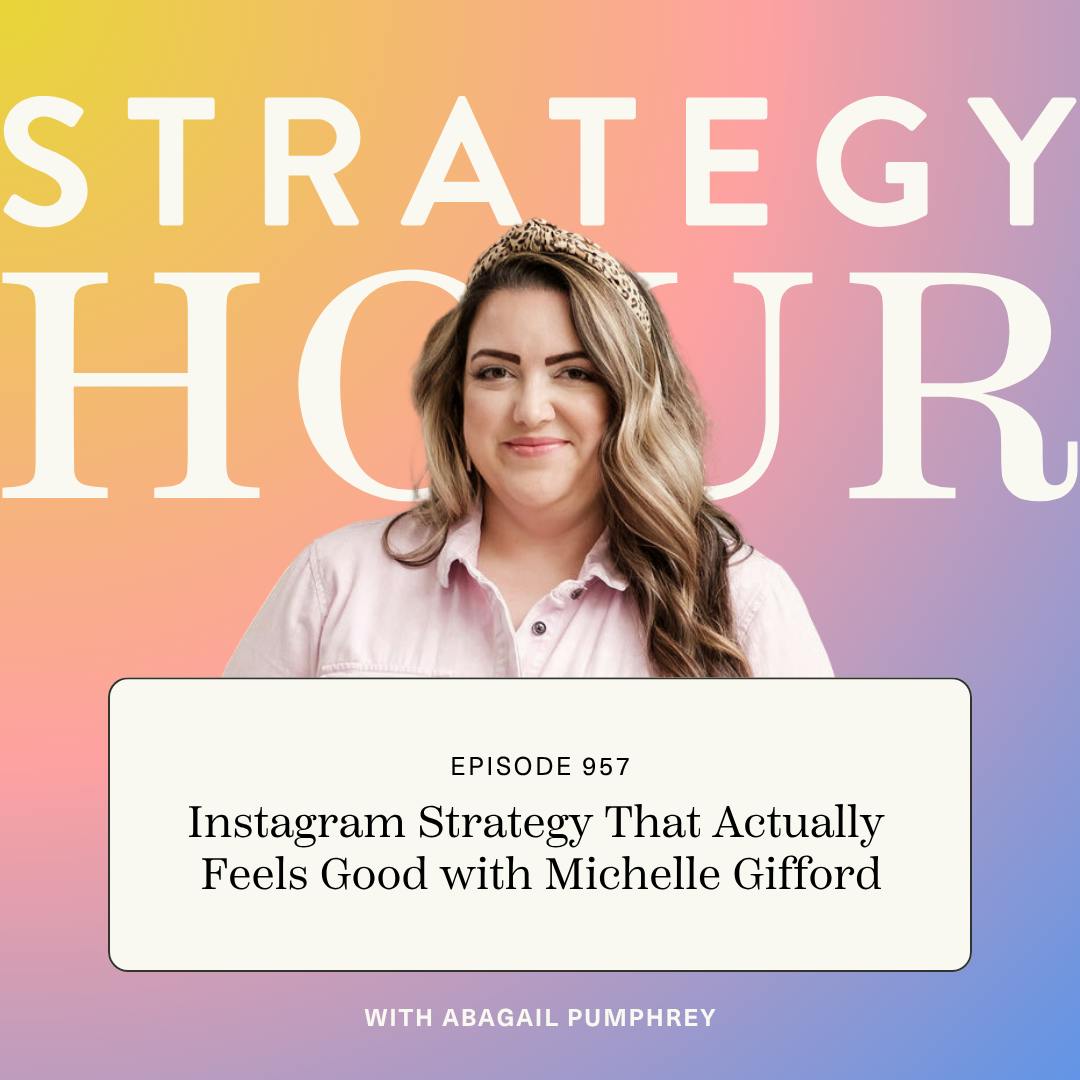
Strategy Hour | Online Marketing for Business Growth
957: Instagram Strategy That Actually Feels Good with Michelle Gifford
00:42:49
This episode with strategist Michelle Gifford will help you reset your strategy and grow with purpose. We’re diving into content that converts, what’s working now, and how to build a presence that feels good and drives real results.
Loading summary
Transcript47 lines
- [00:02]
Abigail Pumphrey
Welcome to the Strategy Hour podcast brought to you by Boss Project. I'm your host, Abigail Pumphrey, and I'm dedicated to supporting online businesses. I don't believe in one right way to build a business. I'm here to help you build business your way, one that supports not only the life you have, but the life you want. I'm on a personal mission to help you become financially free. I'm taking all the lessons learned as I turned a layoff into a seven figure online business. I'm here to help you prioritize your life every step of the way. Whether you're creating your first digital product, growing an email list, or scaling an already profitable business. Settle in. It's time to talk strategy. Does working with your accounting software make your head hurt? That's why I'm here to talk to you about FreshBooks, the cloud accounting software designed to make the hard part easy. Lose the complicated process and switch to FreshBooks. Run your billing books and payroll on the same platform. They've made it easy to send invoices, get paid fast, save time on data entry, and keep your finances organized. No accounting classes required. With FreshBooks, you'll save time and get peace of mind. Imagine having all of your expenses neatly organized and a clear picture of your business health, all in just a few clicks. FreshBooks automates your workflow year round. Snap photos of your expenses on the go, send professional invoices in seconds and track payments seamlessly. Feel more confident about your numbers. Switch to FreshBooks today. Get FreshBooks 50% off for six months@freshbooks.com that's 50% off for six months@ freshbooks.com.
- [01:43]
Michelle Gifford
So every Monday, whatever day, I want you to do some Instagram strategy. And during that time, I want you to plan ahead and I want you to look back. I want you to see what's working and what you need to shift for this coming week.
- [01:56]
Abigail Pumphrey
When it comes to Instagram, it's easy to get stuck in the cycle of.
- [02:00]
Unknown
Chasing trends, counting likes and trying to stay relevant.
- [02:04]
Abigail Pumphrey
But today's guest, Michelle Gifford, is here.
- [02:06]
Unknown
To remind us that sustainable Instagram growth doesn't come from constant performance. It comes from purpose. Michelle is the Go to Instagram strategist.
- [02:18]
Abigail Pumphrey
Behind multiple six and seven figure brands. She's helped business owners grow their reach.
- [02:25]
Unknown
Amplify their voice, and drive real results without burning out or losing themselves in the algorithm. And in this episode, we're talking about what it really means to create content that converts, positions you as the expert, and still feels good to make. We get into what's working right now on Instagram, what business owners should stop.
- [02:49]
Abigail Pumphrey
Doing, and how to reset your strategy if you're feeling stuck or discouraged.
- [02:55]
Unknown
This conversation is honest, empowering, and packed with practical insights for anyone who wants to use Instagram as a true business growth tool, not just a content machine. So let's get into it. Hey, Michelle, welcome to the show.
- [03:12]
Michelle Gifford
Hey. I'm excited to be here. Ready to talk about Instagram?
- [03:15]
Unknown
I am absolutely ready to talk about Instagram. I think there is so much to continually learn. You know, even if you listen to an episode about Instagram three months ago, things shift, things change. This is a platform that's always evolving. But I'm excited about your take because I do think it's a little bit different. But before we get in too much to today's topic, I want to know a little more about your background and your expertise and what originally drew you to Instagram in the first place.
- [03:46]
Michelle Gifford
Awesome. Well, I'll start there. Actually. I love Instagram because it is like an amazing place for people who are just starting out in business or just like it's free, right? It's a free place that you don't have to have any followers, you don't have to have any before experience and you can show up and millions of people can see your content. Right? If you create great content, it can get out there. So I think that that is such a huge benefit to how we can grow a business. But most people are not taking social media seriously and the power that it can have and also strategically. So I love a good strategy and I love figuring out how can we do this in a way that not only is sustainable, but fits into our overall integrated business strategy. So I have a marketing agency where we specialize in helping personality led brands use Instagram to grow their business. So we help people who have a face to their brand and we help them create content. And that's what my agency does. And then I teach Instagram and and have been teaching how to grow on Instagram for quite a while. And so I have an education side where I'm teaching it. I have a marketing agency where I'm doing it for people and I'm building my own brand on Instagram. So I love it, I live it and I love talking about it. Because either you are unconvinced that Instagram is as powerful as I say it is, or you're using it and you want it to be that powerful, but you don't know the strategy. And either group that you're in I can help you get to using Instagram to be more strategic.
- [05:19]
Unknown
Yeah, you know, I think a lot can be had on that platform. I know for myself, Instagram has been one of my best places that organic growth has fueled my business. And I think there's a misconception that you have to have a ton of followers for it to be lucrative. But I had under 50,000 and had a multiple seven figure business. So it doesn't necessarily necessarily equate to, you know, one follower equals x amount of money. I think there's lots of opportunities for what that can look like. I'm curious, since you've helped so many different kinds of brands grow multiple six and seven figures behind the scenes, regardless of the size of their account. What sort of patterns have you noticed that have helped shape both your approach, but also that you're seeing are more effective and actually landing sales?
- [06:15]
Michelle Gifford
Sure. So one of the biggest things that we have to start teaching and start realizing is that your Instagram account, the content that you make there, there's different goals for different types of content. I think a lot of times we show up and we just want to like post stuff and we just want it to go viral and then we get all the followers. But if you have a clear brand message and you can create content in three different ways, and I'll tell you what those are in a second, but if you can create content that supports that brand message, then you start attracting the right people and it really seamlessly moves down your funnel. So it's not hard to get email subscribers because your content leads people to where you want them to go. And so that's where we implement my attract, nurture, sell method, which we create content that's specifically for attracting new followers in, and then we create content that nurtures those followers and gets them to know like, and trust us and then we can sell to them. And if you are not creating content, each of those specific phases of, I mean, this is a marketing funnel, right? Attract, nurture, sell. But if you start applying that to the type of content you create, then it changes how you show up and it also changes how powerful your content can be.
- [07:26]
Unknown
Yeah, no, I think that's a really solid model. You know, my approach may be a little bit different. I think of Instagram as the attract mechanism and I do my nurture and sell on other platforms entirely. And maybe that's a false approach, but it's definitely one that's worked for me. I am curious, when you go about creating those different types of content, what does that actually functionally look like what's the difference in how you're approaching the content?
- [07:58]
Michelle Gifford
Yeah, so different content, like I said, does different things. So like if I'm creating, as I'm creating a reel and if I want it to be an attraction reel, these are going to be more like things that I know are going to take off more, people are going to share more. So these could be quick wins, they could be trends, they could be a little bit more like fast paced storytelling. Right. So I know, and that's one of the things like with my clients and with my students, I have them do a lot of research or we do it for them where we're like seeing what is working around their niche or even outside their niche and then we start creating that attraction content. That's goal is to have people share it. So let's take a specific, right, let's take a specific. Let's say you're a plant based business, right, and you sell plants. And so an attraction piece of content would be a piece of content that I know that a plant lover is going to share. So that could be like a quick hack of like one that my student has done, like how to turn a mug into a planter. And so that was a quick win, a quick hack that ton of people saved and shared. So that's going to be more of attraction content. Now a nurture piece of content is going to be more like seven things I wish I knew as a new plant owner. I don't know. But let's say it's a carousel, right? And it has more information, it's deeper value. And yes, it's probably gets saved more, but it gets saved more than shared. But it really starts speaking to your audience that you already have. And then a sell post could be you reviewing your favorite plant box that you have an affiliate for. Or it could be listen to my plant podcast. That's also a sell, right? You're asking your audience to do something and also a sell thing.
- [09:40]
Unknown
All right. I can definitely see how the content would naturally vary between those various things. I think one of the trends I've noticed recently is that followers don't necessarily equate to what they used to. So what I mean by that is if you had followers previously, it would naturally lift the reach you would get kind of like as a base reach or whatever. Now I've seen people who have tons of followers who aren't necessarily getting any sort of organic boost from the beginning. And it makes it both harder if you have bothered and spent that time growing the following, but also potentially easier for people who are starting out to, if they're focused on great content, they can get that exposure. What sort of trends have you noticed there with your own clients and with your own account?
- [10:39]
Michelle Gifford
So that actually is a true thing. Like that's universally true because Instagram over the last year has changed their algorithm and they came out, I think it was the end of February. And so a year ago February, they said they were going to do this, and then this February they said, it's complete, we've done it. And the transition went from being a follower count algorithm where if you had more followers, you automatically got more views and that kind of thing, and now it's a content based algorithm, much like TikTok, where it actually doesn't matter quite as much how many followers you have. It just has to do with the content and how people are responding and reacting to it. So like you said, this is good and it's bad, right? If you build a following, you're used to getting those views just naturally. And you know, if your followers are seeing your content, then that's an easier sell, right? Because they're warm, they already know you. But it's also pretty hard because now it's like, okay, now we have to, it's like every piece of content has to earn its own weight. And so there is a shift there that's happening across the board. And it's actually, I mean, if you're a new content creator, it's awesome because you can, come on, you don't have to have a million to get a million. And that's a pretty powerful thing.
- [11:52]
Unknown
Yeah, no, it is a powerful thing. And I think in some ways incentivizes people to want to start over. Like, you know, maybe they've had an account before and their engagement has kind of gone down and they're maybe feeling discouraged about reach and they're kind of questioning like, do I keep going here? Do I start something new? Or how do I reawake my account? What's sort of your take on all of that?
- [12:21]
Michelle Gifford
Well, if you already have a following and even if you're shifting, maybe you're just pivoting a little bit. I wouldn't start over because your following, most of them will probably come with you. And so I would say, like, just recommit to creating content because that's usually, usually what it takes because you have, whether you have 0 followers or like maybe have 50,000 and you're shifting either way, it's going to take work and time to train the algorithm. Again, like, period. Like, that's just true whether you have 0 or 50,000. So if you have people and your content is still similar, like, let's keep those 50,000 with us. And then let's do a very strategic test on the type of content that we should create, that our audience likes and attracts new people. So that's what I would tell my clients. You don't have to start over, but I would say, like, you have to give yourself grace during this period as you're like, testing out new content and testing out and learning how to do different types of content. Because the content you created two years ago doesn't work now. It just doesn't. And so if you are, maybe you're picking back up and starting new, it'd be like, okay, well, just know that just like anything, your first podcast, your first email isn't your best. And so you just have to know that, like, that's okay, that's showing up, that's growing. And to be okay with that part of the growth process and give yourself time, be like, I'm going to try this for six months and every two weeks, I'm going to, you know, figure out a new strategy, a new piece of content, and test that out to see if it works. And then look at your analytics. Be really, really dedicated and religious about, like, looking at those analytics and digging into what they mean and how they can guide your content going forward.
- [14:01]
Unknown
Yeah, I saw someone post today actually over on LinkedIn talking about how the more he's experimented, he hasn't necessarily seen more growth. But I think there's like a caveat to that, and one that I know has really worked for me on Instagram, is I think you should always be experimenting with your content. I don't think that should ever go away. But you should start to layer in, you know, those pieces that have performed previously. What can you learn about them? Whether it's format, hook, you know, length of content, the way you showed up, like how you formatted it. There's a million things you can kind of take away. You have to start to make educated guesses over time as to why you think something performed better than another. But you can layer that in with the new stuff. I am curious though, right now, what are you seeing in terms of trends for what is performing?
- [14:57]
Michelle Gifford
Yeah. So right now, carousels are having a moment. So those are when you have more than one image that you can swipe through. Also, like, specifically with that, if you add music, then it shows up in Your Reels feed. And so not only is it just, you know, in the regular feed, it's in your reels feed. And then also with that, if you do a video first, so like a short video in your carousel and then you carousel through pictures, that's a very, very specific one that's working really well. And then for story, well, I'll stay with reels for a second. So I think you're going to notice people are going to. The ones that are successful are developing signature series or signature content, something that they can be known for and that people like recognize them for. So this is something worth developing and it's also something that's going to take some trial and error and some experimentation. But that signature content can be about topic or type, right? It can be like this is how I create my videos or this is like the type of content that I talk about. So those are going to be more and more powerful. Especially I've seen like just skyrocket people's profiles because they're easy to share. People know what they're going to get and they're really, really impactful, whether they are super funny or they're super educational. And then for stories, if you want to see those perk up, then you give yourself a 24 hour reset, which means that you don't post for 24 hours and then you come back with a slide with some words on it, a picture, not a video, and have a reason for a DM response. So whether that's a manychat automation or like a quick leave this or this to vote for this, that also is increasing story views by quite a bit.
- [16:44]
Unknown
Yeah, no, I've definitely noticed similar results from the 24 hour reset over on stories. And I agree with you when you were talking about reels specifically having that signature series, I think one thing people get stuck on when it comes to that is they either feel this pressure to like come up with a topic or like way in which they're going to present themselves before they've like actually tested to see what's going to take off. Similar with the editing style. So like I think a lot of the people that have performed really well, like you're saying they're editing their content in a very specific way that's very specific to just them. But it's really easy to like think that they just started that way and it's just worked from day one. And if I get my own kind of take, that is just going to work. So how do you go about testing those things when the goal is to eventually, like, adopt it as your identity, especially when you're like in conflict with, you know, you may have certain brand colors or a brand look, and that's already established.
- [17:58]
Michelle Gifford
Yeah, so I would do some strategic consumption. So I would go and consume on Instagram and I would just save all of the content that resonates. Because right now, you know, if you go now, you have, I mean, maybe some ideas of what your signature content could be. But I want you to go outside your niche and I want you to go do some research and start looking at content which resonates, which is doing well, how are they showing up? And start like learning, like, you know, success leaves clues, says Tony Robbins. So, like, start learning what is making other content successful and figure out if there are any, like, running threads to those like, that you're drawn to that you would like. And then I want you to test them out, like, create content. And you need to do it for like two weeks. You can't just create one piece of content with that format and be like, and then we're done. Because it didn't perform well. Because if you go back and look at anyone who has a signature series, go scroll back a ways and see when that signature series started and see what they were doing before. They were testing stuff out too. And then one took off and then they doubled down on it. So I would start, like, just giving yourself freedom to try new things, to do the research, figure out what's working and what you like, and then test it out. Like, you're never gonna know unless you create the content if you like it or if your audience likes it. And then you have to again, give it a couple weeks and then look at analytics. Usually reels take a couple weeks to take off and mature fully. And so you can't do it after three days, you can't do it after a week. You have to let it ride. And then in two weeks, look at it and see what you can see. Look at where people are falling off right now. We can see like how long people are watching and where people are dropping off. And then you can start adjusting and make that content even better or just make a whole shift and do something else.
- [19:54]
Abigail Pumphrey
Want to learn exactly, step by step how to get paid to generate leads in your business? I'm ready to give you the exact steps that help me generate tens of thousands of qualified leads and millions in low ticket digital product sales. I won't just show you what I did, but teach you how you can do it too. I'm talking not just how to create low ticket digital products, but also showing you how to use them strategically to generate leads for your other existing or future offers. I'm sharing it all@bossproject.com jumpstart including exactly how I made $8033 and generated 277 leads my very first month selling digital products. Find out more@bossproject.com jumpstart Imagine sipping your morning coffee, knowing that each cup is helping change lives. Talitha coffee is not just another brew. It's crafted with care and support. Survivors of human trafficking. Every bag sold empowers those in need, giving hope and a fresh start. Head over to bossproject.com Coffee to grab a bag or join their subscription. Make your coffee routine count@bossproject.com Coffee it's interesting though.
- [21:03]
Unknown
I think so often people get discouraged in this sort of phase. You know, they may acknowledge that they're experimenting, they may acknowledge that they're trying to figure out what sticks. But if it doesn't work and it doesn't work and it doesn't work, you know, even if it's not for very long, like, it could just not work for a week. And then all of a sudden these people are discouraged and they want to put it down and they, like, onto some other shiny object, you know, what can I do next to grow my business? Because clearly Instagram is not going to work for me. How do you get people to stay motivated and get them to continue to push through that season?
- [21:42]
Michelle Gifford
Yeah. So for one, I want to ask, like, what do you do that you do really well? That took you only a week to accomplish, like, nothing, right? Like, if you play the piano, if you're a good cook, if you're. I don't know anything outside of marketing. Okay, Right. It takes a while to figure those things out. And that's true for Instagram. And then I would also say if Instagram weren't Instagram, but it was another marketing platform that you didn't use and consume content on, would you treat it differently? And I would say yes, because most people, there's a blurry line between Instagram for business and Instagram for pleasure. And that is the trick, right? Because really, what's happening? Because I hear it all the time. Women who come to me and they're like, well, like, Instagram's not working. I was like, well, what happened? And it's like, well, they didn't have a strategy. They just went on and they looked for inspiration, right? They just scrolled two reels to see what content they should create. And then, then they get lost in the algorithm and they get scroll and scroll and scroll and then they're like, wait a minute, I was supposed to create content and then they hurry and throw something up and then they're like, it didn't perform. And I was like, well, did it have a strategy? Well, no, I just posted it. Right. Anyway, so we get lost in those cycles. But if we started treating Instagram as an actual marketing platform, and I mean, I was listening to Gary Vee and they. I think it was like some. He said these big brands need to be shifting like 30% of their marketing budget to Instagram and people creating great content. Don't hold me to that number. I'm not exactly sure if that's exactly what he said, but he just was saying, like, these big brands are not realizing how powerful social media is. If they did, they would be spending 10 times as much time and money on the platform. And we have an opportunity as these smaller brands to actually have a lot more market share in what we're doing. If we took marketing on Instagram seriously. So what does that look like? I need you to put it in your calendar. So every Monday, whatever day, I want you to do some Instagram strategy. And during that time, I want you to plan ahead and I want you to look back, I want you to see what's working and what you need to shift for this coming week. A lot of people are like, hey, here's a plan for a month. I have found that with my clients and my students that two weeks at a time is better because Instagram moves so quickly. And most of my people, frankly, are creatives and creating a month in advance makes them want to die. So I say, don't do that. So, like, making a plan two weeks at a time and then decide how you like to create, whether that's batch creating or if it's like, hey, I'm scheduled every day. I'm going to have a 30 minute session where I'm going to create something for Instagram and commit to it. I used to do like a real love challenge where I said, hey, I'm going to tell you what to post every day with the audio, and then you just have to adjust it for your account. When those people commit to every day for 30 days, magic happens. Because they might not go viral. They might. Some of them did. But that's when people learned how to use the platform. They learned how to create content and they learned what content did well for their audience. And so if you're taking this business seriously and if you're taking Instagram seriously, then you show up different and you create differently.
- [24:52]
Unknown
Yeah. So I'm curious the how do you keep going, though, after that sprint? Because I think I know for me, that's the biggest issue. Like, I will go and post two or three times a day for two weeks or a month or even 45 days, and then I just burn myself out because I've been trying to do all of that, plus all the other stuff I was already committed to, and I just feel way spread too thin. So how do you create sustainability around that?
- [25:25]
Michelle Gifford
So I would look at a couple things, and number one, I say, like, how important is Instagram to your business now and how important do you want it to be in the future? And then what are your resources? So is this something you have resources to do for the next year? One post a day? Do you have the resources and capacity for that? Because to me, it sounds like. Like, let's say you just said I post for 30 days and that two or three times a day, and then I'm burnt out. So I don't think you had capacity to sustain that for a year. Right. Two or three times a day. So I would say, yeah, sometimes those sprints are necessary. But then how do I scale back so that I'm creating consistent content that I can keep marketing on Instagram, a part of my strategy? Because that's what we want, Right? We want the sustainable, predictable thing that we can do. And so either we're going to pull back and not. Not force ourselves to post two or three times a day, or you're gonna hire help. You're going to get people to help you create the content, maybe an assistant or a social media strategist so that you can keep that going. And that's actually like with my agency, that's where we step into with a lot of creators, because they already know how to create on Instagram. That's not the problem. They're just so burnt out because they have to edit it. They have to come up with ideas, they have to write the caption. It's a whole production. And so there are pieces of that, whether you hire an agency or if you have an assistant, that they could help you. Right. So start finding those pieces that you can get help with and put in some systems in your calendar so you know when you're going to show up. And then you have to show up. And also do it in a way that is sustainable. Like, I wouldn't do Two or three times a day. If you do not have someone helping you do it, that's so much. So much time.
- [27:12]
Unknown
It's a lot time. I was recently listening to an interview with the guy who helped grow Gary V's account, and then he was hired on Hermosi, and he was Talking about testing 300 pieces of content a week. And I was like, okay. So the reason the small business owners feel like they're not, you know, making it big is they just don't have as much time or access to. When you're throwing that much at the wall, something's going to stick. Right? And if you're only throwing five pieces of content, something isn't. Now, this is not me saying, go post 300 times a week. That's not what I'm saying. I'm just saying you don't have the same capacity as some of these other businesses that you maybe envy or look up to. And I think it's okay to, like, slow down and give yourself some grace around it, because you also don't have the team of 200 people salaries to pay for. Right? Yeah.
- [28:14]
Michelle Gifford
And the business model is different. Right. Like, he has to have that many eyes to do the thing that makes the money that he wants to make. You don't need that many eyes on your content.
- [28:25]
Unknown
No, you really don't. I do think people get caught up on this idea of visibility, though. Like, not everybody loves it, but I have this hunch, I used to think, that not everybody loves visibility. I don't actually know if that's true. I think people are terrified that people are gonna see the real them. Like, they're gonna expose themselves online, so to speak. And I'm curious how you get people to not only be more comfortable on camera and comfortable with their face being a part of their brand, but also just, like, comfortable being themselves because it's not always the same, culturally, as what other people are doing. And so you feel like you're gonna stick out like a sore thumb because you're not, like, so and so.
- [29:07]
Michelle Gifford
Oh, totally. And I think on a personal level, too, it's a little bit weird. Like, I have people, you know, that I know in real life who they only see me on, like, they see me at, like, I don't know, church functions or school functions or things like that. And they're like, I see you all the time on Facebook. And I'm like, yeah, you know, so it's also a little bit weird, right, because you have, like, real life people. You're like, okay, yeah, I know, I know. Stop clicking on me. Like, if you stop clicking, you'll stop seeing me. So it's a really weird thing. And so. But it also is a muscle, right? It's a skill. I think this is a skill people can hone and learn. And so if you're like, absolutely just hate seeing yourself on camera, I would start using the Marco Polo app. Marco Polo. Do you use it?
- [29:54]
Unknown
I'm familiar. I don't use it on a regular.
- [29:56]
Michelle Gifford
It's just a. It's a FaceTime app where you can send messages. It's like a text message, but it's your video. But, you know, you're sending it to a friend or a sister or mom or whatever. And it helps you get used to seeing yourself on camera in a really, like, it doesn't really matter way. Right. And then I would say, like, start showing up in stories. There's not as many people there. They have to be following you to see you, and you can start getting used to it. I also, just. One of the things I need people to understand is that when you don't show up, you're robbing those people who need you from what you have to give. And so I don't want the potential judgment from someone to stop me from the potential capacity I have to help and serve. And so usually my mom was right. It's not about me. Right. That's what my mom would be like. It's not about you. Right. And when you realize that when you show up on Instagram, it's not about you. It's not about you looking good. It's not about you being perfect. It's about how you can show up and serve. And the minute you, like, switch it to be like, oh, if I share this with people, then they won't kill as many plants, I'm like, okay, I'll do that. Right? When I show up, I'm like, if I can really just get the ear of these people and help them see their business differently and Instagram differently, then, I mean, it could change because it has. I've seen it. You know, it can change their lives. It can change how much money they make, how much time they can spend with their kids, all of those things. Well, then it becomes less about me and my imperfections, and it's, how can I help and serve those around me? And that's just a different energy.
- [31:31]
Unknown
Yeah. And honestly, you impacting just one person, I know. It's so easy to think, well, that's not enough, or, like, that's not a Real big impact. But just for sake of an example, I was speaking at a conference last week in New York and I was talking about building teams and specifically how to scale the back end systems behind that. And I was talking specifically about the difference between, you know, getting management where you're kind of hiring an outside agency versus you know, having some of your internal infrastructure. And this one particular creator, I had talked to her pre event, she saw me speak and, and then she recently just posted kind of like recapping what she was thinking. And she went from one direction in her business to changing her mind on the direction she was going to go. And we're talking potentially saving 20% of her income by making this difference. And this person is making hundreds of thousands of dollars a year. So saving 20% is not a small thing. And if I had just been like, oh, I can't put my face out there, I can't sit on a stage, I can't, you know, center myself, then this person could have potentially spent hundreds of thousands of dollars on something that she doesn't need to spend hundreds of thousands of dollars on. And I know that's a really extreme example, but you don't often realize how like, a really nuanced, like, tiny thing you say can massively impact the people. And you may never know. Like, they're not always going to follow up with you and tell you that you made a difference. And that's a part that's a little hard to kind of get your head around. But it is helpful the more kind of clues you can get back from people that you did make a difference. I know for me it's gotten far easier to show up, I'm curious for you is how you balance growth without like chasing growth for growth's sake. Because, you know, obviously metrics, followers don't equal income like we talked about at the beginning, but followers do often equal, like, respect sometimes in certain communities. And so I'm curious how you balance doing it the right way, I guess, is what I'm doing.
- [34:04]
Michelle Gifford
Yeah, I think, yeah, that's a great question. So one of the things I would consider is how much of that, like, how much of gaining a following is necessary for you to accomplish your goals. So, for example, like, If I have 10,000 followers and I say I am the Instagram expert that actually, I mean, you know, there's some things that I'm going to say that doesn't carry as much weight as when I have 250,000 followers. Right. There's some difference there. And I think that's true for different industries as well. That it's like, actually, like, having more followers does mean something. And, like, does help me get into the doors that I want to get into. But a lot of brands, that's just not true. Like, it's just really unnecessary. And so I think you have to check your ego at the door a little bit and say, like, what do I actually need to get where I want to go and how can I do it in a way that I am attracting the right exact people? And so I think that it can be tricky. But that's where if you're tracking your metrics and you're like, if you're getting engagement, if you're getting, you can track, like, is your engagement going up? You know, there's different goals that you can set that. Because I like goals. I like figuring out where I am and where I want to go next and like tracking that. And so there's different ways to do that. So we had a brand that had 80,000 followers and they didn't really care if they grew. They just needed to, like, have so many conversions every month. And so we were like, you know, they knew that they were getting pretty good story views, but they knew when they, like when they pitched their service that like 3% of the people who opted in that they 3% opted in, bought. Okay. So because they knew that we were like, okay, well, let's see. Your. I mean, your story views are way lower than your followers. So we focus on story views and we were able to like, 10x their story views, and that, like, directly impacted their bottom line. And so there's just different ways that you can look at it. But if you look at Instagram as a whole, and it's just like, I have to get more followers. Well, like, why? Right? But if you can connect your followers or your views or, you know, your stories to an actual thing in your business that moves a needle, that's when you're going to be a lot more motivated, right? You're going to be able to like, oh my gosh, I got to figure out stories. And so I like to figure out, like, why did we set this goal, right? Like, why did we set this follower goal? And does it make sense? Or is it just something like vanity wise? We want. I don't think it's vain to want more followers. That's not what I'm saying. But can we see a specific outcome that we want not just for the followers, but just like, I want more followers so I can charge more for My keynote. Awesome. I love that. Right. But really get to the bottom of your why, of why you want more followers and see how you can track that with your analytics and then go hit that goal.
- [37:05]
Unknown
Yeah. I think having the purpose behind it not only is more motivating, but you have a reason why you're doing it. And then it's also going to shape the kinds of content you put out there because, you know, for the sake of the person who wants to have higher end keynotes, well, that person needs to be doing more video because they need to have their face out there. Because, you know, people aren't going to hire speakers necessarily that are only writing content. So knowing your end game, I think is hugely important. I appreciate you saying that. Well, before we wrap up, I'd love to know a mindset shift that you want to see every business owner have around Instagram.
- [37:52]
Michelle Gifford
Instagram is serious business and so we need to take it seriously. And so that it's. I feel real passionate about that because we're sleeping on it, you know, and I think these bigger brands are becoming more and more aware that this is happening and that social media, I mean, you look at Duolingo, I mean, there's these big brands that are having huge success on social media and right now small business and especially like personality face led brands are running the show. And if we took it seriously, we'd be able to build this community, like your community, to these loyal followers who really care about you. It's just really powerful. But it won't happen unless you decide to take Instagram seriously and to know that it can be one of your biggest marketing machines and it can be one of the most fun ones. I love Instagram.
- [38:45]
Unknown
I love Instagram too. Well, I know people are going to be interested in learning more from you, connecting with you, potentially working with your team. So where can they find you online?
- [38:56]
Michelle Gifford
Yeah, come find me on Instagram. Come hang out with me at I am Michelle gifford and then iammichelle gifford.com. yeah, anywhere you type in I am Michelle Gifford, it usually comes up. So. But Instagram and my website and I have a podcast called the Michelle Gifford Podcast. We'd love to have you over there too.
- [39:12]
Unknown
Amazing. Thank you guys so much for listening. I'm excited to hear all about your growth and impact on Instagram. Definitely hit us up if you have a specific takeaway from today's show, something you're going to try, maybe a new post you put out into the world. I'd love to see you tag myself at Abigail says and at I Am Michelle Gifford. We'd love to see your content. So I really appreciate you guys listening today and until next time.
- [39:40]
Abigail Pumphrey
Hey, a few quick favors before you leave. I'd love if you'd share today's episode, send it to a friend who needs to hear it, and post on social. You can show us where you're listening from, your favorite takeaway, or why someone else should listen. Be sure to tag me bigale says and bossproject so we can share it.
- [39:57]
Unknown
Okay.
- [39:57]
Abigail Pumphrey
Second favor, to get podcast updates and all the behind the scenes news from Boss Project, I'd love if you'd join my VIP list. Just head to bossproject.com signup to make sure I have all your contact details. Really love this show. It would mean so much to me if you'd leave a rating and review. It not only helps more listeners find the show, but allows us to bring on quality sponsors so we can keep bringing you this valuable content for free. Thanks so much for listening.
- [40:24]
Unknown
Until next time.