← Strategy Hour | Online Marketing for Business Growth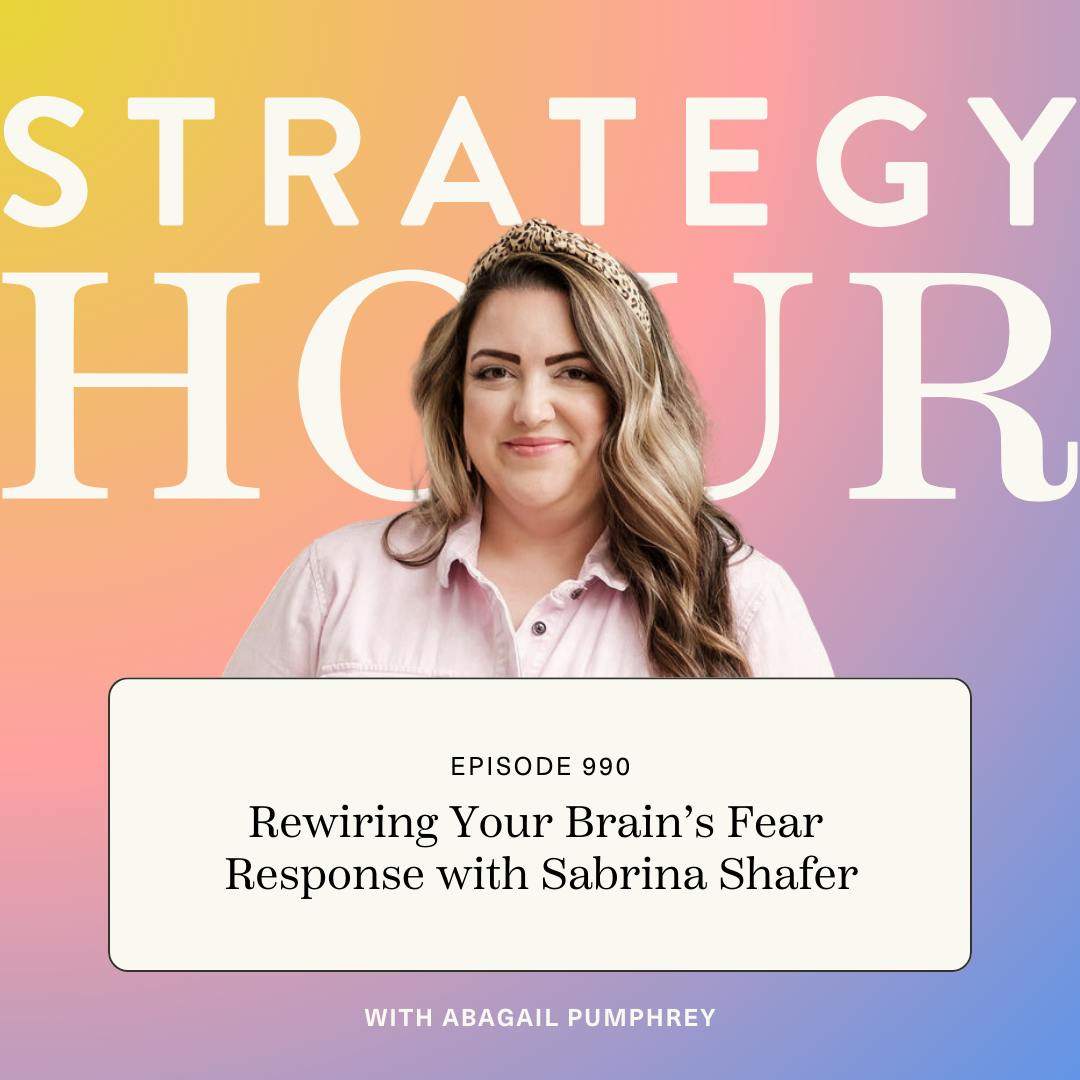
Strategy Hour | Online Marketing for Business Growth
990: Rewiring Your Brain’s Fear Response with Sabrina Shafer
00:37:38
Whatever scares you most will change your life the most!
Loading summary
Transcript70 lines
- [00:00]
Sabrina Schaeffer
But I just decided to start sharing it because maybe even if it's trivial to me, it'll inspire someone else to take action or to do some type of a fear forward, even if it feels little. Because the whole art behind all of this as well, if I did it, you can do it too. So if I can do a little fear, maybe it'll inspire somebody else to do a little fear themselves.
- [00:26]
Abigail Pumphrey
Welcome to the Strategy Hour podcast brought to you by Boss Project.
- [00:30]
Sabrina Schaeffer
I'm.
- [00:30]
Abigail Pumphrey
I'm your host Abigail Pumphrey and I'm dedicated to supporting online businesses. I don't believe in one right way to build a business. I'm here to help you build business your way.
- [00:41]
Podcast Host/Interviewer
One that supports not only the life.
- [00:42]
Abigail Pumphrey
You have, but the life you want. I'm on a personal mission to help you become financially free. I'm taking all the lessons learned as I turned a layoff into a seven figure online business. I'm here to help you prioritize your life every step of the way, whether you're creating your first digital product, growing an email list, or scaling an already profitable business. Business settle in. It's time to talk strategy.
- [01:10]
WhatsApp Advertiser
When did making plans get this complicated? It's time to streamline with WhatsApp, the secure messaging app that brings the whole group together. Use polls to settle dinner plans, send event invites and pin messages so no one forgets mom 60th and never miss a meme or milestone. All protected with end to end encryption. It's time for WhatsApp message privately with everyone. Learn more@WhatsApp.com okay, quick question.
- [01:38]
Abigail Pumphrey
When was the last time your bookkeeping made you smile?
- [01:42]
Podcast Host/Interviewer
Yeah, I didn't think so.
- [01:44]
Abigail Pumphrey
That's why FreshBooks is giving you 70% off your first three months. Yep, I said 7.
- [01:51]
Podcast Host/Interviewer
0. Here's the catch.
- [01:53]
Abigail Pumphrey
It is a super limited time deal. So if you've been waiting for a sign to finally ditch the spreadsheets and.
- [01:59]
Podcast Host/Interviewer
Get back to doing more of what you love, this is it.
- [02:02]
Abigail Pumphrey
Go grab 70% off for three whole months right now@bossproject.com freshbooks that's 70% off@bossproject.com.
- [02:12]
Podcast Host/Interviewer
Freshbooks don't wait, because missing out on this one is going to hurt more than tax season. Today, I'm joined by Sabrina Shafer to talk about a topic that every entrepreneur wrestles with. Fear. Not the kind that keeps you safe from danger, but the kind that holds you back from the opportunities you know you were meant for. Sabrina's keynote Fear Forward is all about rewiring how we Respond to fear so we can use it as fuel. Instead of a roadblock. We're diving into the neuroscience of fear. How to spot limiting beliefs and what it looks like to actually build a culture of courage. If you've ever wondered how to step into your full potential while still feeling afraid, this conversation is for you. Sabrina, welcome to the show.
- [02:57]
Sabrina Schaeffer
Thank you for having me. I'm very excited. This is an incredible podcast and a great topic, so thank you.
- [03:05]
Podcast Host/Interviewer
Yeah, I am really interested in your career and I know the people listening are going to be too. So I would love like a little behind the scenes knowledge before we dive into today's topic. If you could share a little bit more about your own journey with fear and how this keynote, specifically Fear Forward, came to be. I'd love to know more.
- [03:26]
Sabrina Schaeffer
And it's been going on for quite some time, I will tell you that. So I've kind of lived by this rule that it's okay to change lanes. You know, a lot of people have said in my career, you've got to pick a lane and stick with it. I've changed. I can't tell you how many times. At least three or four major changes in my career. And it's made me so much better for it. I'll say what got me to Fear Forward was really being sick of fear or things that were kind of getting in my way, dictating what I did and didn't do. So I was scared of so much that I just decided I'm going to use fear as a way to help, maybe use it as a compass as a guide for what I should do or where I should focus instead of using it as something that was dictating what I shouldn't do. And it's changed just about everything in my life. It's been incredible.
- [04:20]
Podcast Host/Interviewer
Yeah, I mean, fear has definitely helped me jump off and like take big risks in the past, but I know there are some people that have to feel a certain way before they can move forward and some people who can push through and take action and kind of push through the fear and then deal with the fear afterwards. I'm curious your thoughts around that. Like, do we have to be ready to face fear before we do it, or are you saying we should jump all in?
- [04:49]
Sabrina Schaeffer
I love that question because each one of us are so different and our tolerance to fear is so different. Kind of where we are in that whole spectrum of are we okay with it or all the way on the other end with we're not okay with any fear, any change at all. So I think being comfortable with meeting yourself where you are, being okay with at least some degree of fear. I started really, really small and in some ways, even in such a trivial way that my editors asked me, you know, please don't speak about it, please don't talk about. Because it was such a trivial fear that my editors thought that it would be even a little bit embarrassing for me to talk about these kinds of things. And the reason why I do is because I want people to know it's okay to start with a little fear. It's okay to start with maybe not, like you said, jumping all in. Some people are okay with it. They maybe have a different risk tolerance or tolerance for the unknown or maybe just a little bit more resilient. That's okay. Starting with a little fear or a little fear forward is equally as good and as positive as well. So start where you're ready.
- [05:59]
Podcast Host/Interviewer
Sure. What was one of those little tiny fears that you face first?
- [06:03]
Sabrina Schaeffer
I started with a whole bunch of little ones. So, for instance, I started with showing up to meetings without makeup or showing up with just a hoodie on, because I think, well, at least for me, a lot of what I was struggling with was being comfortable showing up as my best, most authentic self. Sometimes that means I'm not going to be dressed up to the nines, and that's pretty embarrassing. Especially as a woman, you think, what's the big deal? Or maybe this won't be as relatable because men don't go to, you know, meetings with makeup a whole bunch. That's sort of a societal thing. But I just decided to start sharing it because maybe even if it's trivial to me, it'll inspire someone else to take action or to do some type of a fear forward, even if it feels little. Because the whole art behind all of this as well, if I did it, you can do it, too. So if I can do a little fear, maybe it'll inspire somebody else to do a little fear themselves.
- [07:10]
Podcast Host/Interviewer
You talk a lot about the neuroscience of fear. Can you break down in a simple way what's actually happening in our brains when we feel fear?
- [07:19]
Sabrina Schaeffer
The science behind it, when you really get down to how do our brains and bodies function, it makes the idea of tolerating or working through fear that much easier. So at the very core of it, this simple version, is our bodies really run off of electricity and chemicals. That's really it. That's what our brains work off of and our bodies work off of. And so when we do something we really like, we Get a hit of a positive, a lot of different positive chemicals or hormones. And when we do, when we stay away from something we don't like, sometimes it's fear for a lot of us, including myself. Then your. Your body reinforces that too, and your body's only looking for ways to keep it alive. So if in the past you've been a sort of adrenaline junkie and that works for you, you're going to be, you know, less adverse to fear because those hormones, those chemicals are not going to be releasing when you do something scary like skydiving or whatever it might be for you. Long story short and very complicated system simplified. It's really a release of chemicals when we stay away or avoid. Things that look bad to us look scary for us, and that's really what's going on. So if you can get good at being scared and showing up anyway, you build these new pathways or highways or what are called neuro pathways in your brain. Just say, okay, I'm just somebody who does things that are scary and get really good at doing things that scare you and showing up anyway.
- [08:58]
Podcast Host/Interviewer
Yeah, I think some of my best experiences were from times that I. I showed up anyway, even when it was hard or confusing or felt impossible. And I know just as much as you do that the rewiring process can be such a powerful thing. You specifically talk about it, though, in a way to help us not just avoid or conquer, but to actually rewire our fear response. How does that work in practice, though?
- [09:30]
Sabrina Schaeffer
You know, it's interesting. I recently went through some training with a gentleman who's been through extensive psyops training and was in the government extensively, working sort of as a more focused on behavioral analysis and behavior profiling. And he talks a lot about boot camp and the different brainwashing techniques that the government's collected over the years. And it's the same thing. It's the exact same thing. You're systematically desensitizing yourself to responding to fear and really creating a courage muscle. You're getting better at being courageous. You're getting better at being scared and showing up anyway. So to your point, instead of. Instead of showing up and seeing something that's scary and going, oh, no, I don't do this, and running away, you're building this new pathway. You're building this new habit of saying, actually, when something scared happens, I do it anyway. And it's incredibly effective. It's very similar to how Bootcamp works. It's very similar to how Psyops works. It's retraining the brain in a very powerful way to say, okay, these are things that I do now, these are skills that I have now. And eventually, I promise you, it really actually even becomes fun to start behaving like that. It's pretty powerful.
- [10:50]
Podcast Host/Interviewer
But how do you do it? Like, what are the steps you're taking to start thinking about it in a new way or actually rewire that connection?
- [10:59]
Sabrina Schaeffer
I always say start really small. A lot of times, like with anything else, maybe a new diet or maybe a new habit you're trying to build. I want to go to bed every day at 10 o' clock or before. I want to stop eating before 6 or any kind of habit that you're starting to build. If we jump in too deep, we haven't built that neuropathway. So the easy, you know, long and short of it is find something small and start doing that. That's how you start building your resilience muscle or your courage or your courageous muscle or what I call fear forward. And for me, personally, I don't think I can ever start thinking myself positively into another mode or into behaving a certain way. I just have to accept that, okay, yes, I'm going to be scared instead of saying, oh, I just won't be scared. That doesn't work for me. So for me, I would say start small. Find little things that aren't as scary for you, maybe slightly scary, and then keep building on them. The more you can build on those fears, the more you can build on doing things that feel uncomfortable, the easier it becomes. And start little. Start with something that's maybe not as big of an outcome or big of an impact if you do it and you screw it up. So, for instance, I started with taking on new challenges. So I was really scared of failing, like failing in public. So I started doing standup comedy. You have to feel like scared and you have to fail in front of people, sometimes hundreds of times to really get good at it. So if you can focus on doing something that feels uncomfortable and slowly but surely keep getting better at it, that's when you really start to build those muscles. So to your question, how do you do it? Start with something small and keep doing little things that help help you take on whatever that thing is. Whatever is. For me, like I mentioned, it was feeling like maybe I might not be perfect in public or maybe I might, if you're a people pleaser, maybe doing something that feels like I'm not going to make this person happy right now in this moment and being okay with it. So find that thing that scares you and start doing it in little doses.
- [13:20]
Podcast Host/Interviewer
Yeah. And I think you brought up a really important point that I think people could easily skip over, and that it's not about, like, lying to yourself that this thing isn't scary or that it's. The fear doesn't exist. It's more about acknowledging, hey, I know I'm nervous. I know I'm anxious, I know I'm scared, and I'm strong and I'm capable and I'm courageous and I can take the next step. And I think if we learn to, like, kind of mirror back our strengths to ourselves, it makes getting over that hard thing a hell of a lot easier. Is there one that you had that was just, like, a really tough one to get over or to, like, muster up the strength for?
- [14:08]
Sabrina Schaeffer
Oh, so many. So many that I, you know, in the moment, you even, like, regret it. What am I doing? Why did I do this to myself? You know, so absolutely, I would say, you know, doing standup comedy, because the worst part is you have to bomb in front of a whole bunch of people a lot, and then you have to go back and watch yourself fail miserably and listen for. Well, when did they laugh? When did they not? I will say another Fear Forward that I did is I was again back to public failure. I decided I was scared, but wanting to get better at singing in public, and not that I want to become a famous singer or anything, but it was just something I enjoyed doing that I stopped doing because I was afraid I wasn't going to be good in public. I was singing in front of probably about 20,000 people at the time, and I just bombed. I just did a terrible job. But the other thing I've learned about Fear Forward is it's not Fail Forward. It's not about the outcome. The fail part is irrelevant. That's why I call it Fear Forward. It's just about being scared and showing up. The outcome is completely irrelevant. Whether I'm successful or not is just a bonus. So I've done things like extreme mountain biking. And because I'm terrified of, you know, I don't want to fall, I don't want to crash. I'm, you know, arguably not that athletic. So, you know, as I'm going down, the instructor is telling us, you know, the faster you go, the more stable you'll be. And so I'm just tailing it down this mountain. And I fell so hard. But again, it goes back to, okay, so I don't like mountain biking. Oh, well, I did something scary. And it's just to your point earlier, I did it and I did it scared. I'm strong, I'm courageous. I'm just someone who does things that are scary. So I've done lots of things. I've had terrifying conversations with people that I didn't know how they were going to take it because I'm a recovering people pleaser. So there's lots and lots of fear forwards that I've done and failed at. A lot of them, by the way. Some of them have been wildly successful and have brought me paid book deals. I mean, it even brought us together. The whole reason people even ask, hey, do you want to be on a podcast? Or I've even learned about your podcast is because I started doing things that scared me, including speaking in public. So there also can be the inverse, where they bring you some of your greatest joys and your best friendships and help get a better sense of self that I never expected having a sense of. You know what? I am courageous. I can do these things. So it's not all bad, it's not all good, but it kind of doesn't matter. It's all about just finding things that scare you and doing it anyway.
- [16:59]
Podcast Host/Interviewer
Yeah, you mentioned that. There are these hidden beliefs, though, that can often sabotage our success. And I think sometimes it's easier to figure out what to do next when we're really clear on what's going on in our head. Like, oh, I am nervous or I am anxious or I am excited and I feel like I'm going to throw up anyway. If we can identify the thing, it's easier to, like, know what to do next. But I think sometimes there's things we're believing deep, deep down that is preventing us from moving forward. And I'm curious what common ones you're seeing, especially in leaders and entrepreneurs all the time.
- [17:40]
Sabrina Schaeffer
And by people, you would be shocked. Who has imposter syndrome? You know, I've had the great fortune of working with, consulting with some of the largest companies, biggest leaders in the world, and I've been shocked to hear who has imposter syndrome or who struggles with some of these things because they have seemingly all of the tools, all of the wealth, all of the popularity, all of the teams, all of the ideas, the education, all the things that we would think, well, you have it all. What are you worried about? Everyone suffers from some level of imposter syndrome or fear, and that's what makes it so equalizing. If they're scared, well, why can't we why can't we just be scared and do it anyway? So you would be surprised. And you're exactly right. I call them fake rules. Life is full of these fake rules that either we write for ourselves, maybe they come from our childhood or things that we think we interpret from society or that society puts on us. I'm not old enough, I'm not young enough. I'm not the right gender, I'm not the right race, I'm not the right religion. I'm not the right age. I'm not the right level of sophistication. I'm not the right level of fill in the blank. I don't have this, or I have too much of this. I'm too big, I'm too little, I don't have enough followers, I have too many followers. You name it. We create these rules in our lives that are so limiting, that take away from some of the best parts of life just because we think there's some rule that doesn't exist. So I'll say one that I hear a lot, especially with women entrepreneurs or women in business is, well, either I'm too young or I'm too old to do that. Which is so funny because it's like, well, which one is it then? You know? But the reality is, no, that's not true. Or a lot of times, well, I don't have the right criteria. A lot of research shows that women in particular, not to make it just about women, but won't, won't apply for a certain job because they don't feel like they have enough of the credentials and they really think that they need 80 to 90 or sometimes even 100% of what the credentials are. And it's a fake rule. So what then? Apply for the job, Just try it. And if it doesn't work, guess what? You're in the same exact spot as you were before. It's just a fake rule.
- [20:19]
Abigail Pumphrey
Want to learn exactly, step by step how to get paid to generate leads in your business? I'm ready to give you the exact steps that help me generate tens of thousands of qualified leads and millions in low ticket digital product sales. I won't just show you what I did, but teach you how you can do it too. I'm talking not just how to create low ticket digital products, but also showing you how to use them strategically to generate leads for your other existing or future offers. I'm sharing it all@bossproject.com jumpstart, including exactly how I made $8,033 and generated 277 leads my very first month selling products. Find out more at bossproject.com jumpstart.
- [21:02]
Podcast Host/Interviewer
New.
- [21:02]
Nordstrom Rack Advertiser
Fall arrivals are at Nordstrom Rack stores. Now get ready to save big with up to 60% off Vince Kurt, Geiger London and more.
- [21:10]
Podcast Host/Interviewer
How did I not know Rack has Adidas?
- [21:12]
Sabrina Schaeffer
Because there's always something new.
- [21:14]
Nordstrom Rack Advertiser
Join the Nordy Club at Nordstrom Rack to unlock exclusive discounts on your favorite brands. Shop new arrivals first and more. Plus get an extra 5% off every rack purchase with a Nordstrom credit card. Great brands, great prices. That's why you rack the Jack Welch.
- [21:31]
Strayer University Advertiser
Management Institute at Strayer University helps you go from I know the way to I've arrived with our top 10 ranked online MBA. Gain skills you can learn today and apply tomorrow. Get ready to go from make it happen to made it happen and keep striving. Visit strayer.edu Jack WelchMBA to learn more. Strayer University is certified to operate in Virginia by Chev and has many campuses, including at 2121 15th Street north in Arlington, Virginia.
- [21:59]
Abercrombie Advertiser
Abercrombie Denim is everything right now. Denim should feel like this. Confident, easy, like your butt has never looked better. If you didn't know, Abercrombie's Curved Love Denim went viral in 2019 for eliminating waist gap, and it's still a game changer. Between that and their classic fits with a straighter line from waist to hip, the perfect denim does exist. Shop Abercrombie Denim in the app, online and in store.
- [22:27]
Podcast Host/Interviewer
Yeah, I think that's the thing more people need to remember is that often the worst case scenario is that you're exactly where you are. Like, very few things set us back, or at least not very much. You know, you may spend some time and you may even spend some money, but ultimately it's not usually the end of your world, you know. But you're right. I think a lot of people struggle with how they view themselves and they're often their own worst critic and they look around and see other people's success and other things that are going well. And I think it's just a reminder that especially with how much social media influences our lives these days, you're just seeing other people's highlight reel. And I think even if you know this, because obviously I'm not the first person to say that there are times when you have to say, okay, enough is enough. Like I have to stop looking, I have to stop consuming. And one of the things I did this year that I think made a really big difference was I decided I was going to Create more than I consumed. Am I perfect at it? Absolutely not. But has it helped, like, bring me back to focusing on what I know I'm good at and being creative and coming up with new ideas? Yes, it has. And so is there a mantra for you or something that can help reground you when you're feeling not enough? I think it's helpful to have those kind of things. Do you have something that helps re center you when you're feeling off?
- [23:59]
Sabrina Schaeffer
I definitely do. I will say to myself often, it's my job to show up as my best, most authentic self. It's their job to figure out what to do with it. Was I my best? Maybe not. And if I wasn't, then I can. Because for me, and I think a lot of friends, it's the rumination that we just can't stop, like, oh, I was so bad and just beating ourselves up. The reality is we get one life. If we're gonna beat ourselves up the whole time, what's the point of living? What are we doing then? So if you can tell yourself, was I my best? No. Okay, the next time I'll show up better, I can do that. Was I my most authentic self? Probably. And if not, okay, then next time I'll work on being more authentic. But for me, that stops the rumination. Was it my best, most authentic self? If not, then I know where I can show up better next time and then that's it. And the rest is left for them to figure out what to do instead of trying to control their behavior or their reaction. That's been incredibly helpful for me because I think a lot of times we're worried about what will other people think when really we don't like everybody. Why does everybody have to like us?
- [25:13]
Podcast Host/Interviewer
No, totally.
- [25:15]
Sabrina Schaeffer
Right?
- [25:16]
Podcast Host/Interviewer
Yeah. I mean, even if even it's not that you have to hate someone or completely disagree with them, but there can be people that aren't your people and you need other influences in your life. And I went through a period where I unfollowed every single person in our industry. If they taught something online, if they spoke on a stage, if they put themselves on the Internet to like showcase their knowledge, unfollow. I've unfollowed all of them. And I only followed people that I felt genuinely inspired by or I enjoyed just how they were living their lives. And it dramatically changed how I felt. Now, granted, back in the day, that was when the algorithm fed you the people you follow. So it's a little bit different now, but you can go through A process of searching, you know, things that do inspire you, liking a handful of posts. Do that a handful of times and your algorithm will adjust.
- [26:16]
Sabrina Schaeffer
Yes, yes, it'll clean back up. Isn't that funny?
- [26:20]
Podcast Host/Interviewer
So once you notice those limiting beliefs, aside from just challenging yourself to move through it, is there any other practical steps you feel like you take to challenge yourself or replace that thought?
- [26:37]
Sabrina Schaeffer
You know, I think it really, it really has to be a gradual thing. If we try to push ourselves too much too fast. If you can slowly, gradually build up a new habit, that's really how habits are created in our brain. Not to get back to like the neuroscience nerdy stuff, but you're really, each time you're creating a new pathway, every time you do something like take a new route to work or learn something new, you're creating this new pathway in your brain to respond to something differently versus if you just jump right into it, you're not going to create the new pathway. It's repeated steps of repeatedly trying to do something new. So that's really what I try to do. If I'm in the immediate and I need to kind of change my thought process or, you know, even my environment a lot of times, then I'll go to something funny to kind of help alleviate, you know, try to change the chemicals that are going on in my body. But I'm really focused on what are some of those short term things I can do that are going to build long term habits. That's really the best thing from a scientific perspective, what you can do. That's what leaders do. That's across the board. What I've noticed is really they start to build sustainable habits that they can put into their daily routine, even down to blocking off time on their calendar. So if it's something that you're really struggling with and you're really trying to improve in your life, I call it an investment block. I take a time in my calendar and block time off and invest in learning whatever that new habit is or that new skill is. And block off 15 minutes, 30 minutes, whatever amount of time you need and that'll be the diff. Like the biggest differentiator to your growth is if you can start doing something like that to really invest in and focus on changing.
- [28:34]
Podcast Host/Interviewer
Yeah, I think repetition is far more important than people give it credit for. There's been a trend going on in social media the last week or so, which is going to date the podcast. But here we are and it's been people showing the thing they do for work that other People tell them that, like, they must have been born talented or they must have, you know, been great at this all their lives. And they're showing just how much repetition it took and how often it was ultra over many years to get to the point that they were ultimately successful. Now, granted, most of these are like people that have super visual jobs, but I think the thing is still the same. Like, you don't have to be a cake decorator to progress in your career over time. You're just not seeing it. You don't have the visual proof in the same way some of these other people do. And so we have to remind ourselves where we've come from and how far we've gotten. But it's so easy to just think, you know, the first version is good enough. And I do think that's a great way to start. Like, I am all for the mvp. What is the easiest thing you can put out into the world? Do that to begin. But I've been in the process of writing a book proposal, and I thought before writing this that I was a great writer. And then writing a book proposal, I have noticed, like, how important, taking time to revise and think about and reorganize your thoughts, that it can just get better. And so often we think, you know, this is as good as it gets. Like, I'm not gonna bother continuing. And it's because we're not, like, persevering enough. Like, we have to keep going. We have to keep taking risks. We have to keep pushing ourselves to a new level. Because sort of in the same way, like, if you think about how social media has changed over time, like, if we all just stayed posting pictures of what we ate for dinner last night, like, social media wouldn't have gone anywhere. But people got more creative, and it obviously progressed the platforms and identified the tools that we would go on to release and all of those things. But that wouldn't have happened if people just became complacent. And, like, we have to keep moving forward, and we don't have to wait for culture or trends or the Internet to tell us it's time to make some changes. We. We can create the path ourselves, which I think is often overlooked. You do some scary for a living, though. Like, I think the majority of the listeners, if they knew what you did for a living, they would. They would be very, very nervous. So, like, talk to me about getting on stage and being in front of those rooms of people and doing that consistently and how that's kind of changed for you over time.
- [31:42]
Sabrina Schaeffer
It is terrifying. And by the way, I just, I just did a speech a couple days ago and I did a speech on fear Forward. And so the emcee of the event, I did a keynote. And he said, okay, what's the scariest thing you've been working on? And I said, well, I've been working on singing in front of people, you know, because that's pretty scary. So he said, would you sing in front of everybody here? And I did. And it was terrifying. Just imagine you weren't planning on singing, you're doing the keynote and they say, would you sing? And you're like, okay, I guess I'm going to do it. I absolutely do scary things. But don't we all? Isn't every day just an opportunity to do more and more scary things? Now, certainly I've become more accustomed and pushed myself to do more scary things, but I will say, a lot of life presents scary opportunities all day, every day. And it's just up to us to really take it on. When I started my career, I really was already doing pretty terrifying things. Just even my last couple companies, I started a company right before the world shut down with the pandemic. That's terrifying. Putting yourself out there on your podcast and how much you do on social and in your business, that's terrifying. A stay at home parent who's literally pouring themselves into their children or child, that's terrifying to know. Like, boy, I really hope this works out okay. You know, I think we all have that level of risk in our days kind of built in, and I've just kept taking it to the max for the reason and for the reasons that I hope it inspires somebody else to say, I'm going to take on a little bit more risk. Because I promise you this, whatever scares you most will change your life the most every single time you're scared of something. I would at least recommend taking your phone out and putting it in some kind of a notes page and just consider doing it one time, whatever it is, whenever you're. It doesn't have to be in that moment. Add it to your notes page and just consider another time doing whatever it was that scared you. And just watch how it slowly makes your life that much better when you start doing the things that scare you. So, yes, I have a scary job and yes, I do things that purposefully take on fear, but it's because I'm really doing what honestly will change the lives of everybody else if they lived this way.
- [34:20]
Podcast Host/Interviewer
Yeah, I know when I've done scary things, I'VE often thought, you know, it was really goofy that I thought that was so scary. Isn't that funny?
- [34:29]
Sabrina Schaeffer
You're like, oh, I actually like this. This is kind of fun.
- [34:32]
Podcast Host/Interviewer
Oh, I don't know about like this, but I definitely remember what, I used to feel that way about getting a tattoo. I was like, I am never getting a tattoo. It's not happening. Don't sign me up for it. Not interested. Not gonna do that. And I had a group of girlfriends from college who were like, let's all get matching tattoos. And we were on a girls trip together in a different state. Nobody had looked up tattoo shops, by the way. There was no research done in advance. And we're asking them to do. I think it was six of us the same night, like, and it's already 7:30pm or something. Ridiculous. We went to, I don't even know where we were the middle of nowhere in some suburb of St. Louis. And we walked in and this guy is like exactly how you would expect an empty tattoo shop guy to be. Like, like, long beard, like Harley Davidson jacket on, and we all sat in his chair and got matching tattoos. And at the end of that, I was like, just hope this was sanitary. And none of us get sick, like, because this was just absolutely insane. But now I'm like, okay, I've made out this thing my entire life. Like, it wasn't just like, oh, I'll never do that, because I just, you know, don't want to mess up my body or whatever. Like, it was. It was bigger than that. Like, and now I'm like, I'm sure there's a lot of things I've been scared of for a very long time that are no big deal.
- [36:06]
Sabrina Schaeffer
Why do we do this to ourselves? Exactly. It's another fake rule. And sometimes, like, some of these things takes public speaking. I absolutely love public speaking. And I was so scared for my first podcast that about, you know, an hour beforehand I was like, someone. I had to call somebody in to do it for me. And so now I can speak in front of a room and I absolutely love it. So some of my fear forwards have ended up being life changing for the good. And some of them have been like, nope, still don't like it. And that's okay too. That's why the outcome just doesn't matter. It's about learning about yourself, going, you know, I can do scary things. That's okay. And I don't have to like everything. The outcome is irrelevant. So there you go.
- [36:52]
Podcast Host/Interviewer
Yeah, there you go. Well, this has been A great reminder to, you know, really push ourselves and take those bigger leaps and do things that scare us, but also put ourselves in front of inspiration that isn't going to make us smaller and hold us back and constantly tell us that we're not enough. I appreciate you for being here today, Sabrina. Thank you.
- [37:17]
Sabrina Schaeffer
Thank you so much for talking about this topic. And I just absolutely love this podcast. So what a pleasure. Thank you for being on.
- [37:25]
Podcast Host/Interviewer
Yeah, and also I'd love to be able to connect people to you. So where can they find you online, hear more about your work and learn more about Fear Forward.
- [37:35]
Sabrina Schaeffer
Absolutely. So Fear Forward is all over my LinkedIn. You can find me at Sabrina Schaeffer or also YouTube. You can find me as well. Sabrina Schaefer official and I would love to connect. As you'll see quickly, all of my content is completely free and ungated so I won't stalk you. We were talking about the algorithm earlier. There won't be any algorithm stalking you or spam or anything like that.
- [38:02]
Podcast Host/Interviewer
Well, I so appreciate your time and look forward to coming on your show to chat even more. So for all of you guys listening, if you are inspired by today's show and you ultimately take a risk that perhaps you didn't think you would, we'd love to hear about it. Post about it over on LinkedIn. Tag myself, Abigail Pumphrey and Sabrina Schaeffer. I know she would love to see what little challenges you take on for yourself and see how this message helps spread and impact more people.
- [38:37]
Sabrina Schaeffer
Absolutely. I hope you do something scary.
- [38:40]
Liberty Mutual Advertiser
Limu Game O and Doug Limu and I always tell you to customize your car insurance and save hundreds with Liberty Mutual. But now we want you to feel it. Cue the emu music. Limu Save yourself money today.
- [38:54]
Sabrina Schaeffer
Increase your wealth. Customize and save.
- [38:58]
Podcast Host/Interviewer
We save.
- [39:00]
Liberty Mutual Advertiser
That may have been too much feeling. Only pay for what you need@liberty mutual.com Liberty Liberty Liberty Liberty Savings Very underwritten by Liberty Mutual Insurance Company and affiliates. Excludes Massachusetts.
- [39:10]
Abigail Pumphrey
Hey, a few quick favors before you leave. I'd love if you'd share today's episode, send it to a friend who needs to hear it and post on social. You can show us where you're listening from, your favorite takeaway or why someone else should listen. Be sure to tag me at Abigail says and Boss Project so we can share it.
- [39:27]
Podcast Host/Interviewer
Okay.
- [39:28]
Abigail Pumphrey
Second favor, to get podcast updates and all the behind the scenes news from Boss Project. I'd love if you'd join my VIP list. Just head to bossproject.com signup to make sure I have all your contact details. Really love this show. It would mean so much to me.
- [39:44]
Podcast Host/Interviewer
If you'd leave a rating and review.
- [39:45]
Abigail Pumphrey
It not only helps more listeners find the show, but allows us to bring on quality sponsors so we can keep bringing you this valuable content for free. Thanks so much for listening.
- [39:54]
Podcast Host/Interviewer
Until next time.