← The Sustainability Story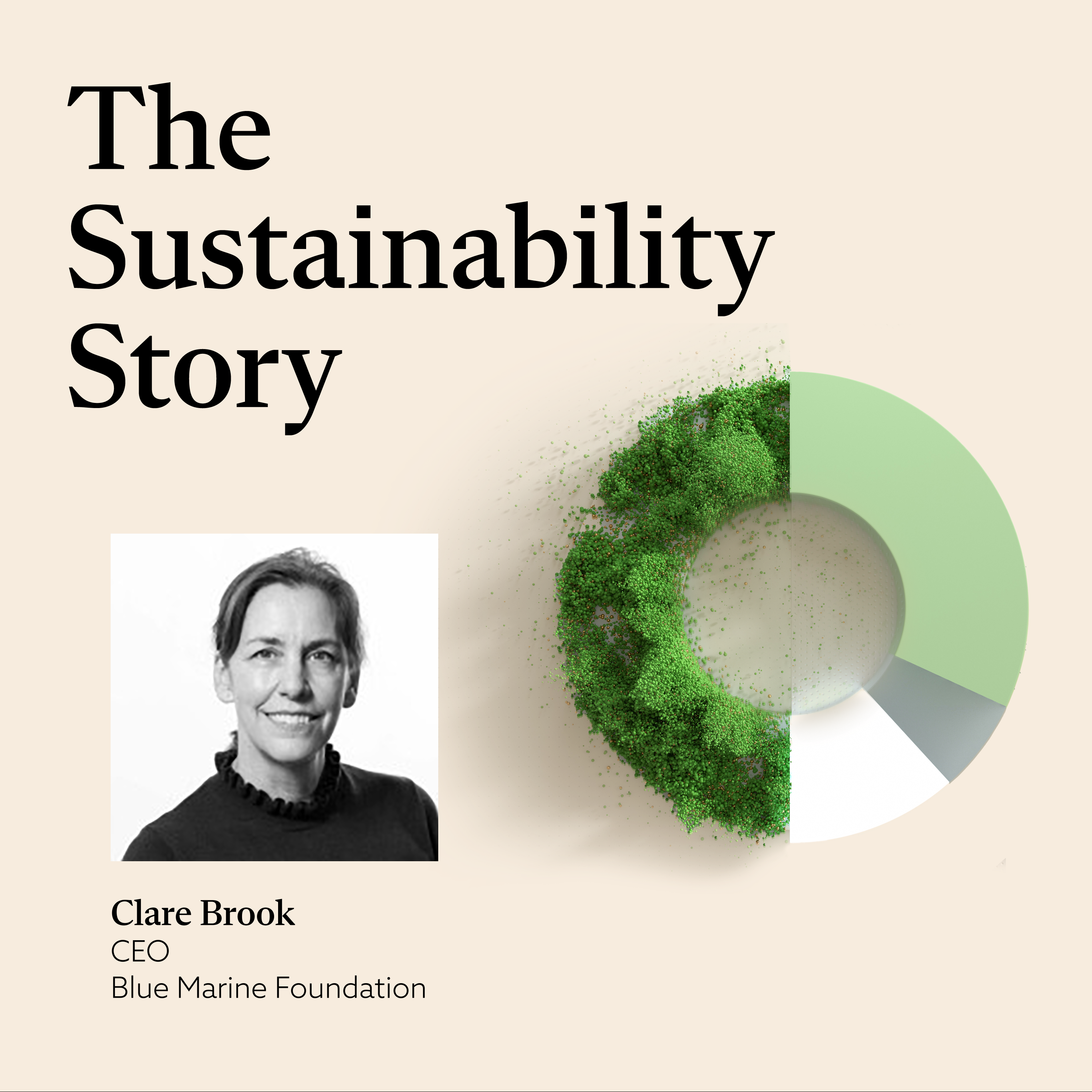
The Sustainability Story
Clare Brook: From Sustainable Finance to Ocean Impact in the Blue Economy
00:32:54
Loading summary
Transcript29 lines
- [00:00]
A
Foreign.
- [00:05]
B
Delighted today to be joined by Claire Brook for the next episode of a sustainability podcast series. Claire and I have worked together for a long time in the past, so know each other well. But for the benefit of the rest of the audience, I want to start with a few questions around Claire's background, career and personal journey. And starting with your background in asset management, you spent 24 years in sustainable finance, really is a pioneer in that sector from 1990 to 2014. What are the key changes you saw in this time? And tell us a little bit about your journey, Claire.
- [00:43]
A
Thanks, Paul. Well, I think in the early days, in the early 90s, it was very nascent. It was then called green or ethical investment. And before the concept of sustainability and then impact investing came, companies were very surprised that we were asking questions that weren't directly to do with their profits and bottom line and so on. And so we were greeted with some surprise, occasionally derision. And gradually, over the years that we were working, it became much more acceptable that we were going to be asking environmental, social and governance questions of companies, and that these issues that we were trying to uncover had real impact on the long term viability of any business. And so to give you an example, when you and I first joined Aviva in 2000, I think only a quarter of all FTSE companies were reporting on their environmental, social and governance issues. By the time I left in 2008, it had gone up to nearly over 90%. Nearly all of them were, and I'm sure now it's entirely normal for companies to be reporting on those issues. So it was a very exciting time to be working in the sector for sure.
- [02:25]
B
In 2014, you decided to leave a world of impact investing. By then you were at Web Assets Management, a firm you'd co founded to join an ocean conservation ngo. What prompted that move from the world of finance into the world of ngo?
- [02:44]
A
It was in a way, quite a, an impulsive decision. But I think those who work with me and my friends and family know that I'm quite impatient. It's probably one of my many faults. And I think by then I was getting impatient at the pace of change that it was possible to achieve through sustainable investing. And at the same time, all the indicators around climate and biodiversity were getting worse at a pace that was happening much faster than had been predicted. So for me, it felt as if I needed to do something more meaningful, more impactful. And I became involved with Blue Marine foundation on just one day a week, as it were, via a great friend of both of us called Cindy Ford and as soon as I started looking into what Blue Marine were doing and were able to achieve, it just struck me as hugely greater than anything that we were able to achieve through sustainable finance in terms of getting vast biodiversity and associated carbon gains.
- [04:17]
B
And I think you'd done your fair share by that point as well, of time in the finance industry and done your part from sort of really when this was in this nascent stage to actually reaching a lot more maturity at that point. And since you joined, you joined obviously, Blue Marine, what are the main objectives there? What are you trying to achieve and why we're particularly attracted to that charity?
- [04:44]
A
So Blue Marine had been set up in 2010 off the back of a film called the End of the Line, which really drew the world's attention to the crisis in our oceans that was being caused by overfishing. A lot of people, first of all, don't understand the crucial role that the oceans play in stabilizing the climate and providing food source for billions of people and so on. And they also don't understand that the ocean can only play these vital roles of providing us with half the oxygen we breathe and absorbing more carbon dioxide than all the forests on land. It can only play these roles if it's teeming with life. And what we've been doing since the beginning of the industrial era, but this is speeding up, is draining the oceans of that life. We're stripping it of life through overfishing. So Blue Marine was set up to directly challenge overfishing and offer the perfect solution, which is the creation of marine protected areas. Because if you have areas of the ocean that are free from destructive overfishing, fish populations and habitats bounce back and that means that there's actually more fish to be caught. So it's good for fishing communities and it's good for marine life and it's good for the climate. So it's a massive win win. And the reason I was so drawn to Blue Marine foundation was that although the charity then was very small, it was achieving these huge wins, persuading governments around the world to set aside vast areas of marine protection. And so I was, I guess, thrilled to have found a charity that was achieving so much and I wanted to be part of it.
- [07:04]
B
You've had phenomenal success since you joined there, along with replicating your great success in asset management. And the charity has grown 12 times since you joined, so it's not so small anymore. And how did you achieve?
- [07:18]
A
Feedback Grave we're now, I think, the biggest marine focused conservation charity in Europe. Our turnover will be 13 million for the financial year just ended. Well, I achieved the growth along with the fantastic people who I work with. So very much a team effort. And I guess I tried to apply the same principles that I'd applied in growing funds under management at the various places we'd worked, including NBI and Henderson and Aviva. And the principle there was that if you have great performing funds that are run with high integrity and are delivering what the investors hope that you'll deliver to them, then more and more investors are attracted to put their money with you. And the same principle applies to donors for a charity, that if you're achieving a lot of impact and delivering even more than you promise your donors, then they'll want to give you more money and more donors will want to give you money. And so the whole thing sort of develops its own momentum. It's a snowball effect, if you like. And the more money that comes in, the more projects you're able to do, the more impact you achieve. And so you get into a kind of virtuous circle.
- [09:01]
B
Given the importance, why do you think marine solutions have received less attention historically compared to territories? Terrestrial approaches like tree planting and forest preservation, Is this simply down to the sciences less understood and we understand less about oceans, or do you think it's beyond, beyond that challenge?
- [09:20]
A
It's partly that. It's that the ocean has always been vast and mysterious and quite inaccessible. We know more about planets in our solar system than we know about some parts of the Ocean. There are 2000 species being discovered every year. The deepest depths of our ocean remain inaccessible. It's also quite hard to measure and record life in the ocean, because it moves around. It's very hard to kind of find it, to determine exactly how much is there and how it all works. So that's a challenge that scientists are brilliantly overcoming, but only through technological developments that are taking place all the time. And then there's the fact that the ocean is out of sight and out of mind. So for a lot of people, even people who live near the sea, they have little perception about what's going on under the surface. So it's really up to us at Blue Marine. And as I say, we were born out of a film. We use a lot of media assets to try and educate people and enlighten people about what's under the surface. But we're thrilled that a film has just come out last week on the 6th of May, with David Attenborough. It's possibly David Attenborough's greatest film so far, it's called Ocean, and I would urge everyone to see it because it's remarkable. But what this film does is reveal so much about what's beneath the waves, about the life in the ocean and how important it is. So that's providing us with. With kind of rocket boosters as far as our mission is concerned.
- [11:28]
B
I haven't seen it yet, but I'm looking forward to watching it. He's got an amazing coverage and profile already from such an icon in the sector and moving a little bit to the challenges and optimistically, the opportunities in marine conservation markets. And actually, I do know Attebrew is very focused on the. The hope of the future as well as the challenge we're sort of facing. So looking at that, what's your perspective on how effectively marine ecosystems can recover when protected and what scale of protection is needed worldwide to achieve that? So I'm hoping you can give us a note of optimism in your response.
- [12:12]
A
The really good news is that marine ecosystems recover faster and better than anyone realized. So as soon as you place these areas under protection, life starts to bounce back. And having been involved in a few areas now that have been protected, in the course of the 10 years that I've been working at Bloomerene, I've seen that happening, which is completely thrilling. So to give you an example, at Blue Marine, we were quite instrumental in helping to get Ascension island in the middle of the Atlantic. We helped the community there to declare a marine protected area in their waters, which is an area nearly the size of France in the middle of the Atlantic. And before it was protected, the waters were heavily fished by longliners, where you have 80 kilometers of baited hooks. So that catches a lot of tuna, which is what they're after. But it's also completely indiscriminate. So it catches sailfish, marlin, swordfish, seabirds, sea turtles. You know, the bycatch would make you weep to see. And so that area has now been completely closed to fishing, which is wonderful. And as a result, life is bouncing back not just within the area, but is spilling over into the rest of the Atlantic. And on the beaches of Ascension, they have one of the largest populations of green turtles in the Atlantic. And this nesting season that has just gone, my colleagues went out there and worked alongside the wonderful team that is helping to monitor and kind of rake the beaches so that these turtles can safely nest. And they counted more nesting green turtles than has been seen since the 1970s, which is just completely wonderful. Really winding the plot back to before Overfishing started to happen in earnest. So there are so many examples of that from all over the world. So in other words, we know that if you protect the ocean, it can spring back to life in the most wonderful way. To your second question of how much needs to be done. At the moment, only 8% of the ocean is under any form of protection, a lot of it quite ineffectual, and only 3% of it is properly protected. And we've committed globally through the Global Biodiversity framework to protect 30% of the world's ocean by 2030. And 196 countries have signed up to that. So we basically need to increase the amount of Ocean protected by 10 times, which is obviously a huge challenge. So how do we go about doing that? There are quite a few pieces to the jigsaw which are completely crucial, but there's political will is the number one thing. That's why we're all heading down to the United Nations Ocean Conference in Nice in early June to try and persuade as many countries as possible to protect 30% of their waters. But there's also a financial element to all of this. And at the moment, the funding gap needed to get to 30% of the ocean protected is estimated at between 9 and 12 billion dollars per year. Now, that sounds pretty huge and unattainable, but if you think that $25 billion was spent on the Elizabeth line in London, I think about 200 billion is being spent upgrading a railway high speed 2 in the UK and meanwhile we're spending at least 20 billion a year on harmful subsidies in overfishing. So once these figures are set into context as to how much it could benefit the world to have a third of the ocean protected and how much we're spending on other things. I mean, I haven't even thought about how much we're now going to be spending globally on defense, but it would dwarf what needs to be spent on ocean protection. So ocean protection is relatively good value. It's incredibly effective, unlike protecting forests in the midst of a climate crisis, as we now find ourselves, there's no danger that they will burn down. So it has permanence and it's highly effective.
- [17:47]
B
Can we bring it back then to the role of the sort of investors we have on the. Listening to the podcast today, what is the role of finance in achieving the 30 by 30?
- [18:01]
A
It's a rapidly evolving area. So you've got investment in protection technologies, for example, satellite monitoring, alternatives to plastic fish that are actually bred in the labs rather than wild caught some very exciting developing areas. Then you've got things like blue bonds and debt for nature swaps that can mobilize large amounts of finance to countries that really need to develop their protection targets. And some very good initiatives are happening right now in Barbados and the Bahamas, for example, and in parts of Asia. Then you've got blended finance, insurance innovations, things like a coral reef bond. I think the important thing that we at Blue Marine are trying to do all the time is match the actual need, the conservation need on the ground with the expectations of would be investors. And I think the difficulty you have is that investors obviously want low risk and incredibly high return and that can't always be delivered. If you're talking about the protection of biodiversity, why is that? Because fundamentally we don't value nature correctly in the world. We don't ascribe a sufficient value to all that nature does for us and how incredibly awful it would be if it wasn't there. So we don't look at the upside and we definitely don't sufficiently examine the downside risk of losing it all. So be that as it may, you know, that's a challenge for the world to try and value nature correctly. But all that we can do in the conservation world at Blue Marine and the other organizations that work in this area is try and match the best possible financial solutions that can have the most impact in terms of actual protection of biodiversity and actual sequestration of carbon. And so we've been working on that at Blue Marine for a long time. And where we've arrived is to try and develop not carbon credits, but biodiversity credits in our largest restoration project that we work on in the Solent. And so we're working on a very exciting structuring and leveraging of philanthropy effectively in the creation of these high integrity biodiversity certificates.
- [21:18]
B
On that topic, are biodiversity credits or certificates a more scientifically robust and higher integrity alternative to carbon credits?
- [21:29]
A
It's an interesting question. It depends obviously what you're after. I mean, we're in the middle of a climate and a biodiversity crisis, so we need. And in the ocean, the two are very symbiotic. It's because of the life in the ocean that the carbon is absorbed as it was. So we need to be doing. Bellows Carver markets have lost quite a lot of their reputation in the last couple of years and there was a lot of criticism lodged at the integrity of the projects that they were supporting and also whether the money raised was actually going to the communities adjacent to the projects. So we're trying to work on something that will be both scientifically robust, but also bring direct benefits to the community around where we're setting up these credits that won't lead to the answer to everyone's prayers in terms of kind of double digit returns. So that's what I mean about expectations. I think pension funds or any would be investors need to understand that the higher the biodiversity impact, you're going to have to modify your expectations around return.
- [23:09]
B
What do you envisage for finance, either Macro or Microsoft in accelerating marine conservation? What more could we do?
- [23:18]
A
There's so much more that can be done. I mean on the macro level we have bonds and debt for nature swaps and so on, which are really done at a governmental level. So that requires concerted political will and international cooperation. On the micro level, I'm really interested in the idea of creating a whole generation of people who work on ocean conservation and protection rather than what we've seen traditionally, which is people earning their money through exploitation of biodiversity. So if you take the example of St. Vincent and the Grenadines and the Caribbean, these islands traditionally had a lot of whaling and whole communities were earning their money from catching and eating whale meat. Now they've started obviously to be inundated with tourists. But the problem is that a lot of the tourists aren't really contributing to the local economy, particularly the ones that arrive on these massive cruise ships. So if through, if you like, ethical as well as environmental considerations, we're hoping that these communities will stop whaling, then they need alternative livelihoods. And those alternative livelihoods could be things like ranges to monitor the whole newly protected marine areas. Park ranges. There are wonderful mangrove parks that visitors can be taken to snorkel safaris and dive safaris and coral reef restoration and drone operators. There's whole new livelihoods. But it's very important that the people visiting the island engage in that process and support this alternative economy so that these livelihoods can thrive.
- [25:37]
B
And so how can asset owners be them? Pension funds, institutional investors, sovereign wealth funds integrate nature based solutions into their sustainability portfolios. And so linked to that, what stops them doing it and what can we do to make it easier and get through those barriers?
- [25:57]
A
If I knew the answer to that question, I'd probably be really famous. So I wish I knew the answer to that question. I think it's about, as I said, needing to put a different value on nature. And how we collectively do that at a time of political discord is very challenging. I think one thing we're noticing at Blue Marine is that increasingly corporates, companies are stepping up and filling the void that governments have left by withdrawing their support for climate and biodiversity initiatives. And we're finding an increasing number of companies that are willing to commit at least 1%, in some cases 10% of their net profits to supporting NGOs in their fight to try and protect nature. And that's incredibly heartening. And then you've got things, you know, initiatives in finance like the Task Force on Nature related financial disclosures, TNFD, which I think now has over 500 organizations as part of it. You've got global recognition on the importance of integrating nature related considerations into decision making, reverberating around banks and major corporates, which is encouraging. You've got organizations like Aura, the Ocean Risk and Resilience Action alliance, which is providing a conduit between governments, private issuers and investors to stimulate the creation of high quality finance to deliver impacts for the blue economy. So there are lots of people working very hard in this area to deliver the finance that's needed. But as I say, we're seeing a decline in political will at the moment overall, and that makes it a pretty challenging environment to be operating in.
- [28:29]
B
Sorry, I've got another difficult question to follow up with that around the challenging area of impacting. How do you measure impact and accountability? And how does Blue Marine foundation approach measuring the impact of marine conservation projects?
- [28:44]
A
That's not so challenging because we think about that all the time. Because as I said before, if you're going to attract more people to donate, then what we are in the business of delivering is not a return, not a financial return, but impact. And so we have thought about it very hard. We produce an impact report and we measure our impact, we call it kii. So key impact indicators, and those include square kilometers of ocean placed under protection, square kilometers of ocean that was nominally protected but wasn't very well protected. So placed under improved protection, numbers of community members engaged and launched into alternative livelihoods, as I was describing, which then secures that protection for the longer term. Numbers of politicians who we've managed to engage because of political will being so important, members of the general public who we've managed to reach, children who we've managed to reach.
- [29:58]
B
You are clearly very exciting. Rightly so. About Sir David Attenborough's salvation film and you described it as a game changer. Why do you describe it as a game changer?
- [30:10]
A
Well, several reasons. I mean, first of all, because it's him. He's the most respected conservationist in the world and his voice is so amazing, Even though he's 99 years old, he's still got a wonderfully strong and melodic voice. And he sounds so reasonable all the time, even when he's talking about some of the things that are happening in the ocean which are really enraging. And so having his voice to describe both the beauty of the ocean, but also the destruction that's being wreaked on it is incredibly helpful for our mission. And the most exciting thing about the film is that they've managed to get footage of a bottom trawler and what is actually happening when that goes along the ocean floor. And it's so shocking to see it. And even though we've been talking about how destructive bottom trawling is at Blue Marine for the last 15 years, having this actual footage is so powerful. And we can show that to politicians, obviously the general public. We can show it at the eu. Everyone who has it in their gift to stop this disastrous practice from going on in marine protected areas is going to be seeing this footage. And I think that's going to bring about a revolution in the way that the sea is managed and long overdue.
- [31:51]
B
And I'm sure a lot of people are interested to know more about Blue Marine. And how can those who are interested get involved and support the initiatives and support Blue Marine?
- [32:02]
A
Well, we've got a website, bluemarinefoundation.com so do have a look at that. There's a lot on it at the moment. A call to action to contact the Secretary of State for the Environment about the issue of bottom trawling. So there's a handy click through where you can email Steve Reed. So we'd urge everyone to do that and do watch the amazing David Attenborough film, Ocean with David Attenborough. It's now available on the Disney Channel, so I really recommend that. Life changing.
- [32:37]
B
Thank you so much, Claire, for all your insights. It's been great to chatting with you. Thank you.
- [32:44]
A
Thanks so much for having me on the podcast.