← The Sustainability Story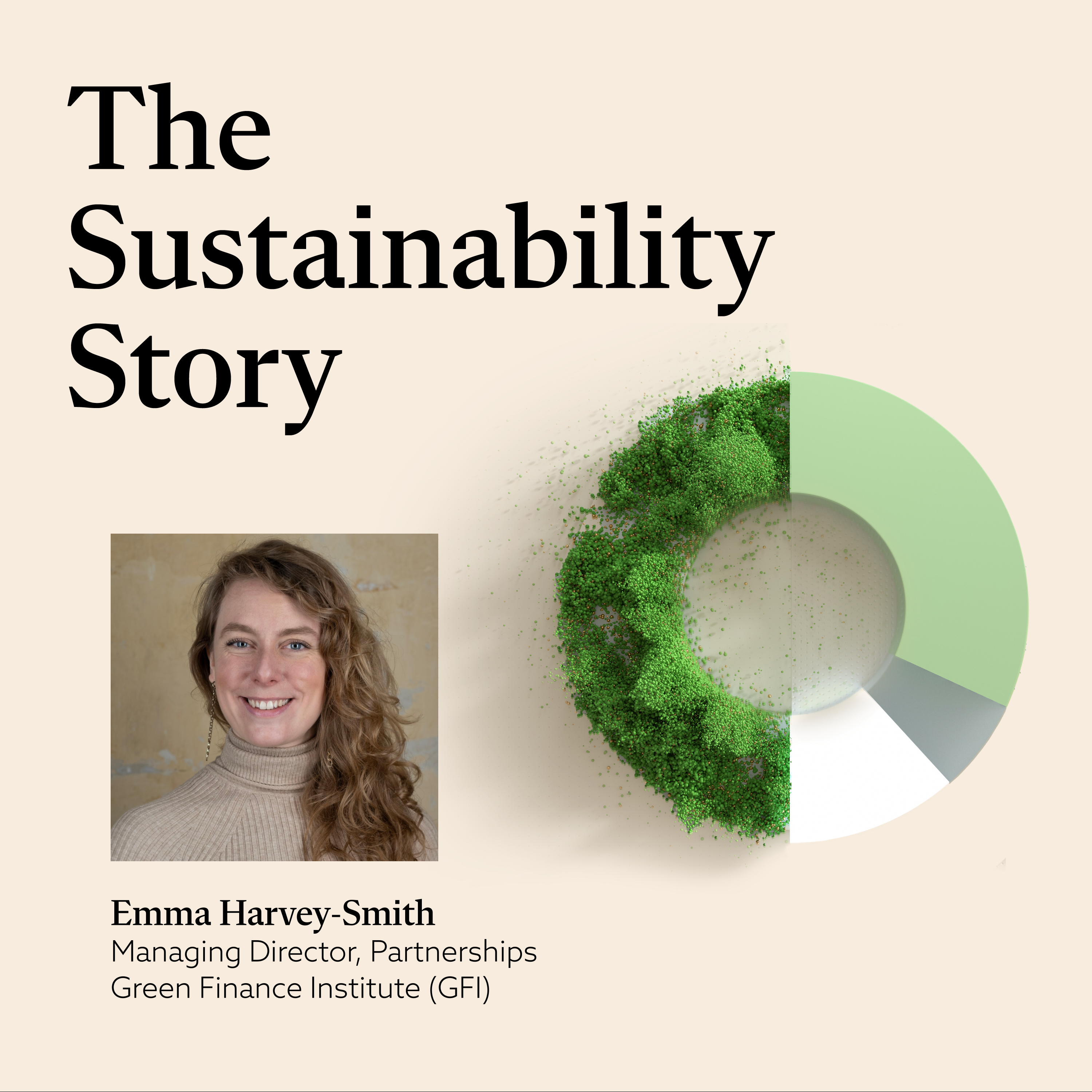
The Sustainability Story
Emma Harvey Smith: Mobilizing Global Capital for a Sustainable Future
00:29:03
Loading summary
Transcript29 lines
- [00:00]
A
Foreign.
- [00:05]
B
To today's sustainability podcast with Emma Harvey Smith from the Green Finance Institute. I'm delighted to have you here today, Emma, and maybe you could just start by introducing yourself and telling the audience a little bit about your background.
- [00:19]
A
Thank you, Paul. Really delighted to be here today. So thank you for the invitation. So, I'm Emma Harby Smith. I am Chief of Staff at the Green Finance Institute. So I work on driving the organization's delivery and ensuring that we have impact and continue to mobilise global capital towards net zero outcomes. I previously led the Green Finance Institute's Built Environment Programme, which convened over 400 experts to, you know, to develop solutions that would support investment into decarbonising homes across the uk. And prior to that, I used to work at Barclays, where I worked across a number of different roles, from debt origination and corporate banking to through to working within the mortgage business, where I first got my bug for green Finance.
- [01:04]
B
So you've worked both in the public sector and also private sector. What attracted you into sustainability and sustainable finance?
- [01:13]
A
So my background's actually as a physicist, so I'm a trained physicist. I really got a bug for understanding how our energy system worked during my academic days. And then when I moved into the banking sector, I started to see the role that finance could play in facilitating the growth ambitions of companies, but also the role it could play in helping individuals to achieve their goals and their ambitions. So it was quite natural that these two passions, science and finance, would come together around the sustainability theme. And it's really interesting to see how finance can facilitate a transition towards net zero. And I really got the bug for sustainability, as I mentioned, when I was at Barclays, where I was working alongside the Green Finance Institute's now chief executive, who was a senior banker at the time at Barclays. And we were working to understand what financial solutions could we develop that would support our clients and our customers to transition towards net zero. So I worked within a team that led the launch of the UK's first green mortgage proposition. It was the first High street bank to offer a green mortgage. And it was so interesting working through the knotty challenges that the sustainable finance landscape can present from working out what are the barriers that customers are facing when they're trying to transition? How can we pull the different financial levers and financial product design elements to provide an attractive solution? And so really, for me, the bug came from applying the rigor of finance and the rigor of science to deliver sustainable outcomes for our economy.
- [02:49]
B
And so then the next logical question is why? Why the Green Finance Institute in particular? What attracted you to their. What are you hoping to achieve?
- [02:59]
A
To give a little bit of background on the Green Finance Institute. So the Green Finance Institute, or the DFI was launched in 2019 off the back of a recommendation from the Government's Green Finance Task Force that identified the need for a central body that could drive the growth of green finance in the UK. So the GFI was launched at the Guildhall in 2019 and I was really drawn to the ambition of the organization which is at the forefront of shaping how finance can be used to deliver a sustainable economy across the globe by creating both the enabling policies and regulations and designing the financial solutions that will channel capital and deploy capital towards net zero and nature positive projects across the globe. So I joined in the very early stages of the Green Finance Institute within its first month and as I mentioned before, I led its Built Environment program and that was really attractive to be involved in a cross industry collaborative environment with a really clear goal to capitalize, normalise investment into decarbonising homes across the uk. And as a result of the organization's success, we've scaled up from a small organization to over 70 people today, operating across nine countries with programs across buildings, transport, nature, aviation, carbon dioxide removals, industrial adaptation. We cover the full range of sectors that the IPCC says is vital to achieve a net zero and nature positive future. And therefore that's why it's also been very natural and exciting for me to move into the Chief of Staff role helping support that growth across the globe. So it's a really vibrant organization, it's having a material impact both in the finance sector and in the sustainability space. And there is so much potential given we know that the trillions and trillions of investment gap that is needed to deliver a sustainable economy.
- [05:03]
B
How do you think about working on a more global basis? Because obviously a lot of the work that's been done has been pioneered here in the uk. But you touched on the need to have global consistency messages to drive capital markets, to drive capital flows, because otherwise it's very confusing for corporate organizations if you're getting different messages in different places. So wonder how you consider that and how to work or the group really the Green Finance Institute plays into helping that consistency approach and collaboration she may have with other groups.
- [05:41]
A
When you're looking at sustainable finance sustainability across the globe, you've got to take into account the local context. So for example, if you look at Indonesia, they are having a transition away from a coal based energy system, which is very different to the context we have in the UK where we have a thriving renewable sector, but actually we have industries that are very energy intensive that we need to try and transition to lower carbon, greener fuel sources. And we have very energy intensive buildings. We've got the dirtiest, leakiest buildings in the uk, we need to transition those. So it's understanding what the local context is. So if you ever look at Australia for example, they need to undertake grid reinforcements. Likewise in America, these are very large countries transitioning to renewables, they need grid reinforcements. So and then you look at Brazil where actually nature restoration and avoiding deforestation is vital. So first thing you've got to understand the local concept and you've then also got to identify who are the influential actors on the ground in the local area who can help drive any collaborative initiative.
- [06:51]
B
Getting to the core of the Green Finance Institute said its actual mission. What is this core mission and core values and has that evolved and will that continue to evolve?
- [07:04]
A
Yeah, so we have always had the same mission, which is to accelerate the transition to a clean, resilient and environmentally sustainable economy by channeling private and public capital at pace and scale towards real economy projects that will result in jobs, prosperity and a sustainable environment. And that has been our mission from day one. And we continue to play a very unique role in the landscape. We sit at the nexus between the public and the private sector. The vast majority of us are ex bankers, ex investors, so we bring that finance knowledge and expertise. But we have very close relationship with governments around the world and that puts us in a really unique position to be able to understand the flows of public and private capital that are needed to go into priority sectors for a particular country. And we are also then highly trusted by the financial institutions in that region so we can have open conversations with them about opportunities, financial models that will support them to invest into net zero and to green their book. And so we provide a neutral platform which also is highly beneficial. We are a not for profit organization, so we are not seeing as a competitor to any of the organizations that are vital to, for working with to achieve a net zero future. So we provide that neutral platform that can help co design, test and scale these new markets, these new asset classes that are going to mobilize capital towards sustainable outcomes. And then with our trusted relationship with governments, we can advise on what are the policies, what are the regulations that are going to unlock the blockers to capital flows and capital markets. So we always have the same approach. We're simply expanding into new sectors, new geographies. And just try to increase our impact every day.
- [08:59]
B
Talking about blockers, what do you see as the core barriers at the moment? Blockers and is that changing? I guess both from a short term perspective and also a longer term perspective.
- [09:12]
A
Over the last six months we've had some choppy waters and some geopolitical headwinds and I think we're seeing commitments by countries but also by corporates start to come under scrutiny. And therefore you've also seen some either backpedaling or green hushing across the landscape. And so that is one near term barrier in and of itself. But the bigger barrier though is that we don't have all of the parts of the value chain working in lockstep to try and deliver a net zero economy. We don't have the development of NDCs. So these are the nationally determined contributions. The development of policies that will drive demand and supply, the creation of market infrastructure, whether that's development banks or institutions that can support the generation of pipeline of net zero projects. We don't have the financial solutions that are going to deliver attractive risk adjusted returns and we don't have the collaborations that again then going to scale those solutions into new markets. We have pockets of excellence along that value chain across countries and across sectors. But what we don't see is that you know, knitting together that weaving together of all of those factors so that we focus on sectoral transitions, regional sectoral transitions that can deliver enormous impact and therefore can be replicated and scaled out. So really it's we need the glue that will weave all of these fantastic initiatives that are happening across the landscape. So we need the glue that will weave them all together behind a common objective which should obviously be real economy impact, decarbonizing X number of homes, you transitioning from internal combustion engines to electric vehicles, et cetera, et cetera. So we need all these initiatives to be focused behind real economy outcomes and working together so that the full value chain is working in lockstep to deliver net zero.
- [11:09]
B
That aligns very closely with our experience as well. So long term asset owners are really ignoring the noise in the system at the moment. But there is a lot of noise in the system for sure. However, the simple answer I get when I speak to those long term investors is that climate change is real, it affects their portfolios, it's part of our investment process. Analyzing, understanding that and taking that into account is going to be essential and the pathways net zero will continue. So the change in the certainly long term investors hasn't altered at all. But maybe short termism is definitely creating more challenge and questioning within there. So it aligns really well there. Just coming in, you talked about sectors a little bit and you would crank sectors quite broad, range from transport to nature. And also, which sectors do you think there's really the biggest opportunity at the moment. What excites you in terms of the opportunity for innovation?
- [12:16]
A
The cheeky answer would be every sector, because every sector is important to achieve net zero, and there are huge opportunities in so many of them. The one I will draw out at the moment, which is really starting to get some attention, is the nature sector. Nature, biodiversity, agriculture. To date, this has been a challenging sector for the finance for financial institutions to support, because biodiversity and very often nature projects do not generate cash flow. A lot of other net zero sectors, there will be a cash flow generated if you invest into, or if you support the development of an offshore wind farm, there will be, you know, there'll be a cash flow coming from the generation of that electricity. If you invest into energy efficiency, there will be cash flow from the savings of the operating cost to that building with nature. It's unclear where that cash flow can come from. So today that's made it quite challenging to invest into. But we are starting to see some really innovative models starting to come forward and really a stepping up of the corporates who are investing into nature and biodiversity in order to very often support the resilience of their supply chains. The gfi, in partnership with a number of partners, including University of Oxford and the University of Reading, published a report last year that was quantifying the risk from nature degradation. And in short, it showed that the risk of nature degradation in the UK was potentially a 12% reduction in UK GDP, which is a larger impact than we had from the COVID pandemic, because we would see our supply chains, our food supply chains, our manufacturing supply chains start to break down due to nature degradation. And it really showed that we need to take into account those risks. But it also showed to corporates the huge impact on vulnerability of their supply chains to nature degradation. Obviously, there's a lot of talk at the moment about vulnerability of supply chains to tariffs, but the quantification of the risks to our supply chains is huge as well. Particularly when you're looking at water. You can either have too much water, too little water, or not the right quality of water. So we're seeing corporate starting to take this seriously. And there is a project that the Green Finance Institute is leading in collaboration with UNEPFI, BioPhin and UNDP, called revenues for Nature, which is identifying the most viable, most promising models for how do you generate a revenue from nature and create nature markets, whether that's biodiversity net gain or its landscape enterprise networks or many, many other models that are trying to create an investable model for nature. And I think we'll start to see some really exciting developments in this space over the next five to 10 years.
- [15:02]
B
Financial analysts should be looking at risk and opportunity here and how. What role should people working in the finance industry and the investment industry, investment professionals, play in addressing these issues within the constraints of trying to optimize portfolios and investment risk return?
- [15:21]
A
I remember back when we were doing a lot of cutting edge greed finance work at Barclays, we had a bit of a mantra which was risk, reputation and return. So there's the three R's. So absolutely you have to consider the risk associated with climate. So to use a very tangible example, we saw huge flooding in Valencia last year. We saw the airport, you know, come under significant strain and be completely flooded. Now off the back of that, we've heard anecdotally that investors are really starting to take into consideration flood risk and you know, some of the more extreme weather events that we can expect from climate. We're already seeing in the US that insurers are pulling out of California and Florida in terms of providing property insurance because they're just not able to take the risk that comes from wildfires and hurricanes and floods. So we do need to take into account the risk, but what we can't do is leave people stranded, other businesses or individuals in that home. So it's about managing risk, but then also working out how do we support and improve the resilience of our infrastructure and our buildings to those climate impacts. The second was reputation. So it's, you know, if you are a financial practitioner, not undertaking or not considering sustainability can have implications on an organization's reputation. That's obviously slightly frothier at the moment in different markets where the term ESG has potentially got a negative connotation around it now, but there are still reputational impacts. And we haven't seen many of the European banks pulling out of these sustainability initiatives. So it's still clearly important to them and their clients and then return. And ultimately this is the one that we've particularly focused on when I was at Barclays, but we particularly focused on as well the GFI is how do you create a return opportunity for financial institutions? How do you structure a financial solution that will deliver the outcome that your client or customer is looking for and provides attractive risk adjusted returns to the financial institution. Because only with those two factors will you get a model of financial and solution that will actually scale and will get traction and will be replicated and adopted by other financial institutions and turn into a market. So to give a tangible example of that, the Green Finance Institute has been heavily involved in scaling the UK's green mortgage market. When I was involved in launching or led the launch of the first green mortgage by High street bank, we were very keen to make sure that we were offering a lower interest rate but we weren't eroding margin. So we were able to look at the risk profile of mortgages on more energy efficient and less energy efficient homes. And it became clear, and this analysis has been replicated by the bank of England, that default rates on properties or mortgages secured against more energy efficient properties are lower than mortgages secured on less energy efficient properties. Now we can talk, we can debate what the reasons for that is, but you have, you have a lower risk asset, which means it's lower likelihood of default, which means you could offer a lower interest rate without eroding your margin. So that's one way of saying, right, we've got to look at the different risk and return factors. What's going to attract and drive people to take out a green mortgage to invest into improving the energy efficiency at their home. And as a result, you know, we've been working with the market for five years now. There are believe well over 60 green mortgage products offered by almost all of the mortgage lenders across the uk. They are now come in many different flavors. Some offer lower interest rates, some offer cashback, some offer a free energy assessment report. But all of them in order to scale must have done that decision of weighing up, right, what's the risk and what's the return? So I'll just repeat again, it's the three R's. It's just consider what's. How can you manage risk through climate? How can you manage your reputation through climate and other opportunities to generate returns through climate change? That's how in your day to day working life you can start to think about sustainability and climate. Day to day.
- [19:22]
B
Great. The Priyas risk, reputation and return. Love it. Go on to move slightly to public policy and regulation. And how closely does the Green Finance Institute engage with UK or international regulators? And where do you see the most promising policy momentum?
- [19:40]
A
As I mentioned previously, the GFI sits at the nexus between the public and private sectors. We are trusted by financial institutions, but also a trusted advisor and an independent trusted advisor to governments around the Globe and we provide this neutral platform to try and drive and scale investment into net zero. Now, policy is absolutely vital. We cannot scale green finance in a vacuum. We need to have enabling policies and regulations and demand signals that will let the investment community know that actually this is a good sector to invest in. It is either been, you know, there's going to be clear demand in that sector for investment, there's going to be growth, there's not going to be chopping and changing in the policy environment. So that is one important factor. The second important factor though that policy can play or public sector can play is it can provide concessional capital. So you quite often hear terms like blended finance bandied around. This is really where a small amount of public capital is used to either pump around the market or, or to crowd in private capital by either acting as a cornerstone investor or by providing a guarantee that can de risk a particular factor of an investment. Or it can, it can create more of a precedent so it can be a first investor into a transaction that's maybe got first of a kind risks and that can make the private sector comfortable to move in. So we work very closely with governments around the world, with regulators. You may be aware that the Green Finance Institute CEO Dr. Thomas chaired the National Wealth Fund task force for the then Labour opposition, now a Labour government in the UK which advised the government on how to deploy the 27 billion plus pounds that are now within the National Wealth Fund to try and crowd in private capital and really catalyze key industries in the uk. So we do work very closely with, on that and it's always about developing targeted policies that are going to unlock capital. Because we can't fix everything through policy. It's unfair to imagine that policy is a magic wand that you can wave and everything will be good. So we're always focused on what are the laser focused policies or regulations or demand signals that will unlock capital flows and therefore make it an attractive investment case to invest into particular sectors, whether that be buildings, transport of sustainable aviation.
- [22:12]
B
Fuel and a move to the future outlook and innovation. What gives you hope about PACER change in green finance? As we alluded to earlier, there's a lot of noise and negativity in the sector at the moment. I think part of it is addressable simply through language, terminology. Certain terminology like ESG is becoming less appealing, but the, the term sustainability still seems to resonate with most people. But it's really what is it that sort of excites you and gives you optimism for the future?
- [22:49]
A
Yeah, as you say There have been headwinds for the last few months and I think we've seen a number of organizations, corporates, governments, financial institutions reflect on what they've been doing in the sustainability space. And as you say, terminology has become incredibly important. What gives me optimism though is that we're still seeing deals happening whether they are labeled green or not. We are seeing deployment primal capital into projects, to name just a few. We saw the European Investment bank signed 108 million euro deal in green loans for Spain's Iberdrola. So they're obviously a major organization in renewables. We saw a Temasek backed ABC impact fund raise $600 million to scale Asia focused healthcare and climate investments. JP Morgan Asset Management raised $1.5 billion for a forest and climate solutions fund. And we also have seen some really interesting transactions such as the Gaia transaction, which is a 1.48 billion dollar lended finance platform that is supported by the likes of Canadia's bilateral development finance institution, Fintep Canada MUFG bank and the Green Climate Fund and Climate Fund Managers, which is a blended platform looking to invest into adaptation across 25 different emerging markets. We're seeing deals happen, they're not always labeled green, but they are still having a positive climate impact. So yeah, we have entered and we have moved into a new, far more transactional phase of the sustainable finance movement. And actually this does represent an opportunity to mobilize significant amounts of capital into real economy transitions that will lead to a more prosperous future and a more sustainable planet.
- [24:41]
B
A lot of people I speak to, not just many young professionals, but many mid career professionals want to move into the space to contribute something and do something with more purpose and contribute to the biggest, what they see as the biggest challenge is sort of facing the globe around sustainability and how, what advice would you give them and how did you make that transition across and has there been anyone who's influential on that journey? But particularly is there any advice you could give to any of our listeners out there who maybe interested in moving more into this field?
- [25:19]
A
I mentioned earlier that there's greening finance and finance in green. So greening finance is about embedding sustainability into risk practices and monitoring across financial institutions and then financing green is about deploying capital towards net zero projects on the ground. And so my advice therefore would be you need to get that sustainability experience, whether you do that through qualifications of the likes of CFA offer or through working in sustainability or environmental practices. But also it's absolutely vital that you get those hard financial skills if you want to be really at the forefront of driving trillions towards net zero outcomes. So making sure that you get experience both in sustainability and in finance is going to be absolutely vital to reach your full potential. And that was really sort of embedded with me by one of my massive supporters and advocates and champions as someone I really look up to, which is the Chief Executive of the Green Finance Institute, Dr. Rhianne Marie Thomas OBE, who's really coached and guided me throughout my career and is a huge champion of female leaders as well. So there's lots of other people I would love to give a shout out to and we don't have enough time, but if I was going to say one person who's always provided that North Star and always driven the ambition said, no, we need to always focus back on are we actually moving capital towards net zero? I would give a shout out to Rianne and that's what I'd advise for everybody as well. Looking to move into sustainability is build up your. Build up your softer technical sustainability skills and then build up your hard skills in finance because that will give you a really rounded profile to succeed in this sector.
- [27:03]
B
For people who've been inspired by your talk today, how can they get involved with the Green Finance Institute?
- [27:10]
A
Do head over to our website if you want to have a look at some of the sectors and get to know the GFI a little bit more, do sign up for our Green Finance Quarterly. This is our quarterly publication capturing all of the latest insights and cutting edge developments in the sustainable finance sector. And if you are a financial institution looking to drive investment into particular sectors, then please do reach out, have a look. If you're who've got sector programmes aligned with what you're doing, we're always keen to have a conversation and see if there's an opportunity to work together on some of these investment opportunities. So hopefully, hopefully that gives enough for your listeners to get a picture of how they can engage with us.
- [27:48]
B
When you were talking about the website and the communications, I would applaud the simplicity and the readability and the ease of all the material you have out there. When I was sort of before Avidum where I was looking through it all at some point, so the really interesting content. So I would reiterate that. Do have a look around. It's. There's some great information sort of on there and is there anything I've not asked you. I should have asked you.
- [28:12]
A
That's a side swerve ball. I'm not sure there is. I think we've had a really, really good conversation today. Really glad we managed to talk about the fact that sustainability isn't just net zero, it is adaptation, it is resilience, which is going to be so important because we have already reached 1.5 degrees. So we do have to adapt to a more extreme climate future. And it is about nature. So, no, I think we've covered off everything and hopefully everyone's got a view on just how exciting this sector is and it really is a wonderful place to make a career.
- [28:46]
B
Thank you for such a fantastic, inspiring talk. I've really enjoyed being able to spend this time with you today. Thank you so much. Thank you.
- [28:55]
A
Paul.