← The Sustainability Story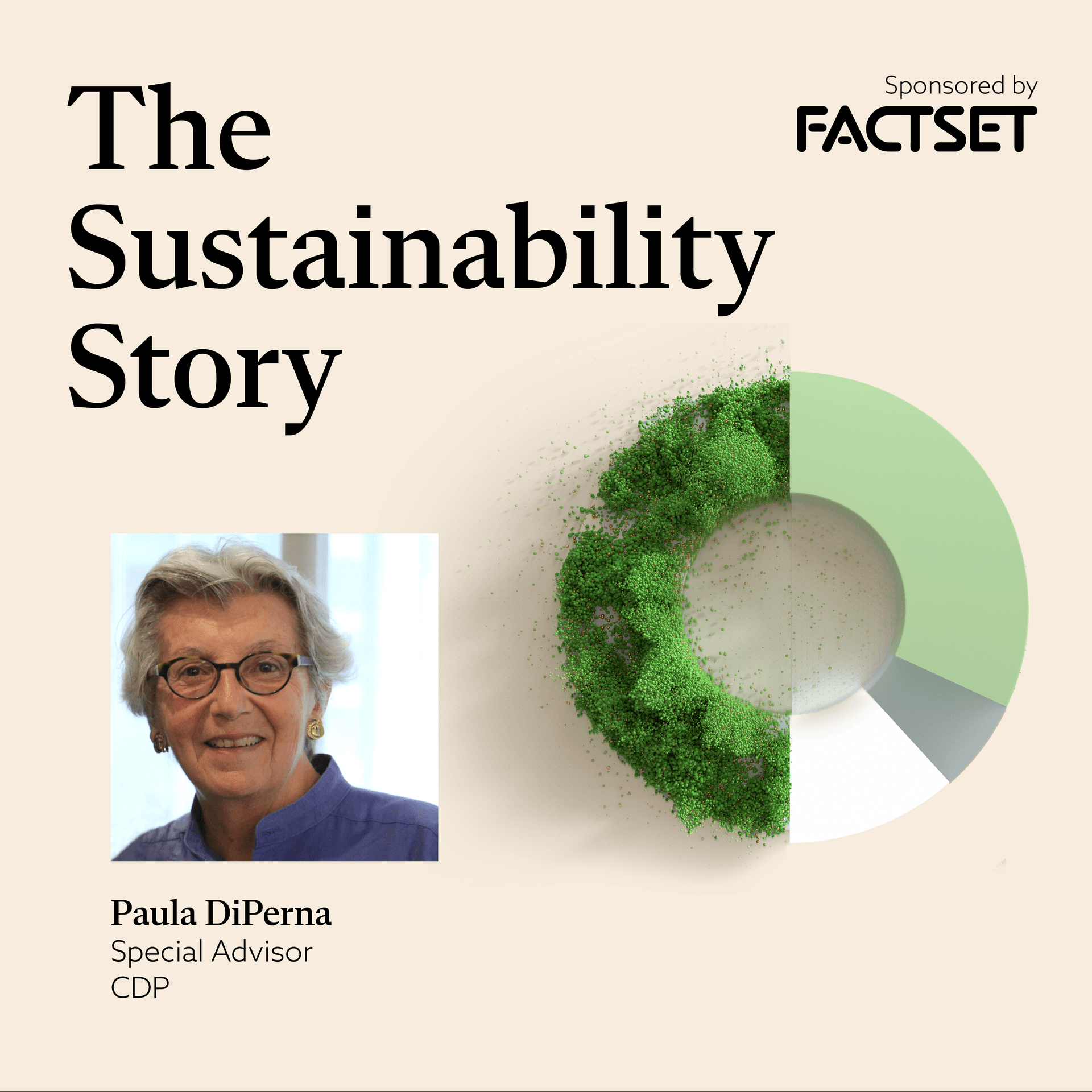
The Sustainability Story
Paula DiPerna: Pricing the Priceless: The Financial Transformation to Value the Planet, Solve the Climate Crisis, and Protect Our Most Precious Assets
00:37:49
In this episode of the Sustainability Story, host Deborah Kidd, CFA, interviews Paula DiPerna, author and Special Advisor to the CDP. In her book, Pricing the Priceless: The Financial Transformation to Value the Planet, Solve the Climate Crisis, and...
Loading summary
Transcript36 lines
- [00:00]
A
Get ready for CFA Institute Live 2025 with free power packed webinars designed to inspire and inform. Led by industry experts, these concise sessions tackle game changing topics like how AI is transforming investment strategies in emerging markets. Don't just show up, show up ready. Gain the insights you need to drive meaningful conversations this May in Chicago. Claim your spot now@cfainstitute.org.
- [00:29]
B
Hi everyone, I'm Debra Kidd with the Sustain Story. Today I have with me Paula DiPerna, author of Pricing the Priceless. It's a book about the financial transformation to value the planet, solve the climate crisis and protect our most precious asset. Paula is an author, public speaker and media commentator. She currently serves as special advisor to the CDP and she's held numerous other positions including as a writer and producer with Ocean's pioneer and filmmaker Jacques Yves Cousteau and serving as the president of CCX International, the Chicago climate exchange which launched and operated the first large, the world's first cap and trade system to address climate change and pioneered emissions trading worldwide. So welcome Paula. Thank you for joining us today. I'm excited to tell our listeners about your book, which again is called Pricing the Priceless and it's about viewing the natural assets of the planet with an accounting and balance sheet construct.
- [01:40]
A
Well, thank you for having me and I look forward to your questions and the audience. Yeah, it's a paradox and a potential, you know, it's on the one hand a paradox to think that we should just think of our relationship with nature like our checking accounts. You know, you put money in, you take money out. On the other hand, if we don't do that, we'll get what we have, which is constant exhaustion of the resources with no control. The only thing we're controlling now is outright pollution, outright put arsenic in the water that's not legal or put mercury up in the air that's no longer legal, or asbestos. There are certain things that are no longer legal and are controlled, but our use of resources as inputs is not controlled. And that is the source of the dilemma we're facing right now. With the one hand, climate change, world temperatures rising faster than anybody thought they would and resources depreciating inexhaustible at a rate that people didn't fully appreciate either. And so if we don't sort of find a new way of looking at all this, we're kind of stuck. And I think the new way is to really become cold hearted and think of it as a checking account. You don't, you can't overdraw your Checking account. I don't care how wildly rich you are, at some point you could have red ink, and we have a lot of red ink with nature right now, and that's what I'm trying to shift.
- [03:09]
B
That concept is fascinating, and the book itself is fascinating. And I just want to say a couple words for listeners who haven't yet read the book, that this book really takes you on a journey. Readers go from rainforest to Wall street to the Detroit Institute of Art to the Vatican. Coral reefs, mangroves, China's carbon markets. You really traverse the world in the story, telling the story of nature as an asset of the planet and how to value it. One thing I also want to say, as a writer myself, is I very much enjoyed the way this book is written. You have an incredible talent with words and turn of phrase. So I am sure that readers will not only find the information itself fascinating, but the way in which you have presented it.
- [04:04]
A
Thank you. It's very nice to hear.
- [04:07]
B
Before we delve into the context of the book, what led you to write this book?
- [04:12]
A
So, you know, that's a very good question, because there's no shortage of things to write about. I guess when you read my bio, you know, it looks a bit like smorgasbord. And, you know, start out as a journalist and become a film writer, work for Jacques Cousteau, then run a foundation, then get into carbon markets. You know, what does it add up to? And so I've synthesized and was looking back and thinking, you know, all these things that I've done revolve around one point, this pricing point. By that, I mean when in my earliest days of working on environmental things, I wasn't really a committed environmentalist, as you might say. I was interested in Earth as a system, as an engineering system, like pistons, you know, going up and down. Wow, the atmosphere is 60 miles only. And, you know, as an engineering prospect, and of course, with Cousteau, the ocean is a dynamic system. But I didn't really have an appreciation for the metaphysical aspects of all this, but the systemic aspects, the engineering aspects, led me to think, okay, how does this thing work? And then I got into the idea of work and then, oh, work. Well, how, you know, don't we pay for that work? And then, wow, no, we don't. And so the book tried to synthesize these experiences and focus on the idea of nature as an unpaid worker from all different points of view. And so what led me to write the book was to try to synthesize a certain amount of experience, past experience, and future projection around this question of unpaid labor, because especially your audience will appreciate this. Imagine what a profit and loss sheet would look like for a company that you're seeking to invest in if there were no labor costs. If nobody paid their workers to do anything and work was all just freely contributed. Imagine how rich the companies would look. They'd look like super investible. Buy some of that. But that's obviously a very false impression. So simplistically, I would say the same situation obtains now with nature. And writing the book was an attempt to put this kind of far out idea in context, because it's not that far out. Environmental economics have been talking about this for 20 or 25 years and it's been kind of an external, almost literally concept. And so I was trying to make it practical and doable.
- [06:43]
B
In your book you have a statement that says basically all GDP is dependent on natural assets. Or maybe I'll phrase it in a different way. Without natural assets, GDP would be just about zero.
- [06:58]
A
Yeah, I mean, a lot of people are saying that now. I mean people have tried to value, there was a, you know, ecosystem services, which you may or may not, your audience may or may not have heard of. This is the labor that nature provides. So obviously clean air is one, but other things that we don't think of as being contributed. So pollination, Nobody owns pollination. Nobody controls pollination really, but it happens. Water filters through ground, nobody understands, nobody controls that, but it happens. These are things that just go on that nature does. And so there was a far sighted economist named Bob Costanza who tried to figure out what these services would be worth if you had to pay for them. And he came up with this very significant figure, $120 trillion a year, which at that point was more than the GDP of the world. And then the World Economic Forum has recalculated recently and come up with something half of world gdp. If you take these services and break them out and say, what is the value of pollination? What is the value of water filtration? And so on. And then other people, like the private equity group that you mentioned, their report really came out and said at the end of the day, there's no GDP without nature. Because obviously, I mean, in a sense that's such a silly, an obvious statement. If there's no clean air and clean water, we're all choking and falling down dead. Of course there's no economy. But I think it's important to be that bold these days because in a sense we're living in an economy. That's based on false presumptions, I would argue. And it's only a question of time. We don't know when, when some of these systems will crash. And then if you're, if your company is dependent on those systems, you crash too.
- [08:43]
B
In your book you talk about how stewardship of natural resources could theoretically affect a sovereign credit rating. So what if a government priced its natural resources with a coherent risk and reward resource management program? Could that theoretically raise the credit rating of that sovereign?
- [09:05]
A
Yeah, I mean if you are creating a statement of national wealth and you list all your infrastructure, we have 100 bridges, 2,000 miles of road, whatever. It's an indicator of how well the country is developed, its development level and how well it's managed, how forward thinking it is and so on. And that's what people kind of build a credit rating on or a credit rating leading to investability or lending. And so if you have, say and 60% of our forests are in perfect shape and are not subject to deforestation and we, we take care of them and we preserve the water filtration, all the benefits and that was booked as if it was, you know, like 100 bridges. That country would be seen as having a well managed portfolio because you're breaking out just the way asset managers have to do asset allocation. Allocating assets to maintaining natural capital is, is, is, is important because it not only underpins the rest, but is also in itself valuable because it can, it's the gift that keeps on giving over time. And so that's, that's quite important, especially for developing countries where the trends are in the opposite direction.
- [10:23]
B
How would that kind of environmental profit and loss statement look for a corporation?
- [10:28]
A
So the one that's the most exciting and probably didn't take off because it was so candid. You know, people run shrink from candor in a way. But the head of puma, which we all know is athletic clothing and running shoe company and so on, he had his financial team doing the normal profit and loss, as you would expect. They're a public company. And then he hired a specialized team of accountants to look at the environmental side of those financial costs. And you know, the original P and L said I think it was 220 million euros a year net revenue that year and 145 million euros was contingent cost. That would have been outlay if Pulad had to pay nature for its work. So €145 is a big chunk out of 220. 220 looked pretty good. And 220 minus 145. You look a lot less good. Now, was that fanciful? Not really, because the 145 included real costs. For example, an average carbon price. If the company was covered by carbon pricing all over the world in all of its operations, what would an average carbon price have been? If they had been charged all over the world for removing waste, which most companies are not yet, if the, if the cost of water were to be incremental, if the company were to be taxed for direct pollution escapes and so on. So the 145 was a kind of a supposition and a presumption, but it wasn't based on, you know, just fanciful and imaginative thoughts. It was based on existing regulations and existing trends that could grow and could become more demanding. So it was an exercise in preparedness that they undertook. And you know, if you undertake an exercise in preparedness, then you, you know, then you have information you may not actually want because you find out, oh, gosh, I'm not prepared. And then what?
- [12:38]
B
And this concept of valuing nature, putting a price on the price list, something that a lot of financial asset that's not really new because you give some examples in your book. You have brand names that you know, and brand equity that companies have. There's attempts to value that there's attempt to value artwork to put a price on a piece of artwork that's unique. So the concept isn't new, but extending it to the earth's natural resources and putting it in a balance sheet is the transformational concept.
- [13:15]
A
Yeah, I mean, that's a good point. I mean, when you think about it, you know, nobody would question valuing in the balance sheet. Research and development. That's part of what a corporation's asset is or assets are their ability to research and develop new ideas, many of which now are ip, you know, intellectual property, software. But there's crazy valuations going on. I mean, things, things are, you know, I mean, Donald Trump's social media company is valued now in the billions of dollars, but it hasn't turned a profit in ever. Amazon didn't turn a profit for a long time, but was continually valued in the billions. Mickey Mantles baseball card, you know, one baseball card has been valued at $10 million. So valuation is in the eye of the beholder. And in terms of asset managers and asset owners, it's often in the eyes of the asset managers and you look to metrics to put some boundaries on what could get out of control. But we're used to, and we do understand how to value intangibles. The difference with nature is nature is like out there. It's not us, it's not human, it's not something that we control. And therefore we kind of to some extent denigrate it because we didn't make it. And again, I'm not necessarily such a committed environmentalist that I, you know, like a tree hugger type. I'm not. But I mean, maybe I am, because the more I think about this, the more I become aware that we're just trampling all over nature. And it's, it's, it's, it's, it's, it's just not economically viable over time.
- [14:54]
B
And climate change is really exacerbating this entire problem with the depletion of the.
- [14:59]
A
Resources, you know, you know, trampling on nature, deforestation, land use, tearing up land to pave over for yet another commercial operation that nobody really needs, but which is valued as a real estate proposition that's not really viable over time. And climate change is a kind of summation of all these problems. The temperature getting back to metrics. The temperature of the Earth is the metric of 100 years of environmental trampling. And when you think about it, the last hundred years we've spent digging out of the ground ancient fossil fuels that have been buried there for eons, tearing them out of the ground, burning them willy nilly, putting them in the atmosphere, heating up the planet, causing all these extremes. And now we'll probably spend the next hundred years taking them out of the atmosphere and putting them back in the earth, because sequestering carbon is the only actual way to keep up with climate change. Now can we do it? Very hard to put the genie back in the bottle and the metric, I mean literally the genie and back into the earth. And the metric is the temperature rise. Now 1.5 degrees Celsius means nothing to the average person. I mean, if you have a fever and a cold like I do, you know, if my temperature went up half a degree, I wouldn't panic, or even a degree. But from the Earth's point of view, that's a significant change. And it's too bad in a way that we were expressing it as 1.5 degrees Celsius as an ideal temperature balance, because the average person can't really think in those terms. But the average person knows that the only time in human memory that admissions went down was during COVID when everybody stayed home and cars weren't on the road. Does that mean therefore that the only way we can solve the problem is to Stay home. That's not an answer that works. So what was inherent in that staying home? Okay, emissions came down. We didn't burn fossil fuels. Okay, so how do we stop burning them? You have to find an alternative. And until it's very costly to keep burning them, we will keep burning them. And this is again, the pricing dilemma. There's not a real carbon tax anywhere. There's cap and trade here and there in Europe particularly. But, you know, the price of mitigation, the price that makes it worthwhile to avoid a ton of carbon dioxide emissions is at least €100 a ton. And nobody got that market price as a general matter. So until that's the general matter, you know, we have a problem.
- [17:33]
B
I love the line in your book, which you just talked about. All of our industrial economic growth has depended on our putting up into the atmosphere, putting carbon up into the atmosphere, that which we must now bring down. You have some solution proposed? So there are some. You mentioned some metrics or measuring. You mentioned some new financial instruments, and you mentioned pricing of carbon. How would you envision these solutions working to help value these assets, put a price on them, and mitigate climate change?
- [18:11]
A
So something, you know, think about that I've experienced a lot in talking about this book is how separated, how segmented the world remains, how siloed the world remains. So investors don't necessarily always know about new instruments, and particularly they kind of wait until something new appears to be scalable. But, you know, scalability means first you have to know about it, then you have to see if it applies where you are now, you're in Canada. So we all know the tragedy of the forest fires last summer. And some are still burning. The what, I forget what they call them, these fires that are still burning underground. And what I understood was one of the things that made the forest so difficult to get under control was because there was a tremendous amount of ground cover that had grown up during a particularly wet season. Lots of grass on the floor. Then it got dry, and then it was like basically tinder boxes all over the forest floor. So what could you do about that? You can't have an army of people out in the forest cleansing the floor, but maybe you can. Now, who would pay that army? How would you ever pay that army? Now, the forest resilience bond, which is up and running in California, was an idea of four graduate students in business school. So it wasn't some eminence grise. It was some very young people. They got the idea of investing in resilience. It's called forest resilience Bond. The resilience of a forest is the priceless aspect of it. The resilience is the part that goes on forever. The resilience is the value, but it's intangible. Resilience means it doesn't burn down, it doesn't fall down. It withstands all kinds of challenges. How can you invest in that? Well, they figured out, well, you may not be able to invest directly in that, but what you can invest in is the quantifiable benefits. If the forest is resilient, that doesn't burn and doesn't fall down. So they began to break out the metrics of the quantifiable benefits. And they started with the obvious, which were homeowners, people whose houses didn't burn down, didn't have that cost. That's a benefit. Tourism operators that could encourage wilderness conservation in a particular forest. They were beneficiaries, insurance companies that would pay less claims if the fire. Forest fires didn't occur. They were beneficiaries. And the one that blew my mind was the hydropower company, the local hydropower company, which had a benefit because the forest again absorbs all this water when it rains and takes the water down into the ground. And gradually that water perks into the watershed, which perks into the dams, which comes across the dam and generates hydropower. Now, if there's not enough water in the dam, the hydropower company has to buy power from someplace else in order to keep the lights on for people. So they were beneficiary too. And those are benefits that you could quantify how much revenue in a year from tourism, how much money saved from not buying power from a third source, et cetera, et cetera. And you come up with a figure. In that particular case, the pilot came up with $4 million of benefits for a very small swath of forest in Tahoe, Lake Tahoe, United States. And they were able to put together a consortium, blended finance, which is not a term I particularly like, but in this case it was 2 million from a foundation which expected a return, but concessionary and a private investor that expected a commercial return. These investors put up 4 million to securitize the benefits that were going to come later. Just the way when you finance a bridge, what generates financing for a bridge as infrastructure? You know that if there's a bridge, it's going to be good traffic, there'll be travel, there'll be flow of goods. People can cross the, you know, but you don't, you don't have those benefits. Yet you invest in those because you know they will come and nobody questions it. And you also know that you're going to have to maintain the bridge. Nobody questions that, although we have allowed our bridges to degrade. So the FRB takes that model and brings cash up front and creates a small army with that money. The California Wildlife, Rather Wild Forest Services could use that money to hire people to go into the forest and clean up the forest floor and make sure there's not a bunch of tinder, take away dead wood and so on and so on. And in theory, that has helped create more resilience in this forest. And they paid back those investors, and they have now another 25 million product. They have a $25 million portfolio of smaller projects that they're aggregating. So my question is, why can't Canada do that? You could do a national series of fibers in Canada, you know, I mean, so this little FRB in California is known, but not widely. And I always ask myself in the Internet world, why do these things end up being so compartmentalized? Not too many people know about them. And so part of why I wrote the book back to the beginning is to broadcast this stuff. I like to broadcast. And there's other things too, like the coral reef insurance, which is fantastic. I mean, when you think about it, coral reef is just as important on the coast as a barrier that's made of cement because the waves come crashing in and the coral reef buffers those waves while we value the coastal property that the waves that the. That the reef protect. But we don't value the reef. If it was a cement barrier, it would be insured. But because it's a natural coral reef, it's not. So how does that make sense? So coral reef insurance is another one of these new instruments. I mean, we should be insuring all the coral reefs around the world at maximum. And what would that do? What would that do in the practical sense? Okay, you can't hold back the rising temperature of the ocean. But what you could do, what it would do, is first of all enable the reefs to be somewhat more repaired if they break down. Because the insurance pays for people to actually go into the water and fix the reefs that are broken, which is a whole other story about that being done when you buy time there. But also it's a mindset this reef is there for free, but it's not free. You know, its value is there. It's it just that we got it somehow through the miracle of whatever you want to think how we, the planet even got here, which is also part of the problem because we don't know how the planet got here. I mean, we all have our, our ideas, but. And our views. But in the end, the planet here, it's like given. And as you know, stuff that's given to you, you tend to take for granted.
- [24:57]
B
Yeah, you make a really compelling argument. Those are great examples. You also talk about the role of carbon pricing and cap and trade in controlling the amount of pollution that goes into the atmosphere. And I thought that was a fascinating discussion. I wondered if you would tell our listeners about that.
- [25:15]
A
Yeah, I love that one. And I mean, Canada has played a significant role in that. You know, again, if you look up between your eyeballs, everybody's fixated now on the eclipse and we'll be able to see the totality of the eclipse or today we're talking. People are fixated on the eclipse. The thing about the atmosphere is that it's so rare and so precious. So what does that mean? If you look up, there's only 60 miles of air between you breathing and you not being able to breathe at all. I mean, and of course that is not you. You know, you can't breathe in a couple of miles, let alone 60. But the protective layer on the earth that is blanketing the, that is protecting the earth from the solar radiation that would otherwise burn us up is only 60 miles thick. Now, you can call that whatever you want, but I call it a penthouse. It's the equivalent of a penthouse on a building. It's the rarest space on the planet. And just the way if somebody gave you access. Here's the key. Choose the best hotel in the world. Here's the penthouse in the most exciting, exclusive res hotel you can think of. And you get the key and you go in there. And what you do, instead of enjoying the penthouse and taking care of it, you just put your dirty diapers in there and your dirty laundry and that's where you store your laundry. That's what we've been doing with the atmosphere. And so we have all these dirty diapers up there in this penthouse. Now, as I said earlier, we have to one, get them out of there, but two, also stop putting them up there. That's a tall order. Getting them down is taller, but stopping them going up is pretty tall. And the only thing you can really do is consider the space remaining in that penthouse as very scarce real estate. And therefore the supply and demand principle kicks in. If you want to occupy this very rare space, you have to pay a lot and back to the price per ton, you know, it's got to be at least 100, 100 tons. So what a cap and trade, 100 Euro a ton. What a cap and trade does is define the scarcity and say there's only X amount left, which is called an allocation. And you, Deborah, are allowed to emit X amount until a certain point. And after that, that's it, you are done with your allocation. Now you maybe can't get to that limit easily. You have a dirty old coal plant and you're stuck with it and you don't know what to do, how to reduce anymore. Me, I have a clean plant. I'm a different company. I started later and I'm easily able to stay under my cap. The atmosphere doesn't care whether you do it or I do it. The atmosphere wants the reduction. So you and I make a deal. It costs you $10 a ton to reduce. It costs me, you know, 8. You will pay me anything lower than 10 and I'll accept anything higher than 8. And so you sell me your allocation and I, or rather I sell you my surplus, and you are, quote, credited for having met your obligation. Now some people say this is letting you off the hook. I say that's for the morality police to decide. The atmosphere is not the morality police.
- [28:35]
B
And the problem is once the carbon emissions go into the atmosphere, they're there.
- [28:40]
A
That's it.
- [28:41]
B
They don't come out.
- [28:42]
A
They don't come out. And so if you saw again, it's crass. And this goes back to the paradox. It's crass to think of the atmosphere as real estate. But what other metaphor would work? It's not that, right? Super precious. You know, think of gold, diamonds. I even talk in the book about gold. There's a company actually in Canada that is tokenizing gold and you can invest in in gold that is never mined. Half the gold that's been mined in the world is in vaults anyway.
- [29:11]
B
I did not know that.
- [29:12]
A
So why take it out of the ground in the first place? You know, we know it's valuable. Is it only valuable if you see it? Or is it valuable because it's still under the ground? We may need it for all kinds of things we don't even know today we'll ever need it for. Who could have imagined that gold would be intrinsic to a computer chip? So there's all kinds of ways of valuing the things that we've been just using up willy nilly. And the atmosphere is the ultimate willy nilly kind of use. I mean, emissions into the atmosphere. And it's not to say that fossil fuels haven't been a miracle. They have been. Who wouldn't use fossil fuels? Before fossil fuels, it was pretty difficult. But now that we know what the dangers are, we need to respond. We can't just pretend that it's keep on having this picnic.
- [30:03]
B
So you've laid out the problem so eloquently. What do you see as the, the bottlenecks and then the breakthroughs to progress in addressing these problems?
- [30:17]
A
Yeah, well, so one bottleneck is that there's not enough sharing of new ideas at the financial level. Also that metrics, people want perfect metrics. As I said, you have a fever. There's a normal range of body temperature. If it's 96.8 or 96.9 or, you know, with metrics on the environment, we want way too much certainty to develop instruments that can be investable like the frb. They made a calculation of the benefits and they were able to quantify the benefits and they were able to convince a group of investors that that was viable and credible. Is that scalable? We'll never know if we don't talk a bunch more investment. And this is a small ngo. They don't really have the power now to go to Wall street and sort of develop the idea broadly. Why don't their investors broadcast it more? I don't know. They're on to other things. So one of the bottlenecks is that we don't share enough information. We're still very siloed and we're not putting financial flow at the top of the problem, which is what I think. You shift from bad things to good things. That's the number one bottleneck. And how do we do that is, as I said, more information sharing, more changing of the record keeping so that we look at, you know, when you look at your. I think I know that I have this in the book. When you put your ATM card in the wall, you know, and this will freak people out. But you get $100 out or $20 out, you're really looking at $20 worth of debt. You're not looking at $20. That's cash to you. It's $20 worth of debt that we owe the environment. If you believe there's no GDP without, without nature, then the $20 bill is a $20 note. IOU. So we have to change the economy, the economic accounting. We have to share information more widely. We have to comprehensively price carbon. It's way too slow. Carbon pricing is way too slow to Be integrated across national boundaries. We need an integrated carbon price. It's a car commodities market, just like wheat, corn and soybean. Again, the morality police want it to be a lot more sacrosanct, but as long as there are rules, it should operate just like any other marketplace. And we just have to step back. I think one of the bottlenecks is again, overly moralizing something at the expense of protecting. Moralizing something doesn't per se protect it. You need a moral compass. But that's not enough, right?
- [32:44]
B
So what kind of advice would you have for today's leaders and emerging leaders with respect to environmental issues?
- [32:55]
A
Well, for everyone, I would say get out of the virtual world and back into the real one. You know, we're in a, in a detour, what I would call dumb time. All we're doing is dumb time. In the Internet, you know, social media, all this circular conversation. The real world is burning. Real world is the one we're dealing with. And we have to get out of use of time, being distracted, taken away from the real problem we have with too many distractions. So for emerging leaders who care about the environment, I think that's number one, is to really understand there's only one planet. You can't reproduce it. It's not a video game, it's not a science fiction. It's the real planet. And that's the thing that should wake everybody up in the morning to do something about that and all the time that's spent in other things. Of course we want to have a good time, but maybe take a good look at how we're spending our time and then don't be afraid of risk. I mean, if you're in a position of tenure and you have access to people, break the mold. Go looking for new things. If you know there is a problem, go looking for the answer. Don't wait for the answer to come to you. And I think from a political, from a UN level point of view, I think we have to recognize that we don't have systems in place that are up to the challenge. The UN itself was and is the most obvious international arbiter of climate progress on climate change through the COP processes. But it's falling short. It's not able to mobilize the kind of finance that's necessary. So we really need a kind of new version of the un, which is more private sector, not just blended finance, but a real concern. The UN is the obvious institution to guide our responses to climate change, but it's insufficient because it cannot access the kinds of money that Wall street can access. There's trillions of dollars going around the world looking for something to do. And if it's not doing good things, it's going to do bad things. And so if I was an emerging leader and I still had time, you know, I wish. Sorry that I didn't go to business school. Easy to say now, but the solutions to climate change are on the finance and technology side. They're not on the advocacy side. We generally have the policies we need. We have the momentum we need, we have the moral high ground that we need. What we don't have is the money shift. And we won't get the money shift without shifting the way we allocate based on what we value. And so that would be my, you know, my summary take. I mean, the more I think about it, those, you know, companies should just all be required to do an environmental P and L. That would be just an eye opener. I think what investors would say if suddenly Everybody was claiming 202 net net earnings, was suddenly claiming 202 minus 145.
- [35:53]
B
Earlier, you drew a parallel between the Earth's climate warming and having a fever. And I really like that analogy because you can have a fever of maybe 2 or 3 degrees for a few days or a little while, but you can't have that fever perpetually because your body would break down. So even though 1.5 degrees Celsius or 2 degrees Celsius doesn't sound like a large number, when you think about how warming can disrupt an entire system, whether it be a body or a planet, if it goes on perpetually, I think the threat becomes more clear.
- [36:30]
A
Well, yeah, I mean, the body of the planet is huge. And so the problem bounces around. You know, it hits you one day, me the next. And that's in part also why it's difficult to track and deal with. But that being said, we know the problem is that kind of problem and going back, say, to insurance or to costs, you know, when, when something terrible happens like these terrible wildfires, why don't they show up in the macro economy? Why does the market go up when Canada is burning and smoke is so sufficient that it blows into the next country? Now, I'm not saying that on the days of those fires that, that the markets went up, but the markets didn't react to that. There was no reaction in the markets. Now, why is that. Why is only. Why is the cost of those wildfires nowhere in the national accounts of the world or of Canada or of anybody? Maybe the forest company That's a falsity.
- [37:28]
B
Paula, this has been a fascinating discussion. I see that we are just about out of time, so I want to thank you for sharing your ideas with us today.
- [37:38]
A
Thank you. And thank you to the CFA because you were instrumental in helping people get these new credentials and understand this new world. It's really important what you're doing. Thanks again.
- [37:48]
B
Thank you. And we do have a climate risk and investing certificate so that listeners who are interested in learning more about how to understand, measure and manage climate risk can now take our certificate and improve their skills and education on the subject.