Loading summary
Transcript24 lines
- [00:00]
Steve Weger
Foreign.
- [00:04]
Paul
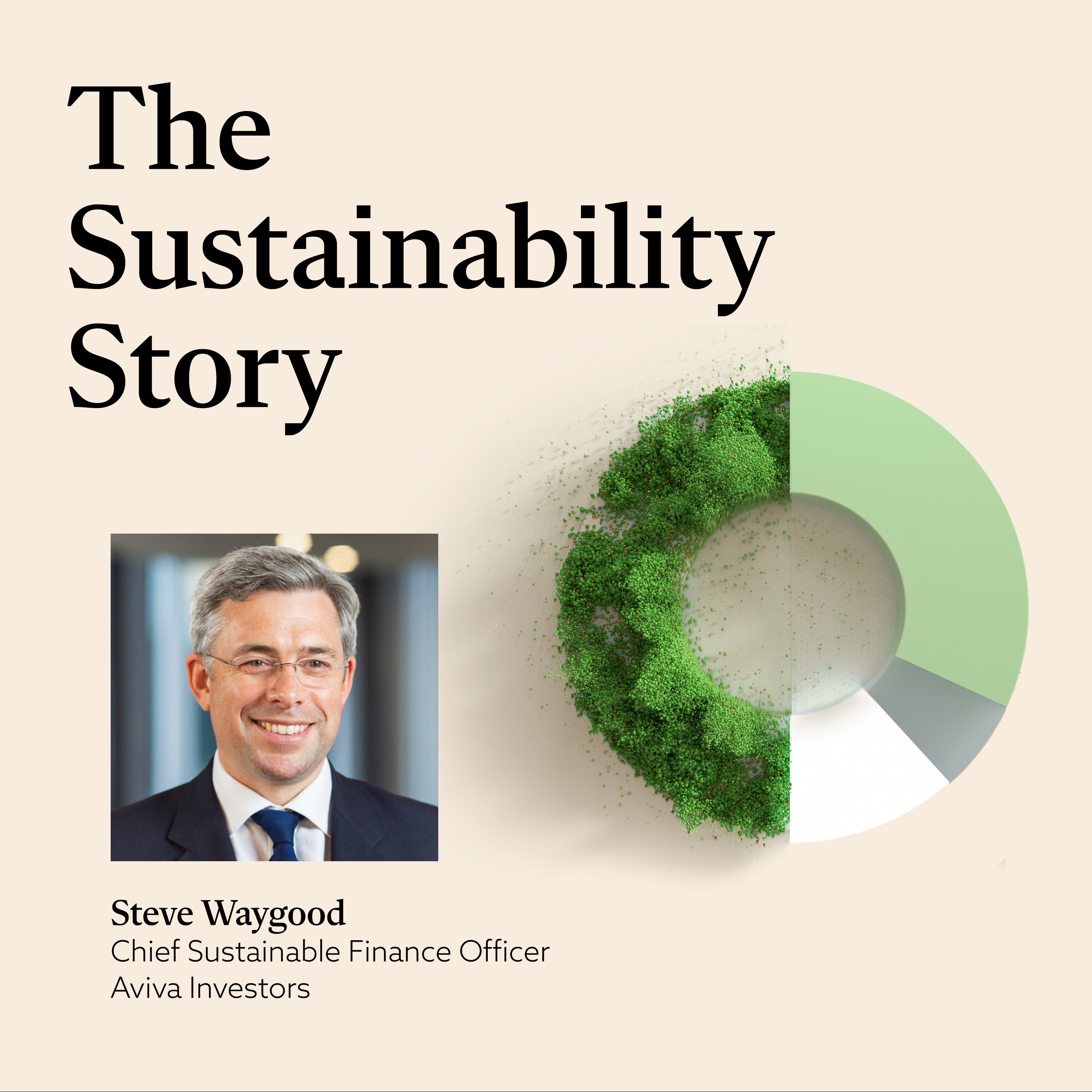
I'm delighted to be hosting Dr. Steve Weger today who's a good friend and long term professional colleague over the last 25 years. Throughout his career Steve has worked on a range of financial, governmental, non governmental and academic institutions on international sustainable finance issues. He is the Chief Sustainable Finance Officer Advisor at Aviva Investors where he's worked for the last 18 years. He founded its Global Responsible Investment team as well as its Sustainable Finance center for Excellence with the aim of transforming capital markets so that they become more sustainable. He also co founded the corporate human rights benchmark, the World Benchmark alliance and the UN Sustainable Stock Exchange Initiative. He is also a member of a Board of Trustees at WWF uk which is where I first met him. Steve is also a Visiting professor of Sustainable Finance at the University of Surrey, an Honorary Senior Visiting Fellow at the University of London, Bayes Business School, University of London and a Senior Associate at the University of Cambridge Institute for Sustainable Sustainability Leadership. Steve has advised the UK government, the European Commission, the G20, the Sustainable Stability Board, the OECB and the UN on the creation of sustainable capital markets. Is recognized amongst the most influential European finance by financial news in 2024. So, as you can see, Steve has a huge amount of credibility and a huge amount of experience. But I wanted to take you back to the start of your personal journey, Steve, and you've been a pioneer in sustainable investment for around 25 years. What initially drew you into this space and what have you seen? How have you seen attitudes evolve since you first started?
- [02:05]
Steve Weger
It's wonderful to be here with you. Thank you to you and to the CFA. I think we first met in 1997 actually, so we go back a long way. Thank you very much for referring to that. And you were part of what drew me actually. You will remember Tessa Tennant who I think inspired us both. And Tessa, the great leader of the Global Care team. I think she was the person who deserves the most credit for the establishment of the sustainable finance industry as it now is, but certainly community as it was in the 90s. And Tesla directly challenged me in no uncertain terms if I cared about finance and sustainability and the long term sustainability of both, survival of both. That I should explore my interests in finance which as a child of the 80s, obviously you couldn't live in London and not be influenced by what was going on in the, if you like, the Thatcher era of, of London finance. And simultaneously we had James Hansen as the Chief Scientist of NASA presenting to the Senate in the us talking about how NASA was beginning to realize that the Climate was changing. So there was this really interesting contrast and that's what drew me in terms of how the values have evolved, in terms of how the norms have shifted, as some might say. I think it's fair to say that it started in the uk, at least as an industry that was focused on negative screening, perhaps based on some charities and church views of ethical investing, and quickly moved to being more about engagement. How do you use the rights of share ownership to improve better performance on a range of issues? I think then maybe sort of 20 years ago, we moved into the phase around integration. So what, what investment insights could you discern from sustainability issues that could contribute to alpha? And I think that really was an inflection point in how sustainable finance started to take off. And then in recent years, I'd say probably the last five, we've seen a move from the micro engaging with individual companies, analyzing individual securities, to the macro, where financial actors are realizing that they operate within a system and their portfolios themselves will suffer as the extent to which the system itself is suffering. And I'm sure we'll talk about that more. But so from negative screening to engagement to integration, and then from the micro to the macro, that's how I would say things have changed.
- [04:44]
Paul
So Aviva Investors has long been seen as a leader in responsible investing. Can you share some of the key lessons that you've learned in terms of embedding sustainability into what is a large, complex global insurance and asset management business? Obviously you're speaking from the investors perspective, but had to navigate all of those issues on that journey.
- [05:07]
Steve Weger
That's kind of you, Paul. Thank you. I joined Aviva investors in 2006 and in 2001, someone we both know, Clare Brook, changed the voting policy of what was then called Morley Asset Management, the pre. The forerunner to Aviva Investors. We rebranded in around about 08. She factored, she changed the voting policy so that sustainability issues would be considered in the way votes were cast. So absolutely, this is a big journey, it's a long journey. One of the lessons that we've learned is that actually delivering that voting policy required significant resources. At the time, none of the proxy voting agencies provided actually a service that looked to our companies, disclosing material sustainability issues, should that be therefore voted in favor of the report and accounts. So that was some finding out just how big a task that is. We do over 70,000 votes a year across our listed equity portfolio. So that's a major challenge. So that was one, I'd say. Second would be that data just having access to data doesn't mean the performance on a sustainability issue is actually material over investment time horizons. The data might be interesting to other stakeholders, but not actually hit the cash flows of the company, in which case, in my view, that means it's not material to your target price and the present value of the firm. So just simple disclosure doesn't mean the data is material. You need to have a view on why and how materiality happens. Third lesson is that data is variable globally. It's difficult to get a comprehensive data set, even still now for all sectors of the economy in a globally fair comparison format. So that's a huge journey has been underway over the last 25 years, big gaps closed, but it's still not finished. It has taken us a few hundred years to get to where we are on financial reporting, so that shouldn't be a surprise. The fourth lesson would be it's really important to have a catalyst over an investment time horizon that you can see coming, you can predict that will then change the rest of the asset management industry's view on that security. Why does this sustainability issue that you think should be material, that isn't yet in the price? When would it become price sensitive? When will it become something that you should factor in? And if you can't see that catalyst over investment time horizons, then it's not something you should factor in today because it's an externality. And that brings me to the fifth lesson. For an externality to be relevant to a business, it has to be internalized. And whilst some stakeholder communities would like fund managers to just factor in what they would call the full cost of the company, the environmental and social costs, unless those costs are actually priced, then it is irrelevant to the way discount cash flows work. So the way that externalities need to be internalized isn't simply by us imagining a figure and calibrating what it might cost, but is for government to then internalize the externality. And the way they do that, sorry to use this economic jargon, but it's basically making sure the polluter pays. The way they do that is through a tax, a subsidy, maybe some kind of a trading scheme like the EU Emissions Trading Scheme, the ets, or either a standard or regulation. So there's a handful of lessons, there are plenty of others, including just how volatile the industry is. But it's been an amazing journey working in IT over the last 25 years in buy side fund management, moving a.
- [08:53]
Paul
Little bit to the role of insurance companies in advancing sustainability. I know you're talking from a perspective of the investment group and the asset management group, but clearly you're looking at investments for the insurance group as well. And how are insurers generally looking to manage risk given the long investment time horizon? And how is climate change altering that risk landscape for an insurer like Aviva? And where does that create opportunities or risks?
- [09:26]
Steve Weger
So let's just think for a second about that time horizon that you've referred to at the top of your question. So we were formed as the hand in hand Insurance Company in 1696. So they've been around for over three centuries. So that's obviously historically a particularly long term time horizon. Going forwards, we're running money for individuals who will be putting it away for their pension. They might not be needing that pension to be paying out for many decades, in some cases maybe four or five. So they will have very long time horizons. And then as a business, the parent company is looking to run money in perpetuity going forward, we hope to continue to exist indefinitely. So we have a fiduciary duty to present shareholders as well as future shareholders or future members, as it is coined in company law. So we have a very long time horizon and that's reflected in both the way we analyze securities, as well as the time horizons of the investments that we're backing, particularly the real assets, the infrastructure projects. So those kinds of time horizons mean that if you're not looking at long term sustainability issues, you're mispricing securities. So this is where climate change comes in, as you put it in your question. It's altering the risk landscape for everybody, not just us. It's bringing in transition risk, individual securities, sometimes countries. As the global economy moves to deliver the Paris Agreement, then it is inevitable that at a certain point the oil and gas industry will be in a sunset environment. And whilst we will need the oil, the gas, to continue to be used for many, many decades, it will be used marginally, less incrementally as renewable energy steps in and closes that gap. We're also going to need carbon capture and storage at scale, and some would contend at a scale that's almost impossible, but we're nevertheless going to need to invest and back it at scale. So we've got the transition risk, the risk of moving too fast, perhaps away from that sector. Might that lead to a rapid price correction? The fsb, the Financial Stability Board, talks about that as a Minsky moment, a rapid price correction. So there's one there transition risk. Second risk would be physical risk. That's of course, the risk of the real environment. The flood, the fire, the drought, what would that do to the individual securities that we're backing, which might require freshwater, it might require all sorts of supply chains to be intact that could be destroyed. And the physical risk isn't just in itself a risk that we need to be contending with and modeling. It gets extremely complicated when you look at the second and third order factors of that physical risk, one of which would be migration. And there are some forecasts of the level of migration that we'll see as a consequence of the physical risk. And the physical risk of some will be that the human body won't be able to actually live in certain environments because they'll be too hot and humid for the body to cope, you'll have hypothermia and the body might shut down and obviously air conditioning will correct that. But for many people, even if we hit 3 degrees by the end of the century is often the prediction 3 degrees of change over the industrial average pre the industrial revolution, the global average, if we hit 3 degrees, we're likely to see, we're told, 74% of the world's population not being able to live where they do today without adaptation, without air con, because the midday mid summer temperature will be hotter than the body can cope with for 20 days of the year now, at least. So that is going to cause geopolitical issues which to be blunt, the vast majority are not yet factoring into their risk assessments because they're so complicated. Even central banks are assuming that away. So that is a incredibly challenging risk environment to be running money in, particularly as we need to be ensuring for the sustainability of our business. We have a fiduciary duty to shareholders and a fiduciary duty to policyholders to consider these issues. So it's big stuff, Paul, as you well know.
- [13:52]
Paul
So your assertion would be that because obviously a lot of people over reference Minsky moments or stranded assets, that generally investors are not able or fully pricing this into markets at the moment. And there is a gap between trying to understand the complexity of the multiple outcomes as a result of sort of climate change on markets. So you generally believe that there is that gap at the moment.
- [14:30]
Steve Weger
That's an absolutely fair characterization of my view. Can I expand on that a little? Would you like me to explain why discount cash flow analysis does exactly what you've just said?
- [14:42]
Paul
The challenge comes back often that everything you say makes complete sense. But then, then the question is why are markets not factoring this into the price at the moment, given if you believe in the sort of Efficient market theory.
- [14:58]
Steve Weger
As the CFA well knows, discount cash flow is a model that originated in the 60s in the Chicago Business School. And it's obviously taught to all analysts, managers, whether they're on the buy side, if fund managers, or whether they're on the sell side in investment banks. And it's the basis upon which everyone models securities and comes up with the present value. And if you are thinking about a listed equity the way it would be conventionally done, you look back over as many years as you can with the data in terms of cost line, earnings line, what are margins looking like? You look at the current price and then you project forwards. Maybe probably in fact three years, maybe five years. With some granular detail, in as much detail as you can. What is this security likely to do? Cash flows, earnings in the next three to five years. And then of course you discount those years by a discount rate. And then for the rest of the duration that that security is likely to exist, you then model it with a terminal value, which in most cases can be well over half of the value, the present value of the security. I know this is a technical audience, so I'm able to make these technical points. But let's just expand on your point around climate change and sustainability and why discount cash flow ignores these long term transition risks, particularly physical risks and geopolitical risks. Well, first of all, as I said, the modeling time horizon is normally three years and can often be five at best. But then you revert to a mean growth rate of, let's say it's 2% ad infinitum. So the physical risks of climate change, because they are only really acute in the second half of the century and get really, really challenging north of 20, 70 and 80 in a 3 degree environment, potentially existentially challenging for certain sectors like insurance. We need to actually recognize that a DCF model, a discount cash flow model, is ignoring the worst physical risks by looking only at a three year time horizon and then fading to a mean growth rate. That's one way it ignores these issues. A second, as I touched on earlier in the lessons that you asked me to share, if the externality, if the cost of the emissions isn't then back onto the cash flows of the company, while society and you like global growth, will suffer as a consequence of the emissions, unless the company is paying for the cleanup or the capturing, or there's a trading scheme with the permit, or there's a tax or some kind of other intervention, unless it comes back and hits the cash flows, then it's an externality so it has to be ignored in your present value. So there's the second way and then the third value. The third way it's ignored is in the terminal value because in many many cases, but by no means all securities are assumed to exist forever and grow at a mean growth rate of say as I say, 2, 2% global growth rate. And that is a contestable assumption in the presence of extreme climate change, which is currently what is the forecast from MSCI? 3 degrees of change is where we're heading. So it's the time horizon problem and as Mark Carney put it, there is a tragedy of horizons where you've got this impact horizon of multiple decades, perhaps centuries that is potentially extremely severe versus modeling horizons, versus business planning horizons versus the time horizons of politicians. And I could carry on. So this tragedy of horizon exists formally in all discount cash flow analyses and it's the heart of the problem. How you change that is a very difficult challenge. But it is the challenge that we need to confront. And I think it's through governments internalizing the externalities and investors showing where the markets are failing and how that in turn is going to harm economic growth and also clients future returns. And I would contend that we have a fiduciary duty to do that. And I would also argue that those of us in Europe, it's part of our duty to help maintain the structural integrity of markets to point to regulators where these issues are failing. So sorry for the long answer Paul, but very complicated. I'm very pleased to be able to talk about these topics with a technical audience like this.
- [19:34]
Paul
A difficult question to throw at you and I mean from even a most simple perspective. This was driven home to me. I, I studied for our own climate risk valuation and investment course and just in there there was a case study around a Chilean producer of aluminium and trying to look at a forward looking valuation. I thought this is going to be quite easy. But when you look at the uncertainty around the climate science, the uncertainty around the impact, the uncertainty around rainfall which was the key driver here because the huge amount of water needed in the aluminium production, but then how you could potentially introduce increased efficiency in water usage but also the pollution of water on the population and probably increase regulations, trying to factor all that in had a huge swing in potential outcomes of what was going to happen. So throwing such a difficult question at you was perhaps a little bit unfair, but it was more to make the point really of the challenges around this and why markets are not as efficient as perhaps people may consider. I'm now going to move to perhaps one of your favorite topics and an area you've been very passionate around, around stewardship and micro stewardship versus macro stewardship. And how has the understanding and practice of stewardship developed over your career?
- [20:58]
Steve Weger
So let's build from the previous question to this one. And one of the ways that it's evolved is that people in most of the really advanced managers now recognize that integrating the sustainability issue into your model may lead to a result that is a null result, if you like, that is immaterial, or in some cases it's actually negatively material for the company to respond. And that indicates not a market inefficiency that we can exploit to generate alpha, it's a market failure, which in the economic jargon means that the current structure of markets, the current free market approach, has led to a suboptimal outcome for society. So there's a really important difference to market inefficiency that active managers are paid to find and search for and put these as a pricing advantage in the way that we run securities versus a market failure, which means that the wrong outcome, if you like, from a say, climate perspective, it needn't just be climate, but the wrong outcome is being delivered for society overall from the current structure of markets. So bringing it back to the practice of stewardship, as you've asked me to, for the best part, for the vast majority of the 90s and 2000, probably up until about 2015, most engagement that I was aware of and indeed conducted myself was from an asset manager, asset owner, to the companies that were listed and used the votes and the opportunities that were offered from the rights of share ownership and indeed the obligations in furtherance of things like the stewardship code, as we had in the UK and was then replicated in other jurisdictions. So the moving away from just engaging with the companies, because if it's a market failure, they can't correct it themselves. In fact, if they did it, if they did correct and do the right thing, if you want to think of that from a long term sustainability perspective, it could harm short term returns for that company, for that sector. But that isn't. There's no point engaging with companies in the presence of market failure. You have to engage with governments and the broader system to ensure that the right incentive structure is set so that it rewards, if you like, the transition towards a lower carbon economy. And at the moment that isn't the case. So having an understanding of how to engage with the system and engage with, say, politicians and policymakers, we define macro stewardship on sustainability issues formally as financial institutions actively engaging government policymakers, non governmental organizations, academics and other key influences to correct material market failures on sustainability issues. So if you like, our lens has got much wider and our ambition has had to raise as it's become clearer and clearer that some of these sustainability issues could harm long term growth so significantly that it could harm the structural integrity of markets itself. So that's a bit about what macro stewardship is, how it differs from micro and how it bridges from discount cash flow and market inefficiency to different concepts of market failure and how one goes about doing that and starts to unpick the role of investors and encouraging governments in making those corrections.
- [24:25]
Paul
Thank you for explaining a little bit around the difference between sort of macro and micro, which is a concept that not everybody will be familiar with. And moving on to how are the stewardship priorities for asset owners being felt? With asset managers and big asset managers like BIBA investors, there's been a really.
- [24:49]
Steve Weger
Interesting I'd say in some ways it lags the leading asset owners and in some cases they're beginning to lead. But the investment consultants I'm going to point to in addressing how the stewardship priorities are shifting and along the same lines as I've been describing, the best and the biggest investment consultants are not always the same, have been factoring in the fund manager's performance in relation to macro stewardship, or others call it systemic engagement. That amounts to the same thing in the way they then advise clients where to allocate money. It isn't a routine part of all requests for proposals or requests for interest and due diligence questionnaires. Yet it's not a routine part. But I'm sure you will remember too, Paul, how the principles for responsible investment in 2006 over the subsequent three years led to those principles being embedded in almost all the request for proposals and due diligence questionnaires that we were getting. And I would forecast the same happening here that the leading asset owners and their advisors are now recognizing. And the last few years have really brought this home that the market structure is rewarding, if you like, no transition. And that means that the long term risks of climate change are not being corrected. And that means that there's such a scale of market failure it's in our interests to seek to correct it globally and therefore we have a role to play. It's obviously not for us to correct the failure, but we have a role to play in informing that debate. So that's how I'd say the stewardship Priorities of asset owners are being felt by us. There's an evolution. They too are getting bigger picture, longer term and more visionary.
- [26:54]
Paul
I want to move a little bit on public policy and advocacy. I maybe you can also talk through a little bit as to why Aviva Investors has been so actively engaged in public policy and advocacy around sustainability and climate action. Because it is an area where VIPA investors has been pioneering and not everybody, all asset managers focus on this area. And then the sort of secondary question around that is to, to what would you like to see as an outcome from that globally or specifically in the UK where we've got obviously either investors have such a strong footprint and what would you see as a significant advance around sustainable investing practices?
- [27:42]
Steve Weger
There are three driving forces that I'll point to that I've touched on a bit already in this little podcast and the first would be the financial argument, which is I believe, and there is very good evidence to suggest that the current structure of markets is failing to such an extent that it will come back to harm the market itself and therefore long term client returns. And given that one of our clients is our parent company, our biggest client of course is our parent company which is running assets in perpetuity. Issues like climate change and their ramifications for economic growth and long term performance are absolutely material and we need to be considering them in the way that we run money today across all asset classes. It applies, it will harm. Well, it will affect all asset classes, all sectors, all geographies in different ways and we need to have a view financially on it. That's the financial case. Legally, I believe we have a fiduciary duty not just to those policyholders and clients, but also to shareholders. I mentioned that earlier, not just the existing members of the business, but future members of the business where these issues are definitely going to be more and more material to valuation as time elapses. And then I said that in the European Union we have a duty to help regulators maintain the integrity of markets. That market integrity duty I believe extends to helping them understand where the markets are failing from a sustainability perspective and highlighting sharing, if you like our analysis so that they can then correct them so that our portfolios can then transition. So those are, if you like, there's a financial, there's a self interested case as well as a fiduciary case to our shareholders and our clients. And then there's this long term market integrity duty. So that's our interpretation and if you want to think of it as macro stewardship or public policy advocacy I think there are very significant similarities. Perhaps the driving force though, in our case is making sure that the assets that we own have this genuine long term sustainability. It's not just, if you like, about the interests of our own business, it's all businesses that we help allocate capital to. So that gives you a bit of a flavor of why, in terms of the big change in the outcome that we've been arguing for our group. Chief Executive co chaired the Transmission Plan Task Force for a number of years. I was on the Task Force for Climate Related Financial Disclosure, the tcfd, and there was a slight overlap in those, but I've been on TCFD since 2015 and Amanda Blanc served for, I think it was three years on the Transition Plan Task Force. We envisage a ecosystem of transition planning and governance whereby governments are learning from companies and investors about where the markets are failing and how they could be corrected through the Transition plan and then ideally indicating to the market how those corrections will come. And it could be through the nationally determined contributions at the Conference of Parties for the UN Framework Convention on Climate Change. You will know, Paul, that there is a nationally determined contribution. That's a requirement of all the member states that signed the Paris Agreement to disclose that. And you remember that this idea is also something that Tessa herself, Tessa Tennant, was recommending a dozen years ago, just after the Paris Agreement was struck. So that would have been 2016, I think. So this is big stuff. The ecosystem of transition planning I think would be the case for it needs to be made too. And I remember the Stern review in 2006 on the economic impacts of climate change. I think it's time to revisit and extend that analysis and look to what does the financial system look like at a 3 degree scenario? Where will it be struggling? How might you correct for that? And what would sensible corrections look like today to help ensure long term sustainability of markets? So those are a couple of contemporary examples of outcomes that we've been advocating for and obviously I can talk for a lot longer about them, but now's.
- [31:53]
Paul
Not the time I'm going to lead. You give you very much a leading question now. I sort of know your answer, but it's probably second part of it that is more meaningful. And do you believe policymakers globally are moving quick enough on sustainability issues, particularly climate? And if not, what more can the financial sector do to accelerate effective public policymaking?
- [32:17]
Steve Weger
As you obviously know, I don't believe policymakers are moving quickly enough on sustainability issues, including climate, particularly climate. In fact, I've been going to the Conference of parties of the UN Framework Convention on Climate Change, the COPs, since COP6, and I haven't been to all of them at all. But I haven't seen many investors turning up to any of them until the last five years. And it's great that investors are going now. And it would be even better if it wasn't just being treated as a trade fair and a networking opportunity, but actually being treated as an important opportunity to help negotiate different outcomes in the global economic system, which is effectively what it represents. It's not just that, because the UN isn't an economic regulator per se, but it can influence them. And so I think one of the things that the financial sector can do to accelerate effective public policymaking is turn up at the meetings that matter, whether it's a G7 or a G20 if one gets invited. And it's amazing when that happens, but it does. Whether it's helping the OECD understand the scale of the issues and what could be done by their member states, whether it's attending the UN General assembly or the New York Climate Week or the London Climate Week, but being part of the debate and highlighting to those that can correct the market failure how they might do that, as well as where the markets are continuing to fail, that is an absolutely. That's a fundamental job in my mind, of the investment market, the investment industry, because it is in our interests very long term that this gets corrected. And we're beginning to see that happen much more. So I think there's an opportunity and an interest to help support policymakers, many of whom recognize the validity of what we've been discussing, but are held back because of the time horizons around which they themselves are working. And that is something that very long term investors can help to correct.
- [34:10]
Paul
And clearly financial incentives to what drive markets and the whole system. And what tools do you think policymakers have to achieve that? And what's the role of investors in supporting them?
- [34:22]
Steve Weger
I touched on at the very outset of the conversation the tools that policymakers have, which are all about making the polluter pay or internalizing the externality, one of which is a fiscal intervention, a tax or a subsidy to make the polluter pay or to subsidize the good outcome you wish to see to help transition cost of capital and move capital in the right direction further forwards. Second intervention would be a trading scheme where you have tradable permits. Talked about the EU emissions trading scheme. There are others in many countries, and in subsets of countries too, around the world. The kind of global harmonization of those trading schemes is beginning to happen, but is a really difficult challenge. So around Article 6 of the Conference of Parties of the UN Private Convention of Climate Change. So this is, this is part of the Paris Agreement actually. So that's happening. A third way is a standard or a regulation and then a fourth would be a consumer information device. So disclosure enabling, for example, somebody to know the emissions of their bridge or their how efficient the car is or how efficient their home is. These are enabling different consumer purchasing behavior. And to the extent that those things then hit the cash flows over a three year time horizon, it will then change the present value of the security and then lead to more investors putting even more capital into those securities that need the capital to finance their growth so they can support the transition. So it's not just enough to have the intervention, it needs to be material over investment time horizons. And that's the role investors play in supporting policymakers, I think, pointing to where the market failure correction is either causing unintended outcomes that are even against the transition, which is happening in more cases than you can imagine, or pointing to specific recommendations. And a colleague of mine, a gentleman called Nick Mollo, worked with another colleague, Sophie English, to produce a document called Boosting Low Carbon Investment in the uk and that goes through a number of sectors that are what's called hard to abate, the challenging carbon intensive sectors, and presents to policymakers a policy roadmap, sector by sector, about how they might go about internalizing the externality now over investment time horizons. So they're beginning to secure the capital in markets. And as many of us know, I know you know this, Paul, but we need to mobilize 4 to 6 trillion a year to deliver the Paris Agreement. And whilst that is an enormous sum of money, there's arguably roughly 500 trillion in the system. So it is deliverable, but only if you make it pay, only if the incentive structure is correct. So another long answer, Paul. I'm sorry, but at least it's comprehensive.
- [37:18]
Paul
Thank you, Steve. It's been fantastic as always talking with you and always an inspiration to listen to you. Thank you.
- [37:26]
Steve Weger
Thank you, Paul. It's been an absolute honor and a pleasure. I look forward to taking it forward together over the years ahead.
- [37:32]
Paul
Great, thank you.