← The Tara Palmeri Show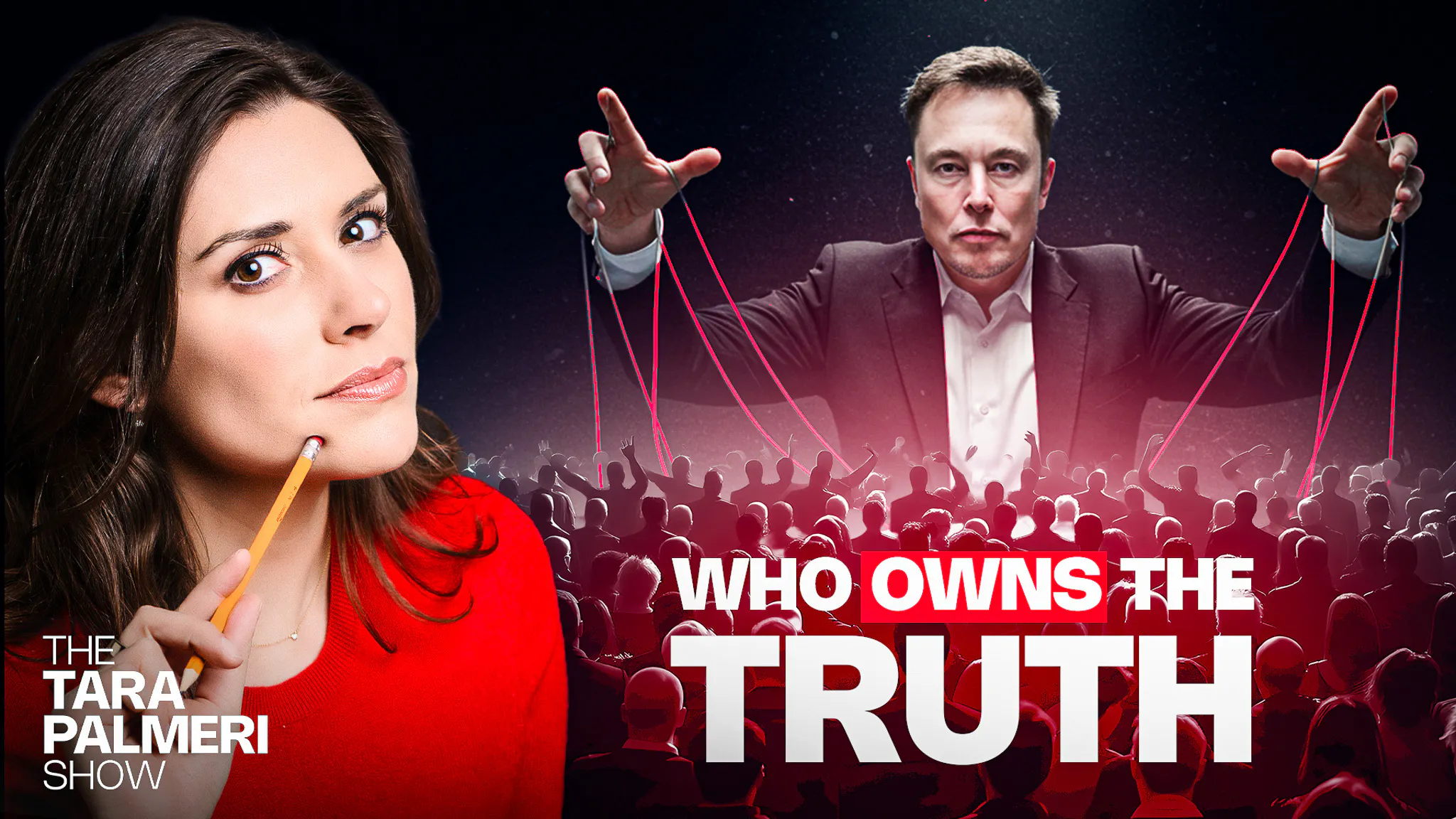
The Tara Palmeri Show
How Algorithms Manipulate What We See — And Who Really Controls the Truth
01:10:03
Loading summary
Transcript95 lines
- [00:00]
A
Take the exit, turn right into the drive thru.
- [00:03]
B
Nope, I'm making dinner tonight.
- [00:05]
A
You don't have time. Josh has practice. Oh, that's right. I'll just get a salad and fries.
- [00:10]
B
No, just the salad.
- [00:11]
A
But salad cancels. Fries.
- [00:13]
B
Salad only.
- [00:14]
A
Fries. Salad, fries. Food noise isn't fair, but Mochi Health is the affordable GLP one source that puts you on the road to successful weight loss.
- [00:22]
B
Hey, can I get the fries? Salad? Sorry.
- [00:25]
A
Learn more@joinmochi.com Mochi members have access to licensed physicians and nutritionists. Results may vary. Welcome to the table Tara Palmary Show. As you can see behind me, I am in a hotel room. I'm in Austin, Texas for South by Southwest, where I spoke on a panel about who owns the truth, who controls it, and I think you probably have a good feeling about what I'm talking about. The algorithms. I'm a denizen of them. You are? You wouldn't have found me here on YouTube or Instagram or substack or wherever you found me, likely, without the algorithms. I have to frankly deal with them. You deal with them whether we know it or not. It's passive. It's in our faces. It's not. You know, I put out political content. Instagram feeds me content about aging all day long because I'm a 38 year old woman. I'm like, I'm tired of seeing these pictures of stars in their 20s versus 30s and then trying to sell me plastic surgery. It's absurd and obscene. And yet that is what the algorithm is coming constantly, feeding me all the time. Really, what the algorithms some of them have become are outrage machines just fueling hate or making you feel kind of shitty about yourself. At least that is what Imran Ahmed, who is the head of the center for Countering Digital Hate, that is his argument that he made at the panel. I spoke purely from the position of having started an independent journalism outlet and how I was work so hard to bring you the truth, to. To verify, to report, do investigative journalism, and how often the conversation overshadows the journalism. But that's okay. I am learning how to navigate it all. I believe ultimately we're all looking for grounding. We're all looking for truth. And I hope that you'll continue to come here for that. And of course you can always support me by hitting that subscribe button or going to Tara Palmery.com so that I can continue to bring great information to you and not get swept up in the algorithm, not give it what it wants, which is just more anger. This Conversation was fascinating. We had a packed house, packed room. I was really happy to see it. And a line around the corner. Not saying it to brag. I was just surprised. I was like, are all these people coming to see me? Maybe they were coming to see Imran Ahmed. He is fascinating person. Fascinating. He worked on Brexit, not for Brexit, against it with the labor government, which is fascinating because as you, many of you know, I covered Brexit for Politico Europe. But he's really come into the forefront as of late because Elon Musk sued him for publishing a report that claimed that hateful and harmful speech was increasing under Musk's leadership at X. And Musk claimed that Imran illegally scraped X's data for that information. The judge threw it out, but he says he's now under investigation and could face deportation because he's British. Yeah, imagine that. Just trying to do some investigative work to counter disinformation and hate and putting these reports together could, you know, jeopardize your status in the country. So we hear about all of that and more. Imran's brilliant. He really is. You get to hear about his story. You can hear a bit about mine and my, and my mission and what it's like for me trying to break through so that you can hear me and so that we can create this community together. Because I actually really believe that communities based on trust and journalism and truth will break the algorithms. I hope. I hope so. We'll see. I'd love to hear your thoughts on all of this and more. And of course you can support independent journalism like mine that cares about this by going to tarapaumary.com it's my one year anniversary. You can help me stay in business by becoming a paid subscriber. It's a way to get my independent journalism and exclusive straight to your inbox. It's not cheap, it's not easy to do good journalism. Commentary is cheaper and easier. But I believe in this mission and I want it to work. I believe it will work. I think the fact that you guys keep coming back is a sign that it does. So take a listen here. Hit that subscribe button. And thank you all for being a part of this. Welcome to Day One of South by Southwest. Thanks for coming in early. So we're going to get into a really, I think, almost existential conversation about who owns the truth and how much. We're being driven and can almost in some ways controlled by the algorithm. It's something that Imran Ahmed has been working on deeply every single day to give us more autonomy over what we see, read and hear, and to make sure that Big Tech is staying in check. And yet as a journalist, I am building an independent media company working within the constraints of what we have to deal with right now. But first, I feel like we should talk about who we are, how we got here on this stage. And Ron, tell me about yourself, a guy from Manchester who is now running a huge center for countering digital hate, who also seems to be a focus of ire of Elon Musk and various members of the Trump administration.
- [05:47]
B
Thank you, Tara. So first of all, let me just say I am so excited to be sharing a stage with Tara. She's a journalist that I've been following, I hope all of you are following as well, via her various channels for many years. And this is a really important topic. The Tara represents, I think, an emerging aspect of how we receive information that's really vital, like new voices that are being elevated on new platforms and helping us to understand the world around us. And she's doing an incredible job at it. So I'm really excited to speak to someone who's kind of a denizen of the algorithm and someone who is showing us what it can do at its best, which is surface really high quality journalism. My name is Imran Ahmed. As you can tell, I'm British. So you know, the question of how I ended up here, gosh, I'm not going to go back to my childhood, but I grew up in a place called Old Trafford in Manchester, so home of Manchester United and that's pretty much the only thing it's famous for. And I ended up working in Parliament via a very long and circuitous route. And in the winter of 2015, I was working for the shadow Foreign Secretary, which sounds very dramatic, but it's just the Labour Party, so the left wing party in the UK's spokesperson on foreign affairs and they shadow the Foreign Secretary, what you would call the Secretary of State in the United States.
- [07:24]
A
States.
- [07:25]
B
And at the time we saw a massive rise in anti Semitic conspiracies on the political left in the uk, which was kind of anathema to the tradition I'd grown up in, the anti racist tradition that saw solidarity between peoples. I grew up in the Muslim faith, my family are Muslim, but I, you know, the hatred based on religion or race was kind of appalling to me. A few months later I was working on the referendum as to whether or not Britain should remain in the European Union. Most of you will remember we remember it by the result Brexit. But I was on the remaining side for labor. And we saw a lot of weird stuff happening. We saw a lot of conspiracy theories about how the EU was trying to import Muslims and black people, people to destroy the white race in the UK. That sounded like a fringe. In the summer of 2016, that sounded like some wild, weird conspiracy theory on social media. And you know, at the time we just thought, but that's social media, that's not the real world. It doesn't affect real elections. And we saw the rise as well of fringe political parties and political movements like Britain first, which was a wildly racist far right party that was basically created by the Facebook algorithm. They'd achieved a million likes on Facebook, more than any other political party, by posting videos of them invading mosques and shouting, this is Britain. Get out of our country. And two weeks before the election, a man called Thomas Mayer is a took a modified.22 hunting rifle and a knife and attacked, shot and stabbed my colleague Jo Cox, who was a 41 year old mother of two and the member of parliament for Batley and Spen, to death in her constituency. While he was killing her, he was screaming, britain First. Death to traitors. Britain first was the name of that political movement. And Death to Traitors was the hashtag being used for the version of the great replacement theory that was so prevalent on social media. And in my grief on that day, I realized a profound for me, truth, which is that every conventional institution I cared about, Parliament, the government, the BBC, journalism, everything, we'd missed something profound that was happening, which was that the primary place where we share information, where we establish our social mores, our norms of attitude and behavior, of where we negotiate our values, even where we negotiate the corpus of information that we call fact had shifted to online spaces that bad actors had learned to weaponize them more effectively than anyone else. And that the mathematics of those platforms, what won and what lost, what information we saw, was completely different to the real world. And that we would have to learn how to adapt to this new world. And we would also have to learn how to deal with some of the negative externalities, the harms that came with that new world as well. And so I spent the next three years studying platforms, talking to them, trying to work out if we could fix them and realize that we couldn't do it just by talking to them. And so I set up the center for Countering Digital Hate to create political advocacy around change, changing the way that we regulate and legislate on social media. And Then eventually AI as well. So that's me. That's how I ended up here. But that's coming at it from a very specific lens as to this question. And there's another and I think much more hopeful and much more optimistic and in many respects more exciting perspective, which is yours, Tara. We've just been talking for the last two hours pretty much nonstop.
- [11:48]
A
Couldn't stop talking.
- [11:48]
B
Yeah, it was fun.
- [11:50]
A
So buckle up.
- [11:51]
B
I want you guys to hear about how Tara ended up here on this stage today.
- [11:57]
A
Thanks for throwing this to me. So I'm just a girl from Jersey with a dream of being a journalist and first generation American. And I went to school in Washington D.C. at American University where I studied communications. I loved politics ever since I was a kid, just because I would be sitting in the car listening to my father, who is now quite Maga and was Maga before maga was Maga listening to him listen to Sean Hannity and Combs on the radio. My mom had differing political views. There was always discourse in the house and I felt like I understood real politic from being a part of it, but didn't have like such strong beliefs that I was choosing one or the other. I was really interested in what drew drove those two, but to me, politics was everything. And so I ended up in Washington and I just tried my hardest to get a job without having any real connections in the world at all. The first time I met a journalist was in college. I grew up in a very blue collar area and so I got a job. I graduated early to work on Obama's inauguration as a news assistant, running school, scripts to the big anchors at the time, Christiane Amanpour, Jake Tapper, and just doing anything they wanted. And at the time taking any opportunity I could to do reporting. And to me, I always wanted to be a reporter whatever way I could get in the door. And through that I was able to get a job at a newspaper as a columnist. And then I went on to be a reporter for the Washington examiner, the New York public. And then I moved to Europe actually to cover Brexit. And I have dual citizenship. And so I lived in Brussels and I covered the movement very closely. In fact, I ended up in a labor town called Doncaster. And it was a pretty working class place and little England as some might say. And I was fascinated by it because everybody who would talk to me thought I was just an American girl who had no, you know, I didn't have a dog in the fight. And they were quite candid and you know, these Old colonels would say, we gotta get the Poles out of here. Little did they know I was here with a Polish passport because the polls were sort of how President Trump talks about Latin American, Mexicans. He talked about them that way. And that was the perception that they were these lower class immigrants who were stealing their jobs from them. And, you know, I'd also, though, talk to Afghani Indian taxi drivers at the time who had the same feeling that they were competing with these Eastern Europeans who had freedom of movement in the country. They were able to take their jobs as well. So I understood that economic plight. I'd heard it myself, though, at home from my father, who was an electrician, who also feared that immigrants would take his trade job at some point. So I was very much aware of these economic fears and how people could really be exploited because of them. And to be completely honest with you, I was not surprised that Brexit happened. In fact, I told friends that I thought it would happen based on these trips to Little England. I told friends that I also thought that Trump would win. And that was based on when I went home and I saw a lot of Trump signs in Bucks county and in parts of New Jersey. And I thought, this is, this is weird. Something's happening. There is. There is a populist movement afoot. And so I went on to be a White House correspondent for ABC News, CNN contributor. And I played the corporate media game, which I sadly learned was not really about breaking news, which was it was really about access and getting bookings and getting interviews. And there was a lot of journalism to be done around the Trump administration. And I felt that a lot of the time it was about getting the right guests and making sure NBC didn't, that NBC didn't get the guests that you wanted. And because of that, the administration can play off of these networks. You know, if you break that story, then you're not going to get the President. We're going to give it to somebody else. And this is a, this is the oldest game in journalism. But it wasn't for me. I was always, you know, the type of reporter that chased the story, no matter what the consequences would be. I always believed the best way to get access was to bring the, the government to its knees. Right. Make them deal with you. And that's what worked for me up until, you know, that point where if you don't really have the backing of the institution you work for, you can't really do that. Right. So I moved on. I did started doing podcasts. I went back to Politico. I led their playbook, which was their, their, I guess you could call it their marquee column. It was the thing that, the thing that everyone really reads and Washington in the Morning. And I had a. And then I left to join Puck, which is. Was a new startup during the Biden administration. And it had, it was, it was exciting, it was cool. We were seeing so many news startups happening. We hadn't quite seen this independent journalism wave that we're seeing right now, but it was just starting to percolate. And so I joined Puck and I had another podcast with the Ringer about the election. And I just felt that it was the right time. I thought if I don't leave and build something myself right now, where I'm going to be behind this is where media is going. People want independent voices. They don't want people who are restrained. They want the connection. You need to build communities. You need to have interaction with your audience. Because often as journalists, we are not just presenting you the news, we're covering the conversation. And so that conversation comes from your community. And it's become almost symbiotic in a lot of ways. But at the same time, I'm an independent. I'm an independent journalist building an independent organization, but I'm not really that independent. I rely on algorithms, a number of them. And I don't think I truly understood that when I worked in corporate media. How much you need the algorithm to make sure that you populate on Google, on substack, on Instagram, on Facebook, on X, so that people actually read. Because if a tree falls in the forest and no one hears it, who cares? And the same thing applies for news. And investigative journalism is expensive, it is time consuming, and you want to make sure it makes impact. Right? And so here I am and we had a great first time year. I'm feeling amazing about my second year. This was actually my anniversary on Monday of launching my independent media. Thank you. And it has been a whirlwind. My strategy has changed. The Epstein story broke, which I actually did two podcasts on. One with Julie K. Brown, who was the obviously the Miami Herald journalist who broke that story open. I spent a lot of time with Virginia Giuffre, one of the main accusers. We traveled all around the country together, knocking on doors of people who are witnesses to her know you. We broke stories that the prosecutors used. Witnessed testimony that was used against Ghislaine Maxwell was to this day the most important work of my life. And I said that even before Pam Bondi said, case closed, and it blew up again. And to see the story become the biggest story in the world, bigger than Watergate, in my opinion, because of the number of very powerful people it ties in. And to have the level of sources and access and really institutional reporting and journalism from having done this for years, to be in the middle of it was actually really, well, time for me to build what I'm building right now. And it all seemed very fortuitous. And I continue to report on the Epstein story, but actually, it's really shown me a lot of problems, too, with the independent journalism and how some of the threads that come out of these Epstein files are not necessarily accurate, but they're pushed by the algorithm. And I think we should. I'll definitely use it as a few case studies throughout this, but the fact that that story has really come back to light has put me in a really good position through my outlet to. To explain it in a way that puts the survivors first, but also explains the story in a way that is not what I always saw as wealth porn, frankly, an obsession with his wealth, his access, his connections, the spy. Kind of like the manosphere obsession with it. I always felt that people forgot that this was a crime story against women and children and that. And when we did the first podcast, I said, I will only do this if it is through the eyes of the survivors. And that's why I follow Virginia and others around to tell their stories. So that's all to say, it's all collided at the right moment. Here we are, and I think it's a perfect story to tell, to talk about what's next, really.
- [21:14]
B
So let's get into our helicopter, and you've just told us what it's like, and we've both talked about our journeys, and that's a really individual perspective on it. But let's try and, like, hover above the system as it exists today. Let me ask you the question, okay? How is journalism changing, A and B? Is that a good thing? First of all, how is journalism changing right now?
- [21:43]
A
Well, first of all, we don't write the first draft anymore. More.
- [21:45]
B
Right.
- [21:46]
A
That's done. And it will. We will never write the first draft again. Homepages, they don't really matter anymore. Maybe the New York Times, but other than that, all of the major websites, most of the major news sites, maybe the Daily Mail is an exception, but, you know, for the most part, they realize they rely on the algorithms. And I believe that the only way as a journalist to survive this disruption that we are experiencing is to. To build direct trust and relationship with your audience. I don't think there's any other way. People do not trust institutions and for good reason. And I think that there is now a burden as a journalist to create, and I don't think it's a bad burden. It is the right burden to maintain the trust of your audience, to make sure that your information is factual, that it's verified, and that your audience knows that when they are going to you, that you are giving them the closest version of the truth with full transparency, being able to show the reporting process, which is something we weren't able to do in institutions. And I think that is the only way to deal with the fact that we have become so disrupted by the algorithms. But there are problems too. I can work for a month on an investigative story. I can break it on substack and maybe for an hour, it's mine. And then after that hour, people with millions and millions of followers, they who just angle it in a way that's more emotive, show more outrage and rage. They pick up my story and they own it. And it's theirs and it's no longer mine. I don't get the algorithmic payoff. I don't get more subscriptions. I don't get more followers because ultimately I still have a business to run. So I need to sell subscriptions. I need to. To get people following my work. But this was always a problem for news agencies, right? I mean, ABC would break a story and then NBC could match it within an hour, and then nobody cares who broke the story, right? But as independent journalists, it becomes a bit more of an issue. You understand, as a business owner, how investigative journalism doesn't always pay off. But I still believe in it. So, I'm sorry, sticking with it.
- [24:04]
B
There's so many strands in that that are really interesting. Let me start by sort of stating some axiomatic facts. News has moved from shared front pages to personalized news feeds. Audiences now encounter story stories through streams which are shaped in great part by their prior behavior, which is really unusual. And commentary arrives way faster than verified news.
- [24:39]
A
Absolutely.
- [24:40]
B
So those are three fundamental shifts in. I call this our information ecosystem. It's the way in which information flows around our world and is provided to us as individuals, as consumers and. And all of us, even Tara and myself, the President of the United States, and Elon Musk, we are all consumers of information that is intermediated by this word that we're going to keep coming back to again and again and again. Algorithms and Algorithms sounds like to most people algorithms are kind of a witchy woo woo. Not quite sure how that works. To me as a mathematician, I sort of sit there and go, well, it's just an equation. Right. But we don't know how that equation's been written, by whom, with what biases. But we do know one thing is that it's a commercial algorithm. And it's really interesting because we're talking about all these changes that are happening. We're talking about democratization and yet Tara talked about running a business. YouTube X meta. These are all absolutely, without a shadow of a doubt, businesses. And we're all in the, and everyone's in the attention game as well. So we have this fragmented information ecosystem in which everyone's getting individualized stuff. Businesses are being disrupted. Legacy businesses that have existed for decades are essentially being crushed overnight. New opportunities are emerging. But we're at this kind of very, very febrile point where we don't know what's going to win. We don't know what the world's going to shape, going to look like. All of these things that are happening. Is this a good thing? Are you hopeful or are you. What's your general. I always think there's two types of people in my Fundamentally in politics there's optimists and pessimists. And I wonder in your world, what drives you? Fear of the future and fear that it could be terrible or genuine optimism that this is very exciting and this is what, you know, we are now shaping a world.
- [27:01]
A
I'm a person who really likes challenge, so I see it as a challenge.
- [27:07]
B
Yeah.
- [27:07]
A
Which can be exhausting. But I also see what is behind us, what we talked about before, gatekeepers at various newspaper news agencies. That's gone. And so I can either live in the past and cry about it, or I can look to the future and try to be a part of it in a way that provides people some grounding. I think that's what we need. We need anchors. Not in the typical TV news sense, but we need anchors of reliable information. Out there in a world of conspiracy and Reddit, you know, subreddits and people like Alex Jones and you know, various others who push out commentary and conspiracy. I think people feel, and you see this in Gen Z, they feel very unmoored. They feel like the algorithm is creating a world for them where they don't know what to believe. They're turning to church, they're turning to
- [28:11]
B
ancient tradition, conspiracist ideation. We did some polling a couple of years ago, 14 to 17 year olds and adults. The most conspiracist age cohort now is 14 to 17 year olds.
- [28:24]
A
Oh, my gosh.
- [28:25]
B
Of any generation.
- [28:27]
A
Wow.
- [28:27]
B
Which is wild. So, like, I think there was an anti Semitic conspiracy theory. 34% of adults believed it, 43% of 14 to 17 year olds and 54% of 14 to 17 year olds who spend more than five hours a day on social media. On average, a 14 to 17 year old in America spends 4.8 hours a day on social media.
- [28:49]
A
Wow.
- [28:49]
B
Yeah. Okay.
- [28:50]
A
Well, that's the next generation. Great. But I do think. I do think this. Like this. These kids that came up during COVID specifically Gen Z, I work with them, obviously, they do my social media. They seem to, like, they seem to want some grounding in the chaotic life of algorithms. Now, boomers, they love the algorithm. I mean, they are becoming one of the biggest audiences on YouTube. Really. They are. I come home, part of the reason I went on YouTube too, was I came home over the holidays, I see my dad and he's like, yeah, we cut cable. I don't trust them anyway. Just watching one YouTube show after another from the next. It's like, first it's like dancing Kids in Africa, then it's Bill O'Reilly, then it's cars. Then I'm like. And it's just going from algorithm. I'm like, what's going on in your head? And we all have to watch it on the big screen right now. And that, that is. And he doesn't know that he's being served up just an algorithmic soup. But he loves it. Never gets it wrong for him. They always know what he wants and he doesn't have to change the channel. So it's. I'm hopeful. I mean, I'm trying to create something. And I know that I'm not for everyone, and not everyone is for me. It's kind of like, I don't think you can own the Internet. I don't think, like, one person can do it. But I'm hopeful that I can create, like, content that people return to. And even if it's only a small, you know, a few million or whatever it is, I know that sounds small, but in the number of people in the world that feel that they can rely on me, and then others see that as an example, to me, that's making some sort of impact. We don't have a ton of examples of independent journalists who have actual journalism experience. Experience that are. That can offer the rigors of a newsroom the standards, the process online. There's a lot of people cosplaying as journalists, not a lot of them who know how to do it.
- [30:50]
B
Oh, I agree, and I actually think so. You know, I come from the political world and typically in the political world, journalists are seen as being. This is going to sound terrible. As kind of the enemy.
- [31:02]
A
Yeah, we are. You should think that as if you're in the government. You should think we are the enemy.
- [31:07]
B
I remember when I first started working in politics, the head of press for my party took me aside and said to me, like, you're quite good at dealing with journalists. Because I always have three basic rules with journalists. One is never lie to them because they will fuck you up if you lie to them. The second rule is never, ever triple check every bit of information you get them because if they have to issue a correction based on your briefing, they will F you up.
- [31:35]
A
That's true.
- [31:38]
B
The third rule I was taught was never, ever think a journalist is your friend because one day they will quite happily fuck you up. And yeah, we're the punks.
- [31:51]
A
I mean, you have to have a rebellious streak to want to be a journalist. If you're a rule follower, you will not be a journalist.
- [31:56]
B
Right.
- [31:57]
A
Because like you are, you are expected to be the one who questions everything. You have to want to cause trouble for people in power.
- [32:07]
B
But you're also incredibly well trained. Like you. Underlying every bit of our conversation today was this real sense of purpose. I did offline with Jon Favreau, the Pod Saves America team in LA, two weeks ago, maybe last week. I've got an 11 day old daughter, so I have no idea what time it is, where I am or when it is. So I think it was two weeks ago I was in LA with Jon Favreau and we were talking as practitioners from politics about precisely these kinds of problems. And that's a really, you know, we were talking about the nobility of public service. And I really believe that politics is a noble thing to do. To seek to improve your country through the political process, I think is a respectable and in fact a noble calling. Yours is an incredibly noble calling. To seek to explain the world, to find the lies, to find the truth. And yet we were just talking about the people that will inherit that mantle. In an algorithmic world, I fear you are the last generation of truth tellers that gives a fuck about the truth.
- [33:21]
A
Yeah, I feel the same and I feel like I am doing this in a public service because let's face it, the content I create doesn't make Me that much money. No, it doesn't. And I've had people say, you could have so many more eyeballs if you do this or do that or dance before. Go, whoa. Or pop or make it more shocking. And I'm like, the world doesn't need any more of that garbage, okay? And here's. And I agree. I believe that public service is a noble profession, but when power and politics corrupt, you need to have a backstop. And I believe that's journalism. But also, journalists who become very powerful have just as much power as the people they cover. They can become easily corrupted as well. And I think, like, we all have to stay in check, and we need. We need, need people to constantly keep us in check. And that is what I believe good journalism does. But I worry that there aren't enough people because of the fact that newsrooms are anemic. I mean, when I came up, I had the luxury of having mentors in a newsroom, and they're still my mentors. And actually, now I have them become the mentors of. I mentor the people who work for me. And I have other journalists that I call my mentors that now mentor them, too. So, so important. You have to learn from someone how to become a journalist. You cannot learn in college. It is the most useless degree, like, literally the most useless degree of all time. Do not go study journalism. I would, but find a mentor. Find a journalist who will show you how to navigate it. My intern, I took her to the bar at BLT at Trump's Doral Golf Course this week. And that was me mentoring her because all of the members of Congress were there for the congressional retreat. I'm like, they're going to have a few drinks and they're going to tell you how they really feel and what Trump's saying behind closed door. Okay? And you can use. You can pay for and just expense it. Okay? That's how you get the truth. Okay? And I know that sounds like, oh, God. But that is how you actually find out what is really going on. You want talking points, Go to the press conference. You want to find out what's really happening. You need to build source relationships. You need to talk to people on the ground, but you would never learn that. Didn't you ever tell you that in journalism school?
- [35:43]
B
Yeah, absolutely.
- [35:46]
A
So. But that's all to say. That's not to take away from what you do in public service or what you did in public service. But anyone with power needs to be put in check.
- [35:56]
B
So I. Look, I just want to hold on to that for a second, because we're going to come back to that. I think I come from a country with kings and queens.
- [36:06]
A
Us too.
- [36:08]
B
This is gonna sound really dumb and really, like, almost, you know, certainly right now it might sound profoundly naive. There is something about coming. And I've been here for six and a half years. I'm a green card holder, which means that I'm a legal, permanent resident. I'm married to an American citizen. I was saying to Tara, my wife's from Oklahoma. She likes guns and fast cars, so she's Murrican. And I have two American daughters. I love this country. And it's a country that's based on an idea, an idea that we can govern ourselves, that no locus of power should not have checks and balances on it. And if we create that system where everything's holding each other in check, that actually we can create a virtuous process that leads us to a better future. And America, for better or for worse, is an incredible country. As an immigrant, I have the zeal, this kind of passion for America that sometimes you wouldn't feel if you were looking at the news every day if you're an American citizen, if you've been here and you maybe take it for granted more than I do, because the economic productivity, the creativity, the vibrancy of the culture is phenomenal. It is so exhilarating and fun, thrilling to be part of this American journey. I want to talk for a second about what it's like to be a denizen of the algorithm, because I think that what Tara has been talking about is kind of. We've been describing the algorithm as observers, as scientists. Talk to me what it's like. And maybe this is going to be tough for you, because in our earlier conversation, you kept saying to me, well, I haven't thought about it that way. But, like, I want you to. Let's treat this like a therapy session. Oh, God. What? How do you acknowledge the way that being part of the algorithm shapes the way you think, live your life, conduct your business? Like, what's it like being, you know, beholden to an algorithm?
- [38:22]
A
It's a horrible feeling, okay? Because you can decide what's true and what's newsworthy, but the algorithm decides what people actually see. So that is a fact. When I put out a story on Substack, I could work on it for hours, but if I can't hit share and I can't get a video up with it and I can't get the right splashy comment to go with it. It dies. Doesn't matter. They're not going to promote it on their algorithm. There's this intense pressure to constantly be posting. As before we got on stage, I said, wait a second, let me send to my intern a video from here. She's got to put up things all day, all morning. We know we have to feed at this time, this time, this time. We know when the traffic is going. Everything is organized around when our audience is tuned in, how do we break through? Right? And so while I don't want to denigrate the actual product and work, I do know that I have to promote it. So I'm in a constant stage of promotion. I know what stories are going to sell and what aren't. I've always known that, though, because I did have experience working in tabloid journalism. So it's like, that is, you know, that is something that it's like inside of me. But, you know, there are some stories to me that matter so much and they just won't break through. Like, here's an example. Jay Clayton, he's running the sdny. He's the guy who's in charge of releasing the Epstein files. We've only seen 2% of them. He also was appointed by Leon Black to Apollo after Leon Black was pushed out of Apollo for the Epstein scandal. Why is Elon Black, I'm sorry, Leon Black, who has been, literally, the FBI, has put together a presentation including him as a possible perpetrator in the Epstein case. Not actually been called in at any point for. For an interview charge. Well, this is the web. Like, this is what everyone needs. And I put this out, and I'm trying, but it doesn't matter. The algorithm's like, nah, pass. Too complex, too nuanced, too weird. Conflict of interest stories. They're really hard for the algorithm to push because it's a little too complex. The algorithm. If I walked out of a Trump rally that won at msg, do you remember that? Right before the election, most views I've ever gotten, me walking out going, what the hell was that? And I'm just rattling off some of the crazy things that Trump was saying. And I'm just walking through the streets. Millions and millions and millions and millions of views. I'm like, that had such little editorial value. It was just me reacting. And like, it was so valueless to me. But that's what owns my TikTok and still generating content. So you have to package for that. You really do. You have to think about them now. Now they're saying people want only 15 seconds on their shorts. Now they want two minutes. I live in a world where the algorithm decides where my. If people see it or they don't. And so I have to create packaging for that. And so that's what it's like. But I, I still will work on the stories that I care about and hope that people will, It'll break through. At the same time, things that are wrong are constantly being spread around. We talked about this yesterday.
- [41:37]
B
It's really interesting because when we started ccd, the first report we wrote at ccdh, the only report that I ever wrote every single word for was a study called Don't Feed the Trolls. And it was based on three years of mathematical analysis of what works and what doesn't on social media. And, you know, I told you the story of why I started ccdh. It was about hate. When it started, it very quickly became about. We look at a whole array of harms, whether it's eating disorder content or self harm content or like disinformation about elections or about health care or about blah, blah, blah, et cetera, et cetera. But what we found was that in conventional, in the offline world, the way that you are trained as someone who believes in anti racism or believes in tolerance is that if you see hate, confront it. Right. Bystander training. So we're literally trained in how to be an effective bystander and how to intervene in the right moment. Turns out that on social media, if you intervene, if you engage with a piece of content, you amplify it. And that single change in Tara says something wildly racist about British people. I stand in front of her and go, that's wrong. Both of our voices are heard equally. We do that on social media. Her voice gets twice as many views. Fifteen people confront her. Each of their voices are drowned out by the algorithmic amplification that's given to her voice. And that unique change to the algorithm is. And the way that information, what information is promoted and what isn't, in my view, is fundamentally changing not just what information we consume, but also our politics, also our understanding of science, of each other, of ourselves, of our bodies, of everything in our society. So I, you know, reminds me of
- [43:35]
A
the algorithm candidate that we were talking about.
- [43:37]
B
Yeah.
- [43:38]
A
So I interviewed a candidate for governor in, in Florida, and he went from 2% polling, his name is James Fishback, to now 23% in the polls. He's about 12 points below the front runner, Byron Donalds, and his entire campaign is calling him DEI Donalds because he's a black man and complaining about how he's a victim and all white men are victims. He just got an endorsement from Nick Fuentes, and he welcomes the endorsement. And so this is a white supremacist who is polling very closely to the front runner in Florida, one of the biggest states in our country. Not like the second largest economy, I think, or third largest economy. And he knows how to work the algorithm. First, he. He said he was going to ban. He's going to put a syntax on OnlyFans stars. He obviously puts out a lot of racist, provocative content against this African American candidate who is in the front runner. And I interviewed him, and there was a part of me that I know that my core audience does not really like to hear from Republicans. And I made the argument and I always do that. Like, you know, call me corny, but, like, I looked up to Barbara Walters. Okay. But I also, like, the thing I liked about her was that she would interview really interesting dark people sometimes, like the Menendez brothers, like Fidel Castro, you know, you know, like Assad. She would go and try to understand what makes darkness, why are these people the way they are? And so, you know, I have gone, I have interviewed people who exist in this space mainly because Trump paved the way for them, I would say. And the algorithms have helped them. I mean, he is a creature of X. He is the algorithm candidate. I cannot think of anyone who has used the algorithms better than him and President Trump, honestly. And, you know, I asked him, like, a pretty simple question because he's, you know, so he lacked so much self aware, he lacked so much self awareness, that I said, you know, what is the worst thing that's ever happened to you in your life? And he went on about how his father lost his job to Haitian immigrants, his landscaping business, and, you know, he was so adversarial, and he said horrible things about Haitians, had said they were uneducated and they were this and they were. That they couldn't be SAT tutors. And, you know, I put it up online and yeah, the algorithm loved it. Still does. But my. My comments are all against him. They all think he's like a horrible person. But you. You made a really interesting point this morning that to me, I'm like, oh, well, now everyone knows who this guy really is, right? But you were saying, actually that frequency of. There's a frequency bias for him now that I may have created unknowingly, and I didn't know that.
- [46:43]
B
So bad actors literally write about this. Andrew Tate's. He's, you Know, everyone knows Andrew Tate as being the misogynist dude, the kind of guy who talks about choking women. Like, if a woman speaks back to you, grab a machete and tell her, tell her who's boss. Like a very, very dangerous man in terms of his rhetoric and the things he believes and the things that he wants boys to do to girls. He will cause violence. He has caused violence. He is himself a violent man. He says, you know what? You need a third of the people that follow you to absolutely hate you, because they're the ones who give you the engagement that pushes you up the algorithmic league table. In that first report we ever wrote, Don't Feed the trolls, which is seven years old now from September 2019 is when it was published, we actually found far right playbooks, so we found neo Nazi playbooks, and they had a playbook for how to weaponize social media to maximize their reach. And they said basically, you need to say the wildest things possible, because then when all the sort of the normies come and start engaging with your content, they are going to make you more visible. And all that matters is visibility, because with visibility comes normalization. With normalization, the Overton window shifts and we become the new norm. We move from the fringes to the mainstream. And can anyone describe the last 10 years in any better way than that precise phenomenon, the fringes moving into the mainstream.
- [48:21]
A
Should we not cover them, though, as journalists? Should I ignore him? He is the. He is. So he has a. He could very well win the primary. I actually think he could.
- [48:32]
B
That is one of the central questions for right now. And this is one of the challenges for people that still care about the truth. And I, and I. And like I said, I think you are the last cohort of real journalists. And I, I abso. I don't believe in God, but like, I pray and I genuinely would get on my knees and pray that you actually win the algorithmic war that's coming up, but I fear that you won't. And what I see in my job, so my job for the main part is producing research reports that drive. I mean, I'm an advocate. I want changes to the way the rules work. I want transparency of that algorithm. I do not think that an unaccountable opaque algorithm should be deciding what, what we know about the world around us. I think at the very least, we deserve transparency and some degree of democratic checks and balances. Going back to those checks and balances idea once again, I think that with sunlight we get more information about how we're Being manipulated by the algorithm. And right now you're trying to back work the algorithm, you're trying to work out, well, what do I think will work on the algorithm? Because that's what it's like. The people, someone like Mr. Beast or some of the anti vaxxers that we study, they have laboratories which are reverse engineering the algorithm constantly. They know exactly what words, what ideas, what visuals will work in the algorithm today. Because also the algorithms are being changed
- [50:10]
A
daily and they're also, they are being modulated around the content that is being pushed out and what is being responded to.
- [50:17]
B
Absolutely. And the people that own them have power over the algorithm. So this is an incredible story and I think it's one of the most undertold stories in the last few years. After January 6th, my first January in America, living in Washington D.C. i actually received my, I received my permanent visa. So this is very funny because when I moved here, President Trump's administration was very anti, anti Semitism and they were anti disinformation and so they gave me an Einstein visa, the Trump administration, and I received it on January 6th. So there's so many layers of fucking irony there.
- [51:07]
A
Now they're trying to deport you. They're like, oh, yes, they are currently
- [51:12]
B
trying to deport me. But those, yeah, the. I've completely lost my place.
- [51:22]
A
I want to, I mean, if I can get this from you, because we are kind of running out of time, unfortunately. But I want to know what would you change about the system, the algorithm?
- [51:29]
B
So, I mean, I would. Look, I think this is going back to picking up the point from January 6th. We have these algorithms that shape our understanding of the world around us and we have no understanding of them at all. So you've got these bad actors that are sort of reverse engineering them constantly and they're the only ones that understand how they work. And the platforms themselves, because they've achieved, they've got the scale to do so there's zero transparency. And what I spent the last six years fighting for is for transparency of those algorithms, transparency of how advertising shapes the content on those platforms. And I think this is the single most undertold story, is that everyone talks about these being free speech platforms. Such utter horseshit. They're fucking billboards. That's all Twitter is, it's a billboard. They sell ad space. They don't care about your content, they just want your attention. They want your eyeballs so they can sell ads. If you look at the Twitter experience as an advertiser or the Instagram experience as an advertiser. You understand how these platforms really work. You are a series of data points that can be used to sell to. That's all you are. Your voice is irrelevant to them. What voices win or don't win, kind of irrelevant to them. But those algorithms, we need to have transparency of the advertising and transparency of the algorithms going back to the point of January 6th. On that day, Mark Zuckerberg took the decision to dial back the Facebook algorithm. It was currently on 10 and the 10 was the negativity of the news feed because Facebook had worked out the more negative the news feed, the more time you spent there. On that day, he dialed it back down to six and he was able to do that. Can you imagine having that power? Can you imagine having the power to make reality seem better for 350 million Americans?
- [53:39]
A
But is that lulling them into a feeling of safety in a world that is quite negative? Because people are always, I wish the news wasn't so dark. And it's like, well, we don't write about when a plane lands, we write about when it crashes.
- [53:51]
B
The question is, what is 10 is 10, reality is 9, reality is 8, reality is 7, reality. And so transparency, those algorithms, by the way, after he dialed it back down to six and made the newsfeed less negative, people posted less negative comments and people spent less time there. So they dialed it back up the next day to 10. And that's the power that these guys have. And I think that there should be some transparency at the very least. And then I think about the other part of what I do. So we're talking about journalism, but we've done studies where we have set up accounts on TikTok as a 13 year old girl in four different countries, the US, UK, Canada and Australia. Within 2.6 minutes as a 13 year old girl, opening a new account where TikTok has no other information about you. 2.6 minutes, it's giving you self harm content within 8 minutes, eating disorder content every 39 seconds on average in the first half hour of using that platform. And we made one subtle change in the accounts. Half the accounts were called something like Susan. Susan's a 13 year old girl. The other half were called Susan lose weight to show that she had a vulnerability. Those accounts got 12 times as much self harm content.
- [55:08]
A
It's horrible.
- [55:09]
B
What the fuck?
- [55:10]
A
Yeah. Now as a 38 year old woman, I get fed plastic surgery, pictures of celebrities when they were in their 20s and I don't know, all sorts of lip fillers, like, don't want that it's really terrible. It's all about aging all the time.
- [55:30]
B
I'm a 47 year old man, so basically Instagram thinks my cock doesn't work and I've got no hair. So they're both fine, thank you very much. 11 day old daughter, just to remind everyone. Shit. I went full Trump and Rubio, didn't I? Oh my God, that's terrible. My hands are normal sized too.
- [55:52]
A
So it's interesting because I put out political content. That's all I put out. I don't put out anything personal. No pictures of myself, no pictures with my friends, no pretty scenes. And yet it still only feeds me things to try to fuel my insecurities. There is not a single political content that it feeds me. When it's like in the searchable area, that's not what I'm putting forward. I'm not putting that out. And yet this is what you're feeding me.
- [56:20]
B
If you don't give it personal data, it will default to the mean. And the mean, what they've worked out is what is the basic stuff that keeps people addicted, make them feel shit about themselves. And you know, Musk, once he was in conversation with Aaron Ross. Yeah, he's a great journalist. And he was talking about Aaron Ross was saying, my feed's full of anti Semitism. And Elon, who kind of, kind of is the most honest of all the leaders, he kind of went, well, yeah, like, do you engage with anti Semitism? He's like, yeah, I'm Jewish, of course, I don't like it. And he's like, well, that's why we give you more of it. Because of course what they do is create your own personal kind of. They want to push all your trigger buttons at the same time. And I'm not sure that's necessary. We can leave aside the question of is that healthy for a society for all of us to be triggered all the fucking time, or does that lead to sort of a Hobbesian state of nature in which we start to loathe and detest everyone around us and start to fear society and start to fear each other. And is that perhaps the we all
- [57:23]
A
turn into cat ladies?
- [57:26]
B
Well, I mean, like, you know, I have to admit, I spend so much time studying harms online, I find it difficult to spend time with people anymore. That's the honest truth. I'm really introverted now now and spend most of my time with my family. And I find it uncomfortable to be with other people because I'm always, I'm so aware of Some of the absolutely malignant things that some people say and think. I remember spending time looking at these little old lady accounts that would be spouting the most vile neo Nazi shit. And after a while you start thinking, well, I can't do this because I'm going to start hating nice little old ladies. And they generally, you know, they make good cookies and generally they're nice people. So. But like. Sorry, do you want to take questions? Yeah, sure.
- [58:15]
A
Should we take some questions? Yeah, we only have a few minutes left, so we wanted to open it up to you for some questions.
- [58:26]
B
Yeah, do you want to do that? Yes, go to the central mic. Oh, this is going to be a line. It's very exciting.
- [58:38]
A
Who owns the algorithm that is each separate social media platform and how did you know they turned from 10 to 16? You must have some inside knowledge about Zuckerberg.
- [58:54]
B
It was very widely publicly known, but you're right, the algorithms owned by each individual owner of a platform. Essentially we're talking about five incredibly wealthy men who have absolutely no connection to the lives that most people live, who are so wealthy that they're immunized from even having to recognize reality as it exists.
- [59:17]
A
They probably don't even use their own platforms, let's be serious.
- [59:25]
B
So one of the value of the, you know, mid 20th century gatekeeper was creating society a common vision, how we see reality and things in a new community ecosystem. Is that gone. And there's just a million subcultures that, you know, collect their own interventions and let's assume they're valuable journalistically informed intervention. Is there a society per se on that?
- [60:05]
A
I think we all now live in a number of different silos, but I do think there is some cohesion. There are some things that in the. Not like we don't have a monolithic society anymore, that's for sure. But you know, I do think that maybe across class, ideological views, age, there is, there's some cohesion, but it's much more niche.
- [60:32]
B
I think one of the issues is we just don't know.
- [60:34]
A
Yeah.
- [60:35]
B
And that we are, we're. We essentially are being reshaped dynamically by algorithms which decide who to connect, what to show them and what to use to trigger them to stay for longer on a platform without any sort of visibility or any sense of coherence. There is no ideological coherence to it and there's no transparency at all. So we don't know. We are basically blind and stuck in an ocean and we don't know if we're near other people or if we're in fact miles away from them as we bob along.
- [61:11]
A
I do think people are craving though, community online, because I see this on substack. Like this morning I sent out my latest piece to my community and I said, what do you think of my latest reporting? And hundreds of people will start communicating with each other about it. And they all kind of see eye to eye, I think, about the story. And so I do think even though we are so fragmented, people are still looking for community online.
- [61:42]
B
I think part of the problem of having these really atomized information environments is that we are craving community, we're craving connection. And we know that most people don't believe or see what we see. So if you want to know why there's a loneliness crisis, I think it's in part that we're stuck in these devices, head start down all the time. And I think it's in part that we don't know what other people believe anymore. We have no community based on shared beliefs, shared values, and a shared understanding of the world around us.
- [62:09]
A
Hi. Hi. My name is Mandy Jung. I'm a seventh grade science teacher in St. Paul, Minnesota. And the strongest emotional reaction from the crowd came when you were talking about like my students. Essentially right now my students are seeing the media lie about what's happening to their community members or ISIS actions. I'm wondering what, what advice you have for educators who are shepherding students through this moment in time where the truth is endless. This is. Yeah, it's so hard right now. I mean, we know for example, that our Tomahawks, only four countries have the ability to have Tomahawk weapons. Two of them actually have them, the US and the uk and one of them bombed a school in Iran. And our President, a 7 year old, and our president will not acknowledge that that is like next level gaslighting of the American people that has to trickle down to that generation. The ice raids, I mean, it's. I don't see how that isn't just completely destabilizing for young people to feel like they're grasping at some sort of truth, something that says, yes, the sky is blue, the grass is green.
- [63:32]
B
I think in the same way that we're going to have to have really tough conversations with them about the physical environment that we've left our kids. I think we have to beg their forgiveness for the information environment that we've left them and tell them we understand that what they are seeing, people say about where they are, about reality is untrue. And that is because of failure Something has gone wrong and it will in part be their jobs with our help to fix it. And it's terrible to say that and I am desperate to make sure that my 18 month old and my 11 day old do not have to live with that. But I think they will. So I think we've got time for one more.
- [64:12]
A
Unfortunately, I think we're done. I was just told that we wrapped up. Can we get one man? Oh, we get one. We get one more. One more question. Okay. What does that mean for the future of democracies which depends on some level of shared reality?
- [64:52]
B
I think we're in real trouble, don't you? Does anyone not think we're in real trouble with the information environment and whether or not it supports the values that underpin democracy? It's not just about our belief in the core democratic process. It's not just about whether or not we see ourselves as same people. I think it is slowly eroding the values that underpin democracy. And that is what is most terrifying to me. I think the conditions that the information ecosystem often shapes our political realities. And I think that the political realities in a chaotic information ecosystem, just as you said, people are reaching for something solid. And it might be Tara, but the truth is that the Soviet Union knew this. Their tactic was not to lie to people, it was to make them unable to tell what was true and what wasn't. Epistemic anxiety. And in that environment you grab for the only thing that seems solid and that's often the autocrat, the dictator. And I have no particular comment on the administration of the America, of the United States of America, which is currently trying to deport me from the country for my advocacy. But, but if you look around the world, is that something that you are seeing happening? And if so, we need to fix the information ecosystem that we are living in. At least have more transparency and accountability or I suspect we are committing suicide for democracy.
- [66:15]
A
And also these people in Russia, they have become so disengaged because they can't handle it. They've been so over flooded with information that they're just like, like we don't trust anyone. There's nothing to trust. All we ask for is the most basic, the most basic things. Food, water, the lowest of the Maslov's hierarchy of needs.
- [66:38]
B
Epistemic anxiety and apathy and political apathy are very deeply linked and so is conspiracist ideation. And apathy is the truest enemy of democracy. When we give up, that's when it all ends.
- [66:51]
A
That's when they win. Yep. Thank you.
- [66:53]
B
We're not giving up.
- [66:56]
A
That was another episode of the Tara Palmeri Show. Thank you so much for tuning in. As always, you can support the show by hitting that subscribe button, the follow button, sharing, commenting, telling your friends all about this means the world to me. You can go to tarapaulmieri.com that's T A R A P A L M E R I dot com. You can sign up for my newsletter, the Red Letter. Get all of my exclusive reporting straight to your inbox. By being a paid subscriber, you don't have to hit a paywall. You can support the work that I spend all day and night on this Is My World. I want to thank my producer, Dan Schiffmacher. I want to thank Abby Baker who is producing, editing, booking, social media. She's doing a lot for me. We've got Adam Stewart on the graphics and Dan Rosen, my manager. See you again soon. This episode is brought to you by Progressive Insurance. Do you ever think about switching insurance companies to see if you could save some cash? Progressive makes it easy to see if you could save when you bundle your home and auto policies. Try it@progressive.com Progressive Casualty Insurance Company and affiliates. Potential savings will vary. Not available in all states.