Loading summary
Transcript86 lines
- [00:00]
Tara Palmeri
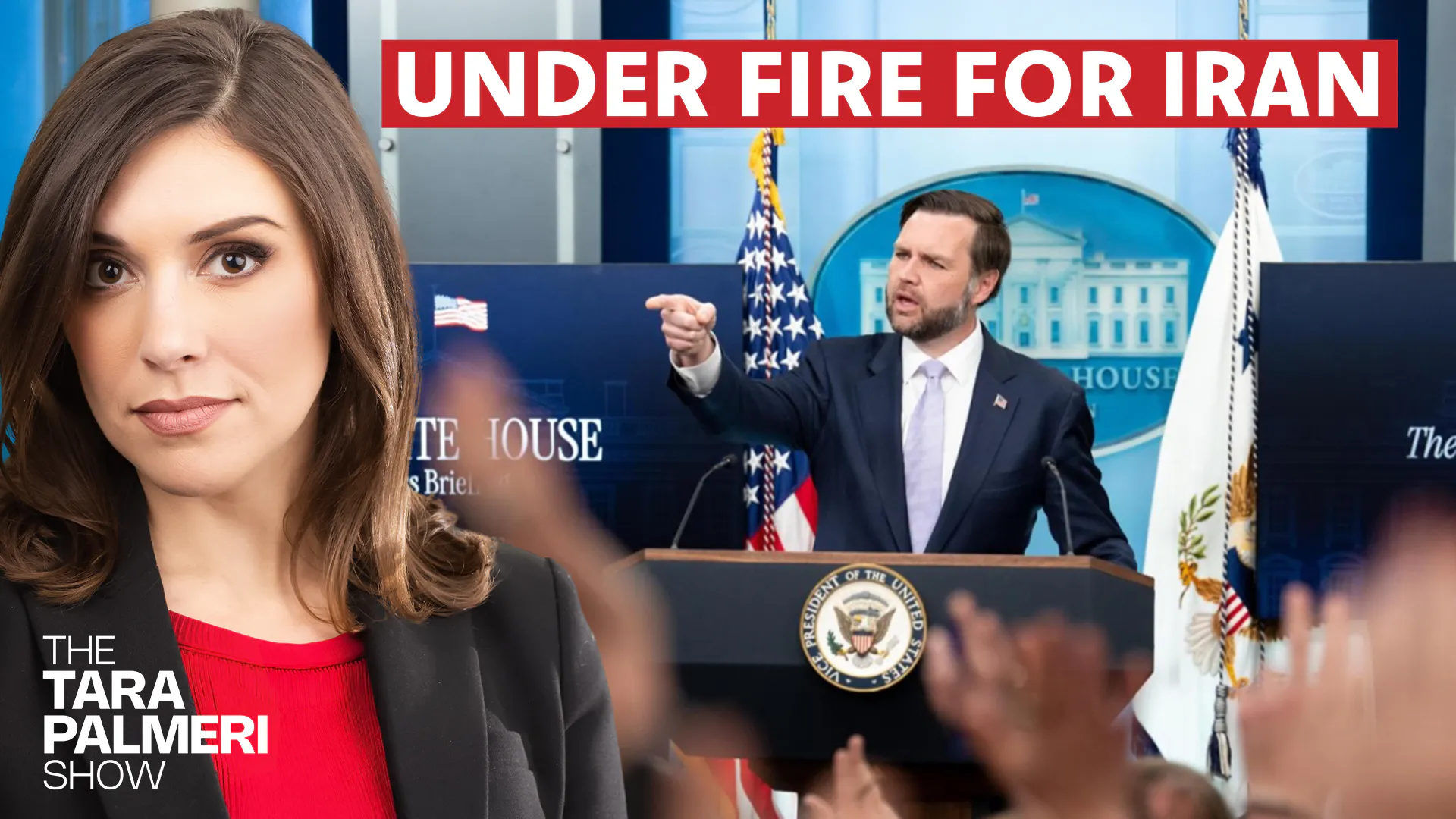
This is a Monday.com ad, the same Monday.com helping people worldwide, getting work done faster and better. The same Monday.com designed for every team and every industry. The same Monday.com with built in AI scaling your work from day one. The same Monday.com that your team will actually love using the samemonday.com with an easy and intuitive setup. Go to Monday.com and try it for free. Yes, the same Monday.com. Welcome back to the Tara Palmary Show. I am taking you inside the James Brady briefing room, the historic briefing room inside of the White House where J.D. vance, the vice president, the America first vice president, is about to be under fire. A number of reporters are going to ask him about this so called Iran peace deal that President Trump signed. And you know, as we know, it's now being dubbed the Vance Peace Deal, almost ironically, right. He's being called the main architect of a deal that, you know, it's a deal that comes from an administration that often over promises and under delivers. Let's not forget that they were close to a deal nearly 38 times. And does Iran really have a history of actually following through on they're on their deals? No. That is why we are here. This is why we are here right now. And it's becoming very clear that J.D. vance may become the scapegoat of another failed deal. So that's why I think it is worth to go over what has been promised. What are we actually getting from this? Very little. In fact, Iran seems to be the obvious winner from all of this. So is no longer Trump's unconditional surrender. If anything, we as Americans have surrendered to Iran. But I'm going to go over point by point. We're going to watch this video together. I'm going to take your questions, please put them in there. Now let's start the conversation, especially while J.D. vance is talking. I'm not going to jump in there, but if there are opportunities to, I will. But we're going to hear how he defends this bill. This, this plan that clearly is, is another nothing burger. And it totally violates his policy of America First. Now let's talk about the politics of it all. J.D. vance wants to run for president in 2028. He's now the face of the party. There's obviously tension with Marco Rubio there. But giving him this mantle, the Iran peace deal, which will most likely fall apart within days, is just like handing him a shit sandwich. And you got to wonder what Donald Trump is thinking right now. Is he pissed at JD Vance for creating distance with the administration over this and the Epstein files and a number of other dead weights around Donald Trump as he tries to Prepare himself for 2028. Perhaps President Trump doesn't like to see his alkali, you know, trying to rise above him. There is one thing that President Trump believes in. The show should be about him and no one else should be benefiting from him or making money off of him or becoming bigger than him in any way. In fact, he's already called it the JD Vance deal and joked that if it goes down, it will be J.D. vance's fault. Abby, roll the tape, please. Oh, got to get that tape. You know, this is the part of the live that's always a bit difficult. But yeah, here we are. This is from Trump. This is, you know, in Europe, after you sign the deal at the, the. Where did he sign it again? The palace of Versailles where a lot of really bad deals were signed. Now listen to this.
- [04:05]
Reporter 1
This way, if it works out, I'm going to take the credit.
- [04:07]
J.D. Vance
If it doesn't work out, I'm blaming J.D.
- [04:09]
Reporter 1
you better be careful, J.D.
- [04:11]
J.D. Vance
he's going to turn his plane around and get the hell out of here. Yeah, I like that idea.
- [04:15]
Reporter 1
I think it's a good idea. This way, if it works out, I'm going to take the credit.
- [04:18]
J.D. Vance
If it doesn't work out, I'm blaming J.D.
- [04:22]
Tara Palmeri
yeah. So I think you heard exactly what's going on right there. Blaming J.D. we're going to pull up the White House briefing room again so that we can wait and watch this together. Guys, thanks so much for joining. Again, we are going to watch JD Vance taking a grilling on a plan. Plan that will surely become dead weight for him in his political career. Now, there's already been moments like, I mean, this literally just happened and JD Vans and Trump have already had disagreements or at least mixed messaging on the deal. So in an interview with CBS, J.D. vance confirmed that the that Iran would get $300 billion in funding to rebuild infrastructure after this short instant of bombing. But Trump said on Truth Social that it was BS. He said, quote, the story that the US is paying Iran 300 million sick dollars billion obviously is fake news put out by the Democrats. I think that's pretty clear that they are not in alignment. And that's not true. I mean, that is part of the deal. JD Is saying that the Arab nations around Iran are going to help pay for their infrastructure. Very doubtful. They did not want to stop this bombing campaign of anything. They just wanted to obliterate Obliterate Iran. We are getting a question from Tom Crown. Let's throw it up on the screen. Yeah. What is their, what is their, what is in their plan that ensures that Iran won't use the $300 billion from modernizing their military, thus making it harder to attack Iran? I mean, that's. Well, that's a great question, Tom, because as part of this deal, not only will they get this money, but they're also going to get sanctions relief and then get this. So for 60 days, passage of, you know, oil tanks and cargo tanks and everything, it can go through the Strait of Hormuz, which is controlled by Iran and Oman right now for free without any fee. And that's how it's always been. 20% of the world's oil passed through there for free. But then after 60 days, Iran and Oman can charge anything they want. So this whole idea that this war, it will somehow, the ending this war will somehow lower oil prices by the time the midterms roll around. Because, of course, this is all they're thinking about, politics when it comes to all of this. That's very unclear because Iran can basically charge what it wants. It could slap a toll now and make even more money, become an even richer country. I mean, they have the ability to become a true superpower. And get this. President Trump has allowed them to keep ballistic missiles and has even defended the, has even defended that as part of the deal allowing them to keep ballistic missiles. Now, of course, he says we're going to handle the nuclear dust, as he likes to call it, that it will be all gone. But as we know, the uranium and the nuclear, the nuclear facilities, they're like hidden in mountains and it's almost impossible to bomb them, even with our super bombs, when we apparently obliterated their entire program last summer, which obviously was not real, otherwise we wouldn't be back in Iran now trying to do the exact same thing of removing their nuclear weapons. I mean, it's gonna be really difficult. Okay, we have another question from Benjamin. Let's throw it up on the screen. Is it overstating things to say that Trump bombed Iran into prominence? No, I think there's always been a threat from Iran, particularly for Israel. I mean, this was about Israel. Israel wanted to go into Iran. Trump wanted, Was convinced to go in there. I mean, how, why that. Those questions are obviously lingering. Obviously there are theories that Benjamin Netanyahu pushed him with some sort of compromise, Vermont, etc, but. Yes, or he was just told that it would be easy by Netanyahu and he wanted a quick win and he saw Venezuela as a quick win and he thought he could make that happen in Iran. But Iran is not Venezuela. This is a very different situation and they're willing to fight for to the death. Jennifer Anderson says Trump loves dictators and Jared wants deals before he leaves office. They are going to be our allies at this rate. I mean, who knows what's going to happen? But I'm going to go into the actual crux, the deal before we hear from J.D. vance. And I want to stress this point. The U.S. only came out with two wins, okay? Just two. And one of them is like a half one if you really think about it. Iran is promising to pursue, not to pursue a nuclear weapon, like I said. Can we really believe them? They get to keep ballistic missiles. They're using very cheap drones, by the way, which are clearly able to attack our amazing fighter, our amazing infrastructure, our military infrastructure. So, I mean, that's the thing. Warfare has changed. I mean, we have to always remember, especially when we're fighting foreign wars, which Americans, I don't think America has won a foreign war. I don't know. Since World War II when we helped our allies, we haven't truly have not won a foreign war because we are up against an enemy that, you know, we're on their land, they know the terrain better than we do, and they're usually in guerrilla warfare mode, hiding in mountains, using cheaper but more effective weapons like drones. I mean, they can literally take out our infrastructure with a $7,000 drone and we're spending billions of dollars, a billion dollars per day for, on this war. So just to go back again about this whole idea that the US has come out with two wins, just two wins from this 14 point plan. Iran has promised not to pursue a nuclear weapon. Yeah, right. Okay, how are we ever even going to know when they're hiding all of their uranium and their sites under mountains and they're going to allow ships to pass through the Strait of Hormuz. Okay, but after 60 days, they can start charging and become one of the richest nations in the world. Crazy. I mean, the oil industry is also pissed. As if we should care about them but still hate. Fenner says. What is the distraction? What is the next distraction from the Epstein Mass? You're right. I mean, the Epstein story really hasn't reared its head recently, but it will again. And then there will be a distraction. Maybe it'll be Cuba. I mean, that one, probably to Trump, seems like an easy hit. Probably learned his lesson that the Middle east is complicated and the US tends to not do very well there. Afghanistan, Iraq, as if we haven't learned our lesson. Scott Cheney, any chance Israel drop some Trump Epstein info in response to this mou? We shall look out for leaks, right? We shall see. Okay, again, I'm gonna say the US Got one win out of this May. No, I don't think there are any wins really. Okay, so the straight of Ormuz is open again and then they control. And then Iran promises not to bomb. But I just want to remind everyone they're going to get a $300 billion investment out of this. Right? They're going to get sanctions relief. That is what they have needed so badly. And ballistic missiles. How is this not more favorable than Obama's 2015 deal?
- [12:01]
Reporter 1
They're going to fix their infrastructure.
- [12:03]
Tara Palmeri
I mean, that's insane. And you know Benjamin Netanyahu is going to take a big hit for this. He's up for reelection and he was planning to run on his closeness to Trump. But according to approval ra to some new polls in Israel, Trump's approval rating fell 38% after this Iran deal announcement. Down 20 points.
- [12:23]
Reporter 1
Yep.
- [12:24]
Tara Palmeri
Okay. Yeah. Okay. I do want to mention this note from Benjamin because I do think it's pretty funny. Tara, can you recall a worse start to a book tour? And he's totally right. So Vance is on this book tour for his book, which I can't even remember the name, like communion or something. It's about his Catholic faith. He's a converted Catholic. Not many people convert to Catholicism very interestingly. But yes, he is a Catholic and he's out there on his book tour and he's. And he's got to answer questions about this Iran deal that he is the so called architect of, which he has been against all along. Not against the deal, but he's been against going into Iran. So now he's the architect of getting out of a deal. I mean out of Iran in a deal that will most likely fall apart like all the other deals have. Because I said, I said earlier they were close to a deal. 38 times Ian Hamilton asks, are you going to dispatch Abby to Boston for Scotland versus Morocco? Our lot have completely taken over. Yeah, Abby, I don't know. We'll have to ask Abby about that one. If she wants to go out to. That's the book, by the way. If she wants to go to Boston, we might have to do a little trip. Tom Crown makes a good point about the Panama Canal. He says it was never considered open waterway. Plus it costs money to operate the lock. Yeah. I mean, it's true that most waterways, they do charge. But you know, Iran wasn't really in a position of power geopolitically to begin charging. But now they are basically the world is just like, please stop bombing us. They are winning. Okay, so let's talk about Vance politically again. I want to step back, right. He's on his book tour. And Molly John, fast, she made a really good point when she said that she's unaware of any other sitting vice president putting out a book while he was in office and collecting all the profit from the books. I mean, that is kind of crazy, right? So he's on the View as I wrote about. You guys should go to the red letter. Go to Tara Palmeri.com and you can read my latest piece about JD and the lies he told about Jeffrey Epstein and his relationship with Donald Trump. Because the ladies of the View don't know the story that well and they didn't actually break it down because point by point by point, all the lies in which he's somehow painting Trump as some sort of hero whistleblower in the Epstein scandal. And he is nothing but that. But he also had to talk about Iran. And as he goes out on this book tour, he is going to have to answer questions and somehow the people around, you know, vans are spinning this in, in some, in some positive way. So I'm going to read to you what one person close to the White House who supports the deal told Dasha Burns from Politico last night. Without question, the biggest political liability, potential political liability Vance has had is the unpopularity of the war in Iran. So it's fascinating to watch his biggest enemies in the GOP unwittingly inoculate him from that liability by branding him as responsible for the peace deal. Now, that only works if the peace deal holds up. So it's absurd to like actually think that this peace deal is going to hold up. Okay, here is another quote from Dasha Burns and her source. He now gets to do a media tour defending the president, AKA the kingmaker of the party from their idiotic criticism of the deal. How can there be like what? First of all, low key Republicans are not happy with this deal. But as you know, they stay in lockstep with Trump. But this is certainly going to hurt them in the midterms. Here's more from this source. While even his critics would acknowledge that the vice president is a smart guy, sometimes what really matters in politics is how stupid your enemies are. How stupid is this person that Dasha is quite quoting though. It's based on an assumption that this deal, which so far has Iran has never upheld steals, that it's somehow going to work. Guys, I'm going to get in the chat with you because I want to see what's going on. Now, is JD Taking his sweet time? He doesn't want to get out there, does he? I don't blame him. Seriously, this is not going to be a fun one. So hold on. I'm going to look and I got to look down to, to see your comments, But let me. Thanks, Remy. He says he'd rather listen to my commentary. Benjamin says Cuba is jumping up and down. Do me next. Do me. Yeah, I think this is very interesting. Tom Crown also says, I think in public JD Vance will be a Trump loyalist. I do believe he will release secrets that will harm Trump and make him look Good. Guys, until J.D. vance takes the stage, as we might say, because this is theatrical and it's all for one person, President Trump and, but not just him. Actually, I think J.D. vance is, and that probably bothers Trump is that he knows that it's not just about him, that it is about J.D. vance's future, his political future. And he's got to be really careful about both defending the President, making this, I'm not going to use the word deal look like a win and while also helping to keep open his political options. Okay, so. All right, let's, let's see what's going on over here. So we see a lot of reporters are in there smiling. No, not really. They're kind of quiet. Who do you think is the source of leaks from the, from the Situation Room regarding Epstein? That is a good question from Jacob Taylor. Let's put it up on the board. Okay, that's a good question. If you look at who looks good in the story, and that's usually who I judge is the leaker or one of the leakers. I would have to say JD Vance looks really good in these stories because in the stories he's saying let's, let's be transparent. Let's leak everything. Let the people see. I think also he was probably thinking let's overwhelm the people with all of the files. But he ran on the Epstein files as a way to win over non traditional Republican voters, young men in the manosphere who are angry at global elitists and who don't vote regularly. And he doesn't want to lose those people because they'll be helpful if he runs for president. So to have that narrative that he Was the transparent one very helpful. Okay, Ben. Ben asks. This you've talked about in the past about how you did a lot of your best work while outside the Beltway, but do you ever miss the press room? Benjamin asks. That's a great question. You know, on days like today, I do miss the press, the briefing room, because it's the hot seat, right? I mean, it's. We're able to watch a public official truly squirm. I mean, Caroline Levitt is pretty skilled at lying and obfuscating, and not a lot of information really comes out during the briefings. Donald Trump is treating the reporters like human pinatas. And unlike the first administration, when you would be blocked from the briefing room or. Or blocked from access to the White House, like I was you, you know, there would be stories about it. I mean, I. They wouldn't give me a White House permanent badge for so long. It was unreal because they were unhappy with my coverage during the first administration. I didn't play ball with them. And that's part of the game in the White House is like, you have to play ball with the press secretary. You're sort of controlled by them.
- [20:36]
Reporter 1
You're like.
- [20:37]
Tara Palmeri
You're like sheep. And if you even see the questions, no one's really willing to go outside of the line once in a while. The TV reporters are all about the drama and the show because they need that clip for their segment or their package later that night. They would love a fight, but it's kind of all Kabuki theater. And Trump is just like. He's just lying and treating them like pinatas. So, you know, by the way, I just want to note that JD is more than 23 minutes late to his own press conference. So I'm sorry you guys are waiting, but, yeah, I mean, I think about it, but I'm telling you, the best stories I broke were not from inside. First of all, you don't want to be taking calls with sensitive sources or meeting with sources on the White House grounds. Sources that are going to tell you real stuff. Oh, what's going on? Oh, okay. I just want to make sure I saw a little skip in the video. They don't want to be seen with you. Like, my best sources would ask to meet with me in parts of town during the Trump administration that Republicans didn't hang out in. Like, we wouldn't go to, like, you know, steakhouses or off the record or that's right across the street from the White House or anywhere where they could be seen. They didn't want to be seen with a reporter, we'd go to, like, honestly, like the liberal hangouts and like the outer parts of the city where they wouldn't be recognizable. So that's one thing. So anything these reporters are getting by being confined to the briefing room is from, is from administration officials who are willing to go on the record or on background, but work within the administration are not willing to really give up much more. But at the end of the day, like, we need to get their statements on the record. And those lies, you know, when the truth comes out, whether you have it or not, you need a response like, we can't live in a world in which they don't answer our questions. So I see the value of it. But I'm a really good, you know, I'm an investigative reporter and I find more value in that than being a part of this sort of like kabuki performance. But who knows, you never know. Maybe one day I'll be back in there. But be really cool to be in there for the Tara Palmeri show. And obviously in a network now, the bosses just aren't standing behind their reporters if they get kicked out or they're not allowed in the briefing room or they end up in some sort of spatula with the powers that be, as you might say. Yeah, your boy Chasey says it's got to be hard to ask questions in this administration since they never tell the truth. And I agree. But I also want to point out that it is not rare for an administration not to tell the truth. Almost all of them lie. I mean, they really do. Remember, remember the George Bush administration? Weapons of mass destruction. I mean, that was pretty terrible. Biden, the entire time, he had only done like, he hadn't even, he wouldn't even do an interview with the New York Times. We were lied to the entire time about the state of his health. Up here comes JD
- [23:31]
J.D. Vance
Nothing to talk about. Slow news day here in Washington D.C. so let me just say a couple of things off the bat. First of all, I think the President's peace plan in Iran is already bearing real fruits for the American people. Last night, 12.5 million barrels of oil went through the Strait of Hormuz. That is a high since the beginning of the conflict. Oil prices are down nearly at their level from the pre war conflict. Gas prices dropped below $4 a gallon today for the first time since the conflict. And importantly, they're going to keep falling further given how low oil prices are on the military side. The Iranians for the second night in A row did not shoot at any ships in the Strait of Hormuz. So so far they are honoring their end of the commitment. And on the blockade, CENTCOM has allowed north of a dozen ships to go through our naval blockade. And so we're also honoring our end of the early part of the. On the military side, a couple of things that are still true and will be true whether the Iranians comply with the rest of the deal or not. Number one, their nuclear program has been completely destroyed. Their capacity for enrichment, the facilities at which they were using to develop enrichment and develop a potential nuclear weapon, those facilities are still destroyed. Their conventional military is still destroyed. Their capacity to threaten their neighbors is still largely gone. And, and now we see whether they are willing to comply with the next step of the President's peace plan. As you all know, the part of the peace plan, the part of this MOU that I think have been most misrepresented by certain parts of the media, is the idea that the Iranians get all these benefits. You will hear things about $300 billion or $24 billion or this or that number of money or amount of money. And the simple fact is that the only way the Iranians get any of those resources, not a single penny, by the way, from the United States of America under any circumstances, but the only way that they would ever get any benefit of the bargain is if they comply fully and change their behavior. And so you really have a win, win situation for the United States of America. If the Iranians don't change their behavior, their military and their nuclear program is still destroyed. If they do change their behavior, then they are going to have a transformative relationship with the Middle east and the Middle east will have a transformative relationship with the people, people of Iran. That's a win for the American people and for the President of the United States. Regardless of which option the Iranians ultimately choose, we obviously want them to choose the right option. The interesting thing about their system, and I think it's. It's important for the American people to appreciate this point in particular, is that there are real divisions within their country about how exactly to proceed. And what we've seen over the last couple of months, is that the pragmatists within the Iranian system, the people who really do want to transform their relationship with the Middle east and with the within, with the world, those people are winning the argument. The United States wants those people to win the argument. The United States wants to have a better relationship. But in order for that to happen, the Iranians have to perform. And if they don't perform, as we've said before, they don't get any of the benefits of the bargain. So what I'd ask all of you is just to report honestly that, that the United States isn't giving up a cent of money to Iran. And even the economic benefits, the sanctions relief and so forth, that comes along with this bargain only happens if the Iranians perform. So with that, I want to say thanks to all of you. It's good to be with you this morning. And I'll kick it over to questions. Let's start right over here. To the right of the United States has put the Iranians under whether that motivates them to change their behavior not just vis a vis the west, but vis a vis the Middle East. And one of the interesting things about this is, you know, the technical details of this we can of course, get into. There are going to be any number of opinions about the negotiation, about where it's ultimately going to go. But I tend to think that you should trust the people who know the Iranians the best and who have the most to lose. What are the Gulf Arab states saying about this deal? What are they saying about this deal? Compared to the JCPOA in 2015? This is the Obama nuclear deal. Well, back then they hated that deal. They felt like it empowered the Iranians to be bad actors across the region. And of course, that's exactly what happened. They were right about that. What are they saying about the president's peace deal? They're saying this is an amazingly transformative thing for the region because either way, we and the broader region win, Iran is weakened, their nuclear program destroyed, their economy in desperate straits. And if they they change their behavior, big things are going to happen for Iran and for the world. If they don't, no skin off our backs. Either way, we win. And that's the way the president has set up this deal and this negotiation.
- [28:14]
Reporter 1
But did the 60 day period officially begin yesterday?
- [28:19]
J.D. Vance
I would say the 60 day period officially started today. It was signed late and it may have even been signed technically, you know, because of the time shift. I think it signed technically today, Iran time. So, yes, the, the deal started yesterday. We're going to start the 60 day clock today. Go ahead.
- [28:38]
Reporter 1
Can you help us understand President Trump's shift on his stance for Iran's ballistic missile program? Initially, it was a key objective to dismantle it. Yesterday he said it would only be fair if they had some, if the countries around Iran also had some. So when and why did that Change and will the final agreement have any restrictions on these missiles?
- [29:00]
J.D. Vance
So we destroyed a substantial number of their ballistic missiles and their ballistic missile launchers themselves. It's not just the bullets, but it's the actual gun. And that's what we were extremely effective at in destroying during the campaign. All the president said yesterday is that of course region countries don't give up the right of self defense. Israel doesn't give up the right of self defense. If Hezbollah fires rockets or drones at Israel, the Iranians don't give up the right of self defense in their country. But we do expect that as part of the final deal they are not going to be able to build the kind of missiles that can broadly threaten the entire world. And that's what the President United States said yesterday. And look, I mean it's very simple. You can't tell a country whether Israel, Iran, they're not allowed to have any self defense defense. That's not what the President has asked, that's not what the President has requested. But as part of the final deal, what we want to see is Iran not funding regional instability, funding regional terrorism and of course trying to rebuild their nuclear weapons program. That's the main thing. The nuclear weapons program is destroyed, it is gone. If the Iranians decided tomorrow to build a nuclear weapon, they simply don't have the capacity in order to do that. What we're trying to ensure is they don't rebuild that capacity not just a year from now, two years from now, but many, many years from now so that our children never have to worry about a state sponsor of terrorism having a nuclear weapon. Thank you, Mr. Vice President. You were just saying that you're hoping this deal would prevent Iran in the future from getting a nuclear weapon. But from what's been put out there of the MoU, I'm curious, how does the MoU reflect that in the future Iran will not fact get a nuclear. What's stopping them from down the road to your point? Rebuilding and restarting from where we were pre the war. Well, number one, they would have to get a lot of money in order to rebuild their nuclear program. You're talking about billions and billions of nuclear infrastructure that the United States destroyed. In order for them to rebuild that program, they would have to get a lot of money. And we have them in an economic chokehold right now that we're not going to release until they fundamentally change their behavior. What would that look like? That would mean a real inspections regime, that would mean a real enforcement regime. As the MOU contemplates that would mean the destruction of their enriched stockpile. All of these things are the sorts of steps you're going to take if you're serious about ending your nuclear weapons program. And that again, is why I go back to this, this fundamental trade that's built into the deal. They need money to do anything. Their economy is in absolute dire straits. But in order for them to get any integration into the world economy, they're going to have to show us and verify for us that they are changing their behavior. And that's why the deal is set up in the way that it is. Go ahead. President Trump said yesterday that he was going to blame you if the talks of the round go sideways. Are you worried that he's going to make you the full guy? No, not at all. I mean, I think the President was joking, but as, as he often does. But no, I think, look, the entire team has worked very well on this and we got this thing to a very good place for the American people. Now, I have seen some progressive criticisms of me personally saying, what experience does the Vice President of the United States have with hostile high stakes negotiations? And I would point those progressive critics to the fact that just two days ago I spent over an hour on the View. So I actually have great experience in very hostile negotiations. And I've used that. I mean, look, Joy Behar is way tougher than the Iranians and she and I are best friends now. So we're going to get to a good place here. We're going to get to a good place. We're already at a good place. It's just a question of whether we can really get the icing on the top of fundamentally transforming Iran's relationship with the world. Go ahead. A couple of just timing questions. How soon as the MoU lays out, can Iran start selling any of its oil that has sort of been impounded?
- [32:46]
Reporter 1
Right.
- [32:46]
J.D. Vance
With the blockade? And two, can you sort of explain the Lebanon capacity component to the MOU and how that front works in the enforceability of it? Yeah, so. So the Lebanon component, this is about regional peace, right? This is about regional peace. And what that means is we expect Hezbollah is not going to be firing rockets and firing drones at the Israelis. And we also expect that the Israelis are not going to be going wild in Lebanon. Right. Both sides have to honor their end of the deal. Now, as you guys know, sometimes these ceasefires are a little messy. The President United States said this a couple of weeks ago, that a ceasefire in that region of the world just means they're shooting A little bit less at each other than they were before. What you've seen is radical progress in Lebanon, less shooting, less firing. But you're still going to have these little flare ups from time to time. And that's just the sort of thing that we're going to have to manage through the diplomatic process. Secretary Rubio has been sort of the person on point. It's actually worked out extraordinarily well because we do have substantially less shooting. But it's going to be something we have to manage. And eventually what we want to see is the Lebanese government, the elected representatives of the people of Lebanon, who are able to police southern Lebanon so that Hezbollah is not taking over the country, the Israelis are not threatened, and then consequently, the Israelis are not attacking southern Lebanon or Beirut either. That's the plan there. You asked about the Iranian oil. Look, one of the interesting things that you've seen is that the Iranians have been completely unable to sell oil, not because of sanctions, but because of the blockade. Fundamentally, the thing that we have done here, the original, you know, what we give, what they give, is that we said we're going to lift the blockade, we're going to allow you to sell some of your oil and they're going to open the Strait of Hormuz. We see that process starting to work already. It's going to take a little time before it picks up fully, but that's where we are today.
- [34:36]
Reporter 1
Thank you, Mr. Vice President. The MOU just on the strait. The MOU guarantees these 60 days of toll free passage, but after that it has of course led to a regional dialogue with Amman and Iran deciding the future governance of the strait. A senior US Official told us yesterday that they expect Iran to push aggressively on this, but also that both states won't allow any kind of tolls. How strenuously will the US fight to keep tolls out of the strait and keep any fees away from the future straight commercial traffic? And are you going to leave it to the Gulf states to kind of fight this battle?
- [35:06]
J.D. Vance
Well, first of all, we believe international waterways should be free of tolls. And that's been our position. That's what you see, of course, in the 60 days of the MoU. And when you say it leaves it open, it doesn't really leave it open except in the sense that, of course, the final negotiation is going to set the terms of what comes afterwards. Right. You said, I think, that it's the Omanis and the Iranians, but It's actually the MoU contemplation that the Omanis, the Iranians and the Gulf coast coalition together will figure out a proper security framework for the straits in the future. And what I mean by that is that we don't ever want this to happen again. That's not about tolling. That's about ensuring that the straits are never used as a choke point for the global economy ever again. It's frankly not what the Iranians want, it's not what the Omanis want. It's not what the GCC wants either. So what we're going to do, of course, working with our allies in the region, is to ensure that that is reflected in the final deal. And if that's not reflected in the final deal, there's not going to be a final deal. And that, that is, I keep coming back to this fundamental structural point of this negotiation, which is that we have all the cards. If the Iranians want the benefits of the bargain, they have to give us the things that are necessary to get those benefits. Go ahead.
- [36:17]
Reporter 1
Thank you, Mr. Vice President.
- [36:18]
J.D. Vance
We'll do. Okay, both of you guys. There's one of the white and then one in know orange, I think. I'm sorry. Okay. Maybe I'm, maybe I'm colorblind. It looks more orange to me. I don't want to have a debate about that. Orange pinkish, you go first and then in front of you, you can go second.
- [36:38]
Reporter 1
Thank you. Mr. How does the points about granting some immediate waivers on sanctions, especially from the Treasury Department, how does that switch square with the Iran Nuclear Agreement Review Act? And are you planning on briefing Congress on this portion?
- [36:55]
J.D. Vance
Yeah. So I talked to James Braid, our head of ola. We do plan to brief Congress very soon. I believe that they got the formal copy of the signed document this morning and if not, they're going to get at some point later today. We are planning a briefing. I believe right now the House is out of session, the Senate is in session, though maybe I've reversed that. But we're, we're going to ensure that the team briefs Congress and of course answers their questions. We've been doing that informally, of course, talking to a number of people in Congress just over the last week. We'll keep on doing that and we'll have a formal briefing. I won't say exactly when that will be because it depends a little bit about session schedule. Your point about the sanctions is. I'll go back to what I said earlier, which is really the choke point on Iranian oil was never the sanctions. We didn't see that as a major concession to the Iranians, frankly, the Iranians didn't see that as a concession to them because prevented them from selling oil was not the sanctions. They were selling plenty of oil without any discount because the sanctions were just fundamentally ineffective at that point. What the sanctions did do is move the Iranian financial system to sort of the shadow banking system. So by lifting the blockade, that's the significant thing that has changed. And by lifting the sanctions, we're actually going to be able to see a little bit where their financial system actually sends money and receives money. That's a real benefit to the American people. And that's really the only thing that has changed by the change in sanctions. Sorry. Yeah, sorry, I forgot that part of the question. No, we don't think so. We actually have an opinion from olc. We feel quite confident about that. You know, Congress does. There are certain things that require congressional approval. There are certain things that don't require congressional approval. We feel quite confident that we can temporarily lift those sanctions without going to Congress and seeking their approval on that.
- [38:35]
Reporter 1
Apparently, there's been reports coming out of Israel that Iran is already funneling oil money to Hezbollah even before this particular MOU was signed. And how exactly is the US Looking at this? If we're talking about behavior on part of Iran, October 7th happened, and if there's concern that perhaps Hezbollah could end up doing some sort of attack on that scale, then, you know, how exactly are we talking about the reaction from the United States? If you're talking about perhaps a humongous scale attack that actually could happen, are we waiting for that type of attack? I mean, what exactly is a scale here?
- [39:20]
J.D. Vance
So you said, what exactly is a scale?
- [39:22]
Reporter 1
Well, I mean, like, what type of attack would it take to actually get a reaction from the United States to say, okay, now we're actually going to start dropping bombs on Iran for having bad behavior?
- [39:35]
J.D. Vance
Well, we don't want any scale of any attack. Any attack, whatever. Its scale is unacceptable under this agreement. Now, you asked the question saying that oil money was flowing to Hezbollah before the MOU was signed. And it's one of the reasons why we are actually engaged in this process is to ensure that no money is flowing to Hezbollah.
- [39:53]
Reporter 1
Blah.
- [39:54]
J.D. Vance
So it's interesting where people will say that the MOU is bad because the MOU produces consequences that were actually happening well before the MOU was signed. That's not a reflection on the mou. That's a reflection of why we need the MOU to ensure that we have the regional peace and stability that we need. Now, what I would Say to, you know, some of the, the, the critics of the deal that I've heard that will say, well, Iran's going to get all this benefit. It, I'll repeat what I've said, and I'm probably going to have to repeat it a number of times, is what is the benefit that the Iranians get that they didn't have before? And the answer is nothing. They don't get anything unless they change their behavior. If they change their behavior, that is a thing to celebrate. That's going to transform the Middle east for a generation. If they don't change their behavior, they don't get the benefit of the bargain. And I think, I got to be honest, I think fundamentally, fundamentally, this idea that, and it's a misrepresentation of the MoU, this idea that the Iranians get all these benefits before the deal is actually consummated, the idea that they get benefits before they change their behavior is fundamentally a talking point that is issued by people who want the conflict to continue indefinitely, despite the fact that that's not good for the American people and it's not good for the region. Way in the back. All the way back. In the red.
- [41:18]
Reporter 1
Thank you so much, Mr. President. Right here. You mean, are you red?
- [41:23]
J.D. Vance
We'll do. Okay, Sorry.
- [41:24]
Reporter 1
Thank you. I'm wearing bright red.
- [41:25]
J.D. Vance
So many people are wearing red. You can go first, Cara. Right.
- [41:28]
Reporter 1
Thank you, Cara.
- [41:29]
J.D. Vance
Okay, and then next after that.
- [41:30]
Reporter 1
Okay, great. Could you highlight the major differences between this deal and President Obama's deal in 2015 and why the administration. Administration believes that this deal is superior. And second, Mr. Vice President, President Trump has been vocal lately about his disapproval for Bibi Netanyahu's attacks on Lebanon. Has the administration spoken to Bibi Netanyahu directly about the president's concerns recently? And what is the feedback from Israel?
- [41:55]
J.D. Vance
Yeah, so we, we speak to Bibi or speak to somebody in the Israeli government, just as we speak to the Gulf coast coalition, our regional partners, pretty much every day, at least at some high level of our government. Look, the President has been very clear. He does not withdraw from Israel. No one could withdraw from another country. The right of self defense. Israel has the right to defend itself. But fundamentally, the Israelis, just like everybody else, have to respect this peace process that is fundamentally good for them and good for the entire region. What the president has grown frustrated sometimes is that we seem to be right on the cusp of a major breakthrough in the agreement. And then all of a sudden, there's a major explosion that goes off in a civilian population center in Beirut. And a lot of people who have nothing to do with Hezbollah lose their lives. That's not acceptable. That's the sort of thing that we've asked for, closer coordination so that we ensure it doesn't happen. And our message to the Israelis, just as our message to everybody else, is fundamentally, we want this peace process to be good for you. We do not want Hezbollah attacking Israel. But in order to ensure that that happens, we have got to actually build the kind of regional framework that can cut off the money to Hezbollah, cut off Iranian support for Hezbollah, and also ensure that Lebanon's terrible territorial sovereignty is respected by all parties. And the difference between the two agreements. So, first of all, the two big differences are not even in the substance of the deal itself, but something I said earlier are, number one, the Gulf coast coalition loves this deal because they think that it makes Iran weaker. They hated the Obama deal because they thought that it made Iran stronger. They know more about this and they have more to lose than anybody, including the United States of America. So I trust their judgment. The second thing is where the deal came from. You have to remember in 2015, Iran had built a sophisticated nuclear weapons program with a nuclear weapon stockpile. So the perspective that we came at as the United States was, you already have a really nice nuclear program. We're going to bribe you with American money in order to stop it. Our perspective and where we're coming at it is we already destroyed your nuclear program. And so if you promise and show verifiable pathways to not rebuild it, then we're willing to give you some sanctions relief and things like that. So it's a fundamentally different perspective. Now, there are all these substantive differences as well. The Obama nuclear deal allowed enrichment. Ours will not. The Obama deal allowed the accumulation of stockpiled weapons grade material. Ours is actually leading to the destruction of that stockpile of enriched material. So there are many differences. The Obama deal gave them over a billion dollars of American money. This deal gives them $0 of American money. So a lot of substantive differences. But I think the most important differences are where we're coming at it from a position of strength and the fact that our Gulf coast partners love this deal. No, sorry, I said the other. All the way the back.
- [44:51]
Reporter 1
Thank you, Margaret, with the Daily Wire.
- [44:53]
Tara Palmeri
The President has said that if Iran
- [44:55]
Reporter 1
doesn't behave themselves, we're going to resume military action. So what is the red line for what Iran can do before they cross that red line? We do resume military action.
- [45:05]
J.D. Vance
Well, it's just, it's going to be a holistic approach where we look at their behavior. Are they funding terrorism? Are they leading to attacks of other people? Are they trying to get centrifuges to redevelop their nuclear weapons program? There are all these questions that we're going to ask about whether they've actually changed their behavior. Do they allow the inspectors in as they have promised that they would do, or do they refuse to allow those inspectors in? A whole host of things we're going to see. We're working towards a very successful resolution of this process. But again, it takes two to tango. And what the President's just saying is that we maintain economic, diplomatic and military leverage that nobody else in the world has. So if the Iranians want to change, great, we're going to help them. If they don't change, we still got all the cards.
- [45:47]
Reporter 1
Thank you. Yeah.
- [45:49]
J.D. Vance
Oh, sorry. In the, in the blue jacket. Yep. This one right here, Mr. Vice President, that's a navy jacket. Should we have, should we have a debate about the difference between blue and navy? Not that guy. Because you give a speech whenever you ask a question. I'm going to give her an opportunity. Hold on, guys. You're speaking over the person who's asking the question.
- [46:12]
Reporter 1
There's been a lot of frustrations with Americans, particularly about the gas prices. You touted the fact that they're coming. President has gone on to social touting this, but when should they expect to see gas reach that $3 threshold?
- [46:23]
J.D. Vance
Well, I'm not an economist and I think even the economists would get this wrong. But the fact that you've seen gas come down about 65 cents a gallon on the national average, and the fact that you see oil prices that are basically close to where they were at the very beginning of the conflict, I think you're to see a substantial reduction in gas prices. I'm not going to predict the exact price. If I was able to do that, I might be in a different business than politics. But we do think you're going to see significant relief at the pump on top of what we've already seen.
- [46:53]
Reporter 1
You keep saying that Iran will only reap economic rewards if they comply and change their behavior.
- [46:58]
Tara Palmeri
But under this deal, they are being
- [47:00]
Reporter 1
allowed now to sell their oil freely. Again, how is that not a financial benefit? And they're being allowed to do that without making any new concrete nuclear commitment. So can you explain how is that not lopsided?
- [47:12]
J.D. Vance
Well, first of all, they've made very concrete nuclear commitments. They have committed to the destruction of the highly enriched stockpile that they have in their possession. But number two, all we've done is lift the blockade in the straits of it. We basically returned it to where it was before the conflict. The blockade is off. We put that in after the conflict started. The straits are now open. That's not a new benefit to the Iranians. They were selling oil for many, many years well before we ever put the blockade. We oppose that blockade. They stopped selling oil and now we've lifted the blockade in order to promote the free flow of energy across, across the world. Go ahead.
- [47:47]
Reporter 1
A U.S. official described having secured some of these, quote, unquote from the gentlemen's agreements with Iran on certain aspects of the negotiation. So when it comes to highly enriched uranium, can you walk us through what's been secured, even in these kind of gentlemen's agreements on how exactly they're going to get rid of the stockpile? Are there agreements on low grade enrichment? How long is the moratorium on enriching uranium for Iran? And are any of these gentlemen's agreements written down anywhere?
- [48:15]
J.D. Vance
So some of them are written down, but fundamentally, whether they're written down or spoken, this is why we structure the deal that we did. Because we don't trust words. We trust action and we trust conduct. And so we're going to reward conduct and we're not going to reward any words, whether they're written on a sheet of paper or not. There's a lot of discussion. The mou, this, the gentleman's agreements, the final deal words don't matter, ladies and gentlemen. We're about verification. And so what we're going to do is to say if they do the things that they have promised to do, they have promised not to enrich. They have promised that they would allow inspectors in to destroy that highly enriched stockpile. And then of course, it's not usable anymore. You take it somewhere else. They promise a number of things and that's why the deal contemplates a number of benefits if they do those things. But it doesn't do anything if they don't actually meet those promises.
- [49:03]
Tara Palmeri
Go ahead.
- [49:05]
Reporter 1
If they don't follow through with their commitment, will the US go back to imposing sanctions and the blockade, or does Iran get to keep some of the concessions that it has already?
- [49:15]
J.D. Vance
Well, first of all, the sanctions are still on. With the exception of the oil sanctions, which I talked about were no longer effective. The purpose of the oil sanctions is to drive down how much Iran is charging for a price for a barrel of oil. Those sanctions had stopped being effective. The blockade is what's effective. And again, that's the thing that has changed. In accordance with them opening the Strait of Hormuz, no sanctions will come off unless they perform the benefit of the bargain and, and every sanction will come back on. Let me, like, hypothetically, let's say two years down the road, they've done what we need to see on the nuclear program, and we release the sanctions as the deal contemplates, then they decide they're going to start rebuilding the nuclear program, then of course, those sanctions are going to come back on. And that's why it's really kind of like a dial. As they dial up their good behavior, we can dial up the economic relief. If they dial down their good behavior, we can turn it off. It's the good thing about having the leverage, and it's a good thing about being the United States of America, where we just fundamentally have so much influence in the world financial system. Go ahead.
- [50:16]
Reporter 1
Thank you, Mr. Vice President. Peter Thune said it's unrealistic to get the Save America act passed by attaching it to fisa, which is what the President's looking for. Do you believe this is possible?
- [50:26]
J.D. Vance
Well, why don't we try. Why don't we try and at least force people to vote against it? One of the things that sometimes frustrates me about the legislative process is that people will go into it saying this isn't possible, therefore we're not even going to try. Well, let's actually see. Let's try it. And if it's not possible, then let the people put their name on it. This is also good for the American people. How many American senators know that the American people love the Save America act because they believe in voter id, but how many of those same senators don't want to vote for it because they know that the radical elements within their own party would punish them for it? Let people go on the record and actually answer to the American people. Which is why I think we should do exactly as the President said. Rob. Rob. On Monday, we were told the MoU will be published within 48 hours. The President then said, after Friday. You, I think, then said by Friday. And then it ended up being read out on. On a briefing call yesterday, we were told the MoU are being signed electronically. On Sunday, there was an Axis Report that it hadn't been. There's going to be a signing ceremony Friday, and then it signed at Versailles yesterday.
- [51:41]
Reporter 1
Last night.
- [51:44]
J.D. Vance
Is, is what's going on behind the scenes as chaotic as your public messaging? Well, I don't think our public Messaging has been chaotic. I think dealing with a fractured Iranian system where communication isn't great is just sometimes something that we don't fully appreciate or we don't fully understand. What really happened here is that we did sign the MOU on Sunday. That locked into the terms of the deal. What the Iranians came to us and said is we'd like not to release the text until Friday in order. We don't. I don't really understand that. I wanted to get the text out immediately, but in order to be accommodating to them, we said, sure, okay, we'll wait until Friday. And then what happened over Monday? Tuesday, the president was in G7. Maybe foreign leaders were talking to the Iranians and encouraging them to do that. We were definitely saying to them, we understand your desire not to have the text out until Friday, but you know, we live in a democratic system. The American people want to see the text of this deal. We would certainly like to get it out as soon as possible. And so they came up with having their president sign it, our president sign it, and then just releasing the text as it's signed document immediately. At that point, I. I do wonder, Rob, just this is pure conjecture. I'm just guessing at this. I wonder if part of it is that they wanted to have a Persian translation, a Farsi translation that they felt good about. And then of course, once they translated into Farsi, our State Department has to confirm that the Farsi translation matches the meaning of the English. I think that is part of what was going on here. But the text is out there. Now. We said that we would be transparent, apparent about it. But the reason why it went back and forth a little bit about when exactly the text would be released is just we were trying to show good faith to the Iranians who, for reasons I have no idea, cared a lot about how the text itself was rolled out. Blue tie there. Thank you very much, Mr. Vice President. As you know, because you were involved in this process, the MoU allows for Iran to sell its oil right away, which means that Iran can take in, on a monthly basis, tens of millions of dollars. Iran's economy was in tatters. How is this not essentially giving a lifeline to Iran economically? And what's to prevent Iran from using all of that money, all of those millions of dollars, to prop up its proxies in the region? Well, the number one thing is that we actually see where the money moves now because of what we've done with the financial sanctions, we actually know where the money is going to move. And so we have great confidence that we're going to be able to see, if they try to fund terrorist organizations, we're going to be able to see that. But you said that millions of dollars is a lifeline. Right now. The Iranian nation is a nation of 94 million people. Their economy is in a free fall. They have sky high inflation and fundamentally about a trillion dollars of damage to their industrial base was caused over the last three months. The idea that selling a few million dollars worth of barrel, barrels of a few million dollars worth of oil is going to fundamentally transform the Iranian economy, that's just not true. We thought that it would be good in order to lift the blockade and open the Straits of Hormuz to allow the free flow of energy. We felt that it was reasonable that if we're going to allow everybody else to sell their energy during this period of negotiation, we would allow everyone to sell their energy. That's all we're doing. We can slap everything right back on if the Iranians don't make the deal that we expect. Either one. Either one. Yeah.
- [55:17]
Reporter 1
Yeah.
- [55:17]
J.D. Vance
Guys, how about, how about both of you go ahead, Vice President. So President Trump said we'll finish one talking about Iran. And he said then Cuba is next. Is Cuba next? And Also on Colombia, Mr. Vice President, he has mentioned Colombia three times this week. Why is it so important the election day in Colombia for President Trump? You guys have to ask Marco about Cuba. That's not, look, our, our view, our, our go ahead in a second. But let me, let me just actually answer this guy's question. Fundamentally, in Cuba, it is a system that hasn't worked. They can't make any money. Their economy is frankly probably in worse shape than the Iranian economy. It's 90 miles from our shore. So every time that there's a crisis, you end up having desperate refugees or desperate, you know, people who can't feed their families trying to flood into our country. We want the people of Cuban to be happy and successful. We're actually talking to the Iranian, or, excuse me, the Cuban government right now about how they could change their ways to change that. We're going to see what they do and obviously if they do one thing, we're going to do something. If they make smart decisions, we're going to have a much better relationship with the, that Island. Go ahead, Mr. Vice President. Mr. Vice President, thank you so much. I know that you are still not sure if you are going to run for president.
- [57:02]
Tara Palmeri
I can't hear JD
- [57:06]
J.D. Vance
how much money is frozen? How much of that is in the US And a senior administration official briefed some of US reporters earlier this week that there might be small antes is what he said, like small releases of money to build trust with Iranians early on. Can you describe that whole situation? So on the frozen funds, the amount of money, I honestly don't know. I've heard numbers north of $100 billion. I've actually heard numbers north of $200 billion. Most of it is not in United States accounts. Most of it's either in the Gulf or in Europe or somewhere else. But I don't know the exact amount of money. It's a lot. It's one of the reasons why, why we've had such a successful choke hold on the Iranian economy, though not even close to the main reason. We're not releasing a single dollar of that money until the Iranians perform. And there are a number of ways they could perform. For example, let's say they actually take meaningful steps and this could happen very quickly to destroy that stockpile of enriched material, then we're going to have a conversation about it, but they have to perform. I've seen some reports, I don't know where this came from, that the Qataris had released billions of dollars in Iranian assets. That's just not, it would be impossible for the Qataris to do that without our buy in and certainly without us seeing it. So a lot of these, this reporting is just fundamentally wrong. They don't get a dollar of unfrozen assets, their money, not our money, but they don't get a dollar of unfrozen assets until they actually perform under the deal. You asked about Switzerland. Our plan is to go to Switzerland. I don't know exactly when. The way that we're setting up this technical negotiation is that obviously you're going to have the political leadership involved. Excuse me, we're going to have people on the ground actually driving the technical talks, the nuclear talks. How do you destroy this highly enriched uranium, all that stuff that you really just have to get into the nitty gritty on. So, you know, I plan to go to Switzerland exactly when, you know, we thought, we think these technical negotiations are going to start sometime this weekend. That's still the plan, but that could change because it's not an easy country, Iran to get out of. And so we're trying to figure out exactly when that's going to happen. I suspect this weekend, but I'm not sure I, I may, it just depends on exactly when the Iranians can get there. We're trying to figure that out as we speak. But again, I suspect it will happen this weekend. We're going to find out exactly whenever the coming days. Go ahead, baby. Well, thank you so much, Mr. Vice President. Just two questions for you to follow up on an earlier question. Secretary Rubio said in March that the goal of this war was to quote, to eliminate the threat of Iran's short range ballistic missiles. You just said earlier that the military program is destroyed. US intelligence estimates that Iran still retains roughly 70% of its pre war ballistic and cruise missile stockpile. So when did the administration decide to abandon that part of the original mission? And then just second as well. Moving forward, are you leaving the US team? Moving forward in terms of the negotiations, how involved will you be? Yeah, so I'm certainly planning to lead the U.S. negotiating team. But on the first question, you know, you talked about an intelligence report, report that was anonymously leaked to a reporter that was not with context and that frankly is not accurate. What has changed about Iranians, about the Iranian ballistics missile program is it matters much less the number of missiles they have, the number of bullets. What matters much more is the number of launchers they have and importantly the teams on the ground that have the capacity to launch those missiles. Their ability to launch missiles has been substantially degraded. Is it zero? No, but it's substantially degraded. And in that sense we haven't abandoned the mission. We've accomplished that particular part of the mission. If you look at the Gulf Arab allies and obviously the Israelis who faced a lot, the two of them together, faced a brunt of these missile attacks, each of them feels substantially safer today from the Iranian missile threat than they did before. Obviously that is something that we would like to continue. All the President said yesterday is that you can't expect any country to give up its right of self defense. You have to have parity. And that's what the President of the United States was talking about.
- [61:11]
Tara Palmeri
Go ahead.
- [61:15]
J.D. Vance
No, no, guys, guys, guys. Yes. Reaction to the mou, the Memorandum of Understanding. What do you say?
- [61:22]
Reporter 1
All right. Okay. I'll give you the short.
- [61:25]
J.D. Vance
Sir.
- [61:25]
Reporter 1
Yeah, sorry. Okay.
- [61:26]
J.D. Vance
He said after you. I'll give you the short version. He gives, he says he welcomes the agreement between the US and Iran, says it hopes it will help strengthen mutual trust, security and stability in the Middle East. And he also hopes that it's truly a solution to the war and that the war is really over. What do you say to the Pope, sir? My response to that is praise Jesus. I'm glad that the Pope has positive things to say about Our mou. I think that the Pope is fundamentally accurate and it's going to be good for the entire world. But we got to keep working at it to make sure that the Iranians honor the commitments that they've made. And then. Yes, you're in front. Go ahead. With, with the, the thing is there's so many people in here. I could say the red tie and then nine of you start shouting at us. The, the, the burgundy tie. There we go, that guy. Yeah.
- [62:16]
Reporter 1
Sorry. Thank you.
- [62:17]
J.D. Vance
Then, when you called for a US
- [62:19]
Reporter 1
troop withdrawal from the Gulf region tied
- [62:22]
J.D. Vance
to the final deal, can you say
- [62:23]
Reporter 1
whether the drawdown will affect US forces after Iraq and Syria where American trips currently help protect Kurdish held areas from the Iranian backed militias?
- [62:33]
J.D. Vance
Okay, so, so the drawdown contemplated, again, this is the final deal. This is assuming that the Iranians comply, that they give us verification that they take real substantial conduct towards this peace agreement. What we're saying is that we will withdraw troops to the pre conflict level, meaning we're not going to keep a couple of extra aircraft carrier groups over there. The Iranians don't want that. Frankly, we don't want that either. Go ahead. Yeah.
- [62:59]
Tara Palmeri
Not going to be funding that $300 billion fund. Who exactly is funding that?
- [63:03]
Reporter 1
Is a private companies. And I also noticed that your voice is hoarse. Are you sick? Have you been using your voice a lot?
- [63:10]
J.D. Vance
Well, I've been on a bit of a book tour the past couple of days, but I can't promote my book here in the White House press briefing room. I had a cold about a week ago. That and talking a lot about this deal and talking a lot about the book. I'm definitely a little bit hoarse, but you asked, your first question was about. Oh, I see. So what's interesting about this is there is a great desire from the Arab world and from outside the Arab world to actually get involved in Iran if they behave properly. So for example, let's say the United Arab Emirates, who've been a great ally over the last, not just few months but over the last many years, let's say that they would like to invest in building a power plant. That actually is impossible right now because of the way that U.S. sanctions work. And so what we're saying is that if you behave and if the Emiratis themselves want to build a power plant, then we will do the sanctions relief necessary, necessary to make that possible. The good thing about that is that it actually creates integration which is leverage. A world where the Gulf coast coalition has greater leverage into the Iranian economy is a World where the Iranians are going to be heavily prevented from misbehaving. So it's a lot of the Gulf coast coalition. Again, they see that Iran is weakened. They see there's an opportunity to build a new relationship there. And they're saying if they behave and if the United States is willing to allow this to happen, then absolutely we want to change our relationship with Iran. Well, I mean I, I assume that in the United Arab Emirates there would be private money and so forth that would, that would be part of this. But again, this is so far in advance because it assumes a transformation in Iranian behavior. Sir, thank you so much. As you know, the Iranian backed group is in the region.
- [64:52]
Tara Palmeri
We're gonna wrap this one up.
- [64:56]
J.D. Vance
Facilities and your allies as well.
- [64:59]
Tara Palmeri
Hey guys, we are gonna wrap this one up. I'm gonna give you some of my top lines. By the way, thank you all for sticking with me. Thanks for, you know, giving out some memberships. Thanks to Terry for the support. I really appreciate all of you for being here, liking subscribing, telling your friends about this, how you keep me in business working for you. So I just want to go over some top lines and, and just to give you an overarching take on this. This is all about ending the war because it is hurting the economy. Americans are upset. It is a very deeply unpopular war. Okay. And now J.D. vance is the face of a so called peace deal, which is barely a deal as you hear. It's all about, well, if they do the right things then we'll reward them. This is not a, it's kind of a wait and see. It's not a true deal. I mean they haven't even. Iran hasn't even, just dispute, hasn't even dispersed it yet because apparently according to JD Vance there they may be still translating into Farsi, as if that takes that long. I mean even the signing process of getting this deal signed apparently took a very long time. It was chaotic. And I think that is just indicative of what we're actually dealing with. What is likely a sham deal that will backfire on J.D. vance as the smiling face. So I'm just going to go over a few points with you guys. I loved all your questions. I love chatting with you. I hope you did too. You would be great White House correspondents, frankly. You really get to the heart of it. Okay, but one of the things he kept saying was that Iran is weakened. That is not true. Iran, if anything, has figured out that actually we can just use cheap drones, we can take out a world superpower yeah, not weekend. Sorry guys. They don't have a nuclear program. Also not true. And the only way to prove that they don't have a nuclear program is to have an inspection regime very similar to Obama's Iran nuclear deal. And as we know, they could easily hide uranium. It's deep, deep. Their program is actually like their facilities are deep into the mountains. So really, you know, this is just an absurd thing to say that their entire program has been completely destroyed. And John Bolton was on my show a few months ago and he made a decent point that if Iran wanted to get a nuclear weapon, they could get one from North Korea in like 48 hours. Okay, so that's absurd. He said he still expects flare ups in the Middle east, so don't expect a true ceasefire, as he said. And also he keeps reiterating that this isn't the final deal. So if it's not the final deal, why are we here? What is this? Is this just some sort of. Oh, like, I mean, it's obviously political performance. We have all the cards. He kept saying this bs. If the Americans had all the cards, they would not be walking away with basically nothing in hand. Okay? The only ones who are winning is Iran, which is getting money, $300 billion for reconstruction and infrastructure. They are going to be able to toll on the Strait of Armrus, which they didn't do before. You know, they now have geopolitical power that they didn't have before and they have a ceasefire. They no longer have bombs weighing down on them anymore. And what have we gotten? Oh, the Strait is, it's open again, exactly where it was before. And a promise to remove their nuclear program, which Iran has been promising forever. You know that, that is exactly why it's just, it's concerning when the Trump administration describes this deal as performance based. Basically, you know, Iran only benefits if it complies with its commitments. But that means it's just like it's a nothing burger. A will reward you, you know. And then when he was asked about the tolling, he sort of brushed it off. He didn't seem to really care about the fact that Iran could become a much richer country because of this. He said, quote, it's about ensuring that the straits are never used as a choke point for the global economy ever again. It's frankly not what the Iranians want. So everything is based on a if they do this. But as we know, Iran never upholds their end of the bargain and we don't really know what's going on in terms of the inspection and making sure that they're not building nuclear weapons. We do know that President Trump thinks that they have a right to self defense and that they should be able to have ballistic missiles. Again, the signing chaotic. We're waiting on it from the Iranians and their interpretation of it because they have to translate it into Farsi. You know that's not true. What they are doing is they are watching JD Bands, they are watching all the messaging out of the White House. They are trying to spin this up in a way that makes them look like they are the winners, which they are by the way. I mean, again, they are not substantially degraded. They are about to become a much richer country that can get a missile, a nuclear missile from North Korea in 48 hours. So guys, that was very cute. You sat with me for about an hour to get all of this. I don't feel like we truly have any more clarity. This could fall apart just like the other 38 attempts. This is the 39th time. It's a semi deal. It's barely a deal. We haven't even heard Iran's take on it. So thank you guys for watching the show. As always. You can subscribe by hitting that button. Hit that subscribe button, follow like, comment, strive up the algo and of course go to Tara Palmery.com it's where I do my investigative journalism. It is where I do. I spend my time writing, working, trying to bring you independent news without any shadowy backers. It's non corporate. Just me working for you. And I am starting to grow and build a team. And so you all make that possible. And I'm only here to deliver the best reporting that I possibly can. And if there's one last thought to leave you with, think about this. President Trump said he's going to blame all of this on J.D.
- [71:30]
Reporter 1
vance.
- [71:32]
Tara Palmeri
And so we'll see what happens if this goes south. And as we know, everything with with Iran tends to go south. Thanks again and thank you to Abby Baker, my producer who has been running the live behind the scenes so that you see the pictures and all of that. So we will see you soon and we'll buy YouTube Premium in the meantime, thanks to your participation and donation, we can do that and so you won't have to do all the ads ever again. Thanks so much.