← The Team House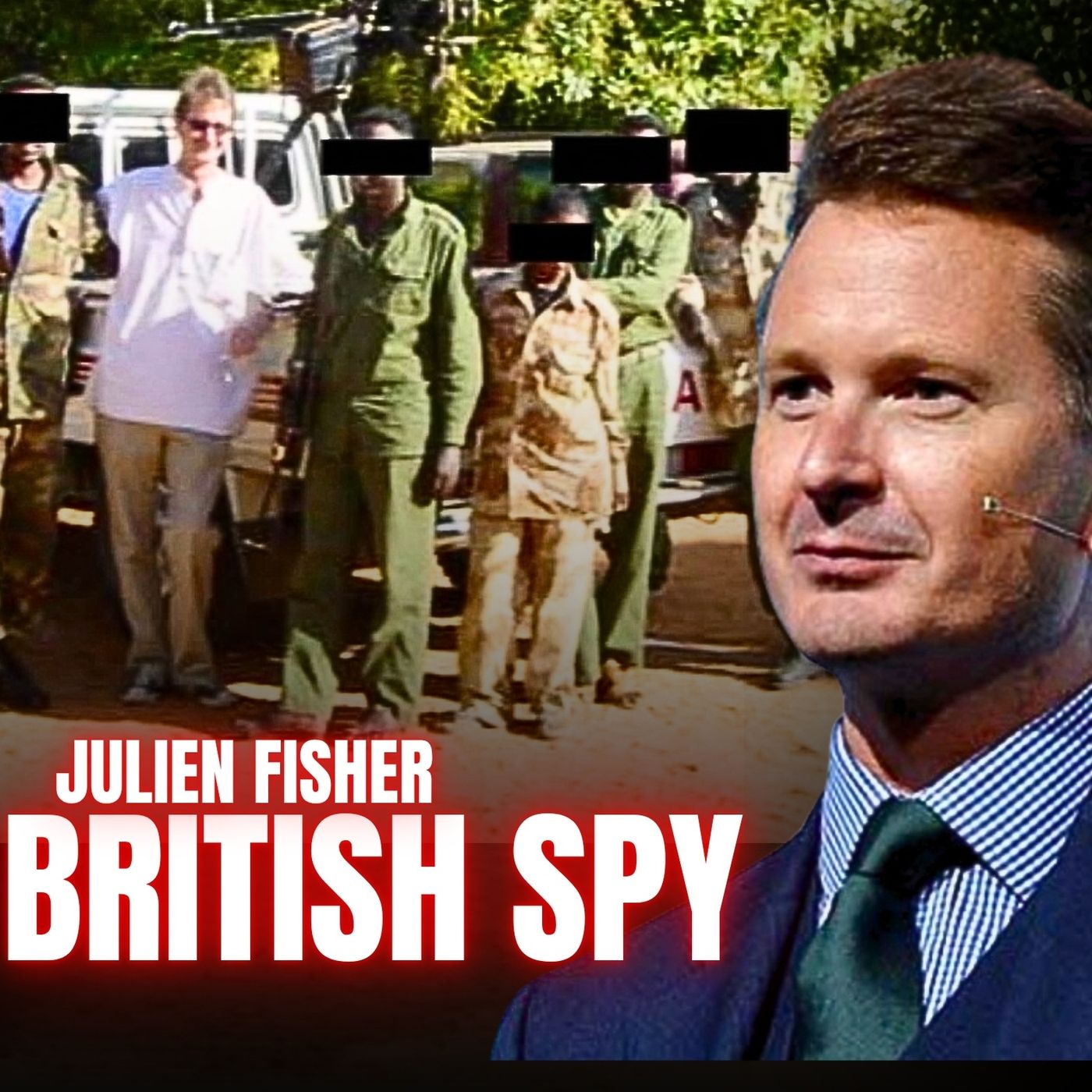
The Team House
Former British Intelligence Officer | Julien Fisher | Ep. 408
02:00:30
Former British intelligence officer Julian Fisher joins us to break down the real world of espionage, from MI6 tradecraft and denied-area operations to private intelligence work across Africa and conflict zones like Congo and Sierra Leone. He shares...
Loading summary
Transcript286 lines
- [00:02]
Julian Fisher
Spring into deals with stay green premium
- [00:04]
Commercial Advertiser
2 cubic foot mulch 5 bags for $10 plus stay fresh with up to 35% off. Select major appliances and save an additional $100 on select laundry pairs. Our best lineup is here at Lowe's. Lowe's we help you save valid through 56 mulch offer excludes Alaska and Hawaii. See lowe's.com for more details.
- [00:25]
Julian Fisher
Visit your nearby Lowes Foreign.
- [00:32]
SpinQuest Advertiser
Quest where you can play and win from the comfort of your own home with hundreds of slot games and all of the table games you love with real cash prizes. Right now, $30 coin packs are on sale for $10. For new users, it's all@spinquest.com that's S-P-I-N Q U S T.com sponsor.
- [00:53]
Commercial Advertiser
Spinquest is a free to play social casino void where prohibited. Visit spinquest.com for more details.
- [01:01]
Jack Murphy
Hey folks, I want to tell all of our listeners tonight about the Spies, Lies and Nukes conference that's coming up pretty soon here. It's hosted by a former guest on this show, Valerie Plaim. She is a former CIA operations officer, did undercover work all over the world. And if you're into the intel world c CIA operations and the national security issues that actually matter, pay attention because this one's for you. There's a conference called Spies, Lies and nukes happening September 25th through the 27th in Tucson, Arizona. It was founded by Valerie Plame and it brings together the people who actually did the work. We're talking former CIA ops officers, senior diplomats, national security professionals, and the investigative journalists who covered the stories nobody was supposed to know about. This isn't a convention hall with a thousand people and a name tag. It's small, it's immersive, and it's built for real conversation with the people who have been inside the room. If you've ever wanted to sit across from the people who are running operations while the rest of the world had no idea, this is how you do it. Tickets are on sale now@spiesliesnukes.com use the code teamhouse at checkout for an exclusive listener discount and also tell you folks, I was recently at an event where Valerie Plame spoke specifically about nuclear proliferation and anti proliferation treaties. She's a great speaker, puts on a great event and I think everyone will really enjoy this. And again, to get tickets, they're on sale@spiesliesnukes.com use the code teamhouse at checkout and you'll get an exclusive listener discount. Hey everyone, this is episode 408 of the Team house. I'm Jack Murphy here with today's guest, Julian Fisher. He is a former British intelligence official and he is the author of Think Like a Spy, which we're going to talk all about in this interview. Julian, thanks for joining us on the show today.
- [03:00]
Julian Fisher
Great, thanks for having me, Jack. It's a real pleasure. I'm an esteemed company. I know you've had some of my former colleagues and amazing writers like Is Berry on your, on your show. So this, this feels like a great privilege.
- [03:15]
Jack Murphy
Yeah, thank you. Yeah. She put us in touch with so many people, I think a few friends of hers from the agency we have booked actually in the future as well.
- [03:24]
Julian Fisher
Great.
- [03:25]
Jack Murphy
Yeah, she's, she's great and. Yeah. So what is it that we're allowed to say about your background, Julian? You told me a kind of funny anecdote about, you know, if you were a Walter Mitty, you'd be able to say much more.
- [03:43]
Julian Fisher
That's about the size of it, Jack. Yes. Okay, so there's a peculiarity of the legal system here in the UK which I'll just very briefly explain that there's no, there's no crime of impersonating an intelligence officer. There's a crime of impersonating a police officer, but not of impersonating an intelligence officer. On the other hand, if someone has worked in one of the three letter acronym services and they avow themselves, that is arguably a criminal act under our Official Secrets Act. So that leads to a paradox that if somebody says that they worked for MI6 and they didn't, then they are not breaking any law. But if they did, they may well be and they may face sanction. So I just get around that by not saying that I work for MI6.
- [04:33]
Jack Murphy
I get it.
- [04:34]
Julian Fisher
And after I didn't work for them, I, I went on to work in the private sector for initially for an extraordinary man called Lieutenant Colonel Tim Spicer, who ran an organization called Aegis Defense Services. So I was his point man in Africa for many years before I went on to set up my own private intelligence boutique called Africa Integrity Services and then wrote this book, Think Like a Spy Master. The Nine Secret Skills of Influence and Leadership which came out in the US only a few months ago, in fact, the beginning of this year.
- [05:12]
Jack Murphy
Tim Spicer, if I recall correctly, he was the guy that was like kind of knee deep in Equatorial guinea and all that. Right.
- [05:20]
Julian Fisher
Amongst other things. Tim is an extraordinary character. I mean, if, if you can get him onto your show, then I highly recommend him. He is he's quite a figure in the private security, private military world, and he's done some amazingly good stuff over the years. I'm a big fan of Tim's, but you're right that there was some controversy in his career, including Equatorial guinea question marks, about his involvement through his former organization Sandline, in West Africa, in Sierra Leone. But, you know, I, I know Tim well. I believe him to be a man of great integrity. And I think what he's done under the auspices of, of his various organizations tends on the. Tends on the whole to be a force for good rather than anything else. And in fact, I recently gave another podcast on I Won't Name It Here, in which I talked about the nursery activity.
- [06:19]
Jack Murphy
Broadly speaking, you can tell people where to find that.
- [06:23]
Julian Fisher
That's on True Spies, the True Spies podcast. It's a members only edition of that, but I think it's worth subscribing for the. For their output generally. And in that, I was talking about how the world of mercenaries, the world of private contractors, military contractors, is actually much misunderstood. And I think one of the saddest things is that the good that is done by some of those contractors, some of those private military types, is never really recognized. We always talk about the controversies and we never recognize the heroism. And there is a great deal of heroism, but I think that's a separate subject for another day. Maybe. Or maybe it's a book that I need to write.
- [07:04]
Jack Murphy
Yeah, we can touch upon that in a little bit. We've had Eben Barlow on the show years prior.
- [07:11]
Julian Fisher
Amazing.
- [07:12]
Jack Murphy
And, you know, I'm. I, I love his book that he wrote. He wrote a memoir that I really recommend to people. But we'll, we'll get to Sierra Leone.
- [07:20]
Julian Fisher
Yeah, great. Sorry, I've lost you, Jack. No. So I don't know what's going on here. My. I'm not getting you at all.
- [07:39]
Jack Murphy
Testing, testing.
- [07:41]
Julian Fisher
Yeah, that's better.
- [07:42]
Jack Murphy
Okay. You can hear me now?
- [07:44]
Julian Fisher
I can now.
- [07:44]
Jack Murphy
Okay. Strange. Okay, so to start at the beginning, Julian, tell us a little bit about your upbringing, your background, and how that kind of propelled you towards governmental service.
- [07:58]
Julian Fisher
Great question. It's the last thing I ever expected to do, to be honest. I was born in the Midlands of the uk in a place called Birmingham, the country's second city. And my upbringing was. I mean, it was a fantastic upbringing in many ways. My parents were amazing characters. They were incredibly clever, they were incredibly creative, and they helped to foster those skills in, in their family of. And I was one of seven. But it is fair to say that we were somewhat financially disadvantaged. So I was brought up in circumstances which were occasionally a bit of a struggle. You know, we would go to bed cold, sometimes go to bed hungry, not, not for want of effort on the part of my parents. But it was the 1970s and the economy here was in the grip of a recession. You know, it was the, the era, I guess, that some people refer to as a winter of discontent. A lot of strikes, a lot of shortages, three day week. So the circumstances of my, of my upbringing were not particularly auspicious. And they were also accompanied by a great deal of grief because when I was 11, on my very first day at school, and that sounds like a quite old, a bit too old to be having my first day at school, but for various reasons I won't go into. My parents elected to educate us at home, homeschool us until the age of 11. And on my very first day at school, I came home to the news that my only sister, my oldest sibling, had killed herself after a very distressing illness diagnosed as paranoid schizophrenia. And of course the age of 11, that's a remarkable loss to have to face. And there's a blindness, I think, sometimes to infant grief, you know, of course my parents were absolutely beside themselves with grief and they were having to look after themselves and they did a great job of looking after the rest of us. But there is, you know, I think there's always a hierarchy of grief. And as an 11 year old boy, I'm not sure I felt I had much right to show that grief. And as a response to this, I became very emotionally drained, I suppose. And about a year later, having suffered about a year of bullying at school, I decided to best way to put an end to all this was to walk in front of a moving vehicle. And luckily I survived that impact. But it did hospitalize me for a year. And I have to say that that was probably the most important year of my life. And it really turned me around. And what happened was there was a young nurse there called Mea, and she was an Iranian refugee, which sounds incredibly topical now, right? But of course, as you'll, as you'll know, the Iranian revolution took place in 1979, when I was nine and I was in hospital in 1982, 1983, Amaya had fled from Tehran with her mother after her father had been disappeared. He was a counter revolutionary. So he was taken into custody one night and it was presumed by her that he, he had died. Being killed, assassinated. We know that's something that is not uncommon in, in Iran. And. But Maya was an extraordinary character and she had every intention of following in her father's footsteps because he'd been a doctor. So she was absolutely hell bent on becoming a nurse. The problem was she didn't really speak very much English. And so she failed her examinations at school, which you were the, the first basis on which to. To be accepted to train as a nurse, and was in despair when one of her teachers had a good idea of getting hold of universities which taught Farsi, the language in Persia, now Iran, through so and introducing her to students of that language. And through that introduction, she met a young man called Daniel, half Israeli, half Brit, and they would meet daily during a summer break and they speak for one hour in Farsi and one hour in English to give her the ability and the skill and the practice to become fluent in English, which she did over the course of a few months. And then she retook her exams. But in the process of, you know, having to retake, they ran out of money. Her mother ran out of money and she was proposing to send her into the workplace as a cleaner or some such, which is how her mother was earning money. And that's when Dan's father stepped in. And Dan's father, who was a local businessman, basically said that he would support Maya through college to make sure she got the qualifications she needed so long as she continued to work with his son Dan, to help him with his university course. And that arrangement worked. And hence by the time I met her, she was just embarking as a student nurse. And she said to me words I'll never forget. One day she said to me, look, what you must remember is allies are the most important thing you can have in life. They will make all the difference. And you must never forget that. And I never have. And I realized from that day forward that actually there's something that some people are born to, and it's called social capital. You know, they have parents, they have a wider social circle, they have schools, they have communities that can help them to navigate their way through the complexities of the education system, to get the loans that they need to qualify to get a degree, to get onto the jobs market. And if you're not born with that, you have to create it. And the way to create it is to build alliances. And so I became quite adept at building alliances with people who not, not in a manipulative sense, but people that I assessed would be able to help me in my own journey, a journey from this financially deprived background eventually took onto Oxford University from there into the financial sector. Well I can't say I'm just a bit of a square peg in a round hole in the financial sector. So I then moved into international relations if I can put it like that and the rest is history before we move on Julian.
- [15:29]
Jack Murphy
I mean Oxford obviously is, you know, the Ivy League of the uk. It's their top school. As you say you come from an economically disadvantaged background. What was your journey coming from, you know, being that 12 year old kid in the hospital bed to gaining admittance into Oxford which we should also point out is like the indoctrination center for British spies. They all go through there, don't they?
- [15:53]
Julian Fisher
More Cambridge actually. Cambridge, yes there is a, there's. Oxford is famous for producing prime ministers here. I'm not sure that's a necessarily good thing. I think the vast majority of our post war prime ministers have been graduates in the same subject that I took which is ppe, philosophy, politics and economics. And Cambridge is quite famous for producing some dubious characters such as Phil B. Burgess. Right, Cambridge, the Cambridge Five. I have to answer your question. I have Readers Digest to thank. It sounds a bit odd. I don't know if you even remember what Readers Digest was. Yeah it, it was I think a weekly or a monthly publication which would provide abridged versions of novels and I didn't read those but what I discovered somewhere along the line was that every so often they'd have IQ tests, self scored IQ tests and I became a bit fixated on them and discovered that I was scoring very highly on these tests whenever I. So I had sort of, you know, table of piled high with copies of the Reader's Digest which I flicked through looking for these IQ tests eventually discovered that I was actually a lot cleverer than I thought I was or I thought I must be because I was scoring highly on these tests. And so I set about when I came out of hospital I insisted that I change school because I didn't fill the school I was at, had the right academic profile for what I wanted and then I suppose I said about making allies of teachers, you know so I, I would, I had a particular aptitude for English as it happened so I'd always make sure that I had a good relationship with my English teachers and they, they would take time out of their work, out of their personal time to help me to become a better writer, to help me to become a better public speaker, a better debater and I think that was very valuable when it came to the process of getting into Oxford because What they look for there really isn't necessarily a traditional education in Latin, Greek and all the rest of it, although there's still an element of that. But they look for an ability to think for yourself. They look for an ability to form arguments cogently and to communicate them well. And through my alliances with two particular English teachers, one from the school I went on to, and then I moved again for my final two years, had this remarkable English teacher called Johnny Cleek in my final two years, and he actually took time, his personal time, to coach me in the Oxford University examination papers. So he was an early ally. And I, you know, if I. I would have looked at those papers without his guidance and, and basically been flummox. But he taught me through it on top of his own curricular work, and I'm forever grateful to him for that. So it was an early exercise in recognizing. Yes, of course, Oxford's looking for raw academic ability. Of course it is. But there's lots of people with that raw academic ability and they're looking for something else on top of that, which is an ability, as I say, to form cogent arguments and communicate them well. And I have my early allies, particularly in the form of Johnny Cleek, to thank for that.
- [19:38]
Jack Murphy
And that's what got you through those admission exams.
- [19:41]
Julian Fisher
Yeah, admission exams and then interviews. So the. The interviews are really were. Then. I think that they're now regarded as less important. But back then, talking quite a long time ago, the interview process was rigorous and frightening, but in a way, very stimulating because, you know, you were being. I sort of expected to go in to be asked questions of fat, but actually they were challenging to see whether I could think on my feet. And that was a. That was quite a bracing experience. And without Johnny's input, I don't think I'd have performed as well as I did.
- [20:24]
Jack Murphy
And then, you know, speaking of your upbringing and, you know, growing up poor, it actually makes a lot of sense that you pushed yourself in this direction and towards finance because you didn't want to have to worry about that anymore.
- [20:38]
Julian Fisher
You make a very astute point. I mean, I came out of university having not a clue what I wanted to do. If I'm. If I'm honest, I knew I was quite interested in politics, but I wasn't one of those people who wanted to get into the political system. Early on, I sort of took the view that one needed to do something else, but to be qualified to be a politician. And I stand by that view. In fact, I think we see today that the quality of politicians, particularly in the uk, is quite low because so many people come into politics for politics sake rather than having life experience. So I was interested in politics, I was interested in the world at large, international events, affairs, but I didn't really know what to do with that. And of course, as you say, I was quite keen by that point. Having struggled through university with very little money, surrounded by people who came from very wealthy families, I think it's fair to say that my priority was to get some money. So the City was the obvious place to go. And I was very lucky to be interviewed to join a firm called Casanove. Casanov was an extraordinary organization, extraordinary firm back in its day, since being acquired by JP Morgan. But it was the last independent partnership, stockbroking partnership in the City of London and it was very, very dominated by the aristocratic class to the extent that I, I stuck at like a sore thumb. But I was, I was lucky enough to be interviewed. And this is where another story about the importance of alliances comes in. Because one of the things I did during university vacations was to work in the House of Commons and our Parliament as a researcher, initially for an mp. I won't name the MP in question, but he was, maybe he was a great guy, but didn't have the profile that I was looking for. So what I wanted, I had it in mind. And this is going to make me sound like a terribly scheming young man, and perhaps I was, but I had it in mind that I wanted, by the time I left university, to have a very highly recognizable name as a reference. And so I sat down, I went through what I describe Target as a targeting exercise in the book, the first stage of the agent recruitment cycle. I sat down in the House of Commons library and went through the entire list of MPs, looking for two things. One was somebody who was very high profile and somebody who had a very small support team, in other words, that might be in the market for a researcher or parliamentary assistant. And one name jumped out at me and it was Winston Churchill. Now, not the original Winston Churchill. I'm. I'm old, but I'm not that old. His grandson, but Winston Churchill nonetheless. Winston Churchill mp. And so I set about cultivating Winston. First of all, I had to get alongside him, find out where his office was. And quite close to his office was one of those old Reuters ticker tape machines which would spew out the daily headlines on spools of paper that was then just collect on the floor. It was quite so archaic and quite Quite amusing. But one of these was. Was cited just outside of his. His office. So I would just make a point of hovering around there, apparently, reading the. The headlines. And I made sure I knew from his register of interest what his. What his external interests were and what his policy areas of interest were. And then if I ever saw a headline and he was around, I would draw his attention to that headline if it was something that I knew he'd be interested in. And eventually, as a result of this, we got chatting and I said to him, look, you know, do you. Do you need a researcher? And he said, well, I don't, but I do need a speech writer. So I became Winston Churchill's speech writer. And I have to say, I wasn't terribly good at it, actually. I didn't really know at that point about how to construct a speech. I certainly didn't really know how to construct an effective parliamentary speech. And there's somewhere, I don't know if you know, the. There's a record of parliamentary proceedings in the UK called Hansard, and there's somewhere in my collection of books a Hansard from the day when Winston delivered one of my speeches. And the response from his opposite number was, I don't know where the Honourable gentleman. I don't know who writes the Honourable Gentleman's speeches for him, but if I were him, I'd look for a new one. And that was me terribly insulting. Winston sent me a copy of that, but he laughed about it and said, you know, actually that that's just the custom for us, the jousting of parliamentary procedure. And we became quite good friends to the extent that I was able to put down Winston Churchill, mp, as one of my referees. And this was because my boss at Casnove, a lovely chap called John, said to me at some point, as we sat opposite each other, just chatting idly, he said, well, I had to offer you a job anyway. And I said, well, why is that? And he said, because I wanted to phone the House of Commons and ask to speak Winston Churchill. And I like to think he was joking, but maybe not. Well, it was enough to get me into the City. And then it sort of gave me. It gave me a springboard.
- [26:48]
Jack Murphy
The way you describe it, you know, is like, you know, maybe you were scheming or manipulating, but again, I think that, you know, when you come from poverty, the other term you would use to describe that is surviving, right? And you had seen from a very young age what happens, you know, that not everybody makes it. And I imagine that must have been a tremendous motivator for you when you were young.
- [27:13]
Julian Fisher
It's certainly incentivizing to know that you have to, you don't have that network of social capital to rely on. Yeah, I think a lot of people don't understand the importance of that. I mean, I quite fond of saying it, you know, what you know is important, but it's not just what you know, it's who you know. And we can control both bits of that equation. You know, you can control who you know and you can control what you know. So of course, I would say to all young people, focus on getting the best education you can, but don't neglect the other side of it. You know, build that network of alliances. And people are often surprised that, you know, those who are successful in life often want to give back. And so this isn't, this isn't manipulative. I don't think it's a case of exploiting somebody. Asking for help, asking for support is not exploitation if you're clear about what you're doing. Many people, and Winston was one of these, Lord rest him, many people in his position are quite keen to have the opportunity to give a helping hand to younger people. So I always say, just, you know, ask. Don't be afraid to ask, because the worst you can get is a no.
- [28:35]
Listener/Viewer
Hey, what's up, guys? I want to thank our newest sponsor, Wild Alaskan Company. It's the best way to get Wild caught. Perfectly portioned, nutrient dense seafood delivered directly to your door. Trust me, you haven't tasted fish this good. They sent us a box like two weeks ago. I want to say they sent us a bunch of stuff. Sockeye salmon, coho salmon, the Pacific halibut, Pacific cod. I destroyed the halibut and I destroyed the coti. I made actually fish and chips with the cod and it was awesome. I gave the salmon to my dad. My dad calls me back like four days later. It's like asking for more fish. I'm like, dude, you got to go to wildalasskin.com house and get 35 off your first box. 100% wild caught never farmed. This means there are no antibiotics, GMOs or additives. Just clean fish, real fish that support healthy oceans and fishing communities. Wild Alaskan fish is frozen off the boat to lock in taste, texture and nutrients like omega 3s. Wild caught from Alaska. Every order supports sustainable harvesting practices and your membership delivers flexible shipments, expert tips, and truly feel good seafood. The other kicker is you could try it risk free. There's 100% money back guarantee if you're not completely satisfied with your first box or Wild Alaskan company will give you a full refund. No questions asked. No risk. Just high quality seafood. Not all fish are the same. Get seafood you could trust. Go to wildalaskin.com house for $35 off your first box of premium wild caught seafood. That's wildalaskan.com house for $35 off YOUR first order. Thanks to Wild Alaskan Company for sponsoring this episode and thank you guys for the continued support supporting us supporting the companies that help support the show. We really love you. Thank you. Wildalaskin.com House $35 off your first order. Thanks guys. A lot of people put off buying a new mattress because it feels like a hassle. Too many options, too many claims and no real way to tell what's actually going to hold up. Ghostbed makes that decision easier. Ghostbed is a family run company with more than 20 years of mattress making experience backed by deep manufacturing expertise. Their approach is straightforward focus on quality materials, smart construction and a consistency over time, not flashy features or complicated sales tactics. Every Ghostbed mattress is built for long term comfort, using durable foam and proven cooling technology to help regulate temperature while you sleep. It's designed to feel reliable night after night, not just when it's brand new. And if you're not sure which mattress is right for you, Ghostbed's online mattress quiz helps narrow it down quickly. Whether you're a side sleeper who needs a little plushness or someone who prefers a firmer feel, the quiz matches you with the right option based on how you actually sleep. They also keep pricing grounded. Ghostbed mattresses cost up to 50% less in comparable brands. You could rest easy knowing you're not you're getting one of the best values at this quality level. Every mattress comes with a 101 night sleep trial, an industry leading warranty and fast free shipping. And as a teamhouse listener, you can get an extra 10% off your order. Just go to ghostbed.com house and use the promo code HOUSE at checkout. That's ghostbed.com house codehouse. For an additional 10% off site wide, upgrade your sleep with Ghostbed, makers of the coolest beds in the world. Some exclusions apply. See cipher details. Thank you Ghostbed for sponsoring the show. Thank you guys for helping support the show. Bye.
- [31:59]
Janet Freeman Daly
When I first heard the words you have lung cancer, I was in shock.
- [32:06]
Health Discovered Host
This week on a special episode of Health Discovered, we're taking a closer look at a common form of lung cancer that accounts for 85% of all cases.
- [32:16]
Janet Freeman Daly
I'm Janet Freeman Daley and I've been living with non small cell lung cancer since 2011.
- [32:24]
Health Discovered Host
Non small cell lung cancer. It's a diagnosis that changes everything and yet the conversation around it too often stops at the biology and misses what patients are actually living through every single day.
- [32:37]
Janet Freeman Daly
There are some things you used to be able to do that you can't do anymore. It's easy to become depressed when you're dealing with all those losses. So mental health plays a really big role.
- [32:47]
Health Discovered Host
So what does it really mean to advocate for yourself when you're living with non small cell lung cancer? Listen to health discovered on the iHeartRadio app, Apple Podcasts, or wherever you get your podcasts.
- [33:02]
Commercial Advertiser
Hey, it's Ryan Seacrest for Albertsons and Safeway. You don't want to miss the annual beauty event. For big savings on all your favorite beauty products now through April 28, spend $25 on participating products and save $5. Shop in store or online for items like Billie Women's Razors, Billie Body Buffer or Body Wash, Native Hand Soap, Neutrogena Makeup Remover Talents and Q Tips. And save $5 when you spend $25. Offer ends April 28. Restrictions apply. Offers may vary. Visit albertsons or safeway.com for more details.
- [33:32]
Julian Fisher
What's up, baby?
- [33:33]
Jack Murphy
It's Bretzky, and I'm here to tell
- [33:35]
Commercial Advertiser
you that spinquest.com is giving out free sweeps coins.
- [33:40]
Jack Murphy
All you got to do is purchase
- [33:41]
Julian Fisher
a $10 coin pack.
- [33:43]
Commercial Advertiser
And guess what?
- [33:44]
Julian Fisher
They're going to give you the coins from a $30 coin pack that lets
- [33:48]
Jack Murphy
you play all your favorite games like
- [33:49]
Julian Fisher
Blackjack, Wanted, Dead or Wild.
- [33:51]
Jack Murphy
And we're talking real cash prizes, baby.
- [33:54]
Commercial Advertiser
Spin Quest.com Spin Quest is a free
- [33:57]
Jack Murphy
to play social casino void where prohibited.
- [33:59]
Commercial Advertiser
Visit spin quest.com for more details.
- [34:03]
Julian Fisher
And often you won't get a no, you'll get enthusiastic, wholehearted support. And if you think about it in a way, that's giving something that's a, that's a mutually beneficial relationship because I know it now. I said I've got to the stage in my life where people will ask me to talk to their friends, children about their careers, right? And it gives me an enormous sense of fulfillment, you know, to do that to help a young person. It's partly why I wrote the book. It's. I mean, I think it's a book that anybody will benefit from at any stage in their life. But Charles Cumming, the spy writer, said of it that he wished it was the book that he wished he'd had to hand when he was first embarking on his career. And I'd say part of the point of this book is to help younger people to realize the importance of alliance building, to realize the importance of building social capital. It's something which, incidentally, your vice president's very keen on. He speaks about it on a number of occasions. Importance of social capital in respect of his own journey from rural Ohio.
- [35:12]
Jack Murphy
Guess it worked for him.
- [35:14]
Julian Fisher
It seems to have done, doesn't it? Absolutely.
- [35:18]
Jack Murphy
So when you go to work in the city of London, I'm picturing in my mind Frederick Forsyth novel.
- [35:26]
Julian Fisher
Yes.
- [35:27]
Jack Murphy
What was it really like?
- [35:31]
Julian Fisher
Actually, funnily enough, I. I had caused to reread because I did another podcast again with true spies on this. This one is. Hasn't been released yet, but it's coming out shortly and it's about a story of mine when I was invited to help plot a coup in a West African republic. And of course I wasn't able to do that and I wasn't going to do that. And actually, I don't know how to plot a coup. It's not something I've ever done, but I did have a copy on my Kindle of Freddy Forsyth's Dogs of Walking.
- [36:03]
Jack Murphy
Great book.
- [36:04]
Julian Fisher
It's a fantastic book. It also has many, many pages devoted to how to plot a coup.
- [36:09]
Jack Murphy
It's like a procedural, it's like a manual. Step by step, this is how you do it.
- [36:14]
Julian Fisher
Exactly. So that came in very helpful because I was. You'll have to listen to this, the podcast, but I can, let me just say, without breaking the law, I was able to lean very heavily on what Freddie Forsyth have written. And Fred is. Freddie's a great guy, actually. I knew him. He's. He was the president of a club I'm a member of in London. Sadly, I never got to tell him that story because I think he'd have been very, very amused by it. But anyway, I. I digress. The important point is that in prepar preparing for. For that podcast, I reread the Dogs of War. I'm always happy to do anyway. And actually your. Your description or your suggestion at the City back in those days was a. Was a bit like the. The portrayal of. I think it's James Manson in the book, isn't it? The. The entrepreneur who funds the attempted couple. It was a bit like that, you know, it really was. I mean, it's a very. When I was working at Caslova, it was very much like A gentleman's club, you know, sort of, sort of plush furnishings and everybody talk about. Well, before we started recording we were talking about how, how Brits dress and we tend to dress little. Certainly if you're going to be on a podcast, you know, might put on a shirt, perhaps even a jacket, perhaps a tie. At Kazanov it was double cuff shirts with definitely no pocket on the shirt. You had to wear a tie. Couldn't be too flashy. A particular cut of suit that was expected to be handmade. Everybody came across as very, very upmarket, quite old fashioned. So yes, you're right in that respect, it did. And it sort of felt like there was an air of quiet power and authority in the, in the corridors of this extraordinary stockbrokers who worked for something like 50% of the FTSE 100 or FTSE 250 companies. You know, they were, were renowned as power brokers. I don't think they were ever involved in any coups, as it happens, but other than economic and financial coups. But yes, it was a remarkable place for a young man from a comprehensive school, that's what we call, what you would call a public school from, in the city of Birmingham, to find himself in. And it was extraordinary because I just didn't fit in. You know, I sort of turned up in a boxy suit which I bought as cheaply as possible from a high street store, had to be taken to one side by my boss because I, I took my jacket off at my desk once upon a time and he said, you know, we don't, just to let you know, we don't take our jackets off at the desk. And by the way, I'm quite glad you did because it means that I've just noticed you're not wearing double cuffs. There's a cuffs on your shirt which you have to. You fold back and then you put the cufflinks in. I was wearing, horror of horrors, a shirt with buttons and that was not done. So he gave me the name of a good tailor and sent me off. So there's that sort of sense of, sort of very old fashioned Britishness about it and I really enjoyed that actually. And, but I had to do, I had to employ a skill which later on I came to rely on in the intelligence world, if you like, of being a chameleon. I had to change my accent, I had to change the things I said, not just accent, but idiom. And I had to become familiar with the ways and expectations and social mores of an entirely different social group to me, you know, I'd never heard, for instance, of Val Des Air, which is a skiing resort, when somebody left a note for one of my colleagues saying, I'll catch up with them at Val D's Air. I had to write it down phonetically. And I remember I got out for lunch, came back and everybody was gathered around his colleagues desk laughing at my note. You know, so gauche. And I could have taken that to heart. But actually I thought, well, all that's happening here is I'm being sent a message that I didn't take it as you're not welcome, but you need to learn to present differently. And that's where I developed the idea of COVID In the book I talk about COVID not necessarily being about lying about who you are, but presenting that version of yourself that fits in the environment in which you find yourself or aligns with the person that you're seeking to recruit as an ally or in the intelligence world as an agent. I mean, of course, cover is important in the sense of you have to pretend to be XYZ for defensive reasons, sometimes to make yourself attractive to the other person. But all of that is actually reasonably technical. The really important part of COVID is how you present your personality. And in a sense, it's a bit like acting. You have to adopt an aspect, you have to adopt a personality which is going to be attractive to your target. And again, that sounds, that sounds like it's being manipulative. It sounds like it's being deceitful. But I don't look at it like that. You know, we're all very, very complicated creatures. Our personalities are like Rubik's cubes and you can adjust them, you can manipulate them to present many, many different faces. And what makes one more genuine than another? You know, we're sort of getting into philosophical questions here, but I don't think one is more genuine than another. You know, this is, this is me as much as somebody who speaks like this, which is the accent that I would have had when I was talking when I was at home as a young lad, you know, because I'm from Birmingham and I had a Birmingham accent there. Is that version of me the genuine me or is this version of me the genuine me? The answer is both. And so again, you know, as I talk throughout the book about the importance of not being, not using your skills in a manipulative way. And I don't think they are per se manipulative. It's not manipulative to take the best of yourself or to take those aspects of yourself that make you attractive to another person.
- [43:22]
Jack Murphy
But presumably you didn't find everything you were looking for in finance. You still had this interest in politics and international affairs and so on. So how did you make the jump from finance to not working for the British intelligence services?
- [43:40]
Julian Fisher
Nicely put. So I, I realized I had a problem in the financial world when somebody asked me to explain a swaps curve and I didn't have a clue. And I, and I, I realized that, I mean, they're quite important swaps curves. I still don't have a clue. More important, I could have, I could have probably fudged it. More importantly, I realized I didn't care. I just wasn't in the least bit interested about what a swaps curve was. And it made me sit down and think, my heavens, I've been spending the past early years in my twenties thinking about gilt yields and thinking about the dividends on stocks. I mean, you could probably tell it's making me wince just thinking about it. A few basis points movements and guilt yields or a 50% cut in interest rates. What effect does that have on the earnings ratios? I, I don't care. And I really, you know, I realized after a few years of this that I was in totally the wrong job. So I thought, what's keeping me here? What am I doing that I enjoy about this? And I thought, it's the travel. It's the travel and it's the, the interest in trying to work out how politics intersects with the market. Okay, that bit is quite interesting. But I'm more interested in the politics than I am in the markets. So I thought, what's the best thing I can do? And the answer was fairly obviously to apply for the diplomatic service. So I did that and was successful and along the way was invited to join a fairly specialized branch of it, which was a great period of my life. You know, I, I did some extraordinary things. I'm going to draw a bit of a veil over what those were and where they were for good reasons that we've discussed, but there's plenty of other stuff to get our teeth into when we get into the private sector work. But ultimately, I had a crisis conscience over the Iraq war in the early 2000s. Found myself unable to support the war in itself. But more important than that, I was appalled at the manipulation of intelligence data by a man called Alistair Campbell, who was then very Senior in number 10 Downing street, the Prime Minister's office. The manipulation of intelligence to make a case for war, I just thought was absolutely unconscionable. I thought the politicization of the intelligence services was a tragedy. And I think the fact that one or two quite senior people in the intelligence services back then were complicit. I think they were perhaps drawn into relationships with Alastair Campbell and the then Prime Minister, Tony Blair, which were not necessarily appropriate because they were flattered to be seen to. They were like moths to a lamp. The proximity around, the proximity to power. And, and then we had this horrific event of a man called David Kelly, Dr. David Kelly, who was a weapons inspector who took his life, worked at the intelligence. It took his life. And that had a profound impact on me because, you know, I've always had a very difficult relationship with suicide because of my, the loss of my sister. And I remember I was in a city in Africa working for government at the time, seeing that news and the sensation of nausea spreading across me and a stark realization at that point that I could no longer continue to work for that government or for any service or service adjacent to it that was complicit in the events leading up to the suicide of a man that I think had great integrity and great intellect, was bullied, harassed and driven to his death by some very deeply unpleasant people. And that was a terrible thing to have to do, you know, and, and I, I'll be completely honest. It had, it had the most astonishing effects on my life. You know, my marriage broke down shortly afterwards. I'm very, I'm ready to say that I, I suffered some emotional distress as a result of it. You know, I was without work, my marriage had fallen apart, so I walked out on the job that I was both good at and enjoyed. And I, I look back on it and I think, did you make a stupid error? You know, could you, could you have been very senior in a very interesting service? Now, what did I turn my back on all that for? And then I remind myself that it was a shameful episode in British international relations and British intelligence work. And I don't regret for a moment walking out on it, actually.
- [49:15]
Jack Murphy
Were you personally drawn into, you know, this conflict in the Middle East?
- [49:21]
Julian Fisher
No, I, I, I won't go into too much detail about what it is that led me to cut to, to conclude that there had been a quite unacceptable manipulation, deceit, gaslighting.
- [49:37]
Jack Murphy
Right.
- [49:37]
Julian Fisher
Essentially of the public, the British public. And what led me to the conclusion that certain agencies have been complicit in that. I can't go into the detail of that, and it wouldn't be right for me to do so. But suffice to say, I Think I've been vindicated.
- [49:54]
Jack Murphy
Yeah.
- [49:55]
Julian Fisher
Every. Every sensible analysis and every inquiry that's been conducted since then has vindicated my position. And I. I imagine to a certain extent that lessons have been learned and changes have been made. But the fact of the matter is it. It was a shameful, shameful episode in British history, and a very good man lost his life as a result of it. Harassed, as I say, harassed and intimidated to death by some extremely unpleasant characters and in British government. And, you know, if you. If you lose confidence in your government and you're working for an organization that serves that government in very. Sometimes in very dangerous and awkward places, I think you really don't. You owe it to yourself to resign. So I did, yeah.
- [50:49]
Jack Murphy
How was that taken? I mean, did. You were like, pretty out about, you know, I'm resigning because of, you know, a conscientious objector status.
- [51:00]
Julian Fisher
I think there was a combination of disappointment and anger, really. You know, there. There was. I think there was a concern that I was going to tell a story to the press, which would have, of course, caused awkwardness. There was another person who resigned from a related service called Catherine Gunn, and. And she. She was working for gchq, and she was prosecuted, or they started the process of prosecution for her because she. She had objected to the use of GCHQ to. To listen into, to spy on members of the United Nations Security Council who were allies of the uk. Did they make a movie about that? They did indeed. Okay.
- [51:55]
Jack Murphy
Okay.
- [51:56]
Julian Fisher
I know it sound familiar. I can't remember the name of the movie, but it's. It's very. It's well worth watching. But I was in touch with Catherine for a short while afterwards. We agreed after a while that it probably didn't make much sense for us to maintain contact. But I respected her decision. But they put her through hell. You know, they. The process is the punishment, as they say, and the process there was to stand her up in court before eventually the decision was taken to drop all charges. But by that point, you can imagine the emotional impact it had. And I'd already gone through severe emotional trauma of making the decision to leave. I wasn't going to compound that at that point, but, you know, I can't speak for the institution or people within it, but I think there was sort of a general sense that. They would be very keen to remind me of my obligations under the Official Secrets act and other surviving obligations of confidentiality and indeed remain so to this day. These are conversations and letters I've had many times, so. But you Know, my position was I resigned on a matter of conscience. I would not say anything that would, Would compromise national security. I don't think I need to. But the fact of my resigning on that, that matter of conscience, I think I am quite entitled to talk about. And actually, you know, it opened up a very much more fulfilling and interesting chapter in my life.
- [53:31]
Jack Murphy
Before we move on to that, I. I just want to ask you if there's any kind of stories you can tell, spy stories, if you will. I know you can't mention countries, dates, certainly not names, but in, in vague terms, are there any interesting ones that you'd be able to share from government service?
- [53:49]
Julian Fisher
I'm afraid not, really. That's, that, that's very difficult. But, but the next stage of my career where I worked in private intelligence, there's a lot more that I can share.
- [53:59]
Jack Murphy
Okay. Okay. So you go through this. It sounds like a rather traumatic experience, resigning from, from governmental service. How did you land in corporate intelligence? That's a whole different world.
- [54:15]
Julian Fisher
It is and it isn't. I was sort of assisted by an outplacement officer, if you like, though that wasn't the term they used, into working for an international bank as head of intelligence in a role that entailed some liaison with government agencies. So that was sort of the first step out. And from there, of course, I was exposed to this whole new world of private intelligence, private security, because quite a lot of the, the companies that worked in that area would minister to me, if you like, or they would, they would, you know, they, they would see me as a potential client and court me and cultivate me. So I met, I got to know the range of providers and eventually, cut a long story short, Tim Spicer became aware that I was in the private sector. He liked my background, and he asked for one of his staff who knew me to sound me out about whether I wanted to become. Would like to become his head of Africa. And I went for an interview with him. I spent a whole night swatting up on every major subject I could think of relating to Africa and private security in those days. And there was quite a lot of getting on top of the politics of the key African countries, knowing who was who. So I was exhausted, but stocked up on data and information. As I walked into the interview with Tim, he sat at the far end of a very long office, waved me to a sofa, tapped away on his computer for a bit, finished what he was doing, then turned to me and he said, are you Julian Fisher? And I said, I am. And he Said good, I think we've decided to give you a job so if you go out, Dominic will sort out the paperwork for you. So all of that preparation and loss of sleep was, was for nothing. But I, I, I told Tim about that just recently when I saw him at a social event and he said yeah, I'd have been able to tell and if you weren't prepared I'd have put you through the ringer. I think he might be right.
- [56:46]
Jack Murphy
And Tim Spicer, just for, for viewers who aren't aware, he was a SAS officer if I recall.
- [56:52]
Julian Fisher
Right, retired, a colonel, left turned colonel, had a background in the Welsh Guards. I think I'm right in saying maybe my, my, my memory may be playing tricks there but he, so he had a, a very fine military background and then when he moved into the private sector was involved in some of the early corporatized private security capabilities organizations. So in particular he worked for a company called Sanline, a private military company or private security company depending on how you want to cast it. Sandline was famous for its, its work in Sierra Leone where it helped the elected but ousted government to fight back against the rebels. And that's why earlier on I mentioned, you know, some of the good things that private soldiers have done and I count that as a very clear example actually they were doing work that for whatever reason the traditional armies were not given the green light to do under the, under the governments of the day. But they certainly took credit for it all later on but didn't give sufficient credit to the likes of Tim and his, and his colleagues in, in Sandlai. He then went on to, in fact they persecuted him to a certain extent because the questions were raised about whether or not UN arms embargoes have been broken, breached by private military work in Sierra Leone. And he was made the fall guy to a certain extent in some of the legal wranglings about all of that. And I think in the, unfortunately in, in amidst all that noise what got missed was that he, he and his colleagues had done something extraordinary which is supporting the democratically elected president to fight back against a really rather evil rebel group. And I think it's, I just think it's unfortunate that those things aren't recognized more readily. But Tim went on then to set up Aegis Defence Services which was the company I joined and he just was famous for winning what was then the biggest single private security contract and it was issued by the U.S. army Corps of Engineers and it was to provide security support and intelligence support to agencies involved in the reconstruction of Iraq. So having resigned over the war in Iraq, I rather ironically ended up working for a major beneficiary of the war in Iraq. And people occasionally have said to me, you know, don't. Didn't that make you feel uncomfortable? I'm like, well, no, because I resigned over the destruction of the country and I'm working for somebody who's involved, again, without adequate recognition, in helping to make the lives of ordinary Iraqis better. What could possibly be wrong with that? And again, you know, we look at the stories from Iraq in those days and actions of organizations like Blackwater, which in one or two cases were highly controversial. But there are stories about people that I heard working for Aegis who would throw themselves on IEDs to protect their clients and suffer mortal injuries and similar acts of heroism, all of which are unrecognized and unremarked on. I think that's terribly, terribly sad. So I'm proud of the fact that I worked for Tim. I'm full of admiration for him. I'm full of admiration for what Aegis Defence Services did. But he was up against a lot of, a lot of opposition, political opposition, both in the UK and in the us.
- [61:17]
Jack Murphy
What do you think that is?
- [61:21]
Julian Fisher
He was involved in a controversy in Northern Ireland where he stood by a couple of his men who had shot a suspected terrorist and was subsequently tried for it. And Tim stood by them as their officer commanding as, as was his duty, as sort of this military duty. But certain, certain stripes of political opinion in the US were disinclined to look favorably upon his actions, let's put it like that. And so they lobbied against his company being given this huge contract. I think there was also a little bit of annoyance that the contract had gone to a UK based company rather than a US based company. One can always, always ask what the real motivation for some of the lobbying against him was. But even in the uk, you know, he. This is a man who should have been invited to number 10 and fated by our Prime Minister for creating a company almost from scratch that then went on to work with one of the best armies, the best army in the world, to re. To undo the damage or help to undo the damage of that conflict. But far from being fated, he was politically, he had opponents and I think that's very, very sad. But I wasn't involved in the Iraq side at all. He asked me to come in as his head of Africa.
- [63:01]
Jack Murphy
Tell us about that, about. So this is, I'm guessing, mid 2000s at this point. What was the work situation like? In, In Africa at the time.
- [63:12]
Julian Fisher
Well, there was lots going on. That's, that's fair to say. If you remember, the conflict in Congo had recently come to an end. And that had been called the. Had been referred to as Africa's Third World War because of so much death and destruction now. And I had my own experience there actually, later on. This was after I'd finished working for Tim. But I'll tell you a quick story about my adventures in Kinshasa, shall I? And again, this actually touches on the use of COVID So, as I say, the Congo had been this, at the heart of a regional conflict which had drawn in countries around it, including Zimbabwe and Uganda, Rwanda. And the fighting had been very intense, particularly in the east of the country. And I was approached by a client, a mining sector client, that wanted somebody to go on the ground to get ground truth intelligence, to assess whether or not they could recommence our operations in the east of the country. So I was instructed to do this work and had to give fairly careful thought about how do I, as a civilian, without government backing, in a. Broadly with an intelligence remit, go and get this intelligence in the, in the east of Africa? And I said, well, I need an ally, don't I? So I flew to Kinshasa via Johannesburg. And those of your listeners who are familiar with Geography of Africa will realize that Kinshasa is about as far away from east as of Congo as you can get. It's. It's on the western coast, in fact. But I had good reason to go there because I was hoping to catch up with. I was hoping to work with a friend of mine who was a former Congolese soldier and had been appointed to what was called the Transitional national assembly that was used of their interim parliament. And he and I had had a conversation and we. We'd agreed that I would fly to Kinshasa and that we would then fly together to the east, where he would introduce me to a number of sources and I could conduct on the ground intelligence debriefs. So that was the plan. I arrived in Kinshasa, which was a challenging place to be, managed to get myself through the airport without having too much too many of my belongings and too much of my money extracted from me. Spent a bit of an uncomfortable night in a local hotel, fending off the attentions of the local gals, the oldest profession in the world. And following day I went to the Palais de Purple, as I as agreed to meet my friend, only to find it absolutely deserted. And the Palais was where the transitional national assembly would meet. So the parliamentary center, horrible Chinese construction, which reminded me of the school that I first went to when I was 11 years old. Sort of 1960s prefab construction. But I was surprised to find it completely deserted. And the doors were opened, which I thought was a bit odd. This important government center, no, as far as I could see, no restrictions on entry and exit, no security anywhere. So I went in and sort of wandered around these deserted corridors before realizing, you know, there was absolutely no way that I was going to find anybody who could help me to locate where my friend was. So I had a very rudimentary mobile phone, and we're talking about the sort of Nokia that can make phone calls and nothing else. But back in those days again, it's fair to say that the signal wasn't very strong in the Congo. So I was struggling to get through. I was trying to phone my chum, my contact, and I had my head down as I pushed my way out the door. And then suddenly I felt a blow to the side of my head, dropped the phone, which went skidding across the tarmac, looked up into the barrel of an AK47 and suddenly realized that there was security around and I was surrounded by it. It was a group of six, seven, something like that, very angry soldiers who wanted to know A, what I was doing there, B, who I was, and C, who I was spying for. You know, it. So the whole thing was very, very uncomfortable and just little old me with my phone now sort of somewhere over there, smashed on the ground. And so I had to think quite fast and I thought, well, what am I, what do I say about this? You know, because if I say, say to them, look, I'm. I'm here to go to the eastern Congo and, and get intelligence on the. The state of the war which had recently ended. So, you know, but it was still lots of conflict going on, but there was a peace deal in place, effectively. But if I say that my. My job is to go and gather that intelligence, you know, this isn't going to help, right? They're not going to. They're not going. Exactly. They're not going to conclude that that makes me unthreatening. So it so happens that the. The night before when I. Sorry, two nights before, when I'd been in Johannesburg on route, I'd stayed in a lovely hotel somewhere in Sandton, which is a very upmarket part of Johannesburg, and I met this chap who turned out to have been the head of African government relations for a very major international consulting firm. And very interesting chat. We'd, we'd had a few drinks and the end of the evening we'd swapped cards and I was wearing a jacket because, you know, Brits abroad in hot countries always wear a jacket. And I put his card in my top pocket and my jacket pocket. I happened to have the same jacket on. So I thought, ah, okay, I'm going to be the head of African government relations for this major consulting company for the purposes, for this, for the purposes of this very specific conflict or dilemma. So I told the guy who was still waving his gun at me, the chap in charge, and I say in charge very loosely, you know, I'm not sure there was a great deal of command and control going on here. They were all fairly high or drunk or whatever. But anyway, I told him that I was, I'd been, I was working for a company that had been instructed to work with the military in the Congo for the peace period to establish how their terms and conditions and salaries could be improved. And of course what that did was play into their motivations. So I said that my role was to interview as many people from the army as I possibly could so that they could tell me what needed to be done to improve their day to day existence and to improve their salaries. Of course that's a great motivator for them, isn't it? So suddenly they're thinking, okay, we're pointing a gun at this guy who's going to be reporting to the President and potentially can help us to, you know, improve our rations and accommodation and salary. But there was still a lot of suspicion. So the, the lead character said to me, that chap in charge said to me, well, look, how do I know you're telling the truth? I said, I'll give you my business card. I so happens to still have the business card of my, the chap I'd met in Joburg in my jacket pocket and I handed over to him. And that was enough. You know, it was a. And this is one of the interesting things about COVID When it comes to defensive cover, quite often very small amounts of ephemera are sufficient to convince people that what you're telling them is true. And a business card is probably the most flimsy evidence of your identity and background that you can think of. But it works. It works partly because people don't. This is a universal human trait. We don't expect to be lied to, actually, we may be suspicious, but we don't expect to be lied to. And we're quite pleased when proof is offered.
- [72:50]
Janet Freeman Daly
When I first heard the words you have lung cancer, I was in shock.
- [72:56]
Health Discovered Host
This week on a special episode of Health Discovered we're taking a closer look at a common form of lung cancer that accounts for 85% of all cases.
- [73:06]
Janet Freeman Daly
I'm Janet Freeman Daly and I've been living with non small cell lung cancer since 2011.
- [73:14]
Health Discovered Host
Non small cell lung cancer, it's a diagnosis that changes everything and yet the conversation around it too often stops at the biology and misses what patients are actually living through every single day.
- [73:27]
Janet Freeman Daly
There are some things you used to be able to do that you can't do anymore. It's easy to become depressed when you're dealing with all those losses. So mental health plays a really big role.
- [73:37]
Health Discovered Host
So what does it really mean to advocate for yourself when you're living with non small cell lung cancer? Listen to Health discovered on the iHeartRadio app, Apple Podcasts or wherever you get your podcasts.
- [73:52]
Commercial Advertiser
Hey, it's Ryan Seacrest for Albertsons and Safeway. Take care of yourself this spring with great savings on all your favorite wellness brands. Now through April 28th. Save $5 when you buy three or more participating wellness items. Shop in store or online for products like centrum, silver, nexium, 24 hour, tums ultra strength or Smoothies tablets and Flonase spray. And save $5 when you buy three or more. Get these deals before they're gone. Offer ends April 28th. Restrictions apply. Offers may vary. Visit albertsons or safeway.com for more details.
- [74:23]
SpinQuest Advertiser
I'm here with Spinquest where you can play and win from the comfort of your own home with hundreds of slot games and all of the table games you love with real cash prizes. Right now, $30 coin packs are on sale for $10 for new users. It's all@spinquest.com that's s p I n
- [74:43]
Julian Fisher
q u s t.com Spin Quest is
- [74:45]
Commercial Advertiser
a free to play social casino void where prohibited. Visit spin quest.com for more details.
- [74:52]
Julian Fisher
To us, that somebody is who that they, that they say they are. And we see this even with, you know, again, I don't want to put ideas into people's heads, but you know, we see it with criminals who will manage to blag their way into buildings just by wearing a yellow high vis jacket because they look official, they look like they're doing something, look like they've got a reason to be there, carry around a clipboard and absolutely all of that sort of stuff. And so I was, I was very lucky in that I had the card with me, but I Think. Actually, you know, it wasn't that I hadn't formed in my mind some idea of how I would deal with the question of what are you doing here? I didn't expect it to be quite such immediately challenging circumstances, but I was ready to default to a use of COVID And in that particular case, the COVID was twofold, wasn't it? It was a defensive cover, by which I mean, you know, this is. Here's my reason to be here. Here's the business card. This is.
- [75:57]
Jack Murphy
Yeah, it makes sense for a white guy to be there doing that.
- [76:01]
Julian Fisher
Exactly. But there was also what I call offensive cover. And what I mean by that is, what is it about what you're telling that person that's going to motivate them to engage with you? What's going to draw them to you? And so my being able to say that I was going to work with them to get their views on how to improve their terms and conditions and salaries was a strong motivation for them. And that's what I mean by offensive cover. And it worked because we then sat down. I would also routinely carry a packet of cigarettes with me in circumstances like that to work on the reciprocity principle. So I offer round cigarettes, which sort of creates that sense of reciprocal obligation. And we got chatting partly about terms and conditions, which of course I wasn't even vaguely interested in, but also they had recently returned from their tools of duty in the east of the country, so they were able to give me a fairly good operating picture even before I went in there. And it was a valuable debriefing session in its own right. So that was the offensive aspect of the COVID The. Incidentally, the reason I didn't find my friend in the transitional national assembly building in the Palais des Peuples is because I'd got the week wrong. He'd understood. So when I said la cement prochen, I meant this coming week. And he understood from that phrase the week after next itself. It's actually a fairly common confusion. So it turned out that he wasn't even in the country.
- [77:45]
Jack Murphy
So I, I have to ask you about the, the Tim Spicer stuff. Cruising around Africa.
- [77:52]
Julian Fisher
Yes.
- [77:52]
Jack Murphy
I read. I read that book, the Wanga Coup, years ago. Like, I gotta get what you know about the, the background behind all that.
- [78:00]
Julian Fisher
Well, Tim wasn't involved in the Wonkaku, of course. And, you know, he. He's been asked about it and people assume that he was, but he, but he wasn't. I mean, that, that, that's an extraordinary story for me. The most important part of that story. And, and can I assume that your listeners will broadly understand what we mean by the, the Wonga coup or should
- [78:25]
Jack Murphy
I outline maybe just briefly explain? I, I believe it was a 2004, there was a. A coup attempt in Equatorial guinea that was allegedly plot plotted in the uk.
- [78:35]
Julian Fisher
It sounds like mostly it's, it's all a bit Wild geese, if you've seen that. If not, I, I recommend it. You know, so sort of come coming out of boardrooms. You in theory that, that nexus between commercial interests in resources and military capability. A brilliant film, Wild Geese. I recommend it to you.
- [79:00]
Jack Murphy
Yeah, it is.
- [79:02]
Julian Fisher
And the idea was to remove the highly dictatorial leader of Equatorial Guinea, Ob Young. And it was the, the, the coup was get. Was actually plotted between London and Cape Town and it involved somebody who was a. Who was a very good friend of Tim's called Simon man, he's now no longer with us. And perhaps more controversially, it involved the son of the former British Prime Minister Margaret Thatcher. Right. Mark Thatcher, whose former house, I gather I was in Cape Town earlier this year and his former property is on sale down there as it happens. If anybody's in the market for a palatial, palatial building in the Constantia region of Cape Town. Very beautiful part of Cape Town. Anyway, that's a bit by the by. The coup was plotted in London and in Cape Town and for reasons which had never really been entirely clear to me, it was decided to use Harare in Zimbabwe as a stopping point for their airframe to collect weapons. And I, I just literally can't think of a worse place to have chosen. I know a bit about Zimbabwe.
- [80:40]
Jack Murphy
Yeah. Mugabe was still in charge at the time. That was not a great idea.
- [80:45]
Julian Fisher
This was, this was not a clever idea. You know, the, the. There was a. It was a febrile suspicious environment in which the cio, the Central Intelligence Organization was incredibly active. There may have been good logistical reasons to. To use Harare, but I just can't really see.
- [81:07]
Jack Murphy
They probably thought they had bribed off the right person, but.
- [81:12]
Julian Fisher
That's right, but they probably in the process, I think the understanding is that they had inadvertently bribed a CIO officer who's entrapping, I think something like that. But it's a long time since I've read the Wong Coup. But you know, to this day I'm just amazed that they chose Harari. In any case, they did and of course it went spectacularly wrong and they were. Man and his team were arrested on the tarmac in Harare imprisoned there for a while, but also then ultimately extradited to the tender mercies of present Obyang in actorial guinea where they were in prison for some years until Simon cut a deal and became a security advisor to the President. In a neat twist of I suppose gamekeeper terms, poacher. For me that was the point at which the, the era of the mercenary rather than the private security or private military contractor came to a definitive end. And I think it's interesting to reflect, isn't it, that I don't think there's been any high profile case since then of attempted coups led by third party military figures in Africa. And so the question rises of what is it, what's changed? You know, because there was a period from the 1960s through to certainly the late latter end of the last century when coup activity, mercenary activity was, was fairly common. Actually some of it was implicitly endorsed on a deniable basis by governments, some of it wasn't. And there was some very high profile figures involved in all of that, quite renowned, the likes of Bob Dinar. And then suddenly it stopped. And you've got a question, it's an interesting question as to why it did. You know, why, why is all of that type of adventurism come to a halt? And I think the answer is better intelligence generally. Actually better intelligence, it's more difficult now to disguise flows of money or to buy arms or to communicate with a wider group of suppliers and boots on the ground, logistical support, all of that. You know, you've got to, you've got to. When you think about how relatively easy it is now to track the whereabouts of airframes, to track where money is going, reporting requirements on banks, an easier ability to track people's whereabouts through mobile phones, an enhanced capability to intercept communication. I think it, it all of that spelled an end to the era of mercenary adventurism.
- [84:31]
Jack Murphy
I, I have to think that there's some economics involved as well, that there's like a more mature corporate model came about which saw security contractors supporting governments rather than overthrowing them and that there was a lot more money to be made in that reconstruction or security for a sitting government. If you get a training contract to train soldiers in Libya, there's a lot of money there and these mercenary adventures go wrong like nine times out of ten.
- [85:04]
Julian Fisher
Yeah, right, exactly. So why take the risk if you can actually be a semi official arm of government? And you're absolutely right because you know, people like Eden Barlow who you've interviewed were of course setting up the likes of Executive outcomes to do exactly that which is to be more legitimate arms of government. And Aegis Defense Services was effectively working as an arm of the U.S. army. That's the reality of the situation. And so both from a legal footing and from a moral footing, it's much easier to justify. And from a risk management perspective, what would you rather do? To fly in with a band of merry men and try to overthrow an insane dictator on the potential promise of funds when you've finally managed to get the resources out of the ground, or take very highly paid work from Western governments where you know the money is going to hit your bank account? I mean, it's a bit of a no brainer, isn't it? So, I mean, you know, I'm not, I don't want to romanticize the era of mass reactivity, but it, let's put it this way, I don't think Blackwater, Aegis or any of the others will be inspiring films like the Wild Geese or even books like Dogs of War.
- [86:28]
Jack Murphy
And some, some of it too, I imagine has to do with the Cold War political climate where, you know, in the case of Mike Hoare, the CIA was kind of in bed with him in 5 Commando and sending them into the Congo. So there's those sorts of like Cold War dynamics that were going on as well.
- [86:45]
Julian Fisher
The deniability of it all was very important. Right, that's right. And you know, the, there was a lot of proxy wars being fought across Africa, you know, whether that was in Angola or Congo or wherever. So governments were quite keen to be able to distance themselves from it. But they were quite, but they were also quite keen to have some, some attempted direction over events. I mean, if you politically now, it would be unthinkable for governments to turn a blind eye to or even be complicit with Masonry activities. I just don't think we can.
- [87:20]
Jack Murphy
Maybe Western governments, if you look at the Wagner group.
- [87:24]
Julian Fisher
Oh, absolutely, yes, sorry, I do, yes. That's a very, very important distinction because mercenary activity coming out of Russia particularly remains, remains a very significant feature of the world, particularly in parts of Africa in fact.
- [87:39]
Jack Murphy
And it's just as well though that things changed. I mean, can we think of any examples where a mercenary coup led to the government transitioning to a democracy? I'm hard pressed to really come up with one.
- [87:56]
Julian Fisher
I think that that's a resounding no.
- [87:58]
Jack Murphy
Yeah, yeah. So maybe it's for the best.
- [88:02]
Julian Fisher
I, I certainly think it's for the best. I mean, you know, as I say, it is an era that you can romanticize, sure. But the reality was it was pretty bloody. And it was as it was a result of a. Of a wider conflict which was being fought much more in the shadows than it. Than it was in plain sight. And. And that's changed to a certain extent now. And so it's evolved. And now private military companies, of course, have got. They've become bigger and bigger. They've shifted towards being more strategic and training support rather than necessarily boots on the ground. So these things will continue to evolve. And who knows, there may be stories out there which are as good as Dogs of War and Wild Geese coming out of the activities of private miniature companies.
- [89:00]
Jack Murphy
It's. Yeah, it's a far cry from Mike Hoare and his guys landing in Seychelles undercover of being the Fraternal Order of Froth Blowers. I believe it was that they. They were a group of international beer drinkers.
- [89:14]
Julian Fisher
That's the thing, isn't it? They. They were just carrots. Actors. Yeah.
- [89:17]
Jack Murphy
Yeah.
- [89:17]
Julian Fisher
As much as anything. I mean, not for nothing was Michael known as Mad. My core.
- [89:24]
Jack Murphy
Right. Yeah. We had his son on the show who wrote a biography. Dad. Yeah.
- [89:30]
Julian Fisher
What's it called? Do you happen to remember?
- [89:34]
Jack Murphy
The book is. The book is called My Father the Mercenary.
- [89:38]
Julian Fisher
Great title.
- [89:39]
Jack Murphy
Yeah. It's a very good book. He did. He put a lot of research into it, and it came out very well. And I know Eben Barlow was at Mike Hoare's hundredth birthday at the birthday party before he passed away, and I would have loved to have heard that conversation between those two guys.
- [89:54]
Julian Fisher
Yeah. Amazing. I mean, it's a different age, isn't it? Yeah, it really is.
- [89:59]
Jack Murphy
Yeah. Yeah. So. Well, tell us about your. More your experience working in Africa.
- [90:06]
Julian Fisher
So I. I've spent many years working in Africa, but in fact, decades, because. So when I was working for government service, I was posted to a couple of places in Africa. I was fortunate enough to be sent to Zanzibar to learn Swahili.
- [90:23]
Commercial Advertiser
Okay.
- [90:25]
Julian Fisher
Which was hardly a hardship. So I've sov. Africa's in my blood. And then, as I say, Tim had me working as his head of Africa Africa. And that was quite an extraordinary experience. And after that, I set up a company called Africa Integrity Services, which I closed last year, which was a private intelligence boutique providing support for ethical engagement in Africa. I slightly changed the approach I was taking by that point, but I really enjoyed working for Tim because there's no sentence where you have Tim Spicer and Risk Averse anywhere near each other unless there's a big knot in the middle of it. So he was, you know, he. He was the sort of character who would send me off to do things which I think would have probably taken months to. To. To get clearance to do when I was working in government sector. Like flying into Somalia pretty much the day after the fall of the Islamic Courts Union. So that the Islamic Courts Union was the forerunner of the terrorist group Al Shabaab and they had taken control of Somalia mainly in Mogadishu and around, and run a horrible sort of Islamo fascist government. They. I think their biggest mistake was to outlaw football. Watching a football in. In public. They also outlaw public dancing and so on. They were not popular, but the people of Somalia were not able to remove them by themselves. They. They relied on support from the government of Ethiopia. The Ethiopian army basically came in and removed the. The Islamic Courts Union to be replaced with something that was called the Transitional Federal Government and the transit. The TFG was based in Baidoa and Tim wanted me to go into work with the TFG to look at how we could help to provide them with architecture for national security. So I had to find a way of getting in. At that time I was based in Nairobi and I had to find a way of getting into Baidoa, which is inland in. In Somalia. But there were no commercial flights, no commercial passenger flights. So I got round that by heading down to Wilson Airport in Nairobi where I learned that there was a daily consignment of CAT which was flown between. Cat is that stuff which is a Tudors, a mild stimulant, sometimes not so mild. And basically hitched a ride with a couple of other team members on one of these CAT flights into. Into Baidoa, where we met the incoming Prime Minister and then were driven in a convoy from Baidoa to Mogadishu. And it was an extraordinary drive in these what they used to call technicals, right, that's basically a flatbed truck with an Uzi 9 millimeter mounted on the back, sort of, you know, riveted into the flatbed of the truck with child soldiers. There's a picture of me somewhere. I'll send it to you. Surrounded by these, my security guards, who I'm looking like a poet of, wearing a white smock, looking foppish. And apparently when I sent a picture back to London, that picture and the cry went up in the ops room, oh, my God, we sent a poet to Somalia by mistake. And. But, you know, my view was, there's no point in trying to. I'm not going to blend in.
- [94:48]
Jack Murphy
Yeah.
- [94:48]
Julian Fisher
You know, there's no point in trying to blend in. Don't be ridiculous. So sort of lean into the, you know, the looking non threatening. That was my, that was my approach. Very much the approach, actually. It's a, it's a very English approach. Please don't be offended. I don't mean this as a. To decry the American approach to security, but if you take convoys driving from the airport to the Green Zone in Baghdad, the American approach has sort of been bristling with arms and sort of armored cars, which is obviously very effective at one level, but oftentimes, I know Tim quite liked the idea of people just getting in the back of a sedan. Yeah, yeah. And just, just being as low key as possible. And that was the approach I took. It's just like, don't, don't, don't forgot sake. Try to blend in, because you can't for fairly obvious reasons. So just look unthreatening, which I was. Anyway, we were working with the government, but of course in a situation like that, there's so much distrust and there's a lot of clan warfare, if you like. So it was incumbent upon me to, to look as unthreatening as possible. Left that sort of military bearing to my colleagues. And so we drove from Baidur down to Mogadishu. And it was an incredibly eventful drive. I was with a chap, I. I called him Magic because he seemed to just get us out of scrapes. There was one point at which we were sort of bombing along. I'm sure the driver already chewed quite a lot of cat. And there was this mortar crater in the middle of the road which was about, you know, half a car's size. And we were headed straight forward. And I thought, oh my God, we're gonna, we're gonna go in there and we're gonna flip. And that's it, it's all over. It's game over. And, you know, we don't have any, no medevac arrangements place or anything like. And I'm thinking, what the hell am I doing here? That mom was like, what on earth am I doing here? And why didn't I phone my mum before I came out? You know, these are all those weird thoughts going through your head, but Magic just turned over, turned around and tapped the shoulder, the driver's shoulder, and he said, just blow the accelerator or worse than that effect, which the driver did. And we just basically sailed over this more. So that was one thing he got saved off. Then there was, there was a Lot of firing by the side of the road and a lot of commotion. Suddenly we were. We were off road. Ch seen that we were chasing a bunch of camels because there was this huge herd of camels. Actually, we were. We were chasing camel rustlers. Camel rustling is a thing in Somalia. Who knew? But great value attached to a herd of camels. And we'd seen these bandits, probably offshoots of Al Shabaab, trying to round up and. And rustle this herd of camels. And. And our driver decided to go off. And again, magic's like, look, I think for the sake of our guests, that we might want to get back onto the road here. So, you know, it was. It was extraordinary. All these kids, these child soldiers on the back of the technical sort of jumping up and down, firing off rounds and that. Just karma, like, let's just get back onto the road and get our guest safely to Mogadishu. And the most extraordinary thing was
- [98:10]
Listener/Viewer
we
- [98:11]
Julian Fisher
went in to see the President in a place called Villa Somalia, which is the presidential compound in Mogadishu. And we had a meeting with him in the main reception room, some very Middle Eastern style, sort of low seats, sort of all down one side, both sides of the room. And then the President sat in the middle, receiving us with grace and. And tea. And became a point at which Magic just decided that we had to go. It's just, I think we should leave now. So. And I just took it. I think he must have decided that we'd outstayed a protocol welcome from the president, which was fine because it was a courtesy call. And off we went. And as we drove away, probably about half a mile down the road, we heard this crump of a mortar bomb. And it turned out that that mortar bomb had hit the very room in which we'd been sat about five minutes earlier. And it's almost like he had this sixth sense. And of course, what, if you think about it, the. The Islamic Courts Union had been recently deposed from power, so they knew exactly where, the layout and the geography of this compound. They knew exactly what they were targeting. And they probably just seen a group of cars go in with white men. And white faces at that point were not very common in Somalia ever since the Black Hawk down incident, if you remember that. So for sort of 1994, all the way through to 2006, 2007, it's quite rare to see white faces in Somalia. So they clearly were watching it. They'd obviously seen us go in. They obviously had an idea of where we would be Meeting the president and that's what they targeted. But magic had managed to magic us out of that, spirit us out of it. Before the, before the bomb hit.
- [100:04]
Jack Murphy
Did. Were you successful in drumming up some business in Somalia?
- [100:09]
Julian Fisher
We worked on the. I can't. There are obviously non disclosure agreements in place about that. But what I can say is that we. I wrote a fairly lengthy piece on the national security architecture, such as it was. And I have to say trying to draw up a coherent national security plan for Somalia back then and probably today is a challenge that is beyond most mortals.
- [100:48]
Jack Murphy
Yeah, I mean we're, we've ground through like 12 transitional governments or something like that.
- [100:53]
Julian Fisher
Yeah.
- [100:54]
Jack Murphy
In Somalia.
- [100:54]
Julian Fisher
Yeah. It's not, it's, it's, it is not. My view is it is not susceptible to what we understand governance and security and central governance. It's for Cyprus, it's clan driven. Obviously corruption is a big part of it. The economy is actually in some parts very, very healthy. Charcoal is a big export, for instance. But it is not run according to precepts that we understand. And I think it would be almost impossible for any Western. And I'm not saying this is not a value judgment by the way. I'm just saying I think it's impossible for any western advisor with understanding of western intelligence, security, military protocol to go in there and apply a template. I just don't think that's possible. And you know, I'm not the first person to find that out, am I? As Black Hawk down illustrated very, very effectively and very, very tragically.
- [102:04]
Jack Murphy
Hey everyone. I want to tell you about my new novel, the Most Dangerous man, out in June. It is a novel about a regimental reconnaissance company soldier who gets kidnapped while he's on a mission to West Africa. And when he wakes up, he finds that he is now being hunted for sport by a group of tech billionaires through the wilds of West Africa. This book is based on stories that I heard over the years about safari guides taking wealthy clients hunting for poachers on game reserves in Africa. I took that and I took a century old short story, the Most Dangerous Game, and modernized it. And the product is this book which I think will feel contemporary and resonate with audiences today. Thank you and please check it out.
- [102:51]
Janet Freeman Daly
When I first heard the words, you have lung cancer, I was in shock.
- [102:57]
Health Discovered Host
This week on a special episode of Health Discovered we're taking a closer look at a common form of lung cancer that accounts for 85% of all cases.
- [103:08]
Janet Freeman Daly
I'm Janet Freeman Daly and I've been living with non Small cell lung cancer
- [103:13]
Health Discovered Host
since 2011 non small cell lung cancer. It's a diagnosis that changes everything and yet the conversation around it too often stops at the biology and misses what patients are actually living through every single day.
- [103:28]
Janet Freeman Daly
There are some things you used to be able to do that you can't do anymore. It's easy to become depressed when you're dealing with all those losses, so mental health plays a really big role.
- [103:39]
Health Discovered Host
So what does it really mean to advocate for yourself when you're living with non small cell lung cancer? Listen to Health discovered on the iHeartRadio app, Apple Podcasts or wherever you get your podcasts.
- [103:53]
Commercial Advertiser
Hey, it's Ryan Seacrest for Albertsons and Safeway. Take care of yourself this spring with great savings on all your favorite wellness brands. Now through April 28th. Save $5 when you buy three or more participating wellness items. Shop in store or online for products like centrum, silver, nexium, 24 hour, tums ultra strength or Smoothies tablets and Flonase spray. And save $5 when you buy three or more. Get these deals before they're gone. Offer ends April 28th. Restrictions apply. Offers may vary. Visit albertsons or safeway.com for more details.
- [104:25]
SpinQuest Advertiser
Forget everything you had planned for this weekend because you are sitting on your couch and winning from the comfort of your own home. I'm here with spinquest where you can play hundreds of slot games, all the table games you love, and you could even win real cash prizes. New users $30 coin packs are on sale for 10@spinquest.com Spin Quest is a
- [104:47]
Commercial Advertiser
free to play social casino void where prohibited. Visit spinquest.com for more details.
- [105:05]
Janet Freeman Daly
When I first heard the words you have lung cancer, I was in shock.
- [105:11]
Health Discovered Host
This week on a special episode of Health Discovered, we're taking a closer look at a common form of lung cancer that accounts for 85% of all cases.
- [105:22]
Janet Freeman Daly
I'm Janet Freeman Daly and I've been living with non small cell lung cancer since 2011.
- [105:29]
Health Discovered Host
Non small cell lung cancer. It's a diagnosis that changes everything and yet the conversation around it too often stops at the biology and misses what patients are actually living through every single day.
- [105:42]
Janet Freeman Daly
There are some things you used to be able to do that you can't do anymore. It's easy to become depressed when you're dealing with all those losses. So mental health plays a really big role.
- [105:53]
Health Discovered Host
So what does it really mean to advocate for yourself when you're living with non small cell lung cancer? Listen to Health discovered on the iHeartRadio app, Apple Podcasts or wherever you get your podcasts.
- [106:07]
Commercial Advertiser
Hey, it's Ryan Seacrest for Albertsons and Safeway. You don't want to miss the annual beauty event. For big savings on all your favorite beauty products now through April 28, spend $25 on participating products and save $5. Shop in store or online for items like Billy Women's Razors, Billy Body Buffer or Body Wash, Native Hand Soap, Neutrogena Makeup Remover towels and Q Tips. And save $5 when you spend $25. Offer ends April 28. Restrictions apply. Offers may vary. Visit albertsons or safeway.com for more details.
- [106:38]
SpinQuest Advertiser
You know what? It sucks to be bored. But when I get on my phone and play real casino games on spinquest.com, the time flies by. That two hour wait at the DMV seems like 10 minutes. Play your favorite slots, live blackjack, live preps with a live dealer, new players $30 coin packs are on sale for 10 bucks. Play style spinquest.com and you'll never be bored again.
- [107:02]
Commercial Advertiser
Spin Quest is a free to play social casino void where prohibited. Visit spinquest.com for more details.
- [107:09]
Jack Murphy
Okay, so any other experiences in Africa you want to share?
- [107:15]
Julian Fisher
I. I'd love to tell you the the story about the coup planning, but that's, that's now been cornered by another podcast. Sadly, There was the case again. This is about. I'll tell you a story about another uncomfortable experience, this time in Zimbabwe. And this is about targeting. Actually I it's a story I tell in the book.
- [107:41]
Jack Murphy
Sure.
- [107:43]
Julian Fisher
Because I try to find stories from my personal life and then from my professional life which illustrate the principles principles that I outlined, which are the principles being the the agent recruitment cycle. So targeting culture, targeting, use of COVID cultivation, elicitation, assessment and motivations, recruitment, debrief and detection of deception and use of tradecraft, obscure running. So I sort of go through the the nine separate skills that are involved in the recruitment of an agent and the running of an agent in a secure way. And in each of them I try to tell a story which is relevant both for my personal life to show how it can be applied in non intelligence settings and then from professional life. And there's one particular one which is I think shows the power of targeting. And that's when I was in Zimbabwe, Harare, and this was Shortly after the 2008 election, which had been particularly bloody. I mean it had been, you know, I think it's fair to say that it was probably one of the most violent elections Zimbabwe ever had to deal with. And I Was visiting for various reasons. But one of the things I wanted to do was to see a friend of mine. And that friend was a senior figure in Zanu pf. Zanu PF been the ruling party in Zimbabwe. And Zanu PF had its headquarters, I kid you not, on a street called Rotten Row in Harare. And I went down to Rotten Row and my friend's office was on pretty much the top floor. Not quite top floor, sort of third one down of this. Not quite a skyscraper, but nine floors or whatever. And I went and met him. We'd known each other, evolved, let's put it like that. We had a good catch up. We had tea and cake and warm Fanta, all the things that you expect when meeting a senior African official. And then as I came out, I was thinking about taking the steps down because I can be a little bit claustrophobic. But the lights in the stairwell were out. So I thought, well, I better, I'll just jump, you know, Hell, it's only a short ride in the elevator. So I waited for the elevator to arrive. Doors opened, nobody in there. Get in. Went down one story and the doors opens. Two gentlemen in suits, quite tatty suits, but suits nonetheless. Got in. I thought, okay, that's good. At least I've got some company if we get trapped and I have to spend half a day here because, let's put like this, they wouldn't have engineers out very, very quickly. And an electrical cutouts are quite common at that point in Zim. But at least I'd have some company. But then behind them in trooped a group of God knows how many Zanu PF Youth Leaguers. Now Designer PF Youth League. They use the word youth in a fairly loose sense. So it was anybody sort of under 40 really. And one of their roles, apart from organizing community events and football games was beating up the opposition. So they would often get groups of youth leaguers together to go down to opposition rallies and knock heads together. One of their favored weapons was one of those curved blades. Conjure pangas. Yeah. Which have been used. I mean, you see those in use of cutting hedges. But they were also very frequently used in the, the Rwandan genocide. So that's quite chilling weapon to see in somebody's hand. And there were a lot of them in the hands of these youth leaguers as they climbed it. And they were all high as kites or drunk. I could smell this evil local brew on their breath. So I was like, you know, this is, I think probably advisable if I just keep Myself, to myself here. I don't want to draw any attention to myself. So sort of shrunk into the corner, doors closed, we went down about half a floor, and suddenly the weight was too much and the whole thing jutted to a halt. And then the lights went out. So we were there in pitch dark, surrounded by these youth leaguers. And given my claustrophobia, I thought, I just need to have some light. So I had, again, fairly rudimentary foam, but there was a little torch thing at the top of it, so I put that on just so I could see what was going on. And of course, I, in so doing, did that thing which I said I shouldn't do, which is draw attention to myself. So suddenly there's this whole group of slightly inebriated, or rather inebriated youth leaguers branching their pangas and looking. I mean, they weren't branching. They. The place was packed, so they wouldn't have been able to brandish, but they were sort of, you know, chaining their eyes on me and wanted to know who I was and what I was doing. And it's important to understand at this point, Britain was not well regarded in Zimbabwe government circles. And so, in fact, we were the. We had been put up as the bogeyman. Yeah, the former British colony politics, Former British colony, all of that stuff. So there was a lot of question about, what is this British man doing here? You know, are you spying? Who are you going to. You know, all this stuff, the usual stuff. And so I thought, well, okay, I need to do. I can't say I need to do. I thought I need to do what Mayor taught me to do, which is to find an ally. But by this point, it was. It was almost ingrained that I would look for allies and I would look target. So I scanned around and of course, the two. Very quickly it occurred to me there's only two people that I'm actually going to be able to engage with here in any meaningful way other than conflict. And that's the two gentlemen wearing suits. And I thought also given that they're wearing suits, they're quite likely to be quite senior, so there might be some deference shown to them. So I needed to find a way of engaging with. With them. And I noticed on the lapel of one of the two, he had a. A little enamel badge, and it just said United. And I worked out that that must be Manchester United. It must be sort of half a broken badge. Half a badge for Manchester United. And because I knew that British soccer was immensely popular in that part of the world. And I knew that the most popular team was Manchester United. So I was able to work out, that must be who we're talking about here. So I sort of looked over to him, caught his eye, and I just simply said I had no idea whether there had been a recent game or not. But I took a gamble. I just said, how was the game the other night? And there was this, like, pause. Everybody sort of looked at him, and then he laughed and he said, oh, yeah, it was great, but, you know, Rooney could have played better. You know, he's one of the best players in the world. And then somebody else said, from the youth league, no, no, no, it's not Rooney. Rooney's not the greatest. Ronaldo's the greatest. And suddenly we were into a debate about something I know nothing about, which is soccer. I just learned literally nothing about it. I think. I don't think I've ever seen. Maybe I might have seen a couple of matches of the World cup or something on occasion, but it's just not something I know anything about. But it was my gamble to say, you know, tell me about the game the other night worked, and it got the whole debate going about soccer and drew all the attention away from me. And by the time he got. We got moving again, which wasn't actually as long as I feared. It was about sort of half an hour to an hour later or so. I'd actually made quite good friends with the. The guy who was wearing the United badge, and he went on to become quite. We stayed in touch, and he became quite a powerful, useful source of mind. So that was a. That was a miniature example of using targeting in the moment. It's. And the lesson in there is you're looking for something with. Which matters to somebody else on which you can engage them. And the really key point is you don't necessarily. You don't have to be an expert, because guess what? People who are experts on their subjects that fascinate them are very happy to tell you their view. So you can spark a conversation. If you've got your targeted learn right, you can come. You can win a. Win an ally, win over an ally relatively easily by appealing to their areas of interest and asking them to educate you. And that's something which I found fairly common across Africa, actually. You know, there's a. Africa is a very, very diverse place. So I always hesitate to generalize. But I think I'm right to say, generally, Africans are incredibly welcoming, and they are very eager, usually, to help. Of course, it's not always the case and sometimes it goes very badly wrong. But I found appealing. Finding out what your interlocutor is interested in and asking them to talk to you about it is a very powerful technique. Not just in Africa for of course, but it seemed to work particularly powerfully in Africa because of that sense of wanting to educate, wanting to help, wanting to support and wanting to be welcoming.
- [118:31]
Jack Murphy
Yeah, I think the most full I have ever been in my life was in West Africa. They like to feed you.
- [118:39]
Julian Fisher
Yes, they sure do. And it's, I manage the time I've had to make excuses for not finishing a plate of food which would have probably affected my entire family.
- [118:51]
Jack Murphy
Exactly.
- [118:52]
Julian Fisher
I'm talking about when there were seven of us.
- [118:56]
Jack Murphy
So you did this for a while, you had your own firm for a while, which you said you had shut down. What was sort of the next step in, in your life? And, and how did this book Think Like a Spy come about?
- [119:08]
Julian Fisher
Well, the book came about mainly because I, I, I've had it in mind for some years now. And what I was very struck by was working in private intelligence and working in government. Many of the skills were the same actually. And then I realized looking back that those skills in intelligence recruitment, age of recruitment, are something which all of us use pretty much all the time, but we just don't do it in any structured way. We don't do it in any intentful way. And I think that's very sad. It's very unfortunate, especially as I think people who don't have. We talked about social capital earlier. Those people who don't have a network of social capital can benefit from understanding how to build relationships. And I thought why should spies have all the fun? You know, why should they? These are not national secrets, they're not massive national security. These are techniques about relationship building, about interpersonal skills, about enhancing your self awareness, your other's awareness and your situational awareness. That's essentially what the book is about, how to do those three things and to turn enhancing your three awarenesses into building enduring ethical relationships. What I call alliance alliances with gold allies, people who can help you to get to that next stage of your career or whatever happens to be your goal. So I draw an equivalence between the intelligence cycle and your achievement cycle. Rather than trying to focus on the outcome in 15, 20 years, focus on the outcome in the next year. What do you need to be doing in the next year, the next two years, three years? Who do you need to support you in that iteration of your achievement cycle? So that's that brings you to targeting. How do you get alongside them? How do you cultivate them? How do you recruit them to support you? What can you give them back? What are their motivations? And I thought, I realized I've been doing it all my life, one way or another, ever since Mayer had taught me about the importance of building alliances. And so it strikes me as a very powerful set of skills for anybody to use at any stage in their life, particularly for younger people who are looking to get into the workplace for the first time. Now, recently I've also been focusing on the relationship between intelligent skills and leadership. Now, that. That may sound a little bit unlikely because intelligence oftentimes involves working by yourself in the field. So what's the leadership all about? Well, John C. Maxwell, the leadership guru, said that leadership is influenced nothing more and nothing less. And if you think about what an intelligence officer is doing, persuading somebody, perhaps in a dangerous country, to become a traitor, at risk of their own freedom, potentially at risk of their own life, I can't think of a better example of influence. So it strikes me that corporate leaders, third sector leaders, local leaders, politicians, could all benefit from learning what the skills of intelligence relationship building are and apply those in the leadership context. Because leadership is influence. And influence is right at the heart of what intelligence officers do
- [123:02]
Jack Murphy
and is
- [123:03]
Julian Fisher
the book of We've Been. I've been. I now run occasional workshops. I don't do publicly accessible workshops at the moment, but there are plans afoot to do that called the Stars and Spies Leadership Program. And this is. This is working with an actor. The idea being that there's a relationship between intelligence work and acting, because it's all about, as we were talking about, presenting that best version of yourself, stepping into a role. And by using acting skills, you can assert a presence and an authority, which is perhaps not something that feels natural to you, but is very, very powerful in the presentation to other people. So we're exploring this Stars and Spies leadership lab and offer it as a private offering to corporates currently. But I will be. We will be planning to offer it publicly. It's with an actor called Louise Osborne. And we will soon be. I think later this year we will have our first publicly accessible leadership masterclass.
- [124:21]
Jack Murphy
And the book is available now. If people want to go and read
- [124:24]
Julian Fisher
Think Like a Spy, the book is available. I'll show you again.
- [124:28]
Jack Murphy
Yeah, please.
- [124:31]
Julian Fisher
The Think Like a Spy Master, the Nine Secret Skills of Influence and Leadership. And it's now out in the U.S. i think it's been out since the Beginning of this year, so should be available in all good bookstores and obviously on Amazon.
- [124:49]
Jack Murphy
Where can people find you online? I know you have a website, right?
- [124:54]
Julian Fisher
Julesfisher.com is my personal website, my author website. You can contact me through that if you'd like to. I'm not a great user of social media, but I am Quite active on LinkedIn and very happy to have connection requests there.
- [125:09]
Jack Murphy
And for the people watching this on YouTube or listening to the podcast, we'll have links down in the description to all of those places where you can find Julian as we wrap up here. I mean, any final thoughts, Anything that you would like to talk about that we didn't get to.
- [125:26]
Julian Fisher
I just want to reiterate that point, really, that. There's an idea around that spying is the preserve of a certain type of person. That people, spies are born and born in bo urne sense, as well as born as in the BN sense. But actually, you know what spying is all about, what intelligence work is all about is the use of personality, the use of human and human relationship skills, interpersonal skills. And we're all capable of enhancing those, learning them, practicing them, and mastering them. And it can make a huge difference to your life. And my final thought is this. We are in an age of artificial intelligence. And I believe given the encroachments of artificial intelligence on our work life and our personal lives, compounded by the prevalence of social media and the ready access to forms of entertainment, streaming entertainment, we're in danger of losing some of those interpersonal skills. They're in danger of losing the human touch. And I think the thing that will mark out your listeners from everybody else as we go, as we hurtle into this artificial intelligence age is enhancing interpersonal skills. So human intelligence is more vital than ever in the age of artificial intelligence. And that's what's going to make all the difference in the. In the coming years.
- [126:59]
Jack Murphy
I think we have one viewer question for you.
- [127:02]
Listener/Viewer
It's actually not a question, it's just a statement. Think like from James. Think like a spy. Fantastic book for those who are working in all disciplines that demand analysis and decision making.
- [127:13]
Jack Murphy
Okay, you have a fan.
- [127:14]
Listener/Viewer
Yeah.
- [127:15]
Julian Fisher
Brilliant. That's fantastic. Thank you so much. I really appreciate that.
- [127:20]
Jack Murphy
So, Jules, thank you for coming on the podcast this morning. Really appreciate it. Well, this morning really enjoyed it. I and Jules Fisher is the website, if you guys are looking for him. And again, we'll have links down in the description. Thanks again and please stay in touch.
- [127:40]
Julian Fisher
Thank you for having me. Really enjoyed that. Great to speak to you Jack and
- [127:44]
Jack Murphy
all you out there. We will see you next time. Hey guys, I want to take a moment to tell you about the Team House Podcast newsletter. If you go and subscribe, it's totally free and what it will do is aggregate all of our data, all of our content that we put out. The things that are on the Team House on our Geopolitics podcast. Eyes on things that I write journalistically with Sean Naylor on the high side, anything else that we have going on, books we recommend upcoming guests that we have coming on the show and also you know filtering in some fun stuff stuff in there as well. If you go and check it out. We send it out just once a week. We don't want to spam you guys. It's just a kind of roll up of all of our content on a weekly basis. You can find our newsletter@teamhousepodcast.kit.com join again. The website for that is teamhousepodcast.kit.com join so we hope to see you there. The link will be down there.
- [128:50]
Janet Freeman Daly
The Description When I first heard the words you have lung cancer, I was in shock.
- [128:57]
Health Discovered Host
This week on a special episode of Health Discovered we're taking a closer look at a common form of lung cancer that accounts for 85% of all cases.
- [129:07]
Janet Freeman Daly
I'm Janet Freeman Daly and I've been living with non small cell lung cancer since 2011.
- [129:15]
Health Discovered Host
Non small cell lung cancer. It's a diagnosis that changes everything and yet the conversation around it too often stops at the biology and misses what patients are actually living through every single day.
- [129:28]
Janet Freeman Daly
There are some things you used to be able to do that you can't do anymore. It's easy to become depressed when you're dealing with all those losses. So mental health plays a really big role.
- [129:38]
Health Discovered Host
So what does it really mean to advocate for yourself when you're living with non small cell lung cancer? Listen to Health discovered on the iHeartRadio app, Apple Podcasts or wherever you get your podcasts.
- [129:52]
Commercial Advertiser
Hey, it's Ryan Seacrest for Albertsons and Safeway. Take care of yourself this spring with great savings on all your favorite wellness brands. Now through April 28th. Save $5 when you buy three or more participating wellness items. Shop in store or online for products like Centrum Silver, Nexium, 24 Hour, Tums Ultra Strength or Smoothies tablets and Flonase spray. And save $5 when you buy three or more. Get these deals before they're gone. Offer ends April 28th. Restrictions apply. Offers may vary. Visit albertsons or safeway.com for more details.
- [130:24]
SpinQuest Advertiser
Forget everything you had planned for this weekend because you are sitting on your couch and winning from the comfort of your own home. I'm here with Spin Quest, where you can play hundreds of slot games or all the table games you love and you could even win real cash prizes. New users $30 coin packs are on sale for 10@spinquest.com Spin Quest is a
- [130:46]
Commercial Advertiser
free to play social casino void where prohibited. Visit spinquest.com for more details.
- [130:58]
Janet Freeman Daly
When I first heard the words you have lung cancer, I was in shock.
- [131:05]
Health Discovered Host
This week on a special episode of Health Discovered, we're taking a closer look at a common form of lung cancer that accounts for 85% of all cases.
- [131:15]
Janet Freeman Daly
I'm Janet Freeman Daly and I've been living with non small cell lung cancer since 2011.
- [131:23]
Health Discovered Host
Non small cell lung cancer. It's a diagnosis that changes everything and yet the conversation around it too often stops at the the biology and misses what patients are actually living through every single day.
- [131:36]
Janet Freeman Daly
There are some things you used to be able to do that you can't do anymore. It's easy to become depressed when you're dealing with all those losses. So mental health plays a really big role.
- [131:46]
Health Discovered Host
So what does it really mean to advocate for yourself when you're living with non small cell lung cancer? Listen to Health discovered on the iHeartRadio app, Apple Podcasts or wherever you get your podcasts.
- [132:01]
Commercial Advertiser
Hey, it's Ryan Seacrest for Albertsons and Safeway. Take care of yourself this spring with great savings on all your favorite wellness brands now through April 28th. Save $5 when you buy three or more participating wellness items. Shop in store or online for products like centrum, silver nexium, 24 hour, Tums ultra strength or Smoothies tablets and Flonase spray. And save $5 when you buy three or more. Get these deals before they're gone. Offer ends April 28. Restrictions apply. Offers may vary. Visit albertsons or safeway.com for more details.
- [132:31]
SpinQuest Advertiser
Whether it's slots or live dealers, Spinquest.com has the fun and action you're looking for with Spinquest exclusives blackjack, roulette, Baccarat and even live dice with craps and bubble craps. The games never stop so you don't have to. And right now, new users get $30 coin packs for just 10 bucks. Play now@Spinquest.com SpinQuest is a free to
- [132:56]
Jack Murphy
play social casino void where prohibited.
- [132:58]
Commercial Advertiser
Visit spinquest.com for more details.
- [133:08]
Janet Freeman Daly
When I first heard the words you have lung cancer, I was in shock.
- [133:14]
Health Discovered Host
This week on a special episode of Health Discovered, we're taking a closer look at a common form of lung cancer that accounts for 85% of all cases.
- [133:25]
Janet Freeman Daly
I'm Janet Freeman Daly and I've been living with non small cell lung cancer since 2011.
- [133:32]
Health Discovered Host
Non small cell lung cancer. It's a diagnosis that changes everything and yet the conversation around it too often stops at the biology and misses what patients are actually living through every single day.
- [133:45]
Janet Freeman Daly
There are some things you used to be able to do that you can't do anymore. It's easy to become depressed when you're dealing with all those losses, so mental health plays a really big role.
- [133:56]
Health Discovered Host
So what does it really mean to advocate for yourself when you're living with non small cell lung cancer? Listen to Health discovered on the iHeartRadio app, Apple Podcasts, or wherever you get your podcasts.
- [134:10]
Commercial Advertiser
Hey, it's Ryan Seacrest for Albertsons and Safeway. You don't want to miss the annual beauty event. For big savings on all your favorite beauty products now through April 28, spend $25 on participating products and save $5. Shop in store or online for items like Billie Women's Razors, Billie Body Buffer or Body Wash Native Hand Soap, Neutrogena Makeup Remover tablets and Q Tips. And save $5 when you spend $25. Offer ends April 28. Restrictions apply. Offers may vary. Visit albertsons or safeway.com for more details.
- [134:41]
SpinQuest Advertiser
You know what? It sucks to be bored. But when I get on my phone and play real casino games on spinquest.com, the time flies by. That two hour wait at the DMV seems like 10 minutes. Play your favorite spots Live blackjack Live craps with a live dealer. New players $30 coin packs are on sale for 10 bucks. Play spinquest.com and you'll never be bored again.
- [135:05]
Julian Fisher
Spin Quest is a free to play
- [135:07]
Commercial Advertiser
social casino void where prohibited. Visit spinquest.com for more details.
- [135:20]
Janet Freeman Daly
When I first heard the words you have lung cancer, I was in shock.
- [135:26]
Health Discovered Host
This week on a special episode of Health Discovery, we're taking a closer look at a common form of lung cancer that accounts for 85% of all cases.
- [135:37]
Janet Freeman Daly
I'm Janet Freeman Daly and I've been living with non small cell lung cancer since 2011.
- [135:44]
Health Discovered Host
Non small cell lung cancer. It's a diagnosis that changes everything and yet the conversation around it too often stops at the biology and misses what patients are actually living through every single day.
- [135:57]
Janet Freeman Daly
There are some things you used to be able to do that you can't do anymore. It's easy to become depressed when you're dealing with all those losses, so mental health plays a really big role.
- [136:08]
Health Discovered Host
So what does it really mean to advocate for yourself when you're living with non small cell lung cancer? Listen to Health discovered on the iHeartRadio app, Apple Podcasts, or wherever you get your podcasts.
- [136:22]
Commercial Advertiser
Hey, it's Ryan Seacrest for Albertsons and Safeway. Take care of yourself this spring with great savings on all your favorite wellness brands. Now through April 28th. Save $5 when you buy three or more participating wellness items. Shop in store or online for products like centrum silver nexium, 24 hour, Tums ultra strength or Smoothies tablets and Flonase spray. And save $5 when you buy three or more. Get these deals before they're gone. Offer ends April 28th. Restrictions apply. Offers may vary. Visit albertsons or safeway.com for more details.
- [136:54]
SpinQuest Advertiser
Forget whatever plans you have this weekend because you're staying at home and playing on spinquest and there's never been a better time to sign up than right now. New users get $30 coin packs for just $10. All the table games you love with hundreds of slot games and real cash Prizes. That's at spinquest.com S P I N
- [137:13]
Julian Fisher
Q U-E S-T.com Spinquest is a free
- [137:16]
Commercial Advertiser
to play social casino void where prohibited. Visit spinquest.com for more details.
- [137:30]
Janet Freeman Daly
When I first heard the words you have lung cancer, I was in shock.
- [137:36]
Health Discovered Host
This week on a special episode of Health Discovered we're taking a closer look at a common form of lung cancer that accounts for 85% of the of all cases.
- [137:47]
Janet Freeman Daly
I'm Janet Freeman Daly and I've been living with non small cell lung cancer since 2011.
- [137:54]
Health Discovered Host
Non small cell lung cancer. It's a diagnosis that changes everything and yet the conversation around it too often stops at the biology and misses what patients are actually living through every single day.
- [138:07]
Janet Freeman Daly
There are some things you used to be able to do that you can't do anymore. It's easy to become depressed when you're dealing with all those losses. So mental health plays a really big role.
- [138:17]
Health Discovered Host
So what does it really mean to advocate for yourself when you're living with non small cell lung cancer? Listen to Health discovered on the iHeartRadio app, Apple Podcasts, or wherever you get your podcasts.
- [138:32]
Commercial Advertiser
Hey, it's Ryan Seacrest for Albertsons and Safeway. Take care of yourself this spring with great savings on all your favorite wellness brands. Now through April 28th. Save $5 when you buy three or more participating wellness items. Shop in store or online for products like Centrum Silver, Nexium, 24 Hour, Tums Ultra Strength or Smoothies tablets and Flonase spray and save $5 when you buy three or more. Get these deals before they're gone. Offer ends April 28th. Restrictions apply. Offers may vary. Visit albertsons or safeway.com for more details.
- [139:04]
SpinQuest Advertiser
Forget everything you had planned for this weekend because you are sitting on your couch and and winning from the comfort of your own home. I'm here with Spin Quest, where you can play hundreds of slot games, all the table games you love, and you could even win real cash prizes. New users $30 coin packs are on sale for 10@Spinquest.com SpinQuest is a free
- [139:26]
Jack Murphy
to play social casino void where prohibited.
- [139:28]
Commercial Advertiser
Visit spinquest.com for more detail.
- [139:39]
Janet Freeman Daly
When I first heard the words you have lung cancer, I was in shock.
- [139:45]
Health Discovered Host
This week on a special episode of Health Discovered we're taking a closer look at a common form of lung cancer that accounts for 85% of all cases.
- [139:55]
Janet Freeman Daly
I'm Janet Freeman Daly and I've been living with non small cell lung cancer since 2011.
- [140:03]
Health Discovered Host
Non small cell lung cancer. It's a diagnosis that changes everything and yet the conversation around it too often stops at the biology and misses what patients are actually living through every single day.
- [140:16]
Janet Freeman Daly
There are some things you used to be able to do that you can't do anymore. It's easy to become depressed when you're dealing with all those losses. So mental health plays a really big role.
- [140:26]
Health Discovered Host
So what does it really mean to to advocate for yourself when you're living with non small cell lung cancer? Listen to Health discovered on the iHeartRadio app, Apple Podcasts or wherever you get your podcasts.
- [140:40]
Commercial Advertiser
Hey, it's Ryan Seacrest for Albertsons and Safe Way. You don't wanna miss the annual beauty event for big savings on all your favorite beauty products now through April 28, spend $25 on participating products and save $5. Shop in store or online for items like Billie Women's razors, Billy Body Buffer or Body Wash, Native Hand Soap, Neutrogena Makeup Remover tablets and Q Tips. And save $5 when you spend $25. Offer ends April 28. Restrictions apply. Offers may vary. Visit albertsons or safeway.com for more details.
- [141:11]
SpinQuest Advertiser
Whether it's slots or live dealers, Spinquest.com has the fun and action you're looking for with Spinquest exclusives, blackjack, roulette, Baccarat and even live dice with craps and bubble craps the games never stop so you don't have to. And right now, new users get $30 coin packs for just 10 bucks. Play now@Spinquest.com SpinQuest is a free to
- [141:36]
Jack Murphy
play social casino void.
- [141:37]
Commercial Advertiser
We're prohibited. Visit spinquest.com for more detail.
- [141:48]
Janet Freeman Daly
When I first heard the words you have lung cancer, I was in shock.
- [141:54]
Health Discovered Host
This week on a special episode of Health Discovered we're taking a closer look at a common form of lung cancer that accounts for 85% of all cases.
- [142:05]
Janet Freeman Daly
I'm Janet Freeman Daly and I've been living with non small cell lung cancer since 2011.
- [142:12]
Health Discovered Host
Non small cell lung cancer. It's a diagnosis that changes everything and yet the conversation around it too often stops at the biology and misses what patients are actually living through every single day.
- [142:25]
Janet Freeman Daly
There are some things you used to be able to do that you can't do anymore. It's easy to become depressed when you're dealing with all those losses. So mental health plays a really big role.
- [142:36]
Health Discovered Host
So what does it really mean to advocate for yourself when you're living with non small cell? Links Lung cancer? Listen to Health discovered on the iHeartRadio app, Apple Podcasts, or wherever you get your podcasts.
- [142:50]
Commercial Advertiser
Hey, it's Ryan Seacrest for Albertsons and Safeway. Take care of yourself this spring with great savings on all your favorite wellness brands. Now through April 28th. Save $5 when you buy three or more participating wellness items. Shop in store or online for products like Centrum Silver, Nexium, 24 Hour, Tums Ultra Strength or Smoothies tablets and Flonase spray. And save $5 when you buy three or more. Get these deals before they're gone. Offer ends April 28th. Restrictions apply. Offers may vary. Visit albertsons or safeway.com for more details.
- [143:21]
SpinQuest Advertiser
Forget whatever plans you have this weekend because you're staying at home and playing on Spin Quest and there's never been a better time to sign up than right now. New users get $30 coin packs for just $10. All the table games you love with hundreds of slot games and real cash Prizes. That's at spinquest.coms p I-n q u
- [143:41]
Julian Fisher
s t.com Spin Quest is a free
- [143:44]
Commercial Advertiser
to play social casino void where prohibited. Visit spinquest.com for more details.
- [143:58]
Janet Freeman Daly
When I first heard the words you have lung cancer, I was in shock.
- [144:04]
Health Discovered Host
This week on a special episode of Health Discovered we're taking a closer look at a common form of lung cancer that accounts for 85% of all cases.
- [144:14]
Janet Freeman Daly
I'm Janet Freeman Daly and I'VE been living with non small cell lung cancer since 2011.
- [144:22]
Health Discovered Host
Non small cell lung cancer. It's a diagnosis that changes everything and yet the conversation around it too often stops at the biology and misses what patients are actually living through every single day.
- [144:35]
Janet Freeman Daly
There are some things you used to be able to do that you can't do anymore. It's easy to become depressed when you're dealing with all those losses, so mental health plays a really big role.
- [144:45]
Health Discovered Host
So what does it really mean to advocate for yourself when you're living with non small cell lung cancer? Listen to health discovered on the iHeartRadio app, Apple Podcasts or wherever you get your podcasts.
- [145:00]
Commercial Advertiser
Hey, it's Ryan Seacrest for Albertsons and Safeway. Take care of yourself this spring with great savings on all your favorite wellness brands. Now through April 28th. Save $5 when you buy three or more participating wellness items. Shop in store or online for products like centrum, silver, nexium, 24 hour, tums ultra strength or Smoothies tablets and Flonase spray. And save $5 when you buy three or more. Get these deals before they're gone. Offer ends April 28th. Restrictions apply. Offers may vary. Visit albertsons or safeway.com for more details.
- [145:31]
SpinQuest Advertiser
I'm here with Spinquest where you can play and win from the comfort of your own home with hundreds of slot games and all of the table games you love with real cash prizes. Right now, $30 coin packs are on sale for $10 for new users. It's all@spinquest.com that's s p I n
- [145:51]
Julian Fisher
q u s t.com Spin Quest is
- [145:53]
Commercial Advertiser
a free to play social casino void where prohibited. Visit spin quest.com for more details.
- [146:02]
SpinQuest Advertiser
Forget everything you had planned for this weekend because you are sitting on your couch and winning from the comfort of your own home. I'm here with Spin Quest where you can play hundreds of slot games, all the table games you love and you could even win win real cash Prizes. New users. 30 coin packs are on sale for 10@Spinquest.com SpinQuest is a free to play
- [146:24]
Commercial Advertiser
social casino void where prohibited. Visit spinquest.com for more details.
- [146:31]
Julian Fisher
Life with CIDP can be tough, but the Thrive Team, a specialized squad of
- [146:36]
Health Discovered Host
experts, helps people living with CIDP make
- [146:39]
SpinQuest Advertiser
more room in their lives for joy.
- [146:41]
Jack Murphy
Watch Rare well Done, an all new reality series.
- [146:46]
Commercial Advertiser
Rare well Done offers help and hope
- [146:48]
Listener/Viewer
to people across the country who live
- [146:50]
Julian Fisher
with the rare disease CIDP.
- [146:53]
Listener/Viewer
Watch the latest episode, now exclusively on
- [146:56]
Jack Murphy
rarewelldone.com
- [147:01]
Commercial Advertiser
here's the truth. You could literally be adored by everyone and then come home and still get completely ignored by your own cat. It's classic cat behavior, but new Shiba Premium Puree is a lickable treat that changes all that. They're protein rich, made with bone broth, and have the smooth, creamy texture cats go crazy for, especially when it's hand fed. Yeah, it's more than a treat. It's a fast pass to favorite human status. So feed your cat Sheba and go from totally ignored to truly adored in just 12 days guaranteed or your money back. Learn more@shiba.com.