← The Telepathy Tapes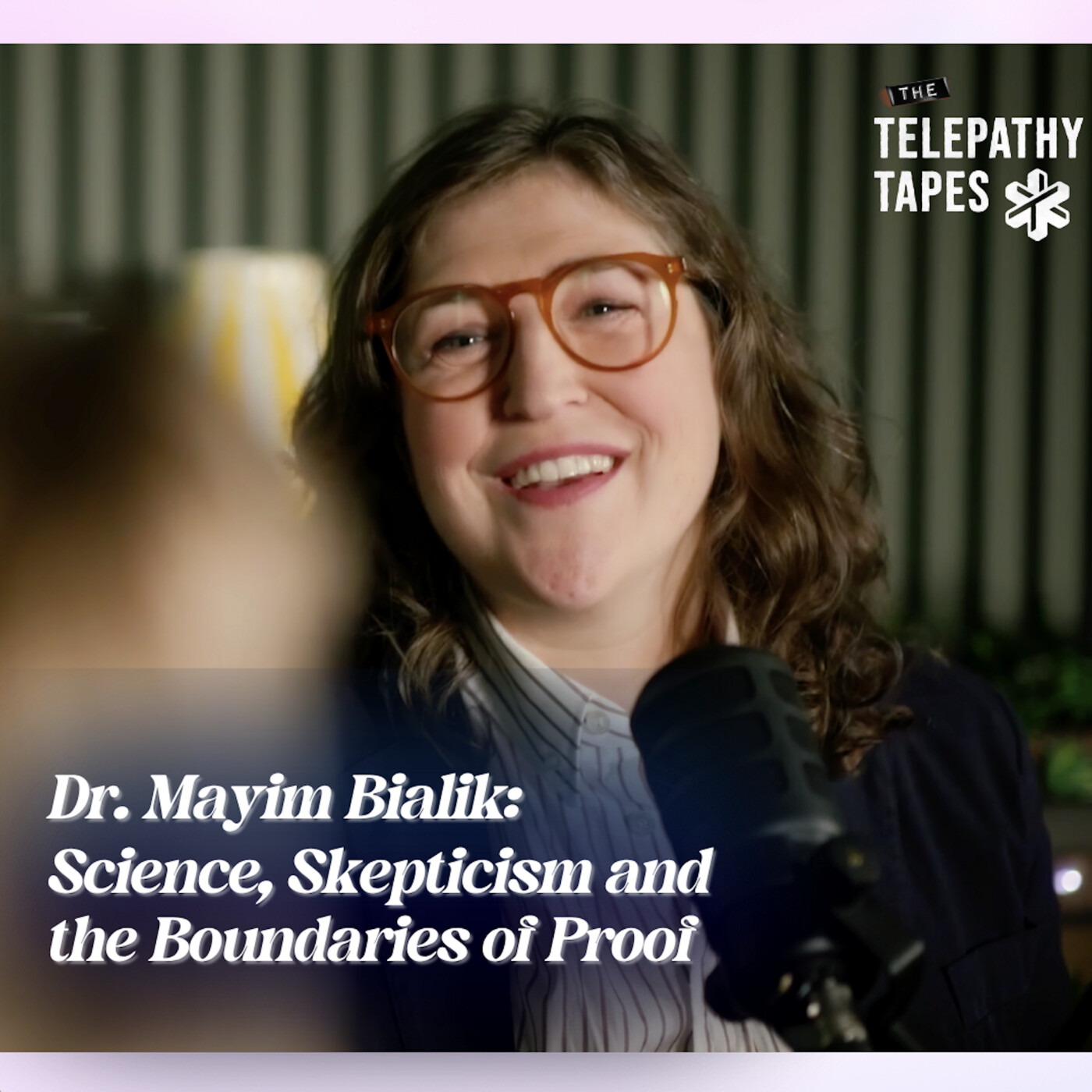
The Telepathy Tapes
S2E28: Dr. Mayim Bialik: Science, Skepticism and the Boundaries of Proof | Talk Tracks
01:03:24
Loading summary
Transcript168 lines
- [00:00]
Kai Dickens
Hey everyone, I'm Kai Dickens and welcome
- [00:02]
back to the Talk Tracks. In this episode, we're sitting down with Mayim Bialik, someone that many of you may know from her decades long career in television.
- [00:09]
From her roles in shows like Blossom to the Big Bang Theory where she played a neuroscientist on tv. The incredible thing about Mayim is that in real life, she actually is one.
- [00:18]
Mayim holds a PhD in neuroscience from UCLA with a focus on psychoneuro, endocrinology and Obsessive Compulsive Disorder. She is also the host of her own podcast, Mayim Bialik's Breakdown, where she explores the intersection between science and spiritual sexuality.
- [00:32]
This was a super fun conversation and Mayim and I have a lot in
- [00:35]
common, so I hope you enjoy it. Hi everyone, I'm Kai Dickens and I'm thrilled to welcome you to the Talk Tracks. In this series, we'll dive deeper into the revelations, challenges and unexpected truths from the telepathy tapes. The goal is to explore all the threads that weave together our understanding of reality, science, spirituality, and yes, even unexplained things like psi abilities. If you haven't yet listened to the telepathy tapes, I encourage you to start there. It lays the foundation for everything we'll be exploring in this journey. We'll feature conversations with groundbreaking researchers, thinkers, non speakers and experiencers who illuminate the extraordinary connections that may defy explanation today, but won't for long. If you want to see our incredible guests in person, we have a video version of this episode on the Telepathy Tapes YouTube page.
- [01:23]
Ad/Promo Voice
Insurance isn't one size fits all. That's why customers have enjoyed Progressive's name your price tool for years. Now. With the name your price tool, you tell them what you want to pay and they'll show you options that fit your budget. So whether you're picking out your first policy or just looking for something that works better for you and your family, they make it easy to see your options. Visit progressive.com, find a rate that works for you with the name your price tool, Progressive Casualty Insurance company and affiliates price and coverage match limited by state law. And Doug, there's nowhere I wouldn't go to help someone customize and save on
- [02:00]
Kai Dickens
car insurance with Liberty Mutual, even if
- [02:03]
Mayim Bialik
it means sitting front row at a comedy show. Hey everyone, Check out this guy and his bird. What is this, your first date?
- [02:09]
Ad/Promo Voice
Oh, no. We help people customize and save on car insurance with Liberty Mutual together.
- [02:13]
Kai Dickens
We're married.
- [02:14]
Mayim Bialik
Me to a human, him to a Bird. Yeah, the bird looks out of your league.
- [02:17]
Ad/Promo Voice
Anyways, get a'@libertymutual.com or with your local agent.
- [02:21]
Mayim Bialik
Liberty. Liberty. Liberty. Liberty.
- [02:24]
Kai Dickens
I do always think it's good for people get to introduce themselves because people know you often for your acting or as a neuroscientist or for your podcast. But how do you want people to think of you?
- [02:35]
Mayim Bialik
Yeah, most people know me from my acting work. I was in Beaches, which a lot of people remember was one of my first kind of big things when I was young. And then I was on Blossom from the time I was 14 to 19. And then I left acting for 12 years, and I did my undergraduate in neuroscience and Hebrew and Jewish studies at UCLA, and then I got my Ph.D. also in neuroscience, also at UCLA. My specialty is psychoneuroendocrinology. I studied obsessive compulsive disorder, and I had two children around the time that I got my doctorate. I returned to acting after teaching neuroscience and Hebrew and piano. And I was on the Big Bang Theory for nine years. Played neurobiologist. I was nominated for four Emmys. I've never won, but I feel like I might as well say that I was nominated. And it's a big deal. Huge deal. And I. My fifth Emmy nomination was for co hosting Jeopardy, Which I was also very excited to do for two seasons. And I have my own podcast called Mind Bialix Breakdown, and I do that with my partner, Jonathan Cohen. And we talk about the intersection of science and spirituality. We talk about sort of science communication, specifically around mental health and also alternative and holistic healing.
- [03:44]
Kai Dickens
I love it. And, you know, being a child actor, like, you probably had a weird school situation, I would imagine. At what point were you always interested in science and neuroscientists or when did that become such a passion that you're like, I'm going to leave everything and pursue it?
- [03:58]
Mayim Bialik
Yeah, I'm a late bloomer to science. I actually, you know, was raised. I was born in 1975, and the sort of going notion for girls was that girls are not good at math or science, and boys are. And the boys frequently reminded all the girls of this. And so, yeah, I struggled. I didn't learn easily those subjects. I was fascinated with quantum mechanics. I was fascinated with physics, and I really like marine biology. You know, I loved the mammals of the ocean. And I never thought that I'd be able to achieve it. And it wasn't until I was on Blossom when I had different tutors for every subject because my parents were both teachers and they Wanted me to have as good an education while on a set as I could. It was the first time I had a female mentor. She was then an undergrad at ucla and she answered an ad for like, Hollywood teen needs a science tutor. It was literally posted on a bulletin board at ucla. And she was at that time an undergrad, a dental student at ucla. And it was the first time I had a one on one instructor for, you know, something science related. And I think having a female mentor and someone who had a really interesting path and journey helped me. It helped me get the confidence and the skill set, which you need both of those things. Sometimes you have the skill set but not the confidence, or you can have the confidence but not the skill set. I needed both. And so it wasn't until late in high school, like, that's a late bloomer for science. And I even had to do some remedial work in college to catch up because I hadn't really been that dialed into chemistry, especially on a set. It was hard, but even so, there are many, many students who get to college. And what you us is doctor, the same way you call the top of the class doctor. But some of us do need a little extra help. And at the time, affirmative action was in place at ucla. And what it meant is that if you came into college needing some extra support, it may take you a couple more quarters, but you'll get there. And that's what I did. Wow.
- [05:47]
Kai Dickens
Now, when you chose neuroscientists instead of marine biology, was there something you wanted to understand about the brain or like a case you came across?
- [05:55]
Mayim Bialik
Yeah, at the time I was very interested in, you know, we called it nurture versus nature back then. Topics like homosexuality, topics like mental illness, schizophrenia, bipolar disorder. These were things that were already in the cultural conversation of is this, you know, genetics or is this environment? Back then you could ask that, you know, polar question. So I was originally interested in genetics. I wanted to go to med school. I wanted to be a psychiatrist. At that time, that was the only way that you could get at mental health. Like, it never occurred to me to like, be a therapist. Like, it was such a rare thing that I figured, like, I want to go to med school, I want to become a psychiatrist. I did not have the grades to go to med school, is the truth. And when I. One of my introductory courses was we learned about the brain and nervous system, and when I learned about the electrophysiology of the neuron, that specifically was the moment I fell in love. All that action potential refractory period. Like, all that stuff. Sodium potassium pump, that really was like, this is the level that I want to understand. And as you well know, neuroscience is. It's the science of how we perceive, it's the science of how we communicate. It's the practical molecular and cellular science of how the sodium potassium pump works, for example, and how medications work. But also it is the science of neuropsychology. It's the science of perception and misperception. So that was really the level that I wanted to study. And, yeah, I registered for an email address. I was nerdcla. Edu back when it wasn't cool to be a nerd. And, yeah, that was what I embarked on as my field of study and as a. I'm a vegan person. So I always knew I wanted to work with humans rather than animals. And so I ended up working in the field of. It's called mental retardation. That's the clinical, you know, kind of category. And I in particular studied Prader Willi syndrome and obsessive compulsive disorder. So that was my specialization for my thesis.
- [07:46]
Kai Dickens
So you've obviously started a podcast, and when you decided to do that, what were you trying to explore? Exactly, yeah.
- [07:53]
Mayim Bialik
So when our podcast first started, you know, keep in mind, not everyone and their mother had a podcast. You know, we're some 360 episodes in now. Like, we're. We're years into something that when we started it, I had never even heard a podcast. Like, I didn't even know what it was that we were doing. But I had wanted to, you know, from a science communicator perspective, start talking about things that many people who are not, you know, either able or have having access to a therapist. Right. There are things that I think is a human right for people to know about, to know the difference between anxiety and depression, to know the difference between an anxiety attack and a panic attack. To me, I just feel like it's a human right for us to be educated about mental health. And I thought, you know, I go to therapy and I have all these things that I've gathered, you know, that my therapist has supported me with. Like, there are certain things that should be just, you know, common knowledge. And we started this and then Covid hit, and it still seemed relevant, but it took on a different flavor because we had so many people experiencing anticipatory anxiety, right? People who were having their sleep disrupted. They didn't know why they were feeling gross all the time and why they were overeating or not eating. And we thought, gosh, how many people are experiencing a global pandemic with no skills? And so the fast track way to communicate this was not through a TV show, it was through a podcast. And so that's where we started with really trying to help people break down basic mental health challenges and also to try and have people relate to either celebrities or experts, you know, about kind of the basics of mental health. And what we discovered was that almost every single guest we had on, whether it was a celebrity, a corporate person, you know, a professional, they all kept circling around the same thing, which is, having a relationship with something greater than you is a source of strength, it's a source of recovery, it's a source of comfort, and can also be a portal to understanding things outside of our current understanding. And we kind of felt like, oh, this is a bit of a pivot. I don't know if it's a pivot. An evolution of understanding mental health in terms of physical health and spiritual health as well.
- [10:03]
Kai Dickens
I love that, because I've never heard what major pivot. Because, I mean, the first, like, iteration of your show was so necessary and beautiful and helpful.
- [10:09]
Mayim Bialik
Thank you.
- [10:10]
Kai Dickens
And I love that this is, like, what it evolved into because of that need.
- [10:14]
Mayim Bialik
Correct?
- [10:14]
Kai Dickens
Yeah.
- [10:15]
Mayim Bialik
Well, and also, we couldn't deny that whether someone believed in God or didn't believe in God, they kept saying, but what keeps me healthy is knowing that I'm not in charge of the universe, knowing that I can take my hands off it. And we thought, gosh, these are all the same things that mystics have talked about these, you know, and even when we got into physical health, right, this notion of, like, oh, you can create an environment in your body that facilitates healing. What? That's not how you and I were raised. We were raised that, like, oh, your body does this and it'll get sick, and here's the medicine to make it better. And then your brain and your mind do this other thing, you know, instead of, oh, when you get a stomach ache because you're nervous, that's the mind and body telling you they're connected. Yes, the mind, body connection.
- [10:59]
Kai Dickens
Yeah. You've now talked to a lot of thinkers, a lot of scientists, a lot of just average, you know, people. What do you think is missing about our current understanding, our own consciousness?
- [11:10]
Mayim Bialik
I mean, I think that a lot of people don't understand how much is in their control in terms of their own state of being. You know, I think that there's still a lot that we don't know, and that can make people feel uncomfortable about consciousness with a capital C, you know, about a sort of larger plane. I think that what a lot of people don't understand also is that it's okay for us to be curious about the science, just like it's okay for us to be curious about the parts that maybe science can't explain. We don't have to reject one or the other. And I think the real sweet spot of consciousness is respecting both of those. And I would even say respecting them equally. Right. And not sort of playing who's more important here, right. The feelers or the scientists. And some of the people I think in this field that are really making headway are people who are not afraid to say I don't know. And if I don't know, that doesn't mean it doesn't exist. But I think we get into trouble when we have this kind of dualist, I think very pessimistic and frankly cold perspective that if it doesn't have a number and it doesn't have an assay, it doesn't exist. That's not true. We don't know what is true, but we know what's not true.
- [12:32]
Kai Dickens
I mean, but it does sound like this has been tethering around your own quest for a little bit. And mine is this idea that the non physical world shouldn't be ignored and there's a place for it in science. I mean, would you agree with that? And if so, why?
- [12:45]
Mayim Bialik
Yeah, I think that the strongest, it's not even evidence, but like the strongest proof of that is how much we didn't know when we didn't have the instruments to record it. So even the notion that bacteria can cause infection. Right. If you go back historically, it's not to make a direct comparison, it's to show that the paradigm that we are sitting in inevitably will shift as technology increases and as our hearts increase and as that sort of capacity to expand the conversation also increases. But to say, you know, microwaves don't work because I can't see the microwaves, well, we know that that's not true and they work and they will heat your food or whatever else they do, the same I think is true at some level of what we call energy. Right. And the notion that some people have very elaborate explanations for energy bodies and things that I don't necessarily understand, you know, that I think will start being better elucidated not only as our technology advances, but I think as our minds start expanding to include some of those things in the conversation. And I was talking to you. Before we started, I started watching Seinfeld again with my son. And, you know, there was an episode about very early on about one of them going to a healer and all of these things that were so crazy. And most of the things this healer did you could literally read about in the New York Times today. You know, things that, you know, were seen as so fringe and so out there. So we are evolving in terms of how we understand many things that were previously dismissed as holistic kooky out there. You know, even the notion that Gabor Mate, you know, and van der Kolk, you know, talked about that trauma impacts the physiology and that that is something that we can see. We can see it passed on epigenetically. We can see it passed on through generations. This is something that sounds like it's out of a Star Trek episode, you know, and the fact is, there is science to it. We can quantify it. Is it as easy to quantify as how much caffeine is in a cup of tea? No. But most things worth experiencing are not easily quantifiable.
- [15:00]
Kai Dickens
100%. I think it's Rupert Sheldrake who has that quote. And I think it's so great where it's like, if you were to ask why music is special, and it's like, okay, you could, like, pull apart a violin and be like, here's the splinters. Like, this will tell us. Oh, no, that's not it. We're not getting the answers. Like, let's look at the ink on the. Oh, there's black dots on white paper. Like, well, this tells us why music is special. And, like, sometimes over quantifying and measuring is not.
- [15:20]
Mayim Bialik
I mean, yeah, you can see it in love and relationships as well. You know, if you look at someone that you love, there may be reasons why you find them beautiful. Does that mean they're objectively beautiful? No.
- [15:34]
Kai Dickens
Sometimes you just stop feeling like yourself and you can't fully explain it.
- [15:38]
And it's usually not just one thing, right?
- [15:39]
It's the sleep that's not quite deep enough, or the mood that's harder to
- [15:43]
manage, or the feeling that you're just
- [15:44]
running on empty way more than you used to be. Lately, a lot of my friends and family members and colleagues are exploring more natural ways to feel like themselves again. And the one company I hear a
- [15:54]
lot about is Batch.
- [15:55]
What stood out to me is Batch
- [15:56]
is not just some, like, trendy wellness company.
- [15:58]
It was started by chemical engineers, and they're fully transparent and tell you what's in everything. The Batch Micro Mints are a sublingual THC and CBD mint designed for daily
- [16:08]
calm and mood, not just one or the other.
- [16:10]
It's a daily ritual replacement that's not about feeling different. It's about feeling more like yourself again. There's no grogginess, there's no dependency, there's no pharmaceutical side effects. And they dissolve under your tongue for faster absorption, unlike a gummy or capsule. And for nights when you really need a reset. Their nighttime gummies are designed for more deeper and more restorative sleep. So you wake up actually feeling rested,
- [16:31]
which, as we all know, changes everything. And I think it's really important to
- [16:34]
note that this isn't about checking out or numbing anything.
- [16:37]
Those are things that I am fully against. But it's more about just feeling present
- [16:40]
with your relationships or your work or even with yourself. And right now, batch is offering 30% off site wide. And yes, that applies to subscriptions too, so you can lock in that discount on your monthly supply. Go to hellobatch.com tapes and use code tapes at checkout. So I started adding magnesium Breakthrough by Bioptimizers to my nightly routine. And I have to say it's made a huge, huge difference. I feel calmer at night and I'm waking up without that same exhausted, wrung out feeling I had started to accept as normal. What I love is that it's not just one form of magnesium. It's a blend of seven, designed to support relaxation and more restful sleep in a more complete way. So here's my invitation to you. Try it with me. Track your sleep, notice how you feel and just see what shifts.
- [17:24]
Here's what you get when you go
- [17:25]
to bioptimizers.com tapes and use code tapes to get 15% off your entire order. Plus a free bottle of Mazymes Bioptimizer's best selling digestive enzyme added to your order automatically when you use our exclusive code. That's a $20 product, free on top of your discount. This is a limited time offer while supplies last. You cannot get this on Amazon. You cannot get it in stores. This offer exists in one place. My link, my code, and that's it. So if you are already thinking about trying it, this is the sign. Go to buyoptimizers.com tapes, use code tapes and grab it before it's gone.
- [18:12]
Mayim Bialik
That's the point of sort of the conglomeration of things. It's the elephant. You know, it's if you have a bunch of people analyzing different parts of an elephant they could each have a decision about what this creature is based on the small region they're looking at. It's only when we see the gestalt in its entirety that we say, this has meaning, or this has meaning to me, which is not always the same thing.
- [18:34]
Kai Dickens
So we've been talking on our show a lot about, like, consciousness. Is it something that we. Our mind creates, or is it something we tap into, or is it both? Like, do you have. Do you fall. Where do you fall on that?
- [18:44]
Mayim Bialik
I don't know that I definitively have a vote. I think that there's a lot of attraction that I have to this notion that consciousness creates us and that there's something before us, which, you know, I think is also kind of a mystical and religious concept. I'm one of these people, especially in who I get to talk to on my podcast, that, you know, we speak to a lot of people who are experts in very specific perspectives. And there are certain things where I definitely feel like that's not me. Like, when Steven Pinker came on, I definitely felt that's not me. I don't have that. But a lot of times, especially with consciousness, you know, we'll speak to astrophysicists, we'll speak to psychologists, we'll speak to healers, we'll speak to channelers. And many different aspects of an explanation of consciousness at any given time can make sense. But I do, you know, have a personal notion that I don't need to wonder what came before the Big bang. It's an unknowable wisdom. And I believe that's sort of the, you know, some sort of primal consciousness, I guess, that that creates and created everything that we experience.
- [19:53]
Kai Dickens
So when Steven Pinker was in, like, what were the things that were you like, Ah, that doesn't resonate with me exactly. Which I think is okay. Like, people have all sorts of choices, you know?
- [20:01]
Mayim Bialik
Well, I mean, I think there's something about. And, you know, I feel so bad picking on Steven Pinker, but I'm sure he'll be fine. I think also he thinks we might be distantly related. So, you know, it also feels like a familial fight. You know, I think there's a notion that there's something very unscientific to me about anyone making a decision about something that we don't have all the information about. Yeah. Meaning as a scientist, my job is to be skeptical and to form independent and isolated hypotheses that I can test or that we, you know, as a scientific public, can test and Verify, compare with other experts and scientists and draw conclusions. But to say that sounds delusional, therefore it's wrong. It's a non scientific perspective. And I think, you know, and I kind of said this to Steven Pinker, you know, I said that it feels like he's more fanatical about there not being a God than I am about there being one. And to me that's something that even when we talk about things like you have introduced and continue to explore with your work. Yeah. The scientific approach is to get more information, to understand it from all angles and to understand it in a socio cultural context and not simply say because this is not what color is it by wavelength that we can understand it. And like I said, some of the best things worth understanding cannot be explained in the way that many dualists would like to explain things.
- [21:40]
Kai Dickens
Yeah, I think that's a really interesting point because you know, I've had come across a lot of really respectable scientists or thinkers that are so fundamental almost and dogmatic in their belief that it almost feels like a close minded believer. Like you're coming from the same place as someone who might like believe wholeheartedly that the earth is flat, that you're gonna tease, you know, like there has to be openings for sure.
- [22:05]
Mayim Bialik
And I also, you know, I feel like, it feels like I'm engaging in a seventh grade argument when I say like, well, we used to think that we were the center of the universe, right. But I think people very quickly forget and I think people wanna believe that we're much more evolved than we are. People wanna believe. Well, since we have, have cell phones and computers and AI and all the other amazing things that there are, there's no way that we could not understand something or there's no way that I don't have the answer to what's happening here. And I think that's what makes a lot of people feel comfortable. And look, I'll be honest, the world feels a little bit scary in a lot of ways. The country feels a little bit lot scary. And people don't like uncertainty, people don't like questions, they just don't. And I think that's what shakes a lot of people up. It really does. And they want to close the door.
- [22:58]
Kai Dickens
Yeah, you know, we've been talking a little bit about like how to measure things and things that can't be measured and is there space? Maybe you could like break this down as someone who's gone through scientific, you know, training, you know, because I think so often we're like, oh, it can only be proven if you can measure it and put it in a lab. But there's also things that we know of by like going into an environment, like Jane Goodall went and spent time, like in the jungle to really be part of a community of animals to understand or like we understood that X rays might cause cancer. Not by putting people in a lab and putting X rays on them, by being like, okay, right. And I think about that in terms of like anecdotal evidence.
- [23:34]
Mayim Bialik
Right.
- [23:34]
Kai Dickens
I mean, we accept it sometimes, right. But we don't in other occasions. And I wonder, like, is there any, like, vernacular for that in science? You know, I think of all these parents of non speakers and teachers, like thousands at this point who are like, this has been my experience. Like, at what point is something weighted enough to be like, yeah, I think,
- [23:51]
Mayim Bialik
I mean, I think it's a good question, you know, in terms of scientific method, I do think that anecdotal experience is exactly that. It's anecdotal experience and by its nature it's variable. And I think that is what butts up so strongly against scientific method, right? Variability. And if we're studying variability and we see that things are falling on a really nice, you know, bell curve, like, we know what to do with that and we know how to say this is two standard deviations outside. But when it comes to the kind of human experience that talking about with anecdotal reports, the problem, you know, and it's a lowercase P problem, but the problem is it cannot and will not and does not want to stand up to the kind of lack of variability that would be required for things like the scientific method. Now, I think your question, though, is more precise and significant. At what point do we weight something? At what point does it carry more weight? Yeah, I think, I think we're there. I think we're there. And I think even having this part of a larger conversation puts us there. But, you know, I'll be honest, even as a layperson, which, you know, I'm not an expert on anything that your, you know, work has introduced me to. I'm very saddened at how many scientists in particular will not engage. That saddens me because I think that there is something to being open to trying to find ways, Right. To quantify. But, but as I've learned from what you've taught me, right. The very nature of the observation, of this kind of ability, access being, does not always lend itself to observation in the ways that we want it to. In which case I don't think it should be dismissed. I don't think it should be thrown out. But I think we also get to see, like, how do we keep it in its appropriate box? So that. And I think this is what you're trying to do, right? So that it is open to an inquiry that would hopefully give it the kind of weight that it deserves.
- [25:54]
Kai Dickens
Yeah, you know, it's interesting. So one of the men who actually invested in our documentary film and he's invested in a lot of consciousness studies and he's doing such good work at like helping find answers. And every once in a while he'll send me an email. And he just was really high up in the tech world and all that stuff. And he sent me some conclusions he's made recently. And he was like, I think that psi abilities and for anyone just jumping in for the first time as like ESP abilities, right. Are shot and don't maybe want to be captured.
- [26:20]
Mayim Bialik
Sweet.
- [26:21]
Kai Dickens
And like, they might be really excited at first and then kind of go in and we again, there might be a reason why eventually we might understand that. But like, is there. Could it be the type of thing where, you know, it's not like shooting baskets over and over? Or maybe you can compare it like that. Like maybe you're really good at free throws. And then when people come to watch,
- [26:38]
Mayim Bialik
look, I think, I don't know that I would anthropomorphize it and make it shy. But I think what is true is that again, I think it comes down to variability that the environment and the conditions in which we can understand psi abilities, I think are very sensitive. And I think they're sensitive in ways that we don't entirely understand. And they're sensitive in ways that a lot of hard scientists don't believe in, which is not helpful. It's the equivalent of, you know, if you're the kind of parent who says to your child, you shouldn't be feeling that, stop feeling it. That's one way to approach it. The other way would be, I see that you're feeling something I may not understand, but I see that it's significant to you. Therefore it exists. It feels like that's kind of the difference. And that's why I say that some of this dualist and sort of hard science perspective, which is very dismissive of psi phenomenon, for example, it feels loveless. It doesn't feel like there's heart to it. And I think there always has been heart to science. And I mean, even my own, you know, I have a 17 and 20 year old who exists to always tell me that I'm wrong. You know, even they will sort of say, well, where does love, you know, what's love got to do with it? Right. And the fact is, there is an openness and a creativity to science. Quantum mechanics, all of those physicists knew there's something going on outside of our realm of calculation. Does that mean that everyone who believes in God should become a physicist? No. Does it mean that all physicists need to believe in God? Absolutely not. But the notion that you can separate the heart, right, or a spiritual component from science, it's never been true. And I don't think that's a sign of our evolution.
- [28:16]
Kai Dickens
Yeah. And then I wonder if you've seen any patterns just in the guests you've talked to when. When people talk about something like remote viewing or, like, in this case, like, telepathy or some other. Maybe sighability or even the UAP phenomenon. I mean, have there been things that keep coming up over and over where you're like, there is overlap in these strange anomalous phenomena?
- [28:35]
Mayim Bialik
Do you mean in, like, sort of like their practicality or in how we analyze them or.
- [28:39]
Kai Dickens
Well, okay, so for instance, for me, one thing that constantly is fascinating is how truly believing that someone can do it makes a big difference, makes a huge difference. Or Julia Mossbridge, Dr. Julie Mossbridge would say, love is always fundamental. And then when she's tested precognition, she'll ask, do you love yourself? Do you love your day so far? Do you love the device you're doing this on? The more people say yes to those love questions, the better they do.
- [29:01]
Mayim Bialik
Okay, so, yeah, that's a great example. This notion of love as a universal or, you know, kind of common denominator, which, you know, for anyone who's had a psychedelic experience, a transcendental experience, there's this, like, feeling of being, like, suffused with, like, love. And those are the states that people like Joe Dispenza and Tony Robbins and Bruce Lipton, and any manifestor or healer is telling you, resonate that feeling of love. Can you make it spread? Neural retraining programs use that. Any good somatic healer will use that. Right. So this notion of love, that is something for sure, that is kind of a common thread. I think one of the other things that, from a science perspective, also interests me is the notion of not just meditation, but what does it mean to regulate a nervous system, which we talk about a lot, for trauma, for healing, all these things. What does it mean, though, in terms of access to Psi phenomenon. And so even, you know, I remember this was one of my most favorite, you know, parts of telepathy tapes. When teachers or therapists would say that they were communing somehow, right, with their nonverbal, you know, students. The notion was they're not just like walking to the fridge and getting a bottle water and getting information beamed into them. They are dropping in. They're dropping into some space that is quiet, that is peaceful, that is calm, and that is receptive. And who hasn't learned, right, that that's a place to drop into when you want to improve immune function, when you want to pray for your highest good or that of someone else. This place of dropping in and regulation is exactly what any doctor will tell you to, to tone your sympathetic nervous system, to teach your body to self regulate so that you are not in fight or flight, but you're in rest and restore, right? That's the place that something seems to be happening. And that's something Jonathan, my co host, and I, we kept picking up on. And you'll pick up on it if someone's doing tm, you know, transcendental meditation. You'll pick up on it if someone is talking about psychedelics. And you'll pick up on it in these healing spaces. When we're trying to heal from trauma, even rehabbing a part of our body, it needs a state of calm to be able to do that from.
- [31:19]
Kai Dickens
I love, by the way, that you said that, because I do think that is such a thing. And, you know, so many more parents now is like it's going on and snowballing and stuff are saying it's not really telepathy the way you think about it. It's joining in the same field.
- [31:31]
Mayim Bialik
Correct? Well, and I think that also the word telepathy freaks a lot of people out, right? Which, you know, with all due respect, I think it's a great name for the podcast. But yeah, I think that those are the ways that we can start getting into some of these fields. To say, let's remove the word telepathy, what is it about when a healer is tapping into their client?
- [31:59]
Kai Dickens
I really value things in life that are easy and effortless. And when it comes to getting dressed, I want to feel comfortable and also stylish with pieces that feel elevated and timeless. And Quint makes getting dressed so much easier. The fabrics are elevated, the price is affordable, and everything just works without overthinking it. Quince uses premium materials like 100% European linen, organic cotton, and ultra soft denim. Their lightweight linen pants Dresses and tops start at $30. They're effortless, breathable and easy to wear on repeat. And everything at Quint's is priced 50 to 80% less than similar brands. They work directly with ethical factories and cut out the middlemen so you're paying for quality and craftsmanship, not brand markup. I recently bought their washable stretch silk palazzo pants in multiple colors for a trip to Mexico. They're lightweight and beautiful. Quality, quality and they can be dressed up or down. I also love the lightweight cotton cashmere link stitch dolman sweater. It doesn't wrinkle, the cut is perfect and it feels elevated and classy, but it's flowy in all the right places,
- [32:57]
if you know what I mean.
- [32:58]
I just cannot say enough about them. Their quality is so much better than my former go to brands and literally everything feels tailored to my body. And it's kind of a rare thing
- [33:07]
after the age of 35 to find
- [33:08]
clothes that make you just feel awesome. Refresh your everyday with luxury you'll actually use. Head to quints.com tapes for free shipping on your order and 365 day return. Now available in Canada too. That's Q-U-I-N-C-E.com tapes for free shipping and 365 day returns. Quince.com tapes with VRBO's last minute deals you can save over $50 on your spring getaway. So whether it's a mountain escape city break or a week at the beach, there's still time to get great discounts. Book your next day now. Average savings $72 select homes only this
- [33:43]
Ad/Promo Voice
podcast is sponsored by Talkspace. November is Men's Health Awareness Month, so Talkspace wants guys to know that being prepared for life's biggest challenges and opportunities means prioritizing mental health too. Talkspace can help you go beyond fine tuned workouts, supplements and productivity hacks. Talkspace can help you fine tune your inner life so you can succeed in being the best version of yourself in any situation. And with Talkspace you can get therapy from anywhere and on your time. You can even text your therapist between sessions. Sessions. If you're depressed, stressed, struggling with a relationship, or just need a little extra one on one support, Talkspace is here for you. Plus Talkspace takes most insurance and most insured members have a zero dollar copay. Men's Health Awareness Month is the perfect time to reach out to TalkSpace. Now get $80 off your first month with promo code SPACE80 when you go to Talkspace.com match with a licensed therapist today at Talkspace.com and save $80 with code SPACE80@Talkspace.com that's Talkspace.com, promo code SPACE80.
- [34:48]
Mayim Bialik
We've all had that experience. If we've ever worked with someone who does Reiki or any of these things, even acupuncture, traditional Chinese medicine. And as you said, what the practitioner believes can impact the outcome. And some very, very early research into these fields discovered this. If the doctor believed right in the methods that they were using, there's a different outcome than if they don't. Like, what? How, what is that? How do we measure it? And the other thing that is also a constant, and it gets a bad rap, the notion of a placebo effect. The notion of placebo and nocebo. Right. The idea that the mind is the most powerful medicine cabinet that we have shows us that there is a power in intention, intentionality, and something that, you know, we think of attention. Like, oh, am I paying attention? Or I have adhd, I have a hard time paying attention. In kind of neuroscience terms, attention is where your nervous system is oriented and what value it gives to that information. And guess what? Just like some people are good artists and other people are good at math, and some people are really good pianists, and other people are good at sports, some people are better at tuning in to this frequency. And for those of us who can't do it naturally, we don't know how to tune into it. It doesn't mean it doesn't exist. That would be like me saying, oh, you are a good long distance runner. I'm not. So it doesn't exist, right? Like, it doesn't even compute. But when it comes to these kind of phenomena, like when Julia Mossbridge sits with me and Jonathan and she's picking up on things, I'm like, where is she pulling this from? How does she know things that we are not, not verbalizing? And I'm not just saying, like, oh, she can tell we like each other. I'm talking about deeper issues of how people function. Some people are better at that. Why shouldn't I believe then that some people are better at tapping in? And of course, people who are teachers, you know, healers, those people are leaning into those fields possibly because they can sense things that other people can't. Right.
- [36:55]
Kai Dickens
Or you're drawn, like, to be a caregiver for some reason because 100% might be more open.
- [37:00]
Mayim Bialik
Absolutely. Why? I mean, and it's a rare exception that you meet a pediatrician who's like, I really fucking hate Kids, I'm just so good at, you know, figuring out what's wrong with them. Or a vet who says, like, God, if I have to look at another pet, I just know what's wrong with them. No, they're people who are intuitive. They're better at that than other people and I'm better at other things than other people. But that doesn't mean that if they don't experience it, it doesn't exist.
- [37:25]
Kai Dickens
Yeah, I love that. And the other thing that you just said that, you know, I've been starting to interview some non speakers that are coming in and often we have to send them the questions in advance to give them time to start answering. And one young man said, you did with me. Yeah, exactly. One young man sent me questions, answers this morning where one of the questions like about love and his relationship with his girlfriend who's also a non speaker, and he said, you know, I feel like I can love in the purest form because it's more about presence than performance. And I thought that was so interesting. You know, he's just about feeling, not talking. We don't need to talk and name it, it's just feeling each other, being there.
- [37:59]
I was like, that is so true.
- [38:00]
Like, because I think the closest I've often felt intuitively to my kids was when they were babies and I just knew what they needed.
- [38:07]
Mayim Bialik
Sure.
- [38:07]
Kai Dickens
Now my 11 year old was like, you just don't want to look at me. You know what I mean?
- [38:11]
Mayim Bialik
I think also when you think about moments of connection, even as adults with other adults, try not speaking to someone and see the feelings that come up when you do. If you've ever been told like it is an exercise, stare into someone's eyes for three minutes, you will feel like your insides need to be taken out with a fish hook. It is so uncomfortable. But there are people who are more comfortable in those spaces. Again, I'm thinking of healers. I work with a somatic therapist and a lot of the session is her looking at me and me being like, this is awkward and she always will pull something out. And what it is is that there are nonverbal spaces where people of different varieties have an understanding, a connection point. Those should not be dismissed simply because not all of us can access them.
- [39:03]
Kai Dickens
And that was actually, I was just looking at my questions and you answered the next one which was like, are there certain characteristics of personhood that might make people more adept to society?
- [39:13]
Mayim Bialik
Oh, I mean, this is something, you know, this is another common theme that we've seen people who have experienced trauma. People who have experienced hardship, people who have experienced abuse are often forced to acquire an ability to dissociate, to. I don't wanna say rationalize, but to understand many sides of complicated situations. Those people often find themselves as the people who are super feelers. I think of Elizabeth Crone, who was struck by lightning as a young woman in 1988. And she looked left her body, watched the entire proceedings of what they did with her body, where they took it, what they said to her. She dropped back into her body. And in her book, she reveals that experiences of abuse as a child taught her to dissociate and watch her body. And she said, I believe that that was the universe giving me the opportunity to learn how to step out of my consciousness. Right. Wow. And what does that mean? But that is something that many people report. I'm a wounded healer. Right. I feel things that other people feel in a way that I cannot distinguish it from me and others. And you'll see this also with a lot of kids on the spectrum, various places on the spectrum, learning to distinguish between what is your pain and someone else's, or even your joy in someone else's. That's something that many kids need to learn. And until it's taught, it feels very confusing. Right. It's very dysregulating to the nervous system.
- [40:49]
Kai Dickens
Yeah, yeah, 100%. You know, I love that you brought this up because it is fascinating where, you know, I've talked to victims of abuse, mostly women, who will say that's what turned on their gift of being able to astral travel or what, you know, as a means of survival. And I think often disassociation, like you said, like leaving your body can be really helpful in those moments. Interestingly, I've talked to a few men, also victims of abuse, but often more physical abuse from fathers and such who said they have a heightened psi ability to turned on, whether it be remote viewing, because they said it was like a spirit. Is it gonna happen if I go home right now? Vigilance.
- [41:20]
Mayim Bialik
Yeah.
- [41:20]
Kai Dickens
Yeah. Like, are they in a bad mood or good mood if I go home will be safe.
- [41:24]
Mayim Bialik
Correct. So, yeah, what you're talking about is similar, I would argue, you know, neurologically speaking, similar to a response from trauma in that the nervous system has ramped up its ability to monitor and scan. So you're constantly scanning and it looks different. It's gonna look different depending on the circumstances. But that makes sense to me that someone who is more in tune to scanning. Right. To that kind of awareness they even be able to name it, but they can have this ability to be more open, for lack of a better word.
- [41:55]
Kai Dickens
Yeah, 100%. And, you know, you brought up the woman who was struck by lightning, and we spent a lot of time looking into near death experiences in season two.
- [42:03]
Mayim Bialik
Yeah.
- [42:03]
Kai Dickens
And, you know, I'm curious. I'm sure you've come across quite a few.
- [42:08]
Mayim Bialik
Yes.
- [42:09]
Kai Dickens
And I mean, to me, I feel like that's like a bridge, like a loophole. That's often the easiest thing for people to start to believe in. Sometimes not. But have you heard of one that you feel like is harder to explain away as a neuroscientist or a few, and what might be those things?
- [42:24]
Mayim Bialik
So the thing about NDEs is it really is one of the most studied set of anecdotal reports across the world. And, you know, the Department of Perceptual Studies at Virginia, and you know, the work of Jeffrey Long and Jim Tucker and Bruce Grayson, you know, they put this on map as legitimate psychiatrists, MDs, who decided to say, we cannot ignore what is happening, even if it's anecdotal reports. Right. The notion of NDEs, though, I think should be one of the places we can have the most conversation with, quote, nonbelievers. Many are still very, very resistant. Speaking about the people in my home, primarily. But I think that one of the things about NDEs that shows that kind of anything is possible. It's Anita Moorjani's experience. And this was a woman who went into full organ failure. She was in a hospital. She had, you know, terminal stage four cancer. She had tumors visible through her neck and chest. She experienced a coma as a result of this organ failure. But she was in there the whole time. She had an experience where she was presented with a set of information about how she got cancer and how she would heal from cancer. And you might say, this is a lovely bedtime story, Mayim. Thank you and good night. What happened was when she woke up from her coma, she said, I want you to stop all the treatments. And the doctors said, what are you talking about? You just basically died. And she said, I'm gonna get better. And they said, that's crazy. And I'll give you the long story short. Short, her tumors started shrinking and she was discharged in two weeks.
- [44:12]
Kai Dickens
So wild.
- [44:13]
Mayim Bialik
It's a. It's a case of legitimate verified spontaneous healing that no one can explain. And her doctor has written extensively about this. But the notion being everyone can be an exception, as Ellen Langer would talk about, just because statistically she should have died. There's always someone who doesn't die. However, that level of spontaneous remission and healing, it is inexplicable. But what is that information she shares in common with so many other nd? I mean, with most of the NDE reports we hear, she shares a common journey. It's a common journey.
- [44:52]
Kai Dickens
She's the season premiere of our Talk to Rex season this year. So, yeah, it's amazing.
- [44:56]
Mayim Bialik
She's next level. It's literally. It's inexplicable.
- [44:59]
Kai Dickens
Yeah, well, and there are those ends NDEs with, you know, things you can validate, you know, once they leave the body and they're describing what was happening in the room next door.
- [45:06]
Mayim Bialik
I mean, look, there's always gonna be people who are like, they must have had. There must have been an air conditioning tunnel that was funneling the information. Bruce Grayson, the reason he started studying NDEs as a psychiatrist was a woman described to him from her bed where she was in a coma, what was happening in the cafeteria with him. I mean, he said, okay, this is my life now. This cannot be explained. I will spend my life studying it. And that's exactly what, you know, he and Jim Tuck and Jeffrey Long have done.
- [45:35]
Kai Dickens
Yeah. Well, and it's interesting, too, I would love your thought on this, because I think I was talking to Dean Radin just about how to capture an airtight telepathy test, if it's possible. And he talked about the whole idea of a purple unicorn, that if you see a purple unicorn, one you capture one purple unicorn. It's proof purple unicorns exist.
- [45:55]
There don't have to be patrions.
- [45:56]
Mayim Bialik
Correct. Horses don't eat meat. Except if you see one horse eat a hot dog. Some horses eat meat.
- [46:02]
Kai Dickens
Yeah. And so I thought that was so interesting, you know, because I think often it's like, oh, like, are all NDEs real? Or could be this or whatever.
- [46:10]
Mayim Bialik
But, like, I think in that case, though, we have to be careful what we're trying to verify. Right. So, like, NDEs happen. Yes. Can spontaneous healing happen? Absolutely. Can we use that to explain much of anything around it? Not necessarily. But when there's hoofbeats, it's usually horses. That's also true, and science knows that to be true. However, it could be zebras. It could be someone who has generated the sound of hoofbeats using AI. But it's usually horses.
- [46:47]
Kai Dickens
Yeah. Right. Yeah. It's interesting. I just think it's. I mean, I think the whole way we study stuff and, like, where the burden of proofs, plays and all that stuff has become so fascinating to me.
- [46:56]
Mayim Bialik
Absolutely.
- [46:57]
Kai Dickens
One thing that really was a mind bender in our season two as well. We talked about some the of savant skills and kind of this debate about whether or not they're latent in all of us and something can happen just turns them on. Like we're all really good at math somewhere.
- [47:09]
We're all great.
- [47:11]
Or music. Or is it something you tap into? And then there's savants like Derek Amato, I don't know if you know his story. He crashes head into a pool. Just a random accident. And then he started seeing like these shapes around his head. And each one carries like pockets of music. And he can like play by seeing them. And when he does so it's like a symphony.
- [47:30]
Mayim Bialik
Yes.
- [47:31]
Kai Dickens
I mean, what on earth?
- [47:33]
Mayim Bialik
Yeah. So I mean, there's a couple categories here that I think are important to speak about. You know, injury is the best way that neuroscience has to learn about anything, unfortunately. Injury, disease, tumors, wars, that's unfortunately where most of that, you know, kind of phenomenal information comes from. And I'm by no means, you know, an expert, obviously, but I will say even from a layperson's, you know, perspective, there are a lot of inhibitory mechanisms that the brain has to use so that we can have this conversation. So the fact that I have clothing on my body is actually disturbing to my nervous system, but my brain has a way to quiet that down so that for the most part, I can focus on this. If you've talked to someone who has the inability to filter, that their clothing will bother them to a significant extent and there are things that we can do to condition them. But for the most part, the brain is constantly saying, not this, not this, not this, not this, so that we can do this, what we know. And in many cases it is from psychedelic experiences, transcendental experiences to some extent. But I'll go ahead and lean into some of the science behind psilocybin, behind some of the MDMA research, even the LSD research. We know that a lot of that inhibition, when you release it, there's a beauty in there. There is a consciousness expanding, not just like, ooh, this feels so good, which is more like pleasure principle. But a deeper desire to connect with a large consciousness is revealed. And in some people, they can access that without drugs. And it's really, really amazing when you talk to someone like Michael Singer, who was kind of touched, right. Just literally in college, had a moment of like, oh, there's a voice in there. What. But in terms of other savant abilities, I do think that there's variability that is exceptional in certain brains. I'm an okay pianist, right. I don't believe with 10,000 hours I will be any more. I'll have more experience, but I'm not going to reach the level of Rahman enough. Like I'm never going to be that. But I do think that there are certain brains that when there's a distribution of resources that usually would go towards fill it in speech, certain cognitive abilities, certain spatial abilities, I think that it does open up other pathways in ways that we also do not understand. I wish that I could be a concert pianist that way. But I think that certain brains are different and there's enough lack of variability that we can all function, we can have this conversation. But looking at these special cases reveals a tremendous amount and it's worthy of us leaning into that, of course.
- [50:27]
Kai Dickens
Well, I find, I mean, savant skills seem like such the best way, like such a concrete thing to study because science has embraced that they're real.
- [50:34]
Correct.
- [50:35]
But you cannot explain them. Exactly. Well.
- [50:38]
Mayim Bialik
Right. So I. One of the rotations I did as a graduate student was I was interested in studying perfect pitch. So this is one of those things that actually does have a genetic basis. It does run in families, but not in the same way that like brown eyes are going to be dominant. Right. It's a lot more complicated and elaborate than that. Also, is it about the environment? Where does that feed in? And so I think that's some of the complexity of studying these things. And it's very hard to find two savants with the same exact brain, same exact set of interest and ability that we have in sort of being able to again, kind of quantify that. So that's the variability that, again, makes it a little bit hard. And there's so many other things we have to control for. That's the other thing, you know, from our conversation about, like, scientific method need to be able to rule out things that might be causing things. Causation and correlation. Right. So, you know, when I studied obsessive compulsive disorder, I had to find a group of subjects who were really, really similar and also were not on too many medications that might be influencing the cortisol and oxytocin of acopressin I'm looking at in their blood. So that's a lot of complexity of working with savants, working with people with special needs, working in savant communities or even autism communities. There's often a lot of comorbidities there's often a lot of other things that need to be treated, medicated, regulated. Where do those, you know, fall into what a statistical analysis is going to require, which is that we can rule out these kind of, you know, outlying influences.
- [52:09]
Kai Dickens
Yeah, it's fascinating. I mean, I just think there's such a loophole because I think about Dr. Hennessy Powell's major thing, which was like, look, if a science can understand or believe that certain things can happen and we don't know how that influences information got into a brain, Right. Like how can someone recite PI to the 30,000th digit when calculators can't even do it, you know, like how, you know, so why can't ESP be in that same list of savant skills with calendar computation? And I think if we could just do that, it would normalize it so much.
- [52:40]
Mayim Bialik
Yeah, well, I think that's also, you know, part of what telepathy tapes has accomplished. It's seeing extrasensory perception as an ability, not as a, you know, freakish anomaly, but as something that has some sort of substrate. Even if we don't know what it is, it has a substrate. There is a mechanism. There has to be a mechanism because that's how we're seeing it. Right. And there has to be a way for us to try and measure it. And I'm also a fan of there may be a collection of things that do not have the same kind of verifiability that we have with, you know, the amount of caffeine in a cup of tea, for example. Just something I had to do in chemistry in college. But there can be, I think, a conversation about do we have to have this notion that it either is or it isn't? Maybe it also is, but not all the time. And we're not exactly sure. And one day, hopefully we'll get there.
- [53:34]
Kai Dickens
Yeah, no, a hundred percent. I love that. And I think being comfortable in that, like, space where we don't know, we don't know and we're not gonna know for a very long time. I feel like so many of the non speakers I've met have been so wonderful in trying to disseminate this, you know, And I think you're right with the sensory regulation and filtering and just perception of everything that's around and how that can be really awful if you can't filter everything out. But it can also be a blessing in a way that some other things are more able to be tuned into.
- [54:07]
Mayim Bialik
Yeah. But I think also what makes people uncomfortable and I think what Makes a lot of people uncomfortable about the telepathy tapes and even this conversation. You know, imagine that for all of human history, we have not given any validity to the possibility that people who are nonprofit have a conscious experience. And we come from a very dark and tragic history of the ways that we have treated people who did not fit the norm. And I'm not just talking about all of the brilliant friends I know who were placed in special ed classes when that actually wasn't where the resources needed to go. Right. I'm talking about, you know, in my own family, people who were institutionalized because in the 1950s, no one. One knew what to do with these people. And I'm friends with someone named Perry Finkelstein, who is nonverbal. And she talks about. And I actually recorded her a TEDx talk for her. I was her voice. And she talked about being a child and hearing people talk about her and saying to herself, I'm in here. Like, you don't know that I'm in here. And I think that makes people very, very uncomfortable because it does show centuries, if not thousands of. Of a problem with institutionalizing humans that did not always behave the way we wanted them to. It brings up a huge conversation about what we call mental illness, because as we know from things like the, you know, premonitions Bureau, there are people who see things before they happen. They also see other things that don't happen. But if they are predicting things that do happen that kill hundreds of people, what does it say about the people who are in our institutions, who we are call crazy, makes people really uncomfortable, or that other cultures have names for those people, and they're often called shamans, and in Western culture, they're not called shamans.
- [56:02]
Kai Dickens
Yeah.
- [56:02]
In season two, we started talking to
- [56:04]
more indigenous cultures, and I was so surprised how the Kuntanawa people talked about in Brazil, this is wild. They talked about telepathy as their technology, and they said it's more powerful than any technology you have that can connect you to people or ideas around the world. Sure, we can do it too, but we can also connect with ancestors and, like, plants and the span. So, like, our technology is better than yours. Ours is just more ancient, and it
- [56:32]
Mayim Bialik
makes people very, very uncomfortable.
- [56:33]
Kai Dickens
Yeah, I mean, talking to pretty much any indigenous population, this stuff is not wild. It is. You're a shaman or you are a medicine woman or man, or you are. Are really able to, like, inform on the hunt. Like, all these things used to be relied upon.
- [56:50]
Mayim Bialik
And I think also the notion that you can get in touch with that by, like, you know, doing an ayahuasca journey on your weekend and having a great time. It's an interesting and lovely notion. But I think what's also important to realize is that there's an entire culture around that kind of understanding of these phenomenon. And I think that's what's hard because we don't have that structure around it. In neuropsychology, we talk about these things all the time. Right. And it's more kind of commonplace to be wondering about consciousness, to be thinking about what it means. But once it's introduced to the lay public, it very quickly can get commercialized, it can get dragged down, it can get diluted, it can get confusing. And I think that's where many people say it's not legitimate. Right. And I think that's not fair.
- [57:39]
Kai Dickens
Yeah. Obviously, there's such cool, amazing transformational research going on around psychedelics and how it can help people with mental illnesses.
- [57:46]
Help.
- [57:46]
However, one thing that I don't think we're equipped to handle at all is the fact that people are talking about these spiritual revelations in it, and they are feeling a sense of oneness, and they do want to know where to go from there. And when we look at these cultures, and it was in Western, you know, history too, the use of psychedelics to try to open up your mind, it was an entire. There are rights around it, There are people that are leading these things. It was an absolutely beautiful spiritual experience. And I fear, like, when you do it in a lab, we're not honoring it the way it was maybe meant
- [58:20]
to be with us.
- [58:21]
Mayim Bialik
You know, I think it's a good point. It's a complicated point. And it's, I think, gets right to the heart of the challenge here, because it is only when people like Rick Doblin could kind of push for, like, for legislation and for, you know, being able to provide this proof, right, that you can publish a paper and you can search it on PubMed and you can see, oh, use of psychedelics, this, that, the other. Right. Oh, it works in ptsd. It's a shame. Right. But also it does sort of, I think, lend itself to the kind of legitimacy that a lot of people look for. And it is incredibly different and should be held distinct from indigenous use of especially these kinds of medicines. But, you know, I think that the history also of psychedelics, the government decided that people who are so in touch with their consciousness and something bigger than themselves do not easily want to go to war to kill people that they don't know it is part of the story as well. There's a politicization. Right. Of access to consciousness.
- [59:28]
Kai Dickens
Yeah, yeah. So I'm curious to know how researching paradigms and consciousness and talking to all the people you've talked to has influenced your faith. Because I know some people where when you start to ask these big questions questions, it freaks them out, and they're like, you can't even ask those. Or this idea that, like, can you form and grow a deeper faith or, like, a more real version of faith for you that might be outside of the bounds of what you're raised with.
- [59:53]
Mayim Bialik
Right. I think that these questions of consciousness, of PSI phenomenon, I think they are very challenging to a traditional notion of a religious experience. And I'm kind of speaking Judeo Christian Foundation. You know, for me personally, I come from a tradition that lends itself to a lot of unknowability. And I think that's been a very convenient landing place for me because that is our tradition. You know, I was raised Jewish, and there's an enormous and very rich, you know, mystical tradition that goes along with our liturgy. Many people are not taught it, but it doesn't mean that it doesn't exist. There's kind of like little bits and pieces of it. But, you know, I was.
- [60:44]
Kai Dickens
Kabbalah Judaism.
- [60:45]
Mayim Bialik
Yeah. I mean, like, Kabbalah is one sort of branch. But even this notion that there was a darkness that had no name and no form before anything was created, and I don't use the Old Testament as a science book. That's not what it is. But the notion that whoever wrote that down, I'm even gonna go ahead and say that whoever wrote that down was living in a time where this was a comfortable conversation, that there's an unknowability and a mystery that holds everything. And that mystery contracted before it expanded, and that we are living in a world that is a projection, right? It is. It's a projection, like, for me, that's comfortable, and it's where a lot of my PSI phenomenon get thrown into that bucket. For people who don't have that, I would imagine it's a little more challenging because how do you reconcile this, you know, with a lot of traditional beliefs? And I am a very traditional in that sense. But I think that there's a lot of grace. There's a lot of grace to be had when you see that all of the things that we comprehend are part of a consciousness that is held by a larger consciousness.
- [61:55]
Kai Dickens
Does it ever scare you?
- [61:58]
Mayim Bialik
I get scared all the time when I hear about things That I can't explain.
- [62:03]
Kai Dickens
It's very scary because we've even had internal meetings when we're talking about an episode or going through notes. And one of our beloved staff members really gets upset when stuff will come up about, like, a simulation or we get a lot of feedback from people where it'll be like, you know, the more we go into these depths, like, the more it erases God. And I. I always think of, like, the example of the rainbow. And Newton and Keats were in a big argument around this.
- [62:25]
Mayim Bialik
Yeah.
- [62:25]
Kai Dickens
Like, if you unweave the rainbow, you're unraveling God.
- [62:27]
Which isn't true.
- [62:28]
Yeah.
- [62:28]
Mayim Bialik
I mean, my. My answer to that is, you need a bigger God.
- [62:31]
Kai Dickens
Yeah.
- [62:31]
Mayim Bialik
You need a God that can hold all of this. And if you're looking for certainty, you will not find it in these realms. And the comfort that you don't have to figure it all out for me is a highly religious concept. I'm not God. Right. If I was, I'd be controlling a lot more. But you need a bigger God, because there is nothing that we are experiencing that is not explaining in the universe that holds our ability to fathom it. There's literally nothing. And there's a mystical concept in Judaism that if God stops thinking about us for even a fraction of a millisecond, we don't exist anymore. That our existence is predicated on something bigger than us, holding us. And whether that's gravity, whatever you want it to be, that's what's holding all of this. And to me, it's like this is the unpeeling. This is the peeling back of that onion. Right. And it's infinite. It's infinite. And what an amazing capacity we've been given as human beings to be able to have these conversations, to be able to love, to be able to be afraid to grieve. Right. All of these experiences. And I think, you know, in terms of this stuff, like, it's the same notion as if you want God to be good all the time, and you wanna say, this is good and that's bad. I got sick when I wished I could go on that date. That's bad. It all just is. It's just happening. And it's not that I don't believe that there's forces of darkness and lightness, but the notion that you can ascribe any of that to the world we're living in, to me is it's setting yourself up for a very rigid perspective. And so when things like psi phenomenon come in, it doesn't Fit the paradigm. And it's stupid, and. And it's ridiculous, which is why atheists fall into the same. I think, the same challenge.
- [64:28]
Kai Dickens
Well, and I also think there's a hubris that maybe us trying to understand this stuff would be like a gnat trying to understand, like, how to get to a mall and go shopping. Like, I mean, there's just no. There's no context for it because it's so outside of your everyday life.
- [64:41]
Mayim Bialik
And how do you get comfortable in that? How do you not reject it? How do you not push back against it? How do you say, there's things that I won't know and I can be okay with that? You know, if you've ever had one moment in meditation of forgetting that you're thinking about the fact that you're meditating, like, that moment is what we're chasing. Right, Right. And it's fleeting, and you'll get, like, little bits of it. We're living from, like, that moment to the next one.
- [65:06]
Kai Dickens
Yeah. Is there anything that's on the horizon scientifically that you're really excited about? Maybe something that's just come across your path where you're like, holy cow, we're talking about that now.
- [65:14]
Mayim Bialik
Oh, gosh. I mean, conversations about consciousness, like, reaching the mainstream of science, I think is really, really special. I think talking about special abilities, I think talking about really all of this stuff where a lot of my podcast also kind of resides. That's exciting. I think the fact that we can talk about diagnoses without shame is really miraculous. I know that there are a lot of things I should know about regarding AI and technology. Technology that, honestly, it really scares me. I'm a real. I'm an intentional Luddite. And so I know that there's a lot that I don't understand that is happening. Like, Greg Braden, you know, tells us that, like, we're all gonna be, like, fused with microchips at some point. I get very nervous about that. I tend to stay away from it, and I just sort of am like, what am I eating for dinner? You know, so there's a lot that. Again, because I'm not also in, like, current neuroscience, you know, fields I don't touch on. Yeah.
- [66:14]
Kai Dickens
And I guess the final question, and one that could either give me hope or not hope, is like, do you think science is slowly changing? Like, I do think, like, 50 years ago, these questions would be considered just absolutely so fringe, you'd be thrown out. You could never get tenure. You would just could never get published, like, in 20, 30 years. Do you think the landscape will be different?
- [66:35]
Mayim Bialik
Yeah, I think we've come a long way. And I think even though I get down about the dualists, we've come a tremendously long way. And the fact that even we're talking about placebo as an example of a shift in perception, a shift in agency, and a shift in attention as methods to help us heal, that's already astounding. I think the fact that near death experiences are becoming something we talk about, that there's information to be gleaned from, that I think has already shown how far we've come. And, you know, even when Jonathan and I had Lee Harris on the podcast, who literally thought we were punking him, he's like, why would you wanna speak to a channeler? Like, I'm not even in this realm. And I think the fact that, like, people are open to saying, what does it feel like in your body? Like, where are you dropping into? Right. That's shown how far we've come. And I have to believe that it's going to continue to expand. I wonder what world our kids will be experiencing when they are our age. I hope that I'm proven right just because moms wanna be proven right. And I. I want my kids to be like, she was right. Yeah. I think we're gonna open up more and more. I think we're gonna find more comfort in our lack of ability to quantify things the way other people want. And I do think we're gonna start seeing ways to visualize what is not yet seen.
- [67:56]
Kai Dickens
And if there's a paradigm on the horizon that might replace the current one, I mean, is there anyone, Is there any paradigm you put your money on?
- [68:06]
Mayim Bialik
No. I mean, and I say no, but because, you know, my tradition teaches that there is a messianic age when we will all love each other and when we will all have tremendous compassion for each other's suffering and each other's challenges. I remain hopeful that even if that is delayed, that that is on the horizon. Like, we were not placed here to hate. I'm certain of that. And no matter how challenging the political situation is, how challenging the scientific community feels by telepathy, I have to believe that there will be an increase in love, openness, rights, and. Yeah. An expansion of belief.
- [68:50]
Kai Dickens
Yeah.
- [68:50]
Mayim Bialik
Look at me being hopeful.
- [68:52]
Kai Dickens
I know. I am so happy about your hopeful ending. I was like, this could go one of two ways. We're going to leave here feeling sad.
- [68:57]
Mayim Bialik
Oh, I usually make people feel sad. Yes. Okay.
- [69:00]
Kai Dickens
That was great. Thank you, Mayim, for joining us.
- [69:03]
Mayim Bialik
Thank you. This is really great.
- [69:04]
Kai Dickens
That's it for this episode of the Talk Tracks, but new episodes will be released every Wednesday, so stay tuned as we work to unravel all the threads, even the veiled ones that knit together our reality. And please remember to stay kind, stay curious, and that being a true skeptic requires an open mind. Thank you to my amazing collaborators, producers Kathryn Ellis and Selena Kennedy. Technical directing, audio, mix and finishing by Jeremy Cole, opening and closing music by Elizabeth PW, and original logo and cover art by Ben Condora.
- [69:31]
Design.
- [69:31]
I'm Kai Dickens, your executive producer, writer and host.