← The Telepathy Tapes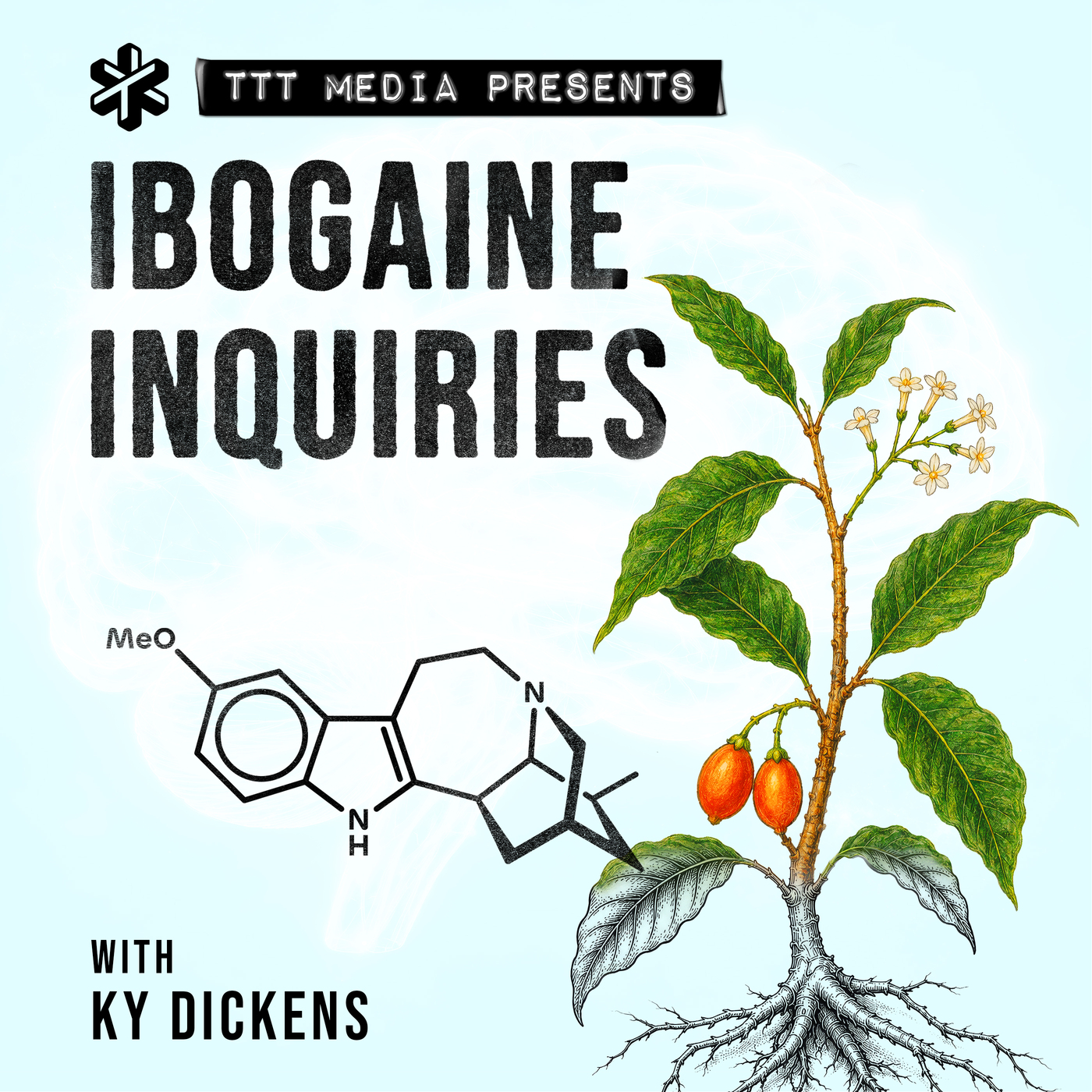
Loading summary
Transcript93 lines
- [00:00]
Kai Dickens
Before we begin a brief Ibogaine is a powerful psychoactive substance. It is not legal in the United States, can be dangerous when administered improperly, and is not appropriate for everyone. This series is not intended as medical advice or an endorsement of treatment. The experiences described by guests reflect their personal accounts and listeners should conduct extensive research and consult qualified medical professionals before making any decisions related to ibogaine or other psychedelic substances.
- [00:38]
Narrator/Host
Hi everyone, this is Kai Dickens and welcome to the Ibogaine Inquiries, a mini series from TTT Media exploring one of the most promising, controversial and misunderstood substances in the world of mental health and addiction recovery. This episode is the beginning of a special five part series that will be released every other weekday. To this feed, go. Concluding on July 31st Ibogaine is a naturally occurring psychoactive compound derived from the root bark of a shrub native to Africa, where it has been used for centuries in spiritual healing and ceremonies. Over the last several decades, it has gained widespread attention due to reports that a single treatment can cure addiction, heal severe ptsd, and address core psychological trauma. To start, we're going back to the day that many of you heard about ibogaine for the first time.
- [01:25]
Jim Hancock
It's called ibogaine treatment. Ibogaine, remember the name.
- [01:31]
Kai Dickens
President Trump now opening the door to more research, signing an executive order over the weekend to fast track studies for ibogaine. Well, last year we learned how psilocybin can help treat some mental health conditions, and now we're learning that ibogaine could as well.
- [01:46]
Narrator/Host
A powerful psychedelic that advocates say has shown promising results.
- [01:51]
Jim Hancock
There's more than 5 million people that are addicted to opiates right now in this country. With one dose of ibogaine, more than 80% of people are free of that addiction.
- [02:00]
Narrator/Host
But the hope and the story of ibogaine is far from simple. And to say it is a one stop shop cure is to ignore issues that widespread access could cause. In the west, ibogaine has been considered a psychedelic drug that many people haven't heard of until recently. But it's been getting a lot of attention due to Trump's recent executive order directing federal health agencies to fast track research. The order allocates 50 million in federal funding to match state investments in psychedelic programs. Many are hopeful that ibogaine can be used for treating things like PTSD, addiction, traumatic brain injury, Parkinson's, Ms. depression and more. Some even call it a miracle. Those who have struggled with addiction for decades report losing their cravings after a single treatment. But there's other elements to the experience as well. Many who Take it. Report having a life review, reliving core memories in vivid detail. Some report communicating with deceased loved ones or being able to see through a blindfold or even have a telepathic experience. Many say the medicine seems to be conscious, and they're able to receive very clear information from intelligences that they cannot explain. It feels like a truly exciting time for this area of study. But how did ibogaine find its way into the mainstream? Many of us have heard of mushrooms or ayahuasca, but why are we just hearing about ibogaine now? Well, to answer that, I think we first need to back up. Ibogaine is derived from a plant called iboga, and utilizing it as a sacred medicine goes back centuries, far outside the realm of Western medicine and the Oval Office. Communities within Gabon, Africa, have used it for thousands of years. In Africa, iboga is not seen as a drug, but as a teacher, a healer, a conscious, living presence. And some researchers have begun asking the radical, does this plant possess a kind of intelligence of its own? In this series, we'll explore the promise, the risks, and the history of ibogaine. We'll trace its history from its indigenous roots to modern clinics and pause to consider the very heavy repercussions to indigenous communities if we fast track the sacred plant to the west too soon, without thoughtful conversation and engagement with the native people. We'll speak with physicians, politicians, indigenous leaders, and veterans whose lives have been forever changed by their experience with ibogaine. But to start, how did a sacred plant medicine from the forest of West Africa end up on the desk of President Trump and supported by mainstream Republicans? To figure that out, we first spoke with former Texas Governor Rick Perry, who by many standards has done a complete 180 when it comes to advocating for something that can be seen as a psychedelic.
- [04:33]
Rick Perry
I was just a big no. I mean, no, no, no, no, no, no, no. Just don't talk to me about, you know, these drugs. They're bad. I don't want to have anything to do with them.
- [04:43]
Narrator/Host
Governor Perry is a seemingly unlikely figure to be at the forefront of a psychedelic push. But he's someone who personally underwent ibogaine treatment at a facility and saw firsthand its healing power. But he certainly didn't always share this enthusiasm for drugs.
- [04:56]
Rick Perry
I grew up in a very, very conservative rural part of Texas in the 60s when the hippies were on TV and the anti war movement was going on. And I was very averse to all of that. I mean, I was, you know, I would have nothing to do with that philosophical position. I went off to college to Texas A and M in 1968. Very conservative. Texas A and M developed more officers for World War II than the military academies combined. So the idea that you would have anything to do with any drugs, illicit drugs, was just off the table. It was a non starter.
- [05:42]
Narrator/Host
This sentiment was backed up when the War on drugs was introduced in 1971, deeming drugs public enemy number one in the US and then again in the 80s under the Reagan administration.
- [05:53]
Rick Perry
Fast forward for another 15 years and you go into the Reagan administration and Mrs. Reagan, who I dearly love, Nancy Reagan. But her message was just say no to drugs. Here's your brain on Drugs was another ad campaign. We were taught that anything that had to do with illicit illegal drugs was bad, bad, bad. I carried that into my political years. If someone were to come to me and said, hey, let's have a conversation about legalization, it's like, you know, get behind me, Satan. What are you talking about?
- [06:25]
Narrator/Host
Rick's stance on the use of drugs has softened over the years, especially when it pertained to healing. During his time as Texas governor, he actually signed an order to legalize medical marijuana after meeting the mother of a child with epilepsy.
- [06:37]
Rick Perry
The mother came to see me with a child. I want to say this child was probably 12 or 13. And they had tried everything for his epilepsy. The only thing that they had found that was functional, that addressed his epilepsy was medical marijuana. And I became curious and I became compassionate. And Texas passed a medical marijuana bill in 2013 that I signed, and that was a pretty big step for me.
- [07:06]
Narrator/Host
So when it came to Governor Perry hearing about ibogaine, he was more open than before to a drug being a salve in a medical setting. In 2017, Governor Perry meets Navy SEAL Marcus Luttrell, author of the book Lone Survivor. We quickly want to acknowledge that the Luttrell brothers can be considered complicated figures. Marcus Lone Survivor story has been publicly disputed, and his brother Morgan's politics have been called extreme and even hurtful. But we bring them up here because their relationship to Rick was critical to his transformation around ibogaine. And that transformation has played a significant role in bringing this medicine to a much larger public conversation. When Governor Perry first met Marcus, he half heartedly told him that if he was ever in Texas to swing by the governor's mansion and say hi.
- [07:51]
Rick Perry
He showed up and the detail call and said, hey, there's a young man here who said, you told him if he was ever through Austin to come by and see you and I chuckled and I said. I said, what's his name? And they told me. And I said, I did tell that kid that last year. I said, cindy, man will give him dinner. That was in May of 07. My wife's a nurse, and she recognized his condition. He was addicted to opioids, masking it with alcohol. He was ptsd. He was a really sick young man. Traumatic brain injury. And he lived with us for the next two and a half years, until August of 2005.
- [08:27]
Narrator/Host
He lived with you?
- [08:28]
Rick Perry
Wow.
- [08:28]
Jim Hancock
Yeah.
- [08:29]
Rick Perry
We had a extra room in the house we were living in. He really became like our son. I remember the first time I ever heard the word I began, it was
- [08:37]
Narrator/Host
through Marcus's twin brother, Morgan.
- [08:39]
Rick Perry
He was up working on a nascent program with the University of California, San Francisco. They were using Department of Energy supercomputers to map the brain of people who had had multiple concussions. And in a kind of a passing conversation, one day we were talking about something and I heard him talking to someone about sending some of his friends, special operators, Navy seals, in this case, down to Mexico to be treated for traumatic brain injury, ptsd, with this plant medicine called ibogaine. I never heard the word before.
- [09:22]
Narrator/Host
Still feeling skeptical on the matter, Rick warned him about his involvement.
- [09:26]
Rick Perry
I said, you need to be really careful with that. I mean, I still had this aversion to anything that had the word psychedelic in it, but it flipped my curiosity switch again. I started talking to some of the veterans who had been down and been treated. I started talking to some people at the Stanford University who were doing some early day studies on this. Fast forward to both Marcus. Actually, Morgan went down and was treated first for his ptsd, and then Marcus went down and was treated. And Marcus will tell you that it saved his life. Morgan will tell you it saved his marriage.
- [10:10]
Narrator/Host
Morgan and Marcus's lives were completely transformed by their experiences with ibogaine. But so many lives have been transformed by ibogaine. I'm going to pass this over to our producer, Katherine Ellis, who's talked to numerous indigenous leaders and physicians and veterans about their experience with this medicine.
- [10:27]
Kai Dickens
An estimated 3,000 veterans have undergone treatment in ibogaine facilities in the west, primarily in Mexico. And what's interesting is that so many of the veterans explain that the real solve wasn't necessarily processing the trauma that happened on the battlefield. Rather, the drug took them through a life review back to childhood, where core wounds needed healing in order to really get to the root of their issues. I spoke with Admiral Jim Hancock, who actually underwent two Treatments. Following a long career in the service.
- [10:56]
Jim Hancock
I always comment that people are running from or to something when they end up in the military. You were never the guy that or gal that absolutely had everything together. Otherwise you'd have gone to college or you'd have gotten a trade and started your life a different way.
- [11:09]
Kai Dickens
Jim started his career in the Navy at age 17 and 40 years later retired as an admiral. In his time, he took on many different roles, even earning his medical degree.
- [11:19]
Jim Hancock
I started out Navy nuclear power, got an engineering degree, got into medicine, did a family medicine residency, actually got to go through flight school and fly F18s for five years, which was my first real exposure to combat.
- [11:33]
Kai Dickens
During the Kosovo war in 1999, in which the US deployed aircrafts in the Balkans, Jim was sent overseas and experienced active combat for the first time, which changed him.
- [11:43]
Jim Hancock
It was my first time really seeing, you know, what men can do to mention and understanding the horrific aspects of that.
- [11:51]
Kai Dickens
But it was on a deployment in Afghanistan following 911 that Jim encountered an incredibly life altering event while working as a doctor caring for injured service members.
- [12:01]
Jim Hancock
I was in a city called Sangin or a city called Nalzad. They called Nalzad the city of death. It was literally a everyday combat scenario. Whether it was rockets, whether it was sniper fire, whether it was all out objectives. It was a tough go. We had several hundred that were hurt, but we had 17 that died of their wounds. Despite my best efforts, all of the wounded went through my hands. You pay a price for that to be, you know, to begin with. As well as my other deployments.
- [12:32]
Kai Dickens
While caring for patients, Jim had to face man to man combat in a very rare scenario.
- [12:37]
Jim Hancock
I was attacked up close and personal and had to defend myself. And when I defended myself meant I had to take somebody else's life in order to defend my patients. Really unusual, not something that happens. I didn't break any rules or any ethics, but as a physician, I did take an oath to do no harm. And so it puts you in a extraordinary position of having to make those decisions.
- [13:01]
Kai Dickens
On the same deployment, Jim suffered a traumatic brain injury.
- [13:05]
Jim Hancock
It was, it was a daunting deployment and that changed my life forever. My ptsd. PTS I will call it, because I always say it's not a disorder, because my reaction to what I was subjected to is what I feel like is the normal human reaction.
- [13:22]
Kai Dickens
And he's right. Countless veterans face horribly difficult feelings following deployment. Post traumatic stress can affect individuals in a multitude of ways that can last the rest of their lives. Upon returning home, many Will turn to substances, to self medicate, becoming dependent on them to function. Jim turned to work as his escape.
- [13:40]
Jim Hancock
My drug was work. It was 20 hours a day, seven days a week. How hard can I go? How much can I accomplish? I volunteered for every deployment, but my family was paying a price. I was paying a price. My weight ballooned. I didn't take care of myself. I wasn't sleeping. My wife would tell you, which quite frankly is where the real story is, is in the wives and the children of folks.
- [14:05]
Kai Dickens
There are roughly 15 million spouses and dependents of veterans whose day to day lives are heavily impacted by trauma, relocation and caregiver responsibilities of their loved ones.
- [14:16]
Jim Hancock
This came to a head in 2011 when my wife basically said, hey, listen, something's got to change.
- [14:23]
Kai Dickens
The military, to the best of its ability, attempted to help Jim. Medicines, psychiatrists, experts, Many of these people provided temporary relief. But as Jim puts it, the gremlins
- [14:34]
Jim Hancock
still came calling every night.
- [14:36]
Kai Dickens
But then by a good friend, Jim was introduced to a group doing research on Schedule 1 drugs like psychedelics to treat PTSD.
- [14:43]
Jim Hancock
I didn't do drugs. I didn't grow up in drugs. I mean, I'd been in the military since I was 17. I watched the Nancy Reagan commercials, your brain being fried in the saucepan. I had not kept up with any literature that had to do with these drugs being used for PTSD or what they were.
- [15:01]
Kai Dickens
However, Jim's desperation for relief opened his mind to this form of treatment, despite his concern about the consequences of how this might look. He underwent three rounds of MDMA treatment, which were fairly successful until another unfortunate incident occurred.
- [15:17]
Jim Hancock
I was hunting with friends in South Dakota and unfortunately got shot in the face in a hunting accident. It put me into a really, really, really dark space. None of the medicines were working. I went back and tried all of the different modalities to try to get there. My world just kept getting darker and darker and darker with evil thoughts breaking in about, you know, hey, maybe this is easier not to live this way. I went back to nightly nightmares and I went back to no crowds. I had a little cancer scare. All kinds of things were, you know, it was like the wheels were coming off.
- [15:58]
Kai Dickens
Luckily, Jim reached out for help.
- [16:00]
Jim Hancock
I went back to the guy that initially had introduced me with MDMA and said, hey, listen, I'm really struggling. And he said, well, I don't have anything here to offer you, but I can offer you to introduction to mission within and Martin down in Mexico. And I said, okay, well, what's that about? And he said, well, it's ibogaine.
- [16:29]
Narrator/Host
Lately I haven't really been drinking and I've been looking for other ways to unwind at the end of the day. Something that still feels relaxing and fun but doesn't leave me feeling off the next morning. That's what I love about Batch. Their micro mints are incredible because they're so easy. They're tiny, they fit in a purse, a jacket, a carry on, wherever, and you can choose your experience based on how many mints you take. So it doesn't feel like this big commitment. It's just a simple, gentle way to take the edge off. And because they dissolve in your mouth, they tend to kick in faster than a gummy, usually around 15 to 30 minutes. What I appreciate is it's not just like a trendy wellness brand. It was founded by chemical engineers who actually understand what they're formulating and they're fully transparent about every ingredient. I also love their nighttime CBD gummies for those evenings when my brain is still running through emails, ideas to do lists and all the things and I want to ease into rest without feeling foggy the next morning. Right now, batch is offering 30% off site wide. And yes, that applies to subscriptions too, so you can lock in that discount for your monthly supply. Go to hellobatch.com tapes and use code tapes at checkout. We talk about supporting our sleep, digestion and energy, but rarely about the organ working behind the scenes on all three Our liver. Your liver is your body's filter. It processes everything you consume and performs more than 500 daily functions including energy production, digestion, fat metabolism and vitamin storage. And when it's overworked, you can feel it. That's why I've added dose to my daily routine. Dose is a clinically backed liver health supplement designed to support daily liver function and help your liver clear unwanted stressors. It's not another capsule or powder. It's a two ounce liquid shot that tastes like fresh squeezed orange juice with zero sugar, zero junk and zero calories. When taken daily, Dose can help reduce sluggishness and those midday crashes while supporting your metabolism and aiding digestion. It's also backed by two double blind placebo controlled studies showing a positive impact on liver enzyme levels. Ready to give your liver the support it deserves, head to Dosedaily Co Tapes and enter tapes to get 35% off your first subscription. Your body does so much for you. Let's do something for it that's D O S E D A I L Y Co tapes for 35% off your first month subscription. One of my favorite little rituals is having something steady in the morning before the day gets away from me. Even if it's just a few quiet minutes in the sun, a walk with a dog, or getting something nourishing in my body before everything starts moving. And in the summer when I'm traveling or out of my normal routine. And that can be so much harder to keep up with. And that's why I love Cachava and especially their new travel packs. It's my favorite all in one nutrition shake. Now packed to go, you can just throw a packet in your bag and know you have complete nutrition ready wherever the day takes you. Each packet has protein, fiber, vitamins, minerals, greens, probiotics, omegas, electrolytes and more. It actually tastes delicious and comes in eight amazing flavors. Chocolate, vanilla, chai matcha, strawberry, coffee, coconut, acai and chocolate mint. It's plant based, non GMO with no artificial flavors, colors, sweeteners, soy, gluten, animal products or preservatives. Just clean nutrition that helps me feel my best wherever I am. Take your daily ritual with you. Go to cachava.com and use code tapes for 15% off your first order. That's Kachava K A C-H-A-V A.com code tapes.
- [19:59]
Kai Dickens
So Admiral Jim decided to give ibogaine a shot, desperate at this point for any solution.
- [20:04]
Jim Hancock
The first time I talked to the worker down at mission with them, they said, well, the medicine knows what you need. Okay, no, I'm a physician. I know pathophysiologically what a medicine does. When I go to give it, I give it for a reason. I'm looking for an effect. And they're talking about this. The medicine knows what you need. They talked in a vocabulary that I fully did not understand. Well, the environment, you know, we're going to cleanse you with sage and we're going to set up the environment, your intentions and we're going to do all of these other, oh my God, granola things, right? I don't have those bones in my body. That was not something I was prepared for. But MDMA had taught me that the environment was important. I didn't think it was as important as it was, but it truly is important that the medicine's given in an environment that makes sense. And the first time I did the ibogaine, I really did not have the preparation that now I would recommend. I was just like, okay, let's just go do this. And most of the seals I've talked to the first Time they did it, they said the exact same thing, dude, I walked in, I'm like, I'll do whatever, take the medicine and take the ride, right? And sure enough, that's what I did. And Martin and his folks were fantastic. I was monitored the whole time. It was seeing my life through a lens that I had never seen. It was absolutely scary. I didn't fully understand. They talk about, you see these visions, you see little tidbits of your life. And they do. I mean it's like a, you know, it's like the old reels from the 60s when you're watching the film.
- [21:48]
Kai Dickens
And for Jim, the visions were not what you'd expect. It wasn't really about his time in the service.
- [21:53]
Jim Hancock
The interesting thing, Katherine, they should be getting rid of their combat, right? When they go to the medicine and they visualize and they're in the third eye space and they're doing this that you would think it would be about that God awful combat they saw. It's all about life experiences, it's all about childhood, it is all about your marriage, your kids, your everything. And now I know that I should pay attention to each one of those because each one of those are my lived experience that are causing me issues. I didn't put that together initially, right. That there was a reason I'm seeing that particular thing, even though it may be six months before I realized why I saw that.
- [22:34]
Kai Dickens
And here's Kai again, the founder of
- [22:36]
Narrator/Host
the Mission within where Jim underwent ibogaine therapy, came to our studio to explain what these visions could be.
- [22:41]
Martin Polanco
My name is Martin Polanco. I am a physician from Mexico and I have been working with ibogaine for 26 years. I'm here to chat about this amazing molecule that has so many benefits and helps calling to question some of the assumptions we have about reality and how these compounds work.
- [23:00]
Narrator/Host
So when Jim talks about having these visions, what are they and does everyone experience them?
- [23:05]
Martin Polanco
So every ibogaine experience is different and up to 30% of people don't have visions at all. And we call them visions. They're not, they're visual hallucinations, but they're autobiographical. So it's generally not just random fractals and material, it's contents of your memory being displayed in visual format. So for most people the experience has three separate segments. So the first one starts about 45 minutes, up to two hours after you ingest the medicine. It starts with, you know, a visual experience. The people that have this visual experience reported as almost like a movie screen opening up in the back of their eyelids and the contents of their memory being displayed. And these are like 30 second clips sometimes of events that were formative and that were traumatic for the individual. And most of the time it's childhood stuff that is displayed. This goes on anywhere from six to eight hours. And then the visual experience stops and people go into this introspective phase where they're thinking about what they saw, they're processing, they're still feeling the effects of the medicine, like they're still in a bit of an altered state, but they're not like in this very intense visual experience. And then afterwards there's a period of residual stimulation where people sometimes have trouble sleeping, but they don't feel tired and they just feel at peace. Their mind is quiet, they feel very calm. A lot of the weight has been lifted off their shoulders. Like literally, people tell us, like they feel they put a rucksack full of rocks down and they have a deeper understanding of their own psyche and the things that affected them and also how they're affecting other people.
- [24:50]
Narrator/Host
How does it do that?
- [24:51]
Martin Polanco
Epigaine seems to occasion a waking dream state where it surfaces memories like repressed memories and unconscious information and allows a person to look at it from a different perspective. It's almost like an AI system that is like diagnosing its own code. You can see the different voices you have in your head and the different patterns and how you're replaying relationship dynamics. So in a way, it's almost like floating in the room, observing yourself from a distance in a very objective way and without being re traumatized by the experience. Also, ibogaine is an experience that occurs with eyes closed. When you open your eyes, you're back in the room. But when you close your eyes, it's like this fully formed 3D world that is a content of your memory, much like a dream in a dream. It feels real. And the ibogaine experience, it also feels real.
- [25:44]
Narrator/Host
Here's Jim with Catherine again on how it felt coming out of this experience.
- [25:48]
Jim Hancock
I woke up the next day and I'd kind of seen the world through all of everything bad I'd ever done, but not through my eyes. Through the eyes of the person that I'd done it to. So when I yelled at my son, I got to see it through his eyes. I got to see how he felt. I got to feel how he felt. And when they said that you wake up the next day and the gray day and your ego is crushed, I'm like, man, they haven't met Jim Hancock.
- [26:18]
Kai Dickens
This Feeling of being totally stripped of one's ego and identity is reported across the board.
- [26:23]
Jim Hancock
And I woke up the next day with absolutely zero ego. I mean, I've never felt so wiped out physically. And I've done some hard things in my life, but I was wiped out physically. But more importantly, my space and my feeling of, oh my God, what, who and what am I now today? The way I would explain that to you is if you're a good candidate for ibogaine, your lived experience is a whiteboard, if you'll picture a whiteboard. And it is so full of life experiences, bad and good, but so full that there's nowhere you can write anything. The red ink is filled up. It almost looks like a solid thing. And you do the ibogaine and when you wake up the next morning, it's a whiteboard. And then you choose what you put back on that board.
- [27:14]
Kai Dickens
This malleable window, or what's known as the critical learning period for the brain following an ibogaine experience is what Martine refers to as an integration phase.
- [27:23]
Martin Polanco
Afterwards, there's a very intense integration phase, which if you do that right, you can maintain the benefits indefinitely and what proper integration looks like. It entails meditation, physical exercise, eating healthy, getting your sleep under control. And then for the veterans, and I think for most people in general, I think there's a lot of metabolic dysfunction nowadays where our diet is causing us health issues. So addressing from a functional medicine standpoint, some of these imbalances can be really beneficial.
- [28:04]
Narrator/Host
Summer always makes me rethink what I'm reaching for because I want lighter fabrics, pieces that feel good the second you put them on, and things that can go from work to dinner without feeling overdone. That's why I love Quince. They focus on high quality essentials like breathable linen, soft organic cotton, washable silk, and beautiful jewelry without the luxury markup. It's that rare balance where everything feels elevated, but it's still easy and affordable. Their 100% European linen pants, dresses and tops are the pieces you reach for all summer. They're lightweight, effortless to style and start at just $32. I recently bought the Flowknit Breeze short sleeve Polo and it's perfect for going to work or going out on a boat or to a concert in the and the big thing for me is that Quint works directly with ethical factories and cuts out the middleman. So you're paying for quality, not brand markup. I personally love their 100% European linen long sleeve shirt because in California you Go from super hot to super cold and it's perfect for layering and easy to throw in a bag. I also love their 100% European linen high waisted shorts. They look so good and classic. If you're going to the pool or to the beach or just to a summer barbecue, make your summer wardrobe feel easier, go to quince.com tapes for free shipping on your order and 365 day returns. Now available in Canada too. That's Q U-I-N-C-E.com tapes for free shipping and 365 day returns. Quince.com tapes.
- [29:36]
Kai Dickens
When Jim first experienced ibogaine, he felt he hadn't taken the necessary preparation. He decided to return to Mission within for a second experience and he came much more prepared this time. He mentions that if the first time was getting everything out into the open, the second time was really dealing with it. He approached the experience with way more intention and care.
- [29:58]
Jim Hancock
And I went back for ibogaine round two. What a very different experience.
- [30:03]
Kai Dickens
Absolutely prepped Jim says he was able to enter into what he refers to as a third eye space where he was aligned with his intuition and able to clearly ask the medicine what he needed to do in order to heal.
- [30:16]
Jim Hancock
I got into the third eye space and now I recognized it for what it was. Now this is where I can actually do the. You know, when you talk to mental health people, they talk about doing the work. I got into the space to be able to do the work. And what does that look like? It's hard to explain to folks that have not been there. But what I will tell you is in the medicine, in your mind, what you can do is ask questions and you get answers.
- [30:42]
Kai Dickens
We'll dive deeper into this concept later in the series, but many people report that under the influence of ibogaine or iboga, they're able to ask the plant questions and receive a very clear, true and intentional answer, something researchers agree is unexplainable by our current measures of science. What has happened in terms of your feelings of suicide and feelings of anxiety in public? How is that feeling now at this point?
- [31:08]
Jim Hancock
Night and day. Night and day?
- [31:11]
Martin Polanco
Yeah.
- [31:12]
Jim Hancock
No, there's, there's, there's no, there's no feelings are going away. There's no, it's not even a thought. It doesn't even enter my mind. Now you look at it and think, how the hell did you get there? Now I will tell you that you have to be careful what you put back on the whiteboard. My first time I put a Lot of shit back on the whiteboard that shouldn't have been put back on the whiteboard. And that's the reason I went back. I'm being very careful with my sleep, with what I do. I want to do the warning that the medicine, while it can be magic, quote unquote, it can be a cure. It doesn't cure the public health part of it, right? If you still don't have a job, if you still have a horrible marriage, you still have all kinds of medical issues, it's not going to erase that. So if, you know, if people have those things and they go right back and they put it on their whiteboard, they're going to end up in a bad place. So when we do this, we have to be all in. And that doesn't mean we're going to fix everything for everybody. But when we do it, just realize it's not going to cure those things, what it's going to cure. It's going to give them a chance. It's going to reset and say, here's a second chance at life.
- [32:16]
Narrator/Host
Martine, I wonder if you can just talk about, you know, the second chance at life that this molecule is giving people. What are the rates of recidivism and how often are people suffering from addiction truly, you know, relieved of their situation?
- [32:29]
Martin Polanco
So with opioid addiction, the benefits of ibogaine are not just that it reduces cravings and helps with depression, but that it eliminates withdrawal. So we would take people that were actively using, and over the course of three days, 90% of the withdrawal was gone, which, again, is unheard of. There's nothing in the west that does that. The best medications that we have are substitution. So we can take someone that's using heroin, give them suboxone or methadone, but then they're addicted to that, whereas ibogaine, the withdrawal goes away and doesn't come back. So what that's telling us is it's changing something in the brain. It's resetting the neurotransmitter systems to the way they were before the person started using. So, in a sense, the person's no longer addicted. Obviously, the biopsychosocial aspects of addiction, of somebody going back home again and the boyfriend using or, you know, needles laying around or them having no job, all of these things play a role. So you do see relapses, but in that moment, they're no longer addicted because
- [33:29]
Narrator/Host
of these incredibly promising rates of addiction relief and recovery from things like PTSD and traumatic brain injury. Governor Perry believes It's time for ibogaine to be reclassified.
- [33:40]
Rick Perry
Ibogaine, although. And ibogaine is actually not a psychedelic in the pure sense of the word. It's an one origin that puts people in a dreamlike state. It should not be on Schedule one shouldn't have never been on schedule one. But you know, Nixon just swept up everything for political purposes, dumped it into schedule one and it happened to be one of those compounds that was swept up. Schedule one says there is no medical use for a compound and it is highly addictive. Ibogaine is neither of those. It is not addictive and there is clear medical use for this. I'd actually like to see it get rescheduled where it's a little easier for these states to be able to do the clinical trials. The good news is if you have ptsd, if you have traumatic brain injury, if you have some of these conditions that are just making your life not worth living, that there are places you can go to get treatment. The bad news is they're not in the United States.
- [34:47]
Narrator/Host
The clinic Martine runs, for example, is just south of the border in Tijuana and requires special transportation from San Diego to the clinic and back.
- [34:55]
Rick Perry
And my goal is to educate the public to the point where they're comfortable that not only do these compounds work, particularly ibogaine, but they can be safely used.
- [35:09]
Narrator/Host
Governor Perry himself underwent treatment in Mexico. Prior to the experience, he had his brain scanned by a neurosurgeon who was very skeptical about the treatment, but agreed to analyze Rick's before and after brain
- [35:21]
Rick Perry
scans, I was treated. I went through the protocol one week after treatment scan saw a 27% increase in the prefrontal cortex. That's your focus, that's your concentration. That's where your emotions lie. He looked at my scan when my six month scan came off the machine and we're driving back to the airport and he said, governor, your brain looks like a 40 year old brain. The atrophy is gone.
- [35:50]
Narrator/Host
Governor Perry is currently 76 years old.
- [35:54]
Rick Perry
So listen, I get it. One person does not a clinical trial make. But for me, not only is my mild insomnia and my mild anxiety gone, that I managed for 40 plus years of being in the political world, that scan that showed that my brain has been healed from the attribute, and I don't have a better word for it, and that's again, that's why I'm so passionate about these clinical trials going forward is let's find out why politicians and
- [36:30]
Narrator/Host
medical providers from both sides of the aisle feel passionate about this medicine due to how it can give much needed support to veterans and possibly curb the catastrophic opioid epidemic.
- [36:42]
Rick Perry
We have been a failure in this country of dealing with our veterans for 20 plus years. As we've sent them into combat. They have come back with post traumatic stress, with traumatic brain injury. We've seen them mask that with alcohol. We've given them massive amounts of opioids and then sat back and said, why are this many kids killing themselves every day?
- [37:06]
Narrator/Host
And as critical as it is to help our veterans and help others suffering from addiction and trauma, our show also took an interest in ibogaine due to what it can reveal about consciousness and the themes that we've explored across our TTT media shows. And next week, we'll meet Talia, who runs beyond another clinic that administers ibogaine in Mexico. And she says that people have visions way beyond the Life review.
- [37:29]
Jim Hancock
Roughly 25% over the last few months are able to see the room with a blindfold on. And some of these people report that they can feel the nurse or somebody coming into the room room before they come into the room. The first vision that the first person sat up and told us was the
- [37:53]
Kai Dickens
same exact vision I had just had.
- [37:55]
Martin Polanco
How does it do all the things that we're seeing? And it goes beyond just pharmacology.
- [38:01]
Narrator/Host
Doctors, hardcore military skeptics, politicians, and everyone in between are trying to understand both the promise and the mystery of this medicine. And this is where the story of ibogaine begins to get more interesting. Because there's one version of the story that can be told through policy and clinical trials. Veterans, addiction, and public health. But there's another story running underneath it, A stranger one. It's not just that people say ibogaine helped them. They say it showed them something. It felt personal, it felt autobiographical. It directly speaks with them and provides clear directions. So the question becomes, is ibogaine only a molecule, or is this plant, as many indigenous traditions have long understood, something more like a teacher, a living being, and a healer with a mind of its own? Next week, we go into the firsthand accounts that make those questions impossible to ignore. And we'll talk to the scientists on the front edge of understanding. Because if ibogaine can heal trauma and addiction, that's already profound. But if it can also open a door into the nature of consciousness itself, then we may be looking at something far bigger than a promising treatment. We may be looking at a medicine that's not only changing minds, but challenging what the mind even is. That's Next time on the Ibogaine Inquiries, a miniseries from TTT.