← The Ten News, News For Curious Kids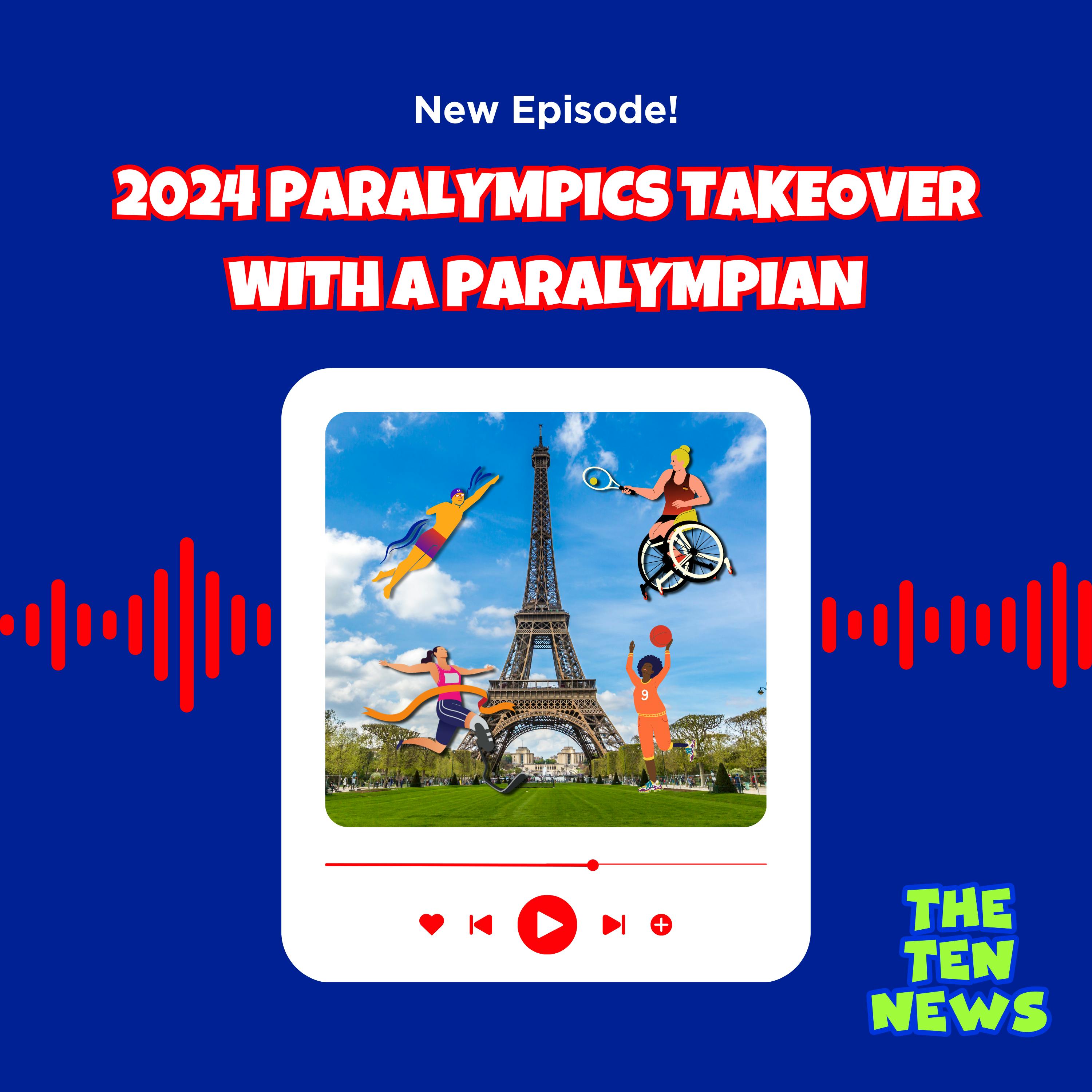
Loading summary
Transcript122 lines
- [00:03]
A
Yeah.
- [00:03]
B
Ryan, are you okay?
- [00:05]
A
Bad.
- [00:06]
C
I'm just. I'm a little sad.
- [00:08]
B
Is everything okay?
- [00:09]
C
I just. I'm a little sad because school basically started and, and, and, and. And I miss the summer and I miss the Olympics. It's like my favorite thing to watch.
- [00:22]
B
Oh, well, we can't stop the school year. But you do know the Olympics aren't over, right?
- [00:28]
C
Wait, what?
- [00:30]
B
Yeah, the Paralympics started on August 28th.
- [00:34]
C
Oh, my goloshes. The Paralympics have already started? Yes. Can we deep dive and talk about it?
- [00:43]
B
Of course we can, but first we gotta start the show. I'm Pamela Kirkland.
- [00:48]
C
And I'm Ryan Willard. It's Friday, August 30th.
- [00:51]
B
This is A10 News. Deep Dive.
- [00:53]
A
10, 9, 8, 7, 6, 5, 4, 3, 2, 1.
- [01:03]
B
It's August 30th, and the 2024 Olympics are over.
- [01:08]
C
Or are they?
- [01:12]
B
The end of the Paris Olympics means now it's time for the 2024 Paralympic Games. They started on August 28 and will run till September 8.
- [01:22]
C
Tenors if you don't know what the Paralympics are, you are in for a treat. The Paralympics are one of the coolest things out there. Even cooler than a polar bear eating ice cream in the wintertime.
- [01:33]
B
Like the Olympics we just saw. The Paralympics are a major international sporting event. But the big difference is that the Paralympics highlights athletes with disabilities or impairments.
- [01:44]
C
Some examples of these include impaired muscle power, range of movement, limb deficiency or vision, and intellectual impairment. This means that these athletes might look different than the ones we just saw compete in Paris, and can even look different from their competitors. But they all perform some pretty incredible stuff.
- [02:03]
B
The Paralympics now take place about two weeks after the Olympics in the same place. But that wasn't always the case.
- [02:10]
C
The first official edition wasn't until 1960, and it was known at the time as the Stone Joke Mandeville Game. We'll get to why in a second, but we've got to rewind a little bit first.
- [02:23]
B
In 1948, a British doctor named Sir Ludwig Gutman.
- [02:27]
C
Pamela, please say it like you mean it.
- [02:30]
B
Dr. Sir Ludwig Gutman organized a sports competition involving 16 World War II veterans. These competitors had spinal injuries that kept them from being able to walk or move the way others might be able to. These were the first Stoke Mandeville Games, named after the Stoke Mandeville Hospital.
- [02:50]
C
The Games may have started small, with just 16 participants, but these first Stoke Mandeville Games were what eventually snowballed into the Paralympic Games.
- [03:00]
B
From that first event, it grew and grew. In 1954, 14 nations were represented at Stoke Mandeville with athletes from as far away as Australia, Egypt, Pakistan and Portugal.
- [03:13]
C
In 1960, these Olympic style games moved to the same site as the Olympics for the first time. And Rome hosted the Paralympics after the close of the standard Olympics. These Paralympic Games attracted 400 participants from 23 countries who competed in eight sports, including archery, basketball, and swimming.
- [03:34]
B
Wow. 16 participants to 400 participants. That's a big improvement.
- [03:41]
C
It gets better. In 1976, the first winter Games in Paralympics history were held in Sweden. In 1989, it got even more official.
- [03:52]
B
The International Paralympic Committee was founded as an international nonprofit organization in Germany. Specifically Dusseldorf Gesentheit.
- [04:00]
D
Oh, wait.
- [04:01]
C
Dusseldorf is a place the Paralympics and the Olympics have a lot in common, right?
- [04:06]
B
Yes, they do. They both have Summer Games every four years. Winter Games every four years include opening and closing ceremonies, and most importantly, feature some super impressive athletes.
- [04:18]
C
All these similarities make a lot of sense considering the word Paralympic is from the Greek preposition para that means beside or alongside. Put it together with the word Olympic and voila. Man, I would love to be para in Paris with the athletes right now.
- [04:33]
B
The Paralympic Games may not have quite the viewership of the Olympics, but they've got a lot of fans, to say the least. The Paralympic Games are the world's third biggest sporting event by ticket sales, outnumbered only by the Olympic Games and the FIFA World Cup.
- [04:49]
A
Whoa.
- [04:50]
C
The Paris 2024 Games have barely just begun, but already they'll make history as the first Paralympic Games to offer some live coverage from each of the 22 sports. Tokyo's 2020 Olympics only had 19 sports broadcast, and Rio's 2016 Paralympic Games had 15 sports that were shown live.
- [05:08]
B
And Ryan, when you look at some of the athletes, it's no wonder that people are eager to tune in. Everybody that makes it to the Paralympics is super impressive just for making it there, which makes it even more difficult to be the best of the best.
- [05:23]
C
That would be someone like swimmer Tricia Zorn Hudson. Despite being born with a genetic eye condition that left her blind, she is the most successful athlete in the history of the Paralympic Games. She's won 55 medals, including 41 gold medals, over seven Paralympics. For context, Michael Phelps has 28 medals.
- [05:43]
B
Absolutely incredible. I'd love to know what it's like to compete at that level.
- [05:47]
C
Yeah, me too.
- [05:49]
B
Well, I think we might know someone who might know someone.
- [05:52]
C
I. I have no idea what you're talking about, but I am game. Pam, what sport are you best at?
- [06:02]
B
Hmm, I'd say volleyball. How about you?
- [06:07]
C
I'M a pretty fast swimmer and a pretty mediocre table tennis ping pong player. So I'd say swimming. Some people have said I'm like a mermaid in the pool. I mean, merman, actually, I'm a merman in the pool.
- [06:23]
B
What would you say if I told you that ten News correspondent Sarah Namayus sat down with an actual Paralympian who competed in swimming in Rio in 2016?
- [06:33]
C
I'd say I'm freaking and geeking out right now. Sara, is this true?
- [06:41]
D
Um, yes. Ryan, I'm with for now.
- [06:43]
A
Maybe.
- [06:44]
D
Calm down and just listen.
- [06:46]
C
Okay, cool. I'm listening.
- [06:48]
D
Okay. So today we have a truly inspiring guest who has swum her way to the top. She competed in the 2016 Paralympics in Rio de Janeiro, Brazil, and she has shown the world that with determination and a lot of heart, you can achieve your dreams no matter what. Let's give a big splashing welcome to Riley Boyt. She's an incredible swimmer who's here to share her story with us. Riley, we're so excited to dive in and learn all about your awesome journey. Welcome.
- [07:17]
B
Thank you.
- [07:18]
A
Thank you for having me. I'm so excited. Great.
- [07:21]
D
So how did you first get started with swimming and what made you fall in love with the sport?
- [07:25]
A
It was a throw it at the wall and see what sticks thing for my parents, they're both athletes. They grew up doing different sports. And so me and my brother, they wanted us to also be athletes. And so I think the first thing we started with was T ball, and it went really badly. I have no hand eye coordination, and I ended up taking a ball to the stomach. And I was like, yeah, this isn't. I'm done. So they put me in dance class and ballet like a lot of young kids. And I loved mirrors as a child. And so I would kind of free flow and do my own thing, interpretive dance style. And that obviously did not work in ballet class, so that didn't work out. And they switched me to soccer for a while. And they're like, okay. Like, this is it. She's gonna be with other kids. She's gonna be running in the fresh air. I don't run. Let's start there. So they're like, okay. And I actually remember going to my first swim practice and my mom being in the front seat and she was like, honey, let's just try this. Like, let's just try. Just stick it out for one week for me. Like, this is it. And they should have started with something first. Would have saved them. I'M sure time and money, because that stuck very quickly. I've always been happiest in the water. It was just kind of instantly home for me. And so I think that was a big stick.
- [08:39]
D
And how old were you when you first got in the water?
- [08:41]
A
I was 8, I think. Yeah.
- [08:44]
D
Wow. So what was your journey like then, to the Paralympics? You know, you. How did you go from being an 8 year old swimming basically in your local pool to winning world championships and qualifying for the games in Rio in 2016?
- [08:57]
A
A long journey. But I actually qualified when I was 11, so I got very, very lucky. I grew up in Fort Collins, Colorado, which is kind of a hometown for Paralympic dwarf swimmers. I don't know what's in the water there, but there's a bunch of us. I just happened to swim at the local pool with the coach, Jackie, and she had coached most of them previously, and I finished 100 breaststroke, and she came up to me and she's like, oh, you qualify for Beijing trials. So that was back in 2008.
- [09:29]
D
So can you tell us what is it like to have dwarfism and be a champion athlete? And what challenges have you faced and how have you overcome them?
- [09:36]
A
Yeah, I think there's a few things to that, like being a dwarf in a society that isn't built for me. I think it's a lot of experiences that most disabled people have is. It can be really frustrating. It can be pretty difficult to navigate a world that wasn't built for me. Dwarfism especially. Society views us differently than, I think, some other disabilities because they've historically been seen. My community has been seen as something for comedic effect. So I think it is a thing of, like, being taken seriously both as a woman and as a dwarf and as an athlete. Took a bit, but I like the powerhouse athlete, especially just the female dwarf swimmers that came before me. I think laid that groundwork. And so that that made it a lot almost easier to get over that obstacle of, like, you can't do this, that society tells you it's a disabled woman. Because, like, if they went and did it and they're getting gold and winning svs and Golden Goggle awards, like, I could probably go do it. So I think that was a really big, big motivator for me.
- [10:39]
D
So what strokes do you swim?
- [10:41]
A
I swim the backstroke, front stroke and 200 IM, which means I also swim a little bit of butterfly.
- [10:49]
C
Excuse me. Hi. Hello, Legend Riley. I'm Ryan. Did you just say that when you swim you turn into a.
- [11:00]
A
I'm sorry, I can understand what you're.
- [11:03]
C
When you swim, do you turn into a butterfly?
- [11:10]
A
Yeah, I swim butterfly. Is he okay?
- [11:19]
D
Yeah, Ryan just has an irrational fear of butterflies.
- [11:23]
A
He knows that. I'm not actually talking about the butterflies though. Like, I'm talking about the butterfly stroke, right?
- [11:29]
D
No, no, he does not. Okay, let's get back to it. So how do you handle your nerves before races or how did you. Do you have special tricks or rituals?
- [11:38]
A
I was so superstitious. And it's so funny because you don't hear about swimmers being superstitious. I was incredibly, incredibly kind of ritualistic. Like what, what would I do behind the blocks? Was always the same. Like I'd always do the same amount of like arm swings. If I was doing backstrokes specifically, I'd always splash water on myself, but not for any of my other strokes. I like it always had to be backstroke, had to be a splash before. I always would have like the same amount, like where my goggles would go on my hip were the same.
- [12:13]
D
I mean, it sounds like a lot of pressure.
- [12:15]
A
Yes.
- [12:15]
D
I mean, did you, did it feel. Because you were young, did it feel like a lot of pressure or do you feel like it worked in your favor and now you've, you know, how you, how do you use that, those skills now?
- [12:26]
A
Oh, yeah. I think the thing that I'm really, really loving about this games is we're finally talking about athletes mental health in a way that I don't think we have in previous years. I think there's been this really big idea that to be at this level of elite, you're like untouchable. Like your mental health is top game. You don't have worries. You're not. This is, there's not this massive pressure and there's so much pressure being at this level. Like, it's not. You aren't just letting yourself down if you fail or if something goes wrong. Like you have everyone that has gotten you to the moment. You have your country behind you. You have kind of the weight of expectations. You have younger generations, I think is the big one for me. Like you have all these little kids and all these people that are looking up to you. And so it is this huge, huge mental pressure.
- [13:17]
D
Tell us about that. Just not to interrupt you, but I was gonna. So you, you've retired from swimming, is that right?
- [13:22]
A
Yeah.
- [13:22]
D
And did that, is that decision partly because the pressure got a lot or do you just kind of end?
- [13:27]
A
No, no, no, no. I had. It didn't have anything to do with the pressure. I think the pressure, it doesn't ever get easier, but it just becomes something that is a part of your day to day life. But it had always been a rule for me. I assume my parents established it when I was younger, but it was the minute I stopped loving the sport and was just doing it. To be a Paralympian was the minute I retired. What's next? Like what, what I do? And it ends up. You end up feeling very adrift and almost useless because this was your kind of big thing.
- [14:04]
D
And so what are you doing now?
- [14:06]
A
I am studying sharks. And so that was a big thing is my parents were like, you have to have another interest. Because you see so many Paralympians and Olympians retire and then they don't know what to do. Like, that's all they've ever been is this athlete.
- [14:20]
D
And so the connection between marine biology and swimming is that. I mean, is that your love for the water?
- [14:27]
A
It is the love for the water. I have always been happiest when I'm in the water. My parents told the story of every time I cry as a baby, they'd stick me in the tub or the sink. It helps that I was a dwarf. I was so tiny they could just do that. But it has always been a major love of the water. And then I think I thought the ocean was so fascinating. I love really gross stuff and there's really gross stuff in the ocean. I study the stomach contents of sharks, so I'm digging through their actual puke and vomit. So I think it gross.
- [14:59]
D
Yeah, it was an awesome, awesome.
- [15:02]
A
Yeah, it was that love for the water that kind of sprang both careers.
- [15:07]
D
And who are you rooting for in these Olympic Games now in Paris?
- [15:10]
A
Oh, so, so many people. I'll start with not swimming because I feel like that's an easier thing to do. I have so many friends in track and field that I'll be rooting for. I mean, Tatiana, obviously. I think this is like her sixth or seventh games. So rooting for her, rooting for Chuck Aoki, who's in wheelchair rugby. The men's wheelchair basketball team is just incredible. I always root for them. Those guys are beast. So for sure be rooting for them. I'm really excited for the world to kind of be introduced to goalball this year. So we'll be cheering those on. My lab is actually going to be watching goalball with me. Sitting volleyball is having an amazing, amazing run, so it'll be cool to see those girls play. And then for swimming, I have so many friends that are there and some newbies too. But like, you have Jessica Long, who's doing, I think this will be her fifth or six games. You have like Zach Shattuck, who I swam with will be going. You have Colleen Mackenzie, I think Jamal Hill, like, the list is endless. You have Evan. So there, there's just a really good, good crew going this year. And so it's going to be really exciting to see them swim.
- [16:25]
D
Exciting. That is exciting. And it's been so exciting talking to you. Really. It's been fascinating to hear your story and I love hearing all of it. Thank you so much for stopping by. Oh, and you know what? And by the way, you should stop by the trivia throne on your way out.
- [16:39]
A
On my way.
- [16:40]
D
Awesome. Thank you.
- [16:44]
B
Thank you so much for joining us. Riley, it was an honor to have you here.
- [16:48]
C
You can catch the Paralympics now through September 8th on NBC. And Peacock.
- [16:59]
E
Welcome to the trivia room.
- [17:01]
A
Hey, Owen.
- [17:03]
E
Oh, my goodness. Riley. Boy, a real life Paralympian. That's so cool.
- [17:08]
A
I heard you're the trivia master and I like challenges, so.
- [17:11]
E
Okay, well, I've got a challenge for you. Hop on up to the trivia throne.
- [17:18]
A
Sweet.
- [17:21]
C
What is going on here.
- [17:31]
E
Is France has been the host of the Olympics and Paralympic games this year. Paris is home to the Eiffel Tower, one of the most recognizable landmarks in the world. But which of the following is true about the Eiffel Tower? A, it has 5,000 steps. B, it can grow, or C is made mostly of wood.
- [17:56]
A
Well, 5,000 is a lot, so I feel like it's not that. But I'm pretty sure I've heard that it can grow. I feel like it has something to do with like heat or cold. So I'm gonna go with it can grow. Mostly because the wood thing doesn't make sense to me.
- [18:10]
E
The answer is B, it can grow. The Eiffel tower only has 1,664 steps, but you can only climb 674 of them. It's made mostly of wrought iron, not wood. As for growing, you heard right. Metal contracts when losing heat. So in the winter, the tower actually shrinks. It also leans to one side because the sun only hits one of the four sides. So this side will expand with the heat, causing the tower to lean.
- [18:48]
A
Yes, I got it.
- [18:50]
E
Thanks for playing, Riley.
- [18:52]
A
Thanks for having me, Owen.
- [18:53]
E
Tenors, if you have a great trivia question or want to sit on the trivia throne, leave us a message at 877-10-NZ and we might have you on the show.
- [19:09]
B
Um, Rye, why are you in a mermaid costume?
- [19:12]
C
Uh, it's a merman costume, actually. And it's because I need to find a pool so I can train in case Riley challenges me. Obviously.
- [19:21]
B
Yeah, Riley's a legend, but she's retired. I don't know if she'll be racing you anytime soon.
- [19:28]
C
That's why I gotta start training now. Legends come out of retirement all the time. Also, I never know if a tenor is going to challenge me, so I got to be ready.
- [19:38]
B
Yeah, I don't know if any amount of training will help you beat any of them.
- [19:42]
C
Thank you for believing in me.
- [19:43]
B
But before we do, here's a quick note for the grown ups.
- [19:47]
C
Steve Cubine and Nan McNamara's podcast From Beneath the Hollywood sun pulls out a box and gives McAllister a ring, saying, here's something to remember me by. Daryl Zanuck hit the roof. Mary Aster has been keeping a diary.
- [20:02]
A
This torrid affair with George S. Kaufman.
- [20:05]
C
Is chronicled on a daily basis, talking about the actors and actresses who won an Oscar on their very first film. Get your fix of old Hollywood on the podcast from beneath the Hollywood sign. Thanks for listening to our Paralympics Deep dive check. Keep a lookout for an extended version of our conversation with Riley Boyd for our Tenors club members. And if you're not a Tenors club member yet, you can join on our website. And while you're there, grownups can help support the show by making a tax deductible donation. The whole team thanks you for your support.
- [20:42]
B
The 10News is a co production of Small but Mighty Media and Next Chapter podcasts and part of the Airwave Podcast Network.
- [20:49]
C
The 10News Creative team is in awe of the amazing Paralympians and includes Tracy Crooks, Adam the Great Bambino Bernard, Kyle Murdock, Heba Guta, and Carson Potter. Big thanks to Sarah Namayus and Riley Boyt for stopping by and to Owen for contributing to this episode.
- [21:05]
B
Our production director is Jeremiah Tittle and our executive producers are Donald Albright and show creator Tracey Leeds Kaplan. I'm Pamela Kirkland.
- [21:14]
C
And I'm Ryan Willard. Thanks for listening to the 10 news.