← The Thyroid (and Hormone) Fixer Podcast: Thyropause, Menopause, Metabolism and How to Fix It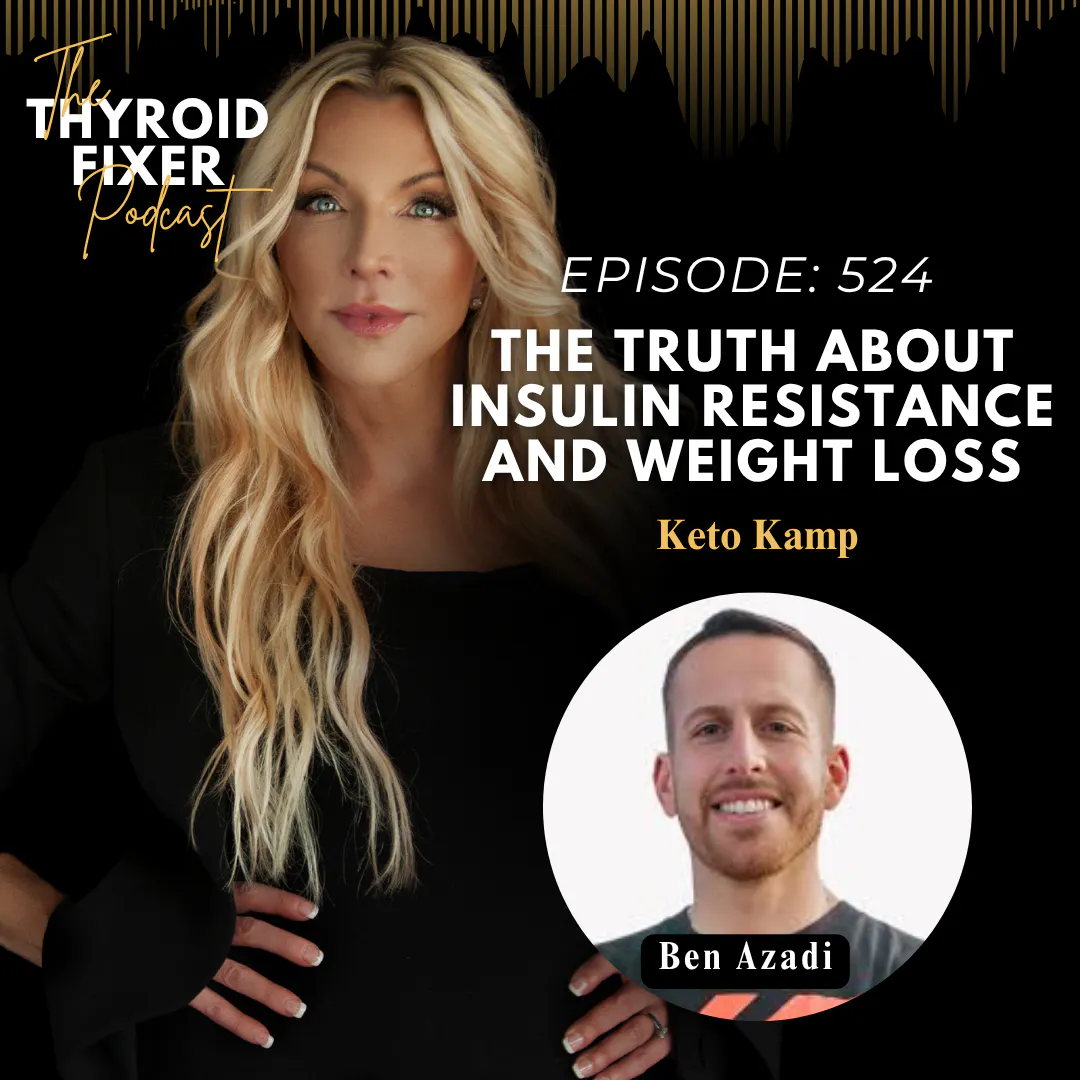
The Thyroid (and Hormone) Fixer Podcast: Thyropause, Menopause, Metabolism and How to Fix It
524. The Truth About Insulin Resistance and Weight Loss with Ben Azadi
00:51:51
Loading summary
Transcript123 lines
- [00:00]
Dr. Amy
Welcome to the Thyroid Fixer podcast, where we dive deep into the world of thyroid and hormones, especially for you ladies navigating perimenopause and menopause, and really for anyone struggling with hypothyroidism. I'm your host, Dr. Amy, thyroid and hormone specialist and CEO of a global telemedicine practice where we prescribe the right thyroid treatment and bioidentical hormones to all 50 states and most of Canada, helping you become that badass human that you're meant to be. So if you're battling weight gain and hair loss, you can't lose weight. No matter what you do. Your energy levels are plummeting and your libido left town. Then you're in the right place, and you have found your tribe. Remember, I want you to embrace every inch of that badass woman that you truly are. So if you're ready to dive in and fix things, let's get started. Okay, here's something I wish someone told me earlier. Your scalp, it's actually skin. And like the rest of your skin, it ages. Which means if you care about things like vibrant, healthy hair, like I do, then your scalp deserves just as much attention as your face. That is why I have been using OS1 hair, the latest breakthrough from One Skin, the brand I already trust from my skincare. But this one is the first ever peptide scalp serum powered by their proprietary OS1 peptide, which was discovered after screening over 900 peptides to find the one that actually works on cellular aging. That's not hype. That's real targeted science. Because here's the deal. As we age, a process called cellular senescence kicks in. And that's what leads to wrinkles, sagging of your face. But what about your scalp? Well, that shows up as thinning hair, slower growth, shedding. That makes you want to count all the hairs that come out of your head and then scream into a pillow. Yeah, that. I've been there, done that. So I started using OS1 hair for three months now with the dermal. So I use the derma roller, put the serum on, stick my head in front of a red light, and I've already noticed results. So way, way less shedding, less breakage, and just better quality. Better quality hair. Oh, my gosh. Definitely faster growth. By the time I go to get my touch up, I got, like, 2 inches of root showing. That's craziness. This is like giving your scalp a wakeup call in a bottle. So if you're already investing in good sleep, the solid nutrition, amazing skincare routine Then here's the piece that you didn't know you were missing. So you're going to use the code Amy this time. Am I? Simple. For 15% off your order, you're going to go to OneSkin Co Amy so o n e s k I n co a mie and use that code. Am I e for 15% off one skin's changing the way that we age, which I love it one cell at a time. But just don't skip your scalp. Since the release of Metabolism Fixer, we have been bombarded by stories of people just raving about it and the results that they're getting. So what we're seeing across the board, control of appetite and without the use of expensive GLPs. Because metabolism contains that patented trademark ingredient suppressor has a boatload of studies behind reducing appetite by 69%. We have heard massive reports thanking us. Thank you from Metabolism Fixer because finally I have control over my appetite once and for all. I'm not binging, I'm not overeating. And that's really half the battle. But beyond that, we have to get the metabolism up. We have to get your metabolism up. How do we do that? Metabolism fixer contains T2. Now, it also contains purple tea and green tea, which both increase your metabolic furnace. But T2 is really the key. That forgotten thyroid hormone that increases your basal metabolic rate stimulates brown adipose tissue. That's why you're jumping into cold plunges, people. To stimulate that brown adipose tissue, turn the white squishy fat brown, make it more metabolically active, protect your muscles. T2 acts like an exercise mimetic. So it's just like you're going to the gym. This is what gives us that better metabolism, so that we're burning fat while we're just sitting around doing nothing. So you don't have to starve yourself to lose weight. You don't have to work out three hours a day to lose weight. By adding a Metabolism fixer, you're going to have better appetite control. You're going to have nice, steady energy through the day. That's another thing that T2 does. Bonus. And you're going to have a better overall basal metabolism, the amount of body fat and energy that you are burning at rest. And that is what is going to ignite your metabolic furnace. And that is what is going to get that weight off of you once and for all. So if you need better appetite control and you know, you just want a better metabolism and you don't want to carry around extra weight Add in Metabolism Fixer. Just one scoop a day. That's all you need, one scoop a day. It will start kicking in very shortly to control your appetite. Studies show about two week onset, but we've had people notice that appetite control kick in within a day or two. Add in one scoop Metabolism Fixer. You are going to thank me that you saved hundreds, if not thousands of dollars not using a GLP, but using this. Yummy. Throw it in your water flavors your water. Oh my God, it tastes like Tang. Metabolism Fixer every day. Okay. Unless you have been living under a rock for many, many years, you have heard of Ben Azadi. He is powerhouse in the keto space. Author and founder of Keto Camp, has five different books. He's known as the health detective. But his latest book, Metabolic Freedom. Oh, it is so good, so amazing, so good. We dive into that book and all of his principles in it that I really wanted to highlight on this episode. Not to give away the book, you still have to read the book. But Ben just dives into these metabolic approaches and explains in depth what it means when your insulin is high, what it means to be metabolically broken, how it goes way beyond just weight and appearance. It goes deeper than that into longevity, into health, into prevention of diseases like cancer, heart disease and Alzheimer's. This is a not to be missed episode with my dear friend and colleague, Benazade Ben. It's only been forever that we've been planning this interview, but because of your amazing new book out, we finally are getting together and diving deep into what's in that. I'm going to start off by saying thank you for writing that book. Number one, we are so metabolically broken as a society and I'm going to let you dive into the stats on that. But the way that you laid everything out in that book, I just felt even as a practitioner that knows a lot of this, I was intrigued, enthralled, drawn in and, and it stimulated my brain to even help my patients more. So you even taught me, in addition to this being very, very easy and very, very doable for anyone, you actually, I mean, I also recommend it for practitioners because you taught me a lot in that and you brought things to light that we're going to talk about on the show today that really made me think about individual patients, family members, the whole thing. So let's start with what, what is the percentage of metabolically broken people in America?
- [07:47]
Ben Azadi
Well, first of all, thank you because I learned from you all the time. So it's great to hear that it's reciprocal as well. And the book was written for the masses. But there. So a lot of scientific citations in there. 275. To answer your question, what is the percentage? It's. It's a bad percentage. 93% of Americans have some variation of metabolic dysfunction, Amy. 93%. And that's a 2022 study. So it's a recent study. There's also a study that I put in the book from 2016 from the Mayo Clinic, which was looking at how many Americans live an active, healthy lifestyle. That was what they were trying to determine. And they based it off of four criterias. The criterias were, number one, they don't smoke cigarettes. Number two, they exercise either. Moderate to vigorous exercise for a total of 150 minutes per week. The third criteria was that they eat what they consider a healthy diet, which is simply just a minimally processed diet. And the fourth criteria was that if they're a female, they have a body fat percentage under 30% and a male under 20%. And at the end of the study, it said only 2.7% of Americans fit that criteria of an active, healthy lifestyle. That's it.
- [08:56]
Dr. Amy
Oh, my gosh.
- [08:57]
Ben Azadi
So we are in dire straits. Most people are not living metabolically free. They're in a metabolic prison, unfortunately.
- [09:04]
Dr. Amy
And what about food addiction? Would it be about the same percentage where people literally can't break free from their addiction to carbs and sugar?
- [09:13]
Ben Azadi
There's. There's variations to the addictions, right? There is chemistry happening in the brain, there's trauma. There's different things going on. But in terms of like, like the, the cravings and the sugar and the processed carbohydrates, it's right up there. Because I don't know what came first, the chicken or the egg. Was it the fact that they were eating unhealthy that led to the addictions and the cravings for sugar? Was it the other way around? But I can tell you that I. I believe food addiction. And I think, let's be clear, not necessarily food addiction, but sugar and carbohydrate addiction. It stems from boredom, lack of purpose. It stems from misinformation. So the book addresses all of that. And I do think, like snacking and grazing, it's. It's an emotional event. A lot of people are doing it out of boredom and, and lack of purpose. That was my story. Being addicted and to drugs and food and sugar and video games for so many years. Cause I lacked purpose and goals. But when you get clear on your goals and your purpose A lot of that starts to go away, which is super cool.
- [10:08]
Dr. Amy
Now we're gonna get into that a little bit deeper and also into insulin resistance, because I really believe my audience desperately needs that. But I'm gonna have you start with your story of your dad, because that was really impactful when I was reading that. So can you share that story with the listeners?
- [10:26]
Ben Azadi
Yeah. It's an unfortunate story, Amy, that I'm also grateful for, because I probably wouldn't have this. This passion and fire inside of me if I didn't go through it. My dad had type 2 diabetes, which about 60% of Americans are diabetic or pre diabetic. I would estimate it's probably more. People just are not testing. And I didn't really understand it. When I was younger. I just remember my dad taking his medication, taking him to his doctor's appointments every Tuesday. I would pick up my dad, actually, and take him to the grocery store and buy all the foods his doctor told him to eat and refill his medication, make sure he was taking his insulin. And year after year, he was getting more symptoms. So he was starting to lose his vision. He was getting really bad diabetic neuropathy. He was gaining weight, inflammation, all the things that start to happen with diabetes as it progresses. And In November of 2013, he called me because he was having severe diabetic neuropathy, where it starts off with pins and needles, and as you know, it leads to, like, your feet feeling like they're inflamed, and then eventually it feels very difficult to even walk. And he was having difficulty walking, even going just to the restroom. So he called me, letting me know that he could barely walk. So I take him to the hospital. Me and my mom take him to the hospital. And in the hospital, he was very stressed out because he knew that amputation was on the table, because as that neuropathy progresses, there could be an infection that could occur, spread to the rest of the body and kill the diabetic. So typically, they amputate the foot or both feet to stop that infection, prevent it from spreading. And you know what's crazy, Amy? In the hospital that next day, he was there overnight. And when I came back the next day, I walked into the room, and I don't even know if I described this in the book. I don't remember. But I walked into the room, and I'm starting to talk to my dad, and he's not talking back to me. He's just looking at me, and he was just speaking to me. The day Before. And I'm thinking, something's wrong with my dad. Nobody's in the room. I'm just there with him. So I flagged the nurses, the doctors. They come and they run tests. And he suffered a massive stroke in the hospital. They'd even catch it. And it was so severe that it left him paralyzed the entire right side of his body. And with the inability to speak, he lost his function. And that was the beginning of the end. Meaning, like, ever since that happened, he started to deteriorate. They. They transferred him to hospice care. And I would visit him in hospice care every week, multiple times a week. And I would just show up for him and play music and update him on my life and talk about things happening in my life, just being there for him. And week after week, every time I came into that hospice room, his body was just shrinking before my eyes. He was deteriorating right before my eyes. And nine months into this, I remember it was August 11, 2014. It was a Monday night. I walk into that hospice room, and he was in the worst shape I had ever seen him. And he was throwing up, convulsing. Really, really bad shape. And the nurses start working on him and cleaning him up, and they did a good job. They cleaned them up. And that night, I remember walking up to him and just expressing how much I love him and how I'm always going to be his son. He's always going to be my dad. And I kissed him on the forehead, and I. I said the words, hasta la vista, baby, which from the movie Terminator. He used to always say it to me when he said goodbye. Like, hasta la vista, baby. And I said it to him, and little did I know that I was giving him permission to let go. He was holding on for nine months. I didn't realize it at the time that I was doing that for him, but when I drove home that night, I was crying in my car and I got home and I was praying that night, and like, I said the same prayer that I said every night for months, which was, God, please end my dad suffering. He suffered enough. I don't want to see him like this anymore. And I went to bed, and I woke up that next morning, and I just went about my day. And around noon that next day, my phone rang. And I look at the phone, and I see the caller id and it's the hospice calling me. And I just knew, you know, my heart just sunk in my chest. I knew something was off. And I pick up the phone, and it's my dad's nurse letting me know that he, he passed away that morning. And it was a wave of emotions came over me. If anybody has lost somebody they love and see how much of a challenge they had to go through, the suffering, it's part of you is relieved because you no longer have to see them in pain. They're no longer in pain. Their suffering is, is ended. But you lose that person you love. And I lost my dad. And it just a wave of emotions. And I was angry. I was so angry. I was pissed off because I followed the instructions. I did what his doctors told me to do. I made sure he took his medication. I went to the grocery store with him every Tuesday and bought the food. They told me to buy his, his Gatorade zero and his fiber one bars and the things that I didn't know was actually making his diabetes worse. And it raised all these questions for me. And that's where I really got hungry when it came to studying health and nutrition. I was treating it as a hobby until that point. And I dug into the research. Metabolic health, diabetes, obesity. And I know the information that I share now is the same information that would have saved them. I know that. But I also know that I was given that mountain so I could show the world the mountain can be moved. You know, diabetes type 2 is a lifestyle condition that's treated with medication. What a mismatch. You don't treat a lifestyle condition with medication, especially type 2 diabetes. You treat it with a lifestyle change. And the amazing thing about type 2 diabetes is that it's completely reversible and it's completely preventable. I wish I would have known that as I was going through those, those challenging times, but I know it now. So my, my purpose and my duty is to get it out into the world. And that's part of the reason why I wrote the book and I dedicated the book to my dad.
- [15:53]
Dr. Amy
Yeah, yeah. I mean that was a very impactful story. It made me cry, just like you almost teared up right there. Because it's. I think it makes people think, just like you said, that it could have been prevented. Technically your dad could still be with us today if he had the information that you're sharing with the rest of the world right now. I don't believe that people with diabetes and even with insulin resistance, that pre diabetic state, I don't think they realize how it can impact them and how it can impact many different aspects of their life and their health. We tend to think. And I put myself in this category too because like I said, I learned from your book, too. We tend to think. Wait, wait, wait. We're, we're very much a vanity society. Let's face it. You know, this is true. We don't think longevity, we don't think death. We don't think about losing a leg or a toe or, or the impact of high insulin and dysregulated glucose. So in your book, you really dive into it. And I want you to do that for me today because I want to punch my audience in the face with this information. And as a wake up call.
- [16:59]
Ben Azadi
Yeah.
- [16:59]
Dr. Amy
If your dad's story wasn't a wake up call, I want this next conversation to be a wake up call. What are all the different ways that insulin and high blood sugar can affect the body?
- [17:10]
Ben Azadi
So, so I dedicated a whole chapter to this. As you know, it's the first domino to fall that leads to a cascade of metabolic diseases. It's high insulin levels. Insulin, as we know, is not a bad hormone. There are no bad hormones. God made the body. We have amazing hormones, including insulin. But when it's chronically elevated, it's a problem. So insulin, as we know, is a, is a fat storage hormone. Yes. It's also an energy sensor. And it just signals growth, growth, growth. And when you have high levels of insulin and when it's chronically elevated for years, things start to change dramatically in your body. But what's interesting is when I looked into the research and there are two studies I put in the book, a Whitehall study, two and a different. In a different study, it shows you could have full blown insulin resistance. In other words, hyperinsulinemia for 6 to 14 years without your fasting blood sugars changing at all, or even your A1C changing at all. Because the pancreas is so busy producing massive amounts of insulin to clear the excess blood sugar until it can't. Until you go deaf, the receptor sites go deaf to the screams of insulin. Then there's a dramatic increase in your blood sugars, then it's prediabetes. And if you're not checking, it's full on diabetes. But if you just got a fasting insulin blood test, you could actually pinpoint this is going in the wrong direction. It's like Einstein said, intellectuals solve problems, geniuses prevent them. Like a fasting insulin is a genius test. We want to see that in the single digits. We want to see that between three and six. That means you have a nice fasting insulin and sensitive levels of insulin. And what's crazy, and I know you talk so magnificently about this in the thyroid world. You just did this on my podcast. The reference range for a fasting insulin is 3 to 28. So if a conventional doctor orders it, which they're not, because there's no medication for a high insulin, they're not gonna order it unless you request it. But if you do look at a fasting insulin blood Test and it's 17 or 21, most doctors will not flag that as being an issue. Even if it's 12, we're fine. That's insulin resistance. You want it to be three to six. And if it progresses, then your blood sugars change. And what happens then your body strips nitric oxide, meaning you lower nitric oxide from the body with high levels of glucose and insulin. Nitric oxide, as you know, is a gaseous molecule. Cell signaling creates vasodilation, which opens up your blood vessels, which is important to allow oxygen and blood flow and nutrients deliver to tissues and cells. When you strip nitric oxide from high glucose and high insulin, it creates vasoconstriction, where now the heart has to pump harder, which is the number one cause of high blood pressure, which is one of the leading factors to the number one killer, high heart disease. Right. So it is the sugar, it is the insulin. That's what's going to trickle. And then, look, once you're diagnosed with diabetes, it opens up huge risk factors for cancer, heart disease. As a matter of fact, I make the case in the book that it's rare to die from diabetes. It doesn't really happen. It's what the diabetes leads to. It's what happened to my dad. It was the stroke, it's the heart disease, the cancer, the kidney failure. That's what the diabetes will lead to. The vision loss, the pricking of your finger, the peeing all the time, being thirsty all the time. It's a poor way to live your life. I saw this with my dad. But if you just looked at your fasting insulin and saw that it was elevated, you can make some changes before any of that happens. One more Point. The A1C is a great test. I'm not knocking that. Get an A1C, which is the three month average of your blood sugar. The fasting glucose is also great. I would put fasting insulin above all of that. But there's a study I put in the book that shows when your A1C is 7.5% or higher, which is diabetic, every year it's at that level, they estimate 100 days come off your lifespan. A hundred days. So if it's at that level for five years, if you're a 15 years. Excuse me. If you're a type 2 diabetic with an A1C of 7.5% for 15 years, you lose four years off your lifespan. That is how destructive diabetes is inside of the body.
- [21:18]
Dr. Amy
Yes. And what about the brain? Because that's. That this is where it touches home for me. I lost my mother and I went through the same prayers as you did, watching her deteriorate over the years from Alzheimer's, praying to God, like, come on, it's. It's time. It's time. When I look back at her life, at. At what really triggered it. Yes, we have that genetic predisposition in my family. And you bet your butt that I'm doing everything to keep my insulin and glucose in check so I don't end up going down that same path. But when I look back at her life, she had bread every single day. She had two to three Diet Pepsis every single day. She finished the day with a bowl of ice cream. I know she was metabolically broken. How does elevated insulin drive. Brain disorders.
- [22:07]
Ben Azadi
They're calling it type 3 diabetes. Diabetes of the brain. Right. We have insulin receptor sites in the brain. So when you're a constant sugar burner, like 93 of Americans are, you are creating glucose and insulin spikes, and eventually those receptor sites get burned out. You're not going to be able to process insulin or glucose into the cell, which via insulin, and that happens in the brain, so that all of a sudden your brain is starving, can't get an energy source, and then you develop Alzheimer's, dementia, whatever it is. They're calling These conditions Type 3 diabetes. Ketosis is great because ketosis and ketones, just a keto approach, this metabolic state of ketosis, it's a great way to get energy into the brain when it's not using glucose. So I think it's a great modality, not just for brain disorders, but in general, it's a great tool to use. But, yes, you're correct. This is diabetes of the brain. What happened with your mom, unfortunately, this is happening with a lot of people that are sugar burners. But you could do something about it. Right? That's the great news. And that's what we're talking about here.
- [23:06]
Dr. Amy
Yeah, absolutely. So now let's go back to the vanity metric.
- [23:09]
Ben Azadi
Yeah.
- [23:10]
Dr. Amy
How does having that elevated insulin make people fatter or prevent them from losing weight? Now, we talked on your show about the importance of thyroid, and I. And I said on your show yes, you have to have an optimized thyroid in order for the body to burn fat. But I also have these patients that we are optimizing their thyroid and they're resistant to change and they won't change their diet and lifestyle. And then they complain about not losing weight. I say, well, you're insulin resistant. Your body's not going to release fat. When you're in that elevated insulin state, can you dive into that more?
- [23:42]
Ben Azadi
Yeah, that's. Insulin is a switch that allows you to burn fat. And if it's elevated, that switch never gets turned off. So you're in sugar burning mode. You cannot burn body fat if you're in sugar burning mode. What do I mean by sugar burning mode? Well, when you're eating high carbohydrates and when you're eating frequently, you're burning sugar in the form of food. Oh, Ben. But I only have, you know, whole grain wheat bread and I have organic cereal. All of that turns into sugar in the body. Sure, it's not as bad as processed, heavily ultra processed foods which rapidly spike your, spike your blood sugar, but it's still turning into sugar. All carbohydrates turn into sugar. Insulin is produced to clear that. And whenever you're doing that, you are not burning fat. You are burning sugar in the form of food. It's not a fun way to live. It ages you fast. We need a lower insulin to tap into store body fat. Insulin is the key. It's the switch that allows you to burn stored body fat. So we eliminate snacking, we increase protein and fat, we decrease carbohydrates, we exercise, we strength train. And you know, I learned from you as I just interviewed you that when you have high levels of insulin, it converts, it takes T4, as you taught me, the inactive inactive form of thyroid. And instead of turning it into the active form, T3, it increases it into reverse T3. Right. High insulin levels. So this is something that also I'm learning from you. If you want to lose weight, burn fat, get lean, shrink belly fat. It's not about calories, it's not about grazing and boosting your metabolism. It's about lowering the hormone insulin. That is the key. That is the sustainable way to do it.
- [25:14]
Dr. Amy
I promise to tell you more about the hormone fixer. So here it is. This is a supplement to raise your GSD hormone. So those of you who have a total Testosterone less than 50, this is for you if you're struggling with weight, if you're aging. Because if you're aging, your growth hormone Is declining. If you need more growth hormone, if you want to just feel better and anti age, we all need testosterone. We need growth hormone as we age, Both of those decline. And in order to have motivation, in order to build sexy, lean muscle, in order to have a libido, a focus, a concentration, energy to get through your day, the desire to even want to go and work out, you need testosterone. To anti age, you need growth hormone. I address both of those in my hormone fixer. So I'm going to invite you to try this out. You could notice we have had reports of women noticing a difference within the first two weeks of use. More energy, better stamina, a little bit of weight loss, better strength at the gym, soreness from those hard workouts gone. So we've had great, great reviews, great reports. I invite you to try it out. Go to my store@drammyhorneman.com click on shop and you will see it right there. And we will put the link in the show notes as well. Well, you just led me beautifully into my next question. You talk in the book and we're not going to give everything away, but when I was reading your five fat loss myths, I was like high fiving you virtually. I'm like, yeah, he's talking about it. This is what I say all the time. Let's just touch on a couple of those. First of all, calories in, calories out. I mean, I think we're still in that mindset sometimes. You know, in the world of weight loss, I think there is still like the Jenny Craig's out there that are counting calories. Talk to me about that myth.
- [27:13]
Ben Azadi
I used to teach that myth. Did you also teach that myth? Oh, yeah, yeah, yeah. I think we're all guilty of it. You know, it's interesting. I see a lot of times people go from teaching calories to hormones, but I never see it the other way is what I mean.
- [27:24]
Dr. Amy
Yeah, exactly.
- [27:25]
Ben Azadi
They never go from hormones to calories. Calories matter, absolutely. But they're not the most important thing. The premise behind cutting calories to lose weight, their premise is that we need to lose weight to get healthy. But that's not how the metabolism works. We don't lose weight to get healthy. We get healthy to lose weight. You see, nobody has a weight problem. I used to be obese. I never had a weight problem. If you're listening to this and you're 50 pounds overweight, you don't have a weight problem. You have a weight symptom. It's a weight symptom. By cutting Calories and focusing on calories. You're looking and focusing on the symptom. The human body is not a calculator, a bank account, a math equation. It's a very complex chemistry lab. And I, I share a study. I share two studies. One study was from the TV show the Biggest Loser, which, as we know, was a popular show. Morbidly obese individuals, calorie deficit. They lost a ton of weight. They celebrated them. This study did a follow up on these contestants, at least 14 of them, and showed that 13 out of the 14 gain all the way back. And some of them actually gained more weight than they when they started. Plus, their hunger hormone ghrelin was through the roof, their satiety fat burning hormone leptin was plummeted, and they damaged their metabolism. You see, it's tricky and deceptive because when you cut calories, it will work most of the time in the beginning, but long term it doesn't. Your metabolism will match the energy coming in, and it'll start to match it by slowing down or becoming more inefficient. You see, we want a metabolism that is efficient. And when you're just cutting calories, you're focusing on a distraction instead. We want to focus on hormones, we want to focus on thyroid, we want to focus on inflammation. Once you tackle that, the weight comes off as a side effect of getting healthy. So I am tired of the old calories and versus. And the gut microbiome, which you talk about all the time as well, plays a role with fat loss. So a calorie is not a calorie. I mean, it's not the same thing. It's. They're, they're very different inside of the body and depending on the person's metabolism and their health history. So calories are not the most important thing. We need to get away from it. It's more of a distraction. Let's focus on hormones and inflammation.
- [29:31]
Dr. Amy
Well, and technically, we can take in more calories if they're in a good form. That works with our body, that works with our hormones. I would always say to my ladies, I'm like, listen, yeah, I can give you 1200 calories of Teddy grams, or I could give you 2500 calories of lean protein and some salmon and really good fats and avocado. And guess what? You're going to lose weight on the higher calorie meal plan than you will on now. Of course, nobody's going to eat 1200 calories, Teddy grams, but you get, you get the point. It is, it is about the quality of the food. And what is that food doing?
- [30:05]
Ben Azadi
Yeah.
- [30:06]
Dr. Amy
When it enters your body, is it driving insulin? Is it causing your. Your glucose to spike? Like what is happening in your body and how's your body responding to that? So same thing with another fat myth that I want to touch on that I was very guilty of even myself, because I came from the bodybuilding world. And what did we do? Eat every two hours to keep your metabolism up.
- [30:31]
Ben Azadi
Yeah.
- [30:31]
Dr. Amy
And then I learned. So I want you to talk about that, too.
- [30:35]
Ben Azadi
So many people want to boost their metabolism, right? Well, the metabolism doesn't even work in speeds necessarily. It's either efficient or inefficient. And the animals in the wildlife that have the fastest metabolism have the shortest lifespan. So we don't necessarily want to boost the metabolism. We want an efficient metabolism. There's a difference. Snacking and grazing. Yeah. Eating every two to three hours is the fastest way to age yourself. If you want to age at a cell level, and not just at a cell level, but look like you're aging, eat every two to three hours. You're going to constantly spike glucose and insulin and you're going to create cell duplication. There's something called the. The hay flick limit, which is a certain amount of times your cells could duplicate until they can't and they go rogue. It turns senescent, which is a problem. And when you are eating and snacking, you're. You're creating an accelerated response in terms of cell duplication where it reaches that Hayflick limit much faster. We're not designed to Graze. My colleague, Dr. Don Klum, did a patient population study where he showed in hundreds of his patients, he had them just write down every time they ate, whether it was a meal or a snack. And the average person was eating 17 to 23 times a day. Amy.
- [31:46]
Dr. Amy
Okay. That's way more than even the six.
- [31:48]
Ben Azadi
Meals for bodybuilders because of the grazing. It was, you know, the handful of almonds, that's a meal to the body. The sip of the kombucha, that's a meal to the body. And these are health, kind of healthier examples. But every time you eat and snack and graze, you start the digestive process. You raise glucose and insulin, you're in a fed state, you're burning sugar. So the first step here, if you're a grazer. I was, too. Amy admitted she was as well. The first step is to eliminate the snacks. Have breakfast, lunch, and dinner, Increase your protein and fat, do decrease your carbs and Eat just three meals a day. That's the first step into going into fat burning.
- [32:24]
Dr. Amy
Yeah. And then maybe incorporate in some fasting. So how do you incorporate in fasting for, and how do you train people to go from that eating every two hours to actually incorporating in fasting for their health?
- [32:36]
Ben Azadi
Yeah. So in, in the 30 day protocol. Hold it up for the video here. There's a 30 day protocol at the end of the book. I give them a step by step process on how to do that. So the first step, it's just take seven days to get them from burning sugar to burning fat. We get them fat adapted and we, we gradually lower their carbohydrates while we increase their healthy fats and protein and I give them a whole list of what to look for and what to eat and not eat and we eliminate the snacking and then we increase their minerals because as we lower insulin, we lose some electrolytes. So we increase the minerals. You do that for seven days and then to your point, then we start pairing or adding in time, restricted feeding time, intermittent fasting. So then we condense the window. Let's say you're having breakfast at 8:00am, lunch at noon, dinner at 7:00pm that's, that's an 11 hour eating window. So once, once we determine what your window is, then we condense that and shift all of your meals into about an eight hour eating window where you have a 16 hour fast, where you're 16 hours in a fasted state, lowering insulin, healing the body, repairing the gut, and a six hour eating window where you have two or three meals getting enough protein. I know you're big on protein within those six hours and then you kind of go from there. But the whole 30 day plan kind of guides them week by week.
- [33:46]
Dr. Amy
And that's really going to help with food noise, which is a whole new term that has come out, I don't know, in the last couple of years. Really, really tied to the GLP is that are making headlines. But you know, now we're hearing a lot more. Well, I have this food noise that is cravings all the time. I mean, what's your take on that? Is that really coming from us being metabolically broken?
- [34:06]
Ben Azadi
Yeah, a lot of it. Well, a lot of it's boredom. Yeah, it's an emotional event. But yeah, when you're a sugar burner, there's going to be food noise. Because here's what happens when you, let's say you hear about fasting and you're a sugar burner and you're like oh, that sounds amazing. I'm going to do a 16 hour fast tomorrow. Well, what's going to happen is you're going to lower blood sugar in the body, in the brain. Your brain's going to panic because it's not used to, it's not metabolically flexible to burn fat and produce ketones. So it will send the body intense signals for cravings, for carbohydrates and sugar. That's the food noise to fulfill its desire to get glucose back in the brain. Because you're not using ketones at this point, you're not fat adapted. You're doing it too much too soon. But when you do it the right way and gradually ease into it and get fat adapted first, then when you skip a meal or condense your meals to a certain window, you tap into stored body fat, you produce ketones and now your, your brain gets a different source of energy, which is ketones, where the food noise goes away, you actually feel great.
- [35:04]
Dr. Amy
So what's your take on GLPs and actually how they are being used to, to lower glucose to bring down the A1C, but they actually kick up insulin and you just said insulin is a driver of many different disease states. So what is your take on the GLPs?
- [35:21]
Ben Azadi
You know, I haven't researched it enough to kind of give like here's my really decisive answer on it. So take this with some skepticism because I'm not 100 sure exactly, but my thoughts currently are. I've seen some people and I've seen some research talk about very low doses of it being beneficial for neurotransmitters in the brain and just cravings in general and some fat loss. But I've also read some studies and heard some horror stories about muscle wasting. They call it what, the Ozempic face the Ozempic butt.
- [35:52]
Dr. Amy
Yeah.
- [35:53]
Ben Azadi
So there is a significant amount of muscle being lost and we want to lose fat, not muscle. So weight loss and fat loss can be different. And from my understanding, a lot of these GLP drugs, including Ozempic, there's muscle wastage happening and I'm not a fan of that. So I don't use it. I don't know much about it. It's just not my wheelhouse.
- [36:11]
Dr. Amy
Yeah, yeah. Well, no, I mean, you nailed it. It's all, it's all in the dose. And I think too many people really what I want this message to be regarding the GLPs is just what you said earlier, you can do this on lifestyle, changing your diet, changing your lifestyle, you can do this on your own without a medication. And yeah, the microdose I'm, I'm fine with, I've gone down that rabbit hole. But the macro dose and there's a huge difference. Or we'll say the standard of care, medical community dose. Yeah, we do see those side effects from it. So really, by following the protocols in metabolic freedom, you're going to reduce that food noise.
- [36:50]
Ben Azadi
Yeah.
- [36:50]
Dr. Amy
You're going to reduce your A1C and you're not necessarily going to have to take the risk of the muscle wasting and the ozempic face and all the things that can come with it. Constipation, slow gastric motility.
- [37:03]
Ben Azadi
Yeah. There's some studies showing what it does to the organs. Organ shrinkage as well. Yeah. I'm all. Always the approach of doing lifestyle first. I'm not against it. If it's the right microdose and the person's benefiting. I'm not saying to get off of anything, but I'm always going to use lifestyle first.
- [37:17]
Dr. Amy
Now, what are your favorite supplements? So I know GLP is not a supplement, but that's kind of spark my brain into, well, what can we use to kind of help support us as we are changing our diet, as we are balancing our insulin, as we are incorporating in intermittent fasting? What are your favorite supplements to add in?
- [37:35]
Ben Azadi
Yeah, apple cider vinegar is great. I'll throw it in as a supplement because it can be. It's fantastic vinegar in general, but I love apple cider vinegar. It's great to have before a meal for many reasons. The acetic acid in it, short chain fatty acid. It's great for digestion. There's also some great studies showing that it helps with that postprandial glucose response, especially if you're already insulin resistant or diabetic. There's a study that I referenced in the book that showed a 34% decrease in postprandial glucose when they had apple cider vinegar before the meal. It's huge.
- [38:06]
Dr. Amy
That's huge.
- [38:07]
Ben Azadi
And diabetics too. Yeah, huge. And for those who don't know, postprandial glucose is the blood sugar response after eating a meal, the more, the higher your blood sugars go, the more insulin that is produced, the more you store fat, essentially. And if you could block that by 34% by having a tablespoon or two tablespoons of apple cider vinegar before the meal, amazing. You could take it in a fast. It doesn't break a fast. You could even have it before bedtime. I actually made a video this Morning that I'm putting on my YouTube about taking Apple cider vinegar before bed to help with blood sugar stabilization so you don't wake up with that blood sugar crash in the middle of the night. And with bloating and gerd, it helps with that as well. People think that apple cider vinegar will be a problem for GERD and acid reflux, but they don't understand. And you understand this, but they don't understand that acid reflux is too little acid.
- [38:54]
Dr. Amy
Right.
- [38:55]
Ben Azadi
It's not too much.
- [38:56]
Dr. Amy
Yeah.
- [38:57]
Ben Azadi
It's just in that lower esophageal sphincter right here. It's come up, but it's a result of too little. So apple cider vinegar builds that acid back up. So you actually. It actually helps with acid reflux. So, yeah, apple cider vinegar. And then I would say berberine is a great supplement as well. I. I would use that sick more cyclically, meaning on and off cycles of it. And I would use it before a meal. Whether you're a diabetic or not. When I have higher carbohydrate meals, I tend to flex out. On some days, I'll. I'll have some berberine and I've done some tests, like putting a CGM on, having gelato one day without berberine and then having it with berberine. And I do see a better response with the berberine. So it's a great tool to have. It acts very similar to metformin without it being actual medication. And then magnesium and minerals just across the board. You know this. We're just so deficient in magnesium in high quality minerals. So I love bean minerals, I love different magnesiums that are out there. But we lack minerals. Our soils lack them. We're not getting them through our food. And when you're mineral deficient, you don't have the building blocks for your mitochondria to produce energy, so you feel fatigue. It wrecks your metabolism. So I'll stop there because I could keep going. You saw my. My pantry with all the supplements, apple cider vinegar, berberine, magnesium, and minerals would be my top four.
- [40:13]
Dr. Amy
Well, I have a very similar pantry. Yeah, I understand completely. Yeah, we have our baseline. Yeah. Shout out to B Minerals. Love them. We have our baseline supplements that we take, and then, you know, you start getting specialized based on what you need. But you had mentioned a CGM and that postprandial glucose.
- [40:31]
Ben Azadi
Yeah.
- [40:31]
Dr. Amy
Where do you like to see it? Because I think a lot of people are throwing on a CGM and they're like, is this good? Is it bad? I don't know what I'm even looking at.
- [40:38]
Ben Azadi
Yeah, yeah, good question. I love talking about this. So what we want to see primarily is you want to get your baseline blood sugar before you eat. Let's say it's 85 milligrams per deciliter, which is a great fasting glucose. Then you want to eat your meal and you want to test two hours after. And what you want to see two hours after eating is that your blood sugars are back to baseline, meaning around 85 where it was before you started eating. That that is considered optimal. Now you could test at the one hour mark and see where it's at. And you want to see that below 120. Anywhere under 120. But around the two hour mark, it should be closer to the baseline marker where it was before you started eating. That showed a good response, meaning your body produced the right amount of insulin where it took it right back to where it was. If you see your, your blood sugars go over 1:40 from a meal, we know that it's creating some sort of damage to your blood vessels. So you never want to see it go over 140. Diabetics are, are thinking, well, my blood Sugars are always 140. Well, I'm talking about not diabetics, but the average person testing. And it's really cool because using a CGM or a finger prick shows you exactly what food is doing right. Even foods you think would be healthy for you might really spike up your blood sugar. Have you seen that to be the case for you as well?
- [41:53]
Dr. Amy
Oh, yeah, yeah.
- [41:54]
Ben Azadi
What, have you seen what spiked your blood sugars?
- [41:56]
Dr. Amy
So keto cereal. So yes, sometimes I actually buy things that say keto on it. And it was the, it, it had to have been the, the sweetener that they used. I even forget what it was, but keto cereal. And then I, I remember I got an almond milk latte at this little coffee shop. It wasn't Starbucks little coffee shop. And I went to 180 and I was like, wow, what was in this.
- [42:22]
Ben Azadi
Sugar in it too?
- [42:23]
Dr. Amy
It had to have been. Yeah, yeah.
- [42:26]
Ben Azadi
180. Wow. Yeah. So that's funny because I had coconut whipped cream, organic coconut whipped cream with blueberries, and it jacked mine up over 150.
- [42:34]
Dr. Amy
Okay.
- [42:35]
Ben Azadi
And it was the coconut whipped cream. Because then when I just had the blueberries, it was a better response. It was actually, for me, something with my metabolism. I just can't have coconut whipped cream. Yeah, but you might have it and not get the same response. And that's where the value of, like, testing actually gets you that actual data. It's super cool.
- [42:49]
Dr. Amy
Well, I think it's even better wearing a CGM and seeing how your body responds is even better than doing a food sensitivity test.
- [42:55]
Ben Azadi
Oh, yeah, Yeah, I agree.
- [42:56]
Dr. Amy
Yeah. There's a lot that'll show you what foods to avoid.
- [42:59]
Ben Azadi
What are your, you know, food sensitivity testing. I'm just not sold on them.
- [43:02]
Dr. Amy
I'm not either.
- [43:03]
Ben Azadi
Yeah. Okay, good. Because it just changes so often. You could do it one day, seven days later, and it's like you're just going to be scrambling just avoiding all these foods.
- [43:10]
Dr. Amy
Yeah, yeah. Or if you. So I did one a long time ago, and this is back in kind of my bodybuilding days where eggs every day was a staple and I showed positive for eggs. And luckily I had a brilliant mentor at the time, and he said, you're eating eggs every day, aren't you? Yeah. He's like, well, just. How about you do it like three days a week instead? So it can actually respond to the.
- [43:31]
Ben Azadi
Things you eat frequently that are good for you.
- [43:33]
Dr. Amy
That, that, that if you were wearing a cgm, you would not see a response based on the eggs. It's just how. Yeah, I'm not a fan, so I'm glad you brought that up. Yeah.
- [43:44]
Ben Azadi
100%.
- [43:44]
Dr. Amy
Yeah. Now, in the book, and I have not had anyone on the show yet talk about uric acid, but I'm seeing a few more, even at different events that we've been to, different speakers talking about it. Why do we need to care? I've always thought uric acid and gout, that's it. It's old guys with toe issues.
- [44:01]
Ben Azadi
Yeah. I learned a lot about uric acid through Richard Johnson. He has a great book called Nature Wants Us to be fat and Dr. David Perlmutter's drop acid book. Well, uric acid is actually an antioxidant, but when it's elevated, it's showing signs of inflammation, kind of like cholesterol. Could be an antioxidant, but when it's elevated or it's showing, it's trying to repair. So uric acid, of course, leads to gout, but it also leads to weight gain and insulin resistance. High fructose corn syrup will raise uric acid levels more than anything else. So I talk about uric acid in relation to high fructose corn syrup. It'll cause weight gain. And we want to see our uric acid levels. If you're testing our blood levels under 6 that's good. You know, a year ago, about a year and a half ago, you were able to buy a uric acid meter, like a finger prick, and test it at home. It was called ua. Sure. But the government banned it. The fda. I don't know who banned it, but maybe it was the fda. You're not able to get it anymore now, hopefully. That's so stupid, right? Yeah, hopefully they change that. Maybe it was changed already, but I remember a year ago, you were not able to get it. But yeah, when I asked Dr. Perlmutter, you know, what's the top five causes of high uric acid levels, he said this. He said, number one, fructose, especially high fructose corn syrup. He said, number two, fructose. He said, number three, fructose. And then he never said number four, alcohol. And then number five, high purine foods.
- [45:29]
Dr. Amy
Okay, right.
- [45:30]
Ben Azadi
So it's pretty much fructose and alcohol. Now, if you have a uric acid issue and a gout issue, high purine foods can be an issue. If you actively have that. But by eating, like, Oregan meat, it won't cause it. But it's really the fructose, the high fructose corn syrup. In Dr. Richard Johnson's book, Nature Wants Us to Be Fat, he shares how this creates fats, weight gain, fat storage, and how animals like bears, they'll eat a ton of fructose before hibernation to put as much fat as possible to go through those months without food. And that happens to us. And the liver has to process the. The major. 90% of fructose is processed by the liver. And when you're eating a whole bunch of fructose, high fructose corn syrup, juices and smoothies, your. Your liver has to deal with that. And then it creates fatty liver disease, which is on the rise, and not just adults, but kids. And yeah, it's huge. And then you're creating visceral fat. So it's a problem. We want to look at our uric acid, and we want to get it an optimal, optimal level.
- [46:29]
Dr. Amy
I'm really happy that you dove into that, because I think giving people like. Like we said in the beginning, the vanity thing, I mean, people will change their diet, change their lifestyle to look better and then to feel better, and then I believe longevity comes last.
- [46:45]
Ben Azadi
Yeah. Unless you're Brian Johnson.
- [46:47]
Dr. Amy
Well, yeah, that's true. Unless you're Ryan Johnson. Right.
- [46:49]
Ben Azadi
But an anomaly.
- [46:51]
Dr. Amy
Bringing uric acid into the conversation just gives yet another layer. So, obviously, on your podcast, we talk about thyroid. I talk about hormones you talk about. We both talk about insulin and glucose control, but uric acid is like, I don't know, like the ugly stepchild that nobody's paying attention to. But it's really, really important. Yeah. Yeah. So I'm glad you dive into that in the book.
- [47:10]
Ben Azadi
Thank you.
- [47:11]
Dr. Amy
What would you tell the audience based on everything that we talked to? If you had to summarize it, what would you say is the first step that everybody needs to do? I mean, besides get the book, read it, and follow everything in it? If you could give just one tip to change someone's life, would it be eliminate high fructose corn syrup? Would it be intermittent fasting? Like, what's the one thing.
- [47:33]
Ben Azadi
It's actually not what your audience thinks it is. It's in chapter 10 of my book. Chapter 10 is the best chapter in the book, by the way. It's. I know a lot of people buy books and they don't read it.
- [47:44]
Dr. Amy
It is true.
- [47:45]
Ben Azadi
I'm guilty of it. There's a whole bunch behind me that I haven't read. I've read most of them. But if you buy my book because you just want to support me, I appreciate that. Thank you. And if you don't really have the intention of reading and listening to it, please at least read or listen to chapter 10. Okay. Chapter 10 is my favorite chapter. I'll probably write a whole book on it. So chapter 10 is about how your thoughts influence your metabolism.
- [48:07]
Dr. Amy
Oh, this is good. Yeah.
- [48:09]
Ben Azadi
And your lifespan or death. And I start the chapter off sharing a true story that I got from Bob Proctor to illustrate how powerful your thoughts are. And the story is about this railroad employee, 1960s. It was in the newspapers. And this guy worked on a train station. At a train station. Inside of a refrigerator cart. Inside of a train. And he was working late one night, and he didn't realize it had gotten past the time he was supposed to clock out. And all of his coworkers had left for the night. So he tried to leave that refrigerator cart, but his coworkers had accidentally locked him in. So he's banging, he's trying to open up that refrigerator cart, but everybody left. So his thoughts started to get the best of him. He started to really panic and freak out because he knew nobody was going to come until the next morning. And it was cold, so he was freaking out. Oh, my gosh, I'm going to die. I can't believe I locked myself in here. So he ended up writing on the wall. The news stations picked it up. They actually Showed photos of his writings documenting his his night. So at around 12am he wrote the words, I'm stuck, I'm freezing. I don't know how this happened. I don't know if I'm going to survive tonight. 1:00am he wrote the words, still cold, shivering, can't keep myself warm. 3am he wrote the words, I'm freezing to death. The temperature keeps dropping. I'm going to die here. Now 7am rolls around, his co workers, they clock in, they open up that refrigerator cart and they see the man died. He froze to death. Hypothermia. But what was interesting about the story is that when they investigated that temperature apparatus he was looking at the temperature apparatus had been malfunctioning for days and it never dropped below 55 degrees Fahrenheit. His thoughts created disease. Now if your thoughts could do that, you think your thoughts could heal the body as well. 100%. And in, in chapter 10 I talk about how we have 60,000 thoughts every single day according to psychiatrist. And the same Studies show that 90% of our thoughts are the same thoughts from yesterday. And 85% of those thoughts are negative thoughts. What Zig Ziglar used to say call stinking thinking. And I say if you're thinking and stinking, your, your health is shrinking. And Dr. Bruce Lipton has proven that your thoughts are a frequency that communicate directly with your DNA nucleus. If it's a hateful thought, angry thought, bitter thought, resentful thought, the signal sent to your DNA produces inflammatory proteins where it shortens your telomeres, damages your DNA and shortens your lifespan with a single thought. But if it's a loving thought, grateful thought, abundant thought, same signal sent, now it's anti inflammatory. So the number one thing I would say is change your thoughts, change your life, change your self image of yourself. I talk about self image in that chapter. You could only go so far just focusing on nutrition and lifestyle and fasting and keto and all that's great. You will continue to sabotage yourself. If your self image is identifying with disease, if your self image is identifying with being overweight, you got to change the self image and you do that with your thoughts. So that would be the number one thing that I would implement versus anything else out there.
- [51:18]
Dr. Amy
Wow, that is a mic drop moment. And I truly want every single one of my patients to get this book and read chapter 10. But I do want every single person listening to this to get the book, preferably read the whole book.
- [51:34]
Ben Azadi
Yes, the whole book's great.
- [51:35]
Dr. Amy
Chapter 10. Because you know Whenever I'm interviewing someone, I think about the people that I work with, and I think about the people that are maybe not working directly with us, but that I see in our Facebook group and the woes and the. And the stories and. And all of it. And when I'm interviewing someone that gives me a mic drop moment, I think, oh, my gosh. All of those women that I look at, their labs, and the labs are perfect, and they're on the right hormones, and they're on the right thyroid, and they're doing all the things, and they're wearing the CGM and they're. They're intermittent fasting, and it's just not moving. Something just isn't happening. Their health isn't getting better. Those symptoms are not going away. Why? It could all be based on our thoughts. Yeah, our thoughts.
- [52:18]
Ben Azadi
That's right.
- [52:18]
Dr. Amy
Amazing. And I. Absolutely. I love that story. It's so impactful.
- [52:22]
Ben Azadi
So, so impactful. Yeah, there's a few stories in that chapter. The. No, see, that's the nocebo effect. Right. But then I get into the placebo effect, and I talk about the. The self image and how to change yourself image so you stop sabotaging yourself. I just love it. I might write a book called Mental Freedom, all about that.
- [52:39]
Dr. Amy
Oh, there you go. Yeah, but that's what I mean about the book. It's so beautifully laid out. This is one that I do believe people will recover to cover, because it's not just a diet book.
- [52:49]
Ben Azadi
No.
- [52:50]
Dr. Amy
It's not just a slap on a CGM and check your blood sugar and call it a day. It's everything. Everything that encompasses our health. And really, I mean, the root. The root of our health really is our metabolic freedom.
- [53:04]
Ben Azadi
That's right.
- [53:05]
Dr. Amy
I. I'm even gonna put thyroid second. I'm gonna put. I'm gonna put it second, man.
- [53:09]
Ben Azadi
Well, it's. It's all part of it, though, right?
- [53:11]
Dr. Amy
Well, yeah. And we talked on your podcast.
- [53:13]
Ben Azadi
Exactly.
- [53:14]
Dr. Amy
Each other. Yeah.
- [53:15]
Ben Azadi
Masterful gave us a breakdown on how the thyroid fits right into it. Right. We. Thyroid is a big part of the piece of the puzzle there. It's all part of it.
- [53:21]
Dr. Amy
Yeah.
- [53:22]
Ben Azadi
But we want that. We want metabolic freedom where we're able to have amazing energy levels, burn fat.
- [53:28]
Dr. Amy
Yeah.
- [53:29]
Ben Azadi
Be lean, feel good, show up as your true self and personality for your friends and family and your job, and that's what we want. That's the way God designed us.
- [53:38]
Dr. Amy
Yes.
- [53:38]
Ben Azadi
We just have to remove the interference, and that's what the book hopefully accomplishes.
- [53:42]
Dr. Amy
I call it optimization. Land. It's a beautiful place to live. You and I live there. We invite other people to join us.
- [53:48]
Ben Azadi
Come join us to optimization land, please.
- [53:51]
Dr. Amy
It's a beautiful place. It's where you're not gaining weight, looking sideways at a brownie and you have abundant energy and, and I'm with you. That is how God designed our bodies. Not to be fat, frustrated and fatigued.
- [54:01]
Ben Azadi
Yes.
- [54:01]
Dr. Amy
To live abundantly and happily and all of it. So thank you for writing this book. I, I, it is so needed. It is so neat. I mean, based on your stats, 93% of us.
- [54:12]
Ben Azadi
Yeah.
- [54:13]
Dr. Amy
Pretty much everybody walking and breathing need this book. So can you tell people where they can find it? Of course. We're gonna put it in the show notes where they can find more about you, but specifically where they can find the book.
- [54:23]
Ben Azadi
Yeah. Thank you, Amy. And thank you for the opportunity to come back on the show. I love that we did this podcast swap here in my studio in Miami. For those who don't know where you are here at my studio in Miami. So we have a gift for your audience to when they order the book, we have a free course that I built out on the metabolism right here in my office. 12 lessons on keto fasting and just how the metabolism works. So 12 lessons. And there are some exclusive interviews in the course with Dr. Jason Fung, Megan Ramos, Cynthia Thurlow, and Dr. Daniel Pompa. These are interviews that we put in the course with the lessons and you can get all of that for free when you go to metabolicfreedombook.com. there's a page there and it has different retailers to buy the book. Whatever retailer you choose, once you buy the book, you go back to that same page and you simply put your email, your name and order number and you'll be automatically, instantly sent that course with the interview. So it is metabolic freedombook dot com.
- [55:16]
Dr. Amy
Oh my gosh. I love it. I love it. We'll put it in the show notes. Where else can people find you and follow you?
- [55:22]
Ben Azadi
Benazadi is my main website. Benazadi.com Benazadi on YouTube and then the socials are at the Benazari as somebody took Benazotti. So I had to choose the at the Benazotti. So yeah, those are the socials.
- [55:36]
Dr. Amy
Beautiful. Well, thank you so much. This has been amazing just hanging out with you for a couple hours. But this information, I mean across the board, incredible for my entire audience. So thank you.
- [55:47]
Ben Azadi
Thank you, Amy. Love your work and I appreciate you.
- [55:53]
Dr. Amy
The information shared on the Thyroid Fixer podcast is intended solely for informational and educational purposes. It is not a substitute for professional medical advice, diagnosis or treatment. Always consult with your physician or other qualified healthcare provider with any questions you may have regarding a medical condition treatment or before making changes to your healthcare regimen, including medications, supplements or other therapies. Use of the information provided in this podcast does not establish a doctor, patient or client provider relationship between you and the host or between you and any other healthcare professionals featured on the show. Any medical opinions or statements made by guests are their own and do not necessarily reflect those of the host or affiliated parties. Statements regarding dietary supplements or health related products mentioned in this podcast have not been evaluated by the fda. These products are not intended to diagnose, treat, cure, or prevent any disease. Some episodes of the Thyroid Fixer podcast may include sponsorships or affiliate links. The host may receive compensation for discussing or promoting certain products or services. Any such sponsorships or affiliations will be clearly disclosed during the episode. All opinions expressed are those of the hosts or guests and do not necessarily reflect the views of any sponsors. The inclusion of a product or service does not imply endorsement by any healthcare professional featured on this podcast.