← The Thyroid (and Hormone) Fixer Podcast: Thyropause, Menopause, Metabolism and How to Fix It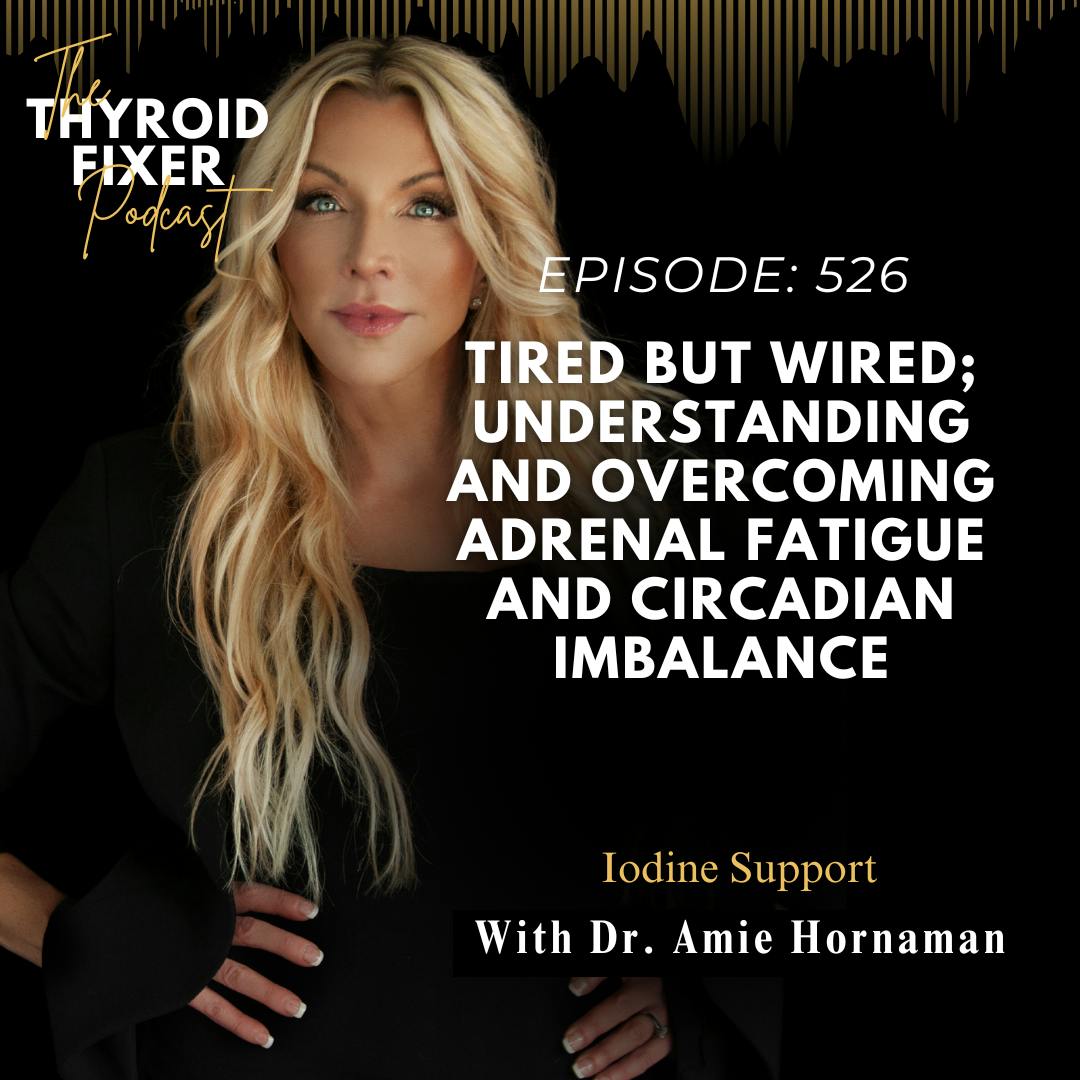
The Thyroid (and Hormone) Fixer Podcast: Thyropause, Menopause, Metabolism and How to Fix It
526. Tired but Wired; Understanding and Overcoming Adrenal Fatigue and Circadian Imbalance
00:35:56
Loading summary
Transcript35 lines
- [00:00]
A
Welcome to the Thyroid Fixer podcast, where we dive deep into the world of thyroid and hormones, especially for you ladies navigating perimenopause and menopause, and really for anyone struggling with hypothyroidism, I'm your host, Dr. Amy, thyroid and hormone specialist and CEO of a global telemedicine practice where we prescribe the right thyroid treatment and bioidentical hormones to all 50 states and most of Canada, helping you become that.
- [00:27]
B
Badass human that you're meant to be.
- [00:30]
A
So if you're battling weight gain and heroin loss, you can't lose weight no.
- [00:34]
B
Matter what you do.
- [00:34]
A
Your energy levels are plummeting and your libido left town. Then you're in the right place and you have found your tribe. Remember, I want you to embrace every inch of that badass woman that you truly are. So if you're ready to dive in and fix things, let's get started. Did you know that there's actually a way to increase your basal metabolic rate? That is the amount of fat that you are burning literally just sitting here. So many of you are suffering with a very slow metabolism. You're doing all of the things to lose weight and nothing is happening. Or worse yet, the scale is going up. Well, with the addition of thyroid fixer that contains T2 and L tyrosine and coleus for scoli, all of which benefit the thyroid, all of which boost metabolism, all of which have been proven to increase fat burning. There's your answer. Add in thyroid fixer and you're getting an array of quality quality. I promise you, I've been studying this for 15 years. I bring nothing but the best to you. Quality ingredients 3, 5 Diodo L thyronine, which is T2. I have multiple podcasts on that. You can go back and listen. L tyrosine, which is required by the thyroid, it reduces strength, stress. It helps the thyroid convert T4 to T3 coleus for school. That has been proven over and over again to increase fat burning. So you put that along with T2 that has its own human studies that show a decrease in body fat percent in just 28 days. Oh, and by the way, an improvement in your mitochondrial function, increasing ATP, which helps with your energy. Just add this in. Whether you are hypothyroid or not, this helps everyone. Yes, I called it thyroid fixer, but it helps every single person out there with a slow metabolism. It does not affect your thyroid function, it has no cardiovascular effects, is totally safe. Let this rock your world. Since the release of metabolism, fixer we have been bombarded by stories of people just raving about it and the results that they're getting. So what we're seeing across the board, control of appetite. And without the use of expensive GLPs. Because metabolism contains that patented trademark ingredient suppressor has a boatload of studies behind it reducing appetite by 69%. We have heard massive reports thanking us, thank you for Metabolism Fixer. Because finally I have control over my appetite once and for all. I'm not binging, I'm not overeating. And that's really half the battle. But beyond that, we have to get the metabolism up. We have to get your metabolism up. How do we do that? Metabolism Fixer contains T2. Now it also contains purple tea and green tea, which both increase your metabolic furnace.
- [03:34]
B
But T2 is really the key.
- [03:36]
A
That forgotten thyroid hormone that increases your basal metabolic rate stimulates brown adipose tissue. That's why you're jumping into cold plunges people to stimulate that brown adipose tissue. Turn the white squishy fat brown, make it more metabolically active, protect your muscles. T2 acts like an exercise mimetic.
- [03:57]
B
So it's just like you're going to the gym.
- [03:59]
A
This is what gives us that better metabolism. So that we're burning fat while we're just sitting around doing nothing. So you don't have to starve yourself to lose weight. You, you don't have to work out.
- [04:09]
B
Three hours a day to lose weight.
- [04:11]
A
By adding a metabolism fixer, you're going to have better appetite control. You're going to have nice steady energy through the day. That's another thing that T2 does bonus. And you're going to have a better overall basal metabolism. The amount of body fat and energy that you are burning at rest. And that is what is going to ignite your metabolic furnace. And that is what is going to get that weight off of you once and for all. So if you need better appetite control and you know you just want a better metabolism and you don't want to carry around extra weight. Add in Metabolism Fixer.
- [04:47]
B
Just one scoop a day.
- [04:48]
A
That's all you need, one scoop a day. It will start kicking in very shortly.
- [04:53]
B
To control your appetite.
- [04:55]
A
Studies show about two week onset. But we've had people notice that appetite control kick in within a day or two. Add in one scoop Metabolism Fixer, you are going to thin. Thank me that you saved hundreds if not thousands of dollars not using a GLP but using this.
- [05:11]
B
Yummy.
- [05:12]
A
Throw it in your water flavors your water. Oh my God, it tastes like Tang metabolism fixer every day.
- [05:18]
B
Hello, and welcome to another episode of the Thyroid Fixer podcast. This one we are diving into. Oh, that wired but tired feeling. And what is happening exactly. And you know what I'm talking about, where you're going through the day and you're kind of dragging your butt through the day and then it comes time to go to bed and you actually feel like you get a second win, like you're a little bit wired up. This paradoxical feeling is more than just an inconvenience, isn't it? No. It's actually a sign that your body's stress response system might be out of balance. So that's why we are going to explore what's happening beneath the surface and then how can we restore harmony to your whole system? Okay, first of all, what is tired but wired mean? You know, you've had this long, demanding day. You lived on Red Bull and coffee to get yourself through. Your body is begging for rest, and then your head hits that pillow and your mind starts to go and sleep nowhere in sight. You start going through your to do list, you start worrying about everything. Maybe even before you got into bed, you were sitting there going, oh my gosh, I could clean my house right now. It's almost like I feel a little bit amped up and jittery and yet tired at the same time. And I know I have to sleep. So this state is often linked to a dysregulation in the body's stress response system, particularly involving our adrenals and cortisol. So cortisol is the hormone responsible for managing stress and for wakefulness. When cortisol levels remain elevated into the evening, it can disrupt your natural sleep pattern and this leads to difficulty falling asleep and then just non restorative rest. Despite sleeping eight hours, seven hours, you never get into that deep rest and repair state where you can feel better the next morning and your body actually decreases inflammation, starts balancing glucose. All the things that our bodies do when we're sleeping that we need our bodies to do when we're sleeping doesn't happen because we're not getting into that deep sleep pattern. Okay. The role of cortisol, the heart of this issue is this HPA axis, hypothalamus, pituitary, adrenal axis. And it is a very complex network that controls our stress response. So under normal conditions, cortisol levels will peak in the morning. And we can see this on a four point saliva cortisol panel. You take your cortisol in the morning, your cortisol Levels peak in the morning and then gradually decline through the day, or they should at least gradually decline through the day and then they can bounce out and be lower at night. So what ends up happening is if we have a reverse curve, if we are under loads of stress, that cortisol can disrupt that pattern. And we might still see someone high in the morning and then starting to drop down and then spiking again in the afternoon or evening, like a U or a V shaped pattern. We can also see someone riding that high cortisol wave or their cortisol is high all day long into the night. That's a huge issue as well. If it's not in that, we'll say a half of a bell curve. If it's not in that half a bell curve shape, then your cortisol is dysregulated. Something's going on with your adrenals. Now, chronic stress, this is what leads to that persistently high cortisol levels, especially in the evening. That's going to totally disrupt your circadian rhythm. Our circadian rhythm is literally built into our bodies. Everybody, everybody's body operates on a circadian rhythm. It's a 24 hour internal clock that regulates the sleep wake cycles. Now, we know many things will disrupt our circadian rhythm. I've had Dani Hamilton on the show before. She goes deep into getting outside, looking at the sun, getting that sunlight exposure in your eyes first thing in the morning, grounding, literally stepping outside if you're able to, based on the weather and where you live, actually grounding your feet on the earth this cheap, well, free, actually process does wonders for resetting our circadian rhythm. Now, one tip that I actually got from Danny as well is when we wake up and it's still dark out, so let's say you're in that daylight savings time. It's the middle of the winter, you have to get up because you got to go to work. What you want to do is put on your blue light blocking glasses, which we will get to for circadian rhythm. Put on your blue light blocking glasses in the morning so your body doesn't think that the lights that you turn on in your kitchen to make your coffee is the sun. And then once that sun actually comes up, take the glasses off, go out, get that natural sunlight into your eyes. Even before you can see it, the sun's rays are still coming up as it's getting light. Look into the direction of the sun, get that natural sunlight into your eyes. Now the other thing you can do is use a mito Lux sun lamp. I love my Vitalux. I use it for red light healing. But you can actually use it as a sunlight source so you could turn that on and get that into your eyes to really start that blood sugar balance, that cortisol balance that occurs as we ease into our natural circadian rhythm and we don't fight it. What do I mean by that? When we wake up and it's pitch dark and the first thing we do is grab a cup of coffee and sit down with our blue light phones and read our emails, we're just jacking up our cortisol. We are really dysregulating that HPA access, doing that. And believe me, I do not speak from a pedestal. I have done this many, many, many times over. But I'm trying to be better. I'm trying to be better because I want my body to rest and repair at night. I want that deep restorative sleep. I don't want to be thrown off because I'm throwing off my own circadian rhythm. That's not good. So I am really trying and I encourage you to do so as well, really, really trying to get into that circadian rhythm pattern by waking up, delaying my coffee. So here's step two. Oh, don't click the stop button. Don't freak out. What I want you to do is instead of having coffee, be your first thing in the morning that you drink. I want you to get up now. This is my new pattern by the way. So I have incorporated this into my life. I want you to wake up in the morning and I want you to first of all do, do your iodine fixer in some water. So I start with my iodine, whatever your dose is, drop that in some water, slam that down, then I follow that with fresh squeezed lemon juice in some water. That starts your gastrointestinal secretions, that starts waking up your liver. Like, hey, it's time to time the process, time to detox. So that's literally waking up your body. And then have a little breakfast, have some Greek yogurt, have a couple of eggs, have a really nice protein shake, have that, that good breakfast first thing and then have your coffee. Now what this will do. Yes, there is a tie in to the whole tire, but wired. What this will do is it will balance out your blood sugar and give you better blood glucose regulation. Now we know that glucose and cortisol are very tightly tied together. If cortisol is too high, it's going to push up your blood glucose and you're not going to be able to regulate your blood sugar. You're not going to have that blood sugar control that we all desperately need because that ties back to thyroid too. Everything is connected. Everything's connected. So you want to wake up, delay that coffee, look at the sun. If you possibly can have a nice little breakfast, drink your iodine, drink your lemon water, then you can have your cup of coffee and move forward with your day. Now, moving forward with our day, do we live on coffee through the day? Well, anything more than two or three cups of coffee in that morning, if you have to live on Red Bull coffee energy drinks through the day, there's a problem. I absolutely recommend getting your cortisol levels tested with a four point saliva cortisol panel so that we can know exactly what is going on. Is your cortisol dipping super low at that time that you need to reach for the cup of coffee at 11 or a.m. or noon just to get you through the day? Or God forbid you're reaching for coffee at 2pm in the afternoon just to get you through the rest of the day? We need to figure out what your cortisol pattern is. Now it can also be that you are reactive hypoglycemic. So when you don't have that blood sugar control, that comes back to what I just told you to do in the morning. When you don't have that blood sugar control, what actually happens is you go on a roller coaster. So maybe it's because you are eating foods that spike your blood sugar. Where there's a high, there's an equal and opposite low. In that low, you will be hangry, but you will also be very, very tired. You'll just get that feeling of low blood sugar and that's where you'll reach for caffeine or more sugary foods to bring you out of that hole. And that then has a feedback loop which dysregulates your cortisol. In addition, if you are reaching for sugary foods to bring you up out of that hole, now you're dysregulating your blood glucose as well. Double edged sword there. Double edged sword. So you can see why getting your body into that circadian rhythm that is built in us is vital, is vital for all things, for thyroid function, for hormone balance, for blood sugar regulation and control for our weight. All the things now you move through the day and now you get to the end of your day and it's starting to get dark out. I know it's staying light later now, which kind of screws up our circadian rhythm. Just a little bit. But it starts to get dark out and we're still on our phones. We're still on our phones, we're still in front of the computer, we're still watching TV with blue light coming into our eyes. Here's the thing about blue light. It literally tells the brain that it's not night out. Don't even produce melatonin. You don't need to. It's still daytime. Why do you think it's possible to stay up all night when you're in Vegas? Because the lights and the smells and the sounds are. They've been studied. They have been deeply studied. There's a boatload of money that goes into perfecting a casino. Did you know that? Oh, if you go behind the scenes, let me tell you, there is science behind that. People, because they want you staying up. I was just at a conference in Vegas. It blew my mind. I walked downstairs 6am to go to the gym and there are large amounts of people still there. Obviously, based on the way they're dressed from the night before. Like, I didn't figure that the woman in the sequin dress and high heels with a drink in her hand was just getting going at 6am she's still going from the night before. Because their brains never were allowed to shut down and produce melatonin. That's why they can stay up that long. It's amazing. So when we do this to ourselves, when we Vegas ourselves at home with our phones and computers and TVs, it's telling our brain to not produce melatonin. And we need that natural melatonin. If you're sitting there going, well, melatonin makes me have nightmares and makes me groggy the next morning. Not your own melatonin. And literally that's why I put a teeny tiny amount of melatonin in Sleep Fixer to mimic your body's own production of melatonin, which, by the way, does not have a negative feedback loop. Melatonin is a hormone. Yes, you can take it. And it does not have a negative feedback loop on your own melatonin production. Side note, but if we're in front of the screens, if we're not wearing those blue light blocking glasses, which there are so many on the market that are just so amazing, there's. There's no excuse why you should not be throwing on a pair of blue light blocking glasses. And I mean the orange tinted, not the ones that have a clear glass. Believe me, I bought into that hype. I got a pair of regular glasses because I like to take my contacts out at night and they were supposedly blue light blockers. Well, they just had some kind of, you know, sheen on them. They weren't truly orange colored or red color. That, that's exactly what we need as we're transitioning into night, we need to have those blue light blocking glasses on. And what that does is it allows our brains to calm down, to recognize that it is getting dark. It resets our circadian rhythm and allows our brains to start producing melatonin. Because if we go back to the ancestral days, if we look at the sun. And again, I'm going to reference my friend Dana Hamilton, follow her on Instagram, she's a boatload of information on this. When we look at our circadian rhythm, our circadian clock, back before all of these electronics were everywhere, our bodies were sleeping and waking in relationship to what it's doing outside. And when it got dark, we started a fire. What are the colors of the fire? Orange and red. That fire does not stimulate our brain to keep us up. It gives us just enough light to get us through until the time we're going to bed. Maybe read a little bit, discuss around the campfire. But if we look back at how our bodies are made, how our ancestors lived, they fell asleep when the sun went down. I've heard this from multiple people that you can actually take, people that have, let's say you have a horrendous sleep issue. We can take away all of your electronics, send you out camping where you are forced to rise and shine with the sun and go to sleep when it's dark. People were regulating their circadian rhythm and getting really high quality sleep and going to sleep within an hour or so of it becoming dark within three days. That is how much our electronics are impacting us and impacting our sleep and throwing off our circadian rhythm, which leads us to feeling that tired but wired feeling. And then that leads to more sleep disturbances, which of course increases daytime fatigue. So beyond sleep issues, this state can manifest in various ways. So you can feel persistent fatigue that does not improve with rest. Mood swings, including anxiety and irritability. Just from your sleep, being off, just from your circadian rhythm, being off. Difficulty concentrating, impaired cognitive function, a weakened immune system. If you're getting sick a lot. Hello. Look at your circadian rhythm. It is vital, it is important for all things. So, yes, absolutely. Could your circadian rhythm be off and your sleep patterns be off? Because your thyroid's off, your progesterone's low, your estrogen's low, you're having hot flashes at night, all day. Absolutely. But everything is tied together. So let's do it all. Let's actually optimize your thyroid, let's optimize your hormones, but let's balance out your circadian rhythms with what we know works. Everything that I'm talking about on the podcast today with what we know actually works.
- [20:58]
A
Do you want to know the biggest health secret that nobody is talking about? Everything.
- [21:04]
B
I mean, everything certs in your gut.
- [21:08]
A
But every day your gut is fighting the silent war against all the processed foods and the stress and the pesticides and the toxins in the air that you breathe. And then when your gut's in trouble, your whole body feels it, not just your gut.
- [21:22]
B
So here's where it gets a little bit crazy.
- [21:24]
A
Most people are spending money on probiotics.
- [21:26]
B
That don't even work.
- [21:28]
A
I see this every day in the practice.
- [21:31]
B
Why?
- [21:32]
A
Because 99% of those traditional brands die in your stomach acid before they even reach your gut. So you might as well just flush them down the drain. That's what makes Just Thrive spore based probiotic completely different. I have tried it and I am sold. I am totally sold. And when I learn more about it after I interviewed the founder of Just.
- [21:55]
B
Thrive, my eyes were opened up. I said, this is why I see no change in patients when they throw.
- [22:01]
A
In a typical probiotic that they got at the grocery store or at the nutrition shop. You need these live probiotic strains in order to do anything in your gut. Just Live is the only one clinically proven to arrive at 100% alive in your gut.
- [22:20]
B
That is crazy.
- [22:21]
A
100%. And it does something no other probiotic can. It turns your gut into an antioxidant factory, creating protective compounds exactly where you need the most. So that means better digestion, better immunity, more energy, a lot easier weight management. Just Thrive probiotic comes in capsule or berry flavored gummies, so there's an option for everyone in the family. So if you're actually ready to transform your health in 2025, you gotta take this 90 day challenge, love the way you feel, or get a full product refund, no questions asked. So to join the gut health revolution and take control of your health Today, visit Just Thrive.com and save 20% on your first 90 day bottle of Just Thrive Probiotic with the promo code Dr. Amy D R A M I E. So don't forget to check out all their other natural, clinically proven products too, like their newest product, digestive bitters. Focus and memory. Gluten away and more so that's just thrive. J U S T T H R.
- [23:28]
B
I V E Health H E A.
- [23:31]
A
L T H.com promo code Dr. Amy D R A M I E so.
- [23:39]
B
Of course, if we leave these symptoms unaddressed, they can actually lead to more serious health concerns, including metabolic disorders and mental health issues. Here's what we've actually found. If we disrupt your sleep and keep you out of that deep restorative sleep that we just talked about, what can actually end up happening is that your body turns into this trauma state and within about five days, three to five days, you can literally become insulin resistant and diabetic. There was a very interesting study. I always reference this study because it's so fascinating. They took twins, put them in a sleep lab, controlled for everything, diet, exercise, movement. The only thing they did with one twin is bring him out of REM sleep, just stimulate his brain enough that he comes out of that REM sleep in it was either three or five days. That twin they disrupted his sleep was insulin resistant, diabetic. So when we look at metabolic disorders, when we look at inflammation, can you see how important balancing your circadian rhythm is? And by the way, none of you are night owls. I say this all the time. You're like, well, I'm a night owl. That's not true. That's not true. Because your body isn't built that way. All of our bodies are built to sleep. When it is dark again, going back to the brain, producing melatonin, our ancestors, all of that, our ancestors were not night shift workers. They went to bed, they worked at dawn when the sun came up. Oh my gosh. Night work, night shift work. When we look at night shift workers and study them, we see an increase in all metabolic diseases, type 2 diabetes, insulin resistance, cholesterol issues, blood pressure problems, cardiovascular issues, mood disorders. Way more antidepressants are prescribed for night shift workers than any other population because our bodies aren't meant to do that. And I, and I get it, many of you, you don't have a choice. You have to work. That's the shift you're put on. And there are many different things there, There are specialists out there, sleep specialists that work with night shift workers. We, we can get into that. Balance your thyroid, balance your hormones, do what you can, sometimes even wearing blue light blocking glasses during your work shift, so that you can then come home and actually go into a sleep that can work as well. But my point is, those of you who have a choice, and you're just staying up until midnight 1:00 clock because you're at quote unquote, night out. That's not true. And you're only damaging your health by choice. By choice. The night shift workers sometimes don't have a choice. You do get your ass to bed earlier and start doing these things to regulate your circadian rhythm. Sometimes doing just relaxation techniques at night. If you're like, well, I can't wind down, maybe you need to get off your phone completely. Not just sit there with blue light blocking glasses on. Maybe you need to put it down. You need to read a book. You need to take out those stimulating scenes, whether it's a movie, whether it's social media. Take that out. Because you can't actually turn your brain down. You can't get, get your GABA working, which is a relaxing neurotransmitter, the calming neurotransmitter gaba. I also put a little GABA in my sleep fixer. You can't get into that deep relaxation state or that meditative state. You can't do deep breathing when you're being constantly stimulated by an action movie or social media posts. You can't do it eating at night. Now this is a huge problem for me as well because I like my Netflix style snack. However, we do know that eating within a couple hours of bed stimulates our digestive juices. They start to flow. That actually disrupts our sleep. Now, do I still do it sometimes? Yeah, I do. I just compensate my. Well, I take my sleep fixer and magnesium progesterone every night. So that helps kind of overcome my choice to eat my Netflix snack. But I also make my Netflix snack protein heavy, protein focused. It's usually my, my power protein fixer. Chocolate. I'll make that into an ice cream. I'll make it into a mousse or a pudding. And that's just enough so I can enjoy my Netflix snack and call it a day. I don't eat a boatload of carbohydrates that are going to send my blood sugar spiking. But I'm going to tell you, if you eat late at night, that blood sugar spikes and then it crashes during the night. And that is what wakes us up. And some people will even have a hard time falling asleep because that elevated blood sugar is stimulating. It's energizing. Remember, like kid in a candy store. Think about that. Kids getting hyperactive because they eat sugar. Well, that's what happens to our bodies and our brain when we consume carbohydrates and sugar. It absolutely does. So eating Late at night is also a no, no. And now let's talk about alcohol and sleep. So are you one of those that pours a glass of wine, pops a beer at the end of the day to wind down? Right. And you're looking forward to the relaxing effects, hoping that it might help you sleep? It turns out half of all adults over the age of 65 report having consumed alcohol in the past year right before bed to help with their sleep. Now, 67% of these people actually say that it helps their sleep, but we know that it doesn't. We know that it doesn't. Here's what actually occurs. So alcohol will provide kind of that relaxation effect, but the problem is it disrupts the sleep cycle. That normal sleep Cycle occurs in four distinct parts. Stage 1, Stage 2, Stage 3, which is Delta Sleep. Stage 4, which is REM sleep. If you're using the Soul Tech device that I interviewed Dr. Dan Cohen on months ago, I've been using it. You can see those four stages and when you are in in each stage. So when you're in the first two stages, you're in just this really light sleep. When you're in the third stage, that delta, you're in deep sleep. And the fourth stage is your vivid dream stage, that REM sleep. Now, every person's sleep cycle varies even with age. But REM is when our brains do some heavy lifting, like processing emotions, combining making sense of memories and knowledge, strengthening neural connections. So getting enough REM sleep is key. Remember I just talked about the twins, that they disrupted the REM sleep long enough to throw the one twin in the type 2 diabetes. So we have to understand how alcohol actually affects the sleep cycle. Here's what happens. Drinking before bedtime delays that REM sleep or shortens the time that you're in it or sometimes prevents you from getting into REM sleep at all, which causes what causes metabolic disturbance, type 2 diabetes, insulin resistance. And then alcohol in and of itself can cause type 2 diabetes and insulin resistance. So alcohol also disrupts sleep stages in other ways. So it is a sedative, so it can send you into that deep sleep quickly. But then what's not supposed to happen happens. It throws off the first two stages of light sleep. It just throws your body off, makes it really difficult for your body to readjust during the remainder of the night. So, so you get really fragmented sleep, and you never get into that deep REM sleep. The other thing that occurs, if you have ever worn a cgm, this is really interesting. I threw on a cgm. I Was just wearing it to experiment. And I rarely drink alcohol at all. But it was my friend's birthday party. I had a glass of wine and literally days before, she had told me that her blood sugar drops incredibly low when she drinks alcohol. Well, it goes back to what I was saying about blood glucose levels. Where there's a high, there's an equal and opposite low. So we know that alcohol will spike our, our blood glucose. So here's me at her birthday party. CGM on. I have a glass or two of wine. I don't remember what my blood sugar went to, what it spiked to, but in the middle of the night, alarms are going off. My CGM is alerting me that my blood sugar dropped too low. I had no idea what was happening. I'm like looking for the phone, ready to throw it across the room. I didn't know how to turn the alarm off. Sure enough, what happened to her happened to me. And if the alarm didn't go off on my cgm, it would have just disrupted my sleep. So I still would have woken up. Because our bodies do that. They kind of jolt our ourselves out of bed. They jolt us awake. Our bodies jolt us awake when our blood sugar drops. Because our bodies know, hey, low blood sugar is not a, a very safe place to be. Better wake this person up so they can go eat and get out of this low blood sugar state. If you're not actually waking up and realizing you're waking up, you're waking up. Wear an aura ring. Get the Soul Tech device. Actually watch your body when you drink alcohol, you will not get a good night's sleep. You will not rest and repair. Alcohol can also increase snoring and sleep apnea as well. So that's going to throw your sleep off too. Let's not forget about the importance of completely eliminating alcohol. And then there is your sleep environment. Yes, this all ties into wired and tired. Because again, if you're not getting this deep REM sleep, your cortisol will get thrown off. There is nothing more stressful than not getting deep sleep. It doesn't even matter what's going on during the day or what you're dealing with in your life. There is nothing more stressful to the body, more inflammatory to the body than not getting deep sleep. So what is your environment? Like I always say, listen, I keep my house cold. I love my house cold. But it is important for sleep. Sleep is best under 68 degrees. So you want cool, you want dark, you want quiet, you want a noise machine, you want a fan. Get Some earplugs. Whatever you have to do to make your bedroom a sanctuary. And no, don't watch TV before bed. Well, it makes me relax. You're getting that blue light blocking. You're getting the blue light in your eyes. You need the blue light blocking glasses if you're going to do that. But I don't recommend electronics in the bedroom. I'm just saying make your sleep environment cozy. I've talked about the cozy earth sheets. They are the bomb. They're the bomb. Just a shameless plug for cozy earth. I think you can use the code Dr. Amy to get 40% off. You want amazing sleep, you want amazing sheets for your sleep, and you want a cool, dark room. Block out the noise, block out the light. Light blocking shades. Whatever you need to do, make your bedroom a sanctuary. Because that wired and tired feeling that you are feeling comes from that dysregulated cortisol. Now let's pull in two other aspects that I mentioned earlier, but we need to close with these. If you are low in progesterone. Progesterone is our calming hormone. Ladies, when your progesterone levels start to tank, sleep will absolutely be disrupted. It'll be disrupted. Many, many, many women entering perimenopause and menopause have insomnia because their progesterone levels are so low. And by adding in progesterone, oh, my gosh, they sleep like a queen and their mood is balanced out as well. And that helps the next day for that wired and tired feeling. So when we give the body progesterone, we're actually helping to support our adrenal glands. So, no, you don't need a boatload of adrenal supplements necessarily. Sometimes adding in progesterone is enough just to calm the brain and help with insomnia. Adding in pregnenolone because when the body is under stress, when our adrenal glands have been pumping out cortisol and eventually they tire out. So adrenal fatigue. What our adrenal glands will do is steal pregnenolone and progesterone in order to make cortisol. We need cortisol to survive. We just don't want too much of it. We don't want it pumping all day long. So our bodies will steal pregnenolone and progesterone in order to make cortisol. Have you heard of the pregnenolone steel? That is what I'm talking about. It will also deplete our progesterone levels. So by adding in pregnenolone and progesterone that can help support our adrenals and help with better sleep at night. Magnesium vital, vitally important for sleep. I love my magnesium and progesterone and sleep fixer stack. That's what really helps me sleep. Maybe a Delta 8 Gummy too, but definitely progesterone, sleep fixer and magnesium. My quad mag, I love that for a sleep stack. I take pregnenolone during the day to protect my brain, but it also helps support my adrenals. Now if you need a little bit of extra help, let's say you did that four point saliva cortisol pattern and you're like, oh my gosh, I'm seeing my cortisol spike at night. Phosphatidylserine is a beautiful add in to lower that cortisol and bring your brain into just this relaxed state along with your progesterone, along with your magnesium. Phosphatidylserine really helps with that elevated cortisol. Now, if you have a wonky pattern during the day, let's say you're waking up and your cortisol's low and you can't even get going in the day, in the morning and then you spike at night. Something like an adrenal glandular during the day will help. And then you can add on the sleep sack at night along with the phosphatidylserine. Like I mentioned earlier, having a little bit of gaba. Gaba's in my sleep fixer. Or you can take it separately. That is the calming neurotransmitter. So that helps to calm down the brain as well. And ladies, as we age, we tend to lose that gaba, we lose that calming neurotransmitter. Oftentimes we do have to add it in. Now, by balancing your hormones, you do help to balance out your neurotransmitters as well and give your brain support. But sometimes we need just a little bit of extra support, especially if you struggle with sleep. And then finally, I will leave you with this. Doing some trauma work. Occasionally a person can go through everything that I just said, check every single box, and they still cannot get that deep sleep. They still have that tired but wired feeling getting into doing that internal work, that trauma work, that trauma response issues can be in the tissues, they can be embedded in. So if we've lived a long life of really poor sleep habits and poor circadian rhythm habits, we've been starting the day with coffee on our phones and on our computers, and then eating like garbage through the day, throwing off our blood sugar, being under stressful situations, not giving our bodies the support that it needs. With magnesium and proper hormone balance and proper thyroid balance, yeah, we can make our own trauma, but often times it's from past trauma, it's in the tissues and sometimes you need to do a little bit deeper work and get into some trauma work. That's why I've interviewed people like Dr. Amy Opagian who does amazing, amazing trauma work. I have not interviewed Dr. Don Wood, but he is also in a mastermind that I'm in. He's amazing and I'm trying to think. I have. Oh, I've interviewed multiple individuals on the benefits of psilocybin and doing a mushroom journey to get into your trauma. Sometimes that is very, very effective. If that is your cup of tea, whatever you have to do, check those boxes. If you have that tired but wired feeling. There are many different things that we can do. There are supplements that are supportive. I mentioned many of them here today. Magnesium Gaba L theanine is fantastic. A B complex. My B fixer. That's amazing for supporting your adrenals. Sometimes you have to add in an adrenal glandular, sometimes you have to go a step further and get some progesterone on board. Balance out those hormones, get your thyroid optimized. That will help regulate your cortisol. Change your diet, but do the cortisol rhythm, HPA access work so that you yourself can get out of that tired but wired feeling. Don't always reach for a sleeping pill. Don't reach for the caffeine to get you going during the day and a sleeping pill, they get you to sleep at night. Do this work to reset your body because that's going to expand into other areas of your body like blood sugar regulation, metabolic control, cholesterol control, protection of your brain against Alzheimer's, Parkinson's, repair of your body, and ultimately balancing of your thyroid and hormones, which cannot happen with any amount of medication. If you are not sleeping and if you are all this combovulated throughout the day, tired but wired. We don't have to be that way. There are absolutely answers we can implement. There are things we can implement to change that pattern in our bodies.
- [40:51]
A
The information shared on the Thyroid Fixer podcast is intended solely for informational and educational purposes. It is not a substitute for professional medical advice, diagnosis or treatment. Always consult with your physician or other qualified health care provider with any questions you may have regarding a medical condition, treatment or before making changes to your health care regimen, including medications, supplements, or other therapies. Use of the information provided in this podcast does not establish a doctor, patient, or client provide a relationship between you and the host or between you and any other healthcare professionals featured on the show. Any medical opinions or statements made by guests are their own and do not necessarily reflect those of the host or affiliated parties. Statements regarding dietary supplements or health related products mentioned in this podcast have not been evaluated by the fda. These products are not intended to diagnose, treat, cure or prevent any disease. Some episodes of the Thyroid Fixer podcast may include sponsorships or affiliate links. The host may receive compensation for discussing or promoting certain products or services. Any such sponsorships or affiliations will be clearly disclosed during the episode. All opinions expressed are those of the hosts or guests and do not necessarily reflect the views of any sponsors. The inclusion of a product or service does not imply endorsement by any healthcare professional featured on this podcast.