← The Thyroid (and Hormone) Fixer Podcast: Thyropause, Menopause, Metabolism and How to Fix It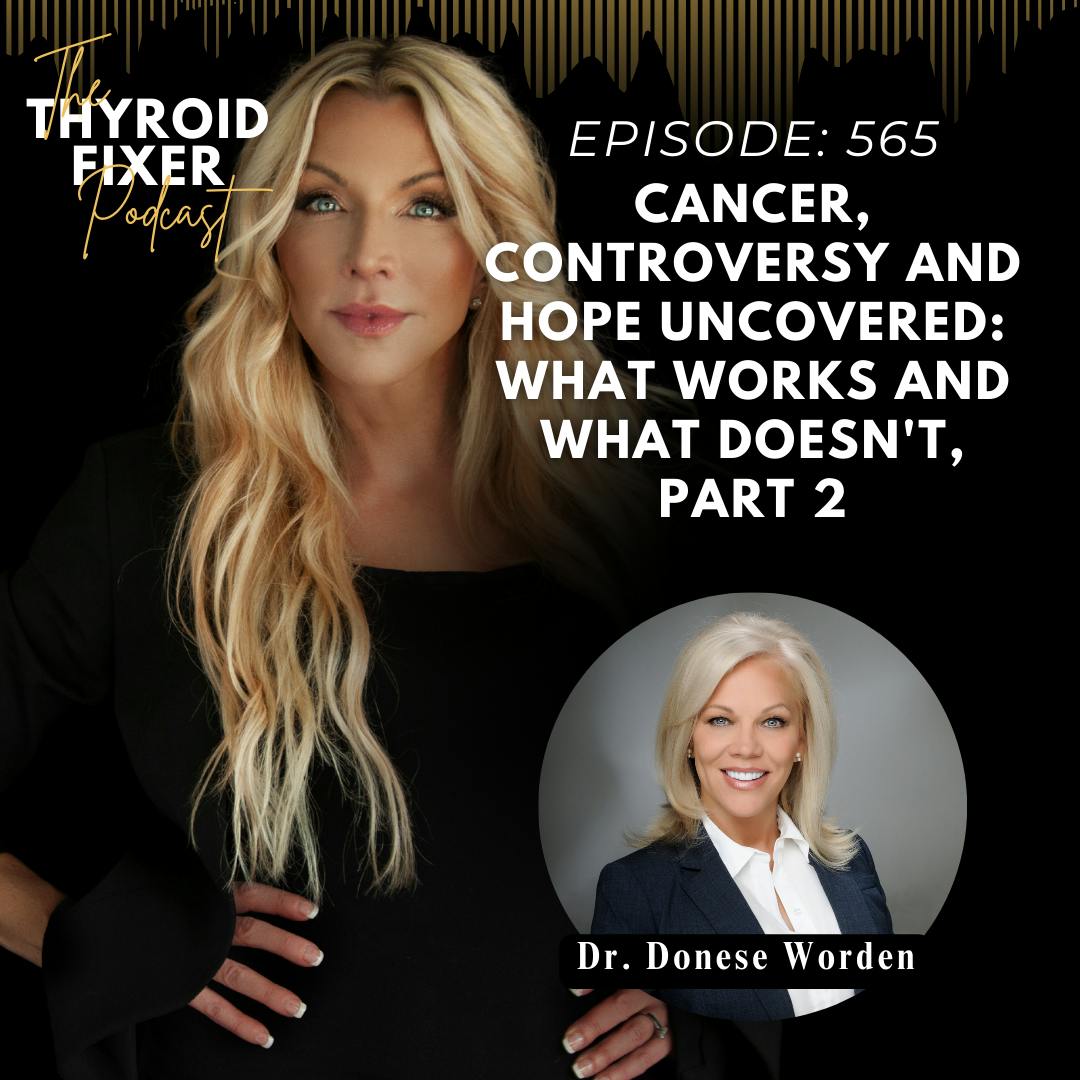
The Thyroid (and Hormone) Fixer Podcast: Thyropause, Menopause, Metabolism and How to Fix It
565. Cancer, Controversy and Hope Uncovered: What Works and What Doesn't, Part 2
00:49:36
Loading summary
Transcript102 lines
- [00:01]
A
More is not better. You've heard me say that, right? A million times. I say it to everybody I work with. More is not better, right? Choose the things we know and the ones that we know are specific to you. Those are the basic now you want to go do other things? Go do, go play, Maybe. But these are your basics.
- [00:19]
B
Welcome to the Thyroid Fixer Podcast, where we dive deep into the world of thyroid and hormones. Especially for you ladies navigating perimenopause and menopause. And really for anyone struggling with hypothyroidism. I'm your host, Dr. Amy, thyroid and hormone specialist and CEO of a global telemedicine practice where we prescribe the right thyroid treatment and bioidentical hormones to all 50 states and most of Canada, helping you become that badass human that you're meant to be. So if you're battling weight gain and hair loss, you can't lose weight no matter what you do. Your energy levels are full plummeting and your libido left town. Then you're in the right place and you have found your tribe. Remember, I want you to embrace every inch of that badass woman that you truly are. So if you're ready to dive in and fix things, let's get started. Have you heard about the incredible health benefits of fasting? Of course you have. But do you struggle to go without food like I do? Or maybe you're a season faster and you're just looking for that next level edge? Or let me introduce you to Mimeo, the first fasting memetic supplement designed from human biology to mimic the cellular effects of a 36 hour fast without skipping meals. This is amazing. We know that fasting turns on powerful longevity pathways. It promotes cellular repair, it boosts metabolic flexibility, supports cognitive health, and even helps slow the aging process. But let's face it, fasting for 24 hours, 36 hours, 48 hours, it's not easy, it's not always practical, and it's not easy. That's where Mimeo health comes in. After over seven years of clinical fasting research, the team at Mimeo has developed a daily supplement that replicates those same cellular benefits without forcing your body into a true fast. Mimeo has been clinically validated in three human studies, and the results are stunning. In just eight weeks, users experienced a reduction in biological age by over 2.5 years. That means better metabolic and cardiovascular health, sharper thinking, more autophagy and cellular regeneration. That's the kind of resilience and longevity we're all looking for. As someone who understands both the science and the real life challenges of fasting, I can honestly say mimeo is a game changer for me. I personally have tried mimeo and I was blown away by the energy, mental clarity and just how much easier it is to put it into my wellness routine without being miserable fasting for 36 hours. So whether you're new or you just want deepen the results, Mimeo's Biomimetic Cell Care gives you the fast without the fast. And right now you can try it risk free. Risk free. Mimio's Happiness Guarantee and special offer just for my listeners. Oh it's so good you're going to head to mimeo health.com M I M I O H E-A L T H.com use the code Dr. Amy D R A M I E and get 20% off your first order. But there's no product that can add more years to your life than this one. Mimeo Health. You can add more life to your years as well. So mimeohealth.com code Dr. Amy for 20% off. I completely and totally hear you and I see you and I understand you and I know exactly where you're at. You're gaining weight. You can't lose. You have all the symptoms that no one's listening to. The fatigue, the hair loss, the brain fog. You can't remember why you walked into a room. You don't want to get dressed and go out because you know if you have that glass of wine with your friend, if you have that dessert with your husband or even order an appetizer, you're going to be five pounds heavier the next day and your clothes are already tight. Every single doctor is telling you that you're normal and everything is fine. You've been to multiple conventional medicine doctors trying to use your insurance, hoping to God that somebody has an answer. Then you've dropped thousands of dollars on functional medicine or integrative medicine because you keep hearing how functional medicine gets to the root cause of the problem. But not every functional medicine practitioner knows the thyroid and knows the hormones and can treat you as a nuanced, personalized individual, a unique person. That is exactly what my team and I do. We specialize in thyroid problems. We specialize in hormones. You can't do one without the other. You cannot just see someone for your thyroid and have them ignore your hormones or have them half ass your hormones. They better be a hormone and thyroid expert. If you are going to spend your time, your energy and your money if you are going to Invest in functional medicine. They need to be a thyroid and hormone expert and treat you as an individual. They can't have a cap on how much T3 that they're going to give you. They have to personalize your treatment plan to get you feeling your best, no matter what that looks like, so that every system in your body functions at the very top, at the very best. And that is exactly what we do. I made it my mission because I went through this. I was dismissed, I was gaslit, I was misdiagnosed, and I dropped thousands of dollars before I found an answer. That is why I made it my mission to be able to treat people in all 50 states so we can prescribe via telehealth. Thyroid and hormones and peptides. Yeah, the GLPs to all 50 states, most of Canada and now Puerto Rico. That is my mission to be able to help you wherever you are because I want you living your best life. I want you to join me in optimization land where you can go out and love life and go out with your friends and go out with your partner and not gain weight looking sideways at a brownie. Yes, we do have financing options available. I'm talking like 0% or 12 months, the whole thing based on your credit score. We got you. And our programs are affordable. They're completely and totally affordable. And they will get you from point A to point B. They will bring you into optimization land. So please don't waste another moment struggling, please. I want you living here with me, a great happy life in optimization land. So go to my website@dramy.com, click the Become a patient button so we can have a chat. Let's talk it out. Let's hear what you've done, what you haven't done, what's worked, what hasn't worked, and let's get you on the right path to feeling your absolute best. If you can imagine the best life ever that is absolutely possible for you. I'm not BSing you. I am not BSing you. I was in your shoes. Many of my patients have been in your shoes. We will get you there and that is my promise to you. So we are now back for part two of this deep discussion with Dr. Doneese, Worden and myself. Dr. Doneese was an integral part of my cancer journey and my cancer care. If you didn't get a chance to listen to part one, go back and listen to that first because we're sliding right on in, picking up where we left off, which was talking about the bombardment of alternative cancer therapies that I was introduced to DM'd, message, emailed, you name it. I heard it all from everyone. Really well meaning, I mean, just huge heart intentions. The love, the support that came pouring out when I shared my uterine cancer diagnosis on social media was literally overwhelming and humbling and restored my faith in humanity. But it was also overwhelming with the amount of information now some things were like, hey, did you look into trauma? Because if you just fix the trauma in your past, your cancer will heal. And it's like, you know, I mean, as we talked about in part one, yes, sure, stress, trauma, cortisol plays a role, but I don't really think resolving my trauma is going to cure my cancer. Thank you though. But we talked in, in, in part one about some of the alternatives that I was being given and introduced to. HBOT of course, has a ton of research behind it. It's Sister Ewat. We discussed that. We went into hormones. So I want to pick up there because I think it's great to expand on this topic before moving into a couple off the cuff things people haven't heard of for sure in the cancer world. And I want to get your take on it. So moving back to hormones, we had said off air, you know, we need to drive this point home that it needs to be the individual's choice as to whether or not they do hormones and especially as it relates to cancer.
- [09:39]
A
That's right. And you know, it's every decision for your health should be yours because your body's own pharmacy. And what happens when you feel that you're in charge and you've made a decision. But my role as a physician is to make sure you really educated to make that decision. You know, I want you using your intuition, but there's also science. Let's use both, let's use research and science, medical and let's use the intuition because that's the best of both worlds. And it was interesting when we were off camera here for a second was that we said it's good for people to hear that two physicians can have a slight altering opinion about something. I've told you I don't like you being on hormones and you're going risk versus reward. I'm going to do it, I'm going to monitor it. I'm okay, I'm going to be here with you. We'll look at it together, we'll make sure as much as we can. But you, I know you understand the risk so therefore I'm comfortable with you making that decision. If you didn't understand the Risk, Then that comes back on me as a physician to say, this is, in my opinion, something that might be too risky. So it's great. Because how many people watching this actually have your physicians talk with each other.
- [10:49]
B
Yeah.
- [10:50]
A
Even if they disagree, to say, okay, let's ask the patient, what do they want? As long as they understand.
- [10:55]
B
Yeah, no, absolutely. And I will add in, too, even for your listeners, that like we discussed in part one, I did drop my hormone dose as soon as I got the diagnosis because that's, you know, just immediately. It's a reproductive cancer. We don't know if it's being fed. Let's drop the hormones. I felt so horrible.
- [11:14]
A
Yeah.
- [11:15]
B
I mean, my quality of I got every symptom under the sun for menopause. I was like, oh, this is what these ladies. This sucks. So that obviously played a role in my decision to not go back as high, but still go back on and monitor because, wow, quality of life was just in the toilet. Let me ask you this question about the. And I think this is. It's really confusing for all women out there. We hear triple negative, E2 positive, P positive, ER negative, ER positive. All of those different terms. And what does that mean in the cancer world? And then kind of piggybacking on that and tying it in, too. I want to throw this part in. When we look at 15, 16, 17, 21, 22, 25 year olds, and they have more hormones surging through their body than we could ever replace, why are we paying attention to the ER positive, negative, triple negative, all of that, and they can live life with their surging hormones and they're not getting cancer? Well, I mean, you did mention we're seeing it. You're seeing a surge of young cancers, but. Yeah. Why can you break that down for us?
- [12:29]
A
Because their repair system is far faster and better than ours. Right.
- [12:33]
B
Okay.
- [12:33]
A
I'm talking about the mitochondria being a repair engine. So when the mitochondria are healthy, it can repair a lot of things. Damage from environmental cancer. It's really a great, great organ that helps us with all those things. As we age, we know mitochondria start slowing down. And they're not the bad cells. Senescent cells aren't getting cleared out. We're just more toxic or slower or sluggish. We don't do as good a job. They're young. They repair faster. That's the answer.
- [13:04]
B
Makes sense.
- [13:05]
A
Okay, but to your mutations, there are certain ones. If you had family history of all kinds of things, a lot of people, even Younger ones are getting it. Like if you have a BRCA mutation, B, R, C, A. Right. If you have the BRCA 1 of the lifetime. Let me start with this. The lifetime risk of a woman who does not have these particular genes is about a 12% lifetime risk of breast cancer and about a 1 to 2% of ovarian cancer. All right? But if you have a BRCA1 running through your family, the lifetime breast risk is about 55 to 72%. And the ovarian cancer risk is about 39 to 44. Right. That's when we start talking about, why did Angelina Jolie do what she did? Right. That's her choice. But BRCA2, it drops from 55, 72% down to 45, 69% in ovarian cancer, about 11 to 12, 17%. So some of these we really know. And then there's lynch syndrome. That's a colorectal cancer. If you have that, a lifetime risk of getting colorectal cancer is 40 to 80%, depending on which kind of gene and how they're matched. That's pretty high. That means you go in and you get colonoscopies more often, because just like with you, you were watching and the minute it turned, you were on it. Right. And you were on it. It helps us before it metastasizes. But women with lynch syndrome, also, they face a 40 to 60% increase in endometrial cancer. So an 8 to 12% in ovarian. So those genes do play a risk. But remember, what percentage of people have those kinds of born with genetic diseases? 5 to 10% at most. So it's the other people which are most people saying, I don't have those. What can I do? What can I prevent? And if I do get cancer, I want to catch it early. And what are the things I decide to do? That makes sense.
- [15:01]
B
Yeah. And they did test me for that, for lynch, because again, I mean, if you looked at my genetics and there wasn't an actual genetic test, they would immediately assume my grandmother on my father's side, the father that had non Hodgkin's lymphoma, my grandmother had uterine and colorectal. You naturally think, right. But it actually turned out they tested.
- [15:23]
A
Lynch, didn't see it. But there may be some gene there we don't know about. There may be. Yep, there may be. But remember, the treatments are going to be kind of the same. On the alternative side, won't change. Metabolic side, alternative, integrated, won't change. But on the traditional side, they would have Specific medicines and treatments for those mutations.
- [15:45]
B
Right, right. Okay. And we're going to get more into specific medications and treatments for specific tumor cells. Hang tight, we'll get to that. I want to keep going with these alternative treatments that are. That were floated to me and get your opinion and let's see if there's any research backing any of them.
- [16:06]
A
Yep.
- [16:07]
B
Okay. I'll ease into it with red light therapy. I myself really continue to be blown away with the research on red light therapy. But I would love to hear from you whether or not that research is accurate and really data based. I keep hearing it's pretty much good for everything. It's good for your skin, it's good for your thyroid, it's good for cancer cells. It's good for everything.
- [16:29]
A
So for 25 years I have lectured on frequency bioenergetic medicine, CME lectures to doctors, which means that everything has to be science based and backed up. I'm considered an expert in cold laser in these things, which are red light lasers. So I know this world well. There are a lot of things that this frequency and this light kinds of therapies can be amazing for pain management, skin, you name it. I will tell you that we were always concerned especially with the other colors, lavender and green, because they're too far on that spectrum side toward, you know, microwave and all that. We would never do it directly over the thyroid. I still don't do red light directly over the thyroid. Now I'll do around. But if you're sitting in a sauna in its whole body, you're probably okay, here's the concern with cancer. Now we use it with cancer patients in a rotation with hyperbaric and this. And that has to be the right kind of timing. Has to be four hours apart. There's the whole thing about it. But here's the issue that we're concerned about. Any red light or even sauna, any of those things can cause angiogenesis. What is that? That is new blood flow. Now you'd say, isn't that good that I could create more circulation? Yes, if you don't have cancer. But do you want cancer cells to have more blood flow? So people that have. We know where the cancer is. It's an organ. I say never ever. And I don't put them in whole body red light. They can use a panel on a different part of the body to get the benefits, but never directly over the tumor. We don't know enough yet to answer your question, to know for sure whether it could be good or bad. But what we do know is it causes angiogenesis. And when women are trying to use thermography and other things besides mammograms to look for breast cancer, what is thermography looking for? It's looking for angiogenesis. Because cancer won't use your blood supply. It's not going to lock into your blood vessels and use it. It has to create its own. That's new angio genesis, new blood vessels. And anything that creates new blood vessels could be suspect to cause those tumors to grow. So I stay away from red light or any kind of light therapies, directly over tumors.
- [18:43]
B
Okay. I love it. Breaking it all down. Hydrogen therapy. You know, a lot of people are buying these machines. They're sticking the hydrogen therapy in their mouth.
- [18:51]
A
No, there's not enough science to know. Here's the thing. Ozone. Ozone and hydrogen. Well, the person that started the hydrogen therapies, I think, has probably been 30 years ago. I was in the middle of the night getting these calls. I don't know how people were getting my phone number that back then, it was a, you know, a real phone. Not even a calling me from all over the world saying, I hear you do hydrogen therapy for cancer. And I'm like, what? Where did you hear that? I'm not doing that. What that started, and I figured out, I guess it was in Suzanne Summers or somebody's book. My name ended up on a list for doctors that do integrative care.
- [19:27]
B
Yeah.
- [19:28]
A
Anyway, I looked into it way back then, and what I will say is, I don't have any more information today than we did 30 years ago. So I'll tell you. I don't know, and I don't think anybody knows. Now, ozone, if you had viruses. We know viruses can cause cancer. Epstein barr virus, cytomegalo, Although those things cause cancers. Right. So if we have known viruses, and I'm not against ozone, because that could reduce that load of virus. So your immune system can take over. But if we don't have those on board, I don't have any evidence telling me that it's killing cancer cells. Now, it might be, but we don't have evidence. We know what hyperbaric does. Right. So I say go with what we know.
- [20:11]
B
Okay. On the ozone, you know, there are ozone suppositories. I was using those all the way up to my surgery. And then there's a treatment called ebu, which essentially uses ozone and kind of filters your blood. Yeah. I mean, is that still kind of in the same realm? Like, we just don't know, but it might not hurt anything.
- [20:31]
A
Well, we don't know. And I don't know if it does hurt anything. So I had a patient. It wasn't a patient, it was a friend. That's not a patient because you don't treat. It's not supposed to treat friends. Right. Although now you're a friend. Anyway, I did an evo yesterday and they pulled out three clots.
- [20:46]
B
Three clots.
- [20:47]
A
I'm like, you can't. No. Your blood might be clotting, but if you had a clot somewhere, it's not going to pull that out. So that's the problem. People are told certain little things and that, oh, that was good for me. And I'm like, I. First of all, I don't know anybody that can show you that they pulled out a clot, an existing clot somewhere. So anyway, again, money, time and risk are something. So anytime you get a needle in your arm, there's a risk of infection, right? There just is. I mean, we clean. We do it. We were doing IVs 30 years ago. Vitamin C, IVs for cancer and things. Yeah. So it's always a risk. So mine is always reward versus risk. I right now, go with the most simple but scientifically sound to date. What we know. There may be stuff coming down. I'll talk about apitherapy in a minute. I want somebody, and I think I'm going to get somebody to fund it, some bee venom therapies for cancer. Okay. There's science there and studies have been done and I have. I've used it for years for different things in my clinic. But I gotta have a scientific rationale. And that's the problem. Some of these things, the hypothesis, or somebody says, what's supposed to do this? So it might be good for that. They're thinking through it. But until you have lots of people doing it to know, we don't know. So if it's going to bring you comfort, if you like how you feel and you can afford it, and we think it might not be risky, then okay. But more is not better. You've heard me say that, right? A million times. I say to everybody I work with, more is not better.
- [22:21]
B
Right.
- [22:21]
A
Choose the things we know. And the ones that we know are specific to you. Those are the basic. Now you want to go do other things, go do. Go play, maybe. But these are your basics.
- [22:31]
B
Okay? I love it. Ivermectin and Fenben.
- [22:35]
A
Yeah. So they both. And this is such a big topic as you know right now, we've been using in A metabolic cancer world. Dr. Tom Siegfried, who is the leader, he's the one that wrote the book Metabolic Theory of Cancer. This big kind of jump started the whole movement. Tom is in our CMO group, the Society Integrative, you know, integrative, international, whatever it is, International Metabolic Society. I'm the one that came up with the name and I can't even remember, but anyway, it's called Simo. Anyway, Tom, he was doing studies with rats, you know, in mice, with cancer inducing and studying the metabolic therapies. And he's the one that came up and said fenbendazole is doing a mubendazole or fenbendazole. They're doing a good job. So we said, okay, why wouldn't we add that in? Now, Ivermectin has some studies that are going on. Again, preliminary, don't know, but it looks pretty good. The problem is if people have liver enzymes that are a problem or the cancer is in the liver. You got to be very careful with these things. I had a patient that came to me new and her liver enzymes were off the chart. And she was doing a bunch of fenbendazole. She had read or some influencers said, do it every day, do high doses. Her enzymes, liver enzymes. She was about to shut her liver down. Liver transplant, we cut that out and she's fine. So again, you gotta be careful with these things. Know what you're doing. We use them, but we alternate three days on, four days off. Three days on, four days off. Two reasons we want to give the liver a break. The other one is, remember what I said in the last session that we did? Cancer Smart. It figures things out. It's better to get in and blast it and it goes, oh. And it gets hurt. And it. And then you wait and it doesn't see it for a while and then you hit it again. If you do the same thing all the time, it's likely the cancer is going to find a way to work around it. It's kind of like getting a vaccine, you know, it just to just pay attention to it anymore. So they're both promising. I have people that were doing both, wanting. They came to me doing both, and I said, well, this DATR test that we're going to talk about in a minute, they're both on there now. So I can see which one of those might be beneficial if they're both showing up high, killing a certain number of cancer cells. Then I came up with a protocol because I called Tom Seyfried, our Fearless Leader. We had Dr. Durak, who's another oncology physician, and this and that. And I said, okay, these guys are doing. Does look good, both of them. Here's my thought. We still want to pulse it. It's called press pulse. That's part of our therapies that we do metabolically. I said, so I would do fenbendazole in the morning and do ivermectin at night just in case there's different pathways. And they do work a little differently, right?
- [25:10]
B
Yeah.
- [25:11]
A
Just in case they're both going to be beneficial, but I'm going to separate them. We're still doing three days on, four days off. And Tom was like, I love it. Because a lot of the guys on the call were like, no, we just have them stay on it all the time. I said, what happened to the press pulse therapy, the theory that we've got to fool the cancer. So Tom Seyfried was on, you know, agreed with me to say we're better off pulsing these things. So it depends on the individual liver enzymes and what's going on, but they're both, I think they have very good promise. Are they going to completely eradicate cancer by themselves? I don't think so. I haven't seen it. But I have seen them, from what I'm seeing, clinically, be beneficial. The problem is now, Amy, everybody's going, everybody's got parasites and everybody needs to take this and it's going to kill all your cancer cells.
- [25:58]
B
Wrong. That'd be my next question. I was doing coffee enemas. That's a pain in the ass. Literally.
- [26:08]
A
Literal. Yeah, exactly. So here's the thing. Not everybody has parasites. The world's leading Parasitologist is called Dr. Omar Amin. He literally named a lot of them. The CDC uses him. I studied with him when I was in medical school for four years. I went to Egypt with him. Studied at our CDC equivalent there. I know more about parasites than most doctors do that aren't parasitologists. So I know for sure we don't all have parasites. And even if we did, you got to have the right medicine for that particular parasite. So everybody getting on fenbendazole is just. Not everybody has parasites, but I do. And I talked to Tom Seyfried about this. I said, people who are concerned about cancer, they don't have it, they haven't had it, but maybe it's family history, something. What's the harm in doing a three day on, four day off, as long as liver's okay, prophylactically And I remember him saying, I never thought of that, but that's probably a good idea. So as long it's a lower dose, it's on and off. Most people might be okay with it, but not everybody has parasites. Okay. And even if it did, do they cause cancer specifically?
- [27:15]
B
Right. And many people say that they do. Well, yeah.
- [27:19]
A
That's stemming from something that came out of Germany, which I studied a long time ago. Darkfield microscopy. Not live cell, where we're just trying to look at your blood, say, oh, it's sticky, and you need to buy all these supplements. Not live cell. That's a different thing. Darkfield is looking in the background. And I had two large microscopes. I was on our board, the Naturopathic Medical Board. To be able to see if people were doing it right is considered experimental because they didn't have a CLIA number. They didn't know what to do with the information because it's a long story. Virus could turn to bacteria, could turn to fungal, and back and forth. That's not supposed to happen. We think there's three separate things, but we can see it with these kinds of microscopes. So controversial. Eventually we got banned. Everybody said, you can't do it. You can't get the certification. So sold my microscopes. I still have one, but I don't use it in practice. But here's the deal. We thought that when we would see those cells turn into fungal, that there was more likelihood. We saw more cancer patients with fungal. Right. And said there may be a link there. The problem is all these people that are not experienced or trained in that dark field properly, they see that and say, that's a parasite. It's moving. First of all, it's rare, if ever, that you would actually be able to see a parasite in blood under a microscope.
- [28:35]
B
Right.
- [28:36]
A
Doesn't exist. But all of a sudden, people are seeing stuff in these microscopes and selling supplements and saying, you've got a parasite. It's incorrect, Amy. It's just. There's no other way to say it.
- [28:46]
B
Well, I always wonder, because I would have thyroid patients say, well, I was told I have a parasite in my thyroid. I'm like, and how do you know you're still living? Like, we. We can't look at your thyroid until you die and we do an autopsy.
- [28:58]
A
Yeah. I mean, it's a nice story. And it sounds easy. And everybody just says, okay, I may have a parasol. I'm going to take fenbendazole and never get cancer. I wish it was that easy. And it'll never be that easy. I'm not sure we're ever going to find one cure. Because cancer is multifaceted. There's many things about it. That's why we have to hit it with different things. That's why we have the metabolic therapies. We do the oxygen thing, we do the ketogenic. Starve it, we hit it with repurposed drugs. We hit it in all the avenues that we know of.
- [29:26]
B
Yeah, and I love the repurposed drugs talk. And we'll pull that in when we talk about the tar test. I might be saying that incorrectly, but just a couple more I want to get your thoughts on and then we'll move to that chlorine dioxide. Have you heard of this one?
- [29:40]
A
Oh, yeah. Another one. I mean, there is scientific rationale. If you go down the biochemistry and you look at it, is it possible that it might work? Maybe. But again, we don't have enough studies. And highly toxic to your normal cells and your microbiome. So now we're destroying microbiome that is part of your immune system, helping with the cancer. We don't know enough about it. It does, though, have rationale behind it? It does. And there are some studies by the company that had it out a long time ago. There are a couple, one or two studies that he did. It was sponsored by him, so you gotta know if it's biased or not, but show that it might be helpful. So, I mean, we thought about it, we considered it. You know, it's part of the maybe, but we don't know enough yet.
- [30:27]
B
The struggle is real when it comes to losing weight. Listen, I know because I've been. You're trying all the things. You're doing the diet, you're tracking your macros, you're getting to the gym, you're going to the Pilates, you're doing all the things, but it's not working. It's not working. And this is independent of a thyroid problem. Maybe you have a thyroid problem. Maybe you have low hormones or maybe you don't and you're just like, I just have a really crappy metabolism that I am putting on weight or I can't lose weight no matter what I do. Then you need some help. But what you don't need is a stimulant fat burner of the old days where you literally thought you were having a heart attack. You need something that is actually going to work to increase your metabolism without jacking up your heart rate. Enter thyroid fixer. Yes, I know. It's Called Thyroid Fixer. But I named it after myself and the brand because it's my baby, it's my child, you know, it's a product that I have been studying for 15 years and using it on patients for 15 years before I brought it to you. Thyroid fixer contains T2. And what this does, I call it the forgotten thyroid hormone. No, there's no tests for T2, but your body does produce T2 in small amounts. T2 will increase your basal metabolic rate, literally the amount of fat that you're burning at rest. It's also browning white adipose tissue. So this is why you jump into cold plunges. Or maybe you're like, I don't want to jump in a cold plunge to brown your white adipose tissue. That helps with insulin resistance, it helps with metabolism, it helps with inflammation, helps with overall health. So that's a good thing as well. And here's the other thing. With T2, it's not going to affect your thyroid. So many of you know, if you take T3, if we give you T3, or if you abuse T3 when you're not supposed to, it will have a feedback loop, a negative feedback loop on your thyroid. And you're going to either look like you're hyperthyroid or you're going to shut down your own Thyroid Production. T2 doesn't do that. It's working at the cell level to just simply increase your metabolism. That's a win all the way around because now you're going to burn fat, now you're going to lose those extra LBs, and that's ultimately what we want. It also bonus, helps with ATP production at the mitochondrial level. This means steady energy through the day. No highs, no lows, no caffeinated Red Bull spikes, just really nice, steady energy through the day to keep you going. So you want to add in Thyroid Fixer and just literally watch your body change over the next couple months. Because, listen, I mean, it's. It's time. Well, it's time all year long. I mean, there's no good time of year to lose body fat. We want to be in shape. We want to look, feel, and perform our best. Add in Thyroid Fixer and your body will absolutely thank you and then you'll come back and you'll thank me, is what I said. Well, no, you actually surprised me with that answer because I thought you were going to be, like, total bunk. No, like. No, no.
- [33:36]
A
It's got a scientific rationale behind it, and it does have a little bit of data behind it, but you Gotta be super careful with it. And you taking that with everything else, there's all kinds of contraindications that can happen. I don't think people should be doing it because we don't know it yet.
- [33:50]
B
Don't know enough. Okay. And then finally, mistletoe, which that's going to be a great transition to the guitar test because I. I did show positive for a certain type of mistletoe. But what I learned from you and from just even reading about it, my own desire for knowledge is, wow, there's a lot of different types of mistletoe. And you can go really toxic if you pick the wrong one. And it could really suck for a long time. Like I, you know, all of that fun stuff. So what's. Where do we get the mistletoe and tie that to cancer?
- [34:22]
A
We will. We run the risk of anybody can have a reaction to anything. But when you go to herbals and things like that, there's sometimes more of a risk. Right. So you don't know who's going to react to what. We don't have that kind of safety data on it. But what we do have, there are quite a few studies that have been done a lot in Europe, but Johns Hopkins started one and has glioblastoma. It had breast cancer. There were about, I don't remember eight or 10 types of cancers. And I think they had 26 patients that went through the phase one. And it looked like in some types of cancer, it might have shrunk the tumor. It didn't. Nobody's went away in Miracle Cure, but it did shrink the tumor in some of those. They're trying to get funding to go into a phase 2 clinical trial bigger. To look at all the things that we want to look at, but it looked promising. And in Europe, they use it. So that's one of those. Okay. It's being used in Europe. They're not saying it's killing. Everybody thought that's just a thought. And then Johns Hopkins did it. Didn't see a lot of side effects, problems. Okay. So that brings us to this testing that we'll talk about in a minute. If your cells show that a certain percentage died when it was exposed to that agent, it's worth considering in my opinion. But it's not FDA approved to use for cancer. Yeah, it's not. Right. A lot of these things are not FDA approved. And we can't say we're treating cancer with it. But.
- [35:47]
B
Yeah, but dot, dot, dot. Okay, so the. Am I saying it right?
- [35:52]
A
The.
- [35:52]
B
The tar.
- [35:53]
A
Yeah.
- [35:54]
B
D A T, A R, really cool test. Expensive, obviously not covered by insurance, but amazing tests and the results that they show. So I'm going to let you explain.
- [36:06]
A
What exactly it is somebody like that is looking for. What are all the ways, what are all the things that I could be doing? If you have it in the budget, it's a good test. Now when they first started I was, I think I'm the first doctor that ever did a again training for Dr. CME lecture on this thing because I got excited about it. Here's the thing. It's a blood draw. It's called a liquid biopsy. Okay. Now liquid biopsies have been out in conventional medicine. Everybody got excited. We're like great, we can find cancer, we can look at it, we can track it. Are the therapies working? And then it just kind of died out. It just didn't work well. So all of us said, well we can't rely on that. Go back to biopsies and imaging. Right. But the liquid biopsy, DATR they are in. Well I don't know at this point how many they're. I don't have affiliation with them except I use, I order it for my clients and patients. Is that they're in 40 countries, I believe. 40 countries. They got FDA approval here. It's been, ooh, when was that? Three, maybe a little longer than three years ago. Got FDA approval here. So at least they're FDA approved. And to your point, they're not insurance based. They're trying for that, they're working hard trying to get insurance pay for it at some point. That'll be great. Here's what it does. Draw your blood and it puts your blood. It does a couple of things. There's two pieces to it. One side looks at that genetic molecular piece. But most people have already had that done by the conventional care underneath their insurance. So I rarely get that side run. It makes it more expensive. The other side is what I'm after, the non oncology repurposed drugs that side. And so on that side we're looking at vitamin C, resveratrol, mistletoe, to your point, looking at metformin, looking at doxycycline, even statins are on there. This is not natural treatments. It's everything. Not everything. It's mostly they're trying to keep up and they keep adding to the list with anything that's had science behind it that's outside of standard oncology. Anything that's had a study that looked good or enough studies to say we ought to Put this in here. Now what happens is they put that agent in the dish with your cancer cells and they see how many die. So it might be metformin. Kills 55% of your cancer cells. It's called cancer death cell. CDC, you know.
- [38:26]
B
Yep.
- [38:26]
A
We look at it, how many cells died? So at least I have some information. Instead of people saying, what do you think about vitamin C? IVs for me? I don't know. Might be okay. Might be good. But now I can say, you want to find out. So vitamin C may be way down at the bottom of their list. They're expensive. They may not be doing enough. And something that orally they could be doing could be helping them better for less money. So the downside is, is that what happens in a dish isn't necessarily always what happens inside the body. We always have to keep that in mind. This is not a hundred percent that I say. Amy, what we saw in you, and we know which percentage died in that dish, it gives us ideas, and these are good data to have. But can I say that that exact amount will happen inside your body? No, because we're complex. But it gives me something. Instead of just read the latest research and then you put everybody on all these therapies. Too much, too expensive. There are interactions. You don't know how they work together. At least this way I've got something to go on and to be able to say this makes sense. Okay. You're having trouble with your blood sugar. You can't get any ketosis. Blood sugar's too high. Metformin's on your list. Is killing a lot of cancer cells. That's a good one because it's going to help us get you into ketosis, get your blood sugar down and be killing, possibly killing some cancer cells. Right. There you go.
- [39:53]
B
Yep. I'm sharing my screen for anybody that wants to jump over to YouTube.
- [39:56]
A
Watch this.
- [39:57]
B
Yeah. Case in point. So the very first, you know, at a 51% cell death rate.
- [40:04]
A
Yeah.
- [40:04]
B
Is a PPI.
- [40:06]
A
Right. Which you and I decided. Yeah. No. Because it disrupts the microbiome for your immune system. It shuts down your absorption of your minerals. It shuts down the acid in the stomach. So now you' getting your nutrition. So now I've got a whole nother thing that could be playing into making cancer worse. So that one, to me, is a no for 51%. It's a no. It's going to. It can keep your body from doing what it needs to and make you more at risk for osteoporosis I could go on and on. The next one down is, to your point, a type of mistletoe. Right. And so now there's a whole community of doctors that do that. Injections could be iv. It could be they teach the patient to give themselves little injections under the skin. There's a lot of things going on in that world. I don't do the treatments anymore. I never did do mistletoe in my practice. But there's enough out of that Johns Hopkins study to go, maybe. But remember, in Johns Hopkins, it did shrink some tumors, but it wasn't like, wow, this eradicated cancers. Yeah. So we look at that and go, that's a maybe if we want. Sometimes I say stick it in your hip pocket. If something goes south and we see a recurrence starting, then we start throwing stuff like this at it. Because if you use up your list early, you don't have anything left. So highlight keeping some of these more toxic, possibly in the hype pocket. Now this one, metformin, makes sense if your blood sugar was high. Helps you get into ketosis and is killing 48% in that dish. It killed 48% of your cancer cell. Good, right? Yep. Chloroquine again, too toxic, hard to get. And do it right. Fenbendazole worked better. Do you see down there on mubendazole down at the bottom? So fenbendazole is made for. It's similar to mebendazole, but you can get it for $6 a month from Merck. You know who makes the human one too? From a veterinarian style. You have to have doctor work with you on this. Not telling everybody to go out and do it. But fenbendazole for you works better than my Bendazole. Yep. Right. And we go down and we go, oh, there's this statin. Eh, I don't love it. You're too active. If you had certain types of cholesterol that were really high, not coming down, we could consider it. And statin has been known to be anti cancer for a long time. In fact, at the beginning, it was being developed, I believe. I'm trying to remember, but I'm pretty sure it was being developed as a cancer drug. Then they said, oh, it lowers cholesterol, we'll make more money and less side effects. Went that way. I could be wrong, but that's the story. I. I think I remember. So statin for you, making you tired, depleting Coq 10. You're active. That was kind of no, but the next one, doxycycline. Now, I would say doxycycline is an antibiotic that's going to interrupt your microbiome. But if you ever, if you had to have dental work or whatever, you get sick and you need an antibiotic, that's the one to choose. But I will say this. Doxycycline can interfere with the mitochondria inside cancer stem cells. Let me say that again. Doxycycline has been used out of the uk. It was part of our original four big boys. We had statins and doxycycline, hyperbaric oxygen and ketogenic diet. That was a four big thing that we put a lot of people on to start with. It can get to the cancer stem cells. Conventional therapy can, by the way, there's not a chemotherapy or an immunotherapy to date that we know of that kills cancer stem cells. And you and I know you can kill off cancer. You could do all these things, but there's still stem cells there. They're the ones that resisted the chemo. They're the strongest that already resisted it. So now it's just a matter of time till it comes back. And that's why we have a lot of reoccurrences. That's why we like things that potentially may get to cancer. The stem cells there, the traditional can't get to it as far as we know. But hyperbaric oxygen and ketogenic diet, we believe it and we'll prove it in the more studies. We believe those kinds of things are getting to the cancer stem cells. So doxycycline is one of those things. Statins disrupts the pathways that those cancer cells use to grow. So it's not by lowering the cholesterol that it's helping you, it's disrupting pathways that those cancer cells use to grow. So you gotta look at what the action is, what are they doing and then what do we have to put up with? All three carbinols. Dim. That one makes sense for you because yours was estrogen positive, but you're taking estrogen, so you got to say, am I going to take this to decrease it while I'm taking it? So that's all right. I'm going to cover.
- [44:47]
B
There we go.
- [44:48]
A
Bad stuff. That's right. And here's vitamin C. So vitamin C IV, maybe once in a while it's killing 42%. It helps the adrenal glands. For somebody who's on the go and on the move all the time, your adrenals are probably a little tired because you're pushing and going, oh, yeah, that's a bad idea. Then you just keep looking down here and you say, okay, this patient has trouble with this or that. I'm gonna go, oh, maybe resveratrol. It only kills 34%. But. But it may work on some pathways. You're not showing it. There's another picture on this. It would let me know. It may not kill a lot of cancer cells, but it might block some bad pathways. And that's on this test, too. It's just not showing on what?
- [45:28]
B
Okay, there resveratrols in your hormone pathway.
- [45:32]
A
That's right.
- [45:32]
B
Anyway, soercitin, these two things.
- [45:35]
A
So you're getting two of those. But I'm using those. I'm using that in that product. Not for the cancer cell death so much as I'm using it from your dietar test that showed me that you went down the wrong pathway. Estrogen. And I'm trying to block that. Yeah. It's very good. And everybody's different in what this shows up.
- [45:54]
B
Yeah. And that's the crazy thing. And then just to give people the full outlook here, you can. You know, you also said, okay, if one day we are facing this again, we now know exactly which drugs to use that your specific cancer cells will respond to.
- [46:11]
A
Right. It would give us a jump start, a head start that doxyrubicin might be one that we'd think about.
- [46:16]
B
Yeah.
- [46:17]
A
Does it kill 67% of the cell death? Right. Still be doing all your other things. And if there is, and I would say, oh, reoccurrence, we're going to shake it up. So that list down below that, I said, let's not do this one and this one yet. That's when we bring in new. Another new thing. Because remember, we've got to fool the cancer. Yep.
- [46:36]
B
Well, and I think that that's something that most people that have never heard anyone say is that cancer is smart and that it'll figure it out. And that's crazy and it's scary at the same time. But if we can just keep changing therapies around and confusing the body. Just like you confuse the body with exercise, just like you confuse the body with your nutrition. The same thing.
- [46:58]
A
The same thing. And, you know, to get on the spiritual side a little bit, you got to say, you know, that cancer is just trying to. It's its own party. It's not part of you. These are cells, not really you. You got to think of them as something separate, but they're just trying to survive. And you could say, no, thank you. You're not. You're not allowed here. Yes.
- [47:14]
B
Yeah, here's that.
- [47:15]
A
Here. Yeah, yeah, yeah.
- [47:17]
B
My body is inhospitable to cancer. I know.
- [47:19]
A
I know.
- [47:19]
B
A lot of my friends are like, watch how you talk about this now.
- [47:22]
A
That's right.
- [47:22]
B
You know, you just want to say, my body gone hospital.
- [47:25]
A
You know, the whole. The whole war on cancer and all that, you know, I mean, we're not winning it, by the way. So how about let's keep our healthy cells healthy so it can keep them in check, those cancer cells in check.
- [47:36]
B
So do you feel that there are. Before we wrap this up, I really want to get your take on this. Based on what you just said, do you feel there are therapies out there that just haven't made it through our governing board, our fda? And I'll give you a quick backstory, and then I'll let you expand on it. My dad was a state representative years ago. He actually was a painter and then became a state representative. Did great things for Pennsylvania. And he met a man named John Kansas. And Kansas was from Erie. And he developed. It was. I don't know, like a tanning bed, almost looking thing with radio frequency waves. And he showed. My dad went with the governor at the time to see this technology, and he was able to show that certain types of cancer, not blood cancer, but when it's a tumor that we can hit it with these radio frequency waves, it will only kill the tumor cells. It will leave the healthy tissue surrounding that cancer. Tumor alone. Well, before he could get these beds that he made to human clinical trials, he died, ironically, of a blood cancer. Yeah. And his research got pulled apart. Some of it's over here, some of it's over there. It's basically gone now. So a potential treatment is now like in the ether being dispersed because people couldn't make enough money off of it or whatever. Are there therapies out there that we just don't know about because of the money trail and because we don't have access to it here in the United States?
- [49:08]
A
So I would say yes. So three bromo pyruvate. From Dr. Young Ko, a colleague and friend of mine, she found a molecule, 3bp3 bromo pyruvate, when she was studying at Johns Hopkins. And what it did, it acts like a Trojan horse. It looks like lactic acid. So the. And the cancer cells want lactic acid. So they open up because they're smart. They don't let things in they open up, it gets inside there and it kills the cancer cells and it does not harm healthy cells. She's trying for the millions of dollars she needs to get it all the way through. She's already got it started in the clinical, into FDA approval as a pharmaceutical. But she's got to have millions and millions and millions of dollars to do it. Right. So that's part of the issue. And if it's some now, hers could be patentable because she's got the process of how she does it. But most natural things, you can't patent a natural substance. Who's going to put in a billion dollars to study something that they can't patent and get their money back out of it? That's a big issue. The other is there's probably 30% of the world's plant medicines have we discovered. There's a whole pharmacy out there in nature that is undiscovered. But who is going to put the money behind it if they can't make a patent and get their money back? That's a, that's an issue. It's not that the government's pushing against them. I will say that it's been harder for Natural things to get NIH grant monies. To get grant monies from the government. They tend to go to pharmaceuticals. And you can look into why you think that is. Right. But I think now I'm hoping that it's going to be opened up where we get more money. Grant monies to study natural things. Right?
- [50:47]
B
Yeah.
- [50:47]
A
And, but so we got a whole pharmacy out there in the planet. I gave a talk at the United nations about this and they were saying, how do we help women in these third worlds? I said, start talking them about the plant medicines, the botanicals they've been using for centuries. Let's get them, teach them to be business owners. Let's look at those plants to study them and make products. So it's a whole nother conversation. But I don't know that. And yes, of course, certain groups will be threatened by natural medicines that can take over something that is a multi, multi, multi billion dollar business. Right. It just is. Cancer's big money. The problem is, if you just look at the numbers, it's not working. It's not working. So there are those of us that are physicians and researchers saying, why is it not working? We believe because we quit looking at, by the way, Otto Warburg, Dr. Warburg won the Nobel Prize for discovering what we see on a PET scan that lighting up of the cancers, that glucose thing. He won The Nobel Prize for that. We were starting to study that for treating cancer way back then in 1920s or whenever it was. But then the Rockefeller Institute came in and said, we're going to do pharmaceuticals. And it got shut down. So Tom Seyfried at Boston College, our fearless leader in this researcher, he's the one that's brought this back, said we need to be looking at this again. And that's where all of our studies and everything's coming off of this movement to say we need to look at this differently and start looking at mitochondrial health. There's a lot of other things we could talk about. Nad all these things. We'll just. If people love this, we'll do some more, right?
- [52:26]
B
Yeah, we'll do more.
- [52:28]
A
But there's a lot of other things that we could talk about that seem to be like the biggest biohack that we're concerned about in the cancer world.
- [52:35]
B
Some of it's true. You can't cover cancer in two hours. So we drive a lot. Done. So what would be the message? I mean, we covered a lot. We covered a lot. Patient choice and pausing. What would be the most important message to. For someone to take out of this?
- [52:52]
A
If you are a loved one or diagnosed with cancer, you take some moments to really try to understand a little bit more and get yourself into the mindset. So you feel that you're slow, somewhat in control of your destiny instead of feeling helpless. I've got to have surgery and cancer and chemo. I don't understand. That is not a good way to go into any therapy ever. Because your immune system is down, your stress hormones are up, you're going to have more reactions. You've got to get yourself into a state of. At this moment, this is the best that I know and I'm going to make these decisions because you can change things later. You can change what you're doing. So slow down unless there's a real immediate emergency. We don't want to wait a long time though, because it could metastasize.
- [53:37]
B
Right? Right.
- [53:38]
A
But remember, most of them have been there for a while for you to take three days or four days to make get yourself in that. I think that's very important. And then you just find your team around you that you trust to help guide you through it, just like you were doing. You had everybody trying to come in. But part of my book is like, tell aunt Mary that you appreciate her concern, but you're focused right now on your therapies and you will let her know later. And all Those people you push to the side, your job is not to make them feel more comfortable and don't let them worry. Let them worry. That's on them. Your job is to focus on you and what you need to be doing. So tell everybody that doesn't bring you comfort or strength or somebody who could do your finances for you or somebody who's going to help you do the research. That's the team that you put together. Right. And then you go in empowered into whatever you've chosen, and that's your best bet.
- [54:32]
B
Oh, I love that. I Love that. Well, Dr. Denise, thank you so much for, for being my guide and for jumping on here and sharing all of this. This is invaluable information for people and for their loved ones. So I'm feeling like there'll be a part three coming up, but we'll definitely.
- [54:49]
A
Unpack, hear about it. Yeah, yeah. And you know what? Even part three, we can stay on cancer too. But there's so much just even in the, the overall health world of misinformation that we could try to dispel.
- [55:01]
B
Oh, yeah.
- [55:02]
A
Like we did today. Let's just talk about, let's just throw out some stuff and ask your listeners to in mind it, you know, to say, what do you want to hear about? You know, what do you want us to talk about? Dr. Amy and Dr. Donnie's. What, what do you want to hear them discuss together?
- [55:15]
B
Oh, I love that. All right, we're gonna do that. We're gonna do it more. All right, well, I love having you on. Please tell where listeners where they can find you if they want to work with you.
- [55:25]
A
Yeah. So, you know, if they've got certain types and all. I'm still accepting a few, but, you know, but I'll try to get to them if I can. So the website is doctorwarden-r w o R-E-N.com Phone number is 480-588-2233. Info-r w o r-e n.com is the email to get to me. But they can get on my website and I think they can get to it through there too. So, yeah, I'd be glad. And sometimes I'd just do a free consult to just say I'm a fit, this is something I can help you with or oh, you know what, no, you've got somebody in your area, you know, I'll help guide them. I'm not needy for patients, but I do still accept them because there's not enough of us around yet.
- [56:07]
B
I was just going to say there's a lot of patients out there and not enough of you.
- [56:10]
A
So yeah, and I'm still seeing them for as long as I can.
- [56:13]
B
Well, we appreciate that and thank you once again for your time. And like I said at the very beginning, when you're listening to this, share this please with your loved ones, your friends on your social because we need to get this message out. If it's just that soul message that you need to pause and not react and take a breath and take a moment and get your team together, then that's the message. And if it helps if the different therapies that we talked about, the testing we talked about, helps one person, then again, we've done our job. So once Again, thank you Dr. Denise, and thank you all for listening all the way through Part one and Part.
- [56:49]
A
Two.
- [56:56]
B
The information shared on the Thyroid Fixer Podcast is intended solely for informational and educational purposes. It is not a substitute for professional medical advice, diagnosis or treatment. Always consult with your physician or other qualified healthcare provider with any questions you may have, have regarding a medical condition treatment or before making changes to your healthcare regimen, including medications, supplements or other therapies. Use of the information provided in this podcast does not establish a doctor, patient or client provider relationship between you and the host or between you and any other healthcare professionals featured on the show. Any medical opinions or statements made by guests are their own and do not necessarily reflect those of the host or affiliated parties. Statements regarding dietary supplements or health related products mentioned in this podcast have not been evaluated by the fda. These products are not intended to diagnose, treat, cure, or prevent any disease. Some episodes of the Thyroid Fixer Podcast may include sponsorships or affiliate links. The host may receive compensation for discussing or promoting certain products or services. Any such sponsorships or affiliations will be clearly disclosed during the episode. All opinions expressed are those of the hosts or guests and do not necessarily reflect the views of any sponsors. The inclusion of a product or service does not imply endorsement by any healthcare professional featured on this podcast.